1370 Year Old Quranic Manuscript Found
☝️
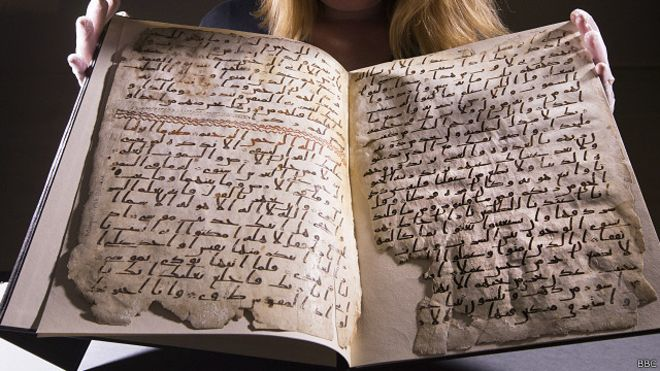
Researchers at the University of Birmingham in Britain announced that they had found pages from a copy of the Qur’an, and after examining them with radiocarbon, it turned out that they are the oldest in the world, dating back to 1,370 years ago.
According to the BBC, these papers have been in the university library for a century, and no one paid attention to them. They were kept in a collection of manuscripts and documents related to the Middle East, until they caught the attention of a doctoral student and were subjected to a radiocarbon examination in a technical unit at Oxford University. It turned out that the text was written on sheep or goat skin, and that it is one of the oldest texts of the Holy Quran in the world.
Radiocarbon dating can determine the age of objects with 95% accuracy, and according to the examination conducted on the manuscript, it dates back to between 568 and 645 AD, while the revelation came to the Prophet Muhammad, peace be upon him, between 610 and 632 AD, which means that the person who wrote these manuscripts lived during the time of Muhammad, peace be upon him, according to what David Thomas, a professor specializing in Christianity and Islam, said.
“This discovery is amazing and will bring joy to the hearts of Muslims,” said Mohammed Issa Wali, a manuscript expert at the British Library. “They are two scrolls written in beautiful, legible Hijazi script, and they certainly date back to the time of the first three caliphs.”
This manuscript is one of more than 3,000 manuscripts and documents collected in the 1920s by Alphonse Mengna, the Chaldean priest who was born in Mosul, Iraq.
“These texts could take us back to the early years of Islam,” said Professor David Thomas, a professor of Christianity and Islam.
The Prophet Muhammad received his revelations between 610 and 632 AD, the year of his death.
“The estimated age of the Birmingham manuscript means that it is very likely that its author lived at the time of the Prophet Muhammad,” he said.
“The person who wrote these pages must have known the Prophet Muhammad, perhaps seen him, heard him speak, perhaps been close to him, and this is what this manuscript evokes.”
Professor Thomas said some of the “revelations” were written on parchment, rocks, leather and camel shoulder blades, and that a final copy of the Qur’an was compiled in 650 AD.
“The parts of the Qur’an written on these parchments can be dated with some confidence to less than two decades after the Prophet Muhammad’s death,” he said.
“These pages are very close to the Quran we read today, which supports the idea that the Quran has undergone only minor changes (meaning the dots and vowels of letters) , or that it has not undergone any changes ( meaning no alteration of the text, distortion, addition or subtraction) and can be dated back to a time very close to the time it is believed to have been revealed,” he added.
The text is written in Hijazi script, one of the earliest Arabic scripts, making the document one of the oldest copies of the Quran in the world.
http://www.bbc.com/arabic/artandcult…rmingham_koran
http://www.skynewsarabia.com/web/art…A8%D9%88%D8%A9
http://www.alaan.tv/news/entertainme…-of-birmingham
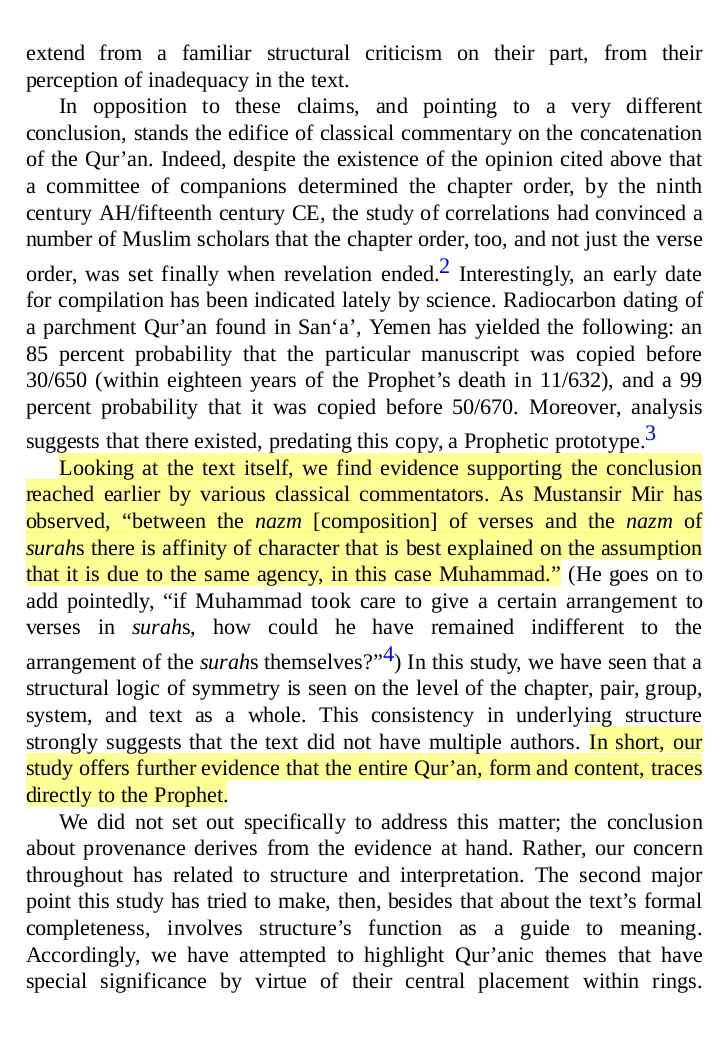
proving the preservation of the Qurʾān using a very unique approach:
“In short, our study offers further evidence that the entire Qur’an, form and content, traces
directly to the Prophet (ﷺ)”
The conclusion of Raymond Farrin’s book Structure and Qurʾānic interpretation page 92.