7 Common Doubts About the Hijab — And How Islam Answers Every One
Seven Doubts About the Hijab: A Complete Refutation
Table of Contents
- Introduction: Satan, the First Caller to Unveiling
- Key Definitions: Hijab, Tabarruj, and Sufur
- Doubt One: Religion Is Easy and Hijab Is Too Difficult Today
- Doubt Two: Good Intention Is Sufficient
- Doubt Three: Ashamed to Wear Proper Hijab
- Doubt Four: Face Covering Is Only for Modesty, Not Religion
- Doubt Five: Allegations and Slanders Against the Hijab
- Doubt Six: All Modern Abayas Are Valid Hijab
- Doubt Seven: Face Covering Is a Controversial Scholarly Issue
- Conclusion: A Word to Two Women
- Bonus: Hijab and Positive Body Image — Research Evidence
Introduction: Satan, the First Caller to Unveiling
The story of Adam and Eve with Satan is the first and greatest evidence of this. His temptation was represented in exposing private parts and tearing down curtains. This reveals to us that this was an intended goal for Satan, because of the serious harm that results from it — spreading immorality and causing fear for honor and souls. Allah the Almighty warned us against precisely this temptation:
Key Definitions: Hijab, Tabarruj, and Sufur
Tabarruj is a woman showing her adornment and the charms of her body, which includes swaggering and strutting in her walk and displaying acquired adornment. It has been said: it is any adornment that a woman is made beautiful by showing it to the eyes of men.
Sufur is the exposing of the face — and it is itself a form of tabarruj.
Based on this, hijab is the opposite of sufur in all its forms. In general, any adornment that does not meet the conditions of hijab is considered forbidden sufur. Sufur is agreed upon as forbidden across all schools of thought and in the sayings of the scholars.
Doubt One: Religion Is Easy and Hijab Is Too Difficult Today
The response to this doubt is from several aspects:
First: Everything that has been proven as an obligation from Allah to His servants is within their ability and capacity. Allah does not burden a soul beyond what it can bear.
Second: Establishing the characteristic of “ease” to remove a hardship associated with a ruling can only be done with legal evidence from the Qur’an or Sunnah. Making a lenient ruling in the Shari’ah must not contradict the Qur’an, Sunnah, sound analogy, or a preponderant interest.
Third: If this reasoning were accepted, it would be said by the same logic: “The hardship of avoiding usury in this age necessitates its permissibility” — or: “The crowding at Hajj makes stoning permissible to drop.” This is self-evidently false.
Fourth: Acts of worship are often not free from hardship, but they are tolerable and compatible with the normal capacity of a person.
There are many legal rulings whose benefits are linked to the hardship and effort they involve — such as retaliation and prescribed punishments. Great acts of worship are routinely not free from hardship: the hardship of performing ablution in the cold, fasting in intense heat on a long day, and performing Hajj.
Fifth: The general spread of a forbidden matter is not a justification for permitting it. The customs of societies do not make it permissible, nor does it become permissible with a change in time and place.
The fallacy of this is clear to anyone with even a basic understanding of religion. If this were acceptable, the legitimacy of all rulings would be subject to people’s customs and traditions — which continue to be dominated by corruption and deviation with the passage of time. The Prophet ﷺ informed us: “There is no time that comes except that the time after it is worse than it.”
Doubt Two: Good Intention Is Sufficient
The excuse of integrity of intention is a justification always heard from those whose hearts are filled with desires and whims and who have fallen into sins. The response is from several aspects:
First: She is worshipping Allah the Almighty with concealment and hijab, which the command came with in the Book of Allah. She must listen and obey, regardless of any other consideration.
Second: A sound intention does not justify a forbidden act, nor does it turn it into something permissible. A wrong act remains wrong, and its doer is sinful even if the intention is sound.
Third: Even if she is safe from temptation for herself — as she claims — she is not safe from being a cause of temptation for whoever looks at her, which is the more likely outcome. She thereby bears the burden of his temptation and seduction without realizing it.
Fourth: Foolish and young girls are deceived and affected by her actions, especially if she is in the position of a role model such as a mother or teacher.
Fifth: Although good intention is very important in a person’s actions, if limited to it alone, one would be like someone walking on one leg or flying with one wing — compliance with the Shari’ah is also necessary.
Doubt Three: Ashamed to Wear Proper Hijab
This is a type of hypocrisy as described by the people of knowledge — the hypocrisy of the people of this world — which is beautifying oneself for people and appearing good in front of them with an appearance that does not please Allah the Almighty.
Doubt Four: Face Covering Is Only for Modesty, Not Religion
It is said to her: Do you think that modesty is not religion?
Modesty is a characteristic of faith that prevents the believer from committing sins out of fear of Allah Almighty, and it is the head of all virtues.
Between sins and lack of modesty there is a connection — each calls for the other and seeks it diligently. The Holy Quran highlighted the characteristic of modesty in the daughters of the righteous man:
Doubt Five: Allegations and Slanders Against the Hijab
Allegation One: Hijab Enables Criminals to Hide Their Identity
Although there are those who exploit military attire to deceive people and use it in impermissible ways — has anyone ever said that is a valid justification for canceling the military uniform? We have never heard anyone say that, although such abuses have been repeated. The same logic applies here.
Allegation Two: Chastity Does Not Lie in Covering
But humans in general are prone to error and disobedience, as the Prophet ﷺ said: “Every son of Adam is prone to error.” So if a chaste, modest woman makes a mistake and engages in shameful behavior — is she blamed for her sin and shortcomings, or for her hijab? The hijab does not require that only the pure and pious wear it. A woman must obey her Lord in wearing the hijab and in everything she has been commanded to do. If she falls short in any of that, she deserves blame and sin — and her obedience can never be a justification for her wrongdoing.
Furthermore: is it required that a Muslim woman be either veiled but ill-behaved or unveiled but well-behaved? Is it not possible for her to combine both good things — to be veiled and well-behaved? This is the principle every Muslim woman should aspire to achieve, rather than finding satisfaction in shortcomings and belittling others for theirs.
Allegation Three: Some Righteous Women Do Not Wear Full Niqab
Why do we not take the actions of the great mass of chaste, pure women as a good example — rather than making our excuse a rare minority of righteous women who have stumbled?
This problem is not new. Here are scholars from different eras documenting the reality of the Muslim woman’s hijab throughout Islamic history:
Allegation Four: Proper Hijab in Non-Hijab Environments Is Blameworthy Notoriety
Therefore, the duty in wearing proper hijab in an environment where the hijab is an exception is the correct intention directed purely to Allah — not to stand out, but to obey Him.
Likewise, a garment is not a forbidden dress of fame unless the people of the town are upright in obeying Allah and His Messenger. However, if their nature is corrupted and they have deviated from the right path, we do not follow them in their misguidance under the pretext of avoiding fame.
Doubt Six: All Modern Abayas Are Valid Hijab
The answer is to present what is called an “abaya” to the legal conditions that must be met in a woman’s hijab when she goes out. If it meets the conditions, it is an abaya. If it lacks any of the conditions, then it does not deserve to be called an abaya — it is what some call “fashion.”
A question is put to every woman who wears an abaya: Do you believe that the abaya you wear is an act of worship by which you draw closer to Allah Almighty?
If the answer is yes — then consider the following conditions carefully, because they are the conditions of worship performed for Allah.
If the answer is no — it is something you are accustomed to — then the Islamic conditions will not concern you, because you are not originally worshipping Allah with them. You will be satisfied with everything new and innovative that is consistent with your love of beauty and adornment. The fierce competition in what they call “abaya fashion shows” is evidence enough of this.
The Eight Conditions of the Islamic Hijab
- It covers the entire body, so that no part is visible.
- It is not an adornment in itself — not decorated, embroidered, or colored.
- It is thick — dense — and not transparent so that the body and adornment are not visible from underneath it.
- It is loose and does not reveal the size of the limbs and body.
- It is not perfumed or scented.
- It does not resemble men’s clothing.
- It does not resemble the clothing of non-Muslim women.
- It is not clothing for fame (libas al-shuhra).
If the abaya does not meet any one of these conditions, then it is a type of tabarruj that contradicts the Shari’ah.
What we see today of manifestations of temptation in what is called the “alleged abaya” — wrapped around the body to highlight its charms, exposing arms through wide sleeves, decorated with all kinds of elegant embellishments — is precisely this forbidden tabarruj. As the poet described:
If they claim to wear the veil, then it is an intrusive lineage. Is she the one for whom the veil was imposed to protect her by the law of the Messenger?
The raven with white wings is an extremely rare description — a metaphor for how few women with these descriptions will enter Paradise. May Allah save us from that.
Doubt Seven: Face Covering Is a Controversial Scholarly Issue
The response is from several aspects:
First: The sincere Muslim must seek the truth by searching for the strongest argument and abandoning the following of whims, seeking help from Allah to be guided to the truth. Whoever does this will inevitably be guided, as Allah said:
The argument of “it is controversial” has been adopted today by many who achieve their desires and whims through a scholar’s slip, a forced concession, a deviant statement, or a mistaken understanding — without any consideration for the contradiction of that statement to the words of the Prophet ﷺ who does not speak from his own whims.
Allah the Almighty has made consensus an infallible proof against misguidance. It is not right to make what contradicts consensus — namely disagreement — into a proof in its own right. Whoever pursues concessions and deviant disagreements in his religion will lead to a deficiency in his servitude, and perhaps to its complete disappearance: “Whoever pursues concessions has become a heretic.”
Second: The confirmed and transmitted historical reality is that the women of Islam remained veiled throughout the stages of Islamic history.
Third: The sum of the statements of the scholars of the four schools of thought can be summarized as follows: they agree on the obligation of women to cover their entire bodies in front of strangers — whether some of them consider the face and hands to be ‘awrah or not. Even those who consider them not ‘awrah require covering them in this age due to the corruption of most people, the weakness of their religion, and their lack of restraint from looking at women in a forbidden way.
Conclusion: A Word to Two Women
To the owner of the “hijab of display”:
Do not be deceived by those who bless your actions from among the masters of satanic purposes, lustful interests, and material benefits — who plan, implement, display, sell, and buy the unveiled hijab. These people respond to Allah’s commands like those about whom Allah said: “Do you believe in part of the Scripture and disbelieve in part?”
“And not to display their adornment except that which is apparent thereof.” — Quran 24:31
“And do not display yourselves like the display of the former times of ignorance.” — Quran 33:33
To the blessed sister who has kept the command of her Lord:
You hear in a society dominated by negligence and immodesty someone saying to you: “You look strange and abnormal” — so be patient, steadfast, and stand firm in the face of temptations. They are only a few days, and after that you will be luxuriating in the bliss of Paradise and the garments of honor by the mercy of Allah Almighty.
Bonus: Hijab and Positive Body Image — Research Evidence
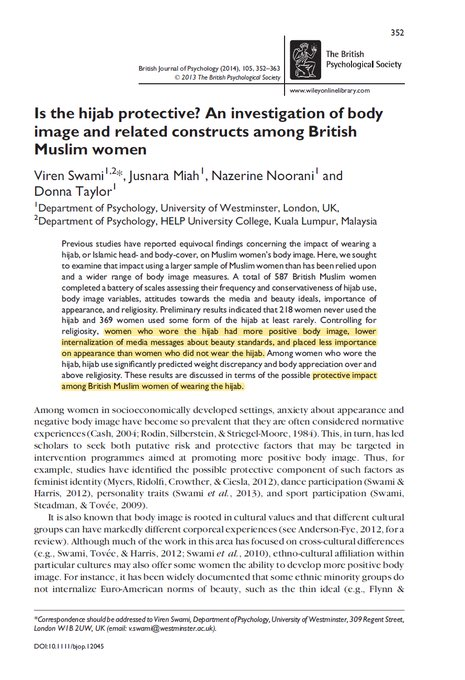
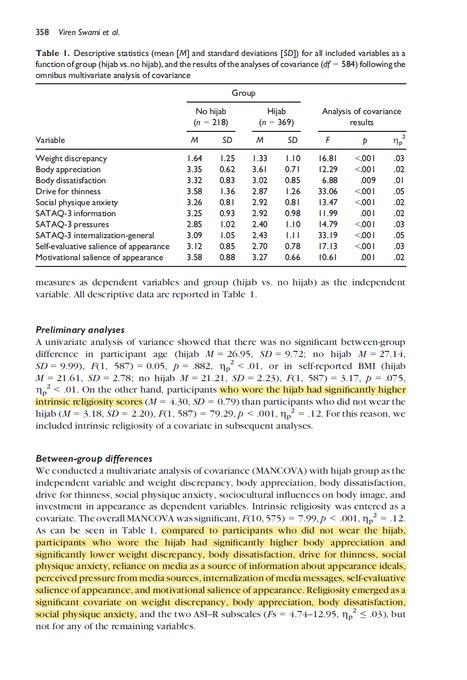
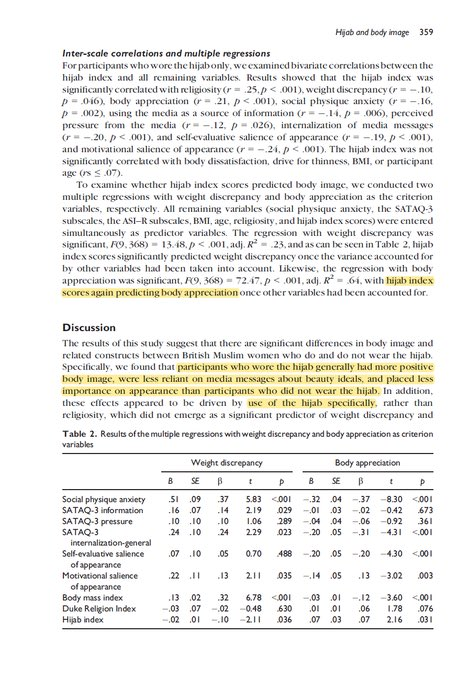
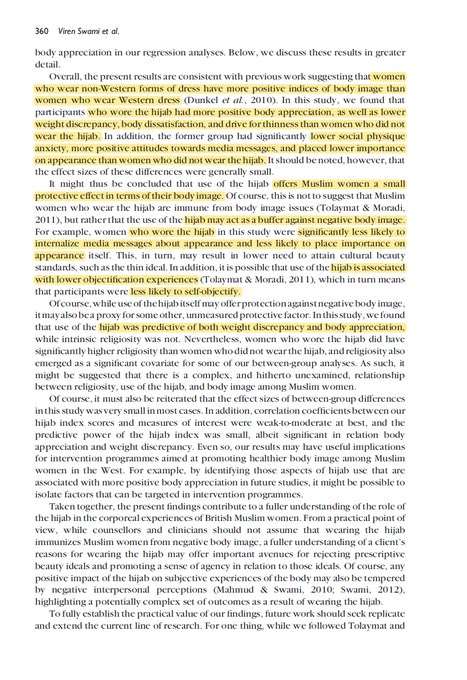
Beyond the Islamic argument, contemporary research confirms that the hijab produces measurable psychological benefits — including greater body satisfaction, reduced fixation on physical appearance, and less dependence on Eurocentric beauty standards promoted in Western media.
This article is part of the OpenIslam Wiki — Women in Islam series.