

A Disbeliever and His Killer Will Never Meet in Hell — Explained
This post provides a full explanation of the hadith: a disbeliever and his killer will never be together in Hellfire. Qadi Iyad offered several interpretations of this statement, and Ibn Raslan added further clarification. Additionally, this post addresses the claim that Islam commands the killing of all Jews or non-combatants, demonstrating that the hadith refers exclusively to the disbelieving combatant, while the killing of covenant-holders is explicitly forbidden.
Scholarly Explanation of the Hadith
Qadi Iyad said:
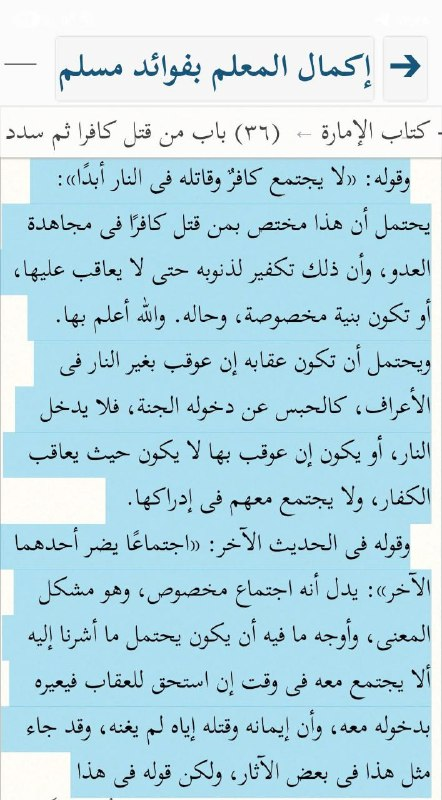
“His statement, ‘A disbeliever and his killer will never be together in Hellfire,’ could mean that this applies specifically to one who kills a disbeliever while fighting the enemy, and that this is an expiation for his sins so that he will not be punished for them, or it could be based on a specific intention and his circumstances. And God knows best. It could also mean that if he is punished with anything other than Hellfire, his punishment will be in the intermediate realm (al-A’raf), such as being prevented from entering Paradise, so he will not enter Hellfire. Or, if he is punished with Hellfire, he will not be where the disbelievers are punished, nor will he be with them in experiencing it. His statement in the other hadith, ‘a gathering that harms one of them,’ indicates that it is a specific gathering, and its meaning is ambiguous. The most plausible interpretation is that it could mean what we have indicated: that he will not be with him at any time if he deserves punishment, so that he will not reproach him for entering Hellfire with him.”
Ibn Raslan said:
“I say: The context of the statement indicates this, as the author mentioned it in the Book of Jihad, and the definite article ‘al’ is generic, meaning: they will never be together in Hellfire. It is also possible that this Hellfire refers to the specific Hellfire reserved for disbelievers.”
Hell has levels and layers. The highest level is for monotheists, the second for Christians, the third for Jews, the fourth for Sabians, the fifth for Magians, the sixth for polytheists, and the seventh for hypocrites.
The cover of the source document establishing these scholarly verdicts is shown below.
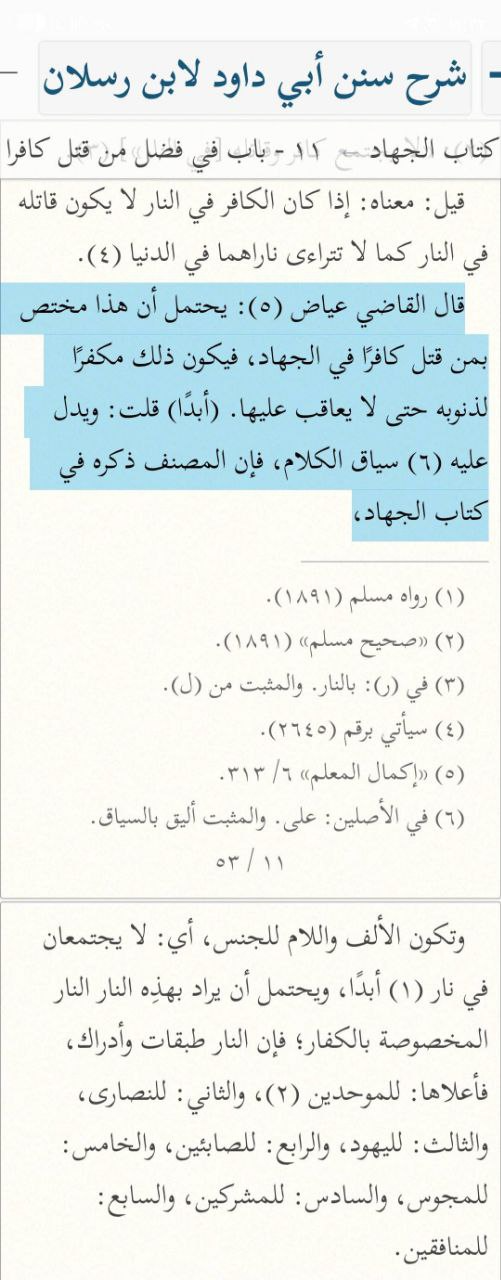
The relevant entry with the highlighted text summarised below is shown here.
- Al-Qadi ‘Iyad’s Interpretation: Al-Qadi ‘Iyad stated that this ruling likely applies specifically to a person who kills a disbeliever during Jihad (combat). In this specific context, the act serves as an expiation for the killer’s sins, ensuring they will never be punished for them in the Hellfire.
- Supporting Evidence: The author/commentator affirms this interpretation, noting that it is strongly supported by the context of the text, as the author placed this entry specifically within the Book of Jihad.
The second source entry, providing the full set of scholarly interpretations with the Arabic text highlighted, is shown below.
- Meaning of “A disbeliever and his killer will never meet in the Hellfire”:
- First Interpretation: This likely applies specifically to someone who kills a disbeliever while fighting the enemy (Jihad). This act serves as an expiation for the killer’s sins so they will not be punished for them, or it depends on a specific intention and circumstance. And Allah knows best.
- Second Interpretation: It is possible that if the killer is punished, their punishment will occur outside of Hell entirely (such as being detained at Al-A’raf — the Heights — delaying entry into Paradise without entering Hell). Alternatively, if they are punished in Hell, it will be in a manner where they do not experience the same severe punishment as the disbelievers, meaning they will not meet them in the same level or degree of torment.
- Meaning of “A meeting that harms one another”:
- This phrase indicates a specific type of meeting, which clarifies a seemingly problematic meaning. It implies that if the killer deserves punishment, they will not be brought together with the disbeliever in a way that allows the disbeliever to mock or shame them for entering Hell despite their faith, as the killer’s faith and their act of killing the disbeliever still hold value. This concept is also supported by other narrations.
Secondly: The Killing of Covenant-Holders Is Explicitly Forbidden
The Messenger of Allah ﷺ said:
“Whoever kills a person with whom a covenant has been made will not smell the fragrance of Paradise, even though its fragrance can be found from a distance of forty years’ journey.”
Grade: Sahih · Bukhari
Allah said in the Quran:
Say, “Come, I will recite what your Lord has prohibited to you. [He commands] that you not associate anything with Him, and to parents do good, and do not kill your children for fear of poverty; We will provide for you and them. And do not approach immoralities — what is apparent of them and what is concealed. Do not kill a soul which God has forbidden except by right. This is what He has enjoined upon you so that you may understand.”
And do not kill a soul which God has forbidden except by right. And whoever is killed unjustly — We have given his heir authority, but let him not exceed limits in killing. Indeed, he was…
In addition to the consensus on the prohibition of killing women and children, the hadith refers to the disbelieving combatant. And I am still waiting for your answer regarding why your Lord commanded the killing of animals in the Book of Samuel.
First Hadith: The Muslim Killer and the Dust of Jihad
A Muslim who killed a disbeliever and then did his best to avoid sin will not be in Hellfire together. Similarly, the dust raised in the path of God and the heat of Hellfire will not be in the heart of a believer. And faith and envy will not be in the heart of a servant of God.
Narrator: Abu Hurayrah · Grade: Sahih · Al-Albani, Sahih al-Jami’ (7620) · Narrated by An-Nasa’i (3109), and the wording is his.
His statement, “then did his best to avoid sin,” means he performed righteous deeds to the best of his ability. His statement, “will not be in Hellfire together,” does not mean that the Muslim will not enter Hellfire, but rather that he will not be in the same place as the disbeliever if he enters. This is the opinion of many scholars.
Second Hadith: They Will Not Be Gathered in a Way That Harms One Another
They will not be gathered together in Hell in a way that harms one another. It was said: Who are they, O Messenger of Allah? He said: A believer who killed a disbeliever, then acted justly.
Narrator: Abu Hurayrah · Grade: Authentic · Muslim, Sahih Muslim (1891)
Sharh al-Durar al-Sunniyyah provides the full explanation of this hadith:
Jihad in the way of Allah has great merit, and it is one of the greatest means of expiating sins. It is from the mercy and justice of Allah that if a believer kills a disbeliever in the way of Allah, then Allah, the Exalted, is too generous to gather in the Hereafter the believing killer and the slain disbeliever in one abode.
In this hadith, the Prophet ﷺ tells us about two who will not be together in Hell in a way that would harm one another. He ﷺ was asked: Who are they? He said: A believer who killed a disbeliever. The killing is specific to the one who is fighting against them — otherwise it is forbidden to kill a disbeliever who has a covenant.
The apparent meaning of the hadith is that what is meant by the believer is the one who strives and fights in the way of God and those who are in his ruling and meaning. In a narration by Muslim: “A disbeliever and his killer will never be together in Hell.” And in a narration by al-Nasa’i: “And the dust of fighting in the way of God and the heat of Hell will not be together in the body of a believer.”
This is achieved by the fact that the believer will not enter Hell at all. And it is possible in his saying: “a meeting in which one of them harms the other” that he will enter it, but in a place that the disbeliever cannot see, so that he will not reproach him for not benefiting him with his faith and his struggle. This is a special meeting that is an exception to the meeting of the arrival and their quarreling on the bridge of Hell.
His saying, “Then he was upright,” means that this believer lived upright in religion, and continued in Islam until death, and avoided the sins that are not forgiven except by repentance, and getting rid of the rights of people, so he became committed to acts of obedience and good deeds, so this uprightness proves for him entry into Paradise and distance from Hell.
It has been said that the purpose of this hadith is to inform us that killing a disbeliever expiates all the past sins of the believer who killed that disbeliever, both major and minor, but not future sins. If the believer who killed the disbeliever dies soon after or after some time, having acted righteously during that period, he will not be punished. If he is not punished, he will be held accountable for what he committed afterward, not for what he committed before, because his sins have already been expiated.