Al-Buraq and the Bible: Refuting Christian Claims About Mythical Creatures in Islam
Al-Buraq and the Christian Objection: Refuting the “Mythical Creature” Claim
Table of Contents
- The Doubt Presented
- First: Nothing Is Beyond the Power of Allah
- Second: Allah Creates What We Do Not Know
- Third: The Bible Itself Contains Wondrous Creatures
- Excerpts from Father Tadros Yacoub’s Interpretation
- Fourth: Allah Honored the Prophet ﷺ with Al-Buraq
- A Reminder from Matthew 22
- Related Resource
- Conclusion
The Doubt Presented
The Christian slanderer is surprised by the existence of such a creature, describing it as mythical and inspired by the mythology and legends of the ancients.
First: Nothing Is Beyond the Power of Allah
The Lord is the Creator of the wondrous universe. Nothing is beyond His power, neither on earth nor in heaven. His command, when He wills a thing, is only to say to it, “Be,” and it is.
Second: Allah Creates What We Do Not Know
“And horses, mules, and donkeys for you to ride and as adornment. And He creates that which you do not know.”
Allah explicitly says that He creates things unknown to us. So the mere fact that a creature is unfamiliar to you is not an argument against its existence. That is weak reasoning.
Third: The Bible Itself Contains Wondrous Creatures
Your holy book is full of wondrous creatures, so why object to what is in the books of others?
Behemoth in the Book of Job
“Behold Behemoth, which I have made with you; he eats grass like an ox. Behold, his strength is in his loins, and his power in the muscle of his belly. He lowers his tail like a harp; the veins of his thighs are woven together; his bones are pipes of bronze, his body like hardened iron.”
The Book of Job describes Behemoth as a powerful and extraordinary creature created by God. The text emphasizes its immense strength, its body, bones, and physical might. If a Christian accepts such biblical descriptions without mockery, then mocking Islamic reports about Al-Buraq is not a principled objection. It is selective skepticism.
Leviathan in the Book of Job
“His sneeze sends forth light, and his eyes are like the eyelashes of the morning. Lamps go out of his mouth; sparks of fire fly from him. Out of his nostrils comes smoke as from an inflated pot or a cauldron. His breath kindles coals, and a flame goes out of his mouth.”
Leviathan is described with imagery of light, smoke, sparks, flame, and terrifying power. This is exactly the kind of passage Christians would not want mocked as “mythology,” yet they mock Muslim texts when they mention a wondrous creature. The double standard is obvious.
The Great Dragon in Revelation
“And another sign appeared in heaven, a great dragon, having seven heads and ten horns, and upon his heads seven crowns.”
Your draft says “blond dragon,” but the standard wording is usually“great red dragon.” Do not leave “blond dragon” unless you are intentionally quoting a specific translation. It looks like a translation mistake and weakens the article.
Horses and Chariots of Fire in 2 Kings
“And while they journeyed on and talked, suddenly a chariot of fire and horses of fire separated them, and Elijah went up into heaven by a whirlwind.”
This passage describes Elijah being taken upward with a chariot of fire and horses of fire. If Christians accept that God can honor Elijah with a miraculous ascension involving fiery horses and a fiery chariot, then objecting to Allah honoring Muhammad ﷺ with Al-Buraq is inconsistent.
Excerpts from Father Tadros Yacoub’s Interpretation
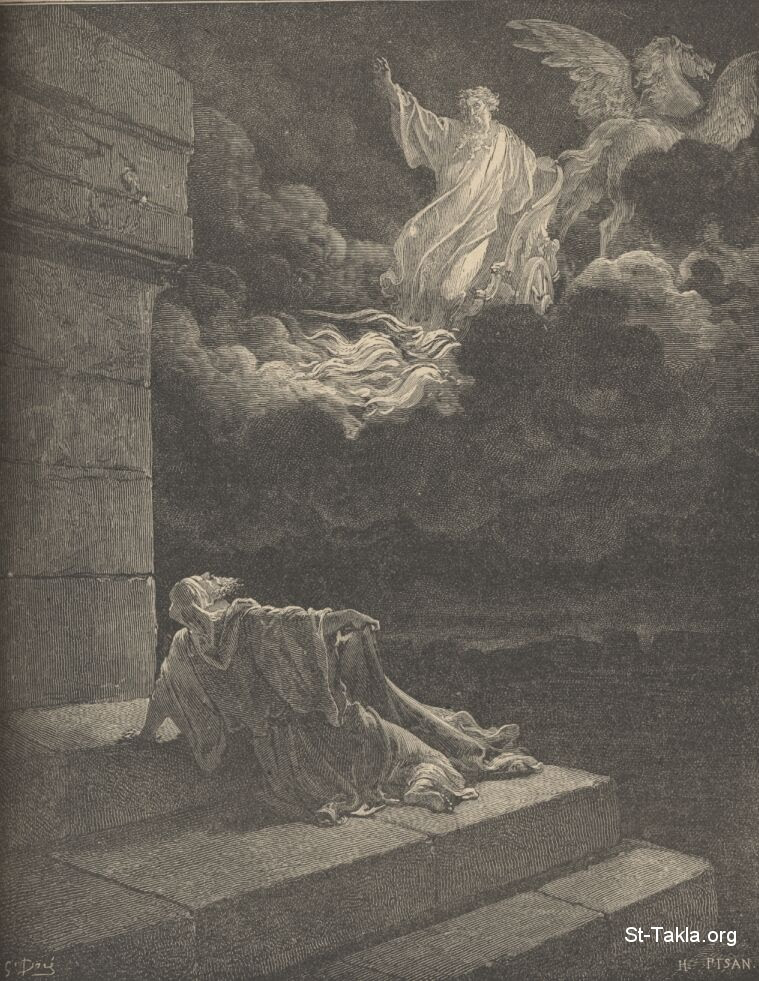
The scan also cites Saint Ambrose, who speaks of Elijah being carried by fiery horses and returning from earth to heaven. This matters because Christian commentators are willing to interpret miraculous ascension imagery reverently when it appears in their own scripture. Therefore, their mockery of Al-Buraq is not based on a consistent principle. It is only polemical selectiveness.
After speaking about Elijah, the owner of the fiery heart, he mentioned his ascension to heaven in a chariot of fire with fiery horses, as if someone whose heart is inflamed with the fire of divine love and whose soul is inflamed with holy jealousy as with fire, his soul is qualified to rise as with a chariot of fire to ascend to where God sits, the consuming fire, and he is counted among his fiery servants.
“On these wings Elijah flew when he was carried in a chariot of fire and horses of fire to the upper places.”
“Elijah endured hunger, betrayal, fears of death, and bitter toils. Yet he alone went from heaven to earth in a chariot of fire with horses of fire and returned from earth to heaven.”
“He concealed any merit of his own for this service, and placed the grace granted to the holy leader above all human consideration.”
Fourth: Allah Honored the Prophet ﷺ with Al-Buraq
Let me, Christian, whisper in your ear, reminding you of the words of your priests from the interpretation of the Second Book of Kings, Chapter 2, by Father Antonius Fikry.
“God glorified Elijah with this ascension so that the prophets would learn to bear witness to the truth like him, no matter what the cost. The same words are addressed to every servant. So that everyone’s eyes may be lifted up to the fact that there is life in heaven, and death is not the end, and that everyone may do good works so that the moment of his departure may be glorious.”
The objection is not intellectual. It is emotional polemics dressed up as skepticism.
A Reminder from Matthew 22
“You are mistaken, not knowing the Scriptures nor the power of God.”
Nor the power of God.
Nor the power of God.
Nor the power of God.
Related Resource
Conclusion
The Qur’an already states that Allah creates what humans do not know. The Bible itself contains Behemoth, Leviathan, the great dragon, fiery horses, and a fiery chariot carrying Elijah upward. Christian priests and commentators interpret these passages reverently, not mockingly.
So if miraculous creatures and heavenly ascension imagery are acceptable inside Christian scripture, then mocking Al-Buraq is nothing but a double standard.
The real issue is exactly what Matthew says:
“You are mistaken, not knowing the Scriptures nor the power of God.”