Arabia Returning to Meadows and Rivers: Prophetic Hadith and Scientific Evidence
Arabia Returning to Meadows and Rivers
In the name of Allah, the Most Gracious, the Most Merciful. Peace, mercy, and blessings of Allah be upon you.
This article discusses the hadith that has baffled earth scientists:
“Until the land of the Arabs returns to meadows and rivers.”
Although the Arabian Peninsula is now known as a barren, dry environment, the hadith speaks of it returning to meadows and rivers. The force of the wording is not merely that Arabia will become green, but that it will return to a previous condition.
The hadith does not only speak about a future transformation. Its wording indicates that the land of the Arabs was once meadows and rivers, and that it will return to that state before the Hour.
The desert is beautiful despite its harshness, but nobody in the seventh century would naturally imagine that its hills, sand dunes, and dry lands were once covered with rivers, lakes, vegetation, and meadows.
One writer, the engineer Gamal Abdel Moneim El-Komy, described this as:
The hadith that took us fourteen centuries to understand.
The point is that this statement could not be imagined by ordinary rational logic or human intelligence in the seventh century. If people were thinking about the signs before the Hour, the closer assumption would be horrors, disasters, destruction, and devastation — not meadows, rivers, and goodness.
The Hadith
“The Hour will not come until the land of the Arabs returns to being meadows and rivers.”
This is an authentic hadith narrated by Imam Muslim.
The wording also appears as:
Narrated by Ahmad in Al-Musnad.
The “land of the Arabs,” as understood by scholars in the past and present, refers to the Arabian Peninsula. Looking at a map, the Arabian Peninsula lies in one of the world’s most arid and dry desert regions. Around it, other areas may have greenery, but the Peninsula itself is known for heat, dryness, and desert conditions.
BBC Report: Arabia Was Once Green
On July 31, 2015, the British Broadcasting Corporation published a report by Michael Marshall titled:
“The Arabian Peninsula was once a green paradise of forests and grasses.”
Source links from the original pasted material:
http://www.bbc.com/earth/story/20150…-lush-paradise
The BBC report stated that when most people think of the Arabian Peninsula, they imagine sand dunes, blazing sun, and scarcity of water. However, in the recent past, the Arabian Peninsula was a lush green meadow with rain-fed forests.
The report explains that this discovery may help researchers understand when and how early humans left Africa. If Arabia was lush and green, it would have been a suitable place for human migration.
Professor Barton of Oxford University said that there were more opportunities for humans to leave Africa than previously thought. Hunter-gatherer ancestors would not have been able to live in different parts of Arabia if it had always been like it is today.
Today, the Indian Ocean stretches along the southern coast of Arabia, and the climate is monsoonal there, while the rest of the peninsula is desert with some oases. A research team led by Barton believes that rainy seasons reached Arabia every 23,000 years, allowing plant and animal life to flourish. Their findings were published in the Journal of Geology.
Human Migration and Arabia’s Wet Periods
Modern humans originated in Africa about 200,000 years ago. Some then moved into Europe and Asia, and from there spread to the rest of the world. Researchers differ over exactly when humans left Africa and which route they took.
The widely accepted idea mentioned in the pasted material is that humans left Africa around 60,000 years ago and traveled along the coast of the Arabian Peninsula into Asia. This would mean they remained in Africa for around 140,000 years.
Other archaeologists believe the first human migration out of Africa occurred around 130,000 years ago.
The research mentioned in the article argues that humans may have spread from Africa into the Middle East by 130,000 years ago, but many thought this movement was blocked by the Arabian desert. Barton and his colleagues found evidence that Arabia went through repeated rainy periods, producing tall vegetation and dense forests, making it hospitable for human life.
Barton studied dry riverbeds in southeastern Arabia and found traces of mud and stones from riverbeds dating back 160,000 years. Geologists found evidence of five rainy periods in the region, during which rivers flowed and carried stones and pebbles. These stones settled when the rivers dried and their waters receded.
The first rainy period was between 160,000 and 150,000 years ago. The most recent was around 55,000 years ago. Each rainy period may have represented an opportunity for humans to move from Africa into Asia.
Previous studies had shown increased rainfall during these periods, but they did not show how much. A small amount of rain in a hot desert makes little difference, but the newer study indicated that the increase was large enough to change the landscape.
“The ecological record I have is very consistent with the archaeological record that is already there. These records indicate that there were human movements and migrations into the Arabian Peninsula.”
Scientific Research Sources Mentioned
The scientific research was led by Dr. Ash Parton.
Source links from the pasted material:
http://www.arch.ox.ac.uk/AP2.html
The research was published in The Journal of Geology:
http://www.journals.uchicago.edu/toc/jg/current
The Geological Society of America source:
http://www.crossref.org/iPage?doi=10.1130%2FG36401.1
http://geology.gsapubs.org/content/43/4/295
Full Hadith Context
“The Hour will not come until wealth increases and overflows, until a man goes out with the zakat of his wealth and finds no one to accept it from him, and until the land of the Arabs returns to being meadows and rivers.”
Narrator: Abu Hurairah
Grade: Sahih
Source: Muslim, Al-Musnad Al-Sahih
Page or number: 157
Another narration states:
They said: “What is harj, O Messenger of Allah?”
He said: “Killing.”
Another source mentioned in the pasted material:
Narrator: Abu Hurairah
Grade summary: Strange from the hadith of Suhayl
Source: Abu Nuʿaym, Hilyat al-Awliya
Page or number: 7/161
Linguistic Meaning of Meadows
“Marj” refers to land with grass where animals graze.
In Al-Tahdhib, it is defined as a vast land with abundant vegetation where animals graze. Its plural is “muruj.”
The meaning is therefore not merely “green land” in a vague sense. It refers to wide pastureland with vegetation where animals can graze.
The Precision of the Word “Returns”
The miraculous rhetorical precision in the hadith is in the word “returns.”
If the Prophet ﷺ had said that Arabia would “become” meadows and rivers, this would only point to the future. If he had said that it “was” meadows and rivers, this would only point to the past. But the word “returns” includes both meanings: it was once meadows and rivers, and it will become so again.
The word “returns” means the land had that condition before and will come back to it again. This is why the wording is central to the argument.
Dr. Muhammad Al-Nabulsi, Professor of Arabic Language, is cited as saying that the Prophet’s eloquence appears in this wording. If the hadith had used “becomes,” the past would not be included. If it had used “was,” the future would not be included. But “returns” includes both the past and the future.
Source from the pasted material:
http://nabulsi.com/blue/ar/artp.php?art=3565
“Nor does he speak from his own desire. It is only a revelation revealed.”
Ancient River Systems in Arabia
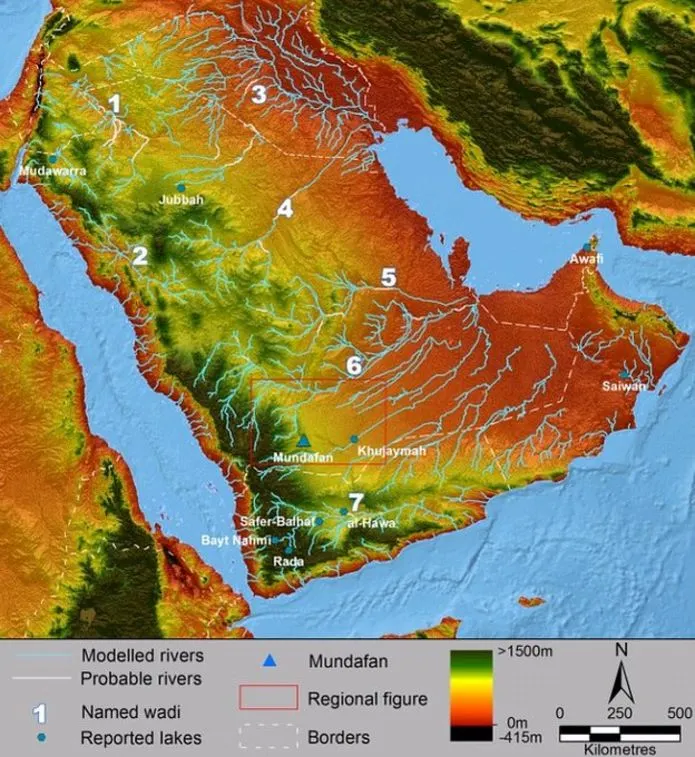
The subject does not end with the general claim that Arabia was once green. Scientists have mapped ancient river systems that crossed what is now desert.
A meadow is land with grass where animals graze. In Al-Tahdhib, it is a wide land with abundant vegetation where animals graze. This raises the question: were animals of different kinds present across Arabia during these green periods?
The pasted material argues that archaeologists were puzzled by the presence of wild animals in the Arabian Peninsula. How could these animals have lived in Arabia if the land had always been a barren desert?
Arabia’s Climate Transformations
The article asks:
When was the land of the Arabs a barren desert, and when was it lush and green? Was its transformation from green to desert meaningless? Was there wisdom in the barren desert land of Arabia becoming the cradle of the final eternal message?
The study mentioned above expects that the rainy season that restores plant life to the Arabian Peninsula may arrive every 23,000 years. Therefore, the article argues that Arabia may one day return to rivers, pastures, and fruits.
A research team supervised by Barton believes that rainy seasons reached the Arabian Peninsula every 23,000 years, allowing plant and animal life to flourish.
BBC Arabic source from the pasted material:
http://www.bbc.com/arabic/scienceand…_lush_paradise
Archaeology and Early Human Settlement in Arabia
As the sun rises over the vast sand sea of the Arabian Peninsula, stone axes are found scattered on the surface of the barren desert. Nearby, teams of international experts examine remains that have given new meaning to the human history of the region and challenged previous theories.
For the first time, specialists from several disciplines — including paleontology, geochronology, and cartography — came together to examine the role Saudi Arabia played in the mass migration of humans out of Africa.
According to Prince Sultan bin Salman bin Abdulaziz Al Saud, the multidisciplinary team discovered evidence that human ancestors took their first steps outside Africa 50,000 years earlier than previously believed. He added that the Arabian Peninsula underwent radical climatic changes during the Middle Pleistocene, encouraging modern humans to make the formerly green peninsula their destination.
New research from an international team showed that the Arabian Peninsula had human settlements for long periods. It was not merely a stopover or transit point, as was previously thought.
The research team revealed several stable periods of wet weather and many environmental changes over the past million years.
One advantage of combining different scientific disciplines is that these multiple lines of evidence create a broader story about the transformation of Arabia’s environment and human history.
What appears from the ground as a dry water channel can, when viewed from space, reveal the paths of major ancient rivers.
Mapping Ancient Lakes and Rivers
Professor Michael Petraglia, who led the group and served as Professor of Human Evolution and Prehistory at the University of Oxford’s School of Archaeology, said that an interdisciplinary approach was productive.
He stated that innovative space-shuttle technology allowed researchers to map more than 10,000 lakes throughout Saudi Arabia, including the arid Nefud Desert.
The article states that researchers mapped more than 10,000 ancient lakes across Saudi Arabia, including in the Nefud Desert. This discovery is connected to remains of elephants, hippos, crocodiles, and molluscs at research sites.
Professor Michael Petraglia is described as uncovering the rich history of early modern human settlement. The evidence suggests that the earliest lakes were freshwater, drinkable, and in some cases connected.
The team of 50 scientists believed that humans and animals had real routes to follow, and that humans followed rivers inland.
While the main routes into Arabia ran from the Somali Peninsula into the southwest of Arabia, other routes passed through Sinai. The article states that humans likely followed rivers inland.
Dr. Ali Ibrahim Al-Ghaban, Vice President of the General Authority for Tourism, Antiquities and National Heritage, said that there was an absence of human skeletal remains in the Kingdom for the relevant period, so human history depends on other evidence.
This evidence is evaluated through similarities in stone technology between discoveries in Arabia and Africa.
According to the material cited, it is reasonable to imagine anatomically modern humans being present in the Arabian Peninsula for at least 125,000 years, if not slightly earlier.
Most ancient sites contain little more than scattered stone tools. Professor Petraglia’s team excavated hundreds of refined tools intended for hunting, scraping, and skinning.
This indicates an important stage in human development. These tools show the ability to plan ahead and prepare for future action.
Professor Petraglia stated that this meant humans at this stage had the ability to kill prey more easily. The shaping of working stones in this manner indicates deliberation, planning, and precision, similar to what is seen in East Africa.
Rock Art and Ancient Lakes
Among the experts working in the region were specialists in rock art. According to Dr. Ali Ibrahim Al-Ghaban, these findings may lead to even more interesting results.
Rock art sites are located in central Saudi Arabia at the ancient lake of Jubbah in the Hail region. There is strong evidence of Middle Paleolithic sites along the banks of the lake.
Source from the pasted material:
http://www.bbc.com/news/science-environment-34170798
Nature Report on Rainy Opportunities Out of Africa
The pasted material also mentions news from Nature magazine dated March 5, 2015.
Early humans may have had several rainy opportunities to move out of Africa and into the Arabian Peninsula, which usually has an arid and difficult climate.
Ash Parton and his colleagues at the University of Oxford discovered sediment layers left by ancient rivers in southeastern Arabia. These rivers flowed for several long periods over the past 160,000 years.
These wet periods likely allowed humans to enter the interior of Arabia much earlier than some theories had suggested.
At least 160,000 years ago, seasonal rains provided fresh water and enough vegetation to support human migrations roughly every 23,000 years.
Source from the pasted material:
http://www.nature.com/nature/journal…l/519009d.html
Summary of the Scientific Material
Scientists from different disciplines, including a team from the University of Oxford, showed that the Arabian Peninsula was once lush, green, and full of pastureland beyond what many would imagine today.
It had human settlements. Humans hunted animals, ate, lived, and coexisted there. There were freshwater rivers from which humans and animals drank.
Arabia had meadows and vegetation.
Arabia had rivers and freshwater systems.
Arabia supported animals and human settlements.
Through this international research, the article argues that the Arabian Peninsula was once meadows and rivers, with beasts, animals, and human settlements. It also argues that scientists regard these human inhabitants as among early human populations who lived in the Arabian Peninsula and then spread across the earth over long periods of time.
These humans had enough precision and skill to interact with their environment, producing tools for hunting and skinning. This indicates awareness, planning, and technical ability.
Animals in Ancient Arabia
The article then focuses on the animals that existed in Arabia.
Since “meadows” means lands with pasture where animals graze, the question arises: were there animals grazing in Arabia during the time when these humans lived there?
Professor Sandra Olsen, Professor of Museum Studies at the University of Kansas, is cited as discussing fossils that preserve the history of climate change in the Arabian Peninsula. She said that the climate and environment were similar to the savannah, with rivers and lakes.
The pasted material states that researchers discovered evidence of wild cows and oryx. It also mentions elephants, hippos, crocodiles, molluscs, cattle, horses, sheep, dogs, goats, and camels in connection with Arabia’s ancient environment.
The article notes that these animals do not belong in a barren desert environment. Their presence raises the question: where did they come from if Arabia had always been desert?
Professor Olsen is also cited as saying that these animals were not previously known in the Kingdom of Saudi Arabia, but are found in savannah-like environments.
The article further mentions rock art traces showing humans using Canaan dogs for hunting, and compares this to how humans later used animals such as horses for riding, hunting, and movement.
Source links from the pasted material:
https://commons.wikimedia.org/wiki/Fair_Warsaw.jpg

http://news.ku.edu/rock-art-provides…e-saudi-arabia
http://saudi-archaeology.com/overvie…com/overview/
Elephant Tusks in the Nefud Desert
The pasted material also mentions a BBC report about the discovery of 325,000-year-old elephant tusks in the Nefud Desert.
The report is connected to the broader claim that the Arabian Peninsula was once green, fertile, and full of meadows and rivers. The Empty Quarter, which today lacks life in many areas, is also mentioned as having once contained animals, pastures, and people.
BBC source from the pasted material:
http://www.bbc.com/news/world-middle-east-26841410
Additional source links from the pasted material:
http://www.palaeodeserts.com/?p=4782
http://www.palaeodeserts.com/?p=4793
American Scientist source from the pasted material:
http://www.americanscientist.org/iss…f-early-humans
YouTube source from the pasted material:
Meadows, Rivers, Humans, and Animals
The article’s formula is simple:
Meadows with grass, animals, and pasture + rivers + humans living in those regions = the Arabian Peninsula, which is now known for sand, stone, and desert.
The argument is that this directly corresponds to the hadith:
“The Hour will not come until the land of the Arabs returns to being meadows and rivers.”
The modern scientific reports mentioned in the article describe Arabia as having ancient rivers, lakes, vegetation, wild animals, and human habitation. The hadith used the word “returns,” indicating both a previous state and a future return.
“Nor does he speak from his own desire. It is only a revelation revealed.”
Conclusion
The hadith states that the land of the Arabs will return to meadows and rivers. The wording “returns” is significant because it points to both a past condition and a future restoration. The scientific material cited in the article argues that Arabia was once green, had rivers and lakes, supported animals, and contained human settlements. Therefore, the article presents this as evidence of the precision of the Prophetic statement and its agreement with discoveries about Arabia’s ancient climate and environment.