Arabic Diacritics
Inscriptions have shown that Arabs were familiar with diacritics before the Prophetic mission and that diacritics were part of their linguistic heritage. Among these dotted inscriptions are:
1 - Raqush Inscription
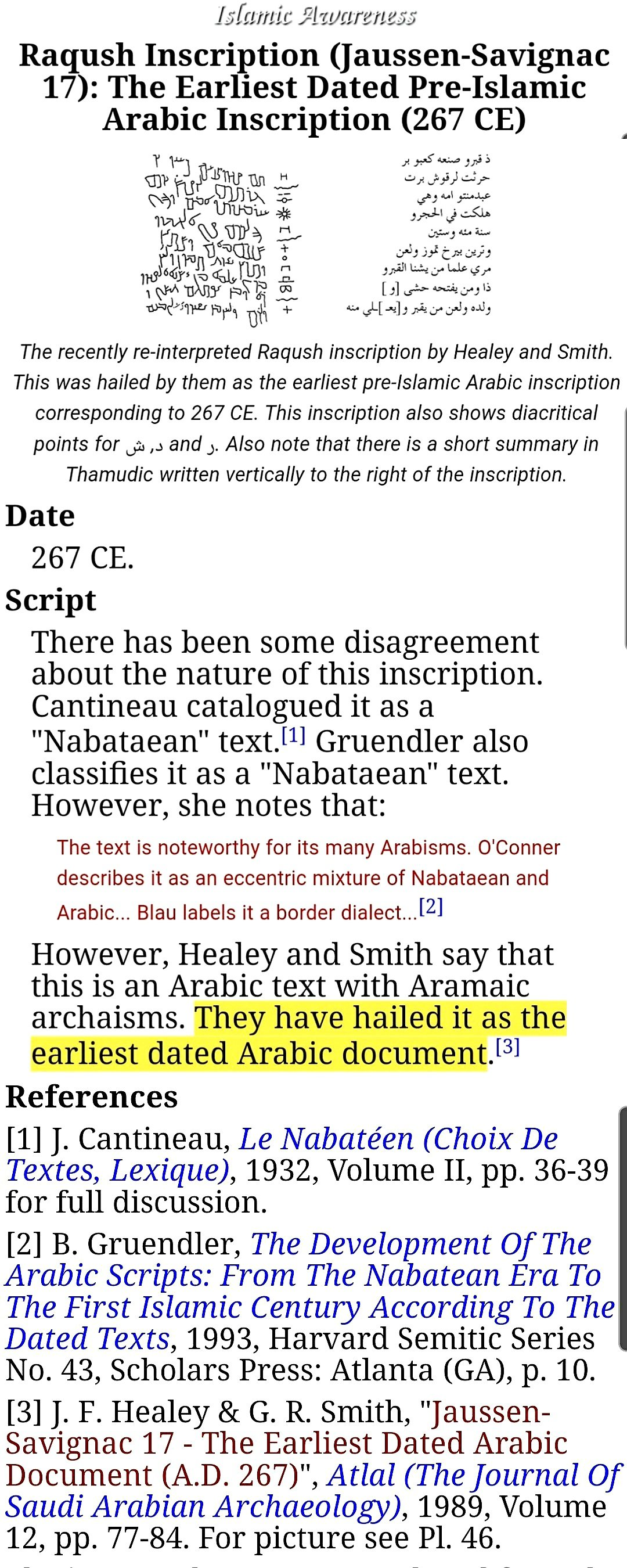
This is an inscription found in Madain Saleh, dating back to 267 CE. This inscription appears on the tomb of a woman named “Raqush.”
Scholars have classified it as both an Arabic and Nabataean inscription, but the Arabic language predominates. This is because the text could only be understood by placing the words within an Arabic context.
[ Raqush Inscription (Jaussen-Savignac 17): The Earliest Dated Pre-Islamic Arabic Inscription (267 CE) ]
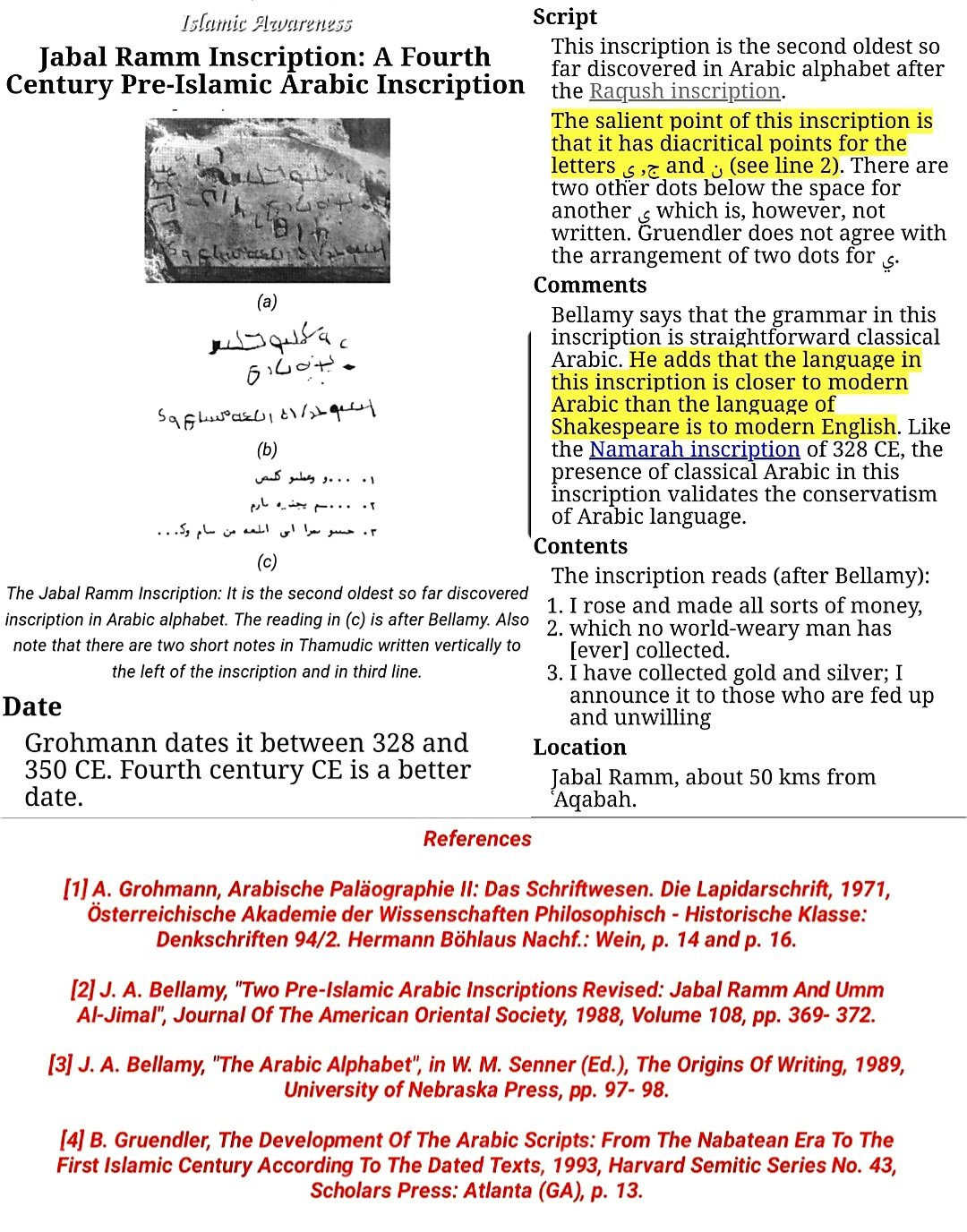
2 - Jabal Ramm Inscription
This dates back to 328 – 350 CE. The text reads: “Temple of Allat, great thanks to the active person who amassed his wealth.”
The letters (ي / ج / ن) in the inscription were dotted.
[ Islamic Awareness , Jabal Ramm Inscription: A Fourth Century Pre-Islamic Arabic Inscription ]
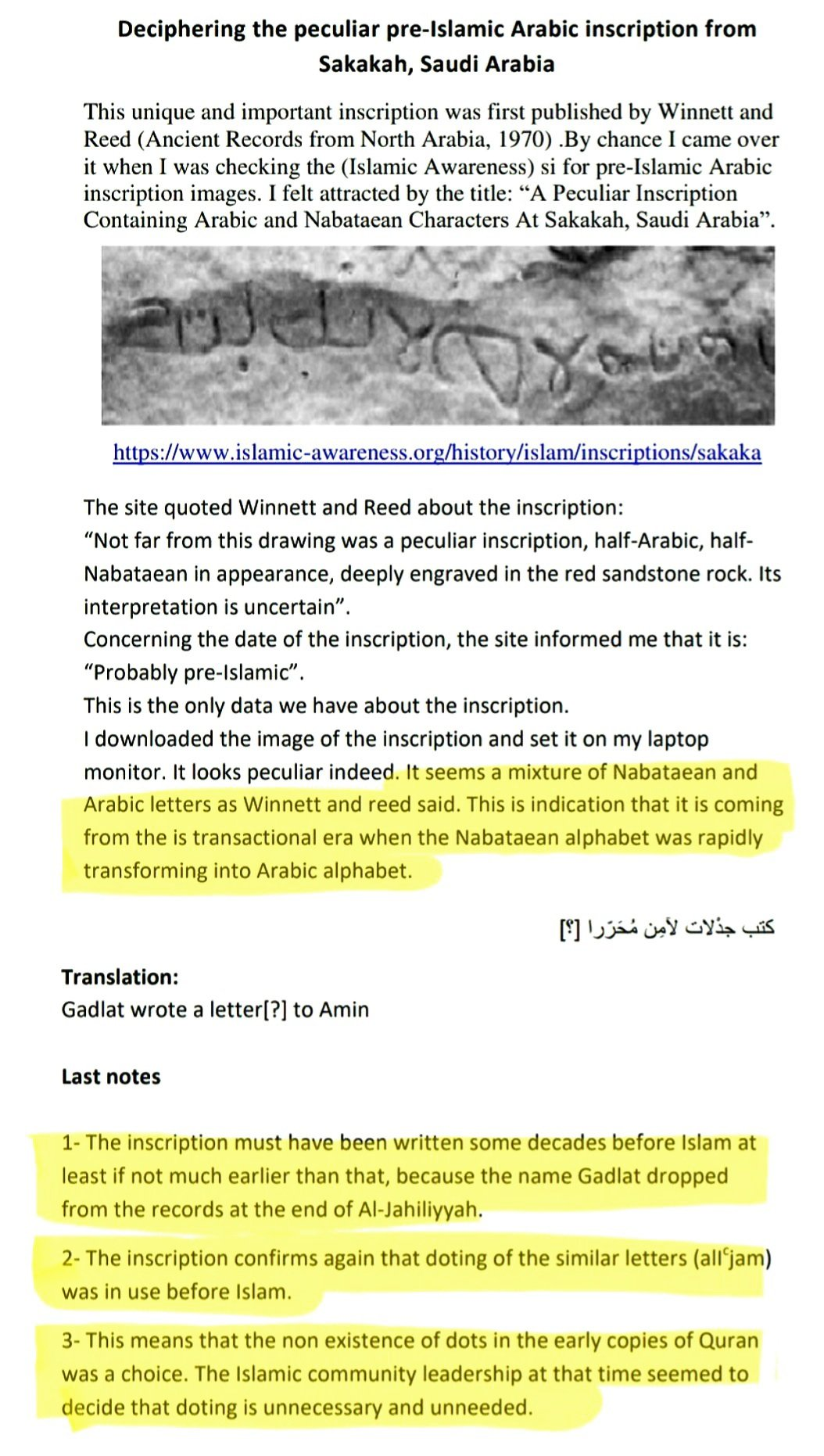
3 - Sakaka Inscription
This is a peculiar mix of Jazm script and Nabataean script letters, found in Sakaka in the land of Hijaz. The inscription shows diacritical marks associated with the Arabic Jazm script letters ب, ت, ن.
The researcher Zakariya Muhammad studied the inscription and discussed it in an article titled
Deciphering the peculiar pre-Islamic Arabic inscription from Sakakah, Saudi Arabia
Zakariya Muhammad states that the inscription is a mix of Nabataean and Arabic letters, and the words “wainit” and “raid” indicate that the inscription reflects a period of development in Arabic writing, during which the Nabataean alphabet was rapidly transforming into the Jazm script alphabet.
The text of the Sakaka inscription reads:
“Wrote Jadilat for Amn, freed.”
Zakariya further notes that the inscription was likely written at least decades before the Prophetic mission, if not much earlier, as the name “Jadilat” disappeared from records by the end of the pre-Islamic era.
The inscription reaffirms that diacritics on similar letters (I’jam) were in use before the Prophetic mission.
This indicates that the absence of diacritics in early Quranic manuscripts was a deliberate choice, as the leadership of the Islamic community at that time abandoned diacritics because they were deemed unnecessary at the time. End.
This inscription also supports refuting the theory that the Northern Arabic script was unknown to the Arabs of the desert.
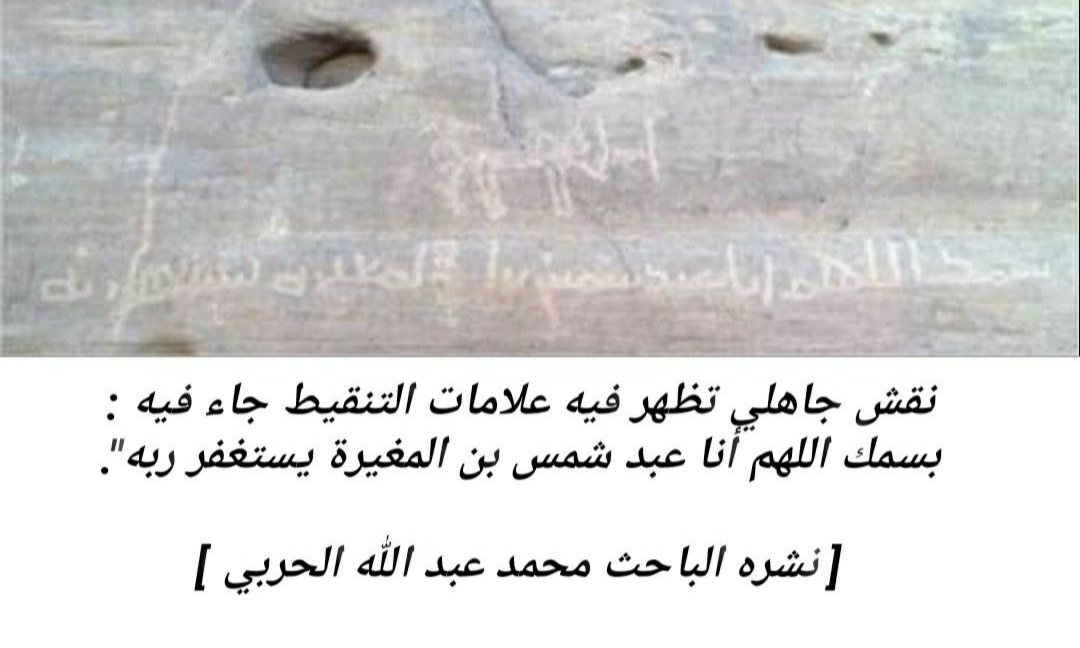
4 - Abd Shams ibn al-Mughira Inscription
The researcher Muhammad Abdullah al-Harbi, an expert in early Islamic inscriptions in the Medina region, published a pre-Islamic inscription that shows diacritical marks and reads:
“In Your name, O Allah, I, Abd Shams ibn al-Mughira, seek forgiveness from my Lord.”
It is believed that the inscription predates the Prophetic mission for two reasons:
a - The inscription begins with: “In Your name, O Allah”
b - The person’s name: “Abd Shams.”
There are also other inscriptions found on the mountain where this particular Abd Shams inscription was discovered.
5 - Petra Church Inscription
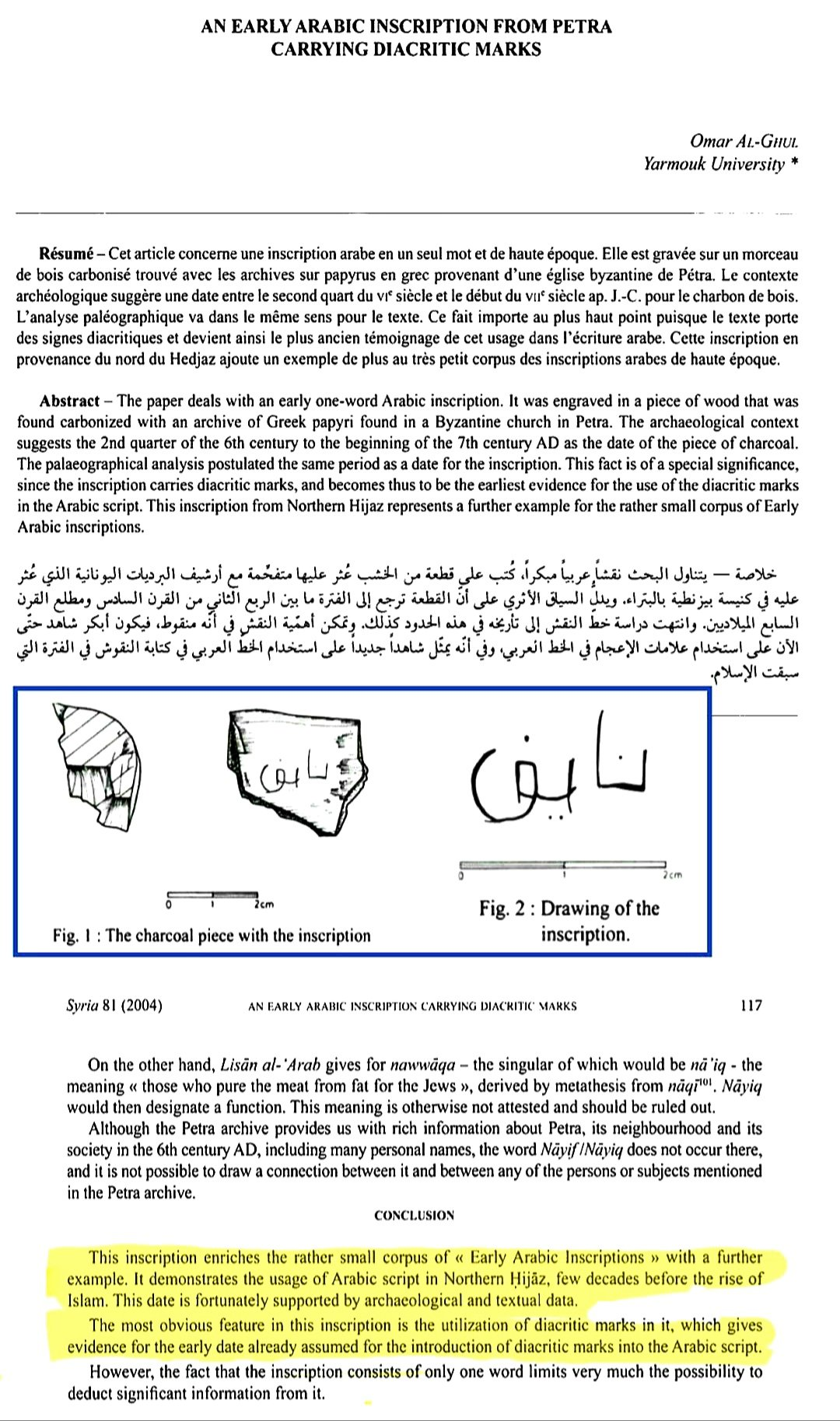
This inscription dates back to between the fifth and sixth centuries CE, and the word (Naif or Naiq) is written in the inscription with dotted letters in the Jazm script, attributed to an Arab writer.
The inscription proves that diacritical marking was known in the Jazm script alphabet before the Prophetic mission.
[ AN EARLY ARABIC INSCRIPTION FROM PETRA CARRYING DIACRITIC MARKS , Omar AL-GHUL ]
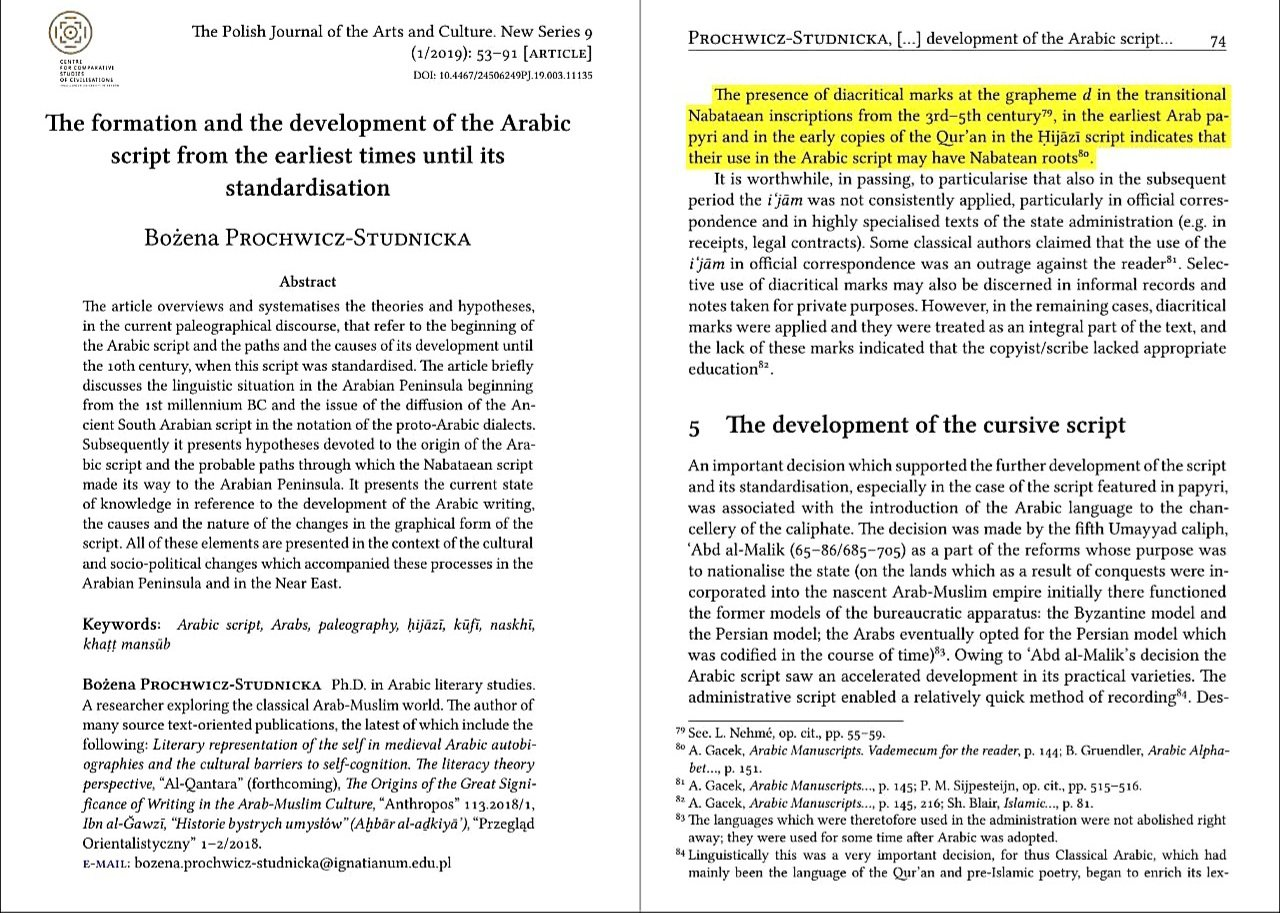
6 - Diacritical marking was known among the Nabataean Arabs, as inscriptions have shown the Nabataeans’ knowledge of diacritical marking.
[ The formation and the development of the Arabic script from the earliest times until its standardisation, Bożena PROCHWICZ STUDNICKA p74 ]
7 - It should be known that the diacritical marking of letters (I’jam) was present in some writings dating back to before the copying of the Quranic manuscripts during the era of Caliph Uthman ibn Affan, who passed away in 35 AH. This is significant in refuting the doubts of some skeptics regarding that early period of Islamic history.
The diacritical marking of letters did not emerge after the codification of the Quran, as some assume. The inscriptions discovered in the Arabian Peninsula demonstrate knowledge of diacritical marking, as mentioned earlier.
Hafni Nasif, who passed away in 1919 CE, stated in his book ”[ History of Literature, p. 88 - Egyptian University, Cairo, 1909 ]: that the invention of I’jam predates the time of Abdul Malik ibn Marwan, and that diacritical marking existed before the Prophetic mission. There are three pieces of evidence supporting this:
The first: It is narrated from Ibn Abbas that Amir ibn Jadara was the one who established I’jam.
The second: We find that the letters Bā’, Tā’, and Thā’—despite their differences in pronunciation—share a single form, as do Jīm, Hā’, and Khā’, and Dāl and Dhāl, and so forth. It is highly unlikely that the letters were originally designed in such a confusing manner, contrary to the wisdom of their creators and the excellence of their invention …
The third, which is decisive: Ancient writings have been found, composed before the caliphate of Abdul Malik, containing diacritical marking for some letters, such as Bā’ and similar ones. From all this, it is understood that I’jam was established before Islam. However, scribes gradually became lax in its use until it was nearly forgotten, with only rare instances remaining. This continued until the time of Abdul Malik, who mandated that the scribes of his state adhere to it.” End quote.
Thus, the Arabs were familiar with diacritical marking before the Prophetic mission.
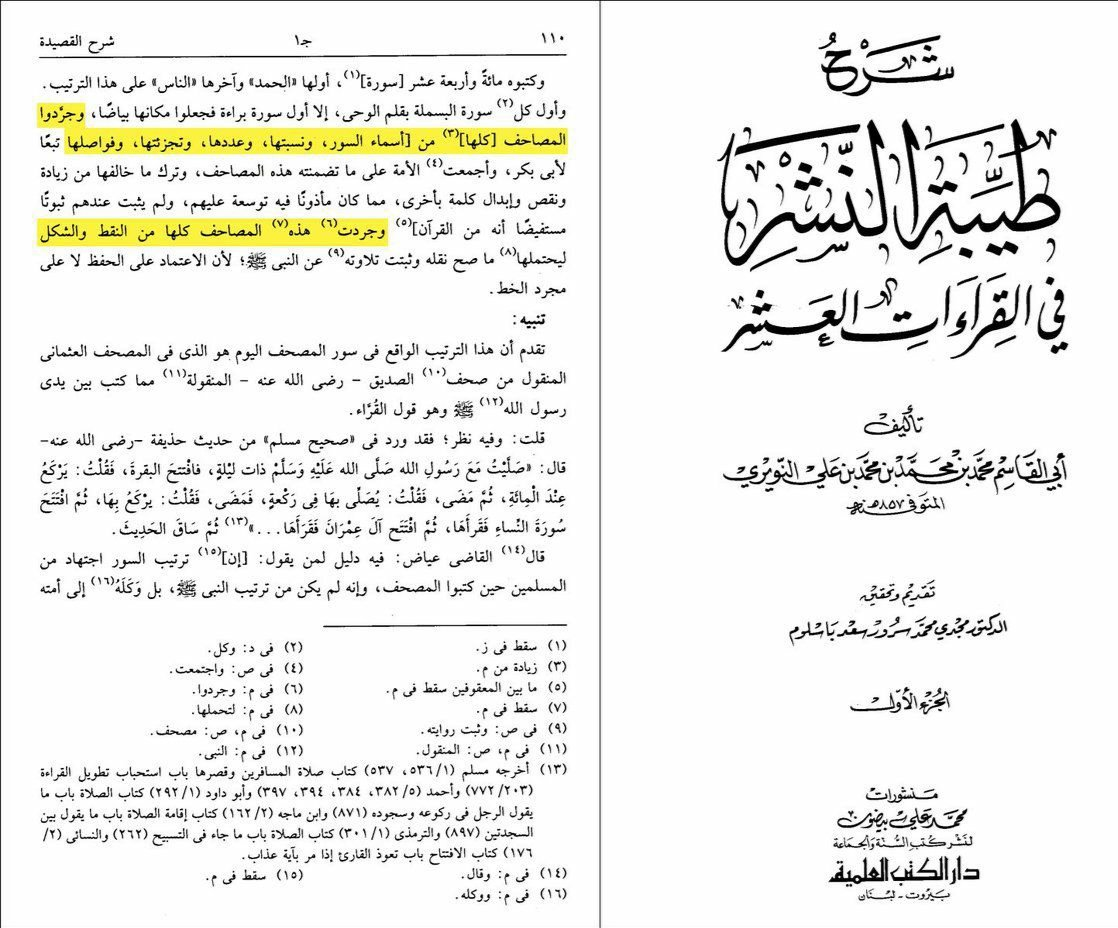
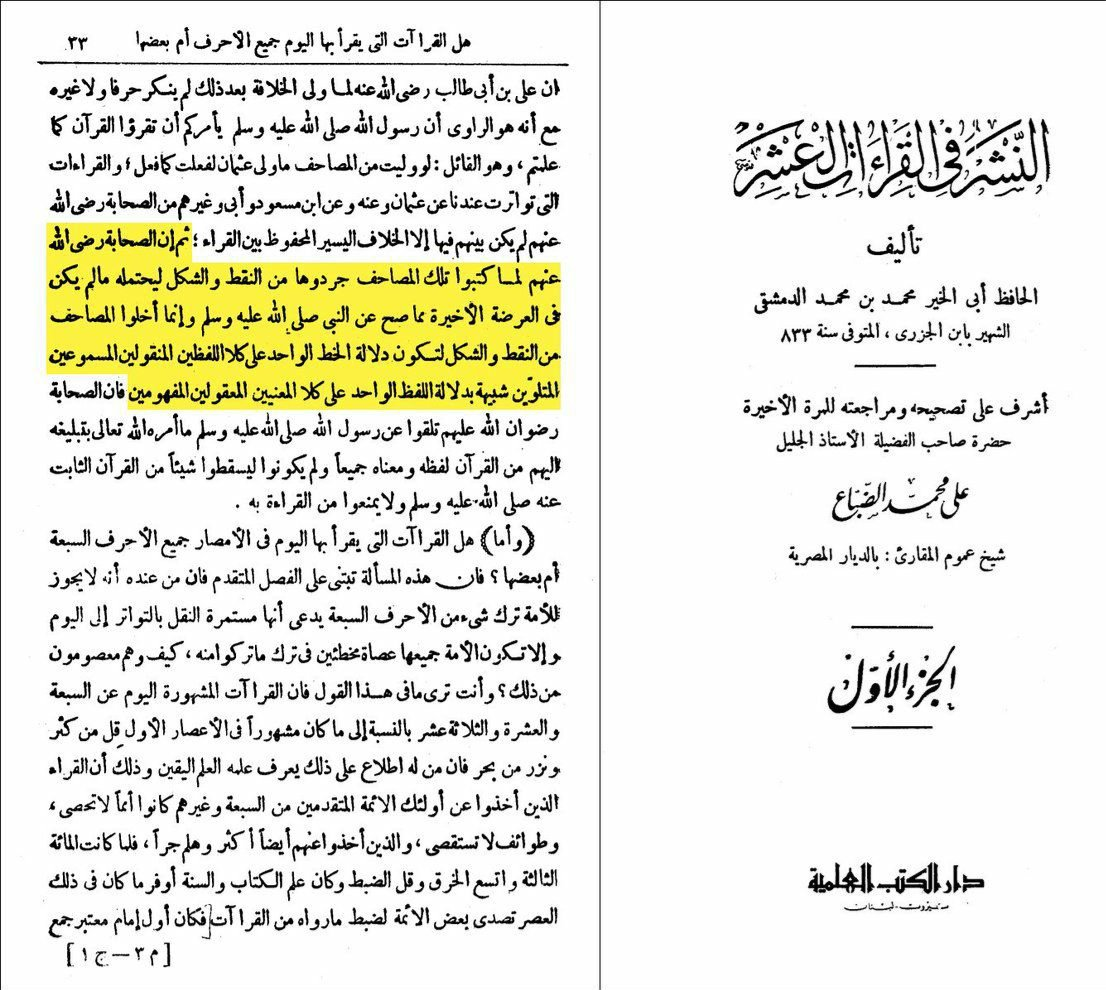
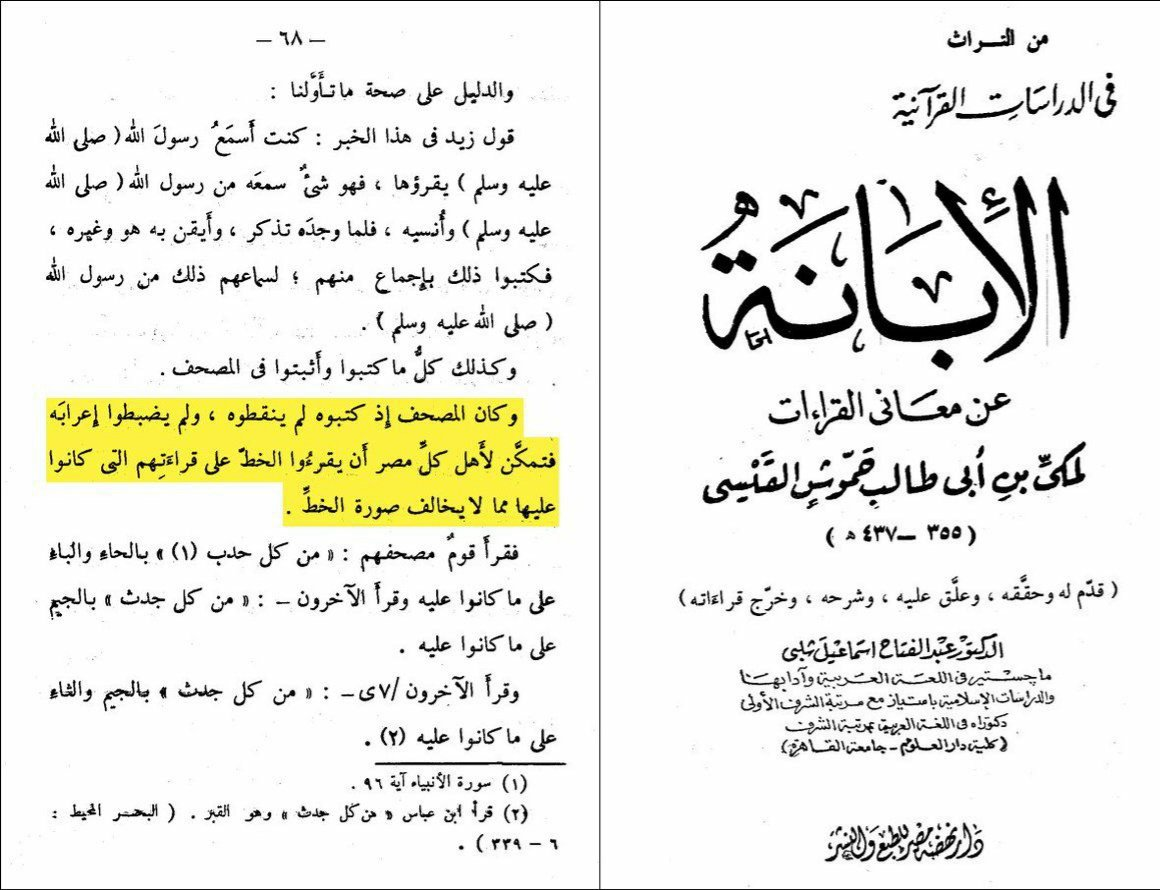
8 - The numbering of chapters, verses, divisions, and punctuation were all present in the Quranic manuscripts since the Prophetic era. The absence of punctuation in the Uthmanic manuscripts is because the scribes of the manuscripts themselves removed the punctuation and divisions from the text after it had been punctuated, with the aim of compiling all recitations and allowing for multiple pronunciations of words in a single text instead of repeating them.
[ Publication on the Ten Recitations, authored by Ibn al-Jazari, edited by Ali Muhammad al-Sina’, Volume 1, p. 33 ]
[ Clarification of the Meanings of the Recitations by Makki ibn Abi Talib, edited by Abdul Fattah Shalabi, p. 68 ]
[ Explanation of the Pleasant Publication on the Ten Recitations by al-Nuwayri, introduced and edited by Dr. Majdi Muhammad Surur Sa’d Baslum, Volume 1, p. 110 ]
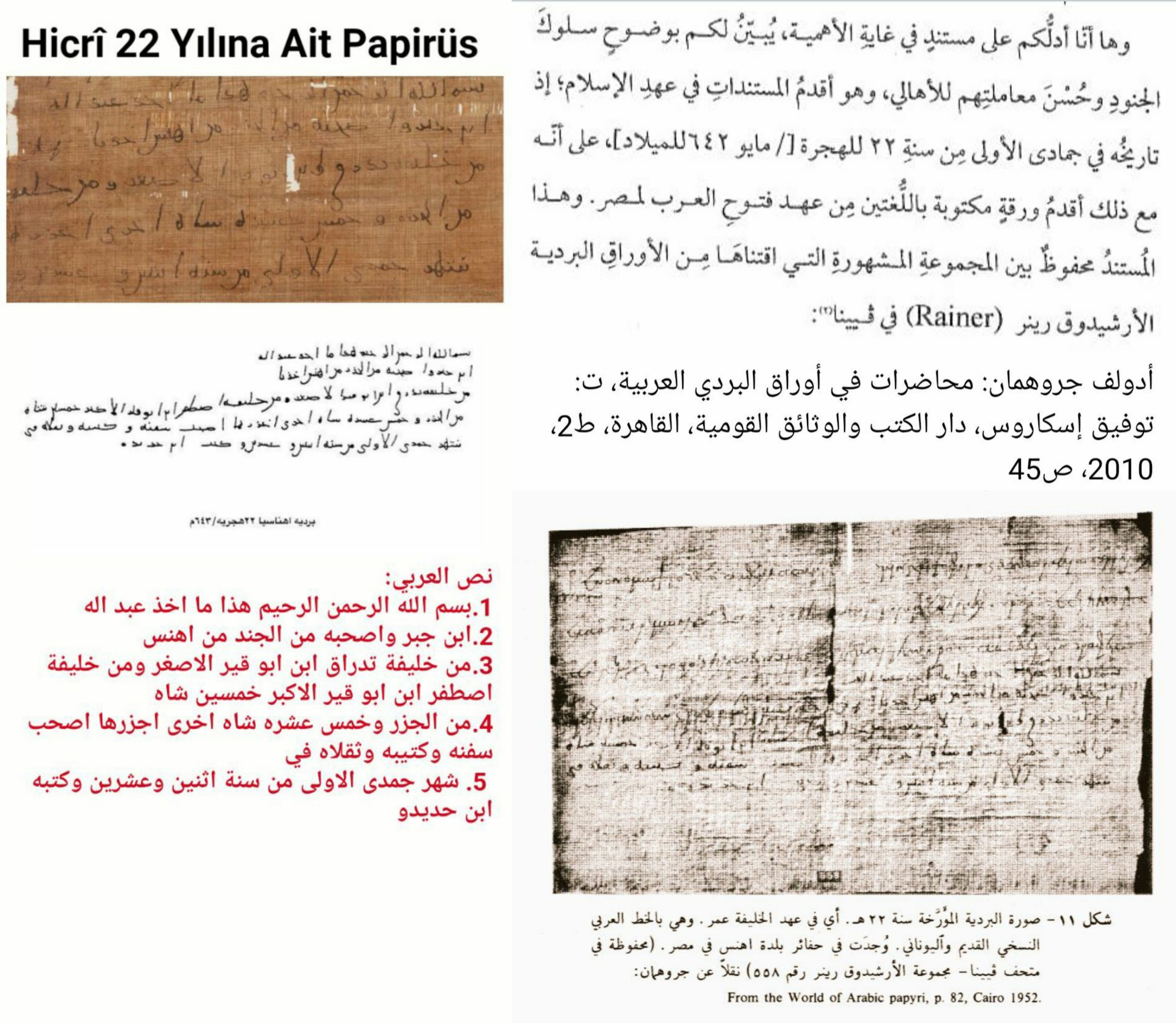
9 - It has been established from the Ihnasya papyrus, dated to the year 22 Hijri, that the use of diacritical marks was widespread among the Arabs during the caliphate of Umar, may Allah be pleased with him.
The text of the papyrus is: In the name of Allah, the Most Gracious, the Most Merciful, this is what Abdullah [thus] ibn Jabir and his companions took from the carrots from Ahnas.
We took from the deputy of Tadrak ibn Abu Qayr the Younger and from the deputy of Istafar ibn Abu Qayr the Elder fifty sheep from the carrots, and another fifteen sheep that were processed by the ship’s crew, its battalion, and its heavy load in the month of Jumada al-Ula in the year twenty-two, and it was written by Ibn Hadidu.
10 - The papyrus P. Berol. 15002 [year 22 Hijri] is an Arabic-Greek papyrus with diacritical marks, and it is a commercial contract between individuals from the conquering Arabs and individuals from the Egyptians, which explains the bilingual nature of the papyrus. The mentioned Hijri date is very early, as it dates back to the second year of the Arabs’ entry into Egypt.
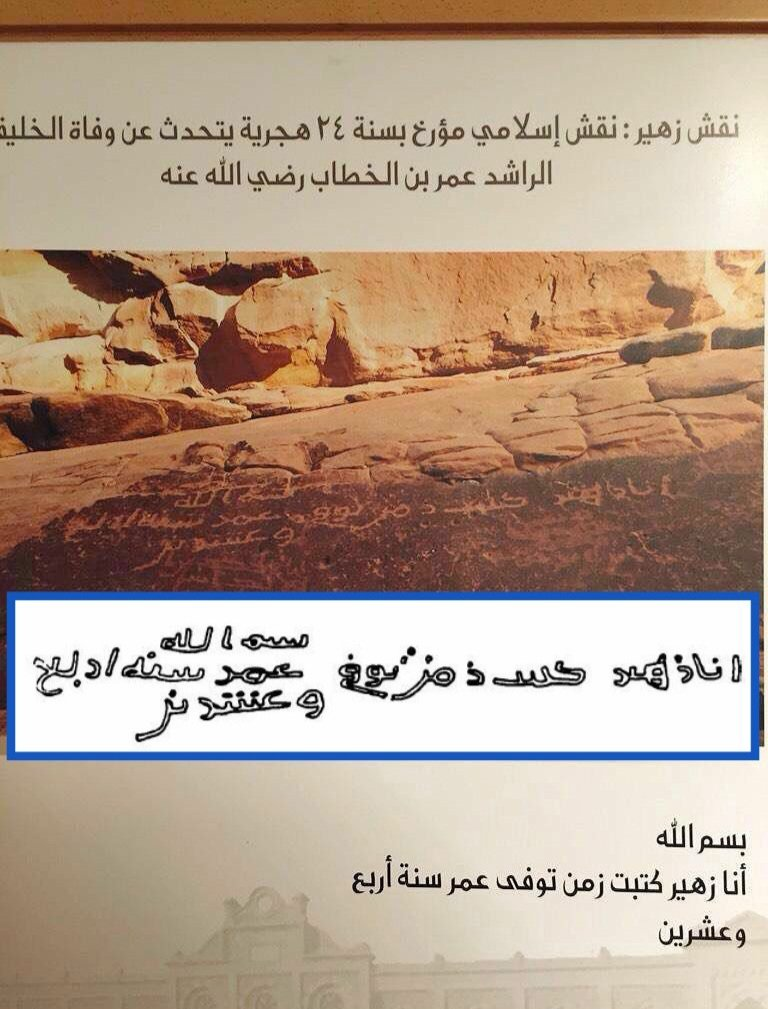
11 - The Zuhayr inscription, dated to the year 24 Hijri, has shown that the Arabs continued to use diacritical marks even after the Prophetic mission during the caliphate of Uthman, may Allah be pleased with him, and thereafter.
The text of the inscription is: In the name of Allah, I, Zuhayr, wrote at the time of Umar’s death in the year twenty-four.
12 - Diacritical marks are also present in the Sana’a palimpsest.
The Sana’a manuscript has proven that the use of diacritical marks did not delay until the second half of the first century; rather, it was present during the caliphate of Umar, may Allah be pleased with him.
Using white and blue X-rays, two researchers from Stanford and Harvard, “Mohsen Goudarzi” and “Behnam Sadeghi,” photographed and transcribed the lower text in a study titled:
[ Ṣan’ā’ 1 and the Origins of the Qur’ān Behnam Sadeghi and Mohsen Goudarzi 1, Stanford University / Harvard University, ]
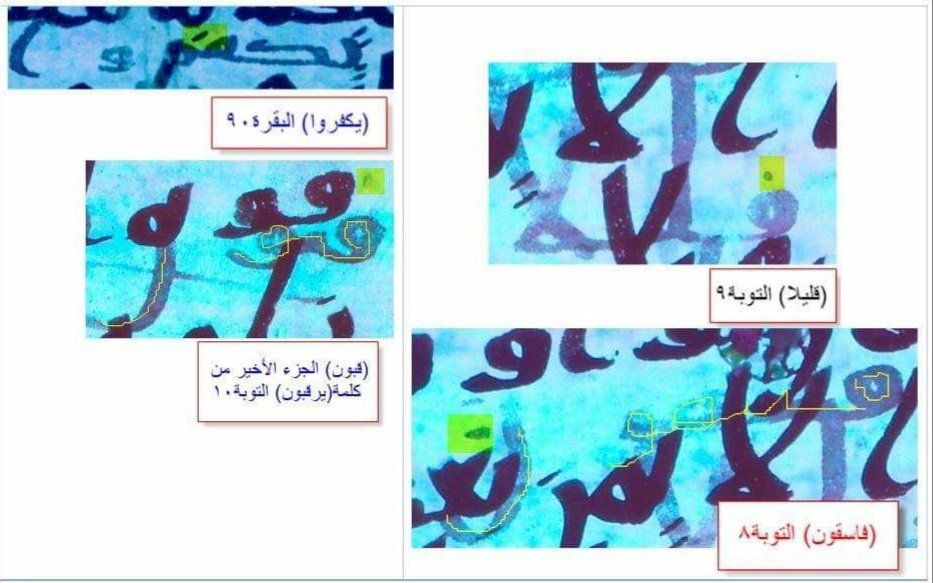
Thus, the date of the lower text of the manuscript was determined to be shortly after the death of the Prophet, peace and blessings be upon him, perhaps 15 years later, and at the latest, to the caliphate of Ali, may Allah be pleased with him. In the lower text, there are many dots on the letters, as shown in the image:
- “qalilan” - Al-Tawba 9 - a dot on the qaf
- “fasiqun” - Al-Tawba 8 - a dot on the nun
- “yakfuru” - Al-Baqara 90 - a dot on the fa
- “yarqubun” - Al-Tawba 10 - a dot on the qaf
It is noted that diacritical marking, even in the mentioned texts themselves, was not mandatory in all instances, and this is a characteristic that should be noted. For example, a scribe might place a dot on the nun in one place but not in another, or perhaps neglect to dot the text except in a specific instance. This indicates that we are not dealing with a standardized system required in writing, until Abu al-Aswad al-Du’ali, who died in the year 69 Hijri - 688 CE - introduced the system of diacritical marking to the Arabic language.
Al-Qalqashandi said in [ Subh al-A’sha, vol. 3, p. 149 ]: “It is unlikely that the letters, despite their similar shapes, were devoid of dots until the time the Qur’an was dotted.” End quote.
13 - It should be noted that there may be confusion in the concept of diacritical marking mentioned in historical narrations, as diacritical marking was of two types: diacritical marking for vocalization and diacritical marking for letter distinction.
As for the diacritical marking for vocalization, it is attributed to Abu al-Aswad al-Du’ali, and its purpose was to regulate the pronunciation in terms of fatha, damma, and kasra to avoid linguistic errors.
However, diacritical marking for vocalization did not last long, as it was replaced by Khalil ibn Ahmad with vowel signs derived from the shapes of alif, ya, and waw, after confusion arose between the dots used for vocalization and the dots used to distinguish between similar letters, which is the system of letter distinction.
It is important to note here that letter distinction exists in various forms, including placing a dot below the qaf, like the fa, as practiced by the Maghrebis, as reported by Al-Farahidi.
It becomes clear to us that diacritical marking, in both its forms—letter distinction and vocalization—is not an invention of non-Arabs, as some have claimed, but rather an ancient Arab heritage.
End, and praise be to Allah.