

Asiya bint Muzahim Identified as Isis-Nefert of Egypt
Asiya bint Muzahim, the believing wife of Pharaoh, is identified with Queen Isis-Nefert through archaeological exclusion, Coptic phonology, and the prophetic hadith. The classical sources describe her torture and martyrdom at the hands of Pharaoh, while Egyptological records document a queen of Ramses II — Isis-Nefert — who was excluded from full royal titulary, killed, and left without a known grave.
The Prophetic Hadith on the Best Women of Paradise
Grade: Sahih · Al-Albani
The Quranic Testimony to Asiya’s Faith
“And Allah presents an example of those who believed: the wife of Pharaoh, when she said, ‘My Lord, build for me near You a house in Paradise and save me from Pharaoh and his deeds and save me from the wrongdoing people.’”
Ibn Kathir on the Martyrdom of Asiya
Ibn Jarir said: Ismail bin Hafs al-Ayli narrated to us, Muhammad bin Ja`far narrated to us, on the authority of Sulayman al-Taymi, on the authority of Abu Uthman al-Nahdi, on the authority of Sulayman, who said: Pharaoh’s wife was being tortured in the sun, and when he turned away from her, the angels shaded her with their wings, and she saw her house in Paradise. Then he narrated it on the authority of Ubayd ibn Muhammad al-Muharibi, on the authority of Asbat ibn Muhammad, on the authority of Sulayman al-Taymi, with it.
Then Ibn Jarir said: Yaqub ibn Ibrahim told me, on the authority of Ibn Ulayyah, on the authority of Hisham al-Dastawai, on the authority of al-Qasim ibn Abi Bazza. He said: The wife of Pharaoh used to ask who had prevailed. It would be said, “Moses and Aaron prevailed.” She would say, “I believe in the Lord of Moses and Aaron.” So Pharaoh sent to her and said, “Look for the largest rock you can find. If it goes on what it says, then throw it on it, but if it goes back on what it says, then she is my wife.” So when they came to her, she raised her eyes to the sky and saw her house in Paradise. So she continued on her words and her soul was taken out and the rock was thrown on a body that had no soul in it.
So her words, “My Lord, build for me a house with You in Paradise,” the scholars said that she chose the neighbor before the house. Something of that was mentioned in a hadith that was traced back to the Prophet. “And save me from Pharaoh and his deeds,” meaning, deliver me from him, for I disavow his deeds to You. “And save me from the wrongdoing people.”
And this woman is Asiyah bint Muzahim, may Allah be pleased with her.
((Abu Jafar al-Razi)) said, on the authority of al-Rabi ibn Anas, on the authority of Abu al-`Aliyah, who said: The faith of Pharaoh’s wife was before the faith of the wife of Pharaoh’s treasurer, and that was because she was sitting combing the hair of Pharaoh’s daughter, and the comb fell from her hand, so she said: “Woe to he who disbelieves in Allah.” So Pharaoh’s daughter said to her: “Do you have a lord other than my father?” She said: “My Lord and the Lord of your father and the Lord of all things is Allah.” So Pharaoh’s daughter slapped her and beat her and told her father. So Pharaoh sent to her and said, “Do you worship a lord other than me?” She said, “Yes, my Lord and your Lord and the Lord of all things, and Him do I worship.” So Pharaoh punished her and fixed for her stakes and bound her hands and feet and sent serpents against her, and she was like that. Then a day came upon her. He said to her, “You will not desist.” She said to him, “My Lord and your Lord and the Lord of all things is Allah.” He said to her, “I will slaughter your son in your mouth if you do not do it.” She said to him, “Do what you are going to do.” So he slaughtered her son in her mouth, and the spirit of her son gave her good news and said to her, “Be of good cheer, O mother, for you will have such and such a reward with Allah.” So she was patient. Then Pharaoh came to her another day and said, She had the same, so she said to him the same, so he slaughtered her other son in her mouth, and his spirit also gave her good tidings and said to her, “Be patient, O mother, for you will have such and such a reward from God.” He said, and Pharaoh’s wife heard the words of the spirit of her eldest son, then the younger, so Pharaoh’s wife believed, and God took the spirit of Pharaoh’s treasurer’s wife and removed the veil from her reward, her status and her honor in Paradise for the wife of Pharaoh until she saw and increased in faith, certainty and belief. Then God informed Pharaoh of her faith, so he said to the assembly: “What do you know about Asiyah bint Muzahim?” So they praised her, and he said to them, “She worships someone other than me.” They said to him, “Kill her.” So he fixed pegs for her and strengthened her hands and feet. Then Asiyah called upon her Lord and said, “My Lord, build for me a house near You in Paradise.” At that time, Pharaoh came to her and she laughed when she saw her house in Paradise. Pharaoh said, “Are you not amazed at her madness? We torture her while she is laughing.” So God took her soul in Paradise. May God be pleased with her.
Inferences from the Classical Narrative
Three facts emerge from the tafsir and prophetic tradition that are decisive for historical identification.
First: Asiya bint Muzahim is the wife of Pharaoh — the Pharaoh of Moses.
Second: Asiya bint Muzahim is not of Pharaonic origin, as evidenced by her name. The name Muzahim is not Egyptian, indicating a foreign, likely Semitic, origin.
Third: Asiya bint Muzahim was subjected to physical liquidation — murder in the most horrific manner. After investigation, it was proven that the three testimonies are identical to one of the wives of Ramses II, namely: Isis-Nefert.
The Archaeological Candidate: Isis-Nefert
Isis-Nefert is a queen of the XIX dynasty, attributed to Ramses II. On the other hand, there is no big choice on this one, and it is not necessary for him to impose his presence in the shadow of the market.
Isis-Nefert is one of the queens of Pharaonic Egypt; she is the wife of Ramses II. The strange thing is that Isis-Nefert did not have the same status as the rest of Ramses II’s wives, such as Queen Nefertari or Bent-Anat. What is the reason? Perhaps as a punishment for something that did not please Pharaoh Ramses II.
Nefertari bore the full titulary: “the wife of the god, the great royal wife, the queen of the two lands, Upper and Lower Egypt.”
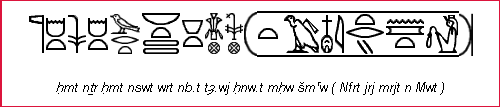
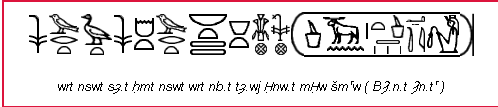
Bent-Anat, both daughter and wife of Ramses II, likewise held the complete title: “the great daughter of the Pharaoh, the great royal wife, the queen of the two lands, Upper and Lower Egypt.”
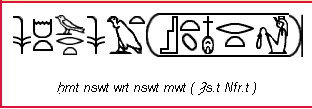
By contrast, Isis-Nefert is recorded only as “the great royal wife, the mother of the king” — conspicuously lacking the designation “queen of the two lands, Upper and Lower Egypt.”
Evidence of Exclusion
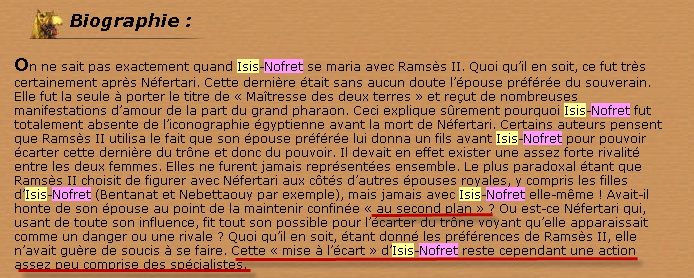
Why is Isis-Nefert not called the Queen of the Two Lands, Upper Egypt and Lower Egypt? Egyptological sources explicitly note this anomaly. The French Egyptology site Egyptos records that Isis-Nefert was excluded, an event that continues to raise questions for specialists.
The Non-Pharaonic Origin of Isis-Nefert
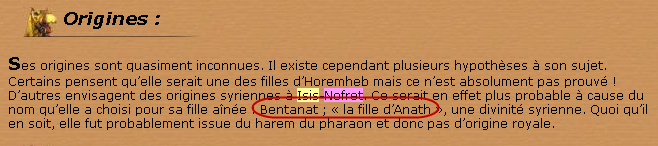
We said before that Asiya bint Muzahim is not of Pharaonic origin. What about Isis-Nefert? Isis-Nefert is also not of Pharaonic origin — she belongs to the region of Syria-Palestine.
A skeptical Christian might say, what is the relationship between the two names? The difference is clear between the names Asiya bint Muzahim and Isis-Nefert. We answer: most likely the name Isis-Nefert is the Pharaonic name of Asiya bint Muzahim.
What is the evidence that Isis-Nefert is the same as Asiya bint Muzahim? The evidence is that the eldest daughter of Isis-Nefert was called Bent-Anat. It is a strange coincidence that we find the word “bint” in the two names: Asiya bint Muzahim, and Bent-Anat.
The strangest thing is how Ramses II allowed the title Bent-Anat — which is a non-Pharaonic name — to be given to his daughter. Bent-Anat means “daughter of the goddess Anat,” the pagan Canaanite goddess. A big question mark.
The name Bent-Anat itself is not Egyptian but Canaanite. Bent-Anat translates to “daughter of Anat,” the pagan Canaanite goddess.

That Ramses II permitted his daughter to bear a name honoring a foreign deity — rather than an Egyptian goddess like Isis or Hathor — signals that her mother, Isis-Nefert, originated from the Syria-Palestine region where Anat was worshipped.
Physical Elimination and the Unknown Grave
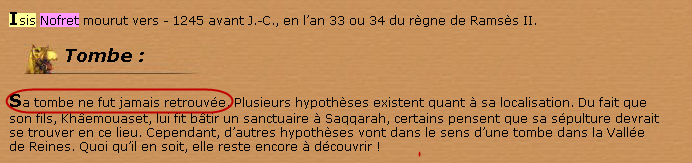
We said before: Asiya bint Muzahim was killed under the torture of Pharaoh. What about Isis-Nefert? Isis-Nefert was also killed. The Egyptologist Christiane Desroches-Noblecourt states:
[!admission] Christiane Desroches-Noblecourt — Egyptological assessment
“Isis-Nefert died early and before she reached old age, she was killed and physically eliminated.”

Where was Isis-Nefert buried? Isis-Nefert’s grave is still unknown to this day.

Further Egyptological records corroborate that no burial site for Isis-Nefert has been located.
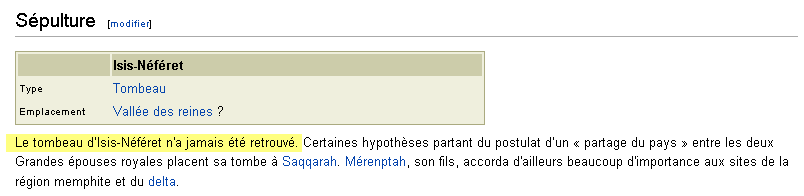
Archaeological sources consistently list her grave as unidentified.
Coptic Phonology: Isis as Asiya
Was all of the above a strange coincidence between the two characters, or is it a similarity that reaches the point of identity?
ISIS, or Isis, or Isis — whatever it is — is the Greek name for the pagan Egyptian goddess Aset, and the queen, the great wife of Ramses II, was named after her: a compound name Aset-Neferet, the second part of which is Neferet, meaning beautiful.
With this, we put the Greek name aside and began to search for the correct pronunciation from hieroglyphic writing — the mother of the ancient Egyptian languages — and its granddaughter, which still maintains its written and spoken entity: the Coptic language. With complete neutrality and from foreign sources, the phonological reconstruction proceeds as follows:
First: The Coptic extended alif has been proven. In Coptic, Isis is (Ese) or (Esi), Aa y-seh or Aa y-see — and the light yaa y is necessary due to the poverty of the Latin language to understand the eastern pronunciation of the extension. This is in addition to the fact that it is not found in the writing of the mentioned hieroglyphic name Aset.
Second: The letter seen is the second letter after the extended alif.
Third: The letter ya is written in one of the two Coptic writings after the seen (Esi) and is specifically pronounced Aa y-s ee T.
Fourth: The source believes that the feminine taa may be pronounced or not, and is replaced by the ha or not, and is satisfied with the ya (Aay-se h). While the culture of the Middle East is the closest, the Arabic language is the closest to cite: the feminine taa appears in the addition and is pronounced as has in the case of the bare noun — [Aasiya bint Muzahim] pronounced [Aseetu bint Muzahim].
Fifth: So we have the most likely results: Aaseet or Asiya, with the previous proof that the y = ي does not exist. And now listen for yourself to Sheikh Muhammad Hassan as he explains how our beloved Prophet Muhammad pronounced it 1400 years ago — and it is a name that does not exist in the books of the Jews or Christians.
The Khnum Inscription: Two Interpretations
Asit-Neferet is represented while she is worshipping, with her husband and son in front of the god Khnum — the head of the ram — which is considered one of the gods of ancient Egypt. This destroys all your assumptions and invalidates what you are trying to prove. Asiya bint Muzahim believed in Allah Almighty, so why do we see her worshipping the god of the pharaohs like this? Asiya, whom the Prophet referred to, was one of the ascetics, devout, worshippers — so did she believe in polytheism?
[!scholar] Ibn Kathir — Tafsir al-Quran al-Azim
[Pharaoh’s wife used to ask who had prevailed? It would be said, “Moses and Aaron have prevailed.” Then she would say, “I believe in the Lord of Moses and Aaron.” This woman is Asiyah bint Muzahim, may God be pleased with her. Abu Jafar al-Razi said, on the authority of al-Rabi ibn Anas, on the authority of Abu al-`Aliyah, who said: The faith of Pharaoh’s wife was before the faith of the wife of Pharaoh’s treasurer. That was because she was sitting combing Pharaoh’s daughter’s hair, and the comb fell from her hand, so she said, “Woe to he who disbelieves in God.” Then Pharaoh’s daughter said to her, “Do you have a lord other than my father?” She said: “My Lord and the Lord of your father and the Lord of all things is Allah.” So Pharaoh’s daughter slapped her and beat her and told her father. So Pharaoh sent to her and said, “Do you worship a lord other than me?” She said: “Yes, my Lord and your Lord and the Lord of all things, and Him do I worship.” So Pharaoh punished her and fixed for her stakes and bound her hands and feet and sent serpents against her, and she was like that, and she was destroyed. One day, he said to her, “What are you going to do?” She said to him, “My Lord and your Lord and the Lord of all things is Allah.” He said to her, “I will slaughter your son in your mouth if you do not do it.” She said to him, “Do what you are going to do.” So he slaughtered her son in her mouth, and the spirit of her son gave her good news and said to her, “Be of good cheer, O mother, for you will have such and such a reward with Allah.” So she was patient, then Pharaoh came upon her another day. So he said to her the same thing, and she said the same thing to him. So he slaughtered her other son in her mouth. Then his spirit also gave her good news and said to her, “Be patient, O mother, for you will have such and such a reward from Allah.” He said, “And Pharaoh’s wife heard the words of the spirit of her eldest son, then the younger, and Pharaoh’s wife believed.”]
[!scholar] al-Tabari — Jami al-Bayan
[Pharaoh’s wife used to ask who had prevailed? It will be said: Moses and Aaron were victorious. Then you will say: I believe in the Lord of Moses and Aaron.]
The evidence is that Asiya bint Muzahim was not a believing monotheist before she saw the miracles that were performed by the hands of our master Moses. Her presence before Khnum documents her pre-conversion state, not her post-faith belief.
Second: Asiya bint Muzahim used to hide her faith and went along with Pharaoh for fear of his power and tyranny. In other words, the same thing that applied to our master Ammar bin Yasir, may God be pleased with him and satisfy him, applies to her:
“Whoever disbelieves in Allah after his belief — except for one who is forced while his heart is at rest in faith — but those who open their breasts to disbelief, upon them is wrath from Allah, and for them is a great punishment.”
The convergence is not coincidental. Asiya bint Muzahim — foreign-born, tortured, killed by Pharaoh, and one of the best women of Paradise — aligns point-for-point with the Egyptological profile of Queen Isis-Nefert: excluded from full titulary, of Syria-Palestine origin, mother to a daughter named after a Canaanite goddess, physically eliminated, and left without a grave. The Coptic phonology of her Egyptian name, Aset, yields the precise Arabic pronunciation: Asiya.