

Breastfeeding from the Semen of a Stallion — Refuting the Polemical Misreading of Sahih Muslim and the Hadith of Aflah ibn Abi al-Qays
The polemic against the hadith of Aflah ibn Abi al-Qays collapses the moment one asks a single question: what does “the semen of a stallion” actually mean in classical Arabic jurisprudence?
A polemicist who identified himself as a Christian writer claimed to have written what he called “a bomb” on the subject of breastfeeding an adult in Islam. Having previously circulated material on the Salim case, he returned with a second piece, this time targeting a chapter heading in Sahih Muslim titled “Prohibition of Breastfeeding from the Semen of a Stallion,” presenting the hadiths of Aisha concerning Aflah ibn Abi al-Qays, a hadith from Sunan Abi Dawud, and a hadith from the Musnad concerning a man from the tribe of Kalb. He appended to these three fatwas from online Islamic question-and-answer sites concerning intimate marital acts, and then asked: “Is there a Muslim who is brave enough to stand before me on this issue?” The answer is yes — and what follows is the step-by-step demolition of the doubt from its roots.
The Doubt Stated — What the Polemicist Claims
The polemicist opened by quoting a chapter heading from Sahih Muslim — “Prohibition of Breastfeeding from the Semen of a Stallion” — and then presented the following hadiths:
The first hadith is from Sahih Muslim, on the authority of Urwah, that Aisha told him that Aflah, the brother of Abu al-Qays, came to ask permission to see her after the veil was revealed, and Abu al-Qays, the father of Aisha through breastfeeding, was away. Aisha said: “By God, I will not give permission to Aflah until I ask permission from the Messenger of God, may God bless him and grant him peace, for Abu al-Qays did not breastfeed me, but his wife breastfed me.” When the Messenger of God entered, she said: “O Messenger of God, Aflah, the brother of Abu al-Qays, came to me asking permission to see me, and I did not want to give him permission until I asked your permission.” The Prophet, may God bless him and grant him peace, said: “Give him permission.” Urwah said: “This is what Aisha used to say: They forbid through breastfeeding what you forbid through lineage.” In a parallel narration in the same collection: “He is your uncle, may you be covered in dust. Your right hand” — and Abu al-Qays was the husband of the woman who breastfed Aisha.
The polemicist then appended a second narration from Sunan Abi Dawud in which Abbad ibn Abdullah ibn al-Zubayr mentions his foster father, one of the Banu Murrah ibn Awf, and his account of the Battle of Mu’tah and the charging of Ja’far ibn Abi Talib on his blond mare. The polemicist labels this “a hadith of calamity” without explaining what he finds objectionable in it beyond its mention of a foster father.
The third hadith cited is from the Musnad on the authority of Anas ibn Malik, that a man from the tribe of Kalb asked the Prophet, may God bless him and grant him peace, about the laban al-fahl — the milk attributed to the stallion — and he forbade him from using it as a basis for prohibition. The man said: “O Messenger of God, we approach it and we honor it,” so he permitted him to honor it. Al-Tirmidhi commented: “This is a good and strange hadith.”
The polemicist concluded by appending three fatwas from Islamic question-and-answer websites concerning marital intimate acts and asked whether any Muslim would respond.
Who Is Abu al-Qays and Who Is Aflah — The Kinship Through Breastfeeding Explained
Lady Aisha, may God be pleased with her, was breastfed when she was an infant by a woman who had a husband called Abu al-Qays. Through this act of breastfeeding, a relationship of rada’ah — foster kinship — was established, producing the same marriage prohibitions as biological lineage.
From this hadith and from the story of Aflah, the following relationships can be established with clarity:
- The woman who breastfed Aisha became her mother through breastfeeding.
- The husband of that woman — Abu al-Qays — became her foster father through breastfeeding.
- Aflah is the brother of Abu al-Qays, meaning he is the foster uncle of Lady Aisha through breastfeeding.
A foster uncle is as forbidden to marry as a biological uncle — and therefore as entitled to visit without the veil as a biological uncle. Aflah’s entry into Aisha’s presence was not a concession or an irregularity; it was a legal right established by the Prophetic ruling on foster kinship.
These three conclusions come directly from the very hadiths the polemicist quoted. He quoted them himself, then accused them of containing a disaster — without apparently reading what they say.
What Does Stallion’s Semen Actually Mean — The Classical Arabic Definition
The polemicist states that he found a chapter in Sahih Muslim called “Prohibition of Breastfeeding from the Semen of a Stallion” and immediately assumed, based on what he himself admits is exposure to pornographic films, that “stallion’s semen” means sexual fluid, and that “breastfeeding from it” means an act of oral sexuality.
This is the meaning confirmed by the hadith itself. The man from the tribe of Kalb asked the Prophet about laban al-fahl — whether breastfeeding through milk caused by a given husband creates a prohibition with respect to that husband — and the ruling was given. The discussion is entirely about which kinship prohibitions this type of milk creates, and it has nothing whatsoever to do with any act involving a man’s body directly.
The polemicist was influenced by his own imagination and by what he explicitly describes as pornographic films. He then projected that imagination onto a classical Arabic legal term. The error is his, not the text’s.
To further confirm that the appearance of milk is a consequence of pregnancy caused by intercourse, the following screenshot from a public medical question-and-answer forum demonstrates that this is a recognized physiological fact. A woman reports that she began secreting milk from her breasts and then discovered she was pregnant, and the medical answer confirms this is a known sign of pregnancy.
The following image is a screenshot of a medical Q&A exchange in which a woman reports unexpected breast milk secretion that proved to be a sign of early pregnancy, confirming the physiological basis for the classical Arabic legal term “the milk of the stallion.”
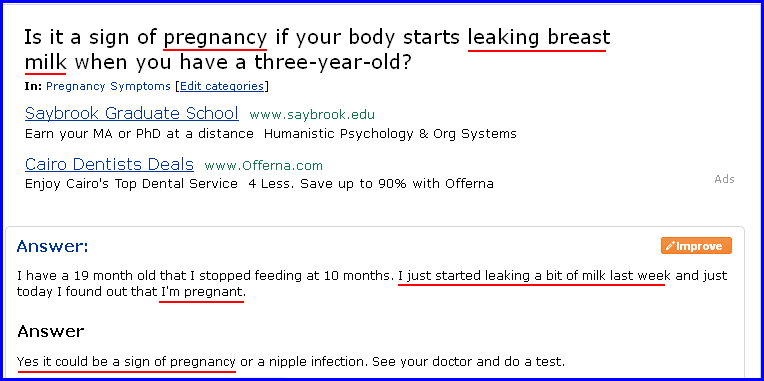
If we conclude that milk is one of the signs of pregnancy, and since the man is the cause of the milk appearing through his intercourse with the woman, this milk was attributed to him and called the stallion’s semen. The chapter heading “Prohibition of Breastfeeding from the Semen of a Stallion” therefore means: a ruling is issued on whether milk whose appearance was caused by a particular man’s intercourse creates the same foster-kinship prohibitions as other breastfeeding. It does not mean anything remotely resembling what the polemicist suggested.
Reading the Hadith of Aisha on Its Own Terms — Where the Polemicist Contradicts Himself
The polemicist’s own transcription of the hadith demolishes his interpretation.
The polemicist claimed that Lady Aisha “wanted Aflah to enter upon her” and that “the Messenger prevented her from doing so.” Let us examine exactly what the hadith he himself quoted says.
Lady Aisha said: “By God, I will not give permission to Aflah until I ask permission from the Messenger of God, may God bless him and grant him peace.”
She also said to the Prophet: “Aflah, the brother of Abu al-Qays, came to me asking permission to see me, and I did not want to give him permission until I asked your permission.”
Even if we were to grant, purely for the sake of argument, the polemicist’s erroneous assumption that “the man’s water” means sexual fluid — even then there is no problem. Lady Aisha herself resolved this in the hadith: “The man did not breastfeed me, but rather his wife breastfed me” — meaning she nursed from the woman’s breast, first and last, and the man had nothing to do with the matter physically. The polemicist’s own source material refutes him on every point he raises.
The Fatwas and the Christian’s Own Standards — Turning the Mirror Around
The polemicist appended three fatwas from online Islamic question-and-answer websites — concerning marital intimate acts between husband and wife — as if these constituted evidence of something shameful in Islam. This requires two responses.
The first response is jurisprudential: the source of Islamic legislation is the Holy Quran and the authentic Sunnah of the Prophet, may God bless him and grant him peace. Online fatwa websites are not sources of Islamic law; they are individual scholars’ opinions, and they differ from one another, and they carry varying degrees of scholarly authority. None of the acts mentioned in those fatwas appear in the Quran or in the authenticated hadith of the Prophet. These fatwas therefore do not concern us as evidence of what Islam teaches, any more than the opinion of an individual Protestant pastor on his personal website would constitute evidence of what Christianity teaches.
The second response is comparative: the polemicist cited a Christian source — gotquestions.org — which itself addressed these same acts within the context of Christian marriage. The following screenshot is from that source, in which the Christian website confirms that there is “nothing in the Bible that is not permitted in marriage — as long as the sexual relationship is consensual,” which their own author acknowledges opens the door to acts that the same author describes as resembling what is done in pornographic films.
The following image is a screenshot of the Christian website gotquestions addressing marital intimate acts in Christianity, confirming that the Bible places no specific restriction on consensual marital sexual conduct, including acts the author associates with pornographic content.
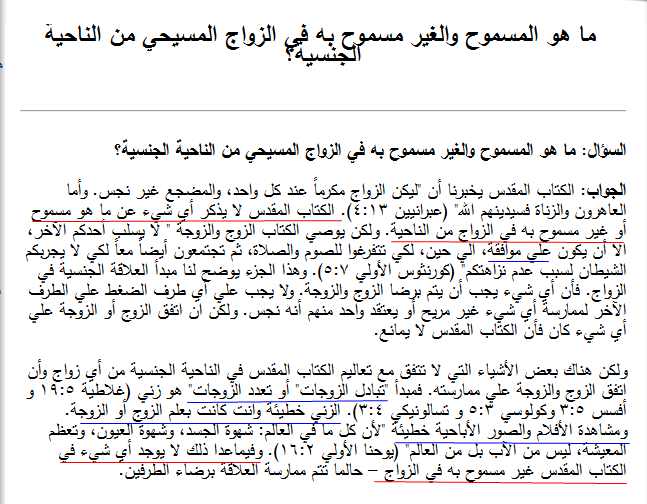
The same source states:
The conclusion that flows from the Christian source itself is:
- There is no problem, according to the Christian religion, if the Christian wife does what is done in the films that the polemicist himself describes as dirty and uses as the basis of his accusations against Islam.
- There is no explicit Biblical prohibition on the acts the polemicist cited in his appended fatwas — the Christian position, by the logic of gotquestions, is that anything consensual is permitted between husband and wife.
The polemicist who builds his attack on Islamic texts using an imagination shaped by exposure to pornographic films, then turns to accuse Islamic scholarship of vulgarity, while his own religious source confirms that his religious tradition has no specific prohibition on the same acts he finds objectionable — this is the very beam in his own eye that the Gospel of Luke warned him about.
...ard-and-breastfeeds-the-animal|Mother of God Breastfeeds Saint Bernard and Breastfeeds the Animal]]