Corruption of the Gospel of John 9 35
Today we have an appointment with a new text, which is the text of the Gospel of John, Chapter 9 , Verse 35 :
The writer says:
{ And Jesus heard that they had cast him out; and when he found him, he said to him, “Do you believe in the Son of God?” He answered and said, “Who is he, Lord, that I may believe in him?” Jesus said to him, “You have seen him, and he who is talking with you is he.” And he said, “Lord, I believe.” And he worshipped him.}
So that the honorable reader will not be distracted, the discussion under this topic will be arranged in specific points:
First: The importance of the text to Christian scholars:
Father Matta El Meskeen says:
{ He thought at first that he was a prophet, but when he knew that the one standing before him, whose face he saw and who was talking to him, was the Son of God, the owner of the kingdom, and the bearer of the keys to the door of life, he fell down before him in worship; and immediately his insight was opened and he saw the owner of the light . } (1)
Here, Father Matta El-Meskeen declares that the blind man’s prostration before Christ was not because he was a prophet, but because he was the Son of God, according to their expression. They say that the title “Son of God” indicates the divinity of Christ.
Pope Shenouda III says:
” Here we are not talking about an ordinary sonship to God that all people share. Otherwise, the man born blind would not have asked: Who is He, Lord? If it were a general sonship, the man born blind would have said: We are all sons of God, and I myself am the son of God. But it was a sonship that required faith and a miracle, and the result was that he prostrated before Him as the Son of God. What increases the importance of this miracle is that it carries a declaration from the Lord Christ Himself that He is the Son of God, and it also carries His call to people to this faith . ” (2)
Pope Shenouda used this word as evidence that Christ is the Son of God and that the blind man prostrated before Him on the basis of it!
So what would be the case if the reader discovered that the word that appeared in this text is the word ” Son of Man ” and not ” Son of God ”?
The meaning would inevitably be that the blind man prostrated before Christ as a human prophet and not as a god.
This miracle and others will be indicative of the prophecy of Christ and not his divinity as Christians say.
Second: Other translations reveal the truth:
Other translations, which are the overwhelming majority, put the word Son of Man instead of the word Son of God .
Most Arabic translations differ with the famous Van Dyck translation in translating this text
. The common Arabic translation says:
{ And Jesus heard that they had cast him out, and when he met him he said to him, “Do you believe in the Son of Man? ”} (3)
And literally the translation of the Good News is similar.
The Jesuit monastic translation says:
{And Jesus heard that they had cast him out. And he found him and said to him, “Do you believe in the Son of Man?” } (4)
I cannot fail to point out that the Catholic translation agrees with the Jesuit in translating the text with the word: {man}.
The Pauline translation says:
{ And Jesus heard that they had cast him out. And he found him and said to him, “Do you believe in the Son of Man? ”} (5)
The simplified Arabic translation says:
{ And Jesus heard that they had cast the man out. And he found him and said to him, “Do you believe in the Son of Man?” (6)
As for the translation of the Holy Book, it surprised everyone with a completely different translation !
The translation of the Holy Book says:
{ And Jesus heard that they had cast him out. And he found him, and said to him, Do you believe in him who became flesh? } (7)
These translations delete the word { God } from the text, and put the word { man } instead !
So what is the reason that prompted the authors of these translations to write the text in this way??
The reason is that they discovered that the oldest and most reliable manuscripts they have do not say { God } but rather { man }.
How can we easily know how the text is found in the manuscripts??
We will present a book that puts the Greek texts and under them the Arabic translation of each Greek word.
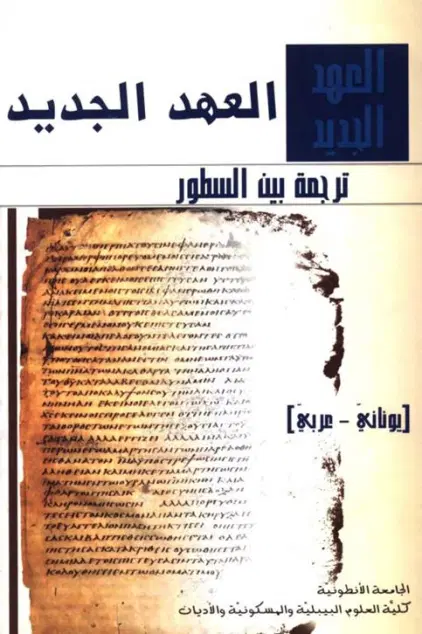
It is the book of the New Testament: Greek-Arabic between the lines. (8)
This is a picture from the book containing the requested text
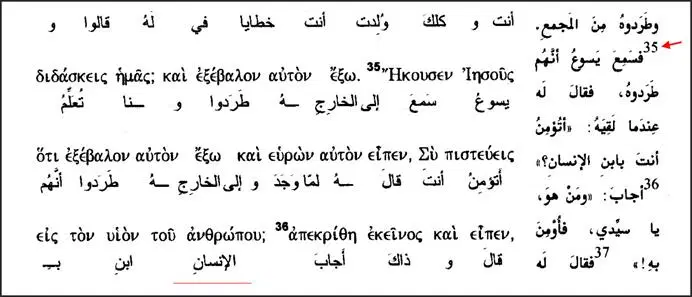
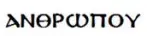
The reader may notice that the Greek word for { man } is { ανθρωπου }.
It is written:
and in the manuscripts

and is pronounced { anthropoi

and in the manuscripts like this

As for the word God in Greek, it is written like this: { θεου }, and in capital letters like this: { }

The word: { θεου } is found in the manuscripts abbreviated like this:

This is called the sacred abbreviation: { Nomina Sacra }.
After this simple explanation of the form and shape of these two words in the Greek language, we can go to the ancient, approved manuscripts to see what they say, without the reader being distracted or confused by these manuscripts or these words.
Third: The approved manuscripts say (the human):
Christians believe that the most important manuscripts of the New Testament are: the Sinaiticus, the Vaticanus, the Alexandrian,
the Ephraimite, the Beza Manuscript, the Washington Manuscript, and some ancient papyri.
Papyrus P066 from the second century AD and its symbol is { P 66 }:
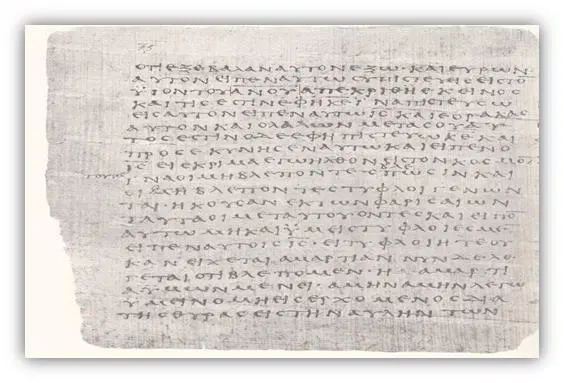
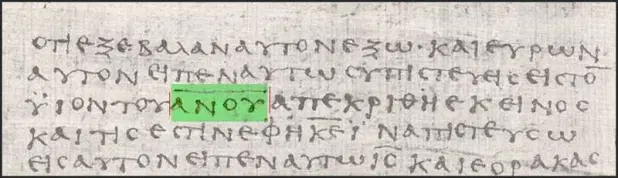
This ancient papyrus dating back to 200 AD mentions the word: abbreviated to mean: { man }.

This confirms that the correct translation is: { Son of Man } and not { Son of God }.
? Papyrus P075 from the second century AD and its symbol is { P 75 }:
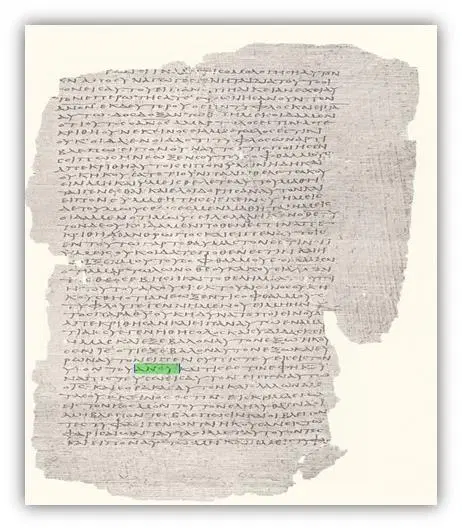
This ancient papyrus dating back to the third century AD also mentions the word: {}
, which confirms that the correct translation of the word is { Son of Man } and not { Son of God }

The Sinaiticus manuscript from the fourth century AD, and its symbol is { א }:
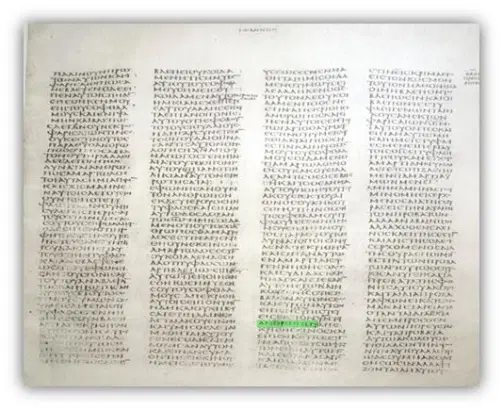
The Sinaiticus manuscript, which is considered the most important manuscript of the New Testament by textual critics, mentions:
{ } meaning { man }. The Sinaiticus
website provides a complete translation of the manuscript in English, saying:
35 Jesus heard that they had cast him out, and he found him and said: Dost thou believe on the Son of man ?
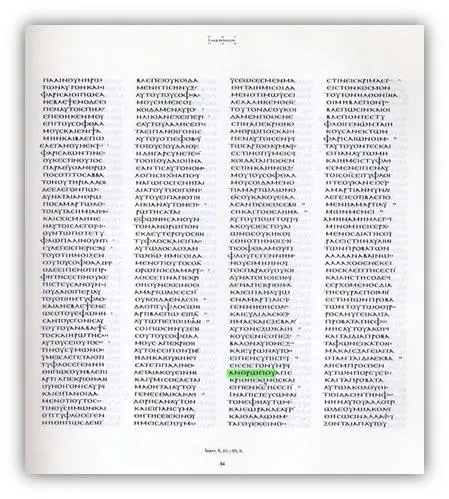
. Also, the Tschendorf
copy of the Sinaiticus manuscript supports and confirms what we say, and it is a copy that the scholar Tschendorf copied from the Sinaiticus manuscript:

Vatican Codex from the 4th century AD, code { B }:
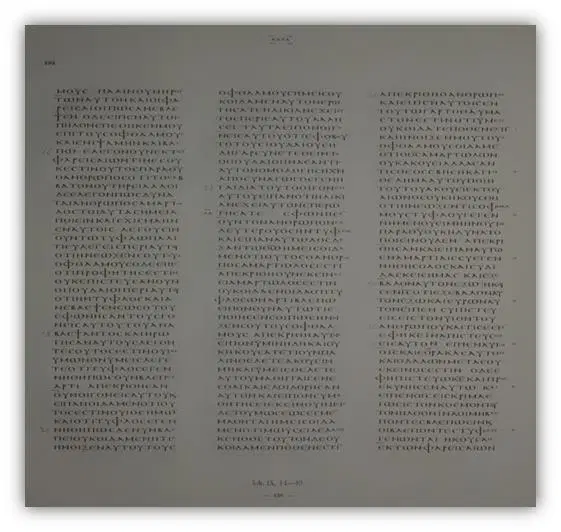
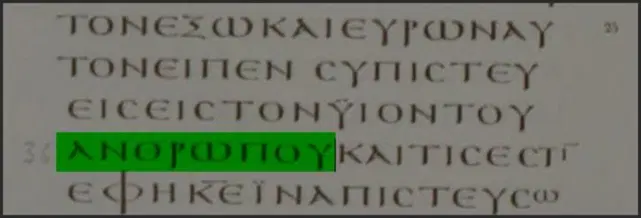
The Vatican manuscript mentions the word: { }, and its translation is: { man }. The Pisa manuscript from the fifth century AD and its symbol is { D }

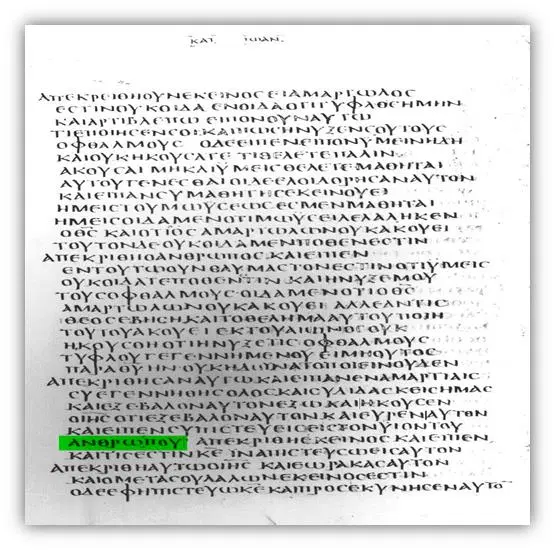
Here the Beza manuscript testifies to the translation of the word as: { } meaning: { man }

Washington Codex, 5th-6th century, symbol { W }:
Here we find the Washington manuscript mentioning: { } abbreviated, and its translation: { the human being }. Then the distortion of the text began in the fifth century in the Alexandrian manuscript! The Alexandrian manuscript from the fifth century and its symbol is { A }
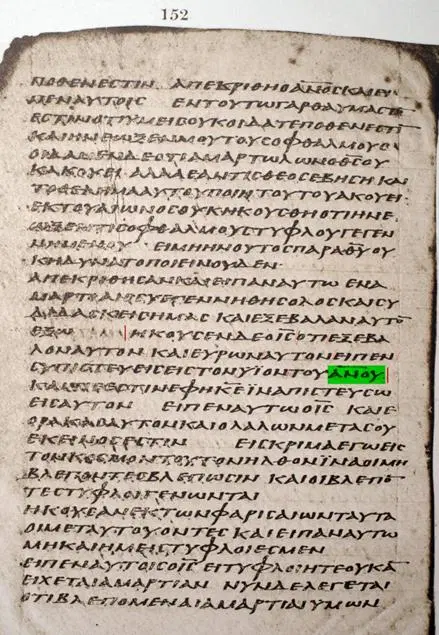
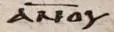
The Alexandrian manuscript mentions the word: } in the sacred abbreviation, and its translation is: { God }.
From here, the distortion of the text in the manuscripts began in the fifth century AD, and I do not find a reason that would push the writer of the Alexandrian manuscript to do this except what scholars have mentioned that the copyists felt free to change and tamper with the manuscripts!
But textual criticism scholars choose to read { ανθρωπου }. Because it appears in the oldest manuscripts.
Father Abdul-Masih Basit Abu al-Khair says:
{ Scientific textual criticism scholars have made precise comparisons of the New Testament manuscripts, especially the later ones, and have identified the parts that are completely ( 100 % ) devoid of various readings and have found that they represent 8/7. They have also identified the parts that have various readings first, then they have studied these parts that have various readings in a precise scientific study and compared them together and made comparisons until they reached several important and decisive results, which are: the oldest manuscript is the most correct and accurate …}.(9)
Based on the rule that Father Abdul-Masih Basit Abu al-Khair transmits from the scholars, these scholars have chosen the reading: { the human being }.
The editors of the Greek New Testament say:
{ (A) The original reading of a manuscript } .
The translation: { (A) ” man ” is the original reading of the manuscript }. (10)
So the scholars adopted the correct original reading: { man }, and did not adopt this later distortion. The monetarist Nestlé Aland
says: εὑρὼν αὐτὸν εἶπεν ✘ · σὺ πιστεύεις εἰς τὸν υἱὸν τοῦ ἀνθρώπου .(11) Fourth: Notes on this Story: Christian scholars cite this text as evidence, and say that the title { Son of God } indicates the divinity of Christ. I say: Even this title does not indicate the divinity of Christ, because he was not the only one described by it according to their book.

Adam, son of God : { Adam, son of God }. Luke 3:38 .
Solomon, son of God : { Solomon… I have chosen him to be my son, and I will be his father .} 1 Chronicles 17-13 .
The children of Israel are the sons of God : { The sons of God came to present themselves before the Lord .} Job 1-6 .
Peacemakers are children of God : { Blessed are the peacemakers, for they will be called children of God .} Matthew 5-9 .
All believers are children of God : { children of God: that is, those who believe in His name }. John 1 - 12.
If we say that Christ’s sonship to God means his divinity, there are texts that completely destroy this meaning:
The Son of God does not know when the hour will come : ” But of that day and hour no one knows, not even the angels in heaven, nor the Son, but only the Father .” Mark 13:32 .
The Son of God is subject to the Father : { The Son Himself will also be subject to Him who subjected all things to Him .} 1 Corinthians 15-28 .
The Son does nothing of himself : { The Son can do nothing of himself .} John 5:19 .
We return to the blind man around whom this story revolves and say:
This blind man himself testified that Christ was a prophet , and not a god or the son of God as the Christians claim.
Evidenced by his saying: “I see that he is a prophet.”
The blind man’s neighbors asked him: ” How were your eyes opened?” How did the man respond to them?
He replied to them, saying: ” A man, Jesus said to him, made clay and anointed my eyes, and I saw. ”
A third testimony from the blind man about the prophecy and humanity of Christ, because the blind man said: ” And we know that God does not listen to sinners. But if anyone fears God and does His will, He listens to him.”
And Christ himself states in the same Gospel that God always and forever responds to him: ” And I know that you always hear me .” As in John 11:42.
William MacDonald’s Interpretation
The miracle that Christ performed with this man was in fact the work of God Almighty and not the work of Christ, meaning that it was done with God’s permission, as evidenced by the fact that before Christ performed it, he said to his disciples: ” I must do the works of him who sent me ,” and this means that the miracle was originally from God and not from Christ.
We are now faced with two choices: either to believe the blind man who saw Christ with his own eyes, and Christ performed this miracle for him, and testified that Christ was a prophet, or to believe the Christians who never saw Christ at all, and who claim that Christ introduced himself to the blind man as the Son of God.
The Jews disbelieved in the prophecy of Christ, but not in his divinity, as the Christians claim, as evidenced by the Jews’ saying about Christ: ” We know that this man is a sinner .”
The entire biography of Christ according to the Christian Gospels cries out for his humanity, and there is no better evidence of this than what Christ himself said to the Jews: { But now you seek to kill me, a man who has told you the truth which I heard from God .} John 8:40.
Some might say that the blind man said this out of fear of the Jews! The response to that is easy, simple and straightforward:
The interpreter Matthew Henry says:
{ Because he spoke very well, and with great courage and boldness , defending the Lord Jesus}. (12)
References:
(1) Explanation of the Gospel of John by Father Matta El Meskeen, Part 1, p. 601 , published by the Monastery of Saint Macarius Press - Wadi El Natrun.
(2) Theology of Christ by Pope Shenouda, p. 19 , published by the Anba Royes Press - Cairo.
(3) The Joint Arabic Translation, p. 159 , published by the Middle East Bible Society, with the participation of Catholics, Orthodox and Protestants.
(4) The Jesuit Monastic Translation - The New Testament, p. 320 , published by Dar El Mashreq - Beirut.
(5) The Pauline Translation - The New Testament, p. 444 , published by the Pauline Library Publications.
(6) The Simplified Arabic Translation - The New Testament, p. 1125 , published by the World Center for Bible Translation.
(7) Translation of the Holy Bible - The New Testament, p. 121 , published by the Bible Society - Lebanon.
(8) The New Testament - Greek-Arabic Between the Lines by Paul Al-Feghali, Antoine Awkar, Nimatallah Al-Khoury and Youssef Fakhry, p. 491 , Antonine University edition.
(9) The Holy Bible Challenges Its Critics and Those Who Say It Has Been Corrupted by Father Abdul-Masih Basit Abu Al-Khair, p. 508 , Sunday School edition.
(10) The Greek New Testament, Fourth Revised Edition, p. 718. (
- Greek New Testament With Critical Apparatus. Nestle-Aland 27th edition.
(12) The Complete Commentary on the Holy Bible by Matthew Henry, Vol. 1 , p . 665 , Eagles Publications, Cairo.
topppppppppppppppppppppppppppppppppppppppppppppppppppppppppppppppppp