David’s Massacre in 2 Samuel 12:29–31: Old Bible Translations vs Modern Changes
Cutting People with Knives and Axes, Sawing Them Apart, and Tearing Them Apart with Threshing Machines
The book called the Holy Book tells us of a hideous massacre carried out by the Prophet of God, David, peace be upon him - the grandfather of Jesus - against the people of (Rabbah), as mentioned in (2 Samuel 12: 29-31).
Table of Contents
- The Massacre in 2 Samuel 12 29-31
- The Sawing and Cutting of People
- The Threshing Machine
- Old Editions Reporting the Text Without Embellishment
- Modern Editions Changing the Meaning
- The Crown Problem
- Las Casas and the Crimes of the Conquistadors
- Conclusion
The Massacre in 2 Samuel 12 29-31
When the Prophet David occupied the village, he cut up its inhabitants - of course, the inhabitants of different ages, infants, children, women, and men - with knives and axes, and sawed them apart with saws…
The Sawing and Cutting of People
An illustrative image of the sawing carried out by the Crusaders against the Muslims of Andalusia, which is based on such texts.
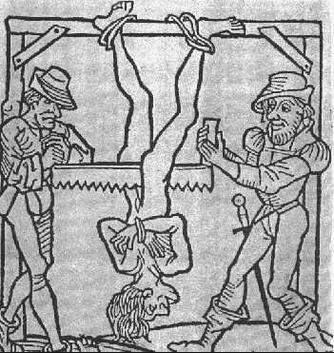
This image is used here as an illustrative visual reference for the act of sawing people apart, which the article connects to the violent reading of 2 Samuel 12:29-31 in older translations. The point being made is that such biblical texts, when read literally according to certain old editions, describe extreme physical punishment and massacre rather than ordinary forced labor.
The Threshing Machine
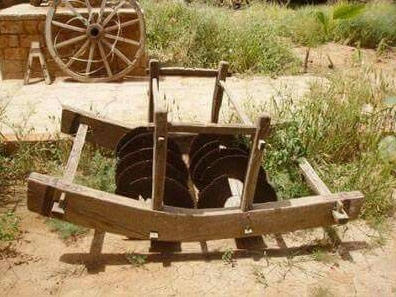
He trampled them with iron threshers (a threshing machine: a machine pulled by two oxen or similar, with which the stalks of harvested wheat are trampled to separate the grain from the ears)…
A picture of the threshing machine, and on YouTube there is a live video of the work of the threshing machine.
Then he threw them into the brick ovens (brick kilns).
Old Editions Reporting the Text Without Embellishment
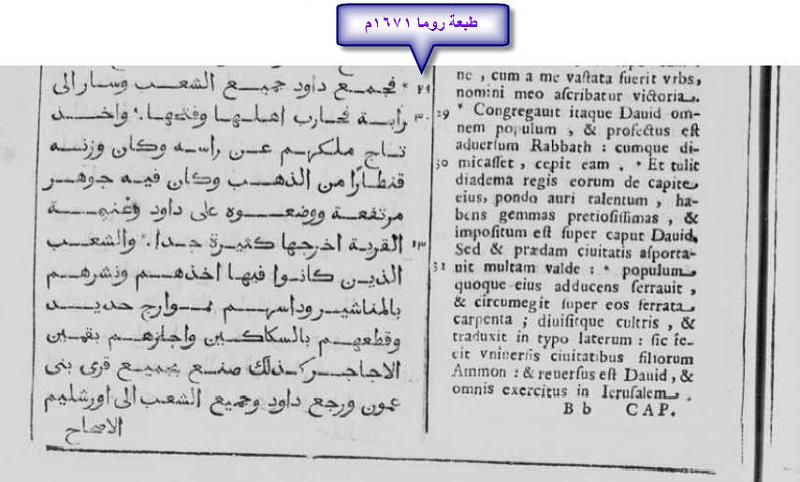
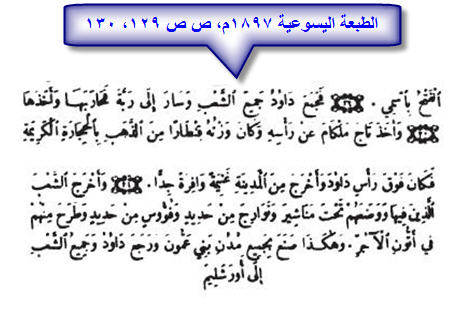
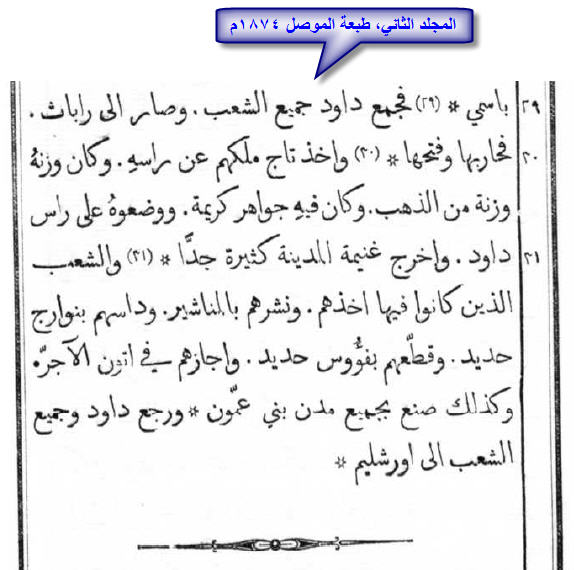
Old editions have reported the story with that unparalleled hideousness without embellishment, as follows:
This scan is presented as part of the article’s documentation for older Bible translations that describe the people of Rabbah as being cut with saws, iron instruments, and axes, and being made to pass through brick kilns. The argument here is that these older renderings preserve the violent meaning openly, without softening the description into labor or manufacturing work.
This scan is placed with the old-edition evidence. It supports the same point: that earlier translations of 2 Samuel 12:29-31 reported the punishment of the conquered people in direct, brutal language. The focus of the article is that these older readings describe the people themselves as the objects of cutting, sawing, threshing, and burning, rather than describing them as workers assigned to tools or industries.
This scan continues the documentation of older translations. The article uses it to show that the violent wording was not an isolated reading in only one edition, but appeared across older biblical renderings. The central issue is that these translations present David’s treatment of the people of Rabbah as massacre and torture, not as ordinary compulsory labor.
Modern Editions Changing the Meaning
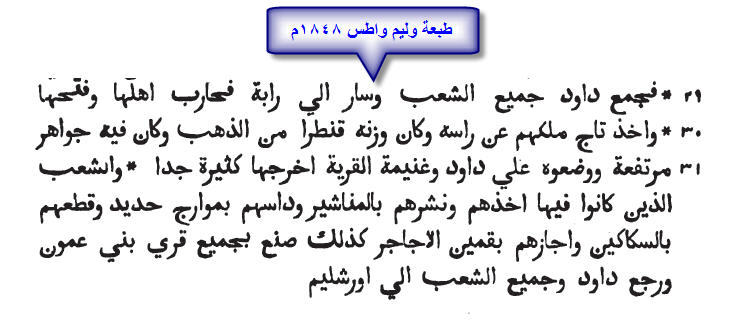
Those old translations that mentioned the massacre in all its ugliness without embellishment, in contrast to them we find in modern editions of the Bible a complete change to the text to embellish the massacre or an attempt to erase it, which distances this book from being sacred or being a revelation from God, when the translators of those modern editions transformed the cutting up of people with knives, axes and saws - threshers - and burning them in mud brick ovens into David, peace be upon him, forcing them to work in the manufacture of knives, axes, saws, threshers and bricks!
This scan is used to document the modern-edition wording. The article’s argument is that the meaning has been softened: instead of the people being cut with tools and burned in brick kilns, the wording is made to sound like they were put to work using or producing saws, axes, threshing tools, and bricks. The scan is therefore placed here to show the contrast between older violent renderings and later softened renderings.
This scan is part of the evidence showing a translation shift. The article uses it to argue that modern editions do not merely use different vocabulary; they change the action itself. The old reading describes punishment inflicted on people, while the modernized reading can be understood as forced labor involving tools and brickmaking.
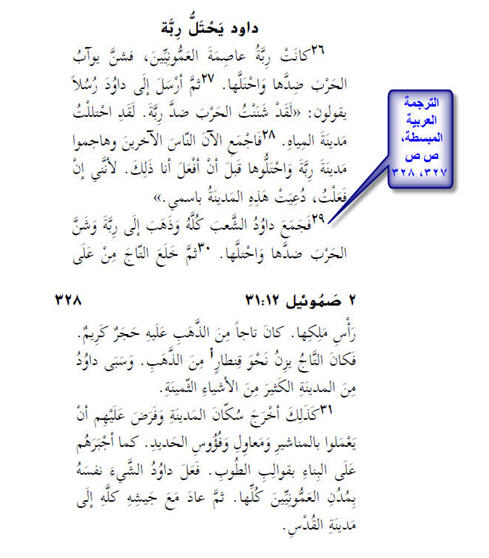
This scan continues the modern-edition comparison. The article’s point is that the same biblical episode is presented in a way that reduces the explicit brutality. This is used as an argument that translators attempted to protect the moral image of the text by changing how the massacre appears to the reader.
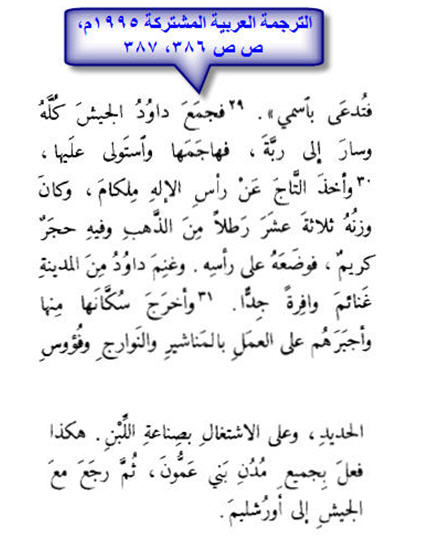
This scan belongs to the same section on modern translations. It is presented to show that the wording of 2 Samuel 12:29-31 is unstable across editions: some preserve the older violent sense, while others recast the passage into work, tools, and brick production. The article uses this instability as part of its criticism of the Bible’s textual reliability and the claim of sacred preservation.
The Crown Problem
Now we have three versions of the weight of the crown, which one is correct?
There is also a conflict between the editions of the Bible about who placed the crown on the head of the Prophet David as follows:
-
The followers of the Prophet David are the ones who placed the crown on his head.
-
He is the one who placed the crown on his head (Joint Arabic Translation).
-
It was on the head of the Prophet David without specifying who placed it!
Of course, we will not discuss the question of how the Prophet David carried a crown weighing 45 kilograms on his head. Or the justifications for solving this dilemma.
This scan is used for the second textual problem in the passage: the crown. The article highlights that different Bible editions do not agree on how the crown detail should be understood. The issue is not only the crown’s heavy weight, which is described as around 45 kilograms, but also who placed it on David’s head. According to the article, some editions say David’s followers placed it on him, another says David placed it on himself, and another gives the wording without clearly identifying who placed it. The scan is therefore used to support the claim that the passage contains conflicting translation choices and unresolved textual difficulty.
Las Casas and the Crimes of the Conquistadors
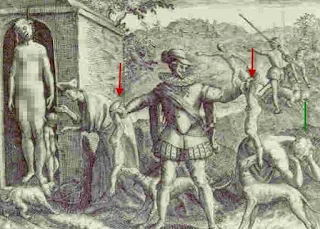
Photo documentation of the crimes of the “God is Love” campaign:
Children are cut in half and thrown as food for the hungry “Conquistadors” dogs!
Short Account of the Destruction of the Indies
Father Bartholomew de Las Casas
This final reference points to documentation connected with Bartolomé de Las Casas and the destruction of the Indies. The article connects this historical violence to the earlier discussion by arguing that violent biblical texts and later Christian imperial violence form part of the same moral problem. The reference is included as external documentation for atrocities committed during the conquest of the Americas.
Conclusion
The article argues that 2 Samuel 12:29-31 contains a severe moral and textual problem. Older editions openly describe David’s treatment of the people of Rabbah as cutting, sawing, threshing, and burning. Modern editions, according to the article, soften or alter the meaning by turning the massacre into forced labor involving tools and brickmaking. The article further argues that the crown detail contains contradictory renderings across editions, strengthening the claim that the text is unstable and cannot be treated as preserved revelation.