Did a Woman Drink the Prophet Muhammad’s Urine? Hadith Authenticity Explained
Was the Hadith About a Woman Drinking the Prophet’s Urine Authentic?
This article collects the narrations, authentication claims, and hadith criticism around the report concerning a woman drinking the urine of the Prophet ﷺ.
Table of Contents
- The Report and Its Narrations
- The Report in Al-Ghaylaniyyat
- Ibn al-Qattan al-Fasi on the Hadith
- The Question of Hakimah bint Umaymah
- Al-Wali Al-Iraqi on the Vessel
- The Umm Ayman Route
- Sunan Abi Dawud and Sunan Al-Nasa’i References
- Conclusion
The Report and Its Narrations
Praise be to Allah, the hadith about a woman drinking the urine of the Prophet - may Allah bless him and grant him peace - was narrated by Al-Tabarani, Abu Nu`aym, Ibn Abi Asim, Ibn Abd Al-Barr, and Al-Mizzi.
On the authority of Al-Hajjaj bin Muhammad Al-Masisi, on the authority of Ibn Jurayh, who said: Hukaymah bint Umaimah bint Ruqayqah informed me, on the authority of her mother Umaimah, who said: The Prophet, may God bless him and grant him peace, used to have a bowl of sticks in which he would urinate, then he would put it under his bed. Then he came and wanted it, but there was nothing in the bowl. So he said to a woman who was serving Umm Habibah, who had brought her from the land of Abyssinia: “Where is the urine that was in the bowl?” She said: “I drank it.” So he said: “I have been protected from the Fire by a pair of glasses” or “a garden of fire.” [Al-Baki said in Al-Manhal Al-Adhb: An-Nawawi, Al-Hafiz Ibn Hajar, and Al-Manawi in his great commentary deemed it good, and Al-Hakim authenticated it in his Mustadrak, and Ibn Hibban mentioned it in his Sahih. End quote. I said: As-Suyuti, Al-Albani, Abdul-Haqq Al-Ishbili, and others authenticated it.
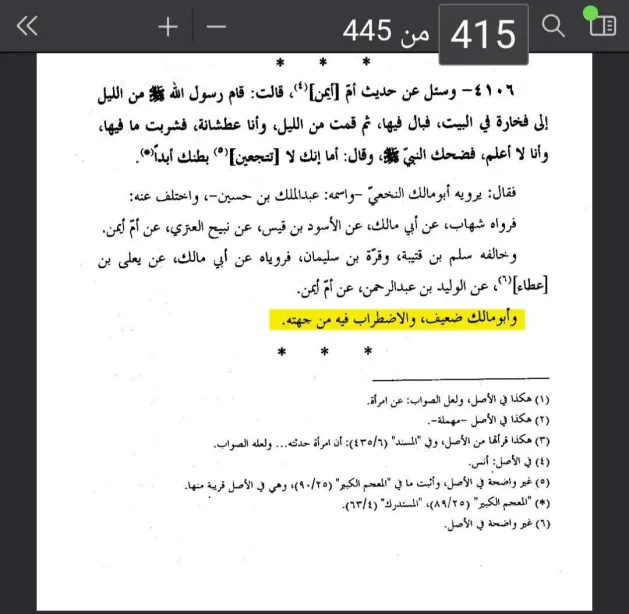
Ibn Al-Sakin, At-Tabarani, and Abu Nu’aym narrated it on the authority of Abdul-Malik bin Husayn Abu Malik Al-Nakha’i, on the authority of Al-Aswad bin Qays, on the authority of Nabih Al-Anzi, on the authority of Umm Ayman said: The Prophet (peace and blessings of Allah be upon him) had a clay pot in which he would urinate at night. When morning came, I would pour it out. I slept one night while I was thirsty, and I made a mistake and drank some of it. I mentioned that to the Prophet (peace and blessings of Allah be upon him), and he laughed until his teeth were visible, and he said: “You will never have stomach pain after this day.”
In another narration: “I got up at night while I was thirsty and drank what was in it without realizing it.” The Prophet (peace and blessings of Allah be upon him) said: “You will never have stomach pain.”
Ad-Daraqutni said: Abu Malik Al-Nakha’i Abdul Malik bin Hussain is the only one who narrated it, on the authority of Al-Aswad bin Qais, on the authority of Nabih.
Al-Hafiz Ibn Hajar said: Abu Malik is weak and Nabih did not reach Umm Ayman.
This story was mentioned by As-Suyuti in Al-Khasais Al-Kubra under the chapter “Healing with his urine (peace and blessings of Allah be upon him).” And Allah knows best, and may Allah’s prayers and peace be upon our Prophet Muhammad, his family, and all his companions.
The Report in Al-Ghaylaniyyat
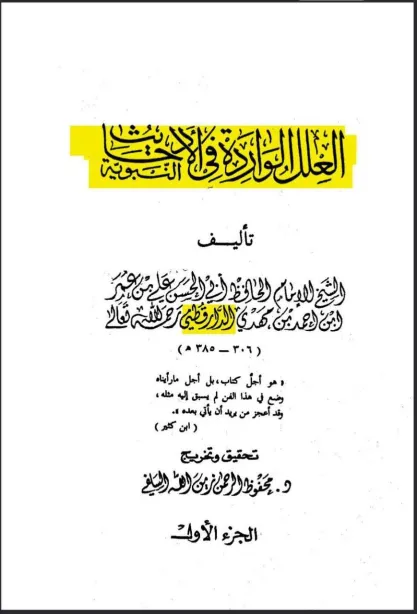
For your info: This scan is the title page of Al-Fawa’id Al-Ghaylaniyyat. It identifies the work and its attribution to the hadith scholar Abu Bakr Ahmad ibn Ja‘far ibn Hamdan Al-Qati‘i. The scan is being used here to show the printed source from which the following report is being discussed.
For your info: This scan shows a page from Al-Fawa’id Al-Ghaylaniyyat where the report is cited. The narration states that the Messenger of Allah ﷺ got up at night to a pottery vessel in the house and urinated in it, then a woman got up while thirsty and drank what was in it without knowing. The Prophet ﷺ laughed and said that her stomach would never ache. The highlighted editorial note says: “The hadith is authentic, and the confusion is in its route of transmission.” This scan is therefore used to document the view that the report was graded authentic by that editor while acknowledging disturbance in the route.
Ibn al-Qattan al-Fasi on the Hadith
It is stated in the book (Bayan al-Wahm wa al-Iham..) by Ibn al-Qattan al-Fasi - may Allah have mercy on him - 5/513-516:
(The Prophet - may Allah bless him and his family and grant them peace - had a cup of sticks under his bed in which he would urinate at night. Then he - Abdul Haqq - said - thus al-Daraqutni said: This hadith is considered authentic, or something to that effect. End of his words, i.e. Abdul Haqq. So I say - and Allah is the Grantor of success -: This also falls under the category of what was transmitted from the authenticated narrations of al-Tirmidhi, or the narrations of al-Bukhari [or Muslim, for he imitates them in their authentication of it], and he should not have imitated them [in that], and this hadith has a narrator who is either weak or unknown.
If he did not obtain knowledge of that, and he had nothing but imitation of al-Daraqutni in what he said, then know that al-Daraqutni did not rule on this hadith as authentic, and it is not authentic. He has that, but the matter is as I describe:
that Al-Bukhari and Muslim did not narrate from a man from whom only one person narrated, rather it is necessary that each of those from whom they narrated had been narrated by two or more, so they did not narrate the hadith of Urwah ibn Mudris, Qays ibn Abi Gharzah, and their likes from the Companions whose hadiths are authentic, but they do not meet their conditions.
With this consideration, Al-Daraqutni wrote a book in which he explained that there are men whom Al-Bukhari and Muslim left out of narrating because of their authentic hadiths; for they are of this description, meaning that two or more narrators narrated from each one of them.
And that there are men from whom he narrated but they did not attain this description, but only one person narrated from each one of them.
Rather, he meant by that in his knowledge, so among what Al-Daraqutni mentioned in this book was a translation whose text is: (He mentioned the hadiths of men from the Companions, who narrated from the Prophet - may God bless him and his family and grant them peace - their hadiths were narrated from authentic sources - not in the printed obligations. The investigator said - there is no criticism of their narrators, and they did not include anything from their hadiths, so it was necessary to include them according to their school of thought, and according to what we have presented of what they included, or one of them). This is the text of his translation.
Its meaning is: Men from the Companions narrated hadiths that were authenticated from them by the narration of trustworthy people, so it was appropriate for each one of them to include in the two Sahihs from his hadith what its chain of transmission was authentic, so they did not include anything from their hadiths, so it was necessary to include them according to his school of thought.
For your info: This scan is the title page of Bayan al-Wahm wa al-Iham by Ibn al-Qattan al-Fasi. It identifies the source being cited in this section. The relevance of this scan is that the following criticism is not a casual modern objection, but is being quoted from a classical hadith-critical work.
For your info: This scan shows the relevant page where the report is cited under the continuation of the discussion about the vessel. The text gives the chain through Hajjaj ibn Muhammad, Ibn Jurayj, and Hakimah bint Umaymah from her mother. The narration says that the Prophet ﷺ had a wooden cup under his bed in which he would urinate. The highlighted judgment says: “Its chain is weak, and it is hasan because of what follows it.” The page then begins discussing the narrators in the chain. This scan is important because it shows that even where the report is not rejected outright, the chain itself is still described as weak and only strengthened through supporting material.
The Question of Hakimah bint Umaymah
Then Al-Daraqutni mentioned in this translation Umaimah bint Ruqayqah, from whom Muhammad bin Al-Munkadir narrated, and her daughter Hakimah.
He did not add anything to this, nor did he specify what they narrated from her, nor did he judge Hakimah to be trustworthy or weak, nor anything that she narrated.
This is his habit in this book, as he only referred to the narrators who he had established this ruling for and were fit to be included in the Sahih, and hadiths were narrated from them. Then Abu Dharr al-Harawi came after him and worked to extract from that book without judging it or any of it as sound or weak, neither from him nor from al-Daraqutni.
Among what he extracted was the hadith of Muhammad ibn al-Munkadir from Umaimah bint Ruqayqah in her following of the Prophet (peace and blessings of Allah be upon him) and his saying to her: My words to a hundred women are like my words to one woman.
It is a sound hadith because its narrators are trustworthy.
Then he brought to her the hadith of her daughter Hakimah in the story of the arrow from the sticks.
He did not judge it as sound or weak, nor as regards Hakimah as being good or bad.
The soundness of the hadith mentioned depends on knowledge of the condition of the aforementioned Hakimah. If her trustworthiness is established, her narration is sound, but it is not established, and relying on the actions of al-Daraqutni in that is not sufficient, and the actions of al-Harawi after him are further away. And Allah knows best.
Here Ibn Al-Mulaqqin said: Ibn Hibban mentioned her among his trustworthy narrators, so she is confirmed, praise be to God.
And here Sheikh Nasir Al-Millah Wal-Din - may God have mercy on him - provided evidence for the authentication of Hakimah - along with the authentication of Ibn Hibban - with the words of Imam Al-Dhahabi at the end of Al-Mizan 4/604: (Chapter on unknown women) He said: I do not know of any women who were accused, nor any who abandoned them.
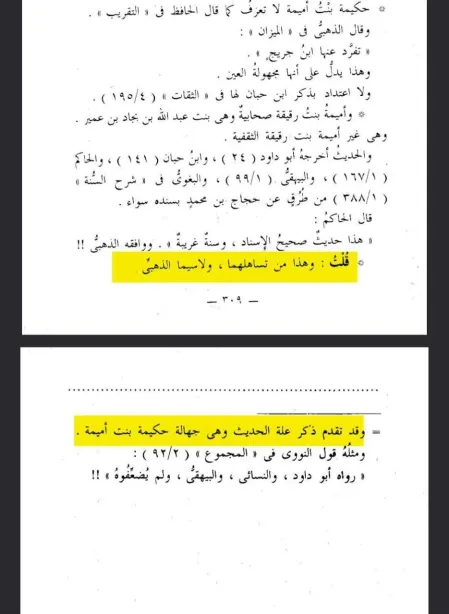
For your info: This scan continues the discussion of the weakness problem. The highlighted passage criticizes the authentication approach and says that calling the report authentic, especially with Al-Dhahabi’s agreement, is an example of leniency. It then states that the defect of the hadith has already been mentioned, namely the unknown status of Hakimah bint Umaymah. The lower highlighted line adds that Al-Nawawi mentioned the report in Al-Majmu‘ as being narrated by Abu Dawud, Al-Nasa’i, and Al-Bayhaqi without them weakening it. The scan therefore supports the argument that the central technical problem is not merely whether the report appears in books, but whether Hakimah’s reliability is established strongly enough for authentication.
Al-Wali Al-Iraqi on the Vessel
Also in Al-Awsat with a chain of transmission, Al-Wali Al-Iraqi said:
It is good that urine should not be soaked in a basin in the house, for the angels do not enter a house in which there is urine, because what is meant by soaking it is its long stay, and what is in the vessel does not stay long, rather the servants pour it out from close by, then it is returned under the bed for what happens. And it appears, as Al-Wali Al-Iraqi said, that this was before the use of the toilet in the houses, for he could not distance himself [p. 178] at night due to the difficulty. As for after it was used, he would relieve himself in it at night and during the day. And it was taken from the specification of urine that he did not defecate in it due to its coarseness in comparison to urine and its density and the dislike of its smell, and at night, that he did not urinate in it during the day, and in it the use of the bed was permitted and that it does not contradict humility due to the urgent need for it, especially in the Hijaz due to its heat, and the solution of the cup from the wood of the palm tree, and what was mentioned in the hadith does not contradict it, because what is meant by honoring it is watering it and pollinating it, as mentioned above. So if something separates from it and a vessel or something else is made, the name of the palm tree is removed from it, so he was not commanded to honor it. As for the answer that Urinating in it is not an insult, but an honor, so it is not correct because it requires that it be permissible to do so, nor is it like that. In it, it is permissible to urinate in a vessel in the house in which he is at night without dislike, as long as he did not stay in it for a long time, as was decided. As for during the day, it is contrary to what is preferable, as there is no excuse, because the night is the place for excuses, unlike the day. And a man urinates near his family out of necessity. It was said that it is permissible to clean oneself without water, because if he cleans himself with it in a cup, its spray will return to him, and cutting down palm trees is necessary. End quote. And they are both forbidden. As for the first, it is clear that it is permissible for him to clean himself with water outside the cup in another cup or in dirt or something similar. As for the second, it is not necessary that the cup be made from a cut palm tree, rather what comes to mind is that it is from a fallen tree due to something like a strong wind or weakness. In it is the permissibility of industries and the like, without which a livelihood is not complete.
The Umm Ayman Route
Narrated by Abu Dawood and Al-Nasa’i.
The hadith was also narrated by Ibn Hibban and Al-Hakim. It was narrated by Abu Dharr Al-Harawi in his Mustadrak, and Al-Hasan bin Sufyan narrated it in his Musnad, and Al-Hakim, Al-Darqutni, Al-Tabarani, and Abu Nu’aym from the hadith of Abu Malik Al-Nakha’i, on the authority of Al-Aswad bin Qais, on the authority of Nabih. Al-Anzi narrated on the authority of Umm Ayman that she said: “The Messenger of God, may God bless him and his family and grant them peace, got up at night and went to a clay pot of his at the side of the house and urinated in it. I got up at night thirsty and drank what was in it without realizing it. When the Prophet, may God bless him and his family and grant them peace, woke up in the morning, he said: ‘O Umm Ayman, get up and pour out what is in that pot.’ I said: ‘By God, I have already drunk it.’ The Messenger of God, may God bless him and his family and grant them peace, laughed until his molars were visible, then he said: ‘By God, your stomach will never ache.’”
Abu Ahmad al-Askari narrated it with the wording: “Your stomach will never complain.”
Abu Malik is weak, and Nabih did not reach Umm Ayman.
Sunan Abi Dawud and Sunan Al-Nasa’i References
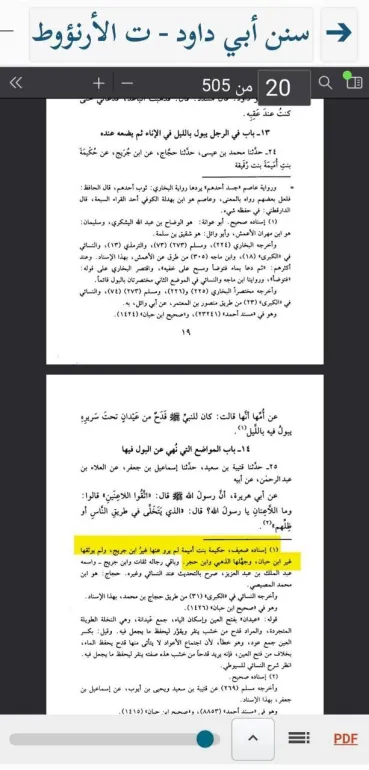
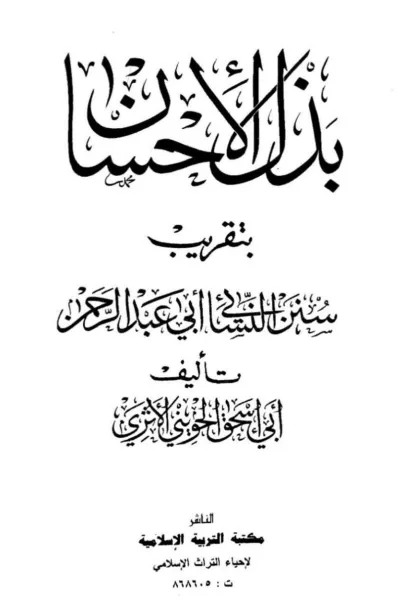
For your info: This scan is from Sunan Abi Dawud under the chapter concerning a man urinating at night into a vessel and placing it near him. The highlighted section cites the report of Hakimah bint Umaymah from her mother, mentioning that the Prophet ﷺ had a wooden cup under his bed in which he would urinate at night. The page is being used to show that the report appears in the Abu Dawud material, while the discussion around the chain remains tied to Hakimah’s status.
For your info: This scan is the book card for Sunan Al-Nasa’i from Al-Maktabah Al-Shamilah. It identifies the work as Sunan Al-Nasa’i, attributed to Abu Abd Al-Rahman Ahmad ibn Shu‘ayb Al-Nasa’i. The page also lists publication and verification details. Its purpose here is to identify the source before showing the relevant hadith-grading note from the same work.
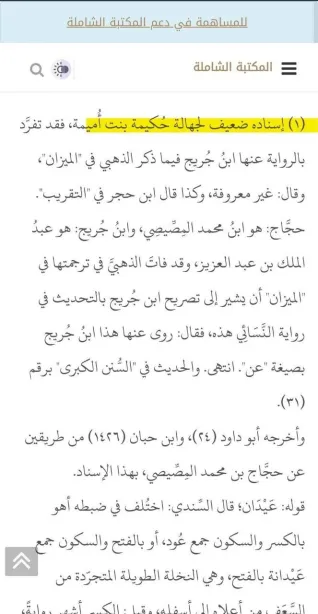
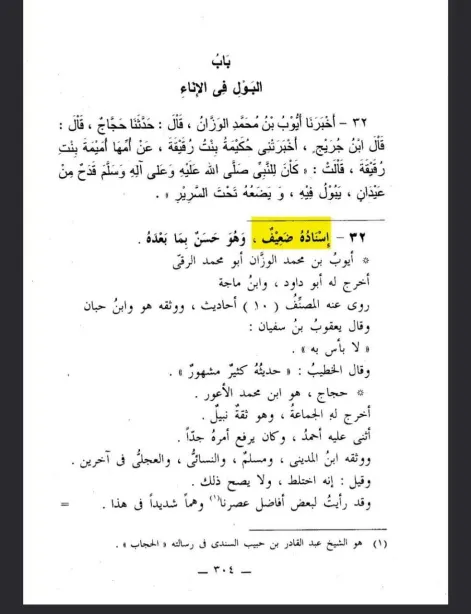
For your info: This scan shows the relevant hadith note in Sunan Al-Nasa’i. The highlighted line says: “Its chain is weak due to the unknown status of Hakimah bint Umaymah.” The text explains that only Ibn Jurayj narrated from her and mentions the criticism connected to her being unknown. It also notes that Ibn Hajar described her as unknown, while other sources such as Ibn Hibban included her among trustworthy narrators. This scan directly supports the objection that the report’s chain is not secure because Hakimah’s reliability is disputed and not firmly established.
Conclusion
- The route of Hakimah bint Umaymah, whose reliability is disputed and described by critics as unknown.
- The Umm Ayman route, which contains Abu Malik Al-Nakha‘i, who is weak, and Nabih, who did not reach Umm Ayman.
So the weak point in the argument is pretending that mere citation in sources settles the issue. It does not. The real question is the condition of the chains, especially Hakimah bint Umaymah and the disconnected/weak Umm Ayman route.