Did Jacob Wrestle With the God of the Christians or With a Human Being
Did Jacob Wrestle With the God of the Christians or With a Human Being?
Christians often evade the story of God’s struggle with Jacob according to their book in Genesis, Chapter 32, that Jacob wrestled with a man and did not wrestle with God. Some of them say that he wrestled with an angel.
I found among them those who describe those who say that Jacob wrestled with God as infidels, knowing that this is what his fathers said in the past and present, as we will explain.
Before beginning, there are two opinions among their scholars here:
- The first opinion is that the one who appeared was an angel in the form of a human being.
- The second opinion is that the one who appeared was God.
The second is correct according to their own texts and their own scholars, as will be shown.
Table of Contents
- The Text According to Genesis 32
- The Direct Wording: Jacob Saw God Face to Face
- Genesis 35 Settles the Issue
- The Testimony of Pope Shenouda
- The Testimony of Augustine / Abba Paula
- The Testimony of Nabila Toma
- The Testimony of Saint Hilary of Poitiers
- The Problem With Escaping to Jewish Interpretation
- St-Takla: The Lord’s Appearance to Jacob
- Anba Bishoy: The One Who Appeared Was Christ Before the Incarnation
- The Christian Explanation: Why the Jews Did Not Accept God Appearing in Flesh
- Why Do They Not Believe That God Appeared in the Flesh?
- Jacob Wrestles With a Man Until Dawn
- Anba Bishoy’s Explanation of Jacob Defeating God
- The Refutation of Anba Bishoy’s Excuse
- The Event in Its Objective Context
- Attached Evidence: Genesis 32 in the Good News Translation
- Final Refutation
- Conclusion
The Text According to Genesis 32
(22) Then he arose that night, and took his two wives, his two maidservants, and his eleven sons, and crossed the ford of Jabbok.
(23) And he took them and led them across the brook, and he carried away what was his.
(24) And Jacob was left alone, and a man wrestled with him until the break of day.
(25) And when he saw that he did not prevail against him, he touched the socket of his thigh, and the socket of Jacob’s thigh was dislocated as he wrestled with him.
(26) And he said, “Let me go, for the day is breaking.” But he said, “I will not let you go unless you bless me.”
(27) And he said to him, “What is your name?” And he said, “Jacob.”
(28) And he said, “Your name shall no longer be called Jacob, but Israel, for you have striven with God and with men, and have prevailed.”
(29) And Jacob asked him, saying, “Please tell me your name.” And he said, “Why do you ask my name?” And he blessed him there.
(30) And Jacob called the name of the place Peniel, saying, “For I have seen God face to face, and my life is preserved.”
(31) And the sun rose upon him as he passed Peniel, and he was stricken on his thigh.
(32) Therefore the children of Israel do not eat the sinew of the sciatica which is on the socket of the thigh to this day, because he struck the socket of Jacob’s thigh on the sinew of the sciatica.
Source: Al-Fandik translation.
Those who say that Jacob wrestled only with “a man” argue from the phrase “a man wrestled with him.”
But according to their own interpretation, this “man” was the form that their god took. The rest of the passage also says that Jacob wrestled with God, because Jacob himself says:
“For I have seen God face to face, and my life is preserved.”
The Direct Wording: Jacob Saw God Face to Face
In the Life translation, the text says:
“Because I saw God face to face.”
In the Jesuit translation, the text says:
“Because I saw God face to face.”
In the English NIV, the text says:
“So Jacob called the place Peniel, saying, ‘It is because I saw God face to face, and yet my life was spared.’”
In the JPS Tanakh 1917 translation, the text says:
“And Jacob called the name of the place Peniel: ‘for I have seen God face to face, and my life is preserved.’”
The text is very clear that it acknowledges that Jacob wrestled with God and saw Him face to face, according to the wording of the passage.
Genesis 35 Settles the Issue
“Then God said to Jacob: Arise, go up to Bethel, and dwell there, and make there an altar to God, who appeared to you when you fled from the face of your brother Esau.”
Jesuit translation.
Here the Lord commands Jacob to make an altar and remember that God appeared to him when he fled from Esau.
This refers back to the story of the struggle in Genesis 32.
The text does not say:
“Make an altar to God because a human appeared to you.”
Nor does it say:
“Make an altar to God because an angel appeared to you.”
Rather, it says that God appeared to Jacob.
“Go up to Bethel and dwell there, and build an altar to God who appeared to you when you were fleeing from your brother Esau.”
Translation of Al-Hayat.
So, O Christian, do you deny your God who says that He appeared to Jacob, and instead believe the patchwork of some of your scholars?
The Testimony of Pope Shenouda
God wanted to raise the morale of this fearful person, by showing him that he could wrestle and overcome, so He appeared to him in the form of a human, with whom Jacob could wrestle and overcome.
Just like a father caressing his child, showing this child that he can defeat him.
And it seemed that Jacob was strong in wrestling with him, and the owner of the vision asked him to let him go, and Jacob answered:
“I will not let you go until you bless me.”
So he blessed him. But he struck him on the hollow of his thigh, so he fainted.
As if God wanted him to rejoice in his victory, but his victory would not be a cause of pride for him.
He allowed him to win, and changed his name to Israel, saying to him:
“Because you have struggled with God and with men, and have prevailed” (Gen. 32:22–28).
How many times did God appear to this weak person to strengthen him and save him from his fear?
Pope Shenouda does not say that Jacob merely wrestled an ordinary human being.
He says God appeared to Jacob in the form of a human being and allowed Jacob to wrestle with Him.
Therefore, the Christian who runs away from the wording of Genesis 32 is not only running away from the biblical text, but also from the explanation of his own authorities.
The Testimony of Augustine / Abba Paula
Jacob was in great fear of meeting Esau, and Jacob was alone at night, seeking refuge in God in prayer, so God appeared to him in the form of a human being, wrestling with Him and allowing Jacob to win over Him, in order to make him brave and drive out fear from within him, and in order to teach him that the superiority of strength is God’s, so He dislocated Jacob’s thigh socket.
And God said to Jacob:
“Let me go, for the dawn has broken.”
The dawn has come, that is, the time for you, Jacob, to complete your journey. You must return to your caravan to continue your journey to your homeland.
The God of light, who made light to illuminate humanity, can never fear the light, but the point is that Jacob and his family complete their journey, not so that they remain afraid of meeting their brothers.
Again, the explanation is not:
“Jacob merely fought a human.”
Rather, it says:
“God appeared to him in the form of a human being.”
This is the exact point Christians try to escape from.
The Testimony of Nabila Toma
“When God said to Jacob, ‘Let me go, for the dawn has broken,’ this does not mean that he cannot set out, but rather he intended by this to declare Jacob’s faith, steadfastness, and clinging to obtain the blessing, and he succeeded in this.”
Source: Previous reference.
Even the phrase “Let me go” is interpreted by Christian writers as God speaking to Jacob, not merely a random human being.
So the escape route collapses again.
The Testimony of Saint Hilary of Poitiers
Saint Hilary, Bishop of Poitiers, was one of the fourth-century Christian fathers. He is cited here because his testimony is direct, early, and explicitly Trinitarian.
Be with me now with your believing spirit, O father of fathers, James, the saint and blessed, to wrestle with the poisonous hissing of the serpent of unbelief.
Win once again in your wrestling with the man and ask for his blessing once again insistently, because you are strong over him.
Why do you plead for what you can ask from your weaker opponent?
Your strong arm has overcome him whose blessing you sought.
Your physical victory varies widely with the humility of your soul, and your works contrast with your thoughts.
He whom you considered weak in your strong grasp of him is a man, but this man is a true God in your eyes, and not a God in name only, but in nature.
It is not the blessing of an adopted God that you have asked for, but the blessing of the true God.
You have struggled with a man, but you have seen God face to face.
What you have seen with the physical eye is far different from what you have seen with the eye of faith.
You thought him a weak man, but your soul was saved because it saw God in him.
When you struggled, you were Jacob, now you are Israel.
Through faith in the blessing you sought after the flesh, for the man is weaker than you because of his suffering in the flesh, but you can perceive God in this weak body according to the sign of his blessing in the spirit.
The testimony of the eye does not cloud your faith.
His weakness does not lead you astray into neglecting his blessing.
Although he is a man, his humanity is no hindrance to his being God, and his identity is no hindrance to his being God.
Really, for He is God, He must certainly be real.
Source: On the Trinity by Saint Hilary / Edition of the Monastery of Saint Anthony / p. 374.
Saint Hilary confirms that the one who wrestled with Jacob was not merely a human being, but God.
His words are clear. The index of the book itself arranges this point under the title:
“Jacob’s Struggle Was Not With a Human Being.”
So do we find a Christian who would reject this saint, Pope Shenouda, and others, while pretending to defend the explicit texts of his own book?
I am surprised that the Christian rejects the incarnation of his God and His struggle with Jacob, and twists the passage, while at the same time accepting the incarnation of his God, His birth from the womb of a woman, His beating, His torture, and His crucifixion.
By what logic?
How do you denounce Jacob’s struggle with God and evade it, and at the same time believe that your God was beaten, crucified, naked, and born before that from the womb of a woman?
What is wrong with you? How do you judge?
The Problem With Escaping to Jewish Interpretation
The Jewish tradition and interpretations — which do not recognize the idea of incarnation, nor the crucified one as Messiah, Redeemer, and Savior — are not binding on the Muslim side.
If the missionary blindly trusts every word contained in Jewish writings, then he must accept all their statements consistently, not selectively use them only when they help him escape the Christian reading.
The missionary has no need to cling to Jewish thought here. The writings of the priests and pastors on the famous Christian site St-Takla came clear, explicit, and do not allow for an iota of doubt regarding the identity of the one whom the Prophet Jacob defeated during the fight.
St-Takla: The Lord’s Appearance to Jacob
Years with People’s Emails!
Questions about the Bible
God’s Appearances in the Old Testament
The Lord’s Appearance to Jacob:
He appeared in human form at Peniel:
“And a man wrestled with him until the breaking of the day” (Genesis 32:24).
“And Jacob called the name of the place Peniel, saying, ‘For I have seen God face to face, and my life is preserved’” (Genesis 32:30).
Jacob later spoke to his son Joseph about this matter and said:
“God Almighty appeared to me in Luz in the land of Canaan, and blessed me” (Genesis 48:3).
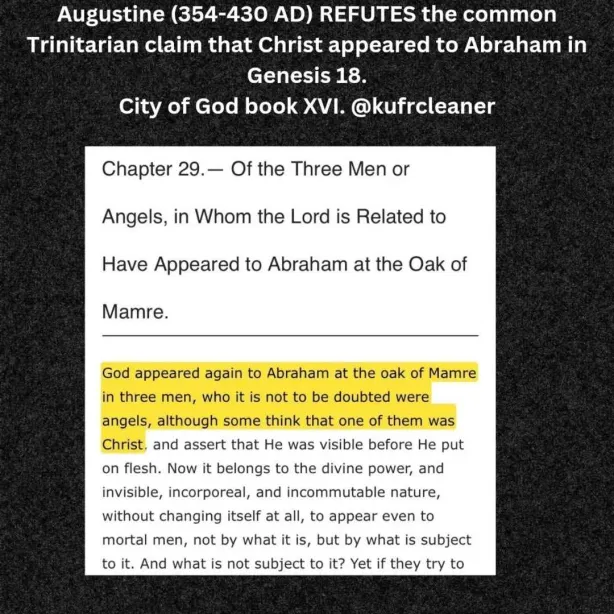
This scan is not directly about Jacob. It shows Augustine’s City of God, Book XVI, Chapter 29, where Augustine discusses Genesis 18 and the three men/angels who appeared to Abraham at the oak of Mamre.
The highlighted section says that God appeared again to Abraham at the oak of Mamre in three men, and that these three men are “not to be doubted” to be angels, although some thought one of them was Christ.
The usefulness of this scan is limited and must not be overstated. It does not prove the Jacob case directly. Rather, it shows that Christian patristic interpretation can distinguish between God appearing through forms/agents and simplistic claims that every human-form appearance must automatically be Christ. For Jacob specifically, the stronger evidence is Genesis 32, Genesis 35, Hilary, Pope Shenouda, St-Takla, and Anba Bishoy.
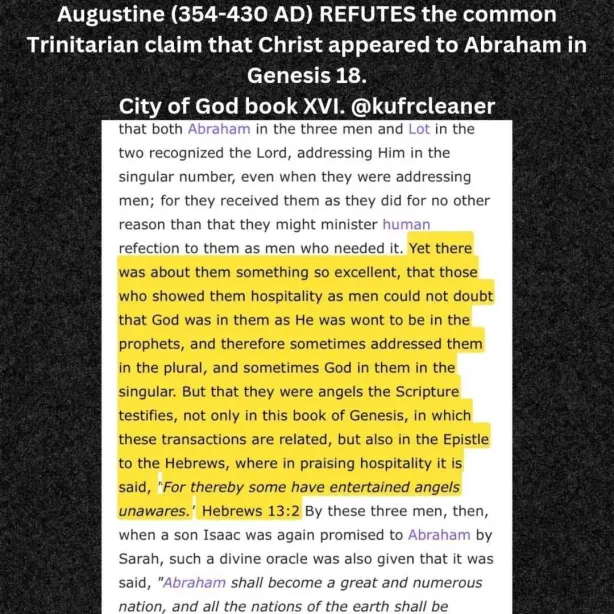
This second scan continues Augustine’s discussion of Genesis 18. The highlighted section explains that Abraham and Lot addressed the visitors in singular and plural language because there was something excellent about them: God was in them as He was accustomed to be in the prophets. Augustine then says Scripture testifies that they were angels, connecting this with Hebrews 13:2 and the idea that some entertained angels unaware.
Again, this scan should be used carefully. It is useful against sloppy Trinitarian claims about every Old Testament appearance being Christ, but it is not the main proof for Jacob. The Jacob argument rests on the direct Christian admissions that Jacob’s opponent was God / Christ in human form.
St-Takla does not merely say:
“Jacob wrestled a human.”
It places the passage under:
“God’s Appearances in the Old Testament.”
Then it says:
“The Lord’s Appearance to Jacob.”
This is fatal for the Christian who tries to escape by saying Jacob only wrestled a human being.
Anba Bishoy: The One Who Appeared Was Christ Before the Incarnation
Chapter One: The Appearances of the Lord Christ in the Old Testament
Whenever the Lord appeared in the Old Testament, they were appearances of the Only-Begotten Son prior to His incarnation in the fullness of time from the Virgin Mary.
The One who appeared to our father Abraham with the two angels at the Oaks of Mamre was the Lord Christ, but that was before the incarnation.
Likewise, the One who appeared to our father Jacob at the ford of the Jabbok in the form of a man and wrestled with him until dawn, then blessed him and said to him, “Why do you ask after My name?” (Gen. 32:29), was also the Lord Christ before the incarnation.
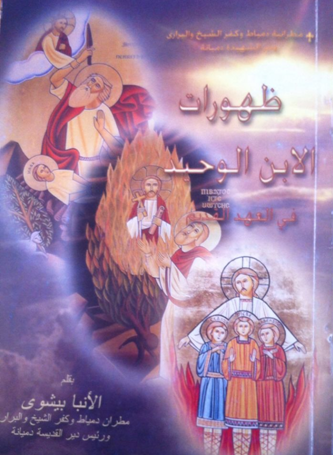
This image is attached in the blog code beside the discussion of Anba Bishoy’s book on the appearances of the Only-Begotten Son in the Old Testament.
The surrounding blog text uses this image to support the claim that Anba Bishoy interprets Old Testament divine appearances as appearances of the Son before the incarnation. The key point is that the one who appeared to Jacob at the ford of Jabbok in the form of a man and wrestled with him until dawn is identified by Anba Bishoy as the Lord Christ before the incarnation.
This directly defeats the escape claim that Jacob merely wrestled a normal human being.
Here the adventure of the church boy has ended and been buried.
Anba Bishoy plainly says the one who appeared to Jacob at Jabbok was the Lord Christ before the incarnation.
The Christian Explanation: Why the Jews Did Not Accept God Appearing in Flesh
Why did the Jews not acknowledge until this moment that the Son of God the Word appeared in the Old Testament?
The Apostle Paul explained this point by saying that there was a veil over the eyes of the Jews.
He borrowed the incident of the Prophet Moses that was mentioned in the Book of Exodus when Moses came down from the mountain after seeing God and speaking with Him, so he wrote:
“And Aaron and all the children of Israel looked at Moses, and behold, the skin of his face shone, and they were afraid to come near him. And it came to pass, when Moses had finished speaking with them, that he put a veil over his face. And when Moses went in before the Lord to speak with Him, he took off the veil, until he came out; and then he went out and spoke to the children of Israel what he commanded. And when the children of Israel saw Moses’ face that his skin shone, Moses put the veil back on his face until he went in to speak with Him” (Exodus 34:30–35).
As long as Moses was speaking with God, he would remove the veil from his face, and when he returned to speak to the children of Israel, he would put the veil back on.
The Apostle Paul borrowed this issue and said that to this day the children of Israel still have a veil on their faces, so they do not see the glory that the Lord declared in the books of the Holy Scriptures about the Lord Christ, who is the image and glory of God.
Christian writers themselves present the Old Testament as full of appearances of God / the Son in human form.
Therefore, when a Christian tries to say, “Jacob only wrestled a man,” he is not being faithful to his own theological tradition. He is merely escaping the scandal of the passage.
Why Do They Not Believe That God Appeared in the Flesh?
The Jews demanded the death penalty for Jesus Christ because he said that he was the Son of God.
In the Gospel of John it says:
“Pilate said to them, ‘You take him and crucify him, for I find no fault in him.’ The Jews answered him, ‘We have a law, and according to our law he ought to die, because he made himself the Son of God’” (John 19:7).
The Jews had also previously answered him, saying:
“For a good work we do not stone you, but for blasphemy, because you, being a man, make yourself God” (John 10:33).
Just because he appeared in human form, they considered it blasphemous for him to say that he was the Son of God.
When he healed the paralytic at the Pool of Bethesda on a Sabbath, St. John the Evangelist wrote:
“For this reason the Jews sought all the more to kill him, because he not only broke the Sabbath but also said that God was his own Father, making himself equal with God” (John 5:18).
The idea that God has a son, and that this son is a human being, is an idea that is completely rejected by the Jews.
Let us leave the New Testament because they do not believe in it, and let us ask them from the Old Testament:
Do you not believe that God has a son and that this son will be born of a virgin as it is written in the Book of Isaiah:
“Behold, a virgin shall conceive and bear a son, and shall call his name Immanuel” (Isaiah 7:14)?
Do you not believe that this son who will be born incarnate of the virgin is the Word of God and his only begotten Son, born of him spiritually before all ages?
They considered that the worst accusation that could be directed at a person is to say about himself that he is the Son of God, or that he is God manifest in the flesh.
The Christian source argues that the Old Testament is full of appearances of God in human form.
So when the same Christian later comes to Genesis 32 and says, “No, no, Jacob only wrestled a human,” he contradicts the very theological pattern used by his own church.
Jacob Wrestles With a Man Until Dawn
This appearance is very important and needs to be paused over.
The Bible says about Jacob, the father of the fathers:
“And a man wrestled with him until the break of dawn” (Genesis 32:24).
Jacob was returning after twenty years of fleeing from his brother Esau, who had taken his birthright and blessing from him.
Esau wanted to kill him, but his parents told him to go to his uncle Laban and take a wife from his daughters. Jacob did so and stayed there twenty years.
When he returned, he was afraid of his brother Esau, so he was praying while watching (see Gen. 32:9–12).
Then a man appeared to him, began to wrestle with him, and continued to wrestle with him all night.
“And when he saw that he did not prevail against him, he touched the socket of his thigh; and Jacob’s hip socket was dislocated as he wrestled with him. And he said, Let me go, for the day is breaking. But he said, I will not let you go, unless you bless me. And he said to him, What is your name? And he said, Jacob. And he said, Your name shall no longer be called Jacob, but Israel, for you have striven with God and with men, and have prevailed” (Gen. 32:25–28).
“And Jacob asked, and said, Tell me thy name. And he said unto him, Why askest thou my name? And he blessed him there. And Jacob called the name of the place Peniel, saying, For I have seen God (Elohim) face to face, and my life is preserved. And the sun rose upon him as he passed over Peniel, and he bowed his thigh” (Gen. 32:29–31).
The events that concern us are that Jacob “wrestled with a man,” and at the end he said:
“I have seen God face to face.”
The Christian explanation itself connects this with God preparing for His incarnation and appearance in the form of a human being in the New Testament.
Anba Bishoy’s Explanation of Jacob Defeating God
How did God allow Jacob to defeat Him in wrestling?
Notice that Jacob did not defeat Him to the end. In the end, He dislocated his thigh bone and could have ended his life if He wanted to.
This situation, of course, has many meanings. Let us take the simple meaning first:
If you notice a father playing with his children or training them in wrestling, for example, at first he is not too harsh, and does not let his young son be defeated, but rather gives him a chance to win. We have all seen that between a father and his children.
In addition, lest we think that Jacob is stronger than God, God showed that He is stronger.
But on the one hand, He gave him the impression that he was victorious, and on the other hand, He made him aware that this victory does not mean that He is stronger than God.
God wanted to encourage him because he was afraid of his brother Esau, so He wanted to give him the impression that He is able and said to him:
“I have struggled with God and with men, and have overcome.”
Do not be afraid, for you are able. But do not think that this is by your own strength.
If you do not rely on My help, you will perish.
Therefore, He stripped him of his thigh so that he would know that the face of God goes before him, as He said to Moses:
“My face goes before you, and I will give you rest.”
This means that no man will stand before you to harm you, and My strength is made perfect in weakness.
The important thing is that your heart is strong from within.
So the first victory was so that his heart would be strengthened, while the second blow was so that he would not rely on his own strength.
The deeper theological aspect of this subject is that even though Jacob was loved by God as a person, and he was the father of the fathers, and a great saint, we must not forget that from his descendants come the people of Israel who will crucify the Lord Christ.
This story contains the spirit of prophecy and a symbol.
He will surrender himself to them and let them do whatever they want to him, and thus it is as if Israel has triumphed over the incarnate Christ, God.
Then after that, He strikes them a blow by His resurrection from the dead, stripping their thigh.
He does not deny the scandal.
He tries to explain it.
But the explanation itself confirms the point:
According to this Christian reading, Jacob wrestled God / Christ, and God allowed Jacob to prevail in a limited way.
The Refutation of Anba Bishoy’s Excuse
In a desperate attempt to get out of the predicament and to cover up the scandal of the alleged victory of the Prophet Jacob over the Lord, Anba Bishoy says:
“If you notice a father playing with his children or training them in wrestling, for example, at first he is not too harsh, and does not let his young son be defeated, but rather gives him a chance to win.”
An excuse worse than a slip.
- A father would not break the socket of one of his son’s thigh.
The Lord, as they claim, broke the socket of the Prophet Jacob’s thigh.
-
This is if we assume, for the sake of argument, that the father would allow his sons to defeat him during their wrestling with him.
-
The Lord, as they claim — may He be exalted above what they describe — humbled himself, hoping that the Prophet Jacob would release him after the latter had bound him tightly.
Were the two wrestlers joking with each other?
Absolutely not.
The Event in Its Objective Context
(25) And when he saw that he did not prevail against him, he struck the socket of his thigh; and Jacob’s thigh was dislocated as he wrestled with him.
(26) And he said:
“Let me go, for the day has broken.”
But he said:
“I will not let you go unless you bless me.”
(27) Then he said to him:
“What is your name?”
And he said:
“Jacob.”
(28) And he said:
“Your name shall no longer be called Jacob, but Israel, for you have struggled with God and with men, and have prevailed.”
(29) Then Jacob asked him:
“Tell me your name.”
He said:
“Why do you ask my name?”
And he blessed him there.
This was not a vision or a dream.
It was a real event, and the proof of that is the injury to the Prophet Jacob in his thigh.
It was the Lord in His appearance before the Prophet Jacob, according to their own reading.
Attached Evidence: Genesis 32 in the Good News Translation
27 — And the man said:
“What is your name?”
And he said:
“My name is Jacob.”
28 — And he said:
“Your name shall no longer be called Jacob, but Israel, for you have contended with God and with men, and have prevailed.”
This attached image is used in the blog code as supporting scan evidence for Genesis 32. The surrounding text says it is from Genesis 32 in the Good News Translation. The highlighted point is that Jacob’s new name is explained by the phrase: “for you have contended with God and with men, and have prevailed.”
The scan is being used to show that even in a modern translation, the passage does not merely say that Jacob wrestled an ordinary man. It says Jacob contended with God and prevailed.
This second attached image belongs to the same evidence set from the blog code. It is placed after the discussion of Genesis 32 and the Good News Translation. Its purpose is to reinforce the wording of the passage that connects Jacob’s wrestling event with striving against God and men.
The relevant point is not merely that a “man” appeared in the story, but that the passage itself interprets the encounter as a struggle involving God.
This third attached image is part of the final scan set in the blog code. It is attached after the argument that the incident was real, not merely a dream or vision, because Jacob physically suffered the injury in his thigh.
The scan supports the article’s final point: the event had physical consequences, so the Christian explanation cannot reduce it to symbolic language only. According to the text and the cited Christian sources, Jacob wrestled with the one they identify as God / Christ in human form.
Final Refutation
-
Genesis 32 says Jacob wrestled with a “man.”
-
The same passage says Jacob was renamed Israel because he struggled “with God and with men” and prevailed.
-
Jacob named the place Peniel because he said:
“I have seen God face to face.”
-
Genesis 35:1 says God appeared to Jacob when he fled from Esau.
-
Pope Shenouda says God appeared in human form and allowed Jacob to wrestle and overcome.
-
The source Answers to the Questions of the Book of Genesis says God appeared to Jacob in the form of a human being and wrestled with him.
-
Nabila Toma explains the phrase “Let me go” as God’s speech to Jacob.
-
Saint Hilary of Poitiers says explicitly that the man was true God, not merely God by name.
-
St-Takla places the event under “God’s Appearances in the Old Testament” and calls it “The Lord’s Appearance to Jacob.”
-
Anba Bishoy says the one who appeared to Jacob at the ford of Jabbok was the Lord Christ before the incarnation.
-
Therefore, the Christian who says Jacob did not wrestle God is contradicting the plain wording of the passage and the testimony of major Christian authorities.
Conclusion
According to Genesis 32, Jacob wrestled with a man.
According to the same passage, Jacob struggled with God and saw God face to face.
According to Genesis 35, God appeared to Jacob when he fled from Esau.
According to Pope Shenouda, Hilary of Poitiers, St-Takla, and Anba Bishoy, this was God / Christ appearing in human form.
Therefore, the escape claim that Jacob only wrestled a normal human being collapses.
Their own book says it.
Their own fathers say it.
Their own priests and bishops say it.
So why the evasion?
If the Christian accepts that his God was born from the womb of a woman, beaten, stripped, crucified, and killed, then what exactly is his problem with admitting that his God wrestled Jacob and was overcome according to the same theological system?
This is not a Muslim invention.
This is their own inherited doctrine exposing itself.