

Did Joseph's Brothers Have Camels? What 'Ba'eer' Means in Surah Yusuf
The answer lies in classical Arabic lexicography: the word ba’eer was used in several ancient Arab dialects to refer to a donkey rather than a camel. This was documented by the earliest Quranic commentators, recorded in the major lexicons, and is directly corroborated by the historical reality that Canaan was a land of donkeys, not camels. The Quran’s phrasing is both linguistically precise and historically accurate.
The Verse in Question
And when they opened their baggage, they found their merchandise returned to them. They said, “O our father, what more could we desire? This is our merchandise returned to us. And we will obtain supplies for our family and protect our brother and obtain an additional camel’s load.”
The phrase {كَيْلَ بَعِيرٍ} — rendered in most translations as “a camel’s load” — is the crux of the objection. The resolution depends entirely on establishing what ba’eer meant to the Arabs whose dialects the Quran addresses and whom the early commentators documented.
Mujahid ibn Jabr: The First Commentator to Record the Dialectal Meaning
The scholar who recorded the dialectal definition of ba’eer as donkey is Mujahid ibn Jabr al-Makki — not to be confused with the later transmitter Ibn Mujahid, and not a non-Arab as some critics have incorrectly claimed. He is Mujahid ibn Jabr al-Makki: a student of Ibn Umar ibn al-Khattab, a close companion of Ibn Abbas, and one whose narrations are transmitted by Ibn Jurayj and others. This identification matters because some who dispute the interpretation have falsely attributed it to an anonymous non-Arab to dismiss it.
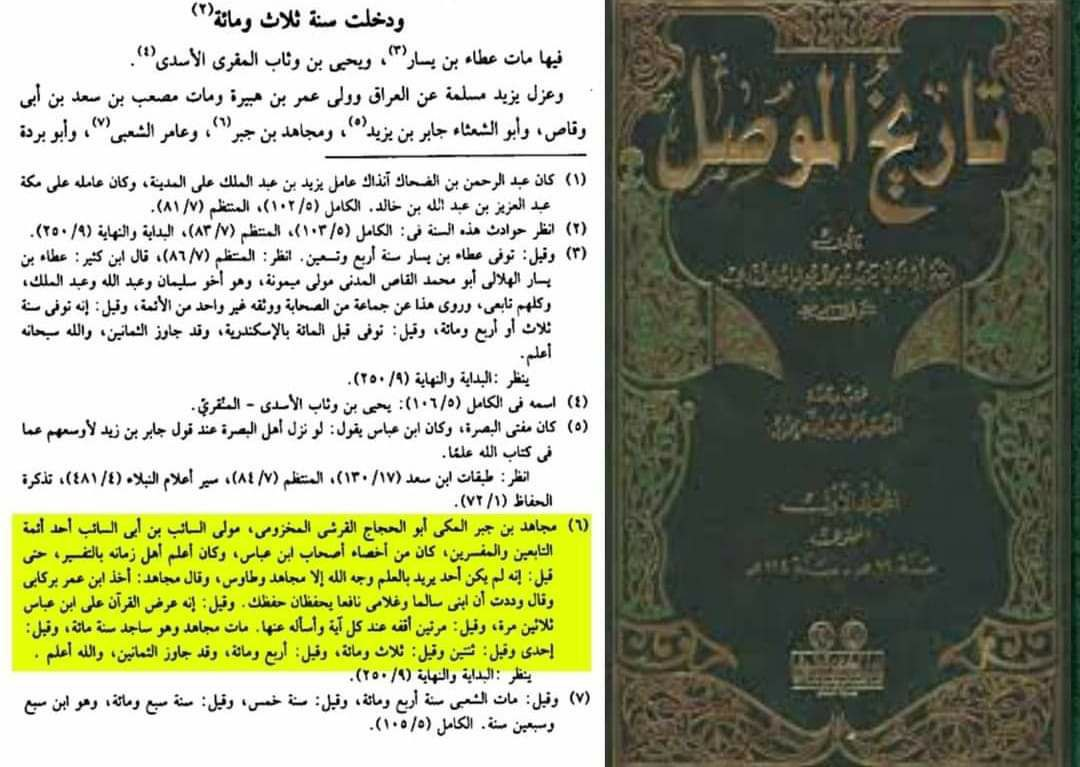
The following scan shows Mujahid ibn Jabr’s biographical entry in Tarikh al-Mawsil, establishing his scholarly authority.
-
Status and Lineage: He was Abu al-Hajjaj al-Qurashi al-Makhzumi (by loyalty), a premier figure among the Tabi’un (the generation following the Companions) and a master theologian and Quranic commentator (Mufassir).
-
Scholarly Authority: He was one of the closest and most specialized disciples of Ibn Abbas. His contemporaries held his knowledge in supreme regard, with statements noting that no one remained on earth more knowledgeable about Quranic exegesis (Tafsir) than him, alongside Tawus.
-
Rigorous Methodology: It is documented that Mujahid thoroughly reviewed and cross-examined the entire text of the Quran directly with Ibn Abbas thirty times. Other reports state he presented the Quran to him three times, stopping meticulously at every single verse to ask exactly when, where, and why it was revealed.
-
Demise: He passed away while in a state of prostration (Sajdah) in Mecca. Historical accounts differ slightly on the exact year of his death, spanning between 101 AH, 102 AH, 103 AH, or 104 AH, having lived past the age of eighty.
Tafsir al-Tabari: Ba’eer as Donkey in Ancient Arab Dialects
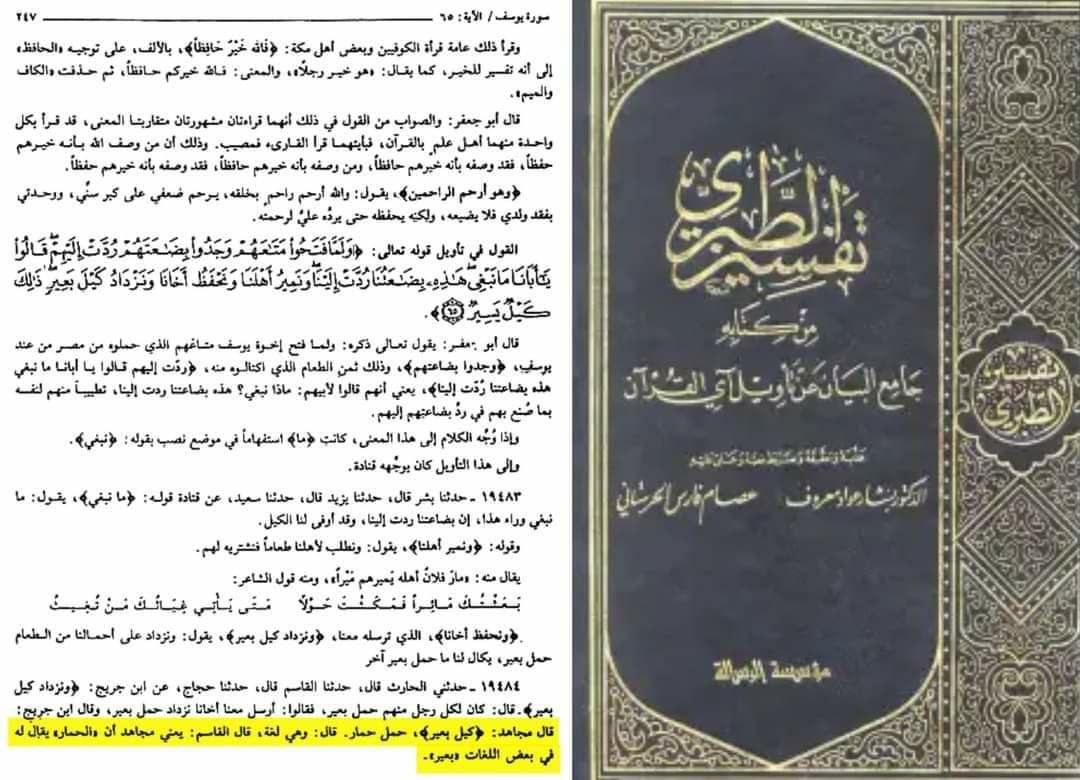
The following scan shows the passage from Ibn Jarir al-Tabari‘s Jami’ al-Bayan where both Ibn Jurayj and Mujahid’s definitions of {كَيْلُ بَعِيرٍ} are recorded, along with al-Qasim’s corroboration.
-
Standard Definition (Ibn Jurayj): According to the narration of Ibn Jurayj, each individual man among them received a specific allocation of food equivalent to exactly what a single camel could carry (حَمْلُ بَعِيرٍ).
-
Dialectal Substitution (Mujahid): The scholar Mujahid clarifies a distinct linguistic variant utilized by certain ancient Arab tribes. He notes that in their local dialect, the word الْبَعِير (al-ba’eer) was actually used to refer to a donkey (الْحِمَار) rather than a camel.
-
Scholarly Consensus on Dialect: Al-Qasim corroborates this view, confirming that substituting the word for a donkey matches the established spoken vernacular found in several specific ancient Arabic dialects.
This definition was not a marginal opinion isolated to al-Tabari. Badr al-Din Ibn Ahmad, the author of the commentary on Sahih al-Bukhari known as Al-Qari, also mentions the interpretation explicitly: “In the language of some Arabs, a donkey is called a camel.” He then adds the geographical corroboration: “This is supported by the fact that the brothers of Joseph were originally from Canaan, and there were no camels in Canaan.” The fact that this was recorded as common knowledge in his era demonstrates how widely accepted the dialectal definition was among the classical scholars.
‘Umdat al-Qari: Historical Geography Confirms the Dialectal Reading
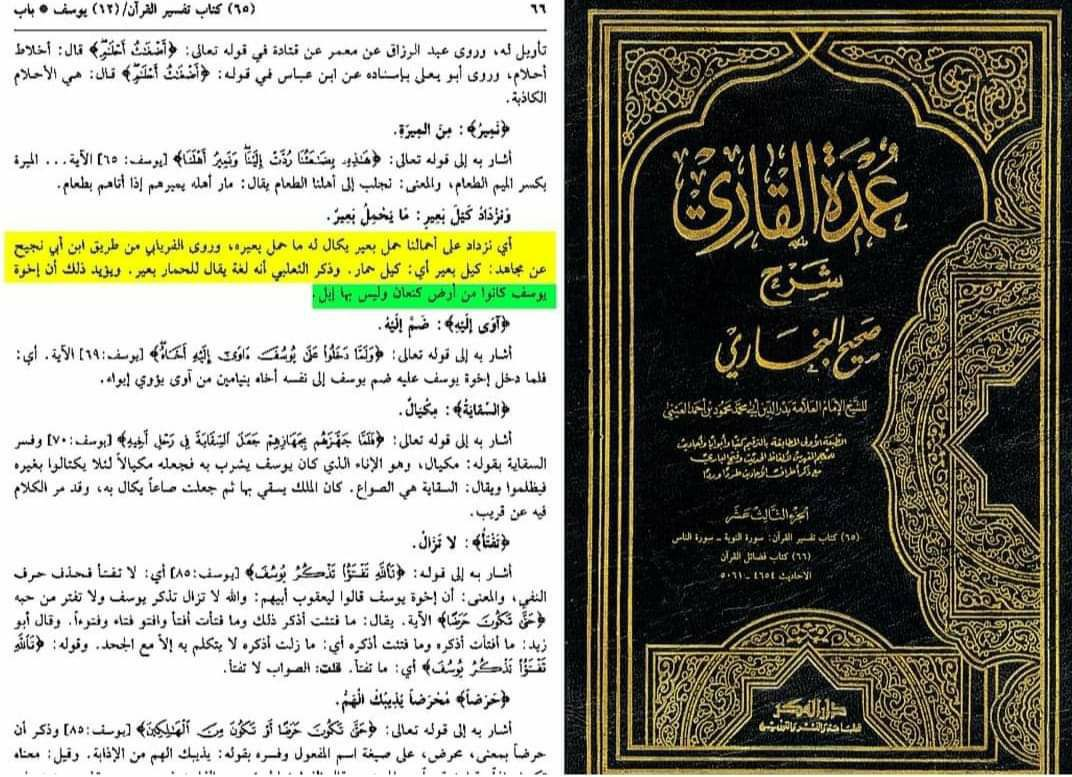
The following scan shows the passage from ‘Umdat al-Qari, Al-‘Ayni‘s commentary on Sahih al-Bukhari, which directly links the dialectal meaning to the historical reality of Canaan.
-
Standard Meaning: It implies adding an extra measure of grain or food provisions equivalent to what a single camel can carry (ما يحمل بعير).
-
The Donkey Dialect Variant: The text references an alternative interpretation from Mujahid (transmitted via Ibn Abi Najih) stating that the phrase contextually translates to “a donkey’s load” (كيل حمار). Al-Tha’labi supports this linguistic perspective, validating that in certain ancient Arabic tribal dialects, the word Al-Ba’eer (البعير) was physically used to denote a donkey.
-
Contextual Supporting Evidence: This regional dialectal reading is textually reinforced by historical geography: it is well-recorded that Prophet Yusuf’s brothers arrived from Canaan, a land where donkeys were standard pack animals and camels were not traditionally owned or utilized by them (وليس بها إبل).
Lisan al-Arab and the Hebrew Parallel
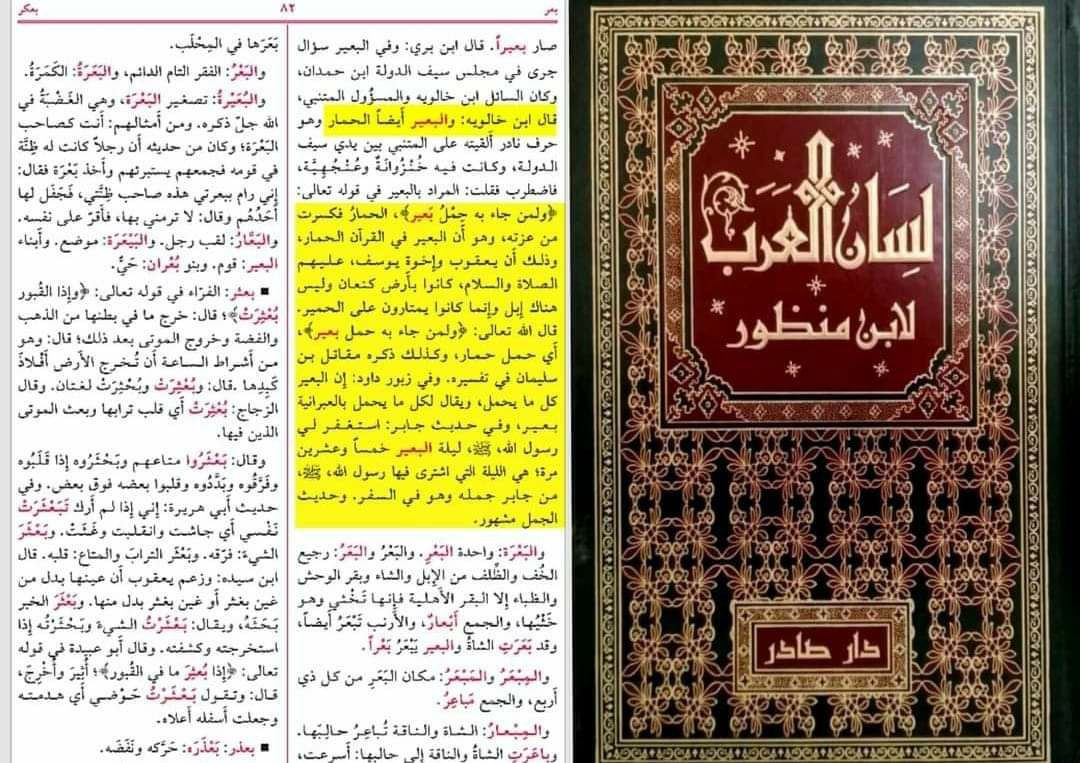
Ibn Manzur in Lisan al-Arab also records that the word ba’ir (camel) refers to a donkey, and that in the Quranic usage it refers to a donkey. The basis of this is well-established: there were no camels in the land of Canaan during the time of Joseph, and ^^in the Hebrew language, anything that carries a load is called a ba’ir^^ — a cognate term covering any beast of burden regardless of species.
Al-Tha’labi: Yemeni and Asadi Tribal Dialects
The dialectal usage of ba’eer for donkey is not confined to one tribe or source. Al-Tha’labi provides independent lexicographical evidence from multiple regional dialects. The following scan shows his analysis.
-
The Core Linguistic Claim: Al-Tha’labi records that according to the dialect of the Yemeni region (في لغة يمانية) as well as the tribe of Asad (وفي لغة بلعنبر أو أسد), the word Al-Ba’eer explicitly refers to a donkey (الْحِمَار).
-
Poetic Evidentiary Proof (الشاهد الشعري): To substantiate this regional usage, the text cites a classical poetic verse:
“Yaridu al-mā’a bi-bā’eerihi… inna-mā al-bā’eeru lahu himār”
(“He goes down to the water with his ‘ba’eer’… lo and behold, his ‘ba’eer’ is actually a donkey”).
-
Contextual Application to Surah Yusuf: This poetic and tribal evidence directly supports the interpretation that the additional load brought back by the brothers was measured by a donkey’s capacity, fitting the agricultural reality of their homeland in Canaan.
Fath al-Qadir: The Broader Term ‘Aeer and the Full Lexical Picture
Al-Shawkani in Fath al-Qadir addresses the related word الْعِير (al-‘aeer) — the caravan — which appears in the same narrative. He notes: “Everything carried on camels, donkeys, and mules is called a caravan, and it is also said to be a caravan of donkeys.” This broader semantic range of the caravan terminology in the same story further confirms that donkeys were the standard pack animals in the brothers’ context, not camels. The following scan shows his full analysis.
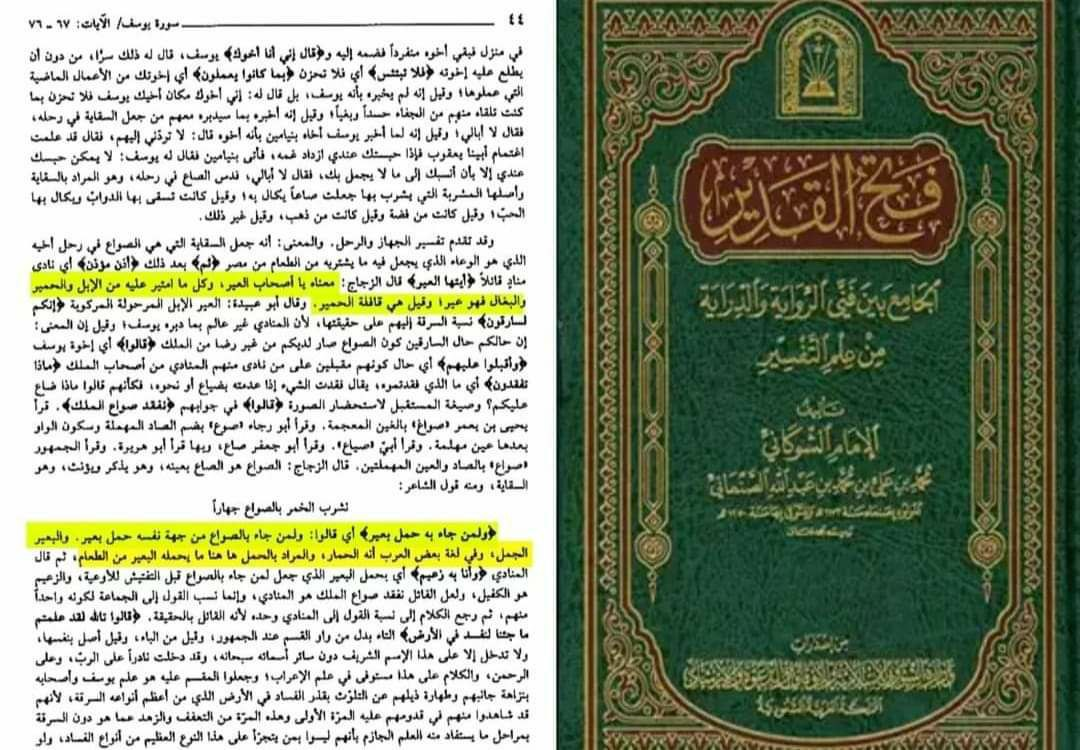
- Definition of Al-‘Aeer (الْعِير) [Top Highlight]: Following the proclamation {ثُمَّ أَذَّنَ مُؤَذِّنٌ أَيَّتُهَا الْعِيرُ} (“Then an announcer called out: O caravan!”), the text defines Al-‘Aeer through classical authorities like Al-Zujaj.
- It refers to any caravan transporting food provisions from Egypt, specifically encompassing the beasts of burden carrying the load — whether camels, donkeys, or mules.
- Analysis of Hamlu Ba’eer (حِمْلُ بَعِيرٍ) [Bottom Highlight]:
- Regarding the reward {وَلِمَنْ جَاءَ بِهِ حِمْلُ بَعِيرٍ} (“and for him who brings it back is a camel’s/beast’s load”), the announcer clarifies that whoever returns the missing measuring bowl will receive an extra measure of food equal to what one pack animal can carry.
- The text reiterates the established dialectal linguistic variant: in the vernacular of certain Arab tribes, الْبَعِير (al-ba’eer) specifically means a donkey (الْحِمَار), though the standard widespread linguistic meaning refers to a camel.
Conclusion
The objection rests on a false assumption: that ba’eer in the Quran can only mean camel. Classical Arabic lexicography, documented across al-Tabari, ‘Umdat al-Qari, Lisan al-Arab, al-Tha’labi, and Fath al-Qadir, establishes that ba’eer was used in multiple ancient Arab dialects to mean a donkey. The scholars did not adopt this dialectal reading arbitrarily — they adopted it because the historical and geographical context of the story demands it. Joseph’s brothers came from Canaan, and Canaan was a land of donkeys. The Quran’s phrasing is precise, its historical awareness is accurate, and the objection dissolves entirely under classical Arabic scholarship.