

Christianity

Did Joshua Destroy the Walls of Jericho? The Archaeological Evidence Against the Book of Joshua

9 min read 1969 words
How to Navigate This Note The Book of Joshua — Scholarly Assessment of Its Historical Value — what Anne Killebrew and Jerome Creach say about the historical reliability of the Book of Joshua as a whole The Claim in Joshua Chapter 6 — The Walls of Jericho — what the Bible says happened at Jericho and the chronological framework placing it in the fifteenth century BCE The Archaeological Evidence — Jericho Was Destroyed Centuries Before Joshua — Kathleen Kenyon’s excavations confirming the city was destroyed in the sixteenth century BCE Scholar Admissions — Killebrew, Finkelstein, Greenberg, Youssef, and Stebbing — direct quotations and evidence from multiple independent scholars confirming the historical impossibility of the Joshua narrative The Christian Apologetic Response — Garstang and Bryant Wood — the two scholars Christians rely on to defend the Biblical account, and why both have been scientifically refuted John Garstang — Criticized for Reading the Bible Into the Evidence — why Garstang’s interpretation was rejected by the scholarly community Bryant Wood — Refuted by High-Precision Radiocarbon Analysis in 1995 — how Bruins and van der Plicht’s radiocarbon dating of 18 samples confirmed Kenyon’s sixteenth-century BCE date, not Wood’s fifteenth century

The Book of Joshua claims that Joshua destroyed the walls of Jericho in the fifteenth century BCE. Archaeological excavation has confirmed that the city of Jericho was completely destroyed in the sixteenth century BCE — centuries before Joshua arrived — and was not inhabited or walled at the time the Bible describes. This is not a matter of interpretation. It is a matter of physical evidence.

We must begin by emphasizing that scholars today confirm that the Book of Joshua is a historically inaccurate book written by different and multiple people over different periods of time. The following examination presents the fatal historical error in Joshua chapter 6, drawing on archaeological research, radiocarbon analysis, and the admissions of multiple independent scholars from different national and disciplinary traditions.


The Book of Joshua — Scholarly Assessment of Its Historical Value

Anne E. Killebrew is an Associate Professor at Pennsylvania State University who has been involved in numerous archaeological projects in Israel, Egypt, and Turkey over more than thirty-five years. She is currently the co-director of the Tel Akko Total Archaeology Project in Israel. Her research focuses on the Bronze and Iron Ages of the Eastern Mediterranean, ancient ceramic studies, Roman and Byzantine Palestine, modern technologies and 3D documentation in archaeology, and heritage studies.

The following image is from Anne Killebrew’s work on Biblical peoples and ethnicity, containing her assessment of the Book of Joshua’s historical value.
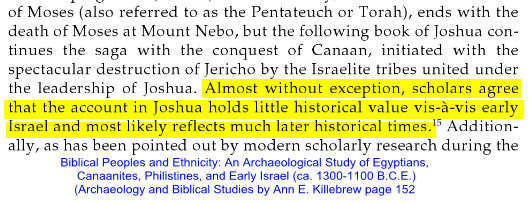
Screenshot of Anne E. Killebrew's statement on the historical unreliability of the Book of Joshua from her work Biblical Peoples and Ethnicity

Anne E. Killebrew — Biblical Peoples and Ethnicity: An Archaeological Study of Egyptians, Canaanites, and Early Israel, 1300–1100 BCE (2005) “Almost all scholars agree that the Book of Joshua holds little historical value for early Israel and most likely reflects a much later period.”

The scholar Jerome F.D. Creach confirms that the Book of Joshua was composed by more than one person and developed and was written long after the events it describes.

The following image is from the commentary on Joshua by Jerome Creach, showing his assessment of the book’s compositional history.
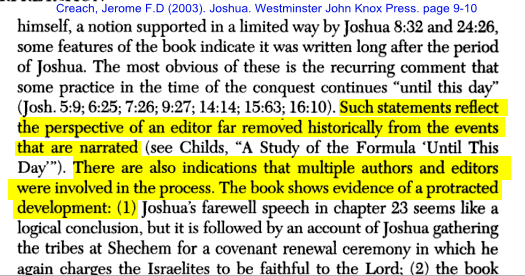
Screenshot from Jerome Creach's commentary on Joshua showing his conclusion that the book was composed by multiple authors over time, long after the events described

Source: Interpretation: A Bible Commentary for Teaching and Preaching — Joshua, pp. 9–10.


The Claim in Joshua Chapter 6 — The Walls of Jericho

The Book of Joshua, chapter 6, describes the conquest of the city of Jericho by the children of Israel and the miraculous destruction of the walls of Jericho by the people’s shouting and the blowing of trumpets. The chronological framework within the Bible itself places this event in the fifteenth century BCE.

The following image presents the Biblical chronological calculation based on 1 Kings 6:1, which establishes the date of Joshua’s conquest of Canaan.
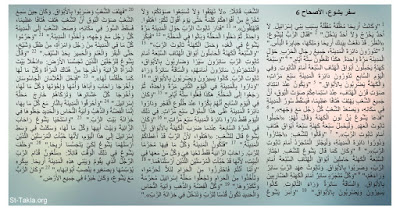
Screenshot showing the Biblical chronological calculation from 1 Kings 6:1 placing Joshua's invasion of Canaan in the fifteenth century BCE

1 Kings 6:1 — King James Version “And it came to pass in the four hundred and eightieth year after the children of Israel had come out of the land of Egypt, in the fourth year of the king of Solomon over Israel in the month of Ziv, which is the second month, that he built the house for the Lord.”

According to this verse, Joshua’s invasion of the cities of Canaan falls in the fifteenth century BCE — approximately 40 years after the Exodus from Egypt, which itself is dated by the correct scholarly opinion to the fifteenth century BCE. Some scholars have argued for a thirteenth-century BCE date, but this does not agree with what is stated in 1 Kings 6:1.


The Archaeological Evidence — Jericho Was Destroyed Centuries Before Joshua

The physical evidence from the site of ancient Jericho directly contradicts the Biblical narrative. The following image presents archaeological and research findings on the state of Jericho during the period when Joshua’s conquest is supposed to have occurred.

Screenshot presenting the archaeological evidence on the state of Jericho at the time of Joshua's supposed conquest, confirming absence of settlement and walls

The archaeologist Kathleen Kenyon conducted systematic research and excavations at Tell es-Sultan, the site of ancient Jericho, and confirmed after comprehensive analysis that the city of Jericho was completely destroyed in the sixteenth century BCE — and there is no trace of destruction, walls, or significant settlement at the time of Joshua’s supposed invasion as described in the Bible. The city was completely destroyed and abandoned centuries before Joshua arrived.

Jericho had no walls to destroy, no population to defeat, and no settlement to conquer when Joshua is said to have blown his trumpets. The city had been a ruin for centuries.


Scholar Admissions — Killebrew, Finkelstein, Greenberg, Youssef, and Stebbing

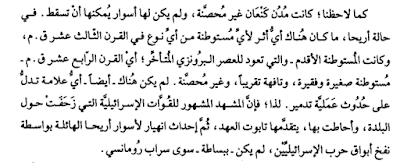
The Reverend Samuel Youssef confirms the archaeological findings in his book Introduction to the Old Testament, page 151:

The following image is from Reverend Samuel Youssef’s Introduction to the Old Testament, page 151, containing his acknowledgment of the archaeological problem with the Jericho narrative.

Screenshot from Reverend Samuel Youssef's Introduction to the Old Testament page 151 acknowledging the archaeological impossibility of the Joshua Jericho narrative

Professor of Archaeology Israel Finkelstein states the same conclusion in his book The Bible Unveiled, page 119:

The following image is from Israel Finkelstein’s The Bible Unveiled, page 119, presenting his assessment of the Jericho evidence.
Screenshot from Israel Finkelstein's The Bible Unveiled page 119 on the archaeological evidence that contradicts the Joshua Jericho narrative

Gary Greenberg, president of the New York Biblical Archaeology Society, states in his book 101 Myths of the Bible that the city of Jericho was destroyed many centuries before the coming of Joshua, as the archaeological evidence shows:

The following image is from Gary Greenberg’s 101 Myths of the Bible, presenting his finding that Jericho was destroyed long before Joshua’s arrival.
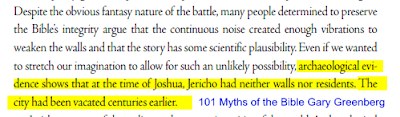
Screenshot from Gary Greenberg's 101 Myths of the Bible confirming that Jericho was destroyed many centuries before Joshua's arrival as shown by archaeological evidence

That destruction occurred in the sixteenth century BCE.

The following image presents the supporting evidence for the sixteenth-century BCE date of Jericho’s destruction from additional scholarly sources.
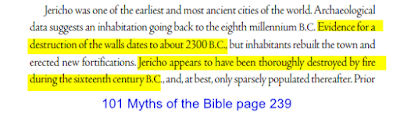
Screenshot presenting additional scholarly confirmation of the sixteenth-century BCE date for the destruction of Jericho

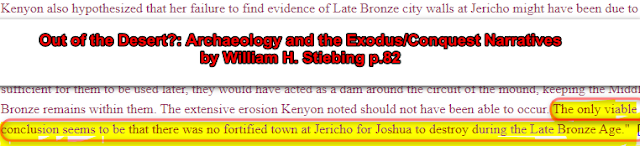
William Stebbing confirms the same conclusion.


The Christian Apologetic Response — Garstang and Bryant Wood

There is one response presented by Christians on all Christian websites, books, and audio or video productions in all languages: reliance on the words of a scholar named John Garstang and another named Bryant Wood, who claimed that the date of the destruction of Jericho agrees with what is stated in the Bible.

Unfortunately, the claims of both scholars have been demonstrated to be incorrect.


John Garstang — Criticized for Reading the Bible Into the Evidence

Scientists criticized John Garstang’s conclusions because he relied on the Bible to interpret the discoveries rather than relying on physical evidence and archaeological methods in a scientific manner. He interpreted what he found to fit the Biblical narrative, rather than letting the physical evidence speak independently.

The following image is the first of two screenshots from Magnus Magnusson’s Archaeology of the Bible addressing Garstang’s methodology and the refutation of his conclusions.
First screenshot from Magnus Magnusson's Archaeology of the Bible on John Garstang's methodology and the scholarly rejection of his conclusions about Jericho

The following image is the second screenshot from Magnus Magnusson’s Archaeology of the Bible, confirming that the walls Garstang celebrated were destroyed a thousand years before Joshua’s invasion as dated by the Bible.
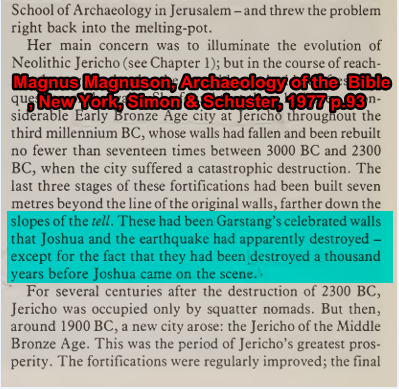
Second screenshot from Magnus Magnusson's Archaeology of the Bible confirming that the walls Garstang attributed to Joshua were destroyed a thousand years before Joshua's supposed arrival

Magnus Magnusson — Archaeology of the Bible The walls that Garstang celebrated as evidence of Joshua’s conquest were destroyed a thousand years before Joshua’s invasion according to the Biblical chronology itself.

Garstang’s error was therefore not merely a matter of mistaken dating. He attributed to Joshua’s period walls that predated the entire Biblical narrative by a millennium.


Bryant Wood — Refuted by High-Precision Radiocarbon Analysis in 1995

Bryant Wood conducted research and announced in 1990 that archaeological discoveries support what the Bible mentions about the destruction of Jericho. He argued that the date of its destruction was in the fifteenth century BCE — not the sixteenth century BCE as Kathleen Kenyon had demonstrated — which would match the Biblical date of Joshua’s invasion.

Unfortunately, the result that Bryant Wood produced is incorrect because it was based on a wrong calibration.

Only five years after Bryant Wood’s announcement, in 1995, the scientists Hendrik J. Bruins and Johannes van der Plicht conducted a high-precision radiocarbon analysis on 18 samples from the Jericho site. Their results confirmed that the destruction of the city of Jericho occurred at the end of the seventeenth century BCE or the sixteenth century BCE — the same date confirmed by Kathleen Kenyon, and centuries before the fifteenth-century date that Wood had proposed and that would be required to align with the Biblical narrative.

The following image presents the radiocarbon analysis results from Bruins and van der Plicht’s 1995 study on the 18 samples from Jericho.
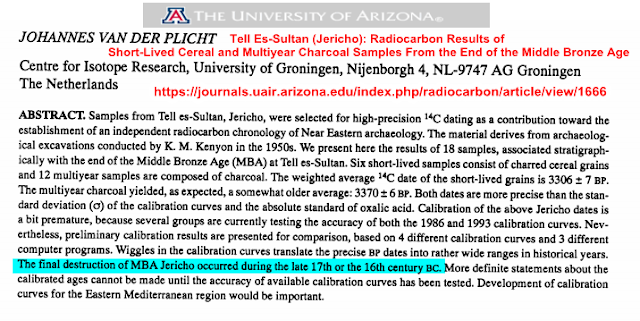
Screenshot presenting the 1995 high-precision radiocarbon analysis results from Hendrik J. Bruins and Johannes van der Plicht on 18 samples from Jericho, confirming destruction in the sixteenth century BCE

Hendrik J. Bruins and Johannes van der Plicht — 1995 High-Precision Radiocarbon Analysis Analysis of 18 samples from the site of Jericho using high-precision radiocarbon dating confirmed that the destruction of the city occurred at the end of the seventeenth century BCE or the sixteenth century BCE — consistent with Kathleen Kenyon’s stratigraphic findings and inconsistent with the fifteenth-century BCE date required by the Biblical narrative of Joshua’s conquest.

The convergence of Kenyon’s stratigraphic excavation, the independent radiocarbon analysis of Bruins and van der Plicht, and the admissions of multiple scholars from different traditions — including a Christian reverend, an Israeli archaeologist, an American Biblical archaeologist, and a New York Biblical archaeology society president — establishes a consistent picture that cannot be dismissed as anti-Biblical bias.

Two lines of independent scientific evidence converge on the same conclusion: physical stratigraphy from Kathleen Kenyon’s excavations, and radiocarbon dating from Bruins and van der Plicht’s 1995 analysis. Both place the destruction of Jericho in the sixteenth century BCE or earlier. The Biblical narrative requires a fifteenth-century BCE destruction. The gap between these two dates is between one and five centuries. This is not a marginal discrepancy — it is a fundamental historical impossibility in the Biblical text.

Conclusion — The Walls of Jericho Were Not Joshua’s to Destroy The Book of Joshua claims that Joshua destroyed the walls of Jericho in the fifteenth century BCE through a miraculous collapse triggered by the Israelites’ trumpets and shouting. The archaeological evidence is unambiguous: the city of Jericho was completely destroyed in the sixteenth century BCE, had no significant walls or population at the time of Joshua’s supposed conquest, and was not rebuilt in a form that would match the Biblical description. This has been confirmed by Kathleen Kenyon’s stratigraphic excavations, by the 1995 high-precision radiocarbon analysis of 18 samples by Bruins and van der Plicht, and by the admissions of scholars including Anne Killebrew, Israel Finkelstein, Gary Greenberg, Reverend Samuel Youssef, and Magnus Magnusson. The two scholars Christians rely on to defend the Biblical account — John Garstang and Bryant Wood — have both been demonstrated to be wrong: Garstang because he interpreted physical evidence through the lens of the Biblical narrative rather than independently, and Wood because his fifteenth-century dating was based on a calibration error refuted within five years by independent radiocarbon analysis. Almost all scholars agree that the Book of Joshua holds little historical value for early Israel and most likely reflects a much later period. The walls of Jericho were not Joshua’s to destroy — because they had already been rubble for centuries.

Historical error

2025 https://www.openislam.wiki/og/did-joshua-destroy-the-walls-of-jericho-the-archaeological-evidence-against-the-book-of-joshua.png