Did Prophet Muhammad Curse People? Refuting the Slander With Evidence
🕌 Refuting the Claim That the Prophet ﷺ Was a Cursor
📜 The Hadith in Question
Two men entered upon the Messenger of God ﷺ and spoke to him about something I do not know what it was, and they angered him, so he cursed them and slandered them. When they left, I said: O Messenger of God, who has attained any good that has befallen these two? He said: What is that? She said: I cursed them and slandered them.
He said: Do you not know what I stipulated with my Lord? I said: O God, I am only a human being, so if I curse or slander any Muslim, make it for him purification and reward.
He said in the hadith of Isa: “So they were alone with him, so he cursed and reviled them and expelled them.”
✍️ Introduction
We respond to this false slander from several aspects.
###- First Response — The Rarity of the Situation
Rather, he ﷺ was the kindest and most compassionate of people. Allah, the Most High, said about him:
“It is part of the mercy of Allah that you are gentle with them. And if you had been rude [in speech] and harsh in heart, they would have disbanded from around you. So pardon them and ask forgiveness for them and consult them in the matter. And when you have decided, then rely upon Allah. Indeed, Allah loves those who rely [upon Him].”
“And lower your wing to those who follow you among the believers.”
It is clear injustice to attribute a description to the Messenger of God ﷺ based on a single position that has its correct interpretation. A description does not apply to the described unless it is an ingrained habit that he is known for — and this never happened. Rather, the Mother of the Believers Aisha narrates her fear and astonishment at what the two men did, which angered the Messenger of God ﷺ in this way!
###- Second Response — The Blame Falls on the Two Men
Allah Almighty said: “It is not for you to harm the Messenger of God.”
###- Third Response — The Misunderstanding of “Unjust Cursing”
This is supported by two matters:
If he had harmed someone without right, the situation would have been one of repentance and seeking forgiveness, not one of condition, hope, and expectation.
When asked about his character, she gave the greatest answer: “His character was the Qur’an.”
And in another hadith: “The Messenger of God ﷺ was never given a choice between two matters except that he took the easier of the two, as long as it was not a sin. If it was a sin, he was the furthest person from it. And the Messenger of God ﷺ never took revenge for himself unless God’s sanctity was violated, in which case he would take revenge for God.” — Sahih al-Bukhari, Book of Virtues, Chapter on the Description of the Prophet ﷺ
###- Fourth Response — The Mirror: What About Jesus in the Gospels?
Moreover, these Gospels only dealt with a very short period of his life (ranging between a year and a half and three years), and even this was covered very briefly. Yet we still find the following:
⚠️ Jesus Curses All of God’s Prophets
⚠️ Jesus Curses the Believing Jews (the Apostles)
“Then one of the lawyers answered and said to him: Teacher, when you say this, you curse us also. And he said: Woe to you, lawyers!”
⚠️ Jesus Curses the Non-Jewish Believers
The woman said to him: “Yes, Lord! Even the dogs eat the crumbs that fall from their masters’ table.”
- Turned away from her
- Said he was only sent to the Jews
- Called her a dog of the Gentiles
Only after she abandoned her dignity and called herself a dog did Jesus accept her request.
📜 Cursing in the Old Testament
📜 Deuteronomy — The Book of Curses
16 Cursed is he who despises his father or his mother. And all the people shall say, Amen.
17 Cursed is he who moves his neighbor’s mark. And all the people shall say, Amen.
18 Cursed is he who leads the blind astray from the way. And all the people shall say, Amen.
19 Cursed is he who perverts the justice of the stranger, the fatherless, and the widow. And all the people shall say, Amen.
20 Cursed is he who lies with his father’s wife. And all the people shall say, Amen.
21 Cursed is he who lies with any beast. And all the people shall say, Amen.
22 Cursed is he who lies with his sister, the daughter of his father or the daughter of his mother. And all the people shall say, Amen.
23 Cursed is he who lies with his mother-in-law. And all the people shall say, Amen.
24 Cursed is he who kills his neighbor in secret. And all the people shall say, Amen.
25 Cursed is he who takes a bribe to kill an innocent person. And all the people shall say, Amen.
26 Cursed is he who does not establish the words of this law to do them. And all the people shall say, Amen.
Cursed shall you be in the city, and cursed shall you be in the field. Cursed shall be your basket and your kneading bowl. Cursed shall be the fruit of your body, and the fruit of your ground… Cursed shall you be when you come in, and cursed shall you be when you go out.
The LORD will send upon you a curse, confusion, and rebuke in all that your hand sets out to do, until you perish…”*
⚠️ Even the Fig Tree Was Not Spared
⚠️ Even Jesus Himself Was Not Spared
⚠️ The Character Attributed to Jesus in the Gospels
⚠️ Jesus Curses His Disciples and Teachers
⚠️ Jesus Curses the One Who Hosted Him for Lunch — In His Own House
38 But when the Pharisee saw it, he marveled that he had not first washed before lunch.
39 Then the Lord said to him: “Now you Pharisees make clean the outside of the cup and the dish, but your inside is full of extortion and wickedness. You fools!”
42 “But woe to you, Pharisees! For you tithe mint and rue and every herb, and neglect justice and the love of God.”
43 “Woe to you, Pharisees, for you love the uppermost seats in the synagogues and greetings in the marketplaces.”
44 “Woe to you, scribes and Pharisees, hypocrites! For you are like hidden graves…”
45 Then one of the lawyers answered: “Teacher, when you say this, you are insulting us also.”
46 But he said: “Woe to you, lawyers! For you burden men with burdens that are hard to bear…”
47 “Woe to you! For you build the tombs of the prophets, whom your fathers killed.”
52 “Woe to you, lawyers! For you have taken away the key of knowledge. You yourselves have not entered, and those who were entering in you have hindered.”
⚠️ Jesus Describes the Ignorant as Dogs and Pigs
Matthew 15:26 Jesus answered and said, “It is not good for the men to be taken away and put it to the dogs.
One copy of the manuscripts of the Saint Catherine Abbey for the Egyptian Church:
“Maybe he who called her a dog will understand the purpose, because the Prophet called the infidels dogs”
https://sinaimanuscripts.library.ucla.edu/catalog/ark:%2F21198%2Fz1cn8nmt
⚠️ Jesus Curses the Teachers of the Law
So either Paul is ignorant of his God’s abrogation of his opinion, or his God contradicted his ruling.
📎 Appendix — The Slander Regarding Muadh Ibn Jabal
…Rather this occurred from him in rare and unusual times, and the Messenger of Allah ﷺ was not obscene nor vulgar nor a cursor nor a vengeful person.
And it was previously said to the Messenger of Allah ﷺ: Pray against the tribe of Daws, so he said: ‘O Allah, guide Daws.’ And he said: ‘O Allah, forgive my people for they do not know.’”
📎 Appendix — Abu Bakr’s Statement About Al-Lat
Sheikh Al-Islam Ibn Taymiyyah said: “When the one being addressed is unjust, we are not commanded to respond to him in the best way.”
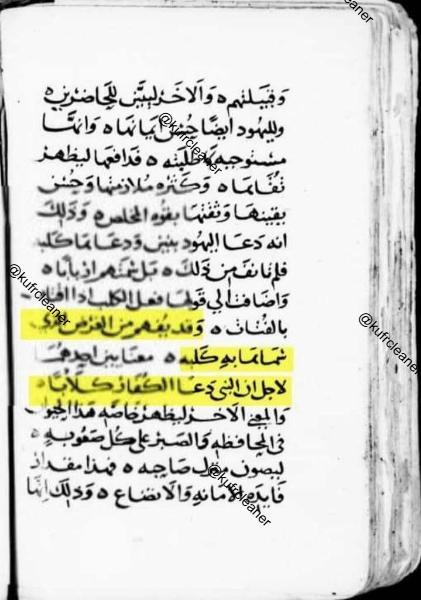
Saying “bite the clitoris of Al-Lat” is like saying “drink from the sea” — and even less than that, because the sea exists and the clitoris of Al-Lat is an illusion.
Abu Bakr did not say “bite the clitoris of your mother.” He placed Al-Lat — the idol Urwah worshipped — in that position, thereby:
- Belittling the enemy
- Exposing the corruption of worshipping stones
- Highlighting that those who claimed Al-Lat was a daughter of Allah attributed female qualities to a stone
Both are an illusion: the clitoris is an illusion. And the worship is an illusion.
📌 Legal Principle — Combining the Hadiths
The legal controls are the basis and main reference for the Muslim person. If what was reported from the Messenger ﷺ is true, then it is necessary to believe in it and act on it — without introducing our personal convictions — because he ﷺ does not speak from his own desires.
Islam cannot be taken from one part and left out — Islam is a single unit whose parts complete each other.
And: “If you speak to people about their Lord, do not speak to them about what is difficult for them.”
If stating a word will lead to corruption and conflict because the person does not understand the intended meaning — explain it in another way that leads to the same meaning.
These doubts were put forth centuries ago, stripped of the understanding of the predecessors. They were responded to hundreds of times. The church preserved the doubts but concealed the responses.
...and being good neighbors or good character populate homes and increase lifespans," and who said: "The believer is not a slanderer, nor a cursor, nor an obscene or vulgar person," may the peace and...