

Did the Pharaohs Know About Meteoric Iron Before the Quran?
The claim has no verified primary source behind it — only a chain of unverified 19th and 20th-century hypotheses that contradict each other and, in at least one case, contradict themselves within the same book. What follows is a direct examination of the academic source that these critics rely on, drawn from the book Cosmic Debris: Meteorites in History, Chapter Seven: “Folklore, Myths, and Public Facilities.”
The Source Critics Rely On Undermines Their Own Claim
Almost all websites that repeat this claim do so without citing any primary source. The trail of references leads back to a single academic work: Cosmic Debris: Meteorites in History. A direct reading of Chapter Seven reveals that the claim rests on a succession of competing and self-contradicting hypotheses, none of which constitute established fact.
Hypothesis One: Franz Von Lauth and ba-ne-pe
The first person to propose that ancient Egyptians had a term for “iron from the sky” was a scholar named Franz Von Lauth. He argued that the Coptic word banipe means iron from the sky — breaking it down as: ba (iron) + ni-pe (from the sky).
The first three scans show the relevant passages from Cosmic Debris documenting Von Lauth’s hypothesis and the scholarly response to it.
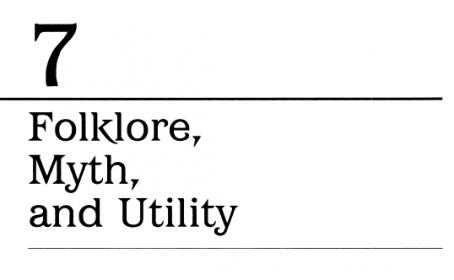
The following scan shows the continuation of the discussion of Von Lauth’s etymology.

The following scan shows the scholarly responses rejecting Von Lauth’s hypothesis.
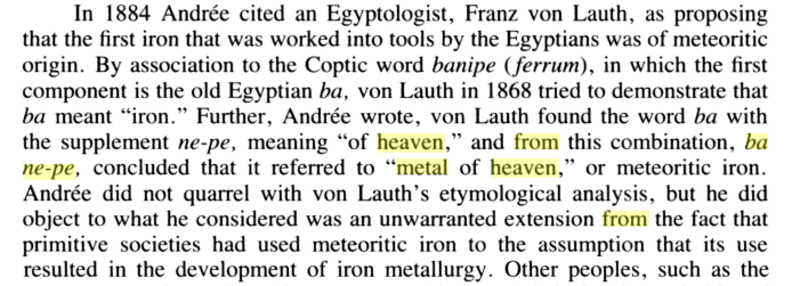
Hypothesis Two: Wainwright and biz-ni-pt
A later scholar named Wainwright attempted to revive Von Lauth’s legacy by substituting the term biz-ni-pt in place of ba-ne-pe. He claimed to have found evidence that pre-dynastic Egyptians used a forked metal knife in burial ceremonies, which evolved into a stone knife, then into an iron chisel called mdtft-biz in the dynastic era. The same type of iron chisel was allegedly found in Tutankhamun’s tomb — made, he claimed, of meteoric iron — and therefore the Egyptians called meteoric iron biz.
The following two scans show Wainwright’s hypothesis and the critical problem with it identified two pages earlier in the same book.
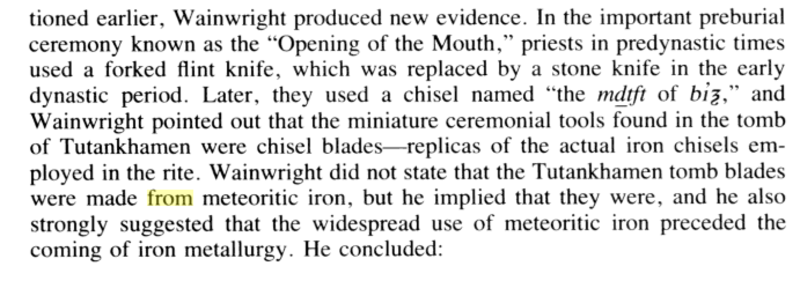
The following scan shows the passage from the same book, two pages prior, acknowledging that the iron from Tutankhamun’s tomb had not yet been analysed.
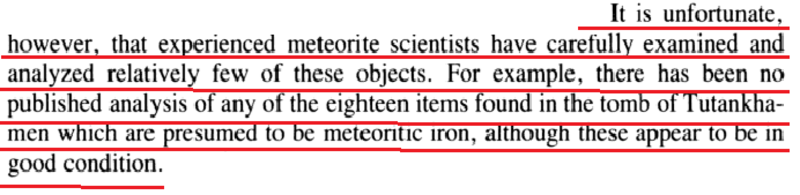
Wainwright’s Internal Contradictions
The problems do not end there. Wainwright then adds a further claim that the word biz means “iron or meteoric material in general” — encompassing both iron and stones.
The following scan shows this admission and its consequences for his own argument.
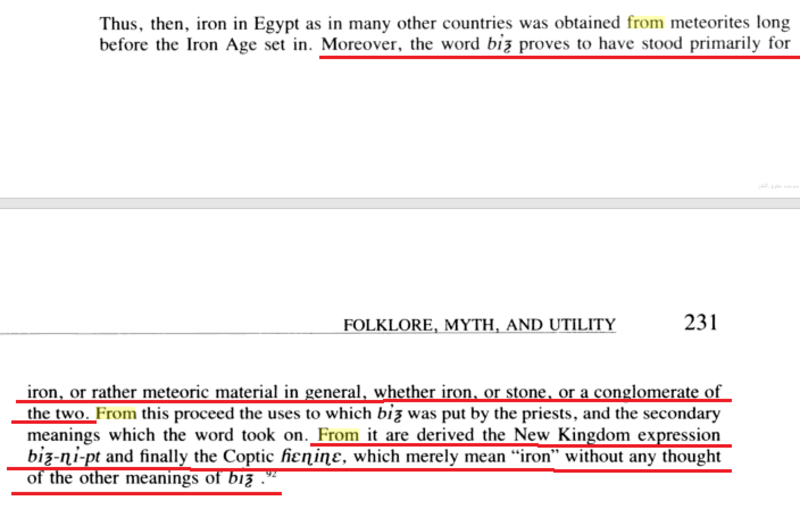
He then concedes that the word biz was coined by priests (which is why he infers a celestial meaning), but that by the end of the royal era the term evolved to mean simply “iron” — with no reference to anything celestial. This means that even on Wainwright’s own account, the supposed heavenly connotation had already disappeared from the language before it could have any relevance to the Prophet ﷺ.
Hypothesis Three: R. J. Forbes and biz as Copper
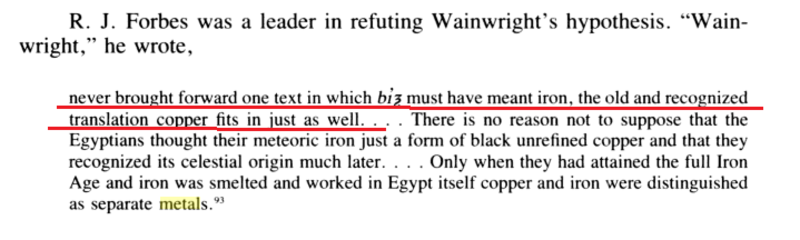
A third scholar, R. J. Forbes, responded to Wainwright directly, arguing that the word biz does not mean iron at all — but rather copper.
The following scan shows Forbes’s rebuttal.
Summary: What the Academic Source Actually Establishes
Second: The claim that any of these words specifically means “iron from the sky” is an unproven hypothesis originating in the 19th century, denied by subsequent scholars, and self-contradicted within the very book that critics use as their source.
Third: One of the primary pieces of evidence cited — the iron artefacts in Tutankhamun’s tomb — had not even been chemically analysed at the time the hypothesis was made. A conclusion drawn from unanalysed material is not evidence.
An Additional Linguistic Problem
Setting aside the scholarly dispute, there is a further problem that critics consistently ignore.
If the Pharaohs mentioned iron from the sky, it would have been recorded in hieroglyphics, not Coptic. Hieroglyphics was an extinct language more than a thousand years before the birth of the Prophet ﷺ. The Coptic language, by contrast, is written in a Greek alphabet, flourished during the Greek and Roman eras, and continued to be used until 1100 AD — it is a later development of the ancient Egyptian language.
These are two distinct languages from two distinct historical eras. Any critic invoking this claim must first specify: is the word in question Coptic or hieroglyphic? The answer changes everything about what era it belongs to, who would have known it, and how it could possibly have reached an unlettered Arab in 7th-century Mecca.
The critics who repeat this claim have produced no photograph of a Pharaonic inscription attributed to any scholar of Pharaonic texts, attached to an identified archaeological site. Everyone issues a verdict and moves on. This is not how scientific research or sound authentication works.
Reference
- Cosmic Debris: Meteorites in History, Chapter Seven — “Folklore, Myths, and Public Facilities”: books.google.com.eg
Quran 57:25 Iron Sent Down from Sky: Atheist Objection Refuted
...of two key practices: - Including the differing opinions of scholars on the issue. - Utilizing the specific Quranic verse itself as a source for refutation or clarification.