

Did the Prophet Oppose Freeing Slaves? The Deathbed Hadith Explained
The Prophet’s intervention in this narration was not opposition to slave manumission but a targeted ruling against a deathbed will that would have left creditors unpaid and heirs destitute. When a dying man sought to free six slaves despite possessing no wealth beyond them, the Prophet ﷺ permitted only a portion to be freed and arranged the remainder to satisfy outstanding debts — a decision grounded in economic justice rather than hostility to liberation.
The hadith appears to show the Prophet ﷺ preventing the manumission of slaves and even selling a manumitted slave, which seems to contradict Islam’s well-known emphasis on liberating the enslaved.
The narration describes a highly specific legal scenario, not a general prohibition. The master in question was on his deathbed, possessed no wealth apart from his six slaves, and sought to free all of them by will. The Prophet ﷺ restricted the manumission to protect the rights of creditors and inheritors, demonstrating that Islamic law prioritizes settled obligations even over virtuous acts.
The following screenshot presents the hadith as it is typically circulated in support of the objection.
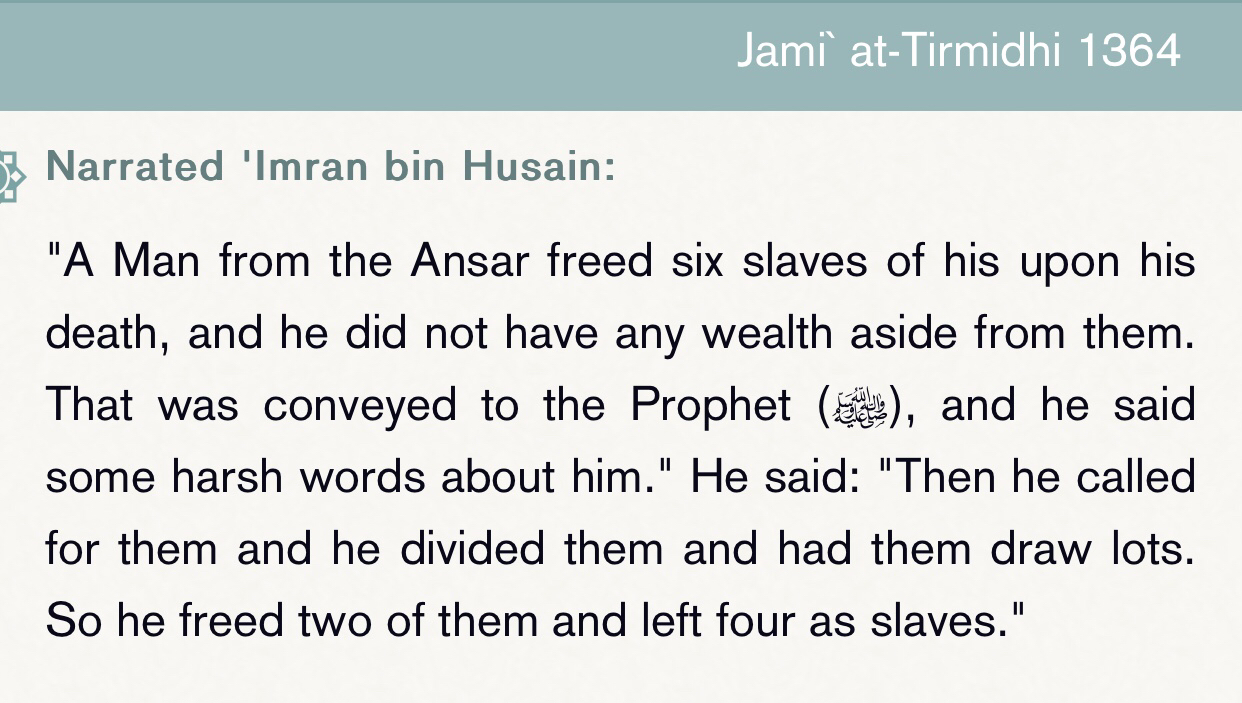
The Deathbed Insolvency Context
This hadith falls under the chapter: “What Has Been Related About One Who Frees His Slaves When He Dies, While He Has No Wealth Aside From Them.” In this scenario, the master had six slaves and no other assets. Had he freed them all, his creditors would have been defrauded and his heirs left with nothing. The Prophet ﷺ therefore ruled that only two would be freed while the remainder were retained to discharge the estate’s obligations — a measure that ensured the man’s virtuous intent did not cause financial harm to others.
The classical commentators note that manumission at death is not unlimited. The estate has prior claimants, and the owner’s power to dispose of his property is constrained by the rights of those he owes. The commentary of Tuhfat al-Ahwadhi Bi Sharh Jamiʿ al-Tirmidhi establishes that the shar’i limit serves to protect the inheritors’ fixed share.
“And in the hadith there is evidence that manumitting slaves at the deathbed only frees one-third of them for the inheritors’ right upon him.”
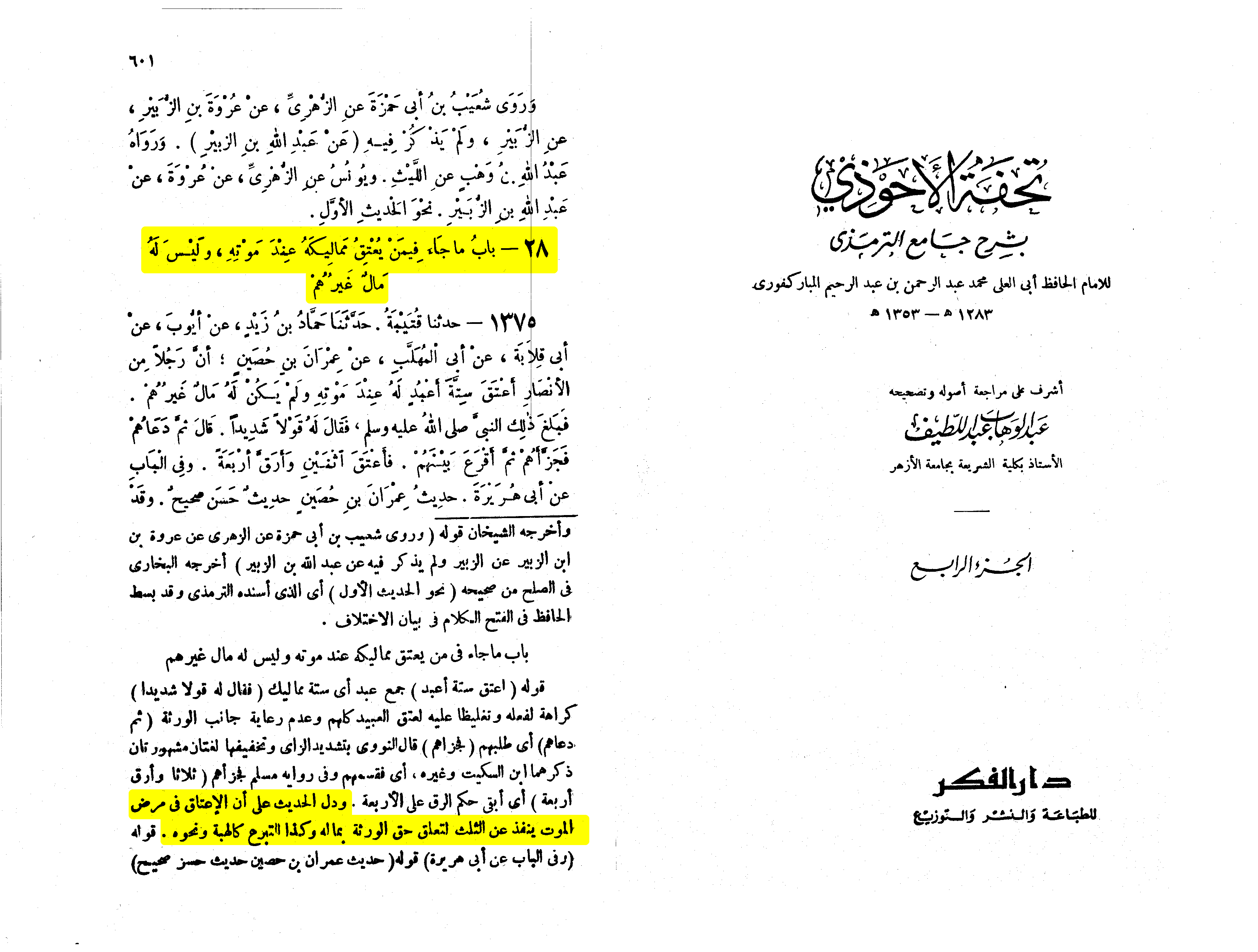
This principle is not an innovation against liberation but a safeguard: a person cannot, by dying declaration, strip his estate of assets needed to pay debts and support his heirs.
The Classical Fiqh on Manumitted Slaves
Islamic law overwhelmingly encourages the liberation of the enslaved as an act of expiation and mercy. In fact, freeing a slave is prescribed as the kaffarah for numerous violations, and the reward for liberating the enslaved extends even when the slave is a non-Muslim. The Prophet ﷺ and the classical schools uniformly regard manumission as one of the most meritorious deeds in Islam.
However, the schools of fiqh recognize that a manumitted slave is ordinarily inviolable and cannot be sold. The majority of the Salaf — including the Maliki and Hanafi schools — hold that purchasing a manumitted slave is impermissible. A related narration found in Sahih al-Bukhari clarifies the financial responsibilities attached to partial manumission.
Narrated Abu Huraira: The Prophet (ﷺ) said, “Whoever manumits his share of a jointly possessed slave, it is imperative for him to get that slave manumitted completely by paying the remaining price, and if he does not have sufficient money to manumit him, then the price of the slave should be estimated justly, and he is to be allowed to work and earn the amount that will manumit him (without overburdening him).”
The majority respond to the apparent sale of a freed slave by restricting it to the precise context of debt discharge. Imam al-Nawawi records this consensus view in his authoritative commentary on Sahih Muslim.
[!scholar] Imam al-Nawawi — Al-Minhaj fi Sharh Sahih Muslim 11/204
“The Malikis and Hanafis and the majority of the Salaf see that buying a manumitted slave is impermissible. They respond to this hadith by saying that the Prophet only sold him because of a debt on his master, and it was said so in a narration in Nasa’i and Daraqutni, so he sold his slave only to push off his debt.”
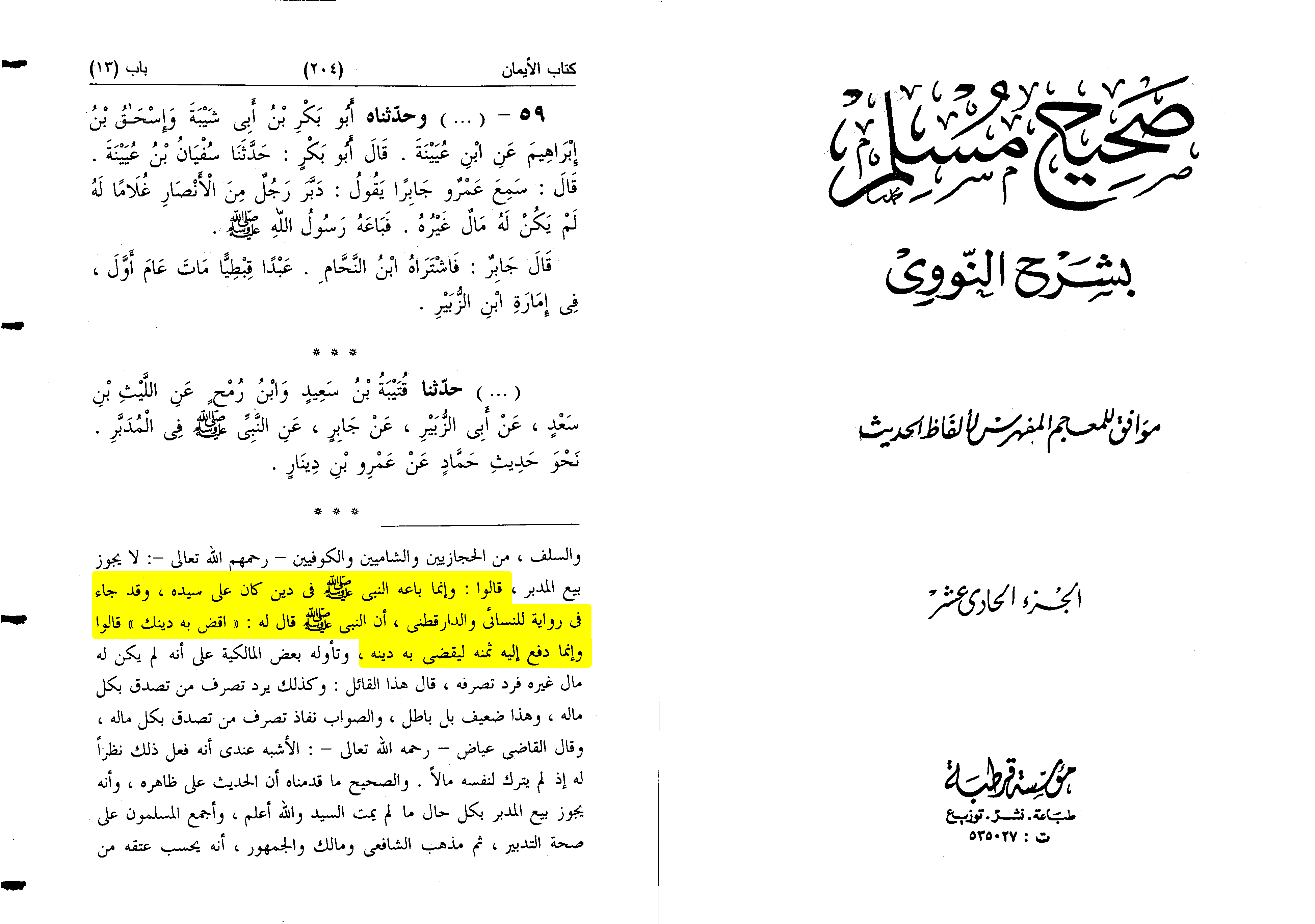
The sale occurred solely to satisfy the master’s debt, not as a general license to traffic in freed persons.
Special Condition, Not General Permission
This ruling applies exclusively to the specific condition where a slave is freed after the death of an insolvent master. Under ordinary circumstances, once a slave is manumitted — whether by contract or grant — he cannot be bought, sold, or reclaimed. The exception arises only when the estate lacks liquidity and the creditors’ rights would otherwise be extinguished.
The objection naturally follows: what of the creditor, and what of the heirs? The answer is that this is precisely why the exception exists — to protect their rights against a will that would enrich the enslaved at the expense of the indebted. The sources confirm that the slave in this narration was ultimately freed after the debt was settled, proving that the restriction was temporary and instrumental.Sharh Sahih Muslim 997 C notes that this slave was freed after the debt was discharged.
The Prophet ﷺ did not oppose manumission; he upheld the rights of creditors and heirs against a deathbed will that would have left debts unpaid while bestowing liberty. Islam institutionalized slave liberation more thoroughly than any preceding system, and this hadith illustrates the balance between the virtue of freedom and the justice of settled obligations.