

Did the Prophet ﷺ Desire Ibn al-Abbas’s Daughter? Analyzing Hadith
The Suspicion That the Messenger ﷺ Desired a Weaned Girl
The Suspicion
Based on the following hadith:
Musnad Ahmad, Hadith No. 25636
Yaqub narrated to us, he said: My father narrated to us, on the authority of Ibn Ishaq, he said: Husayn ibn ‘Abdullah ibn ‘Abbas narrated to me, on the authority of ‘Ikrimah, the freed slave of ‘Abdullah ibn ‘Abbas, on the authority of ‘Abdullah ibn ‘Abbas, on the authority of Umm al-Fadl bint al-Harith, that the Messenger of Allah ﷺ saw Umm Habibah bint Abbas while she was still weaned. He said: “If this daughter of Abbas reaches puberty while I am alive, I will marry her.”
The Response — With Allah’s Help
Apart from the authenticity of the hadith or its invalidity, we see the infidel who presented the doubt deceiving even in the title — saying that the Prophet ﷺ desired a weaned girl — although it is written in the hadith: “over the weaned.”
But we will not differ as to whether she was weaned or over the weaned. Let us see whether this hadith is authentic or not.
The Full Narration
The Messenger of Allah ﷺ saw Umm Habibah bint Abbas while she was still weaned. He said: “If this daughter of Abbas reaches puberty while I am still alive, I will marry her.”
He died before she reached puberty. Al-Aswad ibn Abdullah married her, and she gave birth to Rizq ibn al-Aswad and Lubabah bint al-Aswad, and named her after her name Umm al-Fadl.
| Field | Detail |
|---|---|
| Narrator | Al-Haythami |
| Source | Majma’ al-Zawa’id |
| Page / Number | 4/279 |
| Summary of Degree | In its chain of transmission is Al-Husayn ibn Abdullah ibn Abbas — and he is rejected. |
Assessment of the Narrator: Al-Husayn Ibn Abdullah Ibn Abbas
Full Name: Al-Husayn ibn Abdullah ibn Ubayd Allah ibn Abbas ibn Abdul Muttalib Al-Qurashi Al-Hashemi, Abu Abdullah Al-Madani.
| Field | Detail |
|---|---|
| Generation | 5th — of the younger Tabi’in |
| Death | 140 or 141 AH |
| Status according to Ibn Hajar | Weak |
| Status according to Al-Dhahabi | Declared weak |
Scholarly Verdicts on This Narrator
The response to the claim that if the daughter of Abbas reached puberty, he would not marry her
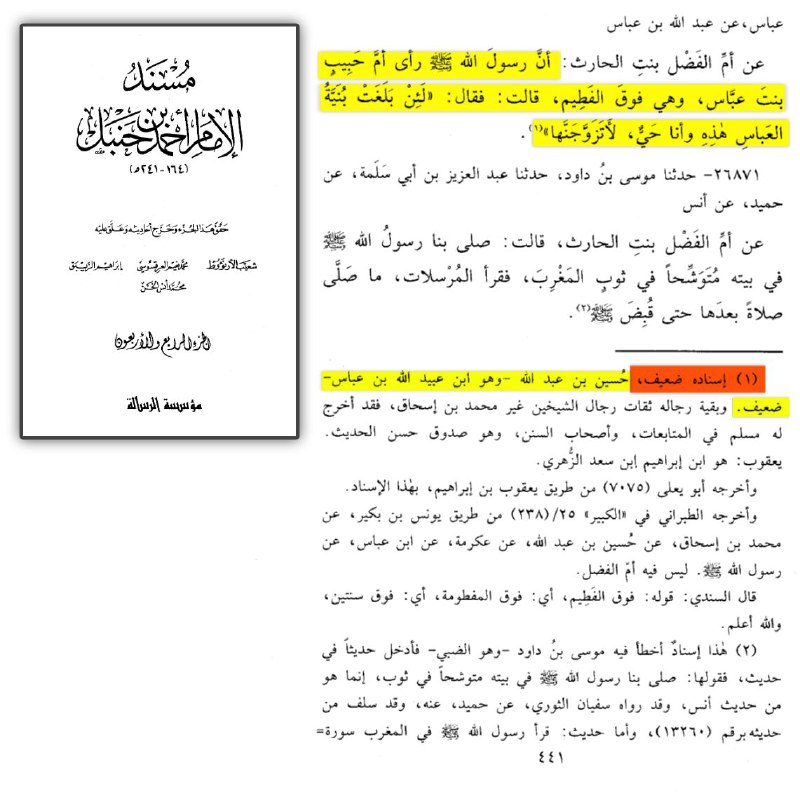
-
Book Source: Musnad al-Imam Ahmad bin Hanbal (164–241 AH), Vol. 44, published by Muassasat al-Risalah.
-
Main Text (Hadith): > * Narrated by Umm al-Fadl bint al-Harith.
-
The Prophet ﷺ saw Umm Habib bint Abbas while she was a child past the age of weaning (above two years old).
-
The Prophet ﷺ stated: “If this little daughter of al-Abbas reaches maturity while I am still alive, I will surely marry her.”
-
-
Hadith Grading & Verification (Footnote 1):
-
Grading: Isnaduhu Da’if (Its chain of transmission is weak).
-
Reason for Weakness: The presence of Hussein bin Abdullah (the son of Ubaidullah bin Abbas), who is classified as a weak narrator (da’if).
-
Other Narrators: The remaining narrators in the chain are reliable (thiqat), meeting the criteria of the two Sahihs (Bukhari and Muslim), except for Muhammad bin Ishaq, whose narrations are accepted by Muslim in al-Mutaba’at and the authors of al-Sunan, and he is considered truthful with good hadith (saduq hasan al-hadith).
-
Cross-References: The text notes that the narration was also extracted by Abu Ya’la and al-Tabarani via alternative chains.
-
-
Linguistic Note: Al-Sindi states that “fawqa al-fatim” means past the age of weaning, i.e., above two years of age.
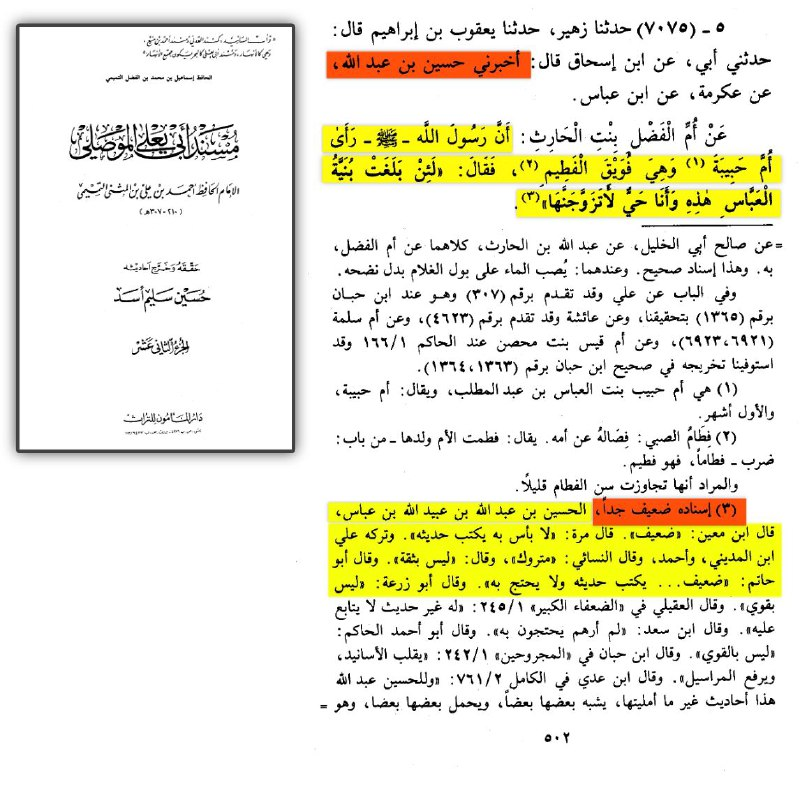
-
Book Source: Musnad Abu Ya’la al-Mawsili by Al-Hafiz Ahmad bin Ali bin Muthanna al-Tamimi (210–307 AH), Vol. 12, verified by Husayn Salim Asad, published by Dar al-Ma’mun li al-Turath.
-
Main Text (Hadith):
-
Chain: Zuhayr narrated to us, from Ya’qub bin Ibrahim, from his father, from Ibn Ishaq, who said: Hussein bin Abdullah informed me, from Ikrima, from Ibn Abbas, from Umm al-Fadl bint al-Harith.
-
Matn: The Prophet ﷺ saw Umm Habibah while she was slightly past the age of weaning (fuwayqa al-fatim). He stated: “If this little daughter of al-Abbas reaches maturity while I am still alive, I will surely marry her.”
-
-
Hadith Grading & Scholar Commentary (Footnote 3):
-
Grading: Isnaduhu Da’if Jiddan (Its chain of transmission is very weak).
-
Reason for Critical Weakness: The narrator Hussein bin Abdullah bin Ubaidullah bin Abbas.
-
Scholarly Verdicts on Hussein bin Abdullah:
-
Ibn Ma’in: Classified him once as Da’if (weak) and another time stated La ba’sa bihi yuktabu hadithuh (There is no harm in him, his hadith is written).
-
Ali ibn al-Madini & Ahmad ibn Hanbal: Abandoned him (Tarakahuh).
-
Al-Nasa’i: Classified him as Matruk (Abandoned).
-
Abu Hatim: Stated Da’if… yuktabu hadithuhu wa la yuhtajju bih (Weak… his hadith is recorded but not used as a proof).
-
Abu Zur’ah: Stated Laysa bi qawiyy (He is not strong).
-
Al-Uqayli: Noted in Al-Du’afa al-Kabir that his narrations are uncorroborated.
-
Ibn Sa’d & Abu Ahmad al-Hakim: Stated that scholars do not use his narrations as proof and that he is not strong.
-
Ibn Hibban: Stated in Al-Majruhin that he reverses chains (yaqlibu al-asanid) and raises interrupted reports (yarfa’u al-marasil).
-
Ibn Adi: Noted in Al-Kamil that he has other uncorroborated narrations where some resemble others or carry one another.
-
-
-
Linguistic & Identity Clarifications (Footnotes 1 & 2):
-
Identity: She is Umm Habib bint al-Abbas bin Abdul Muttalib, though it is also said her name is Umm Habibah, with the first being more famous.
-
Language: Fatam al-sabiyy refers to separating a child from suckling. Fuwayqa al-fatim means she had just slightly exceeded the age of weaning.
-
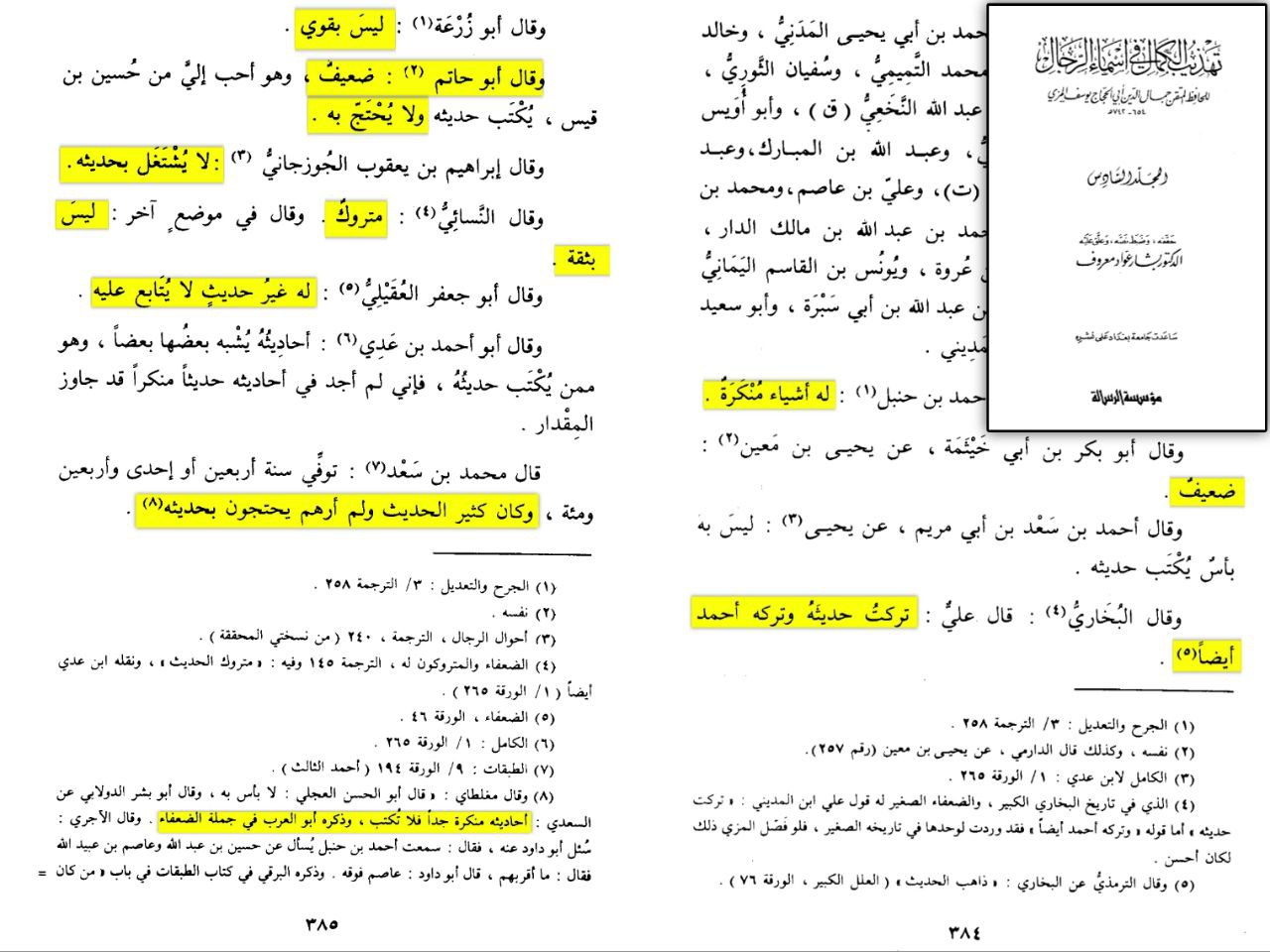
-
Book Source: Tahdhib al-Kamal fi Asma’ al-Rijal by Al-Hafiz Abu al-Hajjaj Yusuf al-Mizzi (654–742 AH), Vol. 6, edited by Dr. Bashar Awad Marouf, published by Muassasat al-Risalah.
-
Context: Biographical entry entries evaluating the reliability of the narrator Hussein bin Abdullah bin Ubaidullah bin Abbas.
-
Scholarly Verdicts & Jarh wa al-Ta’dil (Pages 384–385):
-
Ahmad bin Hanbal: Stated Lahu ashya’ munkarah (He narrates objectionable/denied reports).
-
Yahya bin Ma’in: Classified him as Da’if (Weak).
-
Ahmad bin Sa’d bin Abi Maryam (from Ibn Ma’in): Stated Laysa bihi ba’s, yuktabu hadithuh (There is no harm in him, his hadith is recorded).
-
Al-Bukhari: Quoted Ali ibn al-Madini stating, “Taraktu hadithahu” (I abandoned his hadith), and added that Ahmad bin Hanbal abandoned him as well (wa tarakahuhu Ahmad aydan). Al-Tirmidhi also noted that al-Bukhari regarded him as Zahib al-Hadith (His hadith is gone/ruined).
-
Abu Zur’ah: Classified him as Laysa bi qawiyy (He is not strong).
-
Abu Hatim: Classified him as Da’if (Weak), adding that he is preferred over Hussein bin Qays, and that his hadith is recorded but cannot be used as proof (yuktabu hadithuhu wa la yuhtajju bih).
-
Ibrahim bin Ya’qub al-Juzajani: Stated La yushtaghalu bi hadithih (His hadith is not to be occupied with/disregarded).
-
Al-Nasa’i: Categorized him in one instance as Matruk (Abandoned) and in another as Laysa bi thiqah (Not trustworthy).
-
Abu Ja’far al-Uqayli: Stated Lahu ghayr hadith la yutaba’u alayh (He has multiple narrations that are uncorroborated).
-
Abu Ahmad bin Adi: Stated that his narrations resemble one another, yet notes that among the narrators whose reports are written, he did not find any narration that excessively crosses into the realm of being completely rejected (munkar).
-
Muhammad bin Sa’d: Noted that he passed away in the year 140 or 141 AH, adding that he transmitted many narrations but he did not see the scholars utilizing his hadith as binding proof (lam arahum yahtajjuna bi hadithih).
-
-
Sub-Footnote Content (Footnote 8 - Mughaltay & Al-Ajli):
-
Abu al-Hasan al-Ajli gave a rare lenient view stating La ba’sa bih (There is no harm in him), while Abu al-Arab included him in Jumlat al-Du’afa (The category of weak narrators).
-
Al-Sadi is quoted describing his reports as ahadithuhu munkarah jiddan fala tuktab (His narrations are extremely rejected, so they should not even be written down).
-
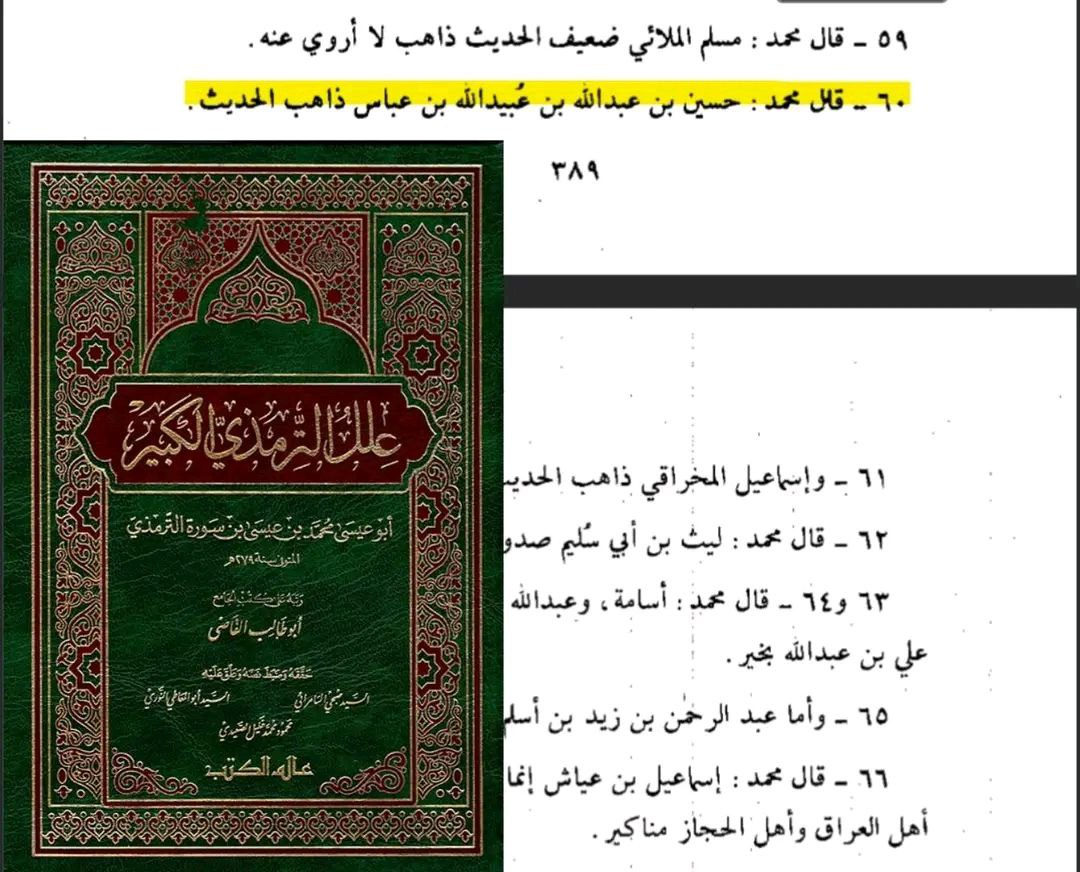
-
Book Source: Al-Ilal al-Kabir by Abu Isa Muhammad bin Isa bin Sawrah al-Tirmidhi (d. 279 AH), arranged according to the chapters of Al-Jami by Abu Talib al-Qadi, published by Alam al-Kutub.
-
Context: Statements from Imam Muhammad bin Ismail al-Bukhari (referred to in the text as “Muhammad”) regarding the reliability of specific transmitters of hadith.
-
Highlighted Verdict (Entry 60):
==- Narrator: Hussein bin Abdullah bin Ubaidullah bin Abbas.==
==- Imam al-Bukhari’s Verdict: Zahib al-Hadith (His hadith is gone/ruined, indicating a high level of weakness).==
-
Surrounding Contextual Entries (Page 389):
-
Entry 59: Al-Bukhari stated that Muslim al-Mula’i is Da’if al-Hadith zahib la arwi anhu (Weak in hadith, ruined, I do not narrate from him).
-
Entry 61: Ismail al-Makhraqi is noted as Zahib al-Hadith (His hadith is ruined).
-
Entry 62: Al-Bukhari stated that Layth bin Abi Sulaim is Saduq (Truthful).
-
Entries 63 & 64: Al-Bukhari stated that Usamah and Abdullah, the sons of Ali bin Abdullah, are bi-khayr (Good/acceptable).
-
Entry 65: Mention of Abd al-Rahman bin Zayd bin Aslam.
-
Entry 66: Al-Bukhari stated that Ismail bin Ayyash is only accepted when narrating from his own people (the people of Syria), whereas his narrations from the people of Iraq and the Hijaz are manakir (denied/rejected reports).
-
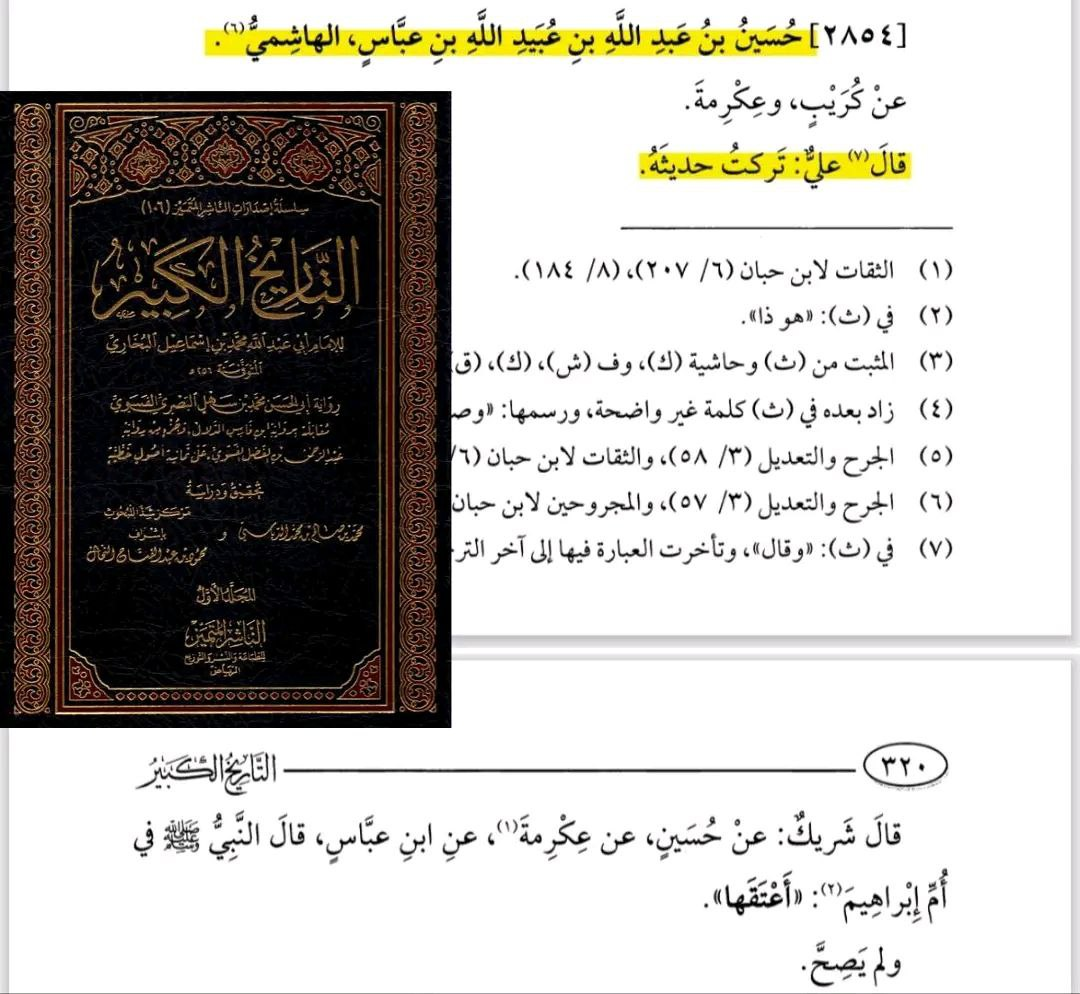
-
Book Source: Al-Tarikh al-Kabir by Imam Abi Abdullah Muhammad bin Ismail al-Bukhari (d. 256 AH), Vol. 1, edited by a team under the supervision of Muhammad bin Abd al-Rahman al-Mar’ashli, published by Al-Nashir al-Mutamayyiz.
-
Context: Biographical entry entries evaluating the reliability and narrations of the transmitter Hussein bin Abdullah.
-
Biographical Entry (Entry 2854):
-
Narrator Name: Hussein bin Abdullah bin Ubaidullah bin Abbas, al-Hashimi.
-
Teachers/Sources: He narrates from Kuryb and Ikrima.
-
Critical Verdict: Ali ibn al-Madini stated: “Taraktu hadithahu” (I abandoned his hadith).
-
-
Textual Transmission Examples (Page 320):
-
Narration Chain: Sharik narrated from Hussein, from Ikrima, from Ibn Abbas.
-
Hadith Content (Matn): The Prophet ﷺ said regarding Umm Ibrahim (the Mother of Ibrahim, i.e., Maria al-Qibtiyya): “A’taqaha” (She has been set free [by her child]).
-
Imam al-Bukhari’s Conclusion: Wa lam yasihh (And it is not authentic).
-
Al-Mizzi said in Tahdhib Al-Kamal:
- Ahmad ibn Hanbal (via Abu Bakr Al-Athram): He has some strange things.
- Yahya ibn Ma’in (via Abu Bakr ibn Abi Khaithama): Weak.
- Yahya ibn Ma’in (via Ahmad ibn Sa’d ibn Abi Maryam): He is not bad; his hadith should be written.
- Al-Bukhari: Ali said: I left his hadith, and Ahmad also left him.
- Abu Zur’ah: He is not strong.
- Abu Hatim: He is weak. I prefer him to Husayn ibn Qays; his hadith should be written, but he should not be used as evidence.
- Ibrahim ibn Ya’qub al-Jawzjani: His hadith should not be used.
- Al-Nasa’i: He is abandoned. And in another place: He is not trustworthy.
- Abu Ja’far al-‘Uqayli: He has hadiths that are not followed.
- Abu Ahmad ibn ‘Adi: His hadiths are similar to each other, and he is one of those whose hadith should be written — for I did not find in his hadiths a single objectionable hadith that exceeded the amount.
- Muhammad ibn Sa’d: He died in the year 140 or 141 AH, and he narrated many hadiths — but I did not see them cite his hadiths as evidence.
Al-Tirmidhi and Ibn Majah narrated from him. — End of Al-Mizzi’s quote.
Additional Notes from Al-Hafiz in Tahdhib al-Tahdhib (2/342)
- Al-Hasan bin Ali bin Muhammad al-Nawfali said: Al-Husayn bin Abdullah was a friend of Abdullah bin Muawiyah bin Abdullah bin Jaafar, and they were both accused of heresy. People said they only reconciled because of that. Then they became estranged, and poems were exchanged between them reproaching each other.
- Al-Bukhari said: It is said that he was accused of heresy.
- Abu Dawud (via Al-Ajurri): Asim bin Ubaydullah is above him.
- Al-Hakim Abu Ahmad: He is not strong in their view.
- Ibn Hibban: He changes the chains of transmission and raises the mursal hadiths.
Conclusion: The hadith is rejected due to a weak and discredited narrator in its chain of transmission