

Did Zayd ibn Thabit Lose Quran Verses? Refuting the “Missing Verses” Doubt from Sahih al-Bukhari
The claim that Zayd ibn Thabit “lost” three Quranic verses rests on a superficial reading of Sahih al-Bukhari that collapses under scholarly reconciliation. The apparent contradiction between narrations — one mentioning a verse from Surah al-Ahzab, the other two verses from Surah al-Tawbah — dissolves when examined through the methodology of hadith compilation, the distinction between written and memorized preservation, and the identities of the two separate companions involved.
The Atheist Objection
Sahih al-Bukhari narrates that Zayd ibn Thabit lost verses during Quranic compilation. One narration says he lost a verse from Surah al-Ahzab and found it with Khuzaymah ibn Thabit al-Ansari. Another says he lost two verses from the end of Surah al-Tawbah and found them with Abu Khuzaymah al-Ansari. This is a contradiction that undermines Quranic preservation.
First Reconciliation: No Contradiction — Three Verses, Two Surahs, Two Eras
First: There is no contradiction between the two narrations. The total number of verses that Zayd ibn Thabit found with Khuzaymah al-Ansari is three: one verse from Surah al-Ahzab, which he found during the transfer from the scroll to the written text during the time of Uthman; and two verses from the end of Surah al-Tawbah, which he found during the transfer from the palm leaves to the written text during the time of Abu Bakr.
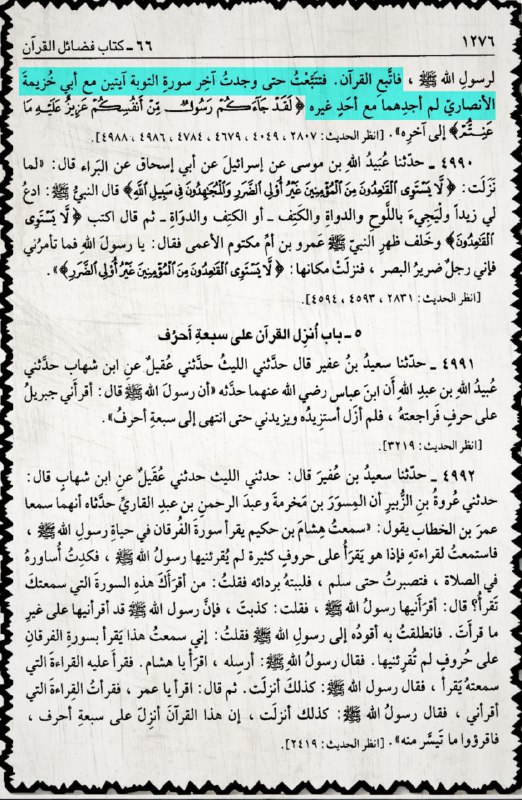
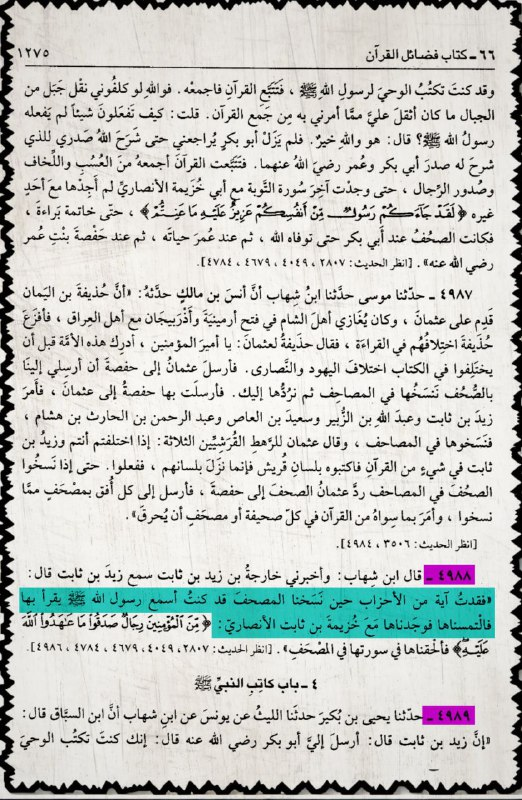
This page from Sahih al-Bukhari (Book 66: Virtues of the Qur’an) contains historical narrations regarding the compilation and standardization of the Quranic text during the eras of the Rightly Guided Caliphs.
1. The Initial Compilation under Abu Bakr
The top narrative details the first official compilation of the Quran following the Battle of Yamama.
-
The Task: Zayd ibn Thabit notes that Abu Bakr commanded him to locate and collect the Quran. Zayd expressed how immense this responsibility was, stating that moving a mountain would have been easier than compiling the Quran.
-
The Methodology: Zayd gathered the text from various materials including palm stalks, thin white stones, and from the memories of men.
-
The Final Verses of Surah At-Tawbah: Zayd highlights that he found the last verses of Surah At-Tawbah (“Verily, there has come unto you a Messenger from among yourselves…”) solely with Abu Khuzaima al-Ansari.
-
Preservation: The compiled sheets (Suhuf) remained with Abu Bakr until his death, then with Umar ibn al-Khattab, and subsequently with Umar’s daughter, Hafsah.
2. Hadith 4987: Standardization under Uthman ibn Affan
This section covers the secondary standardization of the Quran into an official codex (Mus-haf).
-
The Incident: Hudhayfah ibn al-Yaman returned from military campaigns in Armenia and Azerbaijan, deeply alarmed by the regional differences in Quranic recitation among Muslims. He urged Caliph Uthman to unite the community before they disputed over their scripture like previous nations.
-
The Process: Uthman borrowed the original Suhuf from Hafsah and commissioned a committee—consisting of Zayd ibn Thabit, Abd-Allah ibn al-Zubayr, Sa’id ibn al-Aas, and Abd al-Rahman ibn al-Harith—to copy them into standardized volumes.
-
The Rule of Dialect: Uthman instructed the three Quraishi committee members that if they disagreed with Zayd ibn Thabit on any linguistic point, they must write it in the dialect of the Quraish, as the Quran was revealed in their tongue.
-
Distribution: Once master copies were made, the original sheets were returned to Hafsah. Uthman dispatched a standardized copy to every Muslim province and ordered all other variant manuscripts or fragments to be burned.
3. Hadith 4988: The Missing Verse of Surah Al-Ahzab (Highlighted)
This specific entry focuses on a detail during the Uthmanic standardization process.
-
The Missing Text: Zayd ibn Thabit narrates that while they were copying the sheets into master volumes, he noticed a missing verse from Surah Al-Ahzab that he used to hear the Prophet Muhammad recite.
-
The Retrieval: After searching, he found it exclusively written with Khuzaima ibn Thabit al-Ansari.
-
The Verse: The text retrieved was: “Among the believers are men who have been true to their covenant with Allah…” (Surah Al-Ahzab, 33:23). It was then officially integrated into its proper place within the chapter.
4. Hadith 4989: Chapter on the Scribes of the Prophet
The final section marks the beginning of Chapter 4, titled “The Scribes of the Prophet”. It initiates an identical chain of narration where Zayd ibn Thabit recounts being summoned by Abu Bakr following the heavy casualties at the Battle of Yamama to begin the textual collection process.
This is evidenced by what Al-Bukhari narrated through Shu’ayb, on the authority of Az-Zuhri, who said: Ibn As-Sabbaq informed me that Zayd ibn Thabit Al-Ansari, may God be pleased with him, said: … until I found two verses from Surat At-Tawbah with Khuzaymah Al-Ansari that I did not find with anyone else: {There has certainly come to you a Messenger from among yourselves. Grievous to him is what you suffer} [At-Tawbah: 128] to the end of them.
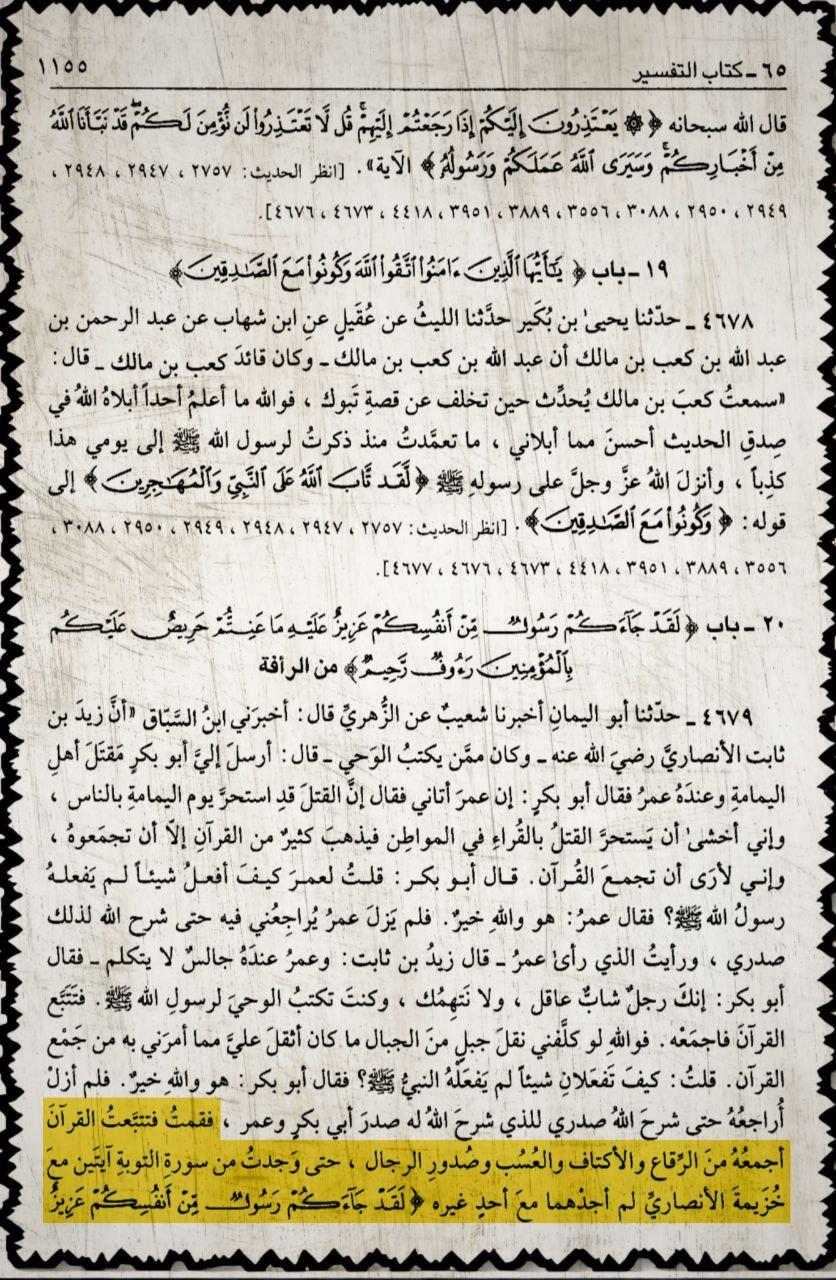
The highlighted passage is from Sahih al-Bukhari, Book 65 (Book of Prophetic Commentary on the Qur’an - Kitab At-Tafsir). It records the firsthand account of Zayd ibn Thabit regarding the exact methodology and materials used during the primary collection of the Quranic text under the direction of Caliph Abu Bakr al-Siddiq and Umar ibn al-Khattab.
Core Narrative Details
-
The Command and Execution: > Following the consensus reached between Abu Bakr and Umar to preserve the scripture, Zayd ibn Thabit states: “So, I started locating the Quranic material and collecting it…” >
-
The Physical Mediums of Collection: > The text specifies the primary raw materials from which the verses were gathered and cross-referenced:
-
Parchment and scraps: Pieces of skin, cloth, or available writing materials (Al-Riqa’).
-
Shoulder blades: Scapula bones of animals used for writing (Al-Aktaf).
-
Stalks of palm trees: Leaf-free palm branches (Al-Usub).
-
The memories of men: The oral preservation kept within the breasts of the companions (Sudur al-Rijal).
-
-
The Final Verses of Surah At-Tawbah: > Zayd explicitly notes a unique archival detail regarding the conclusion of Surah At-Tawbah (9:128):
-
He discovered the final two verses of this chapter exclusively in written form with a companion named Khuzaima al-Ansari.
-
He states clearly that he could not find these specific verses written down with anyone else at that exact moment.
-
The specific text recovered begins with the verse: “Verily, there has come unto you a Messenger from among yourselves. It grieves him that you should receive any injury or difficulty…”
-
Ibn al-Jawzi commented on this hadith, saying: “In some versions of this hadith, Zayd said: ‘I lost a verse from Surah al-Ahzab that I used to hear the Messenger of Allah, peace and blessings be upon him, recite. We searched for it and found it with Khuzaymah, whose testimony the Messenger of Allah made equivalent to the testimony of two men: {Among the believers are men who have been true to their covenant with Allah} [Al-Ahzab: 23].’ Someone might say: ‘This contradicts what was mentioned earlier, that they found the last verse of Surah At-Tawbah with Khuzaymah. So which is more correct?’ The answer is: ‘Both are correct. Both verses were found with Khuzaymah. The last verse of Surah At-Tawbah was found with him during the time of Abu Bakr, and the verse from Surah al-Ahzab was found with him during the time of Uthman.’”
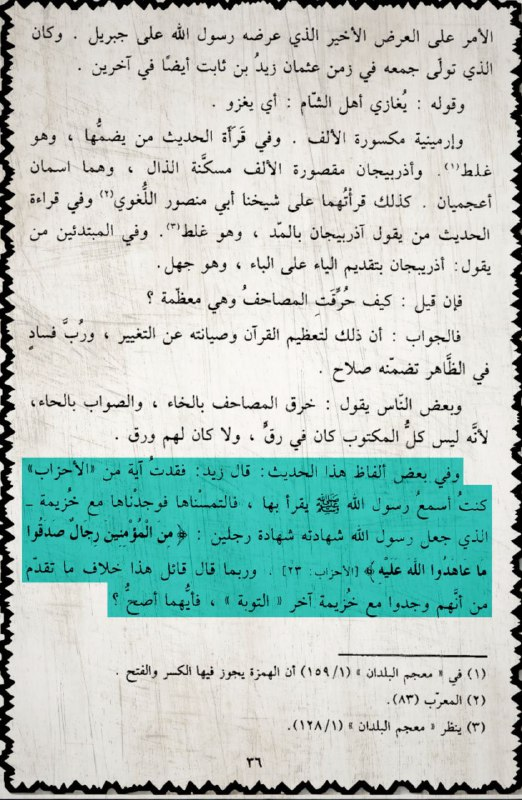
This passage addresses a specific textual variant in the narrations concerning the preservation of the Quran by Zayd ibn Thabit, highlighting a potential scholarly contradiction regarding where a particular verse was found.
Key Details of the Narrative
-
The Missing Verse of Surah Al-Ahzab: > Zayd ibn Thabit states that during the collection process, he noticed a missing verse from Surah Al-Ahzab that he used to hear the Prophet Muhammad recite.
-
The Source (Khuzaima): > They searched for it and found it explicitly with Khuzaima, whom the Prophet Muhammad had uniquely decreed that his solitary testimony was equivalent to the testimony of two men.
-
The Specific Verse: > The verse in question is: “Among the believers are men who have been true to their covenant with Allah…” (Surah Al-Ahzab, 33:23).
-
The Textual Conflict Raised: > The author notes that a reader might perceive a contradiction between this narration and previous accounts. Earlier accounts stated that the verses found uniquely with Khuzaima were actually the concluding verses of Surah At-Tawbah, rather than this verse from Surah Al-Ahzab. The text concludes by raising the critical question: “Which of the two accounts is more accurate?”
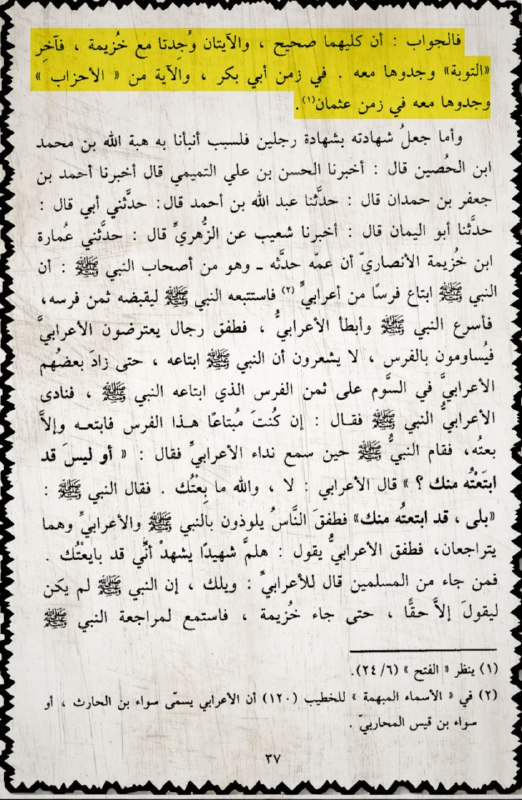
This passage provides the definitive scholarly answer to the question raised previously regarding where the missing verses were found and with which companion named Khuzaima.
Key Clarifications
-
Both Accounts are Correct: > The text resolves the apparent contradiction by stating: “The answer is: Both accounts are correct…”
-
The Distinction of Events and Eras: > The text explains that these were two separate historical events that took place under different Caliphs:
-
During the era of Abu Bakr: The final two verses of Surah At-Tawbah were the ones found uniquely with Khuzaima.
-
During the era of Uthman: The specific missing verse of Surah Al-Ahzab was the one found written with him.
-
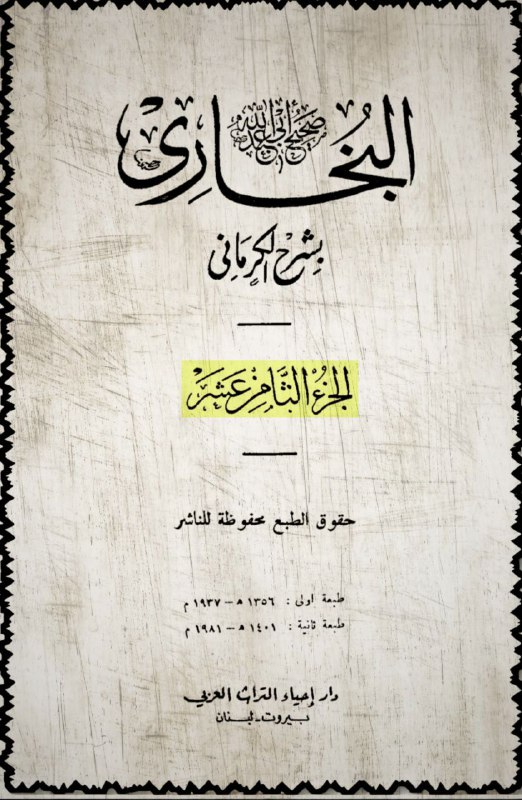
Al-Kirmani said: (If you say: It has been mentioned that the missing verse that he found with Khuzaymah is the last verse of Surat At-Tawbah! I say: There is no evidence of exclusivity in it, and there is no problem in both of them being written with him and not with others, or the first was when it was transferred from the palm leaves and the like to the pages, and the second was when it was transferred from the page to the Mushaf)
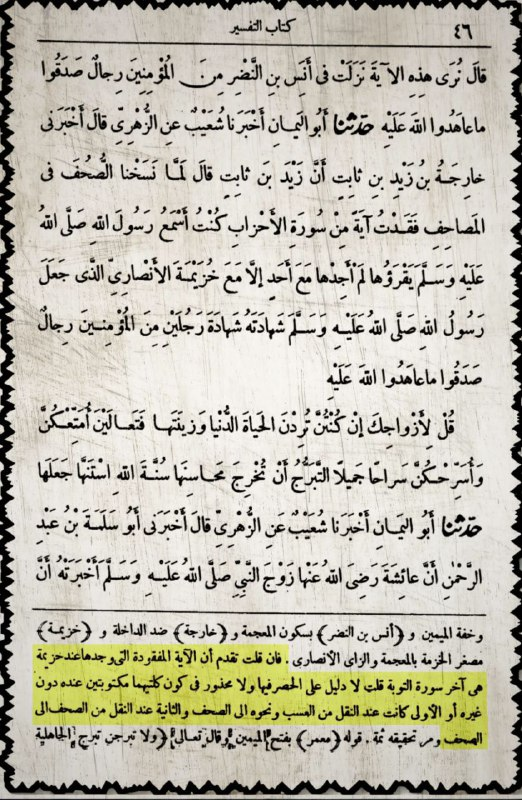
This text block provides a profound scholarly commentary concerning how the missing verses were preserved, clarifying what “finding them exclusively with Khuzaima” actually implies textually and contextually.
Key Interpretations
-
Refuting Complete Textual Absence: > The author notes: “If you object by saying that the missing verse found with Khuzaima is the end of Surah At-Tawbah, I reply that there is no absolute proof to limit the text exclusively to him in an absolute sense…”
-
No Issue with Dual Documentation: > The text states there is no theological or historical issue in both missing sections being found written down with him specifically, separate from other companions.
-
The Two Different Copying Phases: > The distinction lies in the nature of the textual transcription itself during the different compilation eras:
-
The First Instance (Abu Bakr’s Era): This occurred during the transfer of the text from raw materials like palm stalks (Al-Usub) onto the primary loose sheets (Al-Suhuf).
-
The Second Instance (Uthman’s Era): This occurred during the formal transcription and standardization from those primary sheets (Al-Suhuf) into the master official codices (Al-Masahif) once the precise verification of the content was completed.
-
The second point of reconciliation is that there is no contradiction between the two narrations. This is explained as follows: Zayd ibn Thabit found the verses with two Companions: Khuzaymah ibn Thabit al-Ansari and Abu Khuzaymah al-Ansari. Khuzaymah ibn Thabit al-Ansari had the verse from Surah al-Ahzab, and Abu Khuzaymah al-Ansari had the last two verses from Surah al-Tawbah. Ibn Battal said: “Because the verse in al-Tawbah was with Abu Khuzaymah, who was a well-known Ansar, and Anas recognized him and said: ‘We inherited it from him.’ The one in al-Ahzab is not a description of the Prophet, peace and blessings be upon him. This one was found with Khuzaymah ibn Thabit, who is not Abu Khuzaymah. Therefore, there is no contradiction in this. The story is not the same story, there is no ambiguity or confusion, and the surah is not the same surah. Zayd and Khuzaymah heard the one in al-Ahzab from the Prophet, so they are witnesses to having heard it from him. The one in al-Tawbah was only established by the testimony of Abu Khuzaymah alone because there is evidence of its authenticity in describing the Prophet, so it is sufficient evidence that makes it unnecessary to seek another witness.”
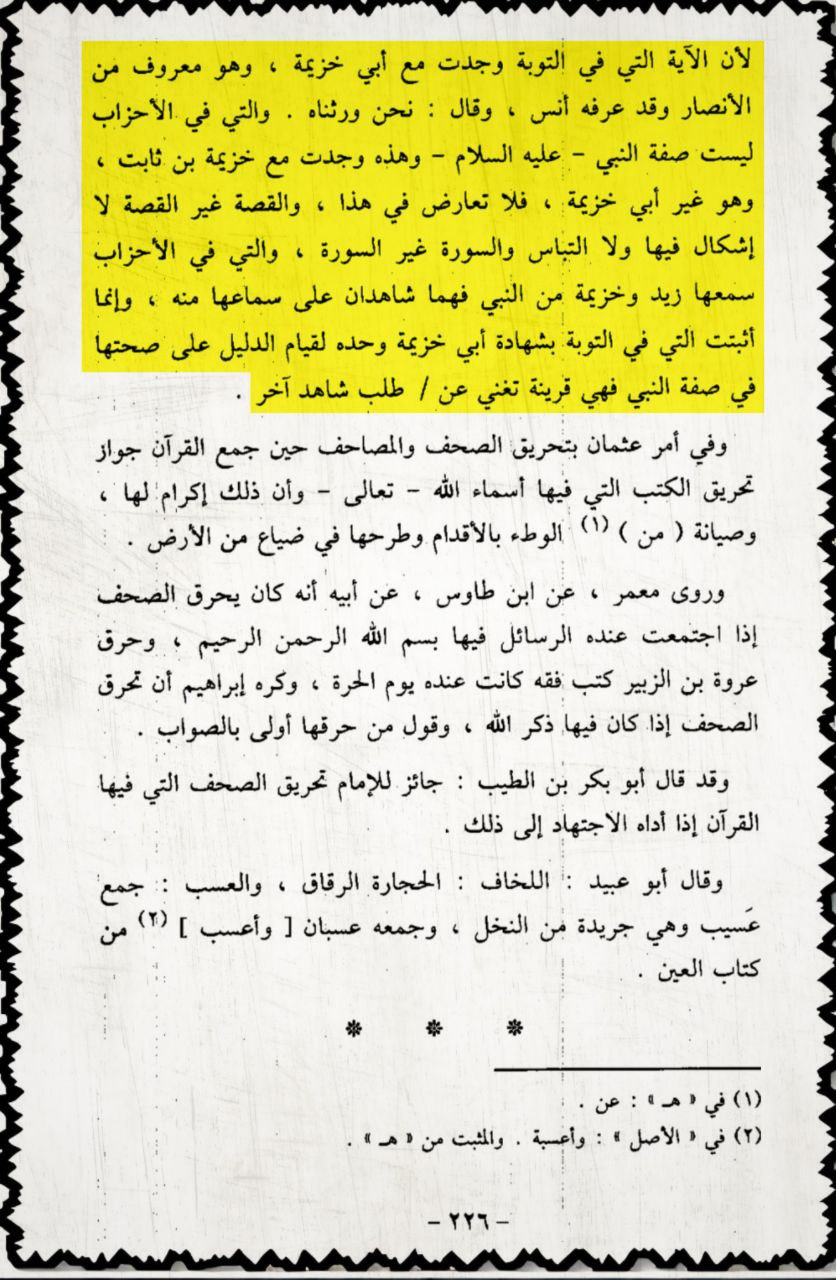
This section delivers the final critical breakdown that completely untangles any remaining confusion regarding the identity of the companions involved, the specific verses they held, and the evidentiary standards met for each.
Key Clarifications
-
Two Distinct Companions and Surahs: > The text explicitly divides the two scenarios to show there is no overlap or contradiction:
-
The Verse in Surah At-Tawbah: This was found with Abu Khuzaima, a well-known member of the Ansar whom Anas ibn Malik recognized and about whom Anas said, “We inherited him.”
-
The Verse in Surah Al-Ahzab: This was found with Khuzaima ibn Thabit, who is an entirely different individual from Abu Khuzaima. Thus, because the stories involve different people and different chapters, there is no complication or ambiguity.
-
-
The Difference in Eyewitness Testimony: > The commentary provides the underlying legal and historical proof for how each verse was validated:
-
For the Verse in Al-Ahzab: Both Zayd ibn Thabit and Khuzaima ibn Thabit had personally heard this verse directly from the Prophet Muhammad, meaning there were already two direct witnesses to its auditory recitation.
-
For the Verse in At-Tawbah: This verse was established solely based on the written testimony of Abu Khuzaymah alone. This was accepted because the contextual evidence (Qarina) regarding the descriptions of the Prophet within the verse itself was so overwhelmingly definitive that it completely substituted for the need to seek out an additional human witness.
-
Al-Khazin said: (His statement: “Until I found the end of Surat At-Tawbah with Khuzaymah or with Abu Khuzaymah Al-Ansari.” And in the other hadith: “I lost a verse from Surat Al-Ahzab—until he said:—and we found it with Khuzaymah ibn Thabit Al-Ansari: {Among the believers are men who have been true to their covenant with Allah} [Al-Ahzab: 23].” Know that the one mentioned in the first hadith is not the same as the one mentioned in the second hadith, and they are two separate incidents. As for the one mentioned in the first hadith: he is Abu Khuzaymah ibn Aws ibn Zayd ibn Asram ibn Tha’labah ibn Umar ibn Malik ibn An-Najjar Al-Ansari. He witnessed Badr and what followed it, and he died during the caliphate of Uthman. He is the one with whom I found the end of Surat At-Tawbah, as Ibn Abd Al-Barr mentioned. As for the one mentioned in the second hadith: he is Abu Amarah Khuzaymah ibn Thabit ibn Al-Fakih ibn Tha’labah ibn Sa’idah al-Khatmi al-Awsi al-Ansari, known as Dhu al-Shahadatayn (the one with two testimonies), witnessed Badr and what followed, and was killed on the day of Siffin with Ali ibn Abi Talib.
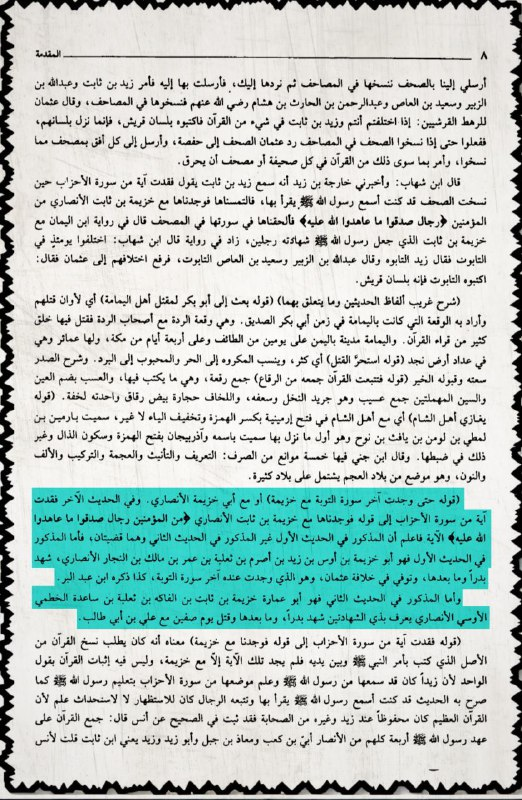
- The First Mentioned Khuzaymah: In the context of finding the end of Surah At-Tawbah, the companion referred to is Abu Khuzaymah bin Aws bin Zayd bin Asram (from the Banu Malik bin An-Najjar branch of the Ansar). He participated in the Battle of Badr and subsequent battles, and passed away during the caliphate of Uthman. This identification is supported by Ibn Abd al-Barr.
- The Second Mentioned Khuzaymah: In the context of finding the missing verse from Surah Al-Ahzab, the companion is Khuzaimah bin Thabit bin Al-Fakah bin Tha’labah (from the Khatmah branch of the Aws tribe). He is famously known as Dhu al-Shahadatayn (the one whose testimony is equal to two men). He also fought at Badr and later battles, and was martised during the Battle of Siffin while fighting alongside Ali bin Abi Talib.
The second objection is that Zayd ibn Thabit was satisfied with accepting the statement of a single Companion in establishing the verse’s inclusion in the Quran, whereas the premise is that the Holy Quran is established through continuous transmission (tawatur), and the absence of a verse casts doubt on the rest. Enemies of the religion have exploited this objection to cast doubt on the Quran’s continuous transmission. The answer to this objection is twofold: Firstly, one of Zayd ibn Thabit’s conditions for compiling the Quran was that he would not include a verse in the codex until he was certain it was written down during the Prophet’s lifetime (peace and blessings be upon him) through the testimony of trustworthy witnesses, and he would not rely solely on memorization. His statement, “So we sought it and found it with Khuzaymah ibn Thabit al-Ansari,” means that Zayd did not find it written down with anyone except Khuzaymah ibn Thabit al-Ansari. His statement, “A verse from Surah al-Ahzab was missing…”, indicates that this was Zayd’s intended meaning. His use of the word “lost” suggests that he had memorized this verse and that it was known to him, but he lost its written form and found it only with Khuzaymah. Otherwise, who informed Zayd of the loss of the verse?
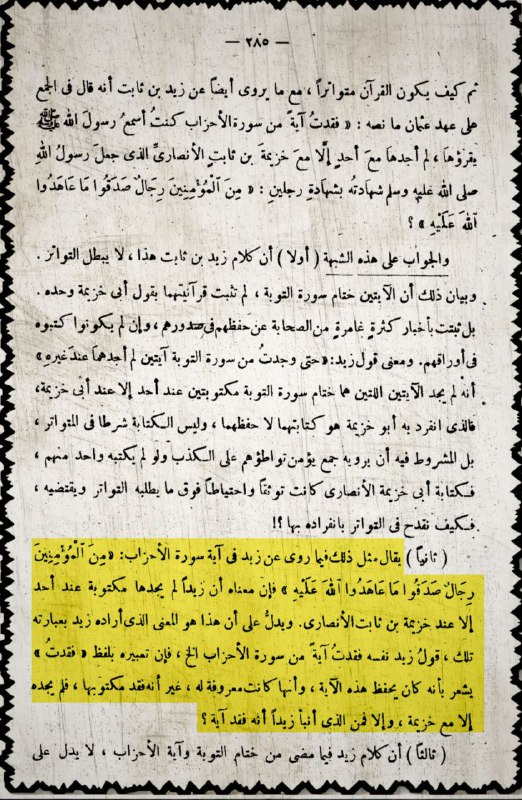
- Meaning of the Missing Verse: The second point of the argument states that regarding the verse from Surah Al-Ahzab (“Among the believers are men who have been true to their covenant with Allah…”), Zayd bin Thabit’s statement means he simply could not find it written down with anyone else except Khuzaymah bin Thabit Al-Ansari.
- Evidence of Written Form vs. Memorization: Zayd’s choice of the word “lost” (faqa’dtu) implies that he already knew and memorized the verse himself. It was a known verse to him; he merely lacked the written record of it until he found it with Khuzaymah. Otherwise, if it wasn’t already known, Zayd wouldn’t have realized a verse was missing in the first place.
Ibn Hajar said: (What appears in the answer is that what he indicated is that its loss is the loss of its written existence, not the loss of its being preserved. Rather, it was preserved with him and with others. This is indicated by his statement in the hadith of the compilation of the Qur’an: “So I began to follow it from the parchments and palm leaves.”) The benefit of following is to exaggerate in memorization and to stop at what was written in the presence of the Prophet, may God bless him and grant him peace. See: Fath al-Bari (9/15).
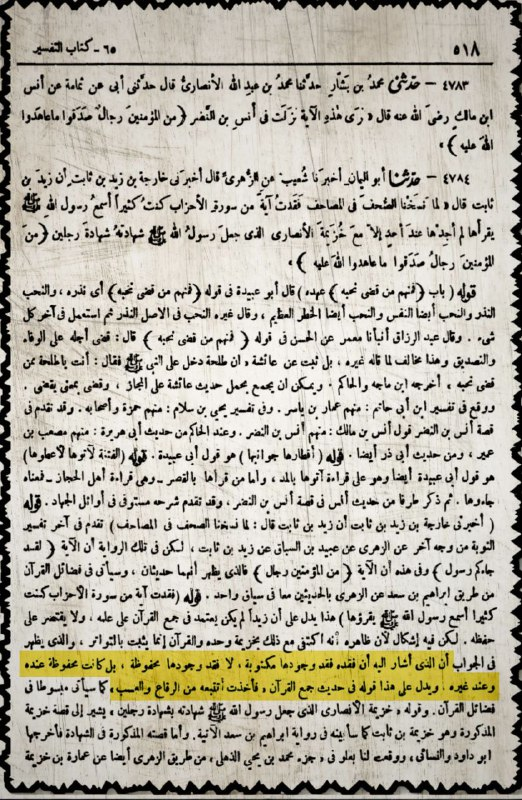
- Nature of the Missing Verse: The correct answer indicated by the text is that when Zayd bin Thabit noted he “lost” the verse, it means he found it missing in written form, not that its existence was lost or forgotten.
- Evidence of Memorization: On the contrary, the verse was completely memorized and preserved by Zayd himself, as well as by other companions. This is further proven by his own statement during the compilation of the Qur’an: “So I followed up tracking the Qur’an, collecting it from parchment, scapula bones, and palm stalks…” which will be elaborated on in the chapters regarding the virtues of the Qur’an.
Badr al-Din al-Ayni, may God have mercy on him, said: (It was said: How can it be included in the Qur’an when the condition for the Qur’an is that it be transmitted through multiple chains of narration? The answer is: It was heard by them from the mouth of the Messenger of God, may God bless him and grant him peace, and its chapter and its place were known to them, so they lost its writing. It was said: Since the Qur’an was transmitted through multiple chains of narration, then what is this investigation and examination of the palm leaves? The answer is: For verification, and it was written in the presence of the Messenger of God, may God bless him and grant him peace, and to know whether it contains a reading other than his reading from its various forms or not)
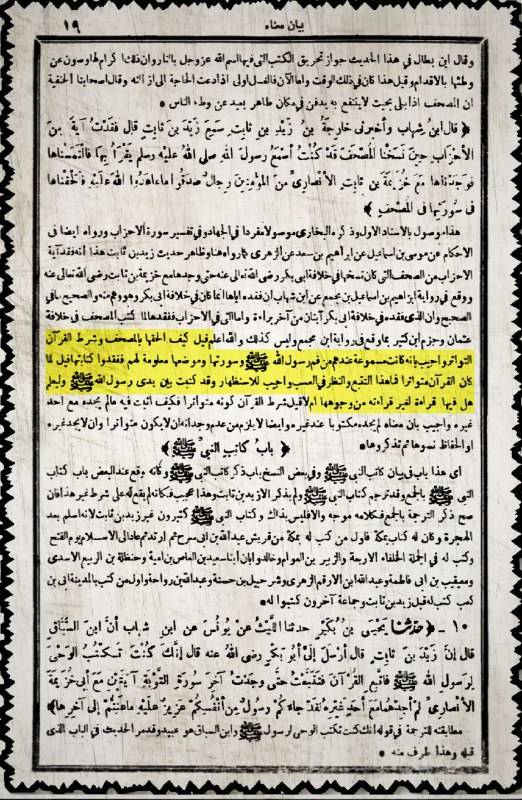
The text addresses a question regarding how a specific verse could be added to the official Mushaf (compiled Quranic text) if a prerequisite for accepting Quranic verses is total mutawatir transmission (widespread concurrent narration).
The response explains that the verse was already well-known and documented in terms of its exact wording and placement within its respective chapter. The companions specifically sought out its written form, as it had originally been transcribed directly in the presence of the Prophet Muhammad.
Furthermore, the passage notes that the core objective was verification through searching for the written copy, while exploring whether the condition for accepting a verse relies strictly on it being mutawatir through written records, or if oral memorization suffice. It concludes that the physical absence of a written record at a particular moment does not negate its status as mutawatir, provided that memorizers still retained it or remembered it later.
Ibn Hazm explains Zayd’s meaning, saying: “As for Zayd ibn Thabit’s missing the verse, it is not as the ignorant thought. Rather, it means that he did not find it written except with that man. This is clear in a hadith narrated to us by Abd al-Rahman ibn Abd Allah, on the authority of Abu Ishaq al-Balkhi, on the authority of al-Farabri, on the authority of al-Bukhari: Abu al-Yaman told us: Shu’ayb informed us, on the authority of al-Zuhri, who said: Kharijah ibn Zayd ibn Thabit informed me that Zayd ibn Thabit said: ‘When we copied the Qur’an into copies, I missed a verse from Surat al-Ahzab, which I used to hear the Messenger of Allah (peace and blessings be upon him) recite. I did not find it with anyone except with Khuzaymah ibn Thabit al-Ansari, whose testimony the Messenger of Allah (peace and blessings be upon him) considered equivalent to the testimony of two men.’” {Among the believers are men who have been true to their covenant with Allah. Some of them have fulfilled their pledge, and some are still waiting, and they have not altered [it] in the least.} [Al-Ahzab: 23]. Abu Muhammad said: The explanation of what we have said is explicitly stated in this hadith itself; for Zayd related that he heard this verse from the Prophet, peace and blessings be upon him, and it was also with Zayd.
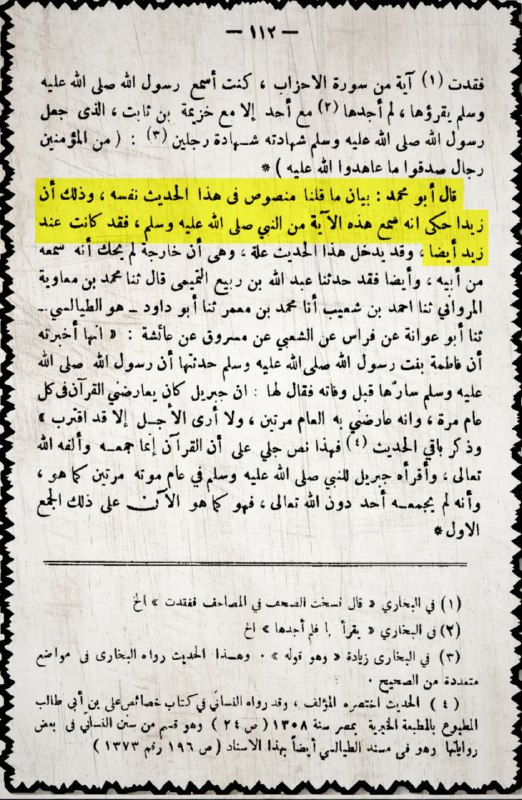
Abu Muhammad states that the explanation of what was mentioned earlier is explicitly stated within this Hadith itself. This is because Zayd related that he heard this specific verse directly from the Prophet, peace and blessings be upon him, meaning that the verse was already retained in memory and known by Zayd as well.
Al-Khazin says: “His statement, ‘I lost a verse from Surat al-Ahzab,’ up to his statement, ‘and we found it with Khuzaymah,’ means that he was seeking a copy of the Quran from the original manuscript written by order of the Prophet (peace and blessings be upon him) and in his presence. He found that verse only with Khuzaymah. This does not establish the Quran based on the testimony of a single individual, because Zayd had heard it from the Messenger of Allah (peace and blessings be upon him) and knew its location in Surat al-Ahzab through the Prophet’s teaching, as the hadith states: ‘I used to hear the Messenger of Allah (peace and blessings be upon him) recite it.’ His seeking out other men was for the purpose of memorization, not to acquire new knowledge, because the Glorious Quran was already preserved with Zayd and other Companions. It is authentically reported from Anas that he said: ‘Four men, all from the Ansar, compiled the Quran during the time of the Prophet (peace and blessings be upon him): Ubayy ibn Ka’b, Mu’adh ibn…’” Jabal, Abu Zayd, and Zayd ibn Thabit…)
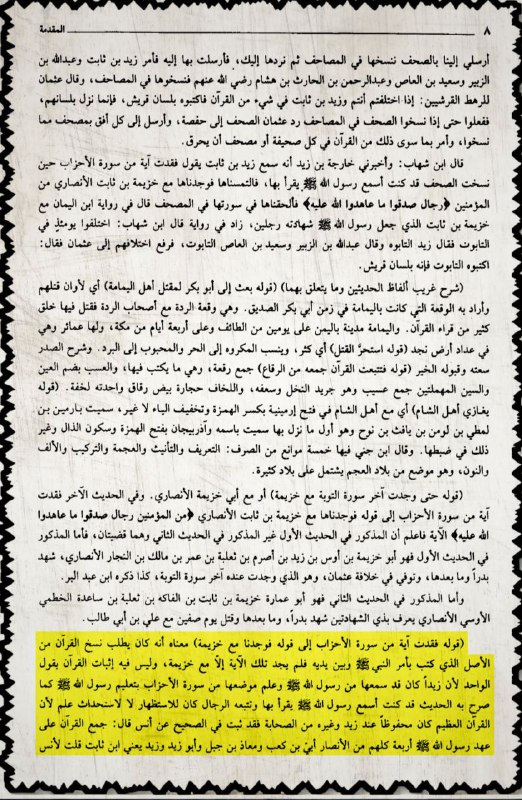
The phrase regarding the missing verse of Surah Al-Ahzab being found only with Khuzaymah means that Zayd was searching for the original written copy that was transcribed directly under the instruction of the Prophet, peace and blessings be upon him. It does not mean the verse was verified based solely on the testimony of a single person.
This is because Zayd had already heard the verse from the Prophet, peace and blessings be upon him, and knew its exact placement within Surah Al-Ahzab. The tracking and verification process was strictly intended to locate the physical, written records for verification, rather than initiating new knowledge, as the Great Quran was already fully memorized and preserved by Zayd and other companions. This is supported by the authentic narration of Anas, which confirms that four individuals from the Ansar—Ubayy ibn Ka’b, Mu’adh ibn Jabal, Zayd ibn Thabit, and Abu Zayd—had completely collected and memorized the Quran during the lifetime of the Prophet, peace and blessings be upon him.
Abu Shama said: “Zayd was seeking copies of the Quran other than those written by order of the Prophet, may God bless him and grant him peace. He could only find that verse written down with that person, otherwise the verse would have been preserved with him and others. This meaning is preferable to what Makki and others mentioned.”
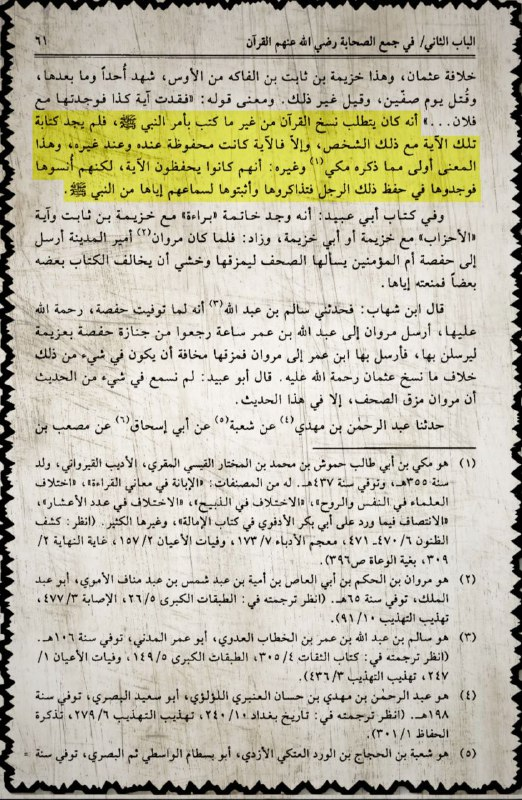
The phrase indicating that a verse was missing and only found with a specific person means that the compiler sought to copy the Quran from the original texts written directly under the command of the Prophet, peace and blessings be upon him. It does not mean the verse itself was unknown, as it was already memorized by the compiler and others.
This interpretation is preferred over the view mentioned by Makki and others, which suggests that the companions had temporarily forgotten the verse, only to remember and document it after finding it preserved in writing by that specific individual who had heard it directly from the Prophet, peace and blessings be upon him.
This is further clarified by the following point: Secondly, Zayd ibn Thabit’s statement does not invalidate the mutawatir (mass-transmitted) transmission. The explanation is that the two verses concluding Surah At-Tawbah were not established as Quranic solely by Abu Khuzaymah’s statement; rather, their status was established through numerous reports from the Companions, who had memorized them even if they hadn’t written them down. Zayd’s statement, “Until I found two verses from Surah At-Tawbah that I didn’t find with anyone else,” means that he didn’t find the two verses concluding Surah At-Tawbah written down by anyone except Abu Khuzaymah. What Abu Khuzaymah uniquely possessed was their writing, not their memorization. Writing is not a condition for mutawatir transmission; rather, the condition is that it be narrated by a group whose collusion on a lie is inconceivable, even if none of them wrote it down. Abu Khuzaymah al-Ansari’s writing was an act of documentation and precaution beyond what mutawatir transmission requires and necessitates. So how can we cast doubt on mutawatir transmission because he alone possessed it?
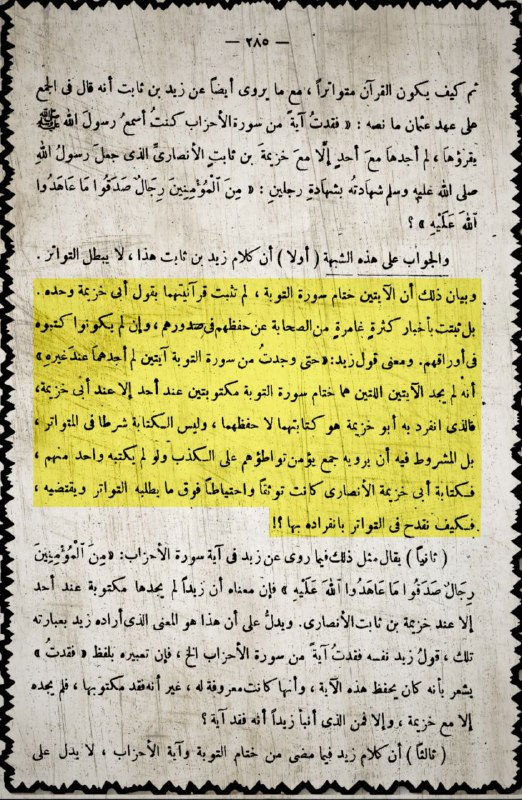
The explanation of this point is that the two concluding verses of Surah At-Tawbah were not established based on the testimony of Abu Khuzaymah alone. Rather, they were verified by mass-transmitted reports from numerous companions who had memorized them in their hearts, even if they had not written them down on their own parchments.
When Zayd stated that he did not find these two verses with anyone else, it means he could not find them written down with anyone except Abu Khuzaymah. Therefore, what Abu Khuzaymah uniquely possessed was the written record of these verses, not the memorization of them. Writing is not a prerequisite for a text to be considered mutawatir (mass-transmitted); the actual requirement is that it is narrated by a group large enough to preclude any possibility of collusion or fabrication, even if not a single one of them had written it down.
Consequently, the written document held by Abu Khuzaymah Al-Ansari served as an extra layer of verification and precaution that went above and beyond the requirements of mutawatir transmission. Therefore, his unique possession of the physical manuscript cannot be used to undermine the mutawatir status of the verses.
Al-Zarkashi said: “Zayd’s statement, ‘I only found it with Khuzaymah,’ does not prove the Qur’an with a single report, because Zayd had heard it and knew its location in Surat Al-Ahzab through the teaching of the Prophet, may God bless him and grant him peace, and so did other companions, then he forgot it. When he heard it, he remembered it, and his following of men was for the purpose of memorization, not for the purpose of creating knowledge.”
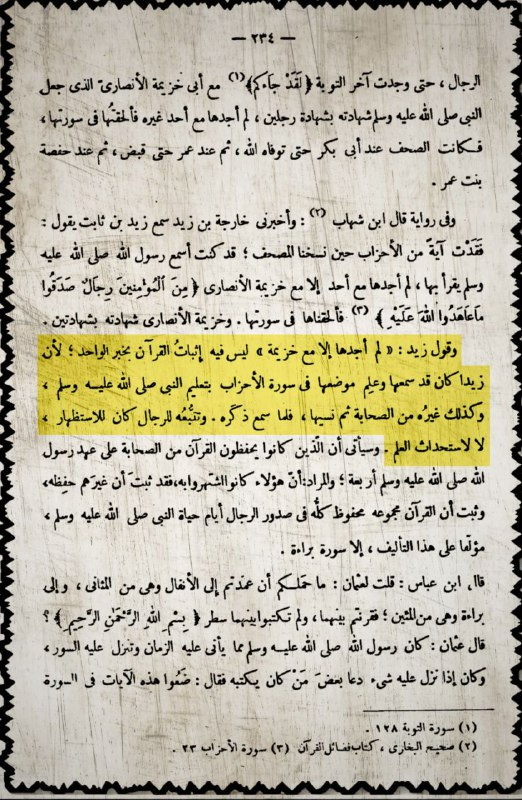
Zayd’s statement, “I did not find it with anyone except Khuzaymah,” does not indicate that the Quran was established based on a solitary report. This is because Zayd himself had previously heard the verse and knew its exact placement in Surah Al-Ahzab through the teaching of the Prophet, peace and blessings be upon him.
Similarly, other companions had also heard it, though some may have subsequently forgotten it until it was mentioned again. Therefore, the tracking and verification process involving different individuals was meant for corroboration and verification, not for initiating new knowledge.
Badr al-Din al-Ayni, may God have mercy on him, said: “It has been said that the condition for the Qur’an is that it be transmitted through multiple independent chains of narrators (mutawatir), so how can it be established that which he did not find with anyone else? The answer is that its meaning is: he did not find it written with anyone else. Also, it does not necessarily follow that its absence means it is not transmitted through multiple independent chains of narrators, or that he did not find it with anyone else, or that the memorizers forgot it and then remembered it.”
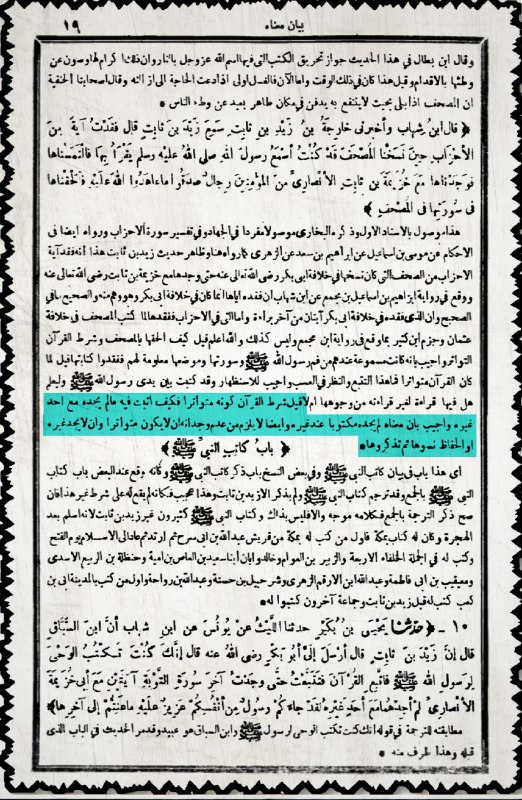
A question is raised: If a necessary condition for validating the Quran is its mutawatir (mass-transmitted) status, how can this status be established if a verse is found with only one individual?
The response clarifies that “not finding it with anyone else” means it could not be found written down in anyone else’s possession. Furthermore, the temporary absence of a physical manuscript or written record does not disprove its mutawatir nature, nor does it imply that the verse cannot be considered mutawatir if memorizers had temporarily forgotten it and then recalled it later.
Dr. Muhammad Hassan Jabal states: “The text explicitly states a condition of utmost importance and extreme caution regarding the Book of God. In practice, this became one of the crucial requirements: that two witnesses testify to what is brought by someone who possesses a portion of the Quran memorized in their heart or in a written document. Naturally, the testimony would be that what so-and-so brought is indeed from the Quran. But how can this be established for the two witnesses? The answer is that the two witnesses themselves must have memorized the portion of the Quran that so-and-so brought, either written down or preserved, and possess a copy of the written text that was in the presence of the Messenger of God, peace and blessings be upon him. Even more significant is that the two witnesses must have been present at the revelation and recording of this portion in the presence of the Messenger of God, peace and blessings be upon him. In summary, the elements of authentication were threefold: 1The text must be written down in the presence of the Prophet, peace and blessings be upon him. 2The text must be preserved and received directly from the Prophet, peace and blessings be upon him, or from someone who received it directly from him. 3Two witnesses must testify to the two preceding conditions.”
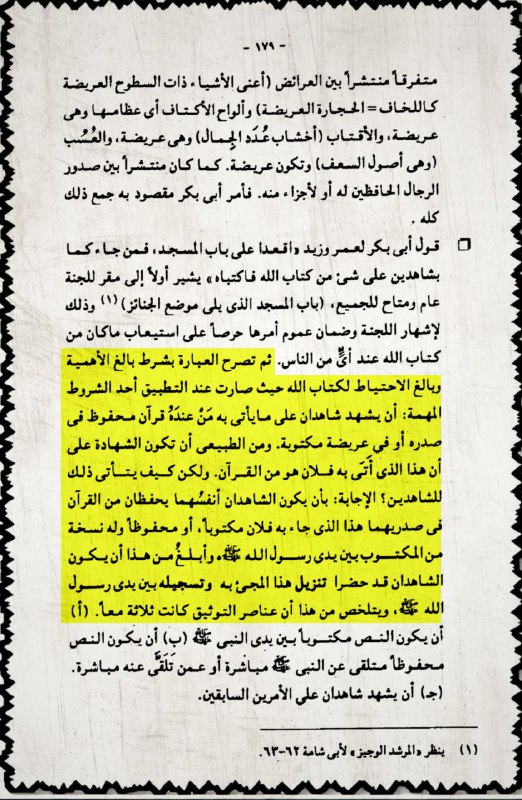
The text emphasizes a highly important and cautious condition applied during the compilation of the Book of Allah: the requirement of two witnesses for any brought text. For anyone presenting a portion of the Quran—whether preserved in their memory or written on a parchment—two witnesses had to testify that it was indeed part of the Quran.
This verification by the two witnesses was achieved in one of three ways:
-
Both witnesses had memorized that specific Quranic text themselves.
-
The text brought by the person was memorized and matched a written copy transcribed directly in the presence of the Prophet, peace and blessings be upon him.
-
More perfectly, both witnesses had personally been present during the revelation of that specific text and its subsequent recording in front of the Prophet, peace and blessings be upon him.
In summary, the verification process relied on three combined elements:
-
(a) The text must be written in the presence of the Prophet, peace and blessings be upon him.
-
(b) The text must be memorized and received either directly from the Prophet, peace and blessings be upon him, or from someone who received it directly from him.
-
(c) Two witnesses must testify to both of the aforementioned conditions.
Al-Zarqani, may God have mercy on him, said: “Zayd followed a precise and meticulous method in his compilation of the Quran, established for him by Abu Bakr and Umar, may God be pleased with them both. This method ensured the preservation of God’s Book with the utmost care, meticulous caution, and comprehensive investigation befitting its sanctity. He did not rely solely on what he had memorized, nor on what he had written, nor on what he had heard directly. Rather, he diligently pursued and investigated, committing himself to relying on two sources in his compilation: first, what was written in the presence of the Messenger of God, peace and blessings be upon him; and second, what was preserved in the hearts of men. His extreme caution was such that he would not accept anything written unless two just witnesses testified that it had been written in the presence of the Messenger of God, peace and blessings be upon him.” Thirdly, Zayd’s statements regarding the conclusion of Surah At-Tawbah and the verse of Al-Ahzab do not indicate a lack of widespread transmission, even assuming he meant that Abu Khuzaymah and Khuzaymah were the only ones to have mentioned them from memory. At most, his words indicate that they were the only ones to have initially mentioned them, and then the Companions recalled what they had mentioned. These Companions were a group whose collusion on falsehood was inconceivable, so those verses were recorded in… The newspapers and the Qur’an after this transmission was established in them
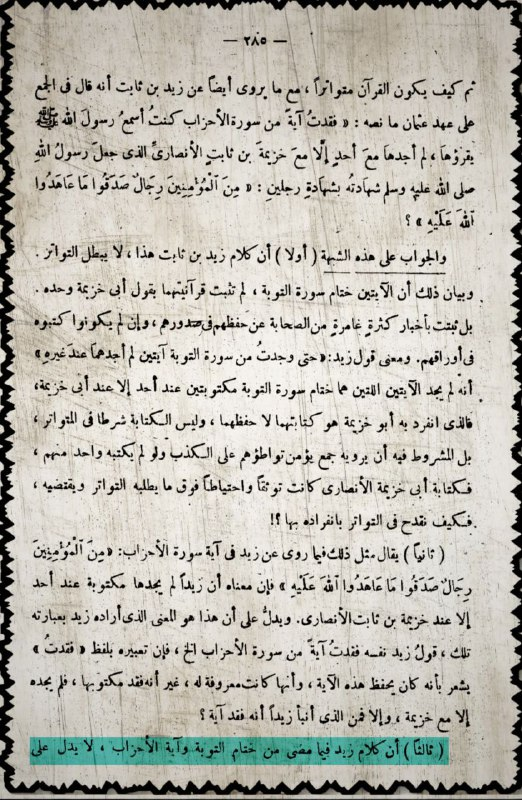
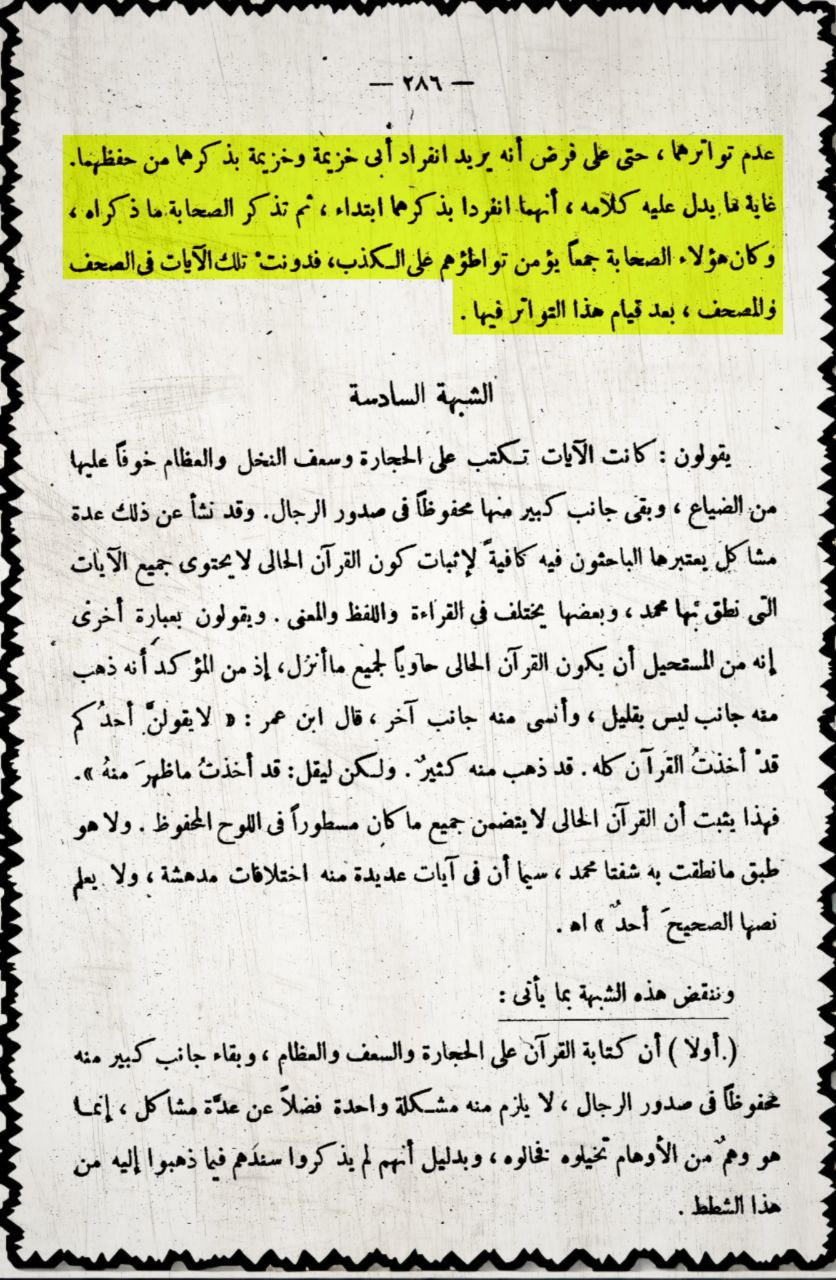
Thirdly, the previous statements made by Zayd regarding the end of Surah At-Tawbah and the verse of Surah Al-Ahzab do not imply a lack of mutawatir (mass-transmission) status. Even if it is assumed for the sake of argument that Abu Khuzaymah and Khuzaymah were unique in recalling these verses from memory, the most this indicates is that they were the ones to initially initiate the reminder. Following their reminder, the remaining companions—who formed a group large enough to preclude any possibility of collusion or fabrication—recalled what they had forgotten. Consequently, these verses were documented in the manuscripts and pages only after their collective mutawatir status was securely established among the group.

Abu Bakr’s Constitution for Writing the Manuscripts:
Zayd followed a precise, meticulous method established for him by Abu Bakr and Umar to ensure the absolute safeguarding and preservation of the Book of Allah. This method relied on extreme verification, utmost caution, and comprehensive tracking. Zayd did not merely rely on what he had memorized in his heart, what he had personally written down, or what he had heard with his own ears.
Instead, he committed himself to compiling the text by relying on two primary sources:
-
First: The written material recorded directly in the presence of the Prophet, peace and blessings be upon him.
-
Second: The verses preserved through memorization within the hearts of men.
To demonstrate his extraordinary caution and vigilance, he would not accept any written text unless two just witnesses testified that it had indeed been recorded in the direct presence of the Prophet, peace and blessings be upon him.
The third issue concerns Zayd ibn Thabit’s loss of the verses. Did this occur during the time of Abu Bakr or during the time of Uthman (may God be pleased with them both)? The answer to this issue is that the loss of the verse of Al-Ahzab, and its subsequent discovery by Khuzaymah ibn Thabit, occurred during the compilation and copying of the Quran during the time of Abu Bakr (may God be pleased with him), and not during the time of Uthman (may God be pleased with him).
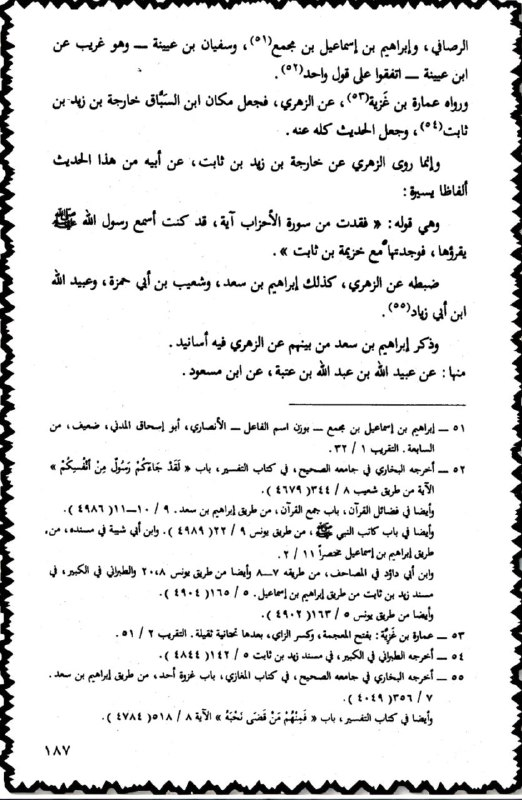
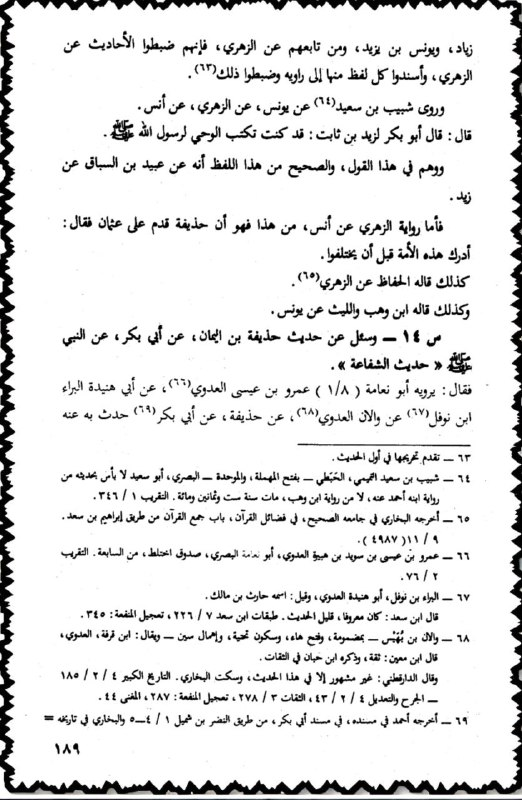
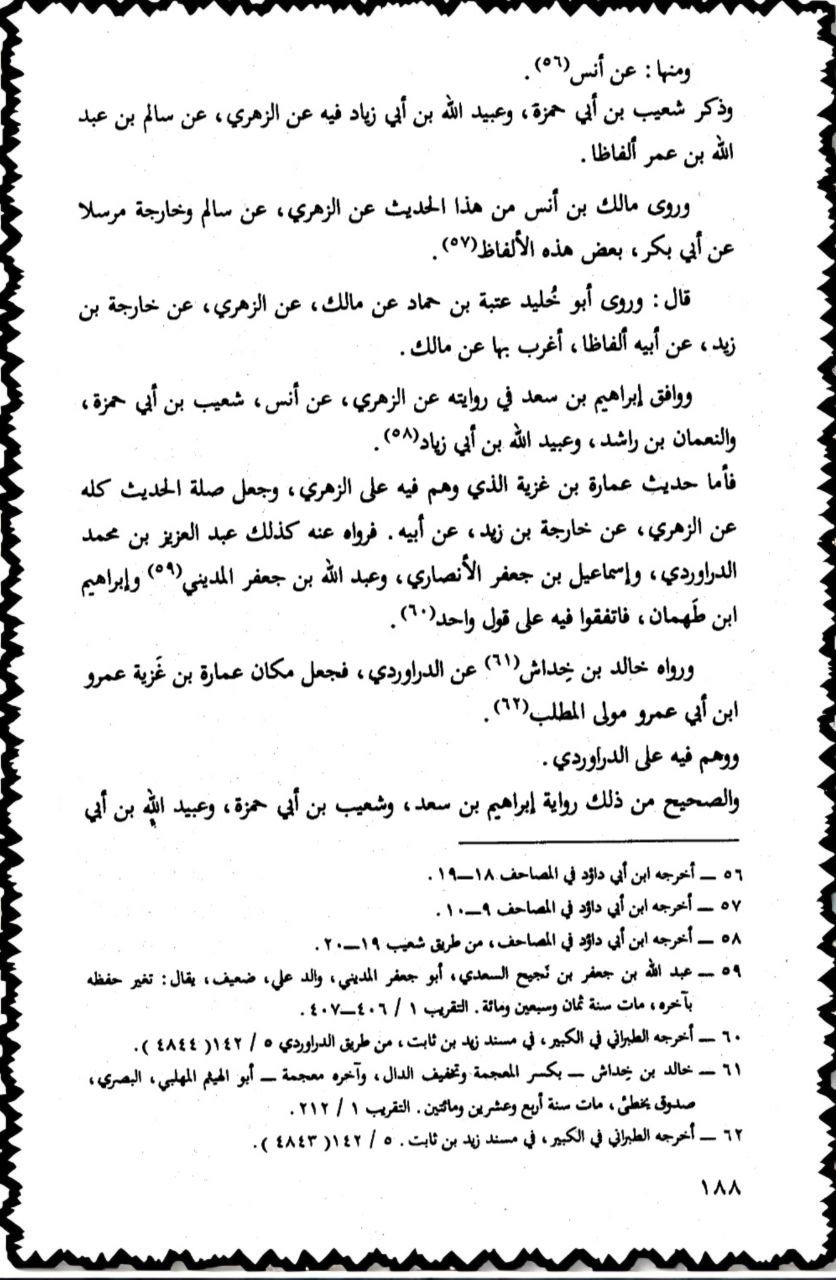
Imam al-Daraqutni (may God have mercy on him) stated that the chain of narration for this story is from Ibn Shihab al-Zuhri, who said: Kharijah ibn Zayd ibn Thabit informed me that he heard Zayd ibn Thabit (may God be pleased with him) say: “I have lost a verse from Surah al-Ahzab…” etc. This chain of narration is one of the chains through which the story of the compilation of the Quran during the time of Abu Bakr al-Siddiq (may God be pleased with him) was narrated. As for al-Zuhri’s narration of the story of the copying of the Qur’an during the time of Uthman (may God be pleased with him), he narrated it directly from Anas ibn Malik, and not from Zayd ibn Thabit. Imam al-Daraqutni was asked about the hadith of Zayd ibn Thabit, on the authority of Abu Bakr al-Siddiq, concerning the compilation of the Qur’an. He said: “It is a hadith about the compilation of the Qur’an, narrated by al-Zuhri, on the authority of Ubayd ibn al-Sabbaq, on the authority of Zayd ibn Thabit. A group of people narrated it from al-Zuhri in the same way—and he mentioned a group of them—and they all agreed on one version. Amarah ibn Ghaziyah narrated it from al-Zuhri, but he replaced Ibn al-Sabbaq with Kharijah ibn Zayd ibn Thabit, and attributed the entire hadith to him. Al-Zuhri only narrated a few words of this hadith from Kharijah ibn Zayd ibn Thabit, on the authority of his father, which is his statement: ‘I missed a verse from Surat al-Ahzab that I used to hear the Messenger of Allah (peace and blessings be upon him) recite often, and I found it with Khuzaymah ibn Thabit.’ This was also recorded from al-Zuhri by Ibrahim ibn Sa’d, Shu’ayb ibn Abi Hamzah, and Ubayd Allah ibn Abi Ziyad… As for al-Zuhri’s narration on the authority of Anas regarding this, it is that Hudhayfah came to Uthman said: “Save this nation before they disagree.” This was also narrated by al-Hafiz on the authority of al-Zuhri, and it was also narrated by Ibn Wahb and al-Layth on the authority of Yunus.
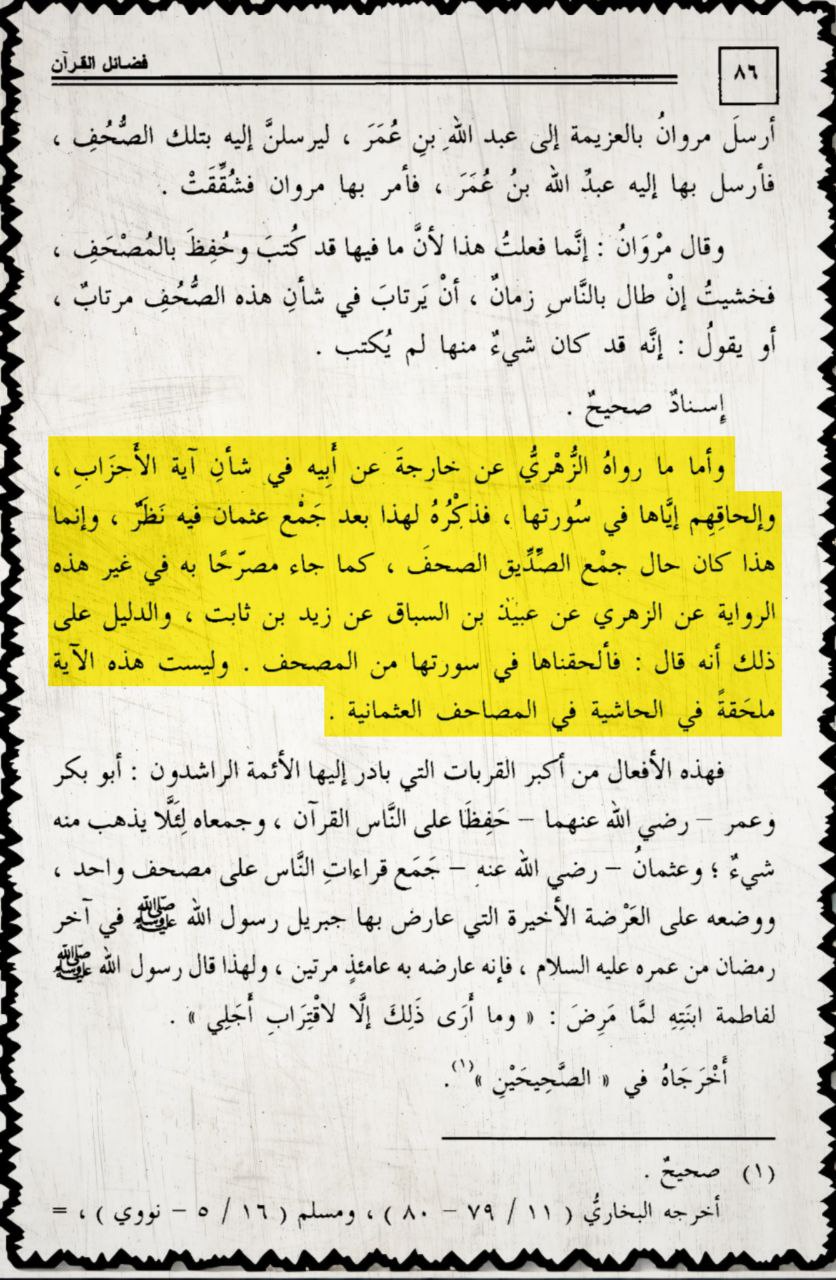
Regarding the narration by Az-Zuhri from Kharijah from his father concerning the verse of Surah Al-Ahzab and its subsequent addition to its respective chapter: the claim that this occurred during the compilation of Uthman is questionable.
Instead, this event actually took place during the compilation initiated by Abu Bakr As-Siddiq. This is explicitly clarified in other variants of the narration reported by Az-Zuhri from Ubayd ibn As-Sabaq from Zayd ibn Thabit, where Zayd states, “So we added it to its Surah in the Mushaf.” Furthermore, this verse was fully integrated within the text of the chapter and was not merely an added note or footnote in the Uthmanic manuscripts.
Imam al-Bukhari, may God have mercy on him, mentioned Zayd ibn Thabit’s statement about the loss of the verse of al-Ahzab following the story of copying the Qur’an during the time of Uthman, may God be pleased with him, not because he believed that the loss of the verse occurred during the time of Uthman, but because the narrator on the authority of al-Zuhri - who is Ibrahim ibn Sa’d - is the one who narrated both narrations, so he included them in order of mentioning them only, and not in order to establish that they were in one context, and that is in (the chapter on the compilation of the Qur’an). This is indicated by the fact that al-Bukhari, may God have mercy on him, narrated the hadith about the loss of the verse of al-Ahzab on the authority of other narrators on the authority of al-Zuhri in two other places in the Sahih, and there is no hadith in them about the story of copying the Qur’an during the time of Uthman, may God be pleased with him, and that is in (the chapter on the Battle of Uhud), and in (the chapter: {So among them are some who have fulfilled their vow and some who are waiting}). 3All the scholars who explained and cited this hadith did so to clarify Zayd ibn Thabit’s methodology in compiling the Quran during the time of Abu Bakr al-Siddiq (may God be pleased with him). They explained how he stipulated that a verse be written down with the testimony of witnesses, in addition to being memorized and accurately recorded. This constitutes a consensus among them that the context of the hadith was during the time of al-Siddiq (may God be pleased with him). Al-Hafiz Ibn Kathir (may God have mercy on him) said: “As for what al-Zuhri narrated from Kharijah, from his father, concerning the verse of al-Ahzab and its inclusion in its chapter, his mentioning this after Uthman’s compilation is questionable. Rather, this was the case during al-Siddiq’s compilation of the pages, as explicitly stated in other narrations from al-Zuhri, from Ubayd ibn al-Sabbaq, from Zayd ibn Thabit. The proof of this is that he said: ‘So we included it in its chapter of the Quran,’ and this verse is not an appendix in the margin of the Uthmanic codices.” This is what I know, and God is Most High and All-Knowing. Attributing knowledge to Him is safer than error or slip, so we ask God to forgive us.
The objection that Zayd ibn Thabit “lost” three verses from the Quran — and that this undermines the Quran’s preservation — rests on multiple layers of misreading that classical scholars have thoroughly addressed:
First: The apparent contradiction between the narration of a verse from Surah al-Ahzab and two verses from Surah al-Tawbah is resolved by recognizing they are two separate incidents involving two separate companions (Khuzaymah ibn Thabit and Abu Khuzaymah al-Ansari) during two separate compilation phases (Abu Bakr’s era and Uthman’s era).
Second: The word “lost” (faqa’dtu) refers to the written record only, not to the memorized text. Zayd ibn Thabit already knew these verses by heart — he was searching for their written documentation from the Prophet’s lifetime, not seeking to establish their existence.
Third: The Quran’s tawatur (continuous mass transmission) was never dependent on a single written copy. The verses were memorized by numerous companions; the written record served as additional verification, not as the sole basis of preservation.
Fourth: Zayd’s methodology — requiring two just witnesses to testify that a verse was written in the Prophet’s presence — demonstrates the extreme caution of the compilation process, not its deficiency.
Fifth: The context of the hadith in Sahih al-Bukhari, when traced through its chains of transmission, consistently places the “loss” of the al-Ahzab verse during Abu Bakr’s compilation, not Uthman’s. Al-Bukhari’s placement of the narration after Uthman’s story is due to the narrator Ibrahim ibn Sa’d having transmitted both stories, not because the events occurred simultaneously.
The Quran remains — in word and in writing — exactly as it was revealed.