Distortion of the Text of 1 Timothy 3_16 (Great Is the Mystery of Godliness_ God Was Manifested in T
Distortion of 1 Timothy 3:16: “God Was Manifested in the Flesh”
This text is treated by Christian theologians as a basic pillar in proving the “mystery of godliness” and the incarnation.
Table of Contents
- The Text of 1 Timothy 3:16
- Why This Text Matters
- Pope Shenouda Used This Text as Proof
- The Manuscript Problem
- OC Not ΘC
- Ancient Manuscripts Support “Who” Not “God”
- Critical Greek Editions Reject “God”
- Arabic Translations Also Removed “God”
- The Theological Difference Is Huge
- The Copyists Changed the Core of the Text
- James Annis Admits the Problem
- Timothy Paul Jones Admits the Alteration
- Deliberate Distortion by Pious Copyists
- Conclusion
The Text of 1 Timothy 3:16
“Without controversy, great is the mystery of godliness: God was manifest in the flesh, was justified in the Spirit.”
καὶ ὁμολογουμένως μέγα ἐστὶν τὸ τῆς εὐσεβείας μυστήριον· Θεὸς ἐφανερώθη ἐν σαρκί ἐδικαιώθη ἐν πνεύματι
The key disputed word is:
- ΘC / Θεός = God
- OC = who / the one who
The article argues that the original reading was OC, meaning “who/the one who,” and that later copyists altered it into ΘC, meaning “God.”
Why This Text Matters
Christian theologians used this text as one of their strongest prooftexts for:
- the divinity of Christ,
- the incarnation,
- the claim that God appeared in human flesh,
- and the mystery of redemption.
So if the word “God” is not original, then one of the strongest Biblical “proofs” for incarnation collapses.
Pope Shenouda Used This Text as Proof
He placed it under a chapter titled:
“Explicit verses that indicate His divinity”
Then he followed this text by saying:
“It is clear from this verse that Christ is God who appeared in the flesh.”
Father Munis Abdel Nour also used it as evidence when introducing the doctrine of incarnation.
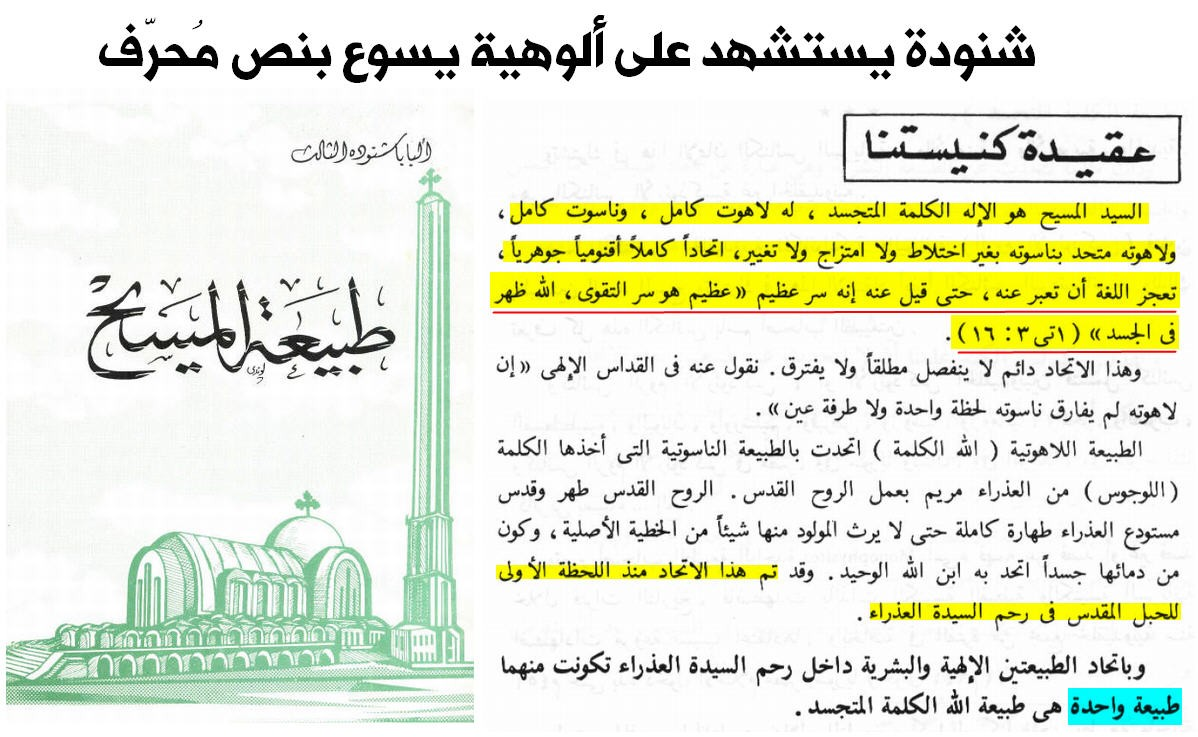
The scan is important because Pope Shenouda uses the disputed reading “God appeared in the flesh” as a direct theological proof for incarnation. He treats the verse as evidence that Christ is God who appeared in human flesh. Therefore, if the word “God” in this verse is textually corrupt, then this entire Christological argument is built on a corrupted reading. This scan proves that the altered wording was not a minor translation issue; it became a major prooftext in Christian theology.
The Manuscript Problem
The corrupt copyist tried to put a line inside the letter Ο to make it Θ.
In other words:
- OC = who / the one who
- ΘC = God
But because the pen and the size of the pen were different, the alteration was exposed, and the manuscript remained as a witness to deliberate distortion.
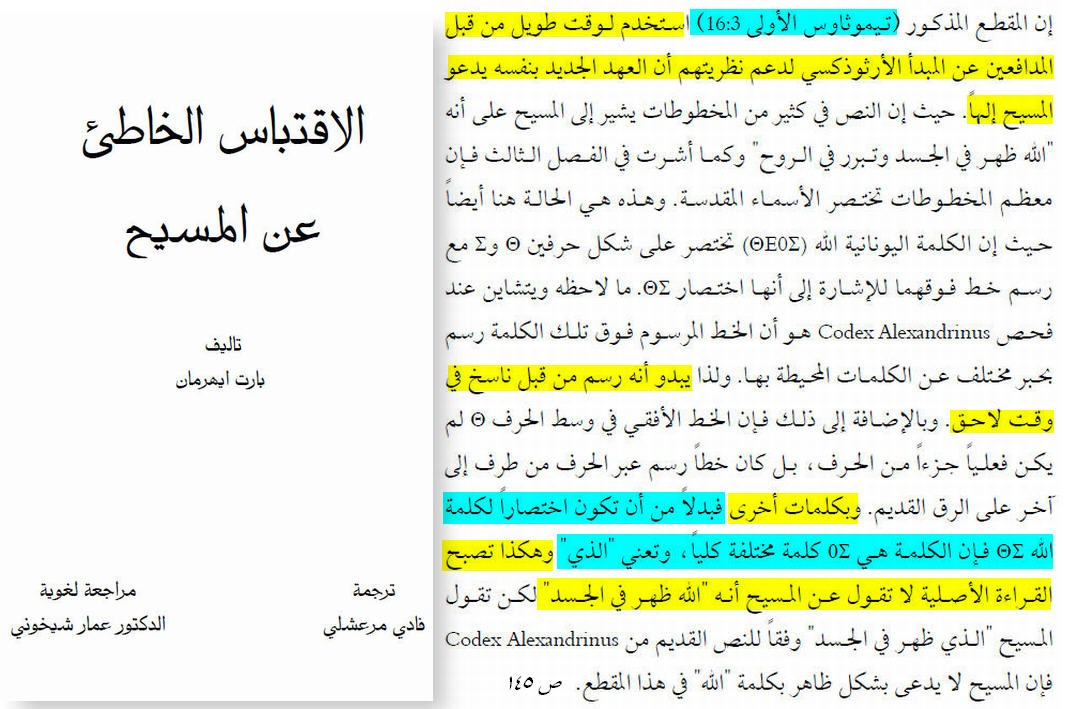
The scan focuses on the Greek manuscript issue: the Greek abbreviation for God is written as ΘC, while the word “who” is OC. Ehrman explains that in Codex Alexandrinus the line above the word appears to have been written by a later hand, and the horizontal stroke inside the theta does not look original. Therefore, the original reading was not ΘC / God, but OC / who.
This scan is powerful because it explains exactly how the corruption happened: a small stroke was added, turning “who” into “God.” It also says the original reading does not say “God appeared in the flesh,” but rather “the one who appeared in the flesh.” This directly destroys the use of 1 Timothy 3:16 as a clean proof for incarnation.
OC Not ΘC
OC = the one who
These include:
- the Sinaitic manuscript,
- the Alexandrian manuscript,
- the Ephraemi manuscript,
- the Ethiopian witnesses,
- and others.
Ancient Manuscripts Support “Who” Not “God”
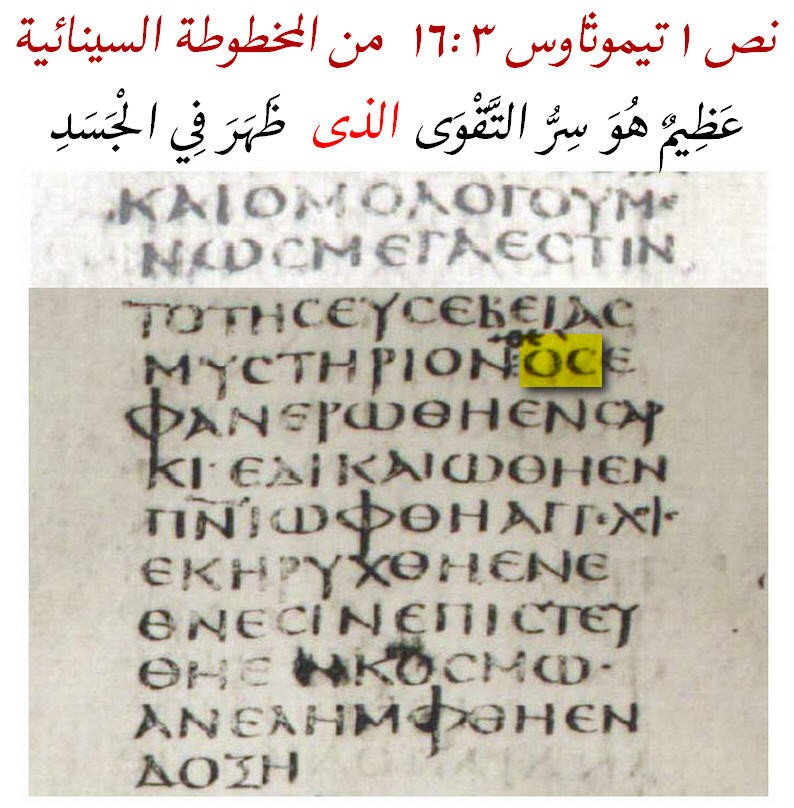
This matters because the Sinaitic manuscript is one of the most important ancient witnesses to the New Testament text. It does not support the later reading ΘC / God. Instead, it supports the reading OC / who.
So the scan proves that the older manuscript evidence does not say “God appeared in the flesh.” It says “who appeared in the flesh.” This removes the verse from being a direct proof that God became incarnate.
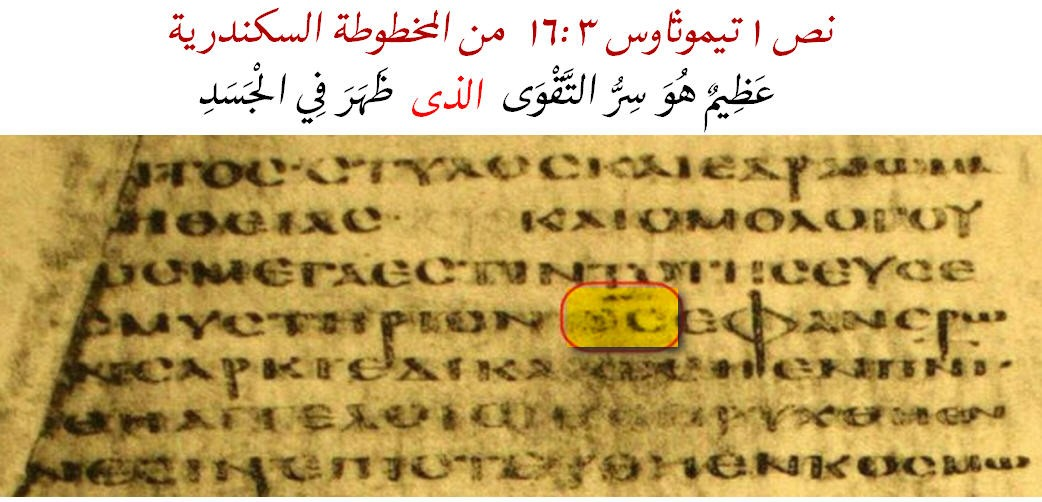
The importance of this scan is that the Alexandrian manuscript became central to the debate because of the visible alteration. The claim is that the manuscript originally had OC, but later a stroke was added in order to make it appear as ΘC. This would transform the meaning from “who was manifested in the flesh” into “God was manifested in the flesh.”
This scan therefore supports the manuscript-level argument: the dispute is not just about translation. It is about whether the Greek manuscript originally contained the word God at all. The evidence points toward the reading “who”, while the reading “God” depends on a later scribal change.
Critical Greek Editions Reject “God”
They preferred the reading:
OC = who / the one who
instead of:
ΘC = God
This reading appears in critical Greek editions such as:
- Nestle-Aland,
- Westcott-Hort,
- UBS,
- Samuel Tregelles,
- Tischendorf,
- and other critical editions that relied on the oldest and best manuscripts of the New Testament.
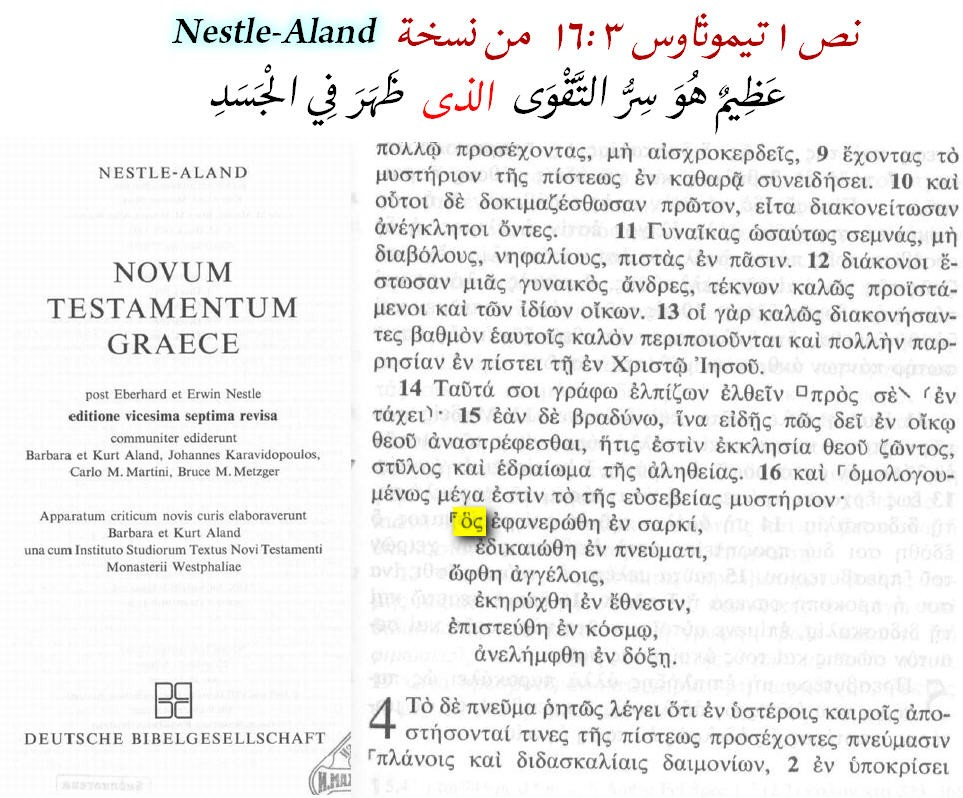
This is important because Nestle-Aland is one of the most respected critical editions of the Greek New Testament. It is not a Muslim polemical source. It is a mainstream scholarly Greek text used by Bible translators and textual critics.
The scan proves that the best critical Greek editions reject the reading “God appeared in the flesh.” Instead, they print the reading “who appeared in the flesh.” This means modern textual criticism itself admits that the explicit word God does not belong in the original text of 1 Timothy 3:16.
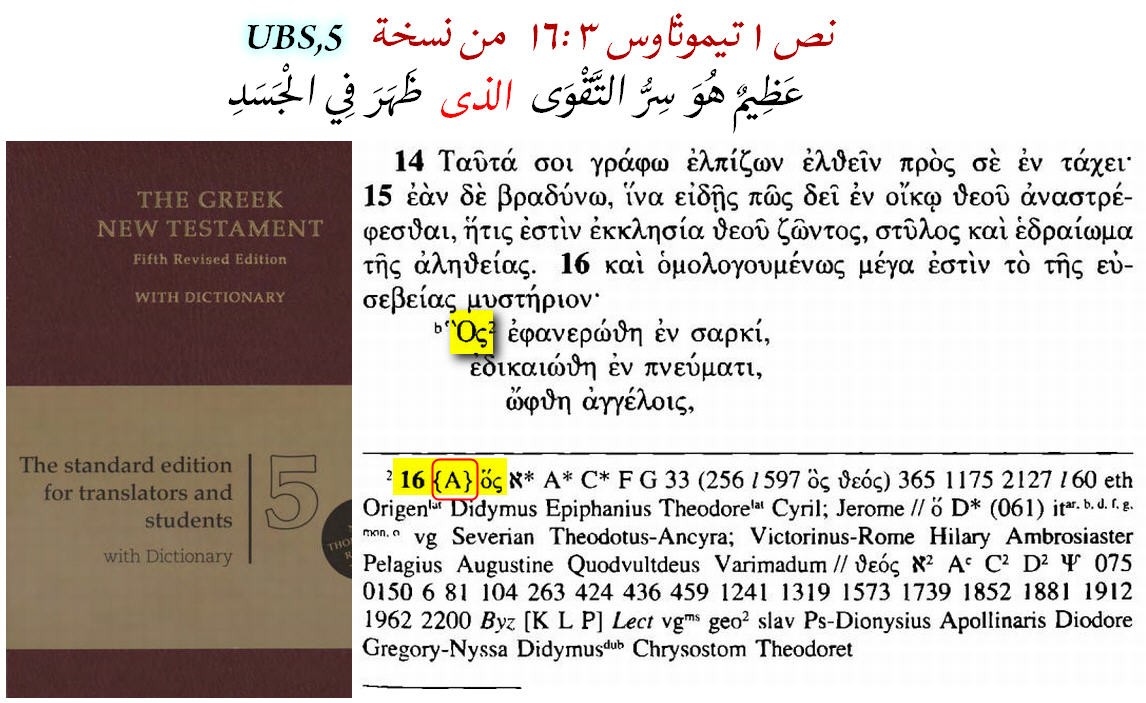
The apparatus below the verse lists the manuscript evidence. The scan shows that UBS gives this reading a high textual rating and records the variant readings underneath. The reading θεός / God appears as a later variant, not as the main text.
This scan is important because the UBS Greek New Testament is a standard scholarly edition used by translators. It confirms that serious textual critics do not print “God was manifested in the flesh” as the original reading. They print “who was manifested in the flesh.” This directly weakens the Christian apologetic use of the verse as an explicit incarnation proof.
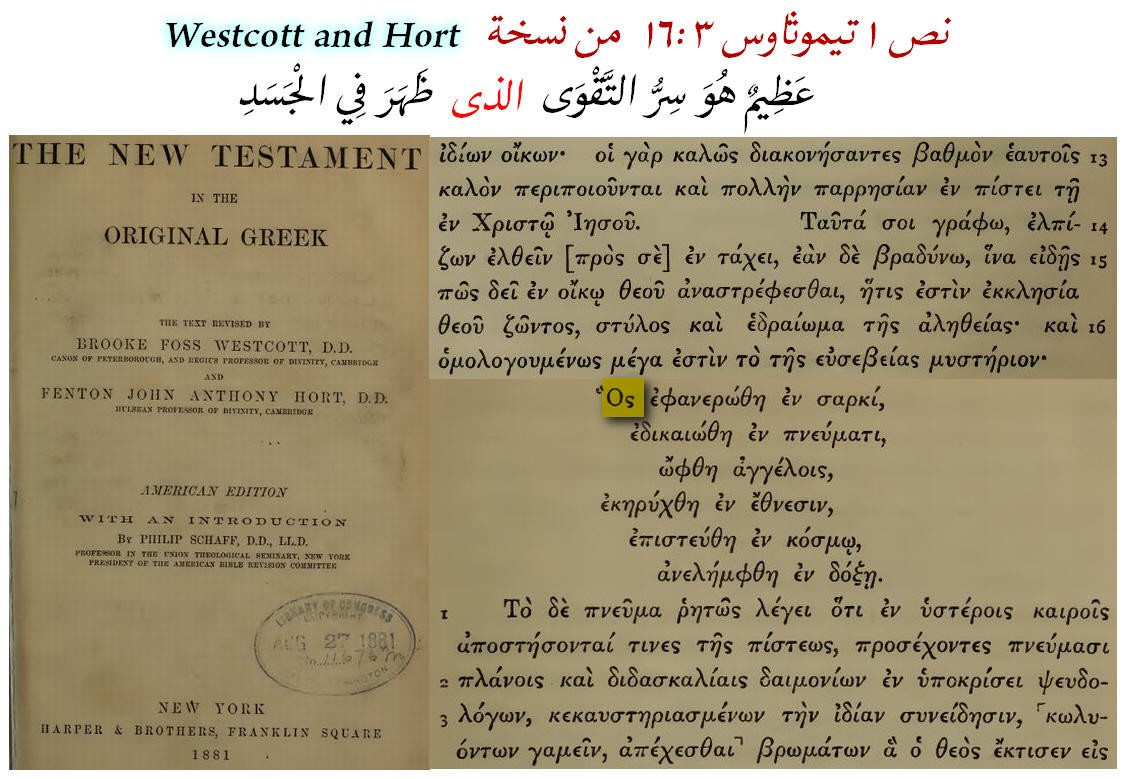
Westcott and Hort were major figures in New Testament textual criticism. Their Greek edition was highly influential in moving away from later Byzantine/Textus Receptus readings and toward earlier manuscript evidence.
This scan proves that Westcott and Hort also rejected the reading “God appeared in the flesh.” They printed “who appeared in the flesh.” This shows that the correction is not isolated to one modern edition; it is part of the wider critical tradition.
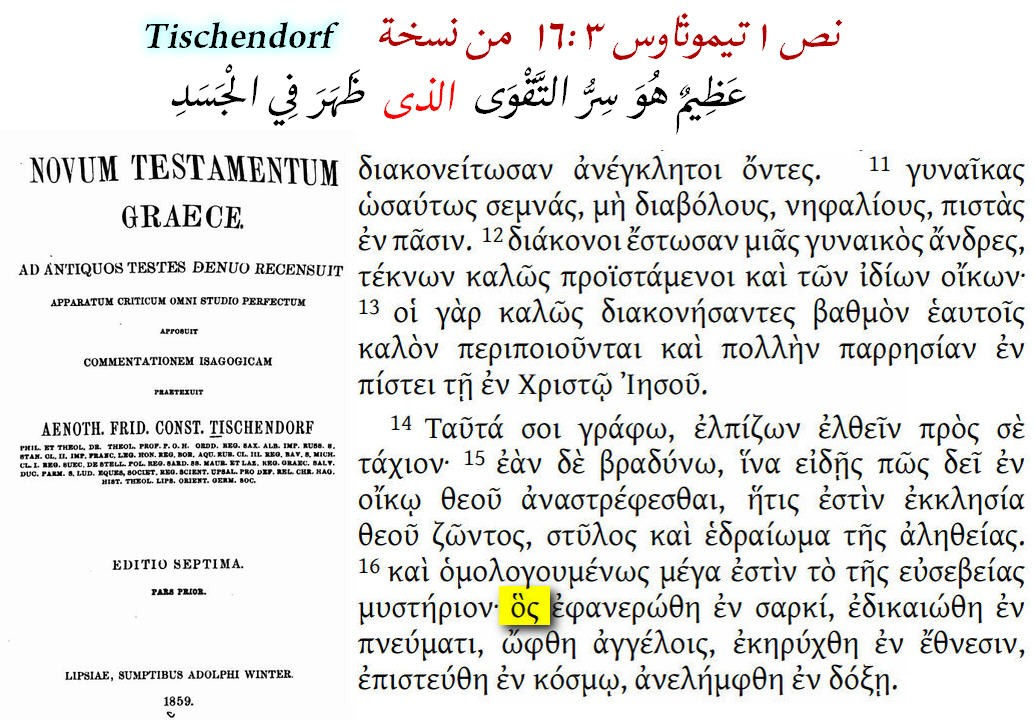
Tischendorf is especially important because of his work with ancient manuscripts, including Codex Sinaiticus. His edition gives serious weight to earlier manuscript witnesses.
This scan therefore adds another major critical witness against the reading “God was manifested in the flesh.” Tischendorf prints the reading “who was manifested in the flesh,” meaning the explicit word God is not supported as the original reading.
Arabic Translations Also Removed “God”
This committee included Biblical scholars and theologians from different Christian churches, including:
- Catholic,
- Orthodox,
- and Evangelical churches.
The text in that translation reads:
“And there is no dispute that great is the mystery of godliness: He was manifested in the flesh, and was declared righteous in the Spirit…”
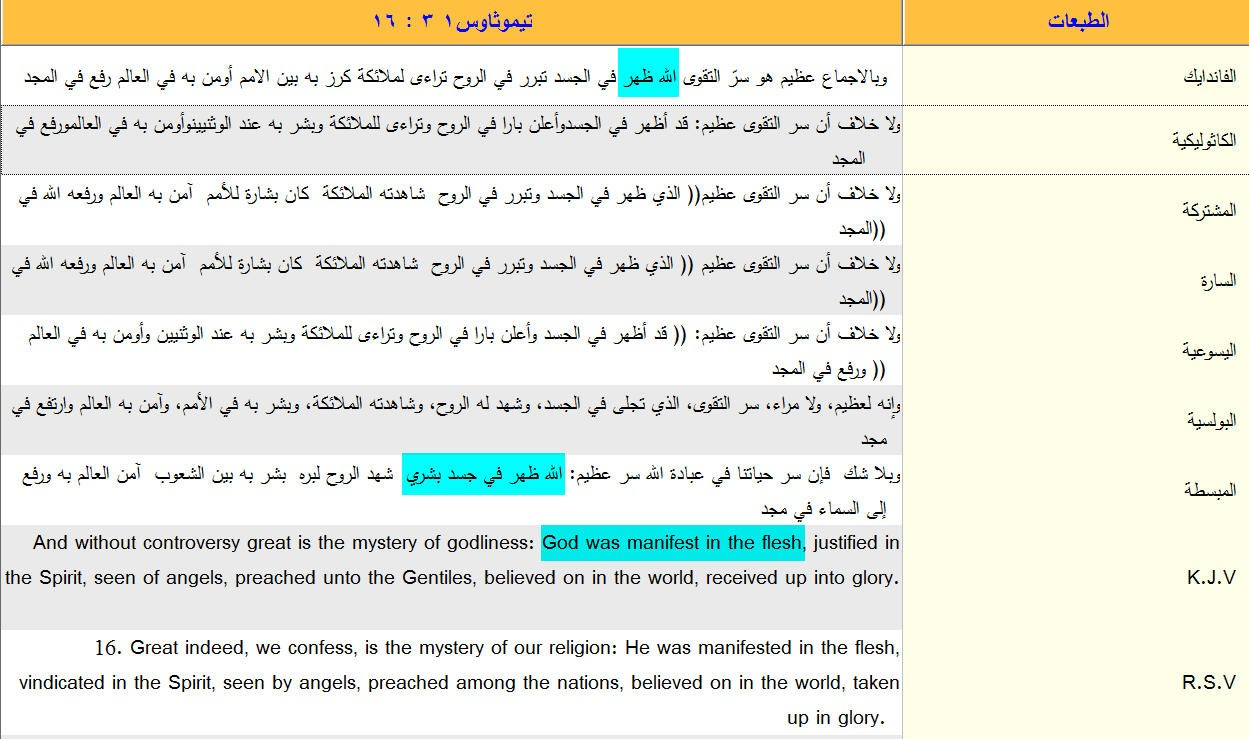
Instead, the Arabic text reads in meaning: “Great is the mystery of godliness: He was manifested in the flesh, declared righteous in the Spirit…” The explicit word God is absent.
This scan is important because it shows that even Christian Arabic translators accepted the textual problem. They removed the word God because the stronger manuscript evidence does not support it. The result is devastating for the apologetic argument: Arabic-speaking Christians reading this corrected translation no longer have a verse that directly says God appeared in flesh.
Their text also reads:
“And there is no dispute that great is the mystery of godliness: He was manifested in the flesh, and was declared righteous in the Spirit…”
The article says many other Bible translations, Arabic and English, old and new, also follow this corrected reading.
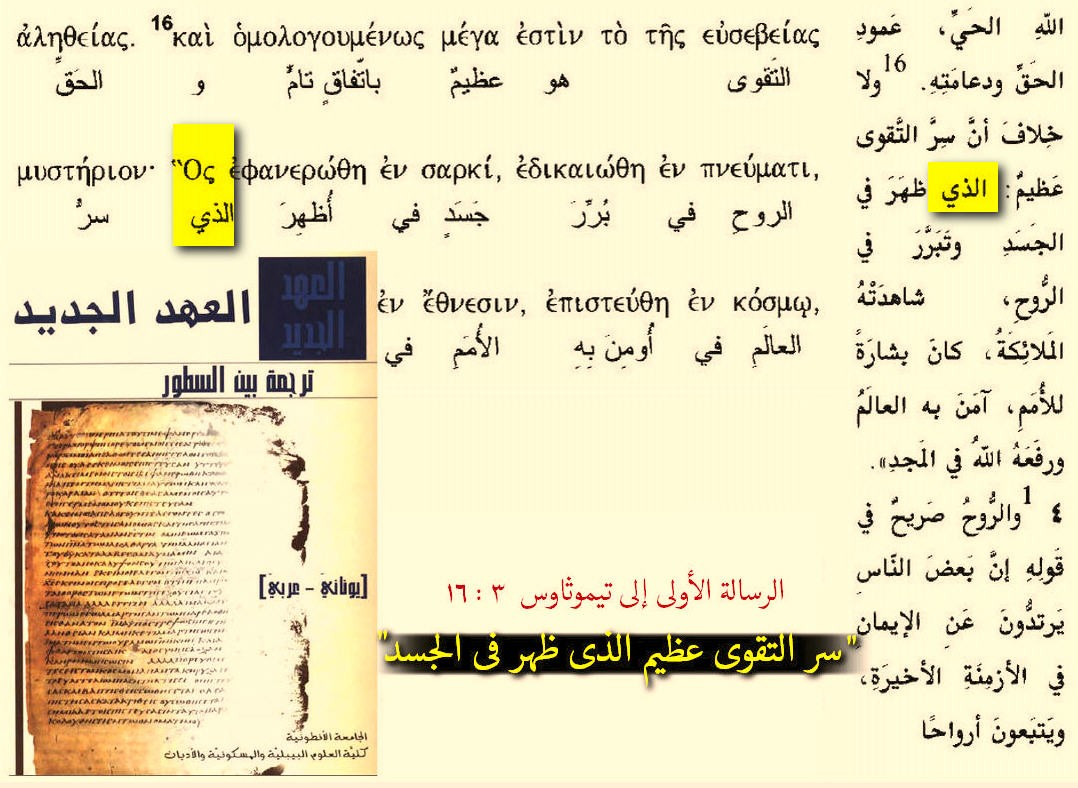
The scan matters because it shows that the correction is not restricted to one Protestant or ecumenical translation. Catholic translators also recognized the weakness of the reading “God.”
This means multiple Christian translation traditions indirectly admit the same point: the explicit wording “God appeared in the flesh” is not the secure original text. The corrected reading removes the direct incarnation proof and leaves the verse saying only that he/who was manifested in flesh.
The Theological Difference Is Huge
If we say according to the Van Dyck translation:
“God appeared in the flesh”
then Christians can use this to claim that God Almighty was incarnated.
But according to the corrected text:
“Great is the mystery of godliness that appeared in the flesh”
or:
“He/who was manifested in the flesh”
then the verse does not directly say God became incarnate.
The mystery of godliness is what appeared in the flesh — not necessarily God Himself.
The corrupted reading gives Christians a direct prooftext for incarnation.
The corrected reading removes that proof.
The Copyists Changed the Core of the Text
What the copyists did by changing the core of the Holy Book was an attempt to prove the divinity of Jesus and to delude ordinary Christians into believing that the one who became incarnate is God.
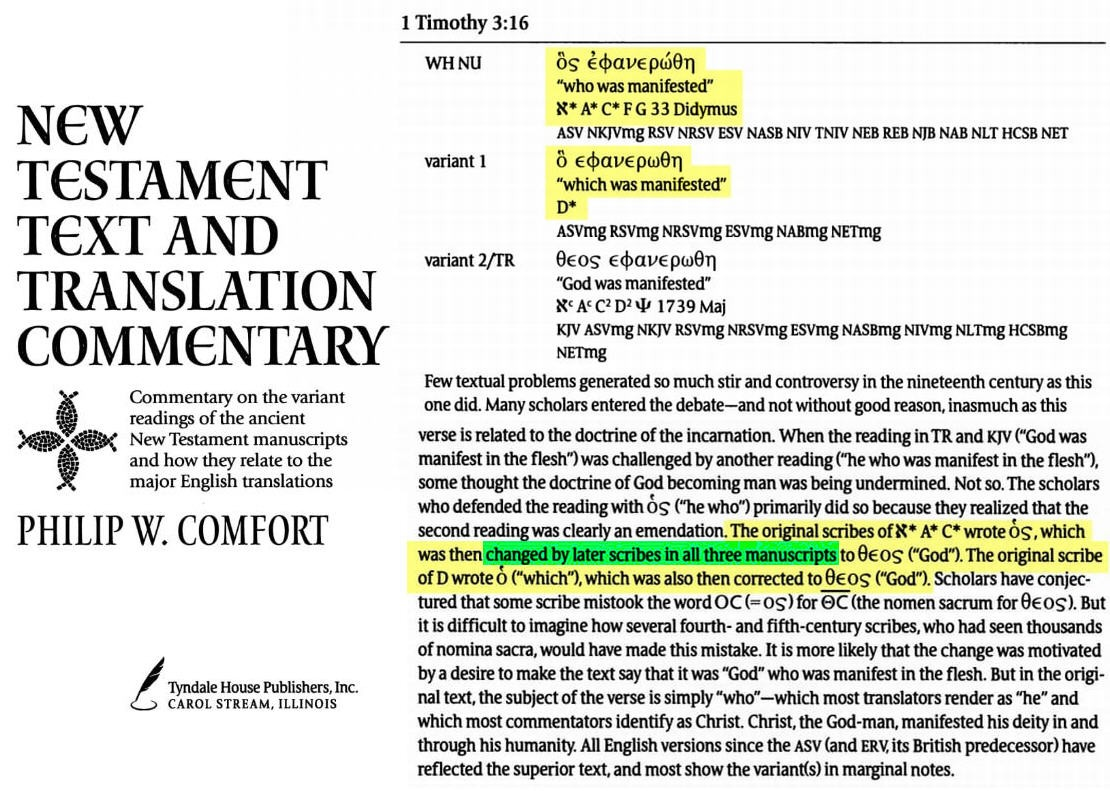
- ὃς ἐφανερώθη = “who was manifested”
- ὅ ἐφανερώθη = “which was manifested”
- θεὸς ἐφανερώθη = “God was manifested”
Comfort explains that this verse generated huge controversy because it was tied to the doctrine of incarnation. The scan says the original scribes of certain manuscripts wrote ὃς / who, but later scribes changed the text in all three manuscripts to θεὸς / God.
This is extremely important because Comfort is not merely saying there is a variant. He says the reading God came through later scribal alteration. He also states that the change was likely motivated by a desire to make the text say that it was God who was manifested in the flesh. This scan therefore directly supports the article’s accusation: the corrupted reading strengthened Christian theology, especially incarnation and deity of Christ.
James Annis Admits the Problem
And what supports the correctness of the reading of ‘who’ is the fact that the ancient theologians did not mention this verse with the many verses that they cited to prove the divinity of Christ, while they were responding to the error of Arius.
As for the reason for replacing the word ‘who’ with the word ‘God’ in the modern Greek versions… the copyists added that small line to clarify the meaning in some versions, so the word ‘who’ was changed to ‘God.’”
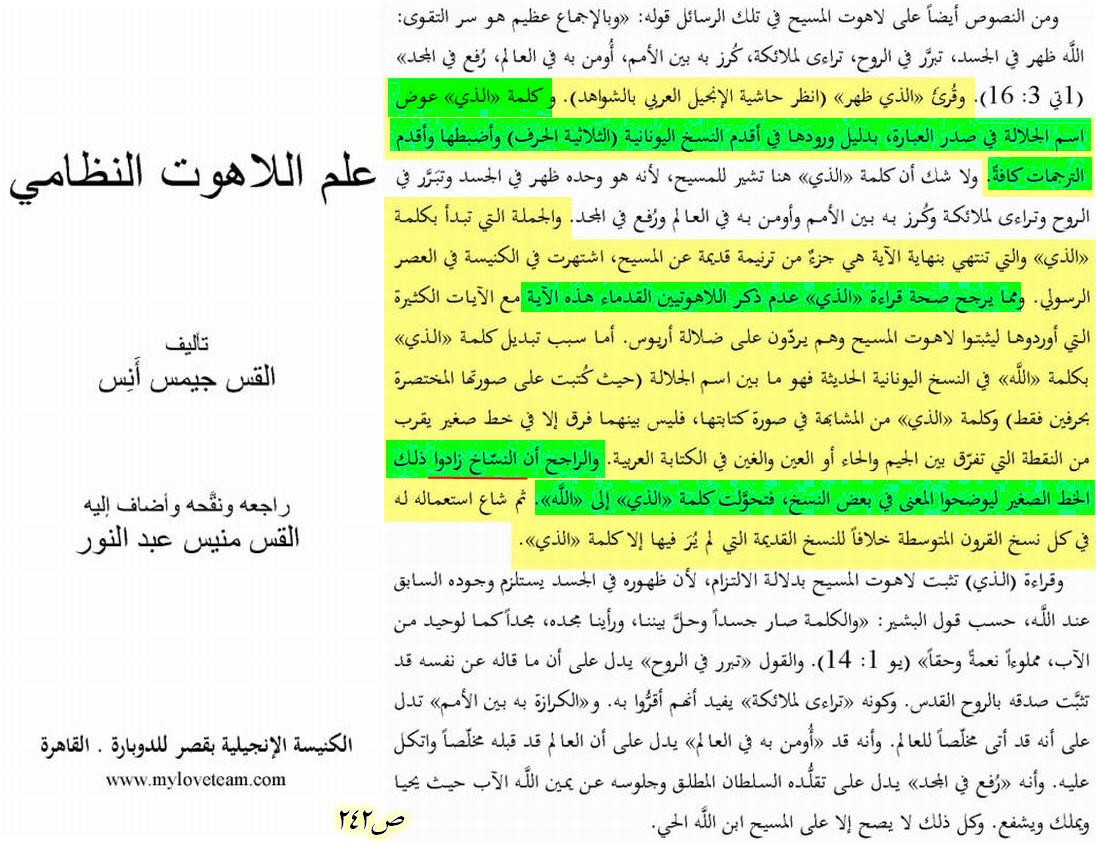
The scan gives a major historical argument: ancient Christian theologians, when responding to Arius and defending the divinity of Christ, did not cite this verse among their proofs. This is very significant. If the original text had clearly said “God was manifested in the flesh,” it would have been one of the strongest possible verses against Arius. Their failure to use it strongly suggests that the reading “God” was not known to them as the original text.
The scan also explains how the corruption happened. In later Greek copies, the word “who” was changed into “God” because the abbreviated forms looked similar, and a small stroke was added. The passage says scribes likely added the small line to clarify the meaning in some manuscripts, but this changed the reading from “who” into “God.”
This scan is one of the strongest because it is a Christian theological source admitting that the reading “who” has stronger textual support, while the reading “God” arose through scribal alteration.
Timothy Paul Jones Admits the Alteration
The copyist wanted to confirm the divinity of Christ.”
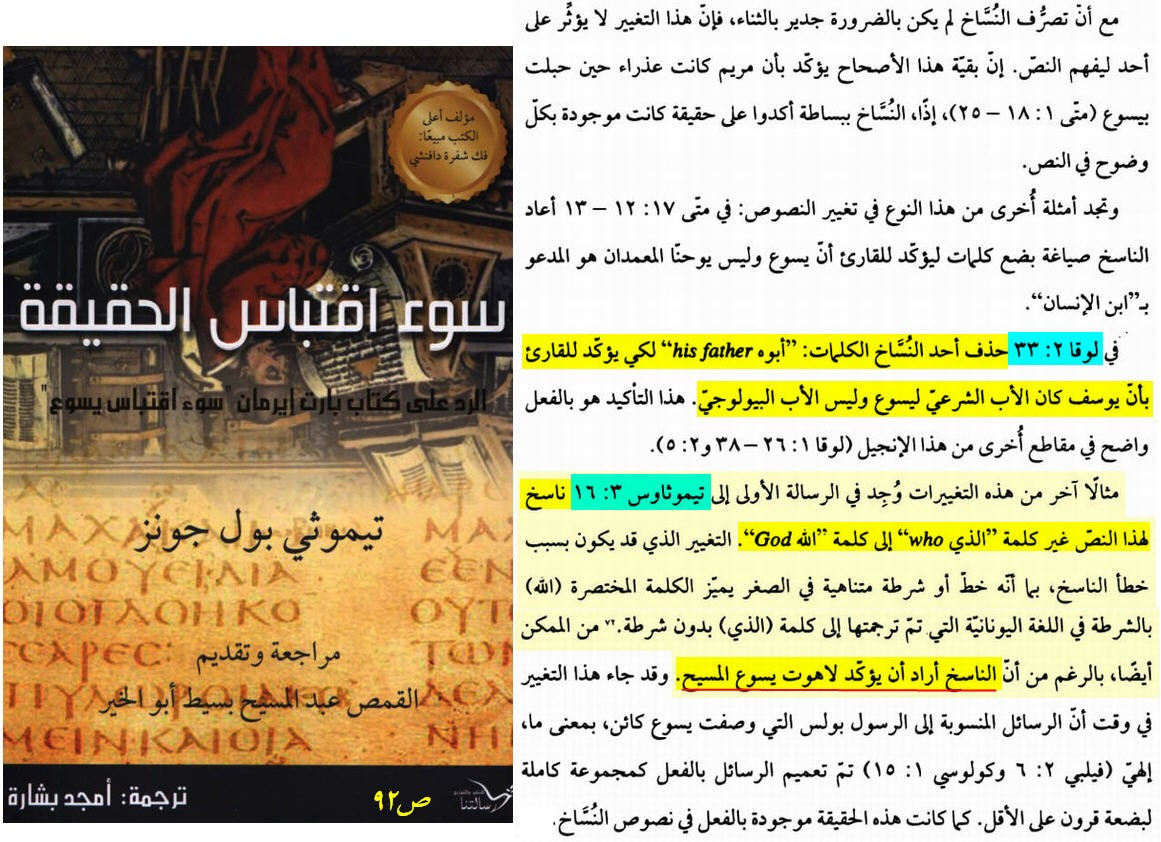
Then the scan moves to 1 Timothy 3:16 and states clearly that a scribe changed the word “who” into the word “God.” It explains that the change could have happened because the difference between the shortened Greek form for God and the word who was very small, involving a line or dot-like mark.
The most important highlighted statement is that the copyist wanted to confirm the divinity of Christ. This means the alteration was not theologically neutral. The scan is used to prove that Christian scholars themselves admit that the wording of 1 Timothy 3:16 was changed in a way that supported the doctrine of Christ’s divinity.
Deliberate Distortion by Pious Copyists
They distorted:
“Who appeared in the flesh”
into:
“God appeared in the flesh”
So that the glory of their god may increase — through lies.
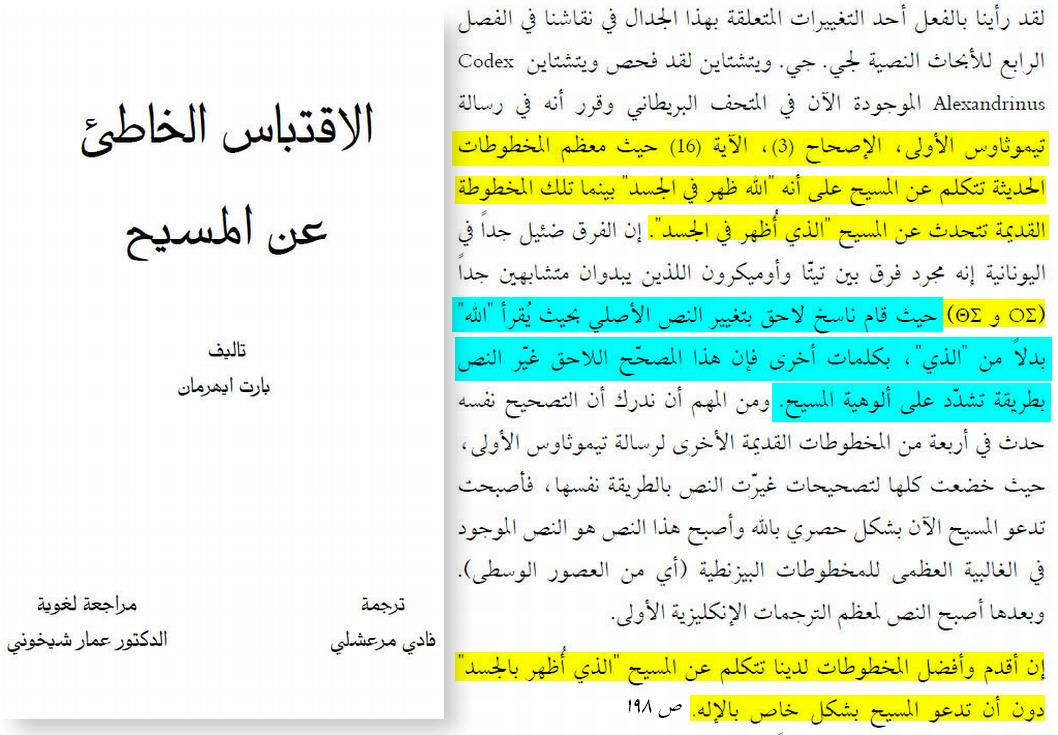
In the case of 1 Timothy 3:16, the alleged change was from “who appeared in the flesh” to “God appeared in the flesh.” That is not a harmless grammatical change. It turns a relative statement about someone being manifested in flesh into a direct theological declaration that God was manifested in flesh.
The scan therefore supports the final argument of the article: this was a “pious” corruption, meaning a scribal alteration made for religious reasons. The copyist’s change served orthodox Christology by manufacturing a stronger prooftext for the divinity of Jesus and the doctrine of incarnation.
Conclusion
The stronger manuscript evidence supports:
“who/he was manifested in the flesh”
not:
“God was manifested in the flesh.”
Therefore, this verse cannot honestly be used as a reliable proof that the New Testament explicitly teaches:
- that Christ is God,
- that God became incarnate,
- or that God appeared in human flesh.
The article concludes that this is a clear example of scribal distortion: a small Greek stroke created a massive theological lie.
The original reading does not say:
“God was manifested in the flesh.”
It says:
“who/he was manifested in the flesh.”
That difference destroys the use of this verse as a direct proof for incarnation.