
Do Idols Harm or Benefit? Reconciling Al-Hajj 12 and 13
An apparent contradiction arises in Surah Al-Hajj between two consecutive verses discussing those who worship other than Allah. The first verse seems to deny idols any influence at all, while the second seems to grant them at least some capacity for harm. Classical tafsir scholars across multiple traditions — from Ibn Ashur to Abu Hayyan to Al-Samin al-Halabi — have addressed this tension in detail, arriving at a coherent resolution through careful linguistic and contextual analysis.
The Apparent Contradiction
He invokes besides Allah that which neither harms him nor benefits him. That is extreme misguidance.
He invokes one whose harm is closer than his benefit. How wretched a patron and how wretched a companion!
The Response: Two Different Subjects in Two Different Verses
Verse 12 describes those who worship inanimate idols — the sun, the moon, carved stone — objects that are physically incapable of either harming or benefiting anyone. Allah uses the Arabic pronoun مَا (mā) meaning “that which,” a word reserved in Arabic for things that are not rational (ghayr al-‘āqil). Idols are inanimate and non-rational, and this verse’s use of mā confirms that is what is being described. These objects have zero real-world causal power. Their worship is therefore called الضَّلَالُ الْبَعِيدُLit. “the distant misguidance” — an emphatic Quranic expression indicating the furthest possible remove from truth and guidance. — extreme, far-reaching misguidance.
Verse 13 describes a different category of those worshipped besides Allah: rational beings such as tyrants who demand divine devotion. Allah uses the pronoun مَن (man) meaning “who/whom,” a word in Arabic reserved for rational beings (al-‘āqil). The prime example is Pharaoh, who declared: “I am your most exalted lord” and threatened imprisonment for anyone who took another deity. Such tyrants may genuinely bestow worldly favors — wealth, status, proximity to power — on those who serve them. This is a real, if fleeting, benefit. But against this worldly gain stands the eternal punishment awaiting those who worship them instead of Allah. That eternal harm utterly dwarfs any temporary worldly benefit, making the harm “closer” in the sense that it is the dominant and decisive reality.
The grammatical distinction between mā and man is therefore the key that unlocks the entire reconciliation. Abu Hayyan made this explicit in Al-Bahr al-Muhit, confirming that the pronoun difference signals a shift in the subject being described between the two verses.
The Priesthood Argument: How Idol Worship Benefited Its Guardians
A further dimension of the resolution addresses a practical historical reality about how idol worship actually functioned in pre-Islamic Arabia and elsewhere.
The idols worshipped in Mecca and other centers had designated guardians — priests and custodians who served as intermediaries between the idols and their worshippers. When worshippers wanted something from the gods, they would approach the guardians and say: “Invoke the gods for us in such and such a way.” These guardians thereby held real temporal influence over both the idols and their worshippers.
This intermediary function brought the guardians enormous material wealth. Everything offered to the idols passed through their hands. So the idols, while genuinely powerless, functioned as a system that generated significant worldly benefit for the priestly class that controlled them. This benefit, however, was strictly bounded by the length of their earthly life. Death would arrive and strip them of every advantage they had accumulated. They would leave this world with no faith, no good deeds, and no repentance — facing the full weight of having maintained and profited from a system of shirk.
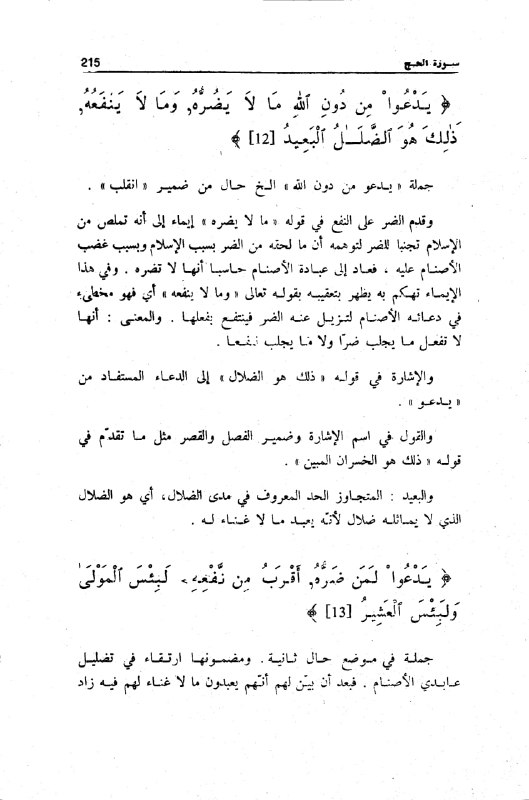
The following image shows the relevant passage from Tafsir al-Tahrir wa al-Tanwir:
The tafsir continues its psychological and rhetorical analysis of the pagan worshipper’s mindset:
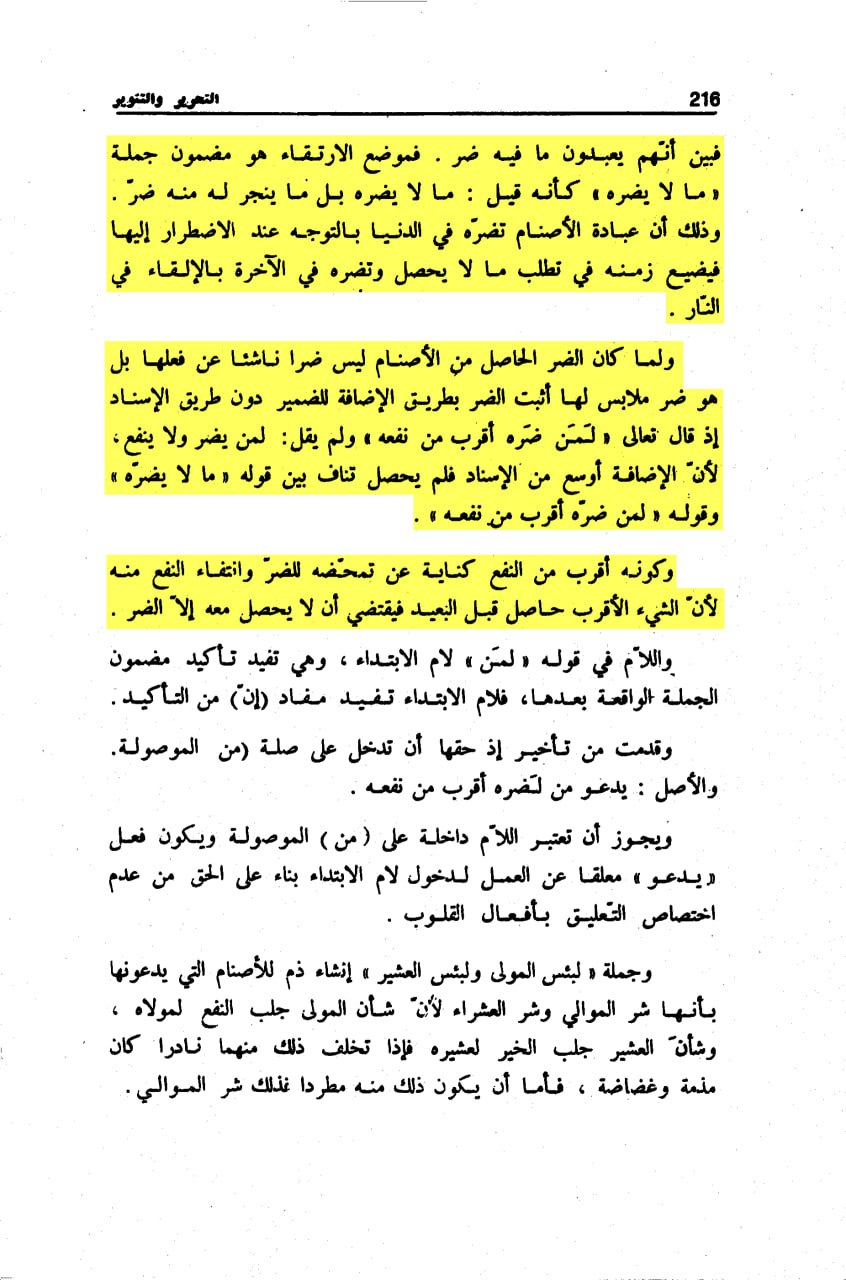
The Rhetorical Structure: Escalation from Negation to Active Harm
Ibn Ashur in Al-Tahrir wa al-Tanwir identifies a sophisticated rhetorical movement — Irtiqa’Rhetorical escalation: a technique in Arabic rhetoric where the argument deliberately moves from a lesser claim to a stronger one, building cumulative force. — across the two verses.
The sequence is deliberate and psychologically precise:
- First, the verse establishes that idols have absolutely no power of any kind — they can neither harm nor benefit. This demolishes any rational basis for worshipping them.
- Then, having established their total impotence, the text escalates: the act of worshipping these impotent things is itself the source of active, real, and devastating harm — the eternal punishment of the Hereafter.
The structural placement of “harm” before “benefit” in verse 12 is itself a psychological hint. The idolater originally abandoned Islam due to some earthly trial or tribulation, driven by a panicked belief that his old idols could protect him from immediate harm. The Quran meets this psychology directly: the very thing you ran to for protection from harm cannot harm anyone, cannot benefit anyone, and your running to it is itself the source of the only harm that truly matters.
- Rhetorical Inversion of Harm and Benefit: In the verse {يَدْعُو مِنْ دُونِ اللَّهِ مَا لَا يَضُرُّهُ وَمَا لَا يَنْفَعُهُ}, the mention of harm is intentionally placed before benefit. This structural sequence serves as a psychological hint: when this person originally abandoned Islam due to trial or tribulation, they did so out of a false panic, mistakenly believing that their old idols could protect them from immediate earthly harm or appease an angry deity.
- Sarcastic Exposure of Idolatry: The text uses mockery (Tehkam) to expose the futility of this mindset. By showing that idols cannot even enact a basic cosmic response — neither causing harm nor delivering benefit — it highlights that the idolater’s prayer is completely flawed and results in nothing but severe, absolute misguidance {ذَٰلِكَ هُوَ الضَّلَالُ الْبَعِيدُ}.
- Escalation to True Harm: The transition to the next verse {يَدْعُو لَمَنْ ضَرُّهُ أَقْرَبُ مِنْ نَفْعِهِ} acts as a rhetorical escalation (Irtiqa’). Once it is firmly established that the idol cannot provide any positive benefit, the text reveals the dark reality: turning to these false gods actually brings immediate spiritual ruin and damnation, proving that the idol is the worst possible protector {لَبِئْسَ الْمَوْلَىٰ} and companion {وَلَبِئْسَ الْعَشِيرُ}.
Al-Kashshaf and Al-Samin al-Halabi: The Semantic Resolution
Al-Zamakhshari in Al-Kashshaf and Al-Samin al-Halabi in his analysis both address the same apparent negation-versus-affirmation tension with precision.
Their resolution distinguishes between two modes of harm:
The absolute reality: Idols, as inanimate stone objects, completely lack any independent power to create benefit or physically strike someone with a calamity. In this sense, harm is genuinely negated from them.
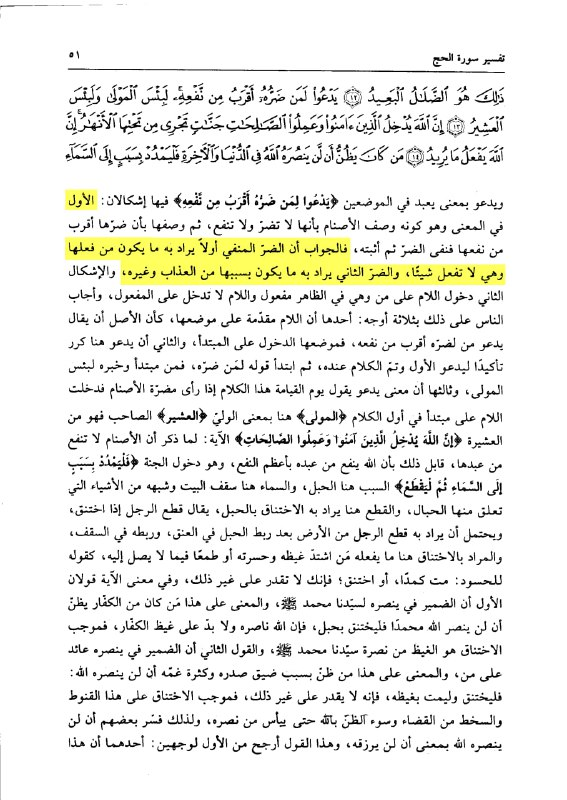
The direct consequence: Active harm is nonetheless affirmed because ==the act of worshipping them is the direct causal trigger for spiritual ruin, misguidance, and eternal damnation.== Their harm is “closer” because their worship yields immediate spiritual loss with absolutely zero possibility of future benefit.
This analysis from Al-Samin al-Halabi is shown in the manuscript image below:
The passage continues with the historical comparison to tyrants who demanded divine devotion:
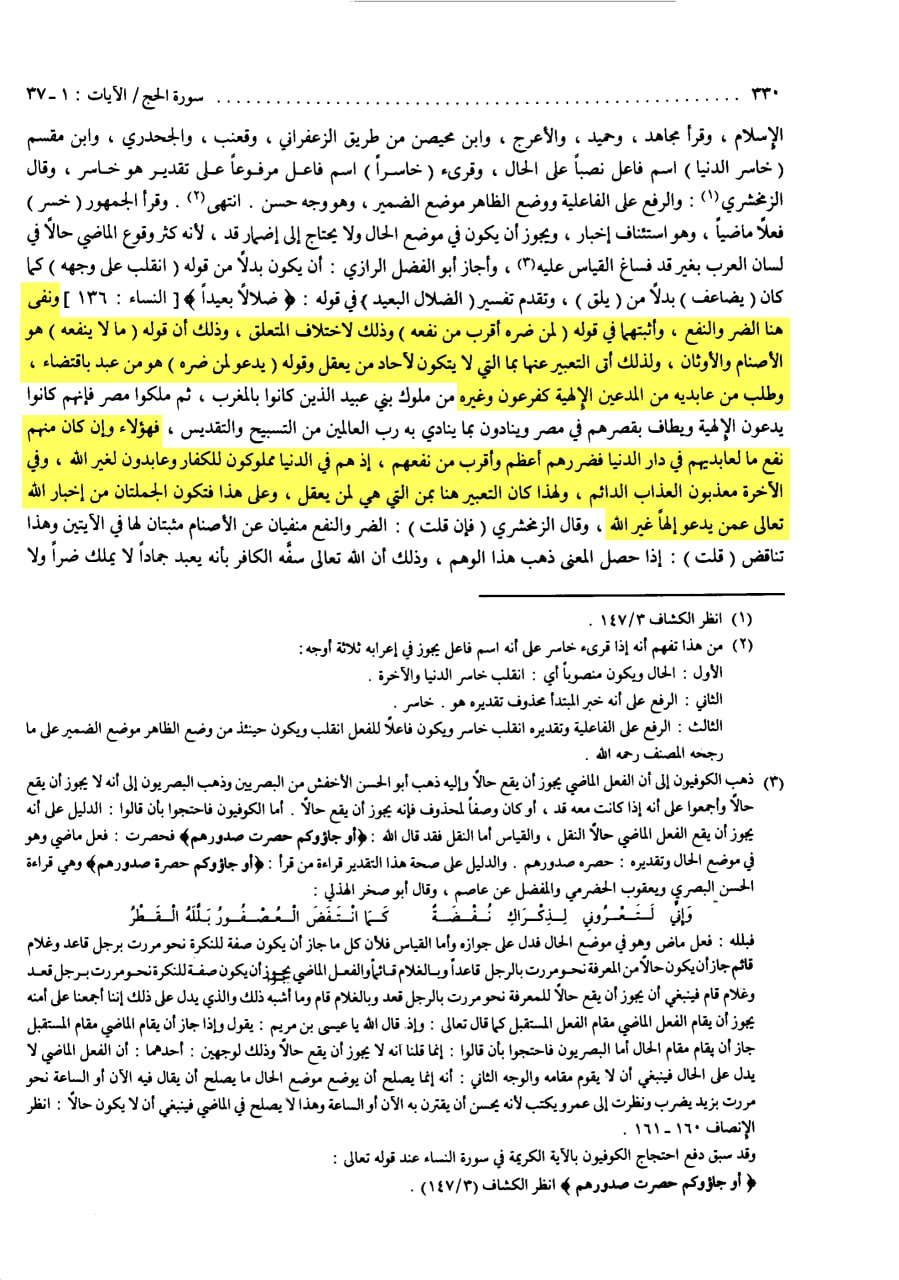
- Negation vs. Affirmation of Harm: The passage addresses the textual tension between the two adjacent verses: the first negates both {مَا لَا يَضُرُّهُ وَمَا لَا يَنْفَعُهُ} and the second affirms harm {لَمَنْ ضَرُّهُ أَقْرَبُ مِنْ نَفْعِهِ}.
- The Semantic Resolution: There is no true contradiction due to a shift in context. In terms of physical capacity, idols are lifeless things that completely lack any independent power to create, benefit, or physically strike someone with a calamity — thus harm is negated. However, active harm is affirmed because the act of worshipping them directly triggers spiritual ruin, misguidance, and eternal damnation in the Hereafter. Their harm is “closer” because their worship yields immediate spiritual loss with absolutely zero hope of future benefit.
- Historical Comparison to Tyrants: This logic is mirrored against megalomaniacs of history — such as Pharaoh, or the kings of the Fatimid dynasty — who demanded divine devotion. While they might have handed out fleeting worldly favors to their inner circles, their ultimate reality led their followers to eternal damnation and divine punishment, cementing them as ultimate sources of harm.
Al-Samin al-Halabi’s Synthesis: Rejecting True Contradiction
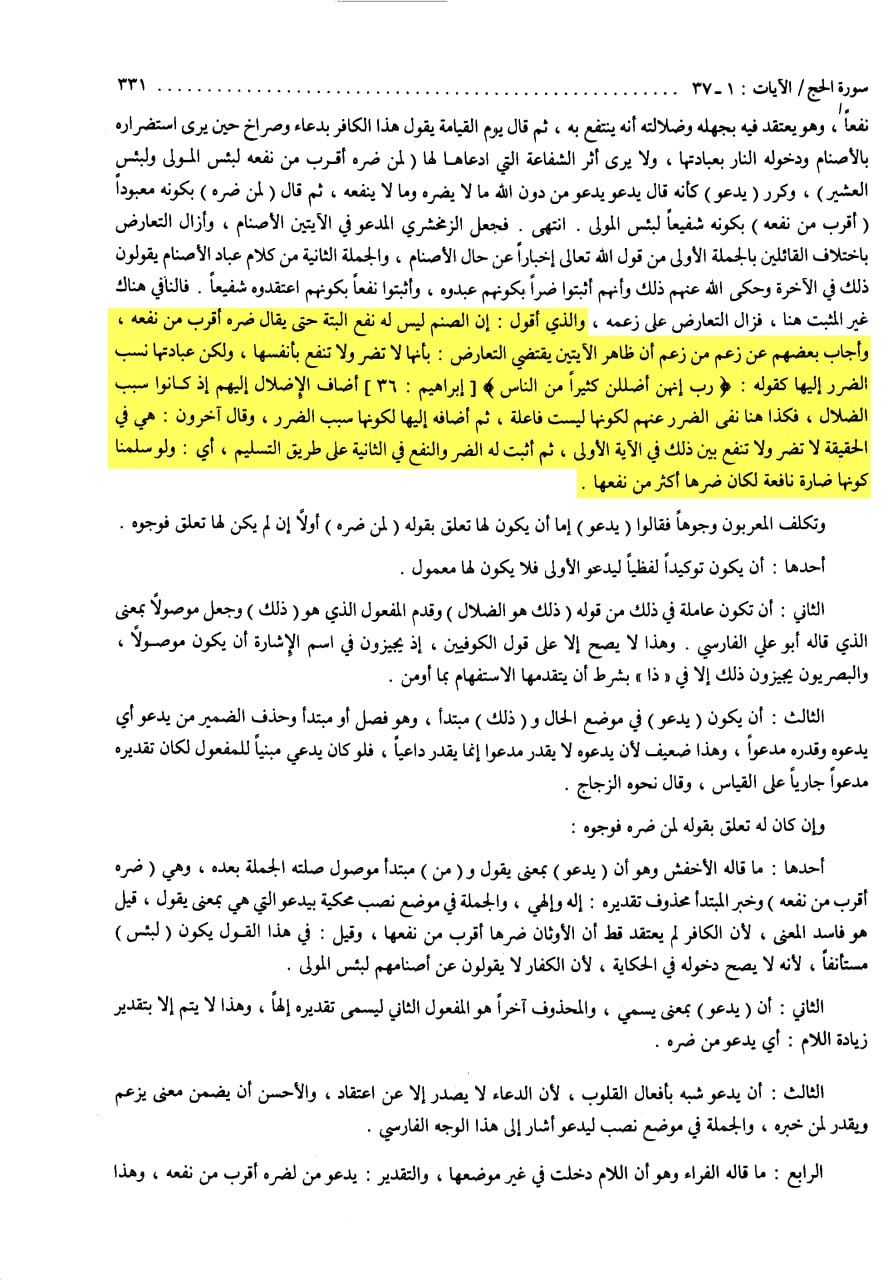
Al-Samin al-Halabi presents his own definitive position, distinguishing between two major scholarly approaches to this apparent conflict.
Two major scholarly approaches resolve the apparent conflict:
First approach — Attribution of Misguidance: One group of scholars attributes active harm to the idols because they are the structural cause of immense misguidance, citing Ibrahim’s statement: {رَبِّ إِنَّهُنَّ أَضْلَلْنَ كَثِيرًا مِّنَ النَّاسِ} — “My Lord, indeed they have led astray many among mankind.”
Second approach — The Grammatical Metaphor: A second group maintains that idols, as inanimate stone objects, cannot inherently cause physical harm or physical benefit on their own. Therefore, the phrase is a pure rhetorical device: if we hypothetically had to concede that they possessed a benefit, their severe spiritual harm would drastically outweigh it.
The manuscript page of Al-Samin al-Halabi’s synthesis is shown here:
The analysis continues across the following page:
The Two Types of Harm: A Final Clarification
The most precise terminological resolution of the entire question distinguishes between harm from the idol’s own actions and !!harm caused because of the idol!!.
The Affirmed Harm: This refers to the harm caused because of them — meaning the punishment and torment that their worshippers will face in the Afterlife as a direct consequence of associating partners with God. This is what verse 13 affirms.
This distinction appears in the following manuscript source:
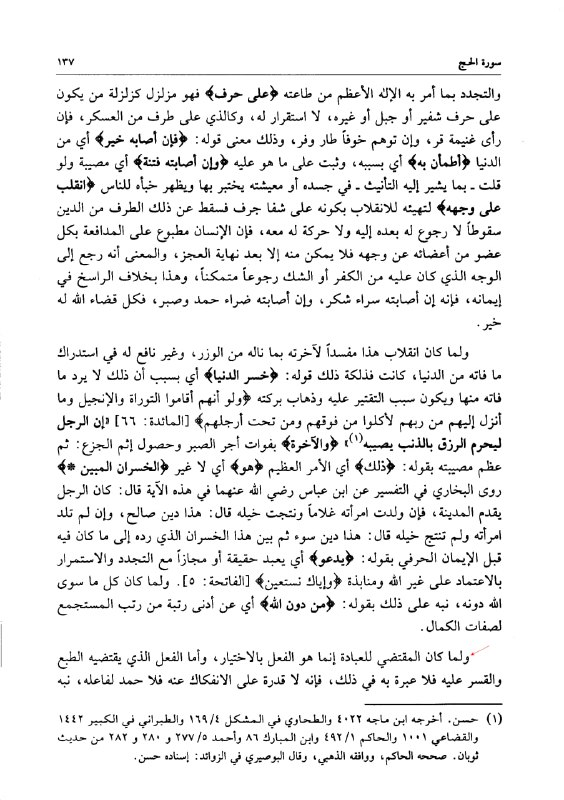
The Context: Worshipping Allah “On the Verge”
Both verses belong to a broader passage describing a specific psychological type: the hypocritical or unstable believer who worships Allah only conditionally, as described in the verses immediately preceding. The classical commentaries explain this context directly.
Such an individual suffers total loss in both worlds {خَسِرَ الدُّنْيَا وَالْآخِرَةَ}. Their turning away does not recover what they lost in this life, and they lose their reward and face punishment in the Next. The text calls this the ultimate, manifest loss {ذلِكَ هُوَ الْخُسْرَانُ الْمُبِينُ}.
Grade: Sahih · Bukhari
The page from this tafsir source is shown below:
- Worshiping on the Verge (
عَلى حَرْف): This refers to an unstable believer whose faith is shaky, like someone standing on the edge of a cliff or a mountain peak. - The Test of Circumstances: If they experience good fortune, wealth, or well-being in this world {فَإِنْ أَصَابَهُ خَيْرٌ}, they contentedly remain in their faith. If they are tested with a trial, illness, or hardship {وَإِنْ أَصَابَتْهُ فِتْنَةٌ}, they immediately turn back to disbelief {انْقَلَبَ عَلَى وَجْهِهِ}, completely falling away from the religion without any resilience.
- The Ultimate Loss: Such an individual suffers a total loss in both worlds {خَسِرَ الدُّنْيَا وَالْآخِرَةَ}. Their turning away does not recover what they lost in this life, and they lose their reward and face punishment in the Next. The text calls this the ultimate, manifest loss {ذلِكَ هُوَ الْخُسْرَانُ الْمُبِينُ}.
- Historical Context (Hadith of Ibn Abbas): A narration from Sahih al-Bukhari illustrates this behavior: a desert Arab would come to Medina; if his wife gave birth to a boy and his horses bred well, he would declare Islam a good religion. If they did not, he would reject it.
- The Nature of True Worship: Genuine worship must be an act of free will and choice. Any action done out of pure natural compulsion or coercion carries no spiritual weight or praise for the doer.
The Perfection of Allah’s Guardianship Versus the Failure of Idols
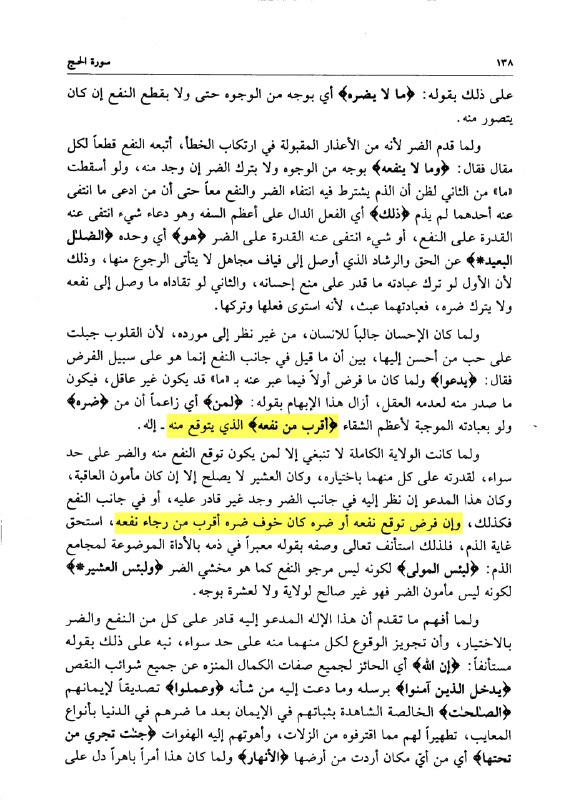
The passage concludes by contrasting the absolute impotence of idols with the perfect power of Allah. The phrase لَبِئْسَ الْمَوْلَىٰ وَلَبِئْسَ الْعَشِيرُ — “How wretched a patron and how wretched a companion!” — is the Quran’s final verdict on what these worshippers have chosen as their protectors.
A ||patron (al-mawlā) is someone who is close to you and benefits you in times of hardship — supporting you when you need their support, assisting you in times of distress. A companion (al-‘ashīr)|| keeps you company, entertains you, and provides comfort, even if they are too weak to support you practically. The idols fail on both counts: they do not support their worshippers in hardship, and they do not provide genuine comfort or companionship. They are the worst of both categories.
Complete guardianship belongs only to an entity that has full, voluntary power over both harm and benefit. Allah alone possesses this in absolute perfection.
- The Absolute Negation of Power (
مَا لَا يَضُرُّهُ... وَمَا لَا يَنْفَعُهُ): Idols are completely devoid of capability. They cannot cause harm under any circumstances, nor can they generate any form of benefit. Worshipping them is described as the ultimate foolishness and a profound straying from the truth {الضَّلَالُ الْبَعِيدُ}, as their worship is entirely futile. - “Closer than its benefit” (
أَقْرَبُ مِنْ نَفْعِهِ): This addresses the false assumption of the worshipper who mistakenly expects or hopes for an imagined benefit from the idol. Even if one were to hypothetically assume any outcome from these idols, the fear of their actual harm — the punishment incurred by worshipping them — is far closer and more certain than any hope of their benefit. - The Flawed Guardian (
لَبِئْسَ الْمَوْلَىٰ وَلَبِئْسَ الْعَشِيرُ): Complete guardianship belongs only to an entity that has full, voluntary power over both benefit and harm. Idols fail this completely; they are a terrible protector because they offer no expected benefit, and a terrible companion because they are not safe from bringing harm — punishment — upon their followers. - The Perfection of Allah’s Promise: In stark contrast, Allah holds absolute perfection and power over both harm and benefit by choice. Consequently, He rewards those who believe and do righteous deeds {إِنَّ اللَّهَ يُدْخِلُ الَّذِينَ آمَنُوا وَعَمِلُوا الصَّالِحَاتِ} by admitting them into gardens beneath which rivers flow, purifying them from their lapses and honouring their steadfast faith.
The final manuscript page showing this analysis is below:
The image preceding it, showing the continuation of this discussion: