

Does Allah Have a Uvula and Molars? Hadith Chain Analysis
A narration circulated in polemical contexts — particularly in dialogue with Twelver Shia — claims that the Prophet ﷺ said Allah laughs “until His uvula and molars become visible.” ==This addition is a rejected anomalous narration (munkar)== that is not found in any of the authentic chains of this hadith. The authentic versions of this report describe the Prophet ﷺ himself laughing while narrating — not Allah. This post documents the hadith criticism establishing this conclusion, drawing from classical rijal literature and the grading of Al-Albani and Ibn Mandah.
The Disputed Narration: Text and Source
The narration in question is attributed to Jabir bin Abdullah (RA) and reads:
يضحك الله ربكم حتى بدت لهواته وأضراسه
Narrated by: Jabir bin Abdullah · Transmitted via: Abu al-Zubair → Ibn Jurayj → Ruh bin Ubadah → Yahya bin Ma’in
Grade: The addition “until His uvula appears” (حتى تبدو لهواته) is rejected and anomalous (munkar) · Al-Albani, Al-Silsilah Al-Sahihah (6/575) · Also transmitted by Al-Tabari in Al-Tafsir (18/236) and by Abu Awana (433) with a slight difference
Al-Albani explicitly grades this specific addition as rejected (munkar) in Al-Silsilah Al-Sahihah (6/575). The core concept of the hadith — that laughter occurred — is authentically reported in Sahih Muslim and by Abdullah bin Ahmad in Al-Sunnah, but in those authentic chains the laughing is that of the Prophet ﷺ himself, not of Allah. The uvula-and-molars phrasing does not appear in any authentic transmission.
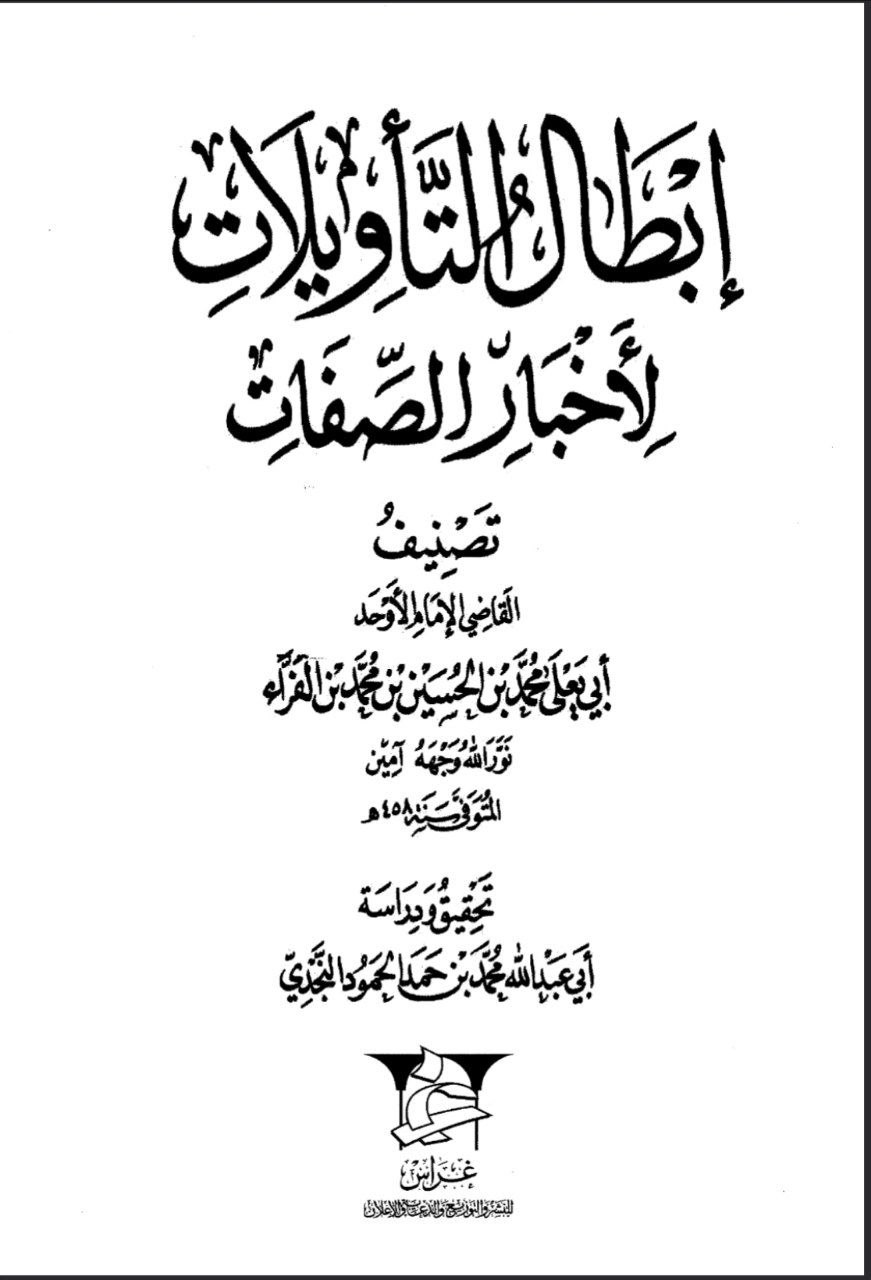
The source documentation for this grading is shown in the following manuscript scan from Ibtal al-Ta’wilat li-Akhbar al-Sifat (p. 256):
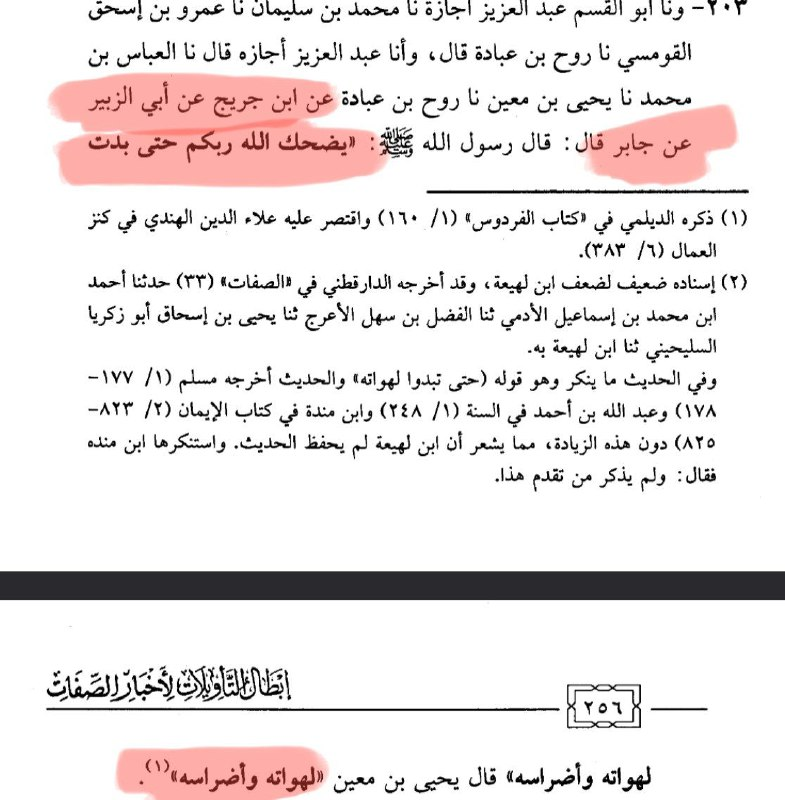
The footnote analysis from the same source, detailing the rejection of the specific addition:
1. Hadith and Chain of Narration (Isnad)
-
The Text: The main text contains a Hadith attributed to the Prophet Muhammad ﷺ, narrated via Jabir, from Abu Al-Zubair, from Ibn Jurayj, from Ruh bin Ubadah, from Yahya bin Ma’in: “Your Lord laughs until His uvula and molars become visible.” (
يضحك الله ربكم حتى بدت لهواته وأضراسه). -
Source Book: The excerpt is taken from page 256 of the book Ibtal al-Ta’wilat li-Akhbar al-Sifat (إبطال التأويلات لأخبار الصفات).
2. Footnotes and Critical Analysis
-
Footnote 1: Notes that Al-Daylami mentioned it in Kitab al-Firdaws, and Ala al-Din al-Hindi limited its citation to Kanz al-Ummal.
-
Footnote 2 (Grading):
- The chain of narration is graded as weak (Da’if) due to the weakness of the narrator Ibn Lahiah. It mentions an alternative chain transmitted by Al-Daraqutni in Al-Sifat.
- It highlights that the phrase “until His uvula appears” (
حتى تبدو لهواته) is a rejected or anomalous addition (Munkar). - While the core concept of the Hadith (the laughing) is authentically reported in Sahih Muslim and by Abd Allah bin Ahmad in Al-Sunnah, it appears without this specific addition. Ibn Mandah explicitly criticized and rejected this particular phrasing, noting that Ibn Lahiah did not memorize it properly.
The Chain Defects: Ibn Lahiah, Ikhtilaṭ, and ʿAnʿanah
Beyond the general weakness of Ibn Lahiah, the chain carries two additional structural defects documented by Ibn Mandah in Kitab al-Iman (p. 826).
First defect — Ikhtilaṭ of Hajjaj bin Muhammad: The narrator Hajjaj bin Muhammad al-MassisiIdentified in rijal literature as Al-Massisi; transmits from Ibn Jurayj. is assessed as thiqah thabt — trustworthy and reliable — in ordinary circumstances. However, the sources document that he experienced IkhtilaṭIkhtilaṭ: mental deterioration or confusion occurring toward the end of a narrator’s life, which invalidates narrations transmitted from him after that point unless confirmed to predate the deterioration. toward the end of his life. This means narrations transmitted from him after his period of confusion cannot be relied upon without external corroboration.
Second defect — ʿAnʿanah of Abu al-Zubair and Ibn Jurayj: The chain contains the formula ʿan-ʿanʿAnʿanah: the use of the ambiguous transmission term “from” (ʿan) rather than explicit expressions of direct hearing such as “I heard” (samiʿtu). When used by narrators known for tadlis (concealing breaks in the chain), ʿanʿanah renders the transmission suspect unless the narrator is confirmed to have actually met and heard from the source. — the use of the ambiguous “from” rather than an explicit statement of direct hearing — by both Abu al-Zubair and Ibn Jurayj. Both are known for tadlisTadlis: the practice of transmitting from a narrator one has not directly heard from, or concealing a weak link in the chain, by using ambiguous language that implies but does not confirm direct transmission., making this ʿanʿanah a signal of potential hidden defects or interruption in the chain.
The manuscript scan documenting these chain defects from Kitab al-Iman:

1. Hadith Source and Chain of Narration
-
Source: Ibn Mandah extracted this narration in his book Kitab al-Iman (page 826).
-
The Chain (Isnad): The transmission chain goes from Al-Abbas bin Muhammad → Yahya bin Ma’in → Hajjaj bin Muhammad → Ibn Jurayj (and onwards).
2. Critical Evaluation of the Narrators (Jarah wa Ta’dil)
-
Hajjaj bin Muhammad: He is identified here as Al-Massisi. The text states that he is trustworthy and reliable (Thiqah Thabt), but notes a critical flaw: he experienced confusion/mental deterioration (Ikhtilaṭ) toward the end of his life.
-
The Flaw of ʿAnʿanah: The text highlights another issue within the chain: “وفيه أيضاً: عنعنة أبي الزبير وابن جريج” (And in it also: the ʿAnʿanah — the use of the ambiguous term “from” instead of direct hearing — by Abu Al-Zubair and Ibn Jurayj). This implies potential interruption or hidden defects (Tadlis) in how they passed down the report.
The Authentic Account: It Was the Prophet ﷺ Who Laughed
The authentic version of this narrative is a long report narrated by Abdullah ibn Mas’ud (RA), graded Sahih by Al-Hakim according to the conditions of the two Sheikhs. It describes the events of the Day of Resurrection: the gathering of mankind, the testing of the idolaters, the revelation of the shin as a sign for the believers, the crossing of the Sirat bridge with light proportional to deeds, and ultimately the entry of the last believers into Paradise. At two specific junctures in this narrative, the Prophet ﷺ laughed — and the companions who transmitted it noted and preserved that laughter as part of the report itself.
He said: And the devil of Ezra will be represented to those who worshipped Ezra, until he represents to them the tree, the wood, and the stone, and the people of Islam will remain kneeling. It will be said to them: Why did you not set out as the people set out? They will say: We have a Lord whom we have not seen yet. He said: It will be said: How will you recognize your Lord if you see Him? They said: There is a sign between us and him; if we see it, we will recognize him. It was said: What is it? They said: He will reveal a leg.
He said: Then a leg will be revealed. He said: Then those whose backs were flat will fall prostrate, and some people will remain whose backs are like the horns of cattle, wanting to prostrate but unable to. Then they will be commanded to raise their heads and be given their light according to their deeds. He said: Some of them will be given light like a mountain in front of them, some of them will be given light above that, some of them will be given light like a palm tree in their right hand, some of them will be given less than that in their right hand, until the last of them will be the one who is given light on the big toe of his foot, shining once and going out once. When it shines, he goes forward; and when it goes out, he stands up.
He said: Then he and they will pass over the bridge, and the bridge is like the edge of a sword. A slippery slope, and it is said to them: “Escape according to the measure of your light.” Some of them will pass like a shooting star, some like a blink of an eye, some like the wind, and some like a man running swiftly, trotting. They will pass according to their deeds until the one whose light is only on the tip of his toe passes. He said: He will drag one hand and hang on the other, drag one foot and hang on the other, and the fire will strike his sides. He said: Then they will be saved. When they are saved, they will say: “Praise be to God who saved us from you after He showed you to us. God has given us what He has not given to anyone else.”
Masruq said: When Abdullah reached this point in this hadith, he laughed. A man said to him: O Abu Abd al-Rahman, you have narrated this hadith many times, and every time you reach this point in this hadith, you laugh? Abdullah said: I heard the Messenger of God, may God bless him and grant him peace, narrate it many times, and when he reached this point in this hadith, he laughed until his uvula was visible and the last of his molars was visible.
When a person says: “Are you mocking me while You are the Lord of the worlds?” He replies: “No, but I am capable of that, so ask Me.”
Narrated by: Abdullah ibn Mas’ud (RA) · Grade: Authentic according to the conditions of the two Sheikhs · Al-Hakim, Al-Mustadrak ‘ala al-Sahihayn (3468)
The structure of this report is decisive. The uvula and molars described belong to the Prophet ﷺ, not to Allah. Masruq narrates that Abdullah ibn Mas’ud himself laughed each time he reached the same point in the hadith, and explained that this was because the Prophet ﷺ used to laugh at that very moment in the narration. The laughter, the visible uvula, the visible molars — these are attributes of a man smiling broadly while telling a story, recorded by the companion who witnessed it repeatedly.
The Second Occurrence: The Last Man Entering Paradise
The same long report from Abdullah ibn Mas’ud contains a second laughter narration, documented separately in Al-Hakim’s Al-Mustadrak (8977). This account describes what follows the salvation of those crossing the Sirat — the entry of the last and lowest of the people of Paradise into their abode.
Masruq said: Abdullah never reached this point in the hadith without laughing. A man said to him: O Abu Abd al-Rahman, you have narrated this hadith many times, and you never reach this point in it without laughing. Abdullah said: I heard the Messenger of Allah (peace and blessings be upon him) narrate this hadith many times, and he never reached this point in it without laughing until his uvula and the last of his molars were visible.
For a man said: “Are you mocking me while you are the King?!” He said: So the Lord, Blessed and Exalted is He, says: “No, but I am capable of that, so ask Me.” He said: So they say: Our Lord, join us with the people. So He says to them: Join the people. He said: So they set off running in Paradise, until a palace of hollow pearl appears to one of them. He said: So he falls prostrate.
Then he takes him there until he opens the palace, which is a hollow pearl. Its roofs, doors, locks, and keys are all from it. The palace opens for him, and he is greeted by a green jewel lined with red, seventy cubits in length, containing sixty doors, each door leading to a single jewel of a different color. In each jewel are thrones, spouses, and attendants. He said: He enters, and there he sees a fair-eyed beauty, wearing seventy robes, through which the marrow of her leg is visible. Her liver is his mirror, and his liver is her mirror. If he turns away from her, she increases in his eyes seventy times more than before.
Then he looks upon his kingdom for a distance of one hundred years’ journey. Then Umar said at that time: O Ka’b, do you not hear what Ibn Umm Abd tells us about the lowest of the people of Paradise and what he has? So what about the highest of them?!
He said: O Commander of the Faithful, what no eye has seen, nor ear heard; God was above the Throne and the water, so He created for Himself a dwelling with His own hand, and He adorned it as He willed, and placed in it fruits and drink, then He closed it, so none of His creation has seen it since the day He created it. Neither Gabriel nor any other angel. Then Ka’b recited: “No soul knows what has been hidden for them of comfort for the eyes” [As-Sajdah: 17].
And He created two gardens besides that, and adorned them as He willed, and placed in them what He mentioned of silk, brocade, and fine silk, and showed them to whomever He willed of His creation from among the angels. So whoever’s record is in ʿIlliyyin will see it in that abode. And if a man from the people of ʿIlliyyin rides in his dominion between one of the tents of Paradise, he will enter it by the light of his face, to the point that they will smell it. They smelled his scent and said: “Oh, what a pleasant fragrance!” They also said: “A man from the highest ranks of the Muslims has appeared to us today.”
Umar said: “Woe to you, Ka’b! These hearts have become so attached to him that you should restrain them.” Ka’b replied: “O Commander of the Faithful, Hell has a roar so intense that no angel near to God, nor any prophet, will escape it without falling to his knees. Even Abraham, the Friend of God, will cry out: ‘My Lord, my soul, my soul!’ Even if you possessed the deeds of seventy prophets in addition to your own, you would still fear that you would not be saved from it.”
Narrated by: Abdullah ibn Mas’ud (RA) · Grade: Sahih · Al-Hakim, Al-Mustadrak ‘ala al-Sahihayn (8977)
Again the pattern is identical: it is the Prophet ﷺ who laughed until his uvula and molars were visible while narrating this account of the last man entering Paradise. The laughter of the Prophet ﷺ was so characteristic and consistent at this particular point in the story that Abdullah ibn Mas’ud himself adopted the same response every time he retold it — and Masruq, in turn, recorded this as a feature worth preserving in the transmission.
For a video discussion of this narration and its chain analysis, see the following presentation:
dd-sunnah.net/forum/showthread.php?t=162013 https://share.google/x8abtawjk5WzadhWk