Does Isaiah 53 Prophesy Jesus? Hebrew and Septuagint Evidence Against the Christian Claim
Does Isaiah 53 Talk About the Crucifixion and Resurrection of Christ?
Table of Contents
- First, Who Is Isaiah 53 Talking About?
- The Arabic Translation Distortion
- The Claim About Offering Himself as a Sacrifice
- Ezekiel Rejects Punishing One Person for Another
- The Hebrew Reading and the Septuagint Evidence
- The Figurative Meaning of Living Sacrifice
- Why Isaiah Speaks in the Singular
- Hosea 11 and the Singular-Plural Pattern
- Isaiah 53:8 and the Word לָֽמוֹ
- The Debate With the German Pastor
- Isaiah 53:9 and the Claim About Joseph of Arimathea
- The Septuagint Says Rich People, Not A Rich Man
- Arabic Translations Confirm the Plural Reading
- Conclusion
First, Who Is Isaiah 53 Talking About?
First, who is Isaiah 53 talking about?
the original Hebrew text. In order to understand the chapter, you must read the correct text from Jewish websites.
The Arabic Translation Distortion
There is no Jew who does not believe that Isaiah 53 speaks of the suffering of the pious Jewish people who suffered because of the sins and transgressions of the corrupt remnant of the people of (S) as well as the nations who believed that their peace was in their persecution, so they attacked them and took them away from Jerusalem, as happened in the Babylonian captivity and other persecutions that happened to the pious among them, and they were killed and buried with the wicked in a foreign land. God allowed these pious people to suffer all the sins of the nations to test them. However, these pious people did not do evil to these nations, but rather sought to guide them to the knowledge of Jehovah and did not wish them harm from God, but rather interceded for God not to punish them. Unfortunately, the Arab Christians tampered with the Jewish original to make this chapter about the crucifixion of Christ!!
They changed the text from “struck because of the sin of my people” to “struck for the sin of my people,” and there is a big difference between the two matters .
The Claim About Offering Himself as a Sacrifice
The Christians claim that verse 16
“But it pleased the Lord to crush Him; He will bruise Him.” If he makes himself an offering for sin, he shall see his offspring, he shall prolong his days, and the pleasure of the LORD shall prosper in his hand. This
clearly indicates that the chapter is talking about a person being offered as a sacrifice for their sins. In fact, this belief is pagan. The prophet Ezekiel warned against punishing one person in place of another,
Ezekiel Rejects Punishing One Person for Another
saying, “The soul that sins shall die. The son shall not bear the iniquity of the father, nor shall the father bear the iniquity of the son.” The righteousness of the righteous will be upon him, and the wickedness of the wicked will be upon him.” (Ezekiel 18:20).
The Hebrew Reading and the Septuagint Evidence
The truth is that the original Hebrew does not say that, but rather says that if he offers a sacrifice, his soul will see offspring, not if he offers himself as a sacrifice.
The evidence for that is what came in the Septuagint Torah, from which the Gospel writers quoted, which mentioned that.
The Figurative Meaning of Living Sacrifice
Let us suppose that the text says that if he offers himself as a sacrifice, this does not mean, as the pagan belief does, that he actually offers himself to death in order for God to forgive their sins, but it means the figurative meaning that Paul intended.
“I urge you therefore, brethren, by the mercies of God, to present your bodies a living sacrifice, holy and acceptable to God, which is your worship.” “The rational.” (Rom. 12:1).
your bodies as a living sacrifice = The apostle explained previously what God has given us as a blessing, so what do we offer Him in return? Our bodies are a living sacrifice. In Jewish worship, animal sacrifices were offered (actually slaughtered), but in Christian worship, we offer our bodies as living sacrifices, meaning that there is no need for us to actually die, but rather to put to death the old man by crucifying our desires (Gal. 5:24), as well as by fasting, prostration (metanoia), and long prayers. And to consider ourselves dead to sin, so we stop using our members as instruments of sin that delight in the lusts of this world, and when we prevent the old man from sensual lusts, he dies by the work of the Spirit and its assistance (Romans 8:13).
And God promised the living among them to take the spoils because he was satisfied and ready to die for his faith and because he suffered from all the sins of the nations that they placed on the Jews, such as killing, imprisonment, etc., even though they were innocent and desired the good of the nations and interceded for God not to destroy them.
This will happen to all the pious Jews in every age.
Why Isaiah Speaks in the Singular
An important note: Isaiah spoke about the pious people of Israel in the singular because this is the custom of the book. For example, when God spoke about the return of the people of Israel from Egypt, He said, “Out of Egypt I called my son” in the singular, not “sons” in the plural, even though after that He spoke about them in the plural.
Hosea 11 and the Singular-Plural Pattern
1 “When Israel was a child, I loved him; And out of Egypt I called my son.
2 Whenever they called them, they went from before them, sacrificing to the Baals, and burning incense to the graven images
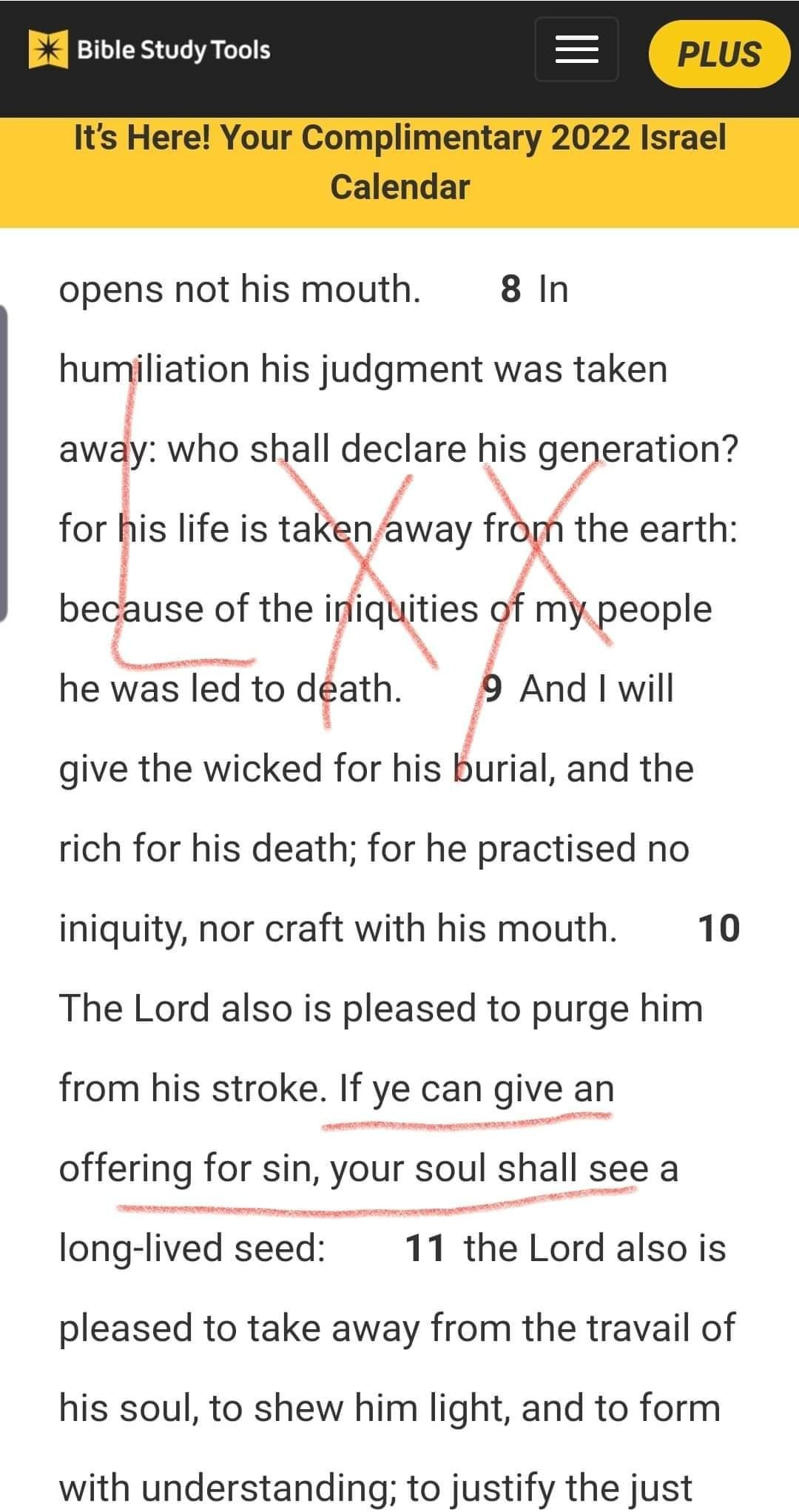
This scan shows Isaiah 53:8-10 from Bible Study Tools. The red markings focus on verse 8, especially the wording “because of the iniquities of my people he was led to death,” and verse 10, especially the wording “If ye can give an offering for sin, your soul shall see a long-lived seed.” The highlighted parts are important because the argument here is that the passage should not be read as saying one person literally becomes a human sacrifice for everyone else’s sins. The scan also shows that verse 10 can be read as speaking about giving an offering for sin, not necessarily offering oneself as the sacrifice. This supports the argument that the Christian crucifixion reading depends on interpretive and translational assumptions.
Isaiah 53:8 and the Word לָֽמוֹ
לָֽמוֹ׃ lamo, which indicates a group, as mentioned in the Hebrew Safari dictionary
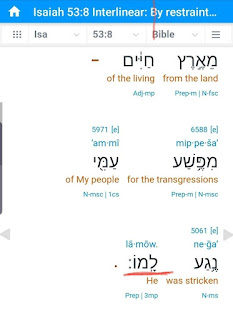
This scan is an interlinear display of Isaiah 53:8. The highlighted Hebrew word isלָֽמוֹ׃ / lamo, shown with the meaning “to them.” The scan also shows the surrounding phrase connected to “the transgression of my people” and “he was stricken.” The point being made is that lamo is not being treated here as a simple singular pronoun, but as language pointing to a group. This is used to argue that Isaiah 53:8 is speaking about a collective servant or group among Israel rather than Jesus alone.
The Jewish academic Sifri’s position is that the word denotes the plural
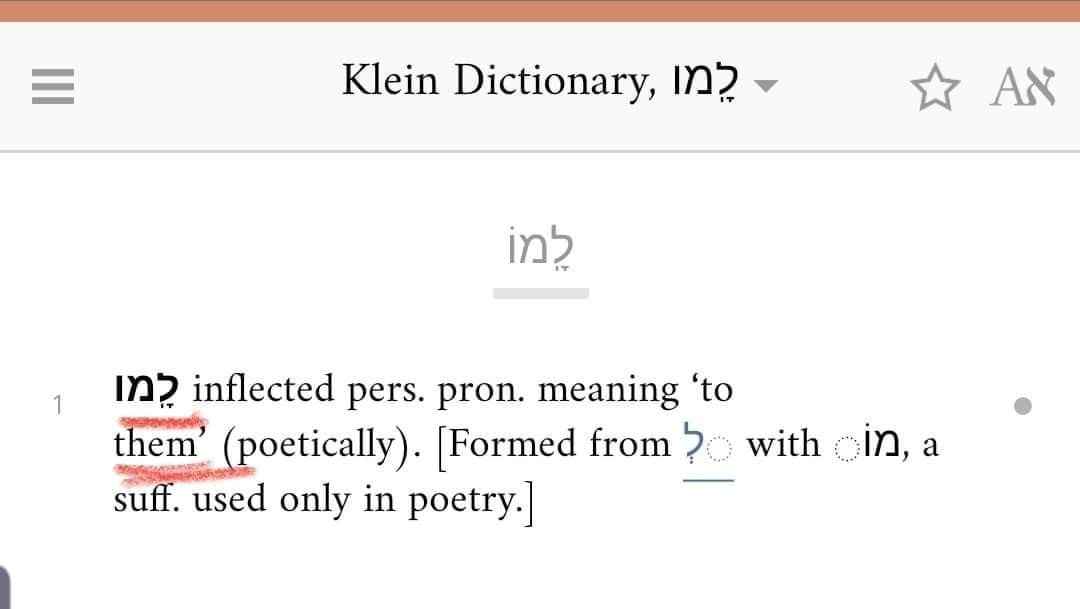
This scan shows the Klein Dictionary entry forלמו. The entry defines it as an inflected personal pronoun meaning “to them” poetically. This supports the argument that the word is plural in meaning. The highlighted part is important because the Christian reading of Isaiah 53 often depends on applying the suffering servant to a single individual, while this dictionary entry is being used to argue that the Hebrew wording points to a plural object: “to them,” not simply “to him.”
This is conclusive evidence that it indicates the plural.
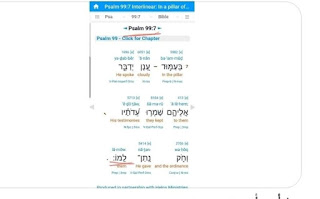
This scan shows a Hebrew interlinear example from Psalm 99:7, whereלָמוֹ / lamo appears and is translated in a plural sense, such as “to them.” The surrounding English wording refers to God speaking “to them” and “they kept,” which gives another biblical example of the same Hebrew form functioning with plural reference. This strengthens the argument that lamo in Isaiah 53:8 should be understood in a plural direction and therefore supports the claim that Isaiah 53 is about a group, not Jesus alone.
The Debate With the German Pastor
a German pastor who has some knowledge about Isaiah 53 and proved to him that it is talking about the pious group of the children of Israel and the evidence is in verse 8 in the original Hebrew he used the word לָֽמוֹ׃ which indicates the plural so the translation would be they were struck because of the sin of my people and I proved to him from the dictionary of the academic website sefaria that it indicates the plural only but he was not convinced so his answer was that it may indicate the singular and the evidence is from within the Bible so he proved to me from Isaiah 44 verse 15 And it shall be for men to burn; And he shall take from it and warm himself; He shall kindle also, and bake bread; And he shall make a god, and worship! He made it an idol and fell down to it,
וְהָיָ֤ה לְאָדָם֙ לְבָעֵ֔ר וַיִּקַּ֤ח מֵהֶם֙ וַיָּ֔חׇם אַף־יַשִּׂיק וְאפה לחם אַף־יִפְעַל־אֵל֙ So my
response to this was that he meant that they make the gods, one god after another, so he spoke in the singular when he made them, but after that they all fall down to them, so לָֽמוֹ refers to the group of gods that they made, one after the other, each one separately. The evidence is what came in the Septuagint. I understood the text that it was talking about a group of idols that were bowed down to, and it was a great shock to him. Then after that he showed his hateful racism and arar 😂😂
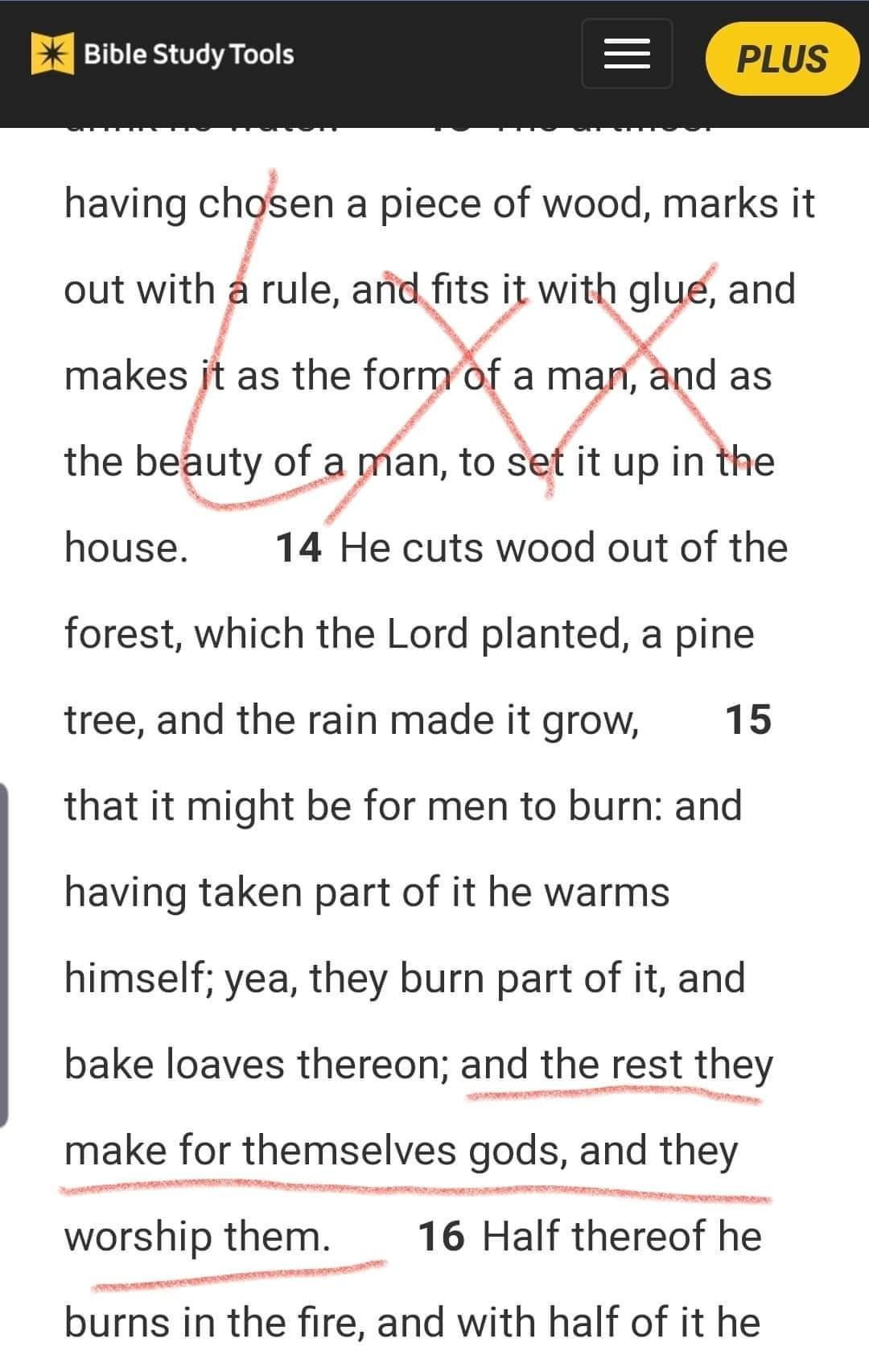
This scan shows Isaiah 44:14-16 from Bible Study Tools. The red markings focus on the section where the idol-maker takes wood, uses part of it for ordinary burning and cooking, and then uses the rest to makegods and worship them. The scan is important because the argument against the pastor’s objection is that Isaiah 44 is not simply speaking of one idol in isolation. The passage describes the making of idols or gods from wood, and the plural language fits the idea that people make gods one after another and worship them. Therefore, this example does not successfully prove that לָֽמוֹ / lamo must be singular in Isaiah 53:8.
Isaiah 53:9 and the Claim About Joseph of Arimathea
The Christian common people who follow their ignorant priests without knowledge say that Christ gave him to Joseph of Arimathea and buried him in his tomb. This is a fulfillment of the prophecy of Isaiah 53:9: ”
And his grave was made with the wicked, but with the rich in his death.” “But he did no violence, nor was there any deceit in his mouth.” (Isaiah 53:9)
The Septuagint Says Rich People, Not A Rich Man
and the word in the original Hebrew Masoretic is עָשִׁיר and denotes both singular and plural.
Therefore, the Jesuit, Life, and Common Arabic translations mentioned the text in the plural.
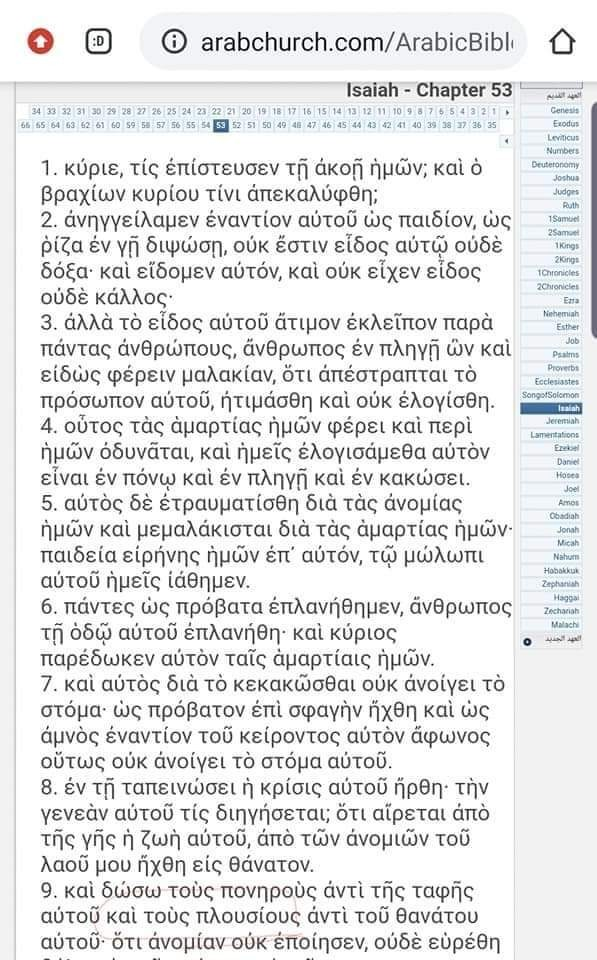
This scan shows Isaiah 53 in Greek from the Septuagint. The relevant part is verse 9, where the text containsκαὶ τοὺς πλουσίους, meaning “and the rich” or “the rich ones.” The Greek article τοὺς is plural, and πλουσίους is also plural. This matters because the common Christian apologetic claim connects Isaiah 53:9 with Jesus being buried in the tomb of Joseph of Arimathea, a single rich man. The scan is being used to show that the Septuagint wording points to rich people in the plural, not one specific rich man.
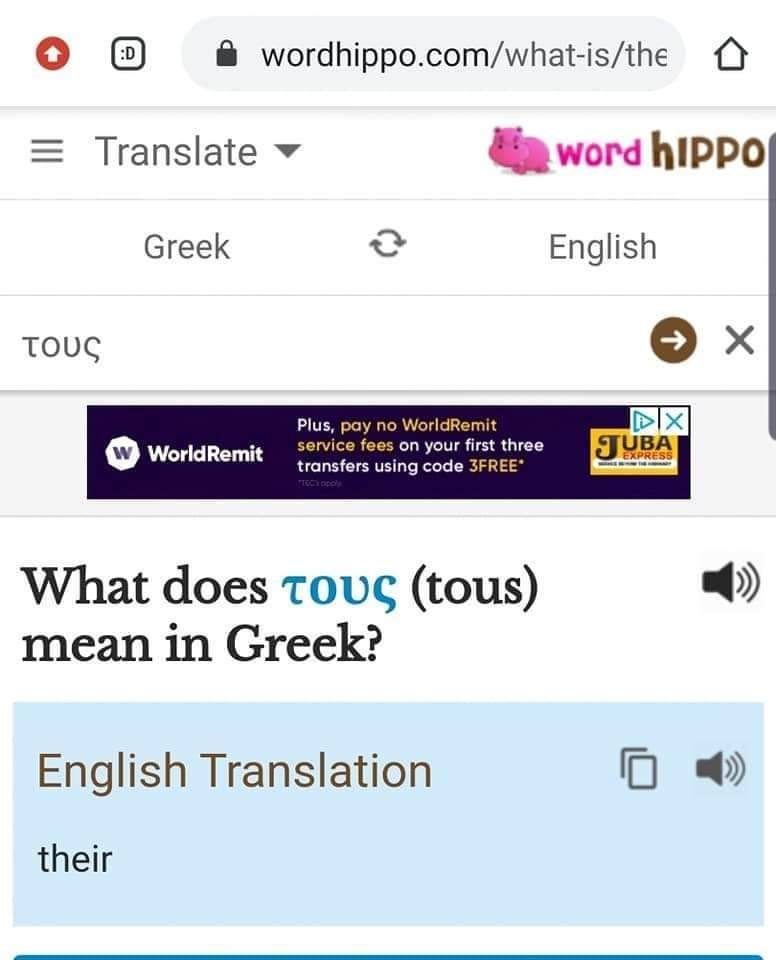
This scan shows a Greek-English dictionary page forτους / tous. The page gives the English translation as “their.” The point here is that the form is plural in sense. This supports the argument that the Greek wording in Isaiah 53:9 is not referring to one rich individual, but to a plural group. In the article’s argument, this weakens the claim that Isaiah 53:9 is a precise prophecy about Jesus being placed in the tomb of one rich man.
Arabic Translations Confirm the Plural Reading
This is what the Arabic translations confirmed
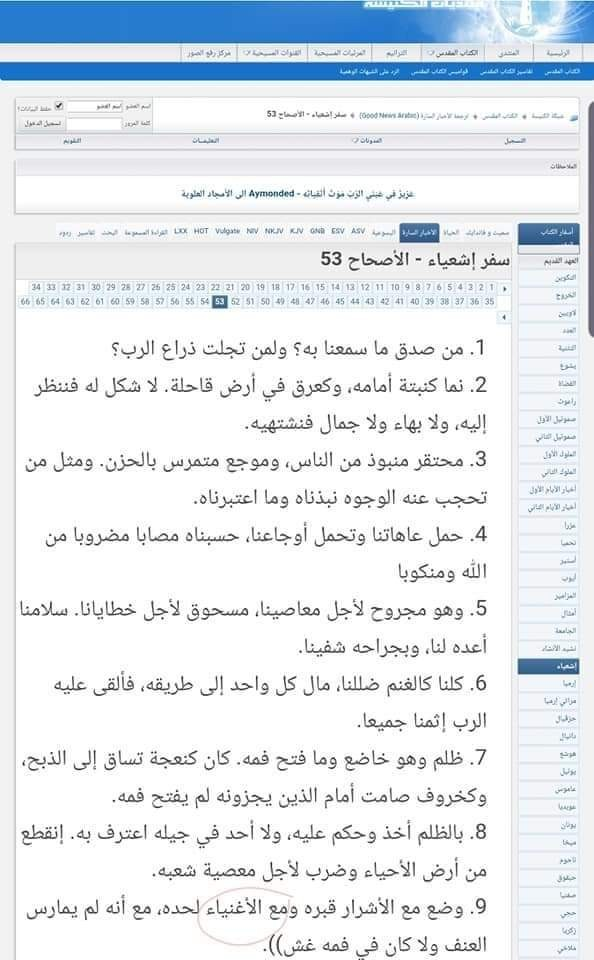
This scan shows Isaiah 53 from the Arabic Good News translation. In verse 9, the highlighted wording says“with the rich” in the plural, not “with a rich man” in the singular. The surrounding text also presents Isaiah 53 as a suffering figure or servant, but the key point in this scan is the plural phrase connected to burial or death. This supports the argument that some Arabic translations themselves preserve the plural reading and therefore do not support the apologetic claim that Isaiah 53:9 specifically predicts burial with one rich man, Joseph of Arimathea.
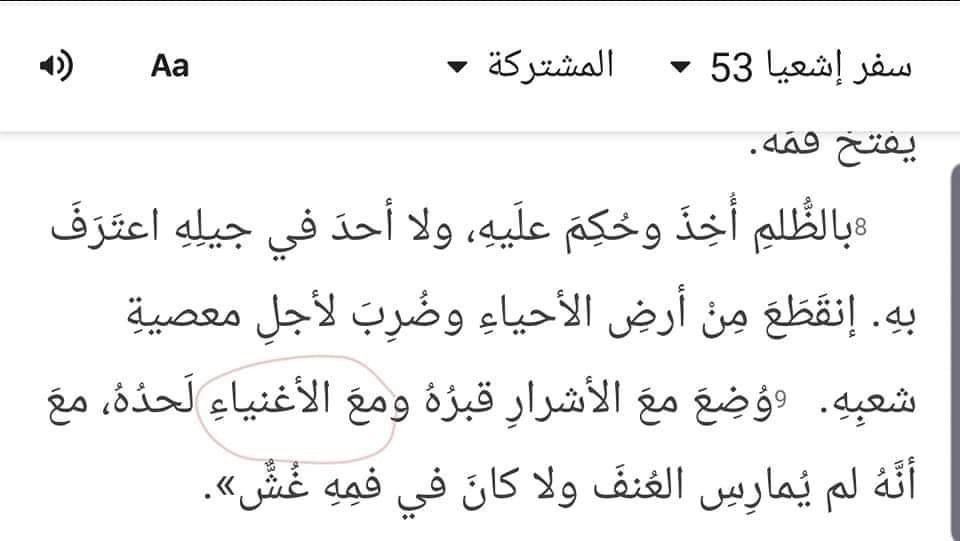
This scan shows Isaiah 53:8-9 from the Arabic Common translation. The highlighted phrase in verse 9 reads“with the rich” in the plural. The scan also shows verse 8 speaking about being cut off from the land of the living and struck because of the sin of his people. The important part for this argument is that the Arabic translation does not say “a rich man,” but uses plural wording. This is presented as confirmation that the text does not naturally fit the Christian claim about one wealthy man’s tomb.
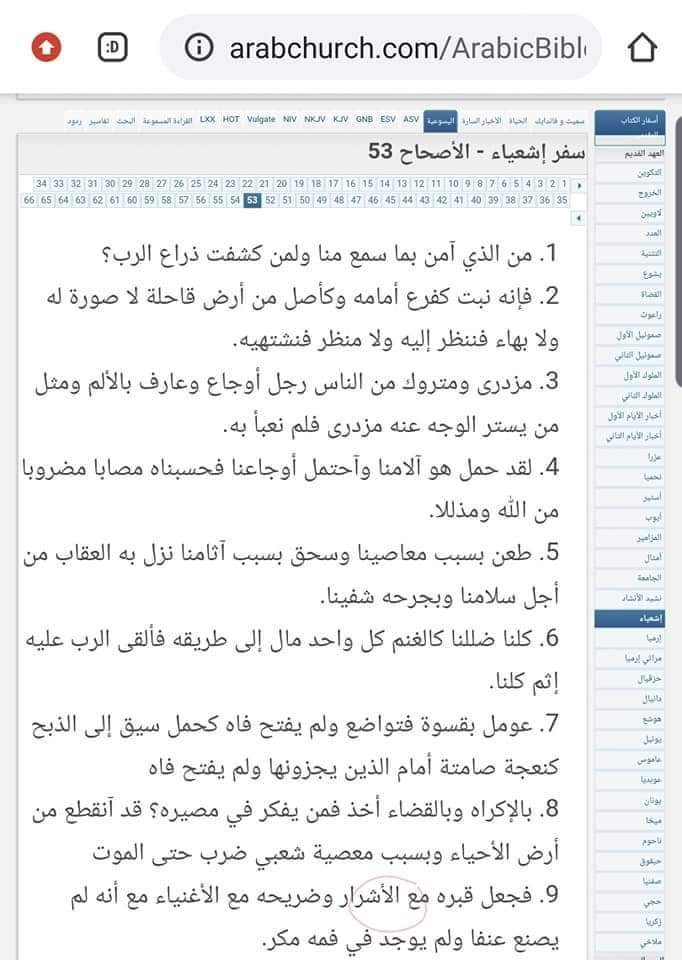
This scan shows another Arabic rendering of Isaiah 53. Verse 9 reads that his grave was made with the wicked and his tomb or resting place waswith the rich, again using plural wording. The text also says he did no violence and no deceit was found in his mouth. The highlighted point is the plural phrase related to the rich, which supports the article’s argument that Isaiah 53:9 is not a clean prophecy about Jesus being buried in the tomb of one rich man. Instead, the plural wording fits the broader argument that the passage concerns suffering righteous people among Israel.
Conclusion
The chapter is read collectively because:
- Isaiah can speak about Israel in the singular.
- Hosea 11 uses singular language for Israel, then shifts to plural.
- Isaiah 53:8 contains לָֽמוֹ / lamo, which indicates a plural reference.
- The Septuagint and dictionary evidence support plural readings.
- Isaiah 53:9 says rich people, not a rich man.
- Several Arabic translations also preserve the plural reading.
Therefore, the Christian claim that Isaiah 53 is a direct prophecy of Jesus’ crucifixion and burial depends on forced interpretation and translation choices.