

Does Islam Allow Killing Non-Combatants? The Thaqif Captive Hadith Explained
Extremists occasionally cite a hadith concerning a captive from the Thaqif tribe to argue that Islam permits the killing of non-combatants, yet a careful examination of the classical sources demonstrates that this claim rests on a fundamental misunderstanding of the text and its legal context. The individual in question was not an innocent bystander; rather, he was held accountable for violating a binding covenant to which his own tribe had agreed.
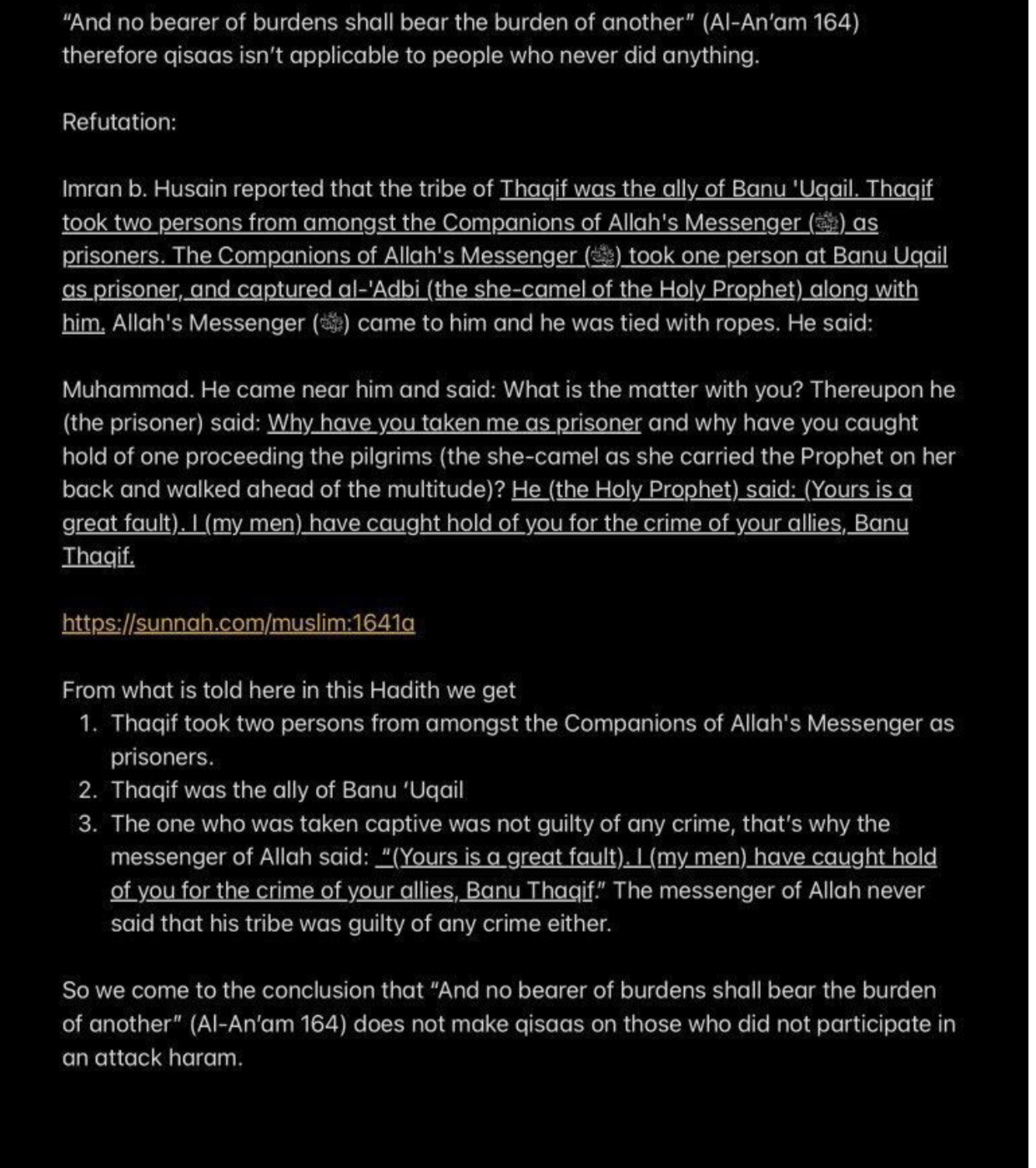
The Legal Framework of War Captives
Before examining the specific narration, several foundational principles of Islamic law regarding captivity must be established. The source of lawful slavery in Islam is restricted exclusively to captures of legitimate warfare, and even within this domain, numerous categories of non-combatants are explicitly protected.
The source of slaves is only captures of war.
Non-combatants — including the elderly, farmers, and those who took no part in hostilities — are not subject to enslavement. Furthermore, the ruler is under no obligation to enslave captives, and dhimmis — protected non-Muslim subjects already residing under Muslim governance — are similarly exempt from being seized.
“So when you meet those who disbelieve, strike at their necks until, when you have inflicted slaughter upon them, then secure their bonds, and either confer favor afterwards or ransom them until the war lays down its burdens…”
The protected status of dhimmis is further confirmed in the authentic Sunnah.
The dhimmis are not to be enslaved.
Moreover, the classical jurists have extended immunity to priests and monks who abstain from warfare entirely.
Priests and old people are not even to be enslaved.
Beyond the exclusion of specific categories, the classical encyclopedia of Kuwaiti jurisprudence clarifies the overarching rationale for wartime captivity. The wisdom underlying the permissibility of taking war captives is not arbitrary subjugation but the strategic necessity of neutralizing combatants and preventing their return to hostilities.
“The wisdom behind slavery is breaking the evil of the disbelievers and getting them away from the fighting field.”
The Covenant-Breaking Context
The central question is whether the captive in this narration was truly an innocent non-combatant. The classical commentaries demonstrate that he was not. Rather, he was implicated in the breach of a treaty undertaken by his tribe and their allies.
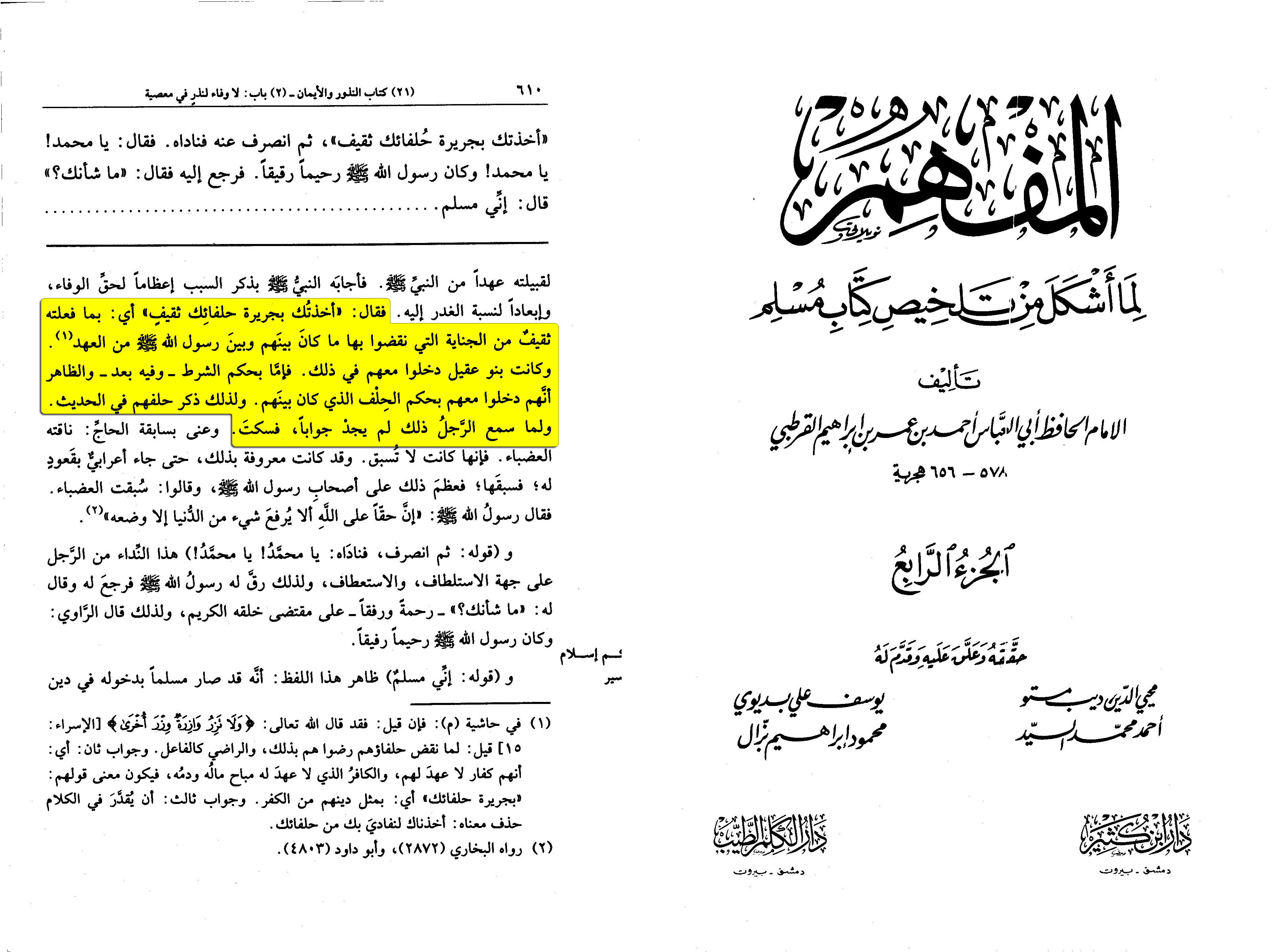
Al-Qurtubi states in his sharhClassical scholarly exegesis and legal commentary on a hadith or scriptural passage. of the narration that the captive was seized not as an innocent civilian but by virtue of his tribe’s violation of their agreement with the Messenger of Allah ﷺ.
And in al-hashiyah it was stated: when their companions broke the covenant, they agreed to it, so they became like them.
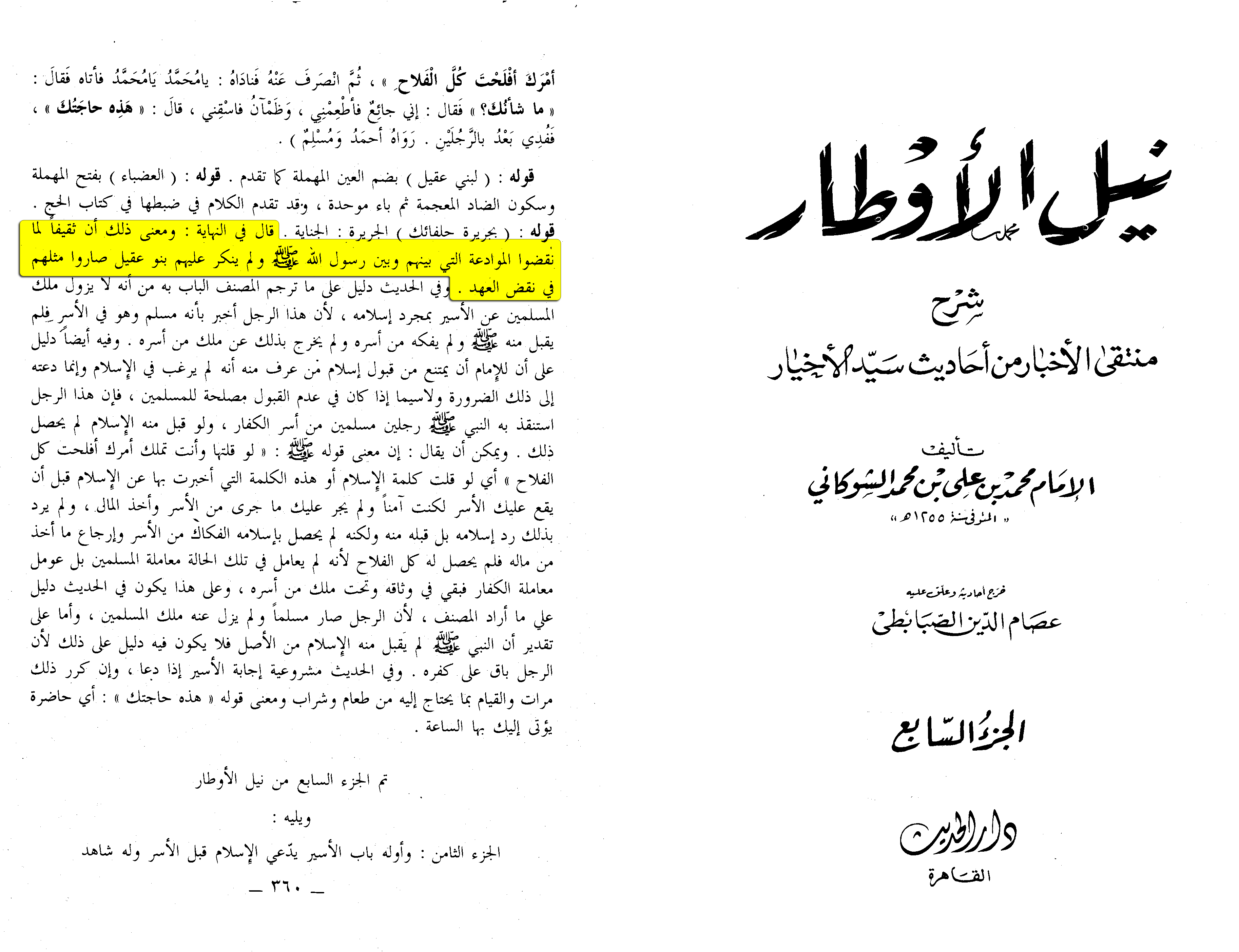
Ash-Shawkani corroborates this interpretation, emphasizing that the Banu Uqayl’s silence and tacit approval of the Thaqif breach rendered them complicit in the violation.
[!scholar] Ash-Shawkani — Nayl al-Awtar 7/360
“And he said in an-nihayah: the meaning of this is that, when Thaqif broke the covenant between them and the Messenger of Allah (may Allah bless him and grant him peace), Banu Uqayl didn’t object to this, so they became like them in breaking the covenant.”
The captive was complicit in breaking a binding covenant, and the ruling applied specifically to this breach rather than to non-combatants generally.
Objections and Responses
How would a woman who was just captured in war accept to sleep with a man?
This objection rests on a historical falsehood. The Hanafi scholars explicitly ruled that intercourse with a captive woman is impermissible if her husband was captured alongside her. As for cases where the husband was not present, the realities of ancient warfare answer the objection directly. Women frequently accompanied armies and aligned themselves with victorious forces.
[!admission] John McClintock — Cyclopædia of Biblical, Theological, and Ecclesiastical Literature
“Women who followed their fathers and husbands to the war put on their finest dresses and ornaments previous to an engagement, in the hope of finding favor in the eyes of their captors in case of a defeat.”
This historical pattern is further corroborated by modern biblical scholarship examining ancient warfare.
[!admission] Matthew B. Schwartz — The Fruit of Her Hands: The Psychology of Biblical Women
“Women have always followed armies to do the soldiers’ laundry, to nurse the sick and wounded, and to serve as prostitutes. They would often dress in such a way as to attract the soldiers who won the battle… The pretty girls crowd around the hero who scores the winning touchdown, not around the players of the losing team. And it is certainly true in war: the winning hero ‘attracts’ the women.”
Historical records from the early Islamic period confirm that women taken at Awtas had accompanied the military expedition, and the captives mentioned in the hadith later embraced Islam, married the Companions, and were freed.
Muhammad bin ‘Ali narrated: “When it was the day of Awtas, the (disbeliever) men fled to the mountains and their women were taken as captives.”
The reason they were freed and married to the Sahaba is that they became Muslim after witnessing the goodness of Islam. The famous incident with the HawazinA tribe whose captives were returned by the Prophet ﷺ after their delegation embraced Islam, demonstrating the discretionary and merciful nature of captivity rulings. delegation further illustrates this principle.
Grade: Sahih · al-Bukhari
As for the option of fida’ (ransom) and mann (grace), some have questioned whether these concessions for captives were abrogated.
Was ransom or mann (grace) of captives of war abrogated? If not, then why not do it?
The wisdom behind taking captives is breaking the strength of the disbelievers and removing them from the battlefield. If they were simply freed or ransomed immediately, they would return to hostilities and rebel again.
As for whether the option of ransom was abrogated, Ibn Abbas held that Surah al-Anfal 8:67 was revealed before the Muslims were numerous, and was later abrogated by Surah Muhammad 47:4. However, the majority of scholars maintained that the verse was never abrogated and that the Imam retains discretion to choose between ransom, enslavement, or grace.
[!scholar] Al-Qurtubi — Al-Jāmi’ li Ahkām al-Qur’ān 18:246–247
“That the verse is not abrogated and the imam has the choice either way. Ali bin Abi Talha narrated it from Ibn Abbas, and this is the saying of a lot of scholars such as Ibn Umar, al-Hasan al-Basri, and Ataa’, and it is the madhhab of Malik and al-Shafi’i and al-Thawri and al-Awza’i and Abu Ubayd and others, and it is the correct opinion as the Prophet did it, as did the rightfully guided caliphs.”
The person in this hadith was not an innocent non-combatant but was complicit in breaking a binding covenant, as demonstrated by the explanations of Al-Qurtubi and Ash-Shawkani. The classical rules of Islamic warfare explicitly protect non-combatants, and the specific ruling in this narration applied only to those who violated their treaty obligations.