

Does the Quran Call Jesus God? Refuting Christian Proof Texts
The correct answer series in refuting what the Christians have used as evidence from the verses of the Holy Qur’an
The meaning of the Almighty’s saying ( The Messiah, Jesus, the son of Mary, was but a messenger of God and His word which He directed to Mary and a spirit from Him )
“His word”
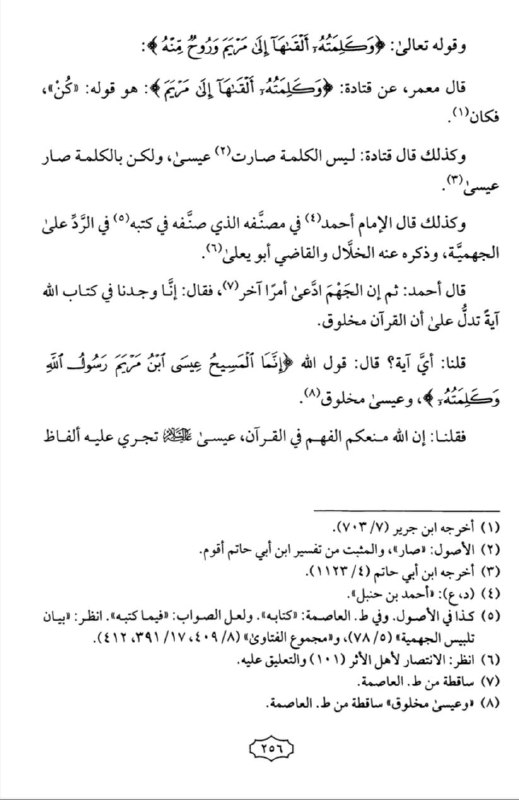
Summary of the Excerpt
This passage moves to a theological discussion regarding the creation of Jesus (‘Isa) and the nature of Allah’s speech, refuting heterodox views. It focuses on the verse: “…and His Word which He directed to Mary and a soul from Him…” (وَكَلِمَتُهُ أَلْقَاهَا إِلَىٰ مَرْيَمَ وَرُوحٌ مِّنْهُ).
-
Qatadah’s Explanation: > * Qatadah clarifies that “His Word” refers to the divine command: “Be” (Kun), and so Jesus came into existence.
- He explicitly underscores a crucial creedal distinction: Jesus did not literally become the Word itself; rather, he came into being through the agency of the Word.
-
Imam Ahmad’s Refutation of the Jahmiyyah:
-
The text references Imam Ahmad bin Hanbal’s book written in refutation of the Jahmiyyah sect (as recorded by al-Khallal and al-Qadi Abu Ya’la).
-
Jahm (the leader of the Jahmiyyah) attempted to argue that the Qur’an contains structural proof that it is created. He used the verse: “The Messiah, Jesus, son of Mary, was but a messenger of Allah and His Word…” to claim that since Jesus is a created being and is called “Allah’s Word,” the Word of Allah (the Qur’an) must also be a created entity.
-
-
The Counter-Argument:
- The orthodox response firmly rejects this deduction, stating that Allah has deprived the Jahmiyyah of correct understanding. Jesus is a human messenger onto whom the words and descriptions of Allah apply, whereas the divine Word itself (Kun) is an uncreated attribute of action from Allah that brings creation into existence.
The meaning of the Almighty’s saying: ” The Messiah, Jesus, the son of Mary, was but a messenger of God and His word which He directed to Mary and a spirit from Him .”
(And a spirit from Him)
Summary of the Excerpt
This page continues the theological exposition regarding the creation of Jesus (‘Isa) and linguistic refutations of heterodox and Christian doctrines.
-
Meaning of “A Soul From Him” (Ruhun Minhu):
- The text defines the possessive attribution of the soul to Allah (“Spirit of Allah” or “Spirit from Him”) as an honorific attribution of ownership and creation, not divinity. It is linguistically parallel to saying “the servant of Allah” or “the sky of Allah”—meaning a soul created and owned by Allah.
-
Al-Sha’bi’s Narration on the Word:
- Al-Sha’bi mirrors Qatadah’s view on the verse “…and His Word which He directed to Mary…”: When Allah said “Be” (Kun), Jesus became a creation. Jesus himself is not the literal command Kun, but was created by it.
-
Mujahid’s Narration on the Spirit:
- Commenting on “…and a soul from Him…”, Mujahid (via Layth) explains it means “A messenger from Him.” This links to Surah Maryam (Verses 17–19), where the Angel Gabriel (Ruhina / Our Spirit) appeared to Mary as a well-proportioned man. Thus, Jesus was conceived via this Spirit (Gabriel) and was called a “spirit” because he was created through a breath originating from a divine command.
-
Refutation of Christian Creed (The Creedal Error):
-
The text notes that Christians state in their creeds/liturgy that Jesus “was incarnated from Mary and the Holy Spirit,” which is found in earlier scriptures.
-
However, they erred fundamentally by misinterpreting “the Holy Spirit” (Ruh al-Qudus) as an uncreated divine attribute of Allah—equating it with His divine life and power, and thus making it a Lord/God.
-
The Correction: The text counters that no prophet ever designated “Life” or “Power” as a distinct persona/entity separate from Allah’s unified essence. Rather, across prophetic speech, “the Holy Spirit” refers either to the Angel Gabriel or to divine inspiration, revelation, guidance, and support cast into the hearts of the prophets.
-
The meaning of His saying, may He be exalted: “And [I have come] as a messenger to the Children of Israel, [saying], ‘Indeed, I have come to you with a sign from your Lord: that I create for you out of clay the likeness of a bird, then I breathe into it, and it becomes a bird by permission of Allah. And I heal the blind and the leper, and I raise the dead by permission of Allah. And I inform you of what you eat and what you store in your houses. Indeed, in the That is a sign for you, if you are believers. (
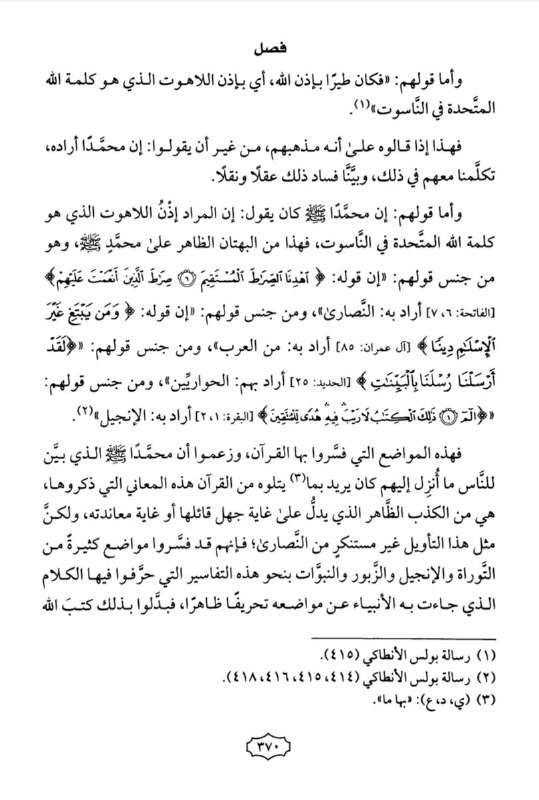
Summary of the Excerpt
In this passage, Ibn Taymiyyah continues his polemical refutation of Christian theological claims, specifically addressing the writings of Paul of Antioch (Bishop of Sidon). He analyzes and dismantles how certain Christian apologists interpreted verses of the Qur’an to justify their own doctrines of Christ’s divinity.
-
The Claim on Christ’s Miracles: > * The text references a claim that Christ’s miracle of creating birds from clay “by Allah’s permission” actually meant it was done by the permission of the Lahut (Divine Nature) which unified with the Nasut (Human Nature)—making the Word of God incarnate.
- Ibn Taymiyyah responds that if they openly state this is their stance, the fundamental falsity of this view can be easily proven through both logical reasoning (Aql) and textual transmission (Naql).
-
Refuting False Interpretations of Qur’an Verses:
-
He denounces the claim that Prophet Muhammad intended to validate Christian Christology through various Qur’anic phrases. The Christian texts argued that certain verses secretly pointed to them or their books:
- “Guide us to the Straight Path… of those You have blessed” Claimed it meant the Christians.
-
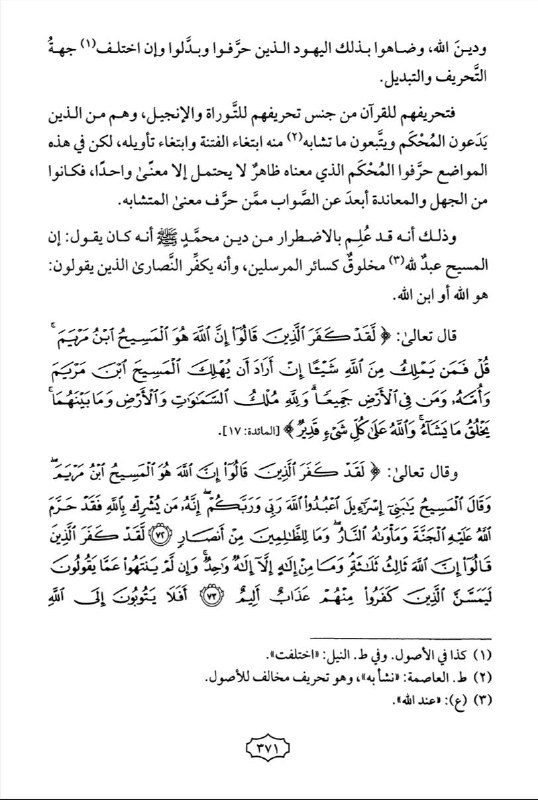
Summary of the Excerpt
This text features Imam Abu Ja’far al-Tabari explaining the divine statement: “Do they not then reflect upon the Qur’an?” >
-
The Target Audience: Al-Tabari explains that God is addressing those who secretly plot or disagree with the Prophet (the hypocrites). He urges them to deeply contemplate and study the Book of Allah.
-
The Proof of Divine Origin: By reflecting on the Qur’an, they would realize Allah’s ultimate proof against them. They would see that the revelations brought by Prophet Muhammad are truly from their Lord because the meanings are perfectly consistent, the rulings are harmonious, and different parts of the text validate, support, and confirm one another.
-
The Counterfactual Argument: He concludes by stating that if this Book had been from anyone other than Allah, its rulings would conflict, its meanings would contradict, and certain parts would expose the flaws and corruption of others.
-
Chain of Narration (Isnad): The text transitions at the bottom to a supporting narration (No. 9987) from Bishr bin Mu’adh, who narrates from Yazid, from Sa’id, from Qatadah to provide further classical commentary on this meaning.
Summary of the Excerpt
Continuing his systematic polemical refutation of Christian theology, Ibn Taymiyyah connects how Christian text-interpretations resemble the historic scriptural distortions (Tahrif) committed by past communities.
-
The Nature of their Qur’anic Distortion: > * He argues that their selective interpretation of specific Qur’anic phrases is akin to the historical distortion of the Torah and Gospel.
- They abandon clear, unambiguous verses (Al-Muhkam) and instead choose to chase after ambiguous phrases (Al-Mutashabih) seeking discord and fitting their pre-conceived theological biases.
-
Ignorance vs. Clear Truth: > * Ibn Taymiyyah asserts that their attempts to twist these verses to mean something that can only have one clear, undeniable meaning shows a level of stubbornness and deep ignorance that is worse than those who simply misinterpret ambiguous texts.
- He states it is an absolute necessity of the religion (Ma’lum bil-Darurah) that Prophet Muhammad explicitly declared Jesus to be a created servant of Allah, like all other messengers, and openly declared the disbelief (Takfir) of Christians who claim that Jesus is God or the Son of God.
-
Scriptural Evidence Cited: > * The text provides textual proof by citing crucial verses from Surah Al-Ma’idah (Verses 17 and 72–73):
-
“They have certainly disbelieved who say, ‘Allah is the Messiah, the son of Mary’…”
-
“They have certainly disbelieved who say, ‘Allah is the third of three’…”
-
These clear declarations firmly dismantle any argument that the Islamic text was sent to validate or approve of the Trinity or Christ’s divinity.
-
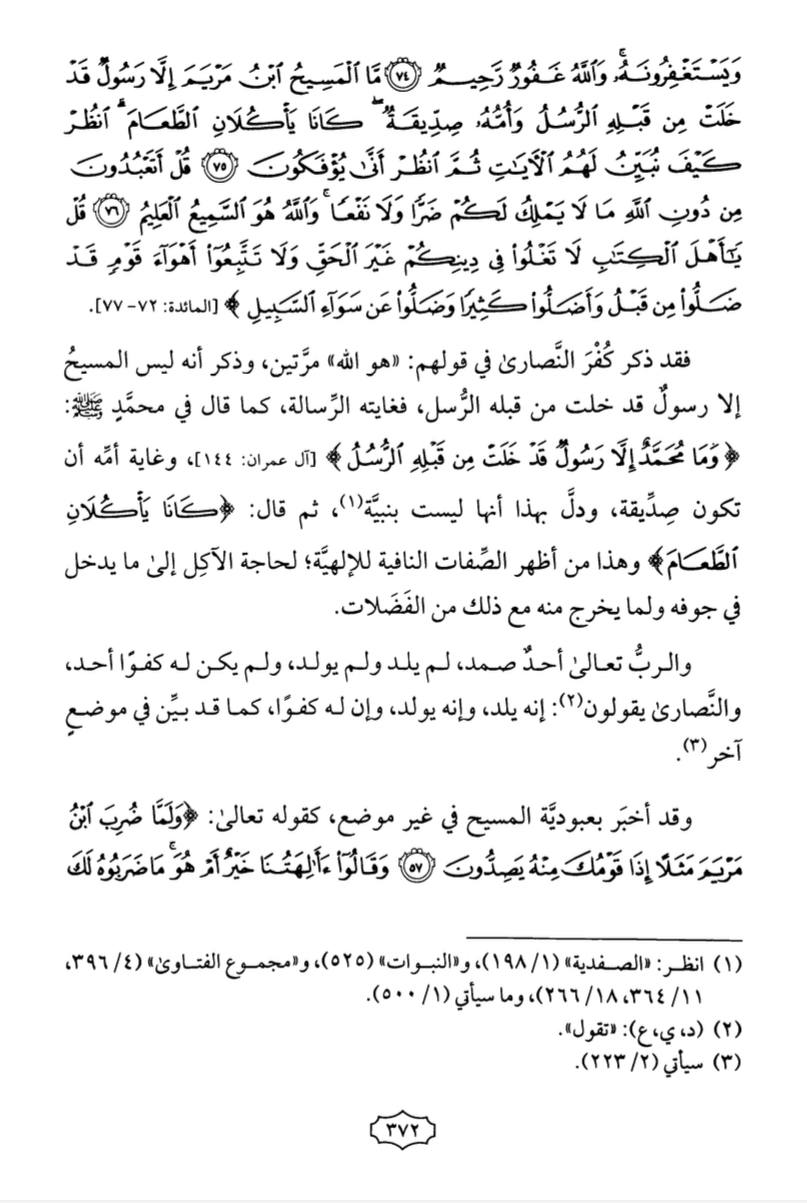
Summary of the Excerpt
This page continues the scriptural refutation of Christian theological claims concerning the nature of Jesus (‘Isa) and his mother Maryam, focusing on Surah Al-Ma’idah (Verses 75–77).
-
The Humanity of the Messiah and His Mother: > * The text quotes the verse: “The Messiah, son of Mary, was not but a messenger; [other] messengers have passed on before him. And his mother was a supporter of truth. They both used to eat food…”
- Ibn Taymiyyah highlights a profound rational argument embedded in this verse: the fact that they both required food (Kāna ya’kulāni al-ṭa’ām) is one of the clearest physical proofs negating divinity. Eating necessitates digestion, internal processing, and the elimination of bodily waste—attributes that are entirely incompatible with the absolute perfection and self-sufficiency of God.
-
The True Status of Maryam: > * The phrase “And his mother was a supporter of truth (Ṣiddīqah)” indicates her high spiritual station, but concurrently establishes that she was not a prophetess (Nabiyyah), let alone a divine entity.
-
The Nature of the Divine Essence vs. Christian Claims: > * The text asserts that the True Lord is Unique, Absolute, and Eternal (Aḥadun Ṣamad); He does not beget, nor is He begotten, and has no equals.
- In contrast, Christian dogmas claim that God begets and is begotten, which the author promises to dismantle further using their own text-traditions in later sections.
-
The Dynamic of Servitude (‘Ubudiyyah): > * The text concludes by transitioning to other scriptural proofs where Allah explicitly informs mankind about the absolute servitude and creation of the Messiah, citing Surah Az-Zukhruf (Verse 57) regarding the reaction of the polytheists when the example of the son of Maryam was put forward.
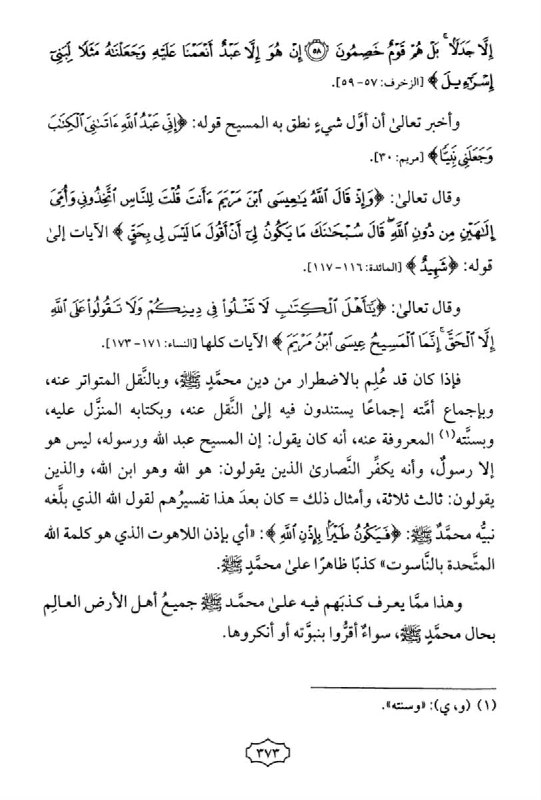
Summary of the Excerpt
This page continues compiling definitive scriptural proofs from the Qur’an to demonstrate the absolute servitude of Jesus (‘Isa) to Allah, conclusively refuting claims of his divinity.
-
Scriptural Evidence of Servitude:
-
Surah Az-Zukhruf (Verses 57–59): Quotes the verse establishing that Jesus is explicitly a servant whom Allah blessed and made an example for the Children of Israel (In huwa illā ‘abdun an’amnā ‘alayhi).
-
Surah Maryam (Verse 30): Highlights the very first words spoken by Jesus in the cradle: “Indeed, I am the servant of Allah; He has given me the Scripture and made me a prophet.”
-
Surah Al-Ma’idah (Verses 116–117): Cites the future testimony where Jesus will be asked if he told people to take him and his mother as gods besides Allah, to which he replies: “Exalted are You! It was not for me to say that to which I have no right…”
-
Surah An-Nisa (Verse 171): Cites the command to the People of the Book not to commit excess in religion and reminds them that the Messiah is only a messenger of Allah.
-
-
Consensus and Conclusion:
-
Ibn Taymiyyah asserts that it is known by historical necessity from the religion of Muhammad, by textual transmission, and by total consensus (Ijma’) of the Muslim nation that Jesus is a created servant and messenger.
-
He concludes that any interpretation attempting to twist the text—such as claiming that when Muhammad said “by Allah’s permission” regarding Christ’s miracles, he actually meant “by permission of the divine nature (Lahut) unified with the human nature (Nasut)“—is a manifest, self-evident lie (Kidhbun Dhāhir) rejected by anyone familiar with the Prophet’s message.
-
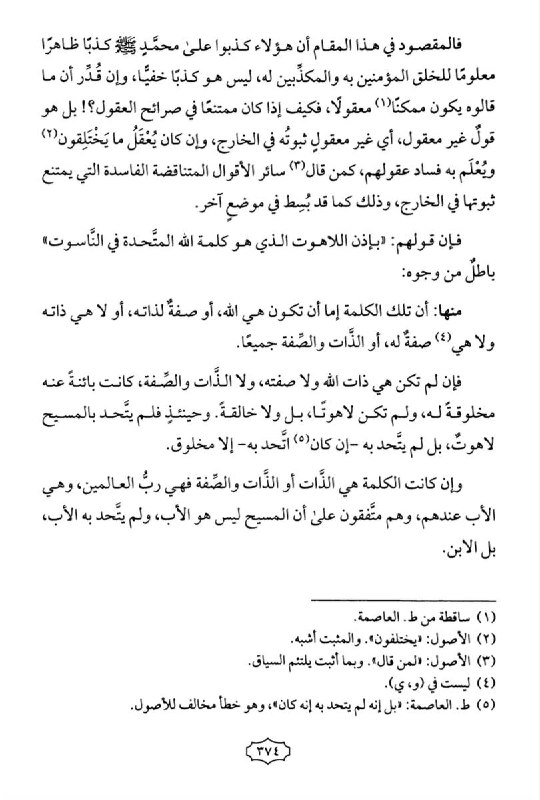
Summary of the Excerpt
Ibn Taymiyyah delivers a rigorous theological and logical breakdown to invalidate the specific Christian doctrine of the Incarnation—specifically the claim that Christ performed miracles because the “Divine Nature (Lahut) united with the Human Nature (Nasut).”
- The Core Logical Dilemma Regarding “The Word”:
He presents a multi-layered theological dilemma concerning the nature of “The Word” (Al-Kalimah) that Christians claim united with Jesus:
- **Scenario A (If the Word is a created entity):** If the Word is distinct from Allah's essence, separate from Him, and created, then it is not divine (_Lahut_), nor is it a creator. Consequently, if a created word united with Jesus, he remains merely a created being, completely invalidating any claim to his divinity.

- **Scenario B (If the Word is the Divine Essence/Attribute itself):** If they claim the Word is the actual Essence of God or His inseparable attribute, then it must be the Lord of the Worlds (which they identify as "The Father"). However, Christian orthodoxy universally agrees that Jesus is "The Son," not the Father, creating an internal contradiction in their own trinitarian theology.- Conclusion on Irrational Creeds:
The author concludes that their specific framing of the Incarnation is completely untenable by sound intellect (Ghayr Ma’qul). He asserts that their arguments are self-contradictory statements whose impossibility is outwardly obvious to any sound mind, exposing a fundamental corruption in their theological deductions.
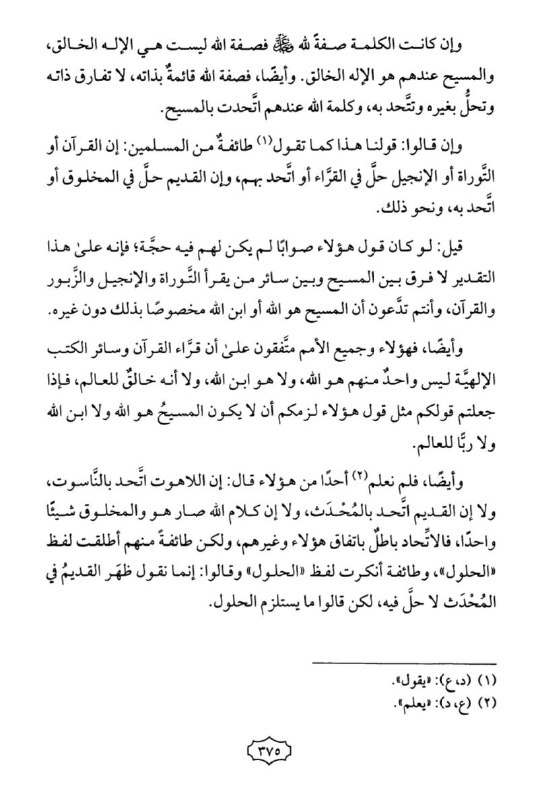
Summary of the Excerpt
Ibn Taymiyyah continues his logical deconstruction of the Christian doctrine of the Incarnation, focusing here on the implications of defining “The Word” as a divine attribute.
-
The Attribute Dilemma: > * If the Word is considered an attribute of Allah, an attribute is not the complete, independent Creator Creator-self (Al-Ilāh al-Khāliq).
- According to Christian belief, Jesus is considered the complete Creator Creator-self. Thus, saying an attribute of God permanently independent-reided within or unified with a human creates an architectural impossibility within their own definitions—as an attribute cannot magically detach from the Divine Essence to become an independent entity somewhere else.
-
The Absurdity of Universal Incarnation Logic: > * The author counters a potential argument made by some sectarian groups who claim that divine words indwell within the hearts of those who recite or study revelation (Torah, Gospel, Psalms, or Qur’an).
- He argues that if merely having the Word of God manifest inside someone makes them divine, then every nation that reads scriptural revelation would have a right to claim divinity or sonship. This logic would force them to accept that there is no unique difference between Christ and any other person who holds scriptural knowledge, an outcome all parties agree is false.
-
Refuting Incarnation (Hulul) and Union (Ittihad): > * The text states that no rational thinker has ever successfully explained how the Eternal (Al-Qadim) could literally merge with or enter a newly originated creation (Al-Muhdath).
- He concludes that whether Christian apologists use the term “Union” (Ittihad) or try to avoid the word “Incarnation/Indwelling” (Hulul), the underlying concept remains intellectually invalid because a physical union between the Divine Nature and Human Nature inevitably implies logical absurdities that sound intellect completely rejects.
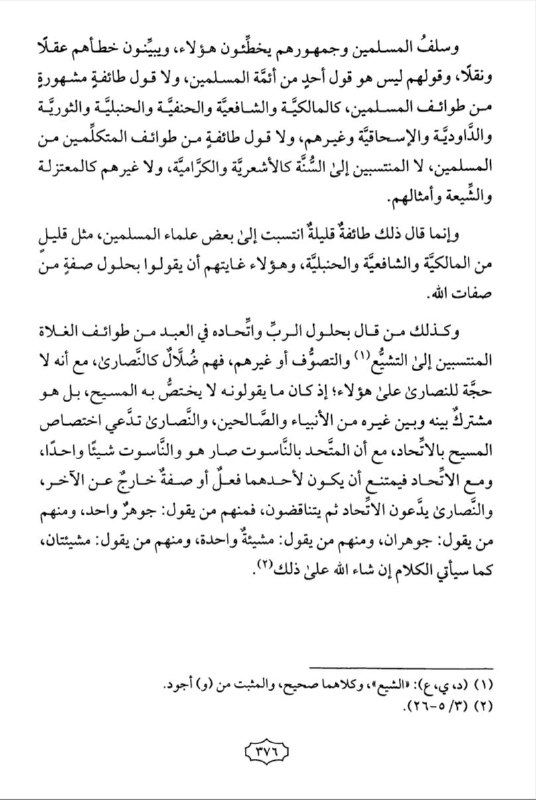
Summary of the Excerpt
Ibn Taymiyyah concludes this specific section by detailing the universal consensus among Islamic scholarly traditions against doctrines of divine incarnation (Hulul) and existential union (Ittihad).
-
The Consensus of Muslim Schools:
-
He explicitly names the mainstream legal schools—including the Maliki, Shafi’i, Hanbali, Thawri, Dawudi (Zahiri), and Ishaqi traditions—alongside theological schools like the Ash’ari, Karrami, Mu’tazilah, and Shi’a.
-
He notes that all these mainstream groups and their predecessors unanimously agree that the Christian claims are false according to text and logic. They firmly reject any notion that a divine attribute detached or manifested inside a creation.
-
-
Addressing Marginal Group Errors:
-
The author acknowledges that a tiny minority attributed to some legal schools or certain extremist Sufi (Tasawwuf) and Shi’a factions fell into misinterpretations regarding divine indwelling.
-
He classifies these groups as straying into the same fundamental error as the Christians.
-
-
The Flaw in the Christian Claim of Uniqueness:
-
Ibn Taymiyyah highlights a logical trap for Christian theology: if they claim that performing miracles or having divine words manifest inside a person proves an existential union with God, then this dynamic is shared by other prophets and righteous figures throughout history.
-
Therefore, their theological reasoning fails to preserve a unique status exclusively for Jesus.
-
-
Internal Disagreements on the Incarnation Structure:
- He points out that the Christians themselves cannot agree on how the Lahut (Divine Nature) and Nasut (Human Nature) unified. They split internally into competing factions: some claim the union resulted in a single essence (Jawhar), others claim two essences, and they remain divided over whether Jesus possesses a single divine will or two separate wills.
The meaning of the Almighty’s saying ( And We gave Jesus, the son of Mary, clear proofs and supported him with the Holy Spirit )
“And We supported him with the Holy Spirit”
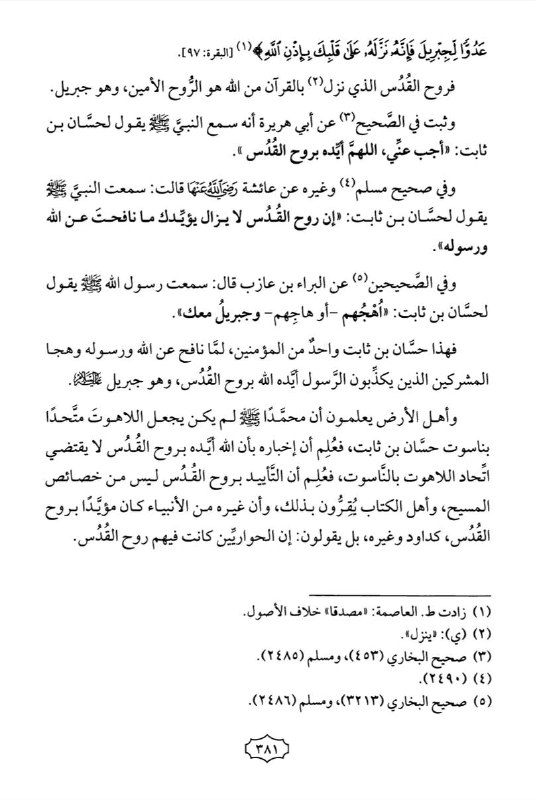
Core Theme: The Concept of Ruh al-Qudus (The Holy Spirit)
This page focuses on the theological and textual evidence establishing that Ruh al-Qudus (الروح القُدُس) is the Angel Jibril (Gabriel), and discusses how this support is granted by Allah.
Key Hadiths & Evidence Presented:
-
Support for Hassan bin Thabit: Multiple authentic narrations (from Sahih al-Bukhari and Sahih Muslim) feature Prophet Muhammad ﷺ praying for or praising the companion Hassan bin Thabit, saying: “O Allah, support him with Ruh al-Qudus” or “Ruh al-Qudus will continue to support you as long as you defend Allah and His Messenger.”
-
Prophetic Command: A narration from Al-Bara bin Azib highlights the Prophet ﷺ telling Hassan to lampoon/satirize the disbelievers while reassuring him that “Jibril is with you.”
Theological Arguments & Refutations:
-
Refutation of Incarnation (Lahut and Nasut): The text argues against the Christian theological perspective regarding Jesus (the divine Lahut uniting with the human Nasut).
-
Universal Support: The author notes that everyone knows Prophet Muhammad ﷺ did not claim a divine nature merged with the human nature of Hassan bin Thabit just because Hassan was supported by Ruh al-Qudus. Therefore, being supported by Ruh al-Qudus is not an exclusive characteristic of Jesus.
-
Other Figures: The text states that the People of the Book acknowledge other Prophets (like David) and the Apostles (Al-Hawariyyun) were also aided or influenced by Ruh al-Qudus.
The meaning of God Almighty’s words ( Then We sent Our messengers in their footsteps, and We sent Jesus, the son of Mary, and gave him the Gospel. And We placed in the hearts of those who followed him compassion and mercy and monasticism which they invented; We did not prescribe it for them except to seek the pleasure of God, but they did not observe it with due observance. So We gave those of them who believed their reward, but many of them are defiantly disobedient) is condemnation, not praise . For them
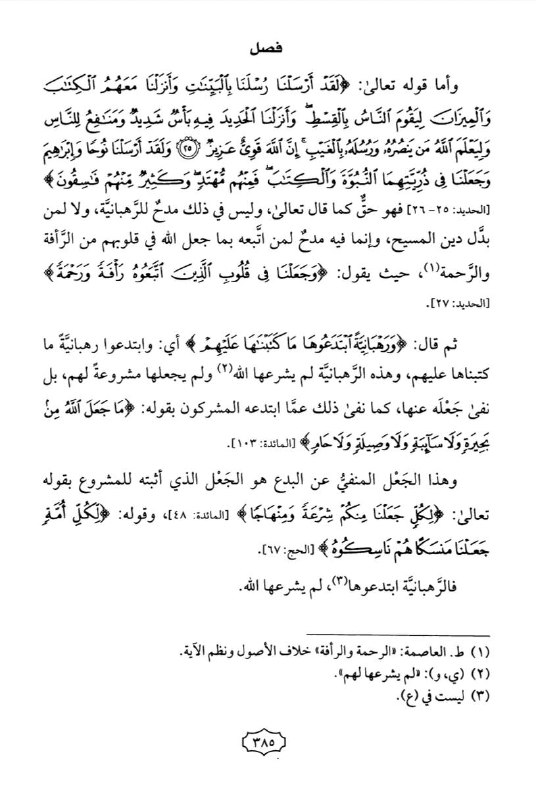
Book Identity:
-
Book Name: Al-Jawab as-Sahih liman baddala dina-l-Masih (The Correct Answer to Those Who Altered the Religion of Jesus) by Ibn Taymiyyah.
Core Theme: Theological Critique of Monasticism (Rahbanyyah)
This page analyzes Quranic verses from Surah Al-Hadid to discuss the origin and legitimacy of monasticism in the Christian tradition, contrasting divine legislation with human innovation.
Key Arguments & Textual Analysis:
-
Context of Praise: The text references Surah Al-Hadid (25–27). It argues that the verses praising the followers of Jesus do not praise monasticism itself, nor do they commend those who altered his original religion. Instead, the praise is strictly directed at the qualities of compassion and mercy (“compassion and mercy in the hearts of those who followed him”).
-
Monasticism as an Innovation: Commenting on the phrase “But monasticism they innovated; We did not prescribe it for them”, the author emphasizes that monasticism was a human introduction, completely unlegislated by Allah.
-
Analogy of Forbidden Practices: The author equates this unauthorized innovation to the superstitions and ritual prohibitions invented by pre-Islamic polytheists (such as Bahirah, Sa’ibah, Wasilah, and Ham mentioned in Surah Al-Ma’idah: 103), which were similarly rejected by divine text.
-
The Nature of Divine Law: The text contrasts human innovation (Bid’ah) with what Allah has explicitly legislated for human benefit, citing verses like “To each of you We prescribed a law and a method” (Al-Ma’idah: 48). It concludes firmly that monasticism was entirely self-imposed and holds no divine authority.
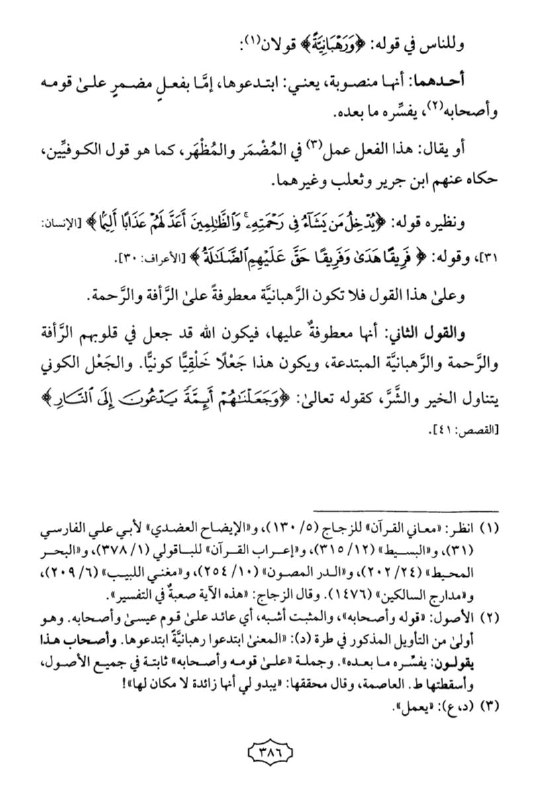
Book Identity:
-
Book Name: Al-Jawab as-Sahih liman baddala dina-l-Masih (The Correct Answer to Those Who Altered the Religion of Jesus) by Ibn Taymiyyah.
Core Theme: Grammatical & Theological Analysis of “Monasticism” (Rahbanyyah)
This page continues the detailed linguistic and interpretive analysis of the word “Monasticism” (وَرَهْبَانِيَّةً) from Surah Al-Hadid, presenting two major scholarly opinions regarding its grammatical position and the theological implications of each.
The Two Interpretive Opinions:
-
First Opinion (The Accusative of a Hidden Verb):
-
Grammatical view: The word is in the accusative case (Mansub) because it is governed by an implied/hidden verb that corresponds with what follows it. Essentially, it implies: “They innovated monasticism.” This is the grammatical view of the Kufan school of linguistics, as narrated by Ibn Jarir [al-Tabari], Tha’lab, and others.
-
Quranic Parallels: The text provides structural examples of this linguistic phenomenon from other verses, such as:
-
“He admits whom He wills into His mercy; but the wrongdoers - He has prepared for them a painful punishment.” (Surah Al-Insan: 31).
-
“[A detailed] group He guided, and a group deserved straying.” (Surah Al-A’raf: 30).
-
-
Theological consequence: Based on this view, monasticism is completely disconnected from the preceding words “compassion and mercy,” meaning it is not a praised attribute given by Allah, but a separate, human-initiated action.
-
-
Second Opinion (Conjunction with “Compassion and Mercy”):
-
Grammatical view: The word is directly conjoined (Ma’tuf) to “compassion and mercy,” meaning Allah placed compassion, mercy, and this innovated monasticism into their hearts.
-
Theological concept of “Universal Decree” (Al-Ja’l al-Kawni): The author explains that if this view is adopted, the placement of monasticism in their hearts is a matter of Allah’s universal decree (Kawni), which encompasses both good and evil, rather than His religious approval (Shar’i).
-
Quranic Parallel: To illustrate this type of decree involving something negative, the text quotes: “And We made them leaders inviting to the Fire.” (Surah Al-Qasas: 41).
-
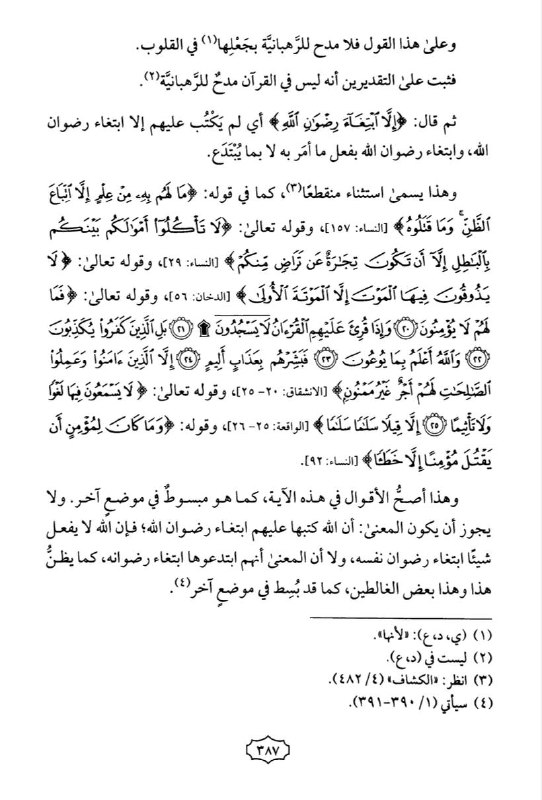
Book Identity:
-
Book Name: Al-Jawab as-Sahih liman baddala dina-l-Masih (The Correct Answer to Those Who Altered the Religion of Jesus) by Ibn Taymiyyah.
Core Theme: Grammatical Analysis of the Exception Regarding Monasticism
This page concludes the discussion on monasticism by analyzing the phrase “…only seeking the pleasure of Allah” (إِلَّا ابْتِغَاءَ رِضْوَانِ اللَّهِ) from Surah Al-Hadid, using classical Arabic grammar rules to determine the true theological meaning.
Key Arguments & Grammatical Points:
-
Conclusion on Monasticism: The author notes that based on the two structural possibilities discussed previously, it is proven that there is no praise for monasticism anywhere in the Quran.
-
The Disjointed/Disconnected Exception (Istithna’ Munqati’): > The phrase “We did not prescribe it for them, except the seeking of Allah’s pleasure” is classified as a disjointed exception. This means that what follows the “except” is not part of what came before it. The meaning is: Allah did not prescribe monasticism for them at all; rather, they were only expected to seek Allah’s pleasure by performing what He actually commanded, not by introducing human innovations.
-
Quranic Examples of Disjointed Exceptions: > To reinforce this linguistic rule, the author provides several Quranic parallels where “except” (Illa) functions as a transition to a completely separate idea (meaning “but”):
-
“They have no knowledge of it except the following of assumption.” (Surah An-Nisa: 157).
-
“…do not consume one another’s wealth unjustly, but only [in lawful] business by mutual consent.” (Surah An-Nisa: 29).
-
“They will not taste therein death except the first death.” (Surah Ad-Dukhan: 56).
-
“…except those who believe and do righteous deeds…” (Surah Al-Inshiqaq: 25).
-
“They will not hear therein ill speech or commission of sin—only a saying of: ‘Peace, peace.’” (Surah Al-Waqi’ah: 25–26).
-
“And it is not for a believer to kill a believer except by mistake.” (Surah An-Nisa: 92).
-
Theological Refutation of Misinterpretations:
-
Refuting Incorrect Meanings: The text states that it is incorrect to interpret the verse as meaning “Allah prescribed monasticism for them so that they might seek His pleasure,” or “they innovated it to seek His pleasure, as some mistaken commentators think.”
-
The Righteous Path: Seeking Allah’s pleasure can only be achieved through obedience to His established law, not through self-imposed asceticism.
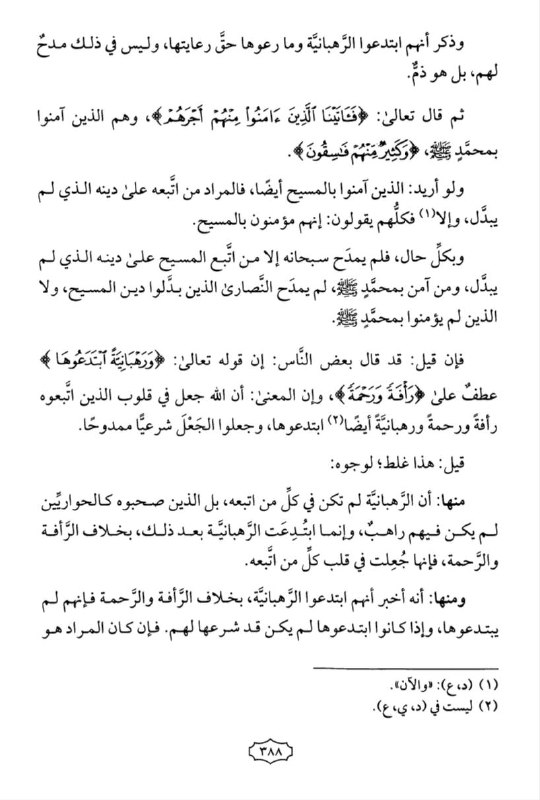
Book Identity:
-
Book Name: Al-Jawab as-Sahih liman baddala dina-l-Masih (The Correct Answer to Those Who Altered the Religion of Jesus) by Ibn Taymiyyah.
Core Theme: The True Meaning of Allah’s Praise and Dispraise of the Followers of Jesus
This page continues the systematic analysis of Surah Al-Hadid, focusing on who exactly receives divine reward, the dispraise of monasticism, and a multi-point refutation against viewing monasticism as a praiseworthy divine placement.
Key Arguments & Interpretations:
-
Dispraise, Not Praise: The page opens by reiterating that when Allah states they innovated monasticism and failed to observe it properly, it constitutes a condemnation (dispraise), not a compliment.
-
Who Receives the Reward? Commenting on the verse “So We gave the ones who believed among them their reward, but many of them are defiantly disobedient,” the text clarifies that the rewarded individuals are specifically those who believed in Prophet Muhammad ﷺ. If it were meant broadly to include early followers of Jesus, it only applies to those who stuck strictly to his unaltered message. Allah does not praise the Christians who changed the faith or rejected Islam.
Refutation of Monasticism as a Divinely Approved Conception:
The text addresses a counter-argument: What if “monasticism” is conjoined to “compassion and mercy,” meaning Allah placed a praiseworthy monasticism into their hearts? >
The author rejects this claim as completely incorrect based on several logical points:
-
Historical Absence: Monasticism was not found among the true, immediate disciples who accompanied Jesus (like Al-Hawariyyun); none of them were monks. It was entirely innovated much later. In contrast, compassion and mercy were placed in the hearts of all his true followers from the start.
-
The Act of Innovation: Allah explicitly states that they innovated monasticism. Compassion and mercy, however, were granted directly by Allah and were not human innovations. If monasticism were a divinely approved law, it would not be described as something they invented outside of His legislation.
The meaning of God Almighty’s saying ( Indeed, those who believed and those who were Jews and the Christians and the Sabeans - those who believed in God and the Last Day and did righteousness - will have their reward with their Lord, and there will be no fear concerning them, nor will they grieve) !refutes their claim that the Qur’an praised them.
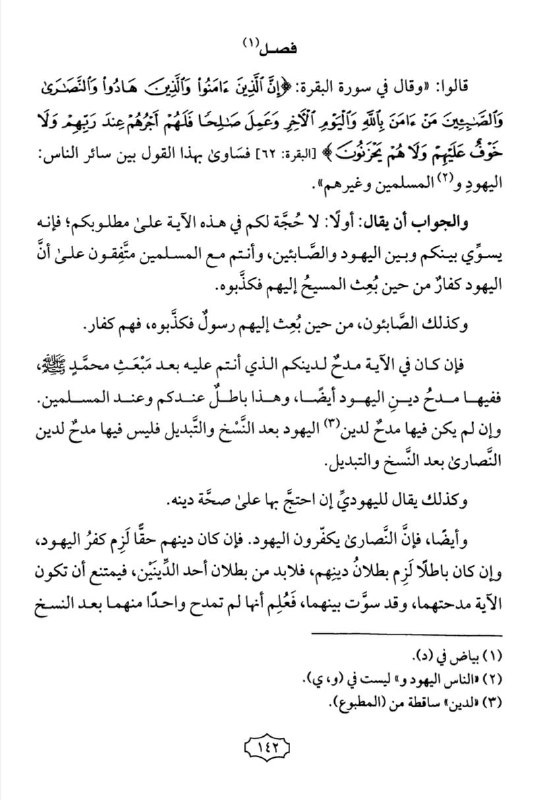
Book Identity:
-
Book Name: Al-Jawab as-Sahih liman baddala dina-l-Masih (The Correct Answer to Those Who Altered the Religion of Jesus) by Ibn Taymiyyah.
Core Theme: Refutation of Using Surah Al-Baqarah (Verse 62) to Validate Abrogated Religions
This page starts a new chapter/section (Fasl) dealing with an argument brought forth by Christian polemicists who try to use the Quran to prove the ongoing validity of their faith after the advent of Islam.
The Christian Argument:
-
They cite Surah Al-Baqarah: 62: “Indeed, those who believed and those who were Jews or Christians or Sabians—those [among them] who believed in Allah and the Last Day and did righteousness—will have their reward with their Lord, and no fear will there be concerning them, nor will they grieve.”
-
Based on this, they argue that the Quran places their faith on an equal footing with Muslims, Jews, and Sabians, thus validating their path to salvation.
The Author’s Refutation:
Ibn Taymiyyah systematically dismantles this claim using several logical and theological arguments:
-
The Problem of Equalizing: If Christians take this verse as proof of their validity after the coming of Prophet Muhammad ﷺ, it means they must also accept that Judaism and Sabianism are valid today. However, Christians themselves agree with Muslims that the Jews became disbelievers (Kuffar) the moment they rejected Jesus when he was sent. The same applies to the Sabians who rejected their respective messengers.
-
The Dilemma of Praise After Abrogation: > * If this verse praises the Christian religion as it is practiced today (after the advent of Islam), it would inherently have to praise the Jewish religion today as well. This is a false premise according to both Christians and Muslims.
- Therefore, since the verse cannot be praising Judaism after it was abrogated and altered, it is impossible for it to be praising Christianity after its own abrogation (Naskh) and alteration (Tabdil) following the arrival of Muhammad ﷺ.
-
Mutual Exclusivity: The author points out the internal contradiction in their stance: Christians declare Jews to be disbelievers, and Jews declare Christians to be disbelievers. If one religion is true, the other must be false; they cannot both be simultaneously valid paths to God. Since the verse treats them equally in its wording, it proves it is not praising either of them in their current, altered states post-abrogation.
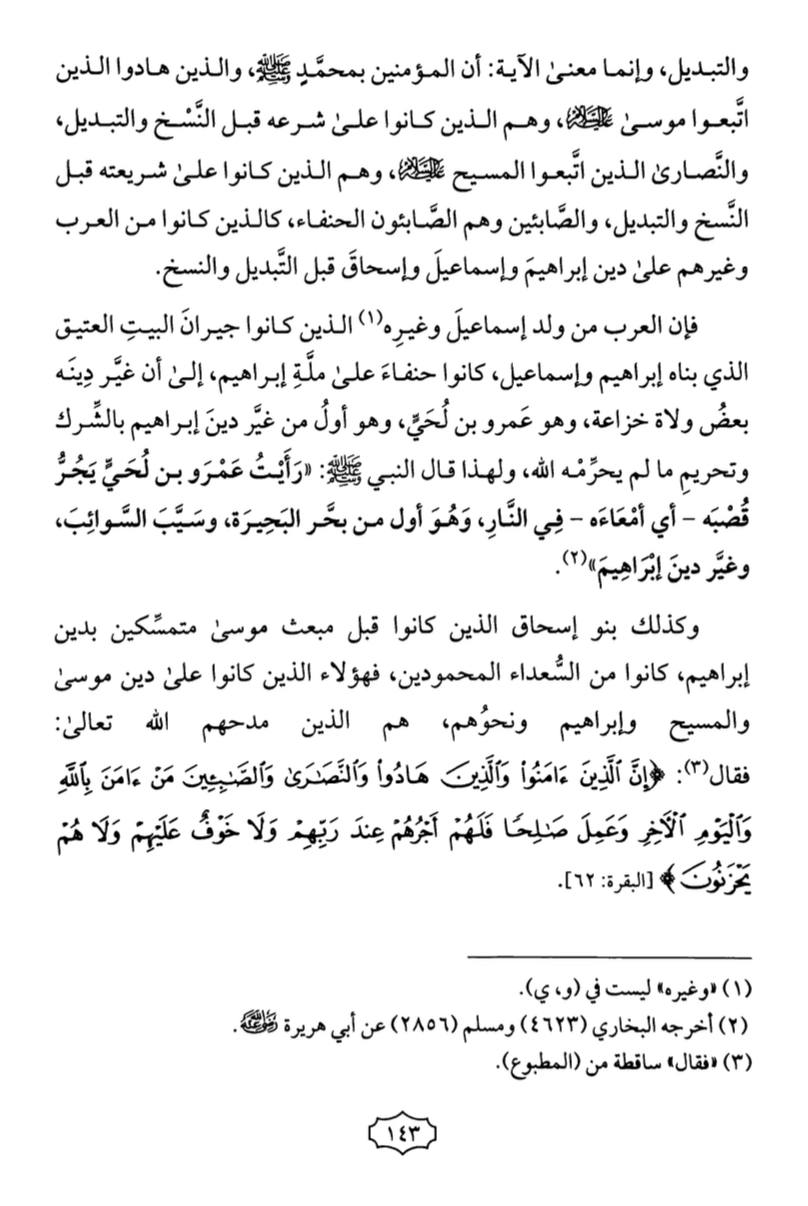
Book Identity:
-
Book Name: Al-Jawab as-Sahih liman baddala dina-l-Masih (The Correct Answer to Those Who Altered the Religion of Jesus) by Ibn Taymiyyah.
Core Theme: The True Historical Context of Surah Al-Baqarah (Verse 62)
This page provides the definitive explanation and context for Surah Al-Baqarah: 62, detailing who the “Jews, Christians, and Sabians” praised in the verse actually are, and confirming that it refers to them before their respective religions were altered or abrogated.
The True Meaning of the Verse:
The author explains that the divine praise and promise of reward in this verse apply strictly to specific historical groups who followed the true, uncorrupted messages of their prophets:
-
The Believers: Those who believe in Prophet Muhammad ﷺ.
-
The Jews: Those who faithfully followed the original law of Moses () before it was abrogated (Naskh) and altered (Tabdil).
-
The Christians: Those who faithfully followed the original message of Jesus () before it was abrogated and altered.
-
The Sabians: The Hunafa’ (monotheists) among the Arabs and others who followed the original, unaltered monotheistic religion of Abraham, Ishmael, and Isaac.
Historical Deviations and Alterations:
To clarify how these original groups later deviated into corruption, the author provides historical examples:
-
The Corruption of the Arab Monotheists (Descendants of Ishmael): The Arabs descended from Ishmael were originally monotheists (Hunafa’) living near the Ancient House (the Kaaba) built by Abraham and Ishmael. They remained on this true path until regional rulers from the Khuza’ah tribe altered Abraham’s religion.
-
The Role of Amr bin Luhayy: The text highlights Amr bin Luhayy as the first person to change Abraham’s faith by introducing idolatry (Shirk) and inventing unauthorized religious prohibitions (such as Bahirah and Sa’ibah). The author quotes a well-known Hadith where the Prophet ﷺ states: “I saw Amr bin Luhayy dragging his intestines in the Hellfire,” because he was the pioneer of altering Abraham’s pure faith.
-
The Descendants of Isaac: Similarly, the descendants of Isaac who held fast to Abraham’s true path before the sending of Moses were among the blessed and saved.
Conclusion:
The page concludes by reiterating that these specific, historically righteous groups who worshipped Allah alone and did good deeds are the true subjects of the verse: “them will have their reward with their Lord, and no fear will there be concerning them, nor will they grieve.”
Book Identity:
-
Book Name: Al-Jawab as-Sahih liman baddala dina-l-Masih (The Correct Answer to Those Who Altered the Religion of Jesus) by Ibn Taymiyyah.
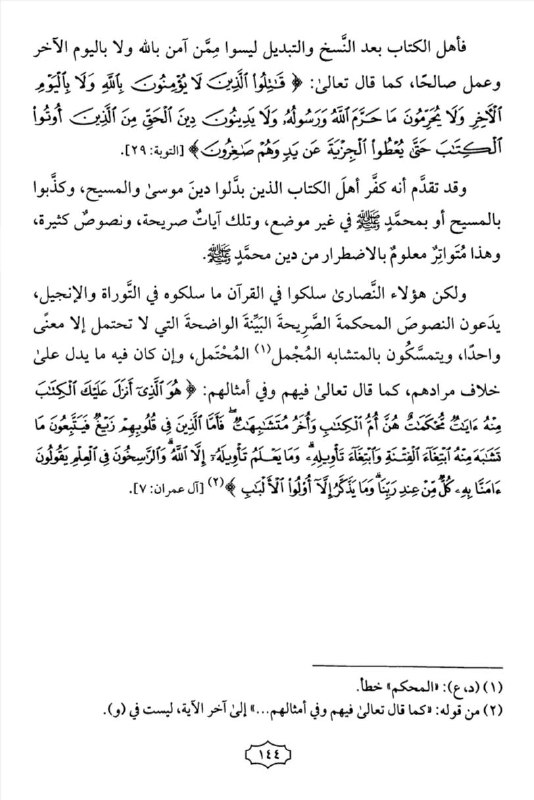
Core Theme: The Status of the People of the Book Post-Abrogation & Their Hermeneutical Deviations
This page continues the theological argument regarding the status of Jews and Christians after the advent of Islam, while introducing a critique of how contemporary Christian polemicists interpret sacred texts (both the Quran and their own scriptures).
Key Arguments & Textual Evidence:
-
The Status of Contemporary People of the Book: The author asserts that following the abrogation (Naskh) and alteration (Tabdil) of their laws, the contemporary People of the Book are not considered true believers in Allah, the Last Day, or righteous doers.
-
Quranic Proof on Disbelief: To support this, the text quotes Surah At-Tawbah: 29: “Fight those who do not believe in Allah or in the Last Day and who do not consider unlawful what Allah and His Messenger have made unlawful and who do not adopt the religion of truth from those who were given the Scripture - [fight them] until they give the jizyah willingly while they are humbled.”
-
A Known Necessity in Islam: The author notes that the disbelief of those who altered the laws of Moses and Jesus, rejected Jesus, or rejected Muhammad ﷺ is firmly established across numerous clear Quranic verses and is a matter of Mutawatir (mass-transmitted) knowledge inherently known within the religion of Islam.
Methodological Critique: Clear vs. Ambiguous Texts
The text shifts to analyze the interpretive flaws of Christian scholars, comparing their approach to scriptural interpretation across the Torah, Gospel, and Quran:
-
Abandoning the Clear (Muhkam): The author argues that these Christians deliberately abandon explicit, clear, and unambiguous texts (Nass Muhkam) which carry only one definitive meaning.
-
Clinging to the Ambiguous (Mutashabih): Instead, they cling to ambiguous, summary, or multi-interpretable expressions (Al-Mutashabih al-Mujmal), distorting them to serve their preconceived doctrines, even if the broader context explicitly contradicts their goals.
-
The Quranic Diagnosis: The author links this behavior to the divine description in Surah Ali ‘Imran: 7: “As for those in whose hearts is deviation [from truth], they will follow that which is unspecific of it, seeking discord and seeking an interpretation [suitable to them]. And no one knows its [true] interpretation except Allah. But those firm in knowledge say, ‘We believe in it. All [of it] is from our Lord.’ And no one will be reminded except those of understanding.”
The meaning of God’s words ( Say, “Who provides for you from the heavens and the earth?” Say, “God.” And either we or you are on guidance or in clear error ) refutes their claim that the Messenger was not sent to them.
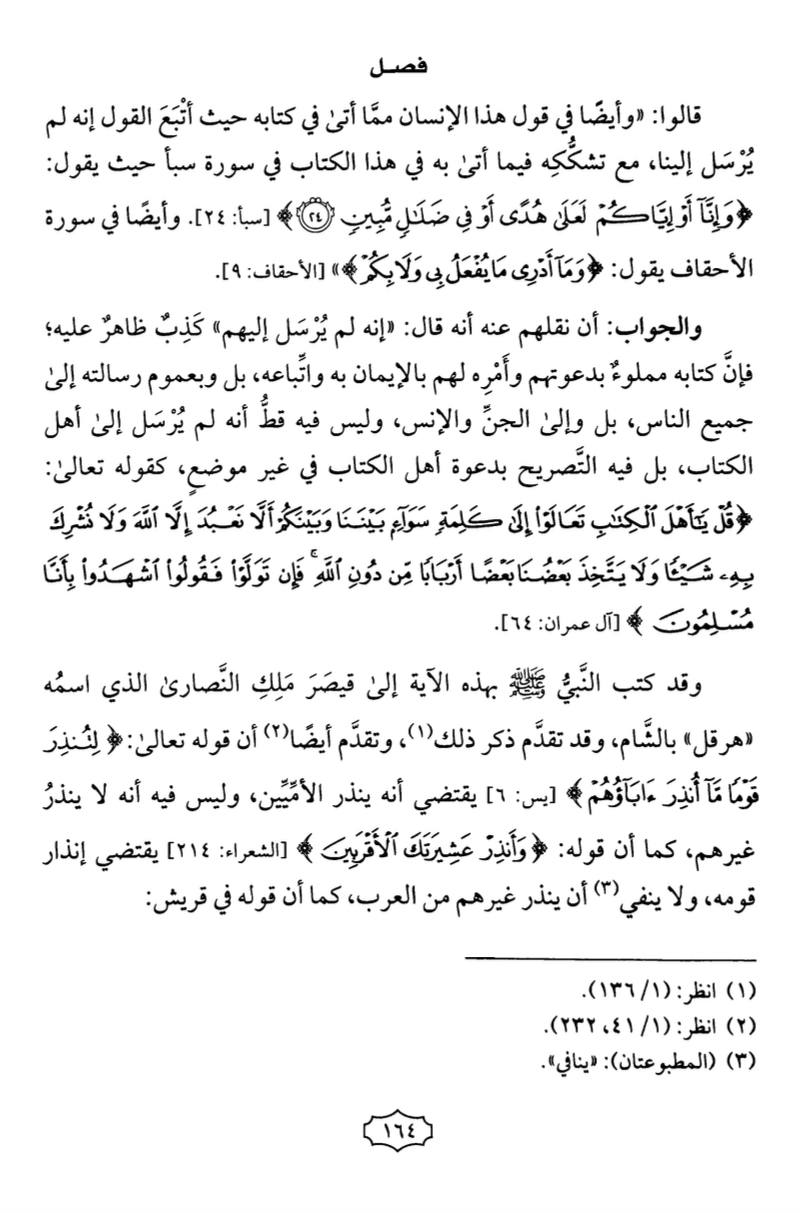
Book Identity:
-
Book Name: Al-Jawab as-Sahih liman baddala dina-l-Masih (The Correct Answer to Those Who Altered the Religion of Jesus) by Ibn Taymiyyah.
Core Theme: Refutation of the Claim That Muhammad ﷺ Was Not Sent to the People of the Book
This page begins a new chapter (Fasl) tackling a specific Christian argument: the claim that Prophet Muhammad ﷺ admitted in his own book (the Quran) that he was not sent as a messenger to them, or that he was uncertain of his own message.
The Christian Claim:
-
Claim of Non-Sent Message: They claim the Quran contains passages implying Muhammad ﷺ was not sent to them.
-
Claim of Doubt: They argue he expressed skepticism about his own status, citing verses like:
-
”…And indeed, either we or you are upon guidance or in clear error.” (Surah Saba: 24).
-
“…and I do not know what will be done with me or with you.” (Surah Al-Ahqaf: 9).
-
The Author’s Refutation:
Ibn Taymiyyah delivers a direct, evidence-based counter-argument to disprove these assertions:
-
A Clear Falsehood: The author states that claiming Muhammad ﷺ was not sent to the People of the Book is a manifest lie (Kidhb Zahir). The Quran is entirely filled with calls explicitly demanding their belief and compliance.
-
Universality of the Message: The text emphasizes that Muhammad’s message is universal, encompassing all of mankind, as well as the Jinn. It is explicitly directed at the People of the Book across numerous explicit passages, such as Surah Ali ‘Imran: 64:
“Say, ‘O People of the Scripture, come to a word that is equitable between us and you - that we will not worship except Allah and not associate anything with Him and not take one another as lords instead of Allah.’ But if they turn away, then say, ‘Bear witness that we are Muslims [submitting to Him].’”
Historical & Contextual Evidence:
-
The Letter to Heraclius: The author highlights historical proof, noting that the Prophet ﷺ specifically wrote a letter containing this exact verse (Ali ‘Imran: 64) to Heraclius (Hirqal), the Christian King of the Levant/Byzantium, explicitly calling him to Islam.
-
Addressing Specific Audiences Does Not Exclude Others: The author addresses a common interpretive flaw. Verses stating that the Prophet was sent to warn a people whose forefathers were not warned (e.g., Surah Ya-Sin: 6) or to “warn your closest kindred” (Surah Ash-Shu’ara: 214) mean he was designated to warn the unlettered Arabs first or primarily. It does not logically negate, exclude, or deny his warning and mission to other nations, such as the non-Qurayshite Arabs and the People of the Book.
Book Identity:
-
Book Name: Al-Jawab as-Sahih liman baddala dina-l-Masih (The Correct Answer to Those Who Altered the Religion of Jesus) by Ibn Taymiyyah.
Core Theme: The Global Universality of Prophet Muhammad’s ﷺ Mission
This page continues to dismantle the argument that the Prophet’s mission was restricted only to unlettered Arabs, using legal Hermeneutics (Usul al-Fiqh) and Quranic context to prove his message binds all of humanity.
Key Arguments & Legal Principles:
-
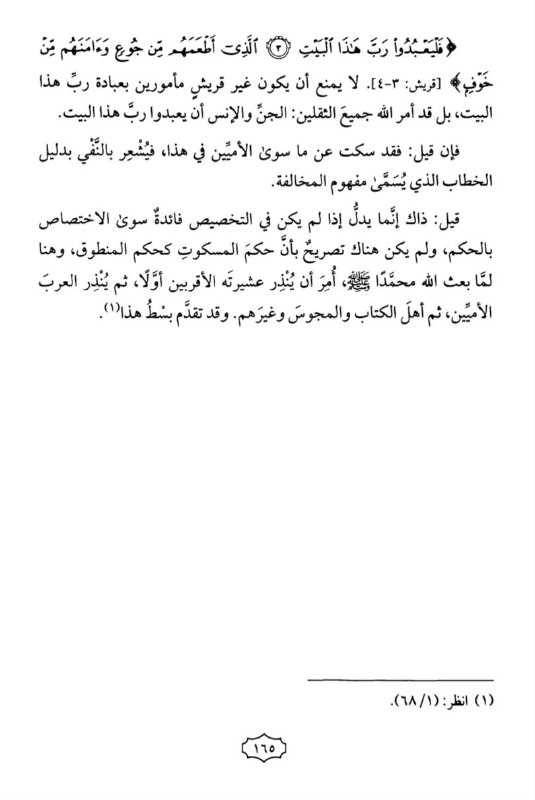
Refuting the Scope of Command via Surah Quraysh: > The page opens by referencing Surah Quraysh: 3–4: “Let them worship the Lord of this House, Who has fed them, [saving them] from hunger and made them safe, [saving them] from fear.” The text clarifies that directing a command to Quraysh does not mean non-Quraysh are exempt from worshipping the Lord of the Kaaba; rather, all Jinn and mankind are commanded to worship Him.
-
Addressing the Argument of Silence (Mafhum al-Mukhalafah):
-
The Objection: A counter-argument is raised: since the Quran explicitly mentions warning the unlettered Arabs whose ancestors weren’t warned, does this silence regarding other nations imply an exclusion (Mafhum al-Mukhalafah)—meaning he wasn’t sent to non-Arabs?
-
The Refutation: The author explains a core principle of Islamic jurisprudence: an argument based on the implication of omission (Mafhum al-Mukhalafah) is only valid if there is no explicit statement (Manthuq) that clarifies the unmentioned ruling. Here, explicit texts do exist, meaning the silent areas cannot be interpreted as a negation.
-
-
The Methodical Progression of the Da’wah:
The author details that when Prophet Muhammad ﷺ was first sent, he was commanded to warn his closest kin (Manthuq), then his wider tribe of Quraysh, then the surrounding unlettered Arabs, and ultimately the People of the Book, the Magians (Zoroastrians), and all others. Specifying a starting group was a matter of practical sequence, not global exclusion.
The meaning of the Almighty’s saying ( **The path of those upon whom You have bestowed favor, not of those who have incurred [Your] wrath, nor of those who are astray) is to refute their statement and to demonstrate their ignorance by saying that they are the ones meant by the Almighty’s saying “The path of those upon whom You have bestowed favor.”
Book Identity:
-
Book Name: Al-Jawab as-Sahih liman baddala dina-l-Masih (The Correct Answer to Those Who Altered the Religion of Jesus) by Ibn Taymiyyah.
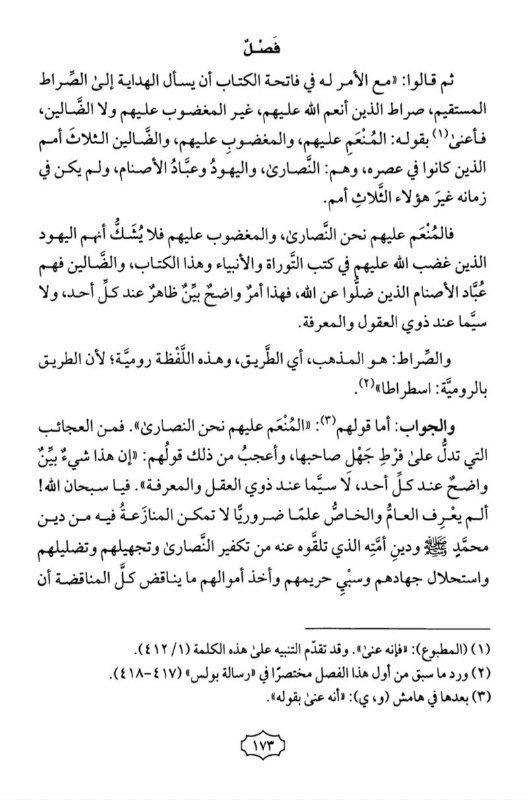
Core Theme: Refutation of the Claim That Christians Are “Those Who Have Earned Divine Favor” in Surah Al-Fatiha
This page starts a new chapter (Fasl) dealing with a specific Christian polemical interpretation of the opening chapter of the Quran (Surah Al-Fatiha), where they attempt to claim they are the ones explicitly praised by Allah in daily Muslim prayers.
The Christian Claim:
-
Interpretation of the Three Paths: They argue that when Muslims pray to be guided to “the path of those upon whom You have bestowed favor, not of those who have earned [Your] anger or of those who are astray” (Al-Fatiha: 6–7), this refers to the three prominent religious factions present during that era:
-
Those blessed with favor: The Christians.
-
Those who earned anger: The Jews.
-
Those who are astray: The idolaters/pagan statue worshippers.
-
-
Therefore, they argue that every time a Muslim prays, they are testifying that Christians are on the correct path of divine favor.
-
Linguistic Note: The text mentions a side argument they make regarding the word “Al-Sirat” (الصِّرَاط - path), claiming it is a Romanized word derived from the Latin/Romance term “Strata” (اسطراطا).
The Author’s Refutation:
Ibn Taymiyyah firmly rejects this logic, characterizing it as a sign of extreme ignorance (Jahl Batin):
-
The Absurdity of the Claim: The author expresses astonishment at how anyone with basic intellect or knowledge could arrive at such a conclusion.
-
The Clear Consensus of the Muslim Ummah: He emphasizes that it is a matter of absolute common knowledge—shared by both ordinary Muslims and scholars—that the entire Islamic community, taught directly by Prophet Muhammad ﷺ, explicitly labels contemporary Christians as being among those who are astray (Al-Dallin).
-
The Contradiction: It is logically impossible for Muslims to implicitly praise Christians as “divinely favored” in their prayers while simultaneously declaring them to be disbelievers, engaging in theological polemics against them, and implementing rulings based on their deviation from true monotheism.
Book Identity:
-
Book Name: Al-Jawab as-Sahih liman baddala dina-l-Masih (The Correct Answer to Those Who Altered the Religion of Jesus) by Ibn Taymiyyah.
Core Theme: The Absurdity of Christians Being the “Favored Ones” in Al-Fatiha
This page concludes the systematic refutation against the claim that Muslims pray to be guided to the path of Christians in Surah Al-Fatiha, highlighting the irreconcilable theological and practical contradictions inherent in such an argument.
Key Arguments & Logical Proofs:
-
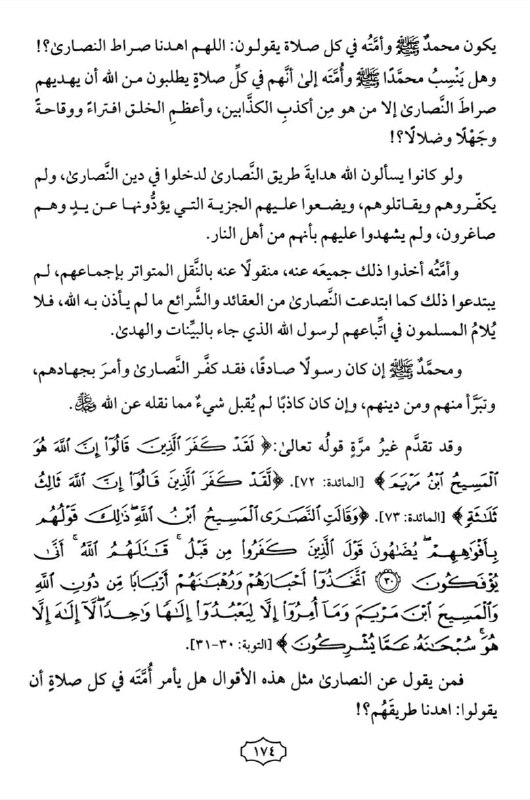
The Core Contradiction: The author highlights the extreme absurdity of the premise: How could Muhammad ﷺ and his Ummah ask Allah in every single prayer to guide them to the path of Christians, while simultaneously declaring them to be disbelievers, engaging in military conflict against them, demanding the Jizyah tax while they are humbled, and testifying that they are destined for the Hellfire?
-
Mass-Transmitted Consensus (Naql Mutawatir): The entire Muslim community has taken their religion via unbroken, mass-transmitted consensus directly from the Prophet ﷺ. They have collectively agreed on the invalidity of the innovations, doctrines, and altered laws introduced by Christians.
-
The Truth of the Prophet’s Mission: If Muhammad ﷺ is a true messenger—which he is—then his condemnation of their faith, his command to wage Jihad against them, and his complete disavowal of their doctrines are absolute truths. Conversely, if a claimant were lying, he still wouldn’t instruct his followers to pray to be guided to the path of those he explicitly opposes.
Explicit Quranic Refutations of Christian Beliefs:
To cement the fact that the Quran rejects the Christian path rather than praising it, the author quotes several clear, decisive verses:
-
Refutation of the Divine Incarnation: “They have certainly disbelieved who say, ‘Allah is the Messiah, the son of Mary.’” (Surah Al-Ma’idah: 72).
-
Refutation of the Trinity: “They have certainly disbelieved who say, ‘Allah is the third of three.’” (Surah Al-Ma’idah: 73).
-
Condemnation of Taking Clergy as Lords: “They have taken their scholars and monks as lords besides Allah, and [also] the Messiah, the son of Mary. And they were not commanded except to worship one God; there is no deity except Him. Exalted is He above whatever they associate with Him.” (Surah At-Tawbah: 31).
Conclusion:
The page closes with a rhetorical challenge: Given these explicit divine condemnations of Christian theological deviation (Shirk), how could any rational mind claim that the Prophet ﷺ commands his nation to ask for the path of the Christians in every prayer?
The meaning of the Almighty’s words: ” O People of the Scripture, do not exceed the limits in your religion or say about God anything except the truth. The Messiah, Jesus, the son of Mary, was but a messenger of God and His word which He directed to Mary and a spirit [created at a command] from Him. So believe in God and His messengers. And do not say, ‘Three [gods].’ Refrain; it is better for you. God is but one God. Exalted is He above having a son. To Him belongs whatever is in the heavens and whatever is in the earth.” (On the earth. And sufficient is Allah as Disposer of affairs .) This is a statement refuting their falsehood in citing the verse, “Jesus, the son of Mary, is the Messenger of Allah and His word which He directed to Mary and a spirit from Him,” as evidence of the union of divinity and humanity.
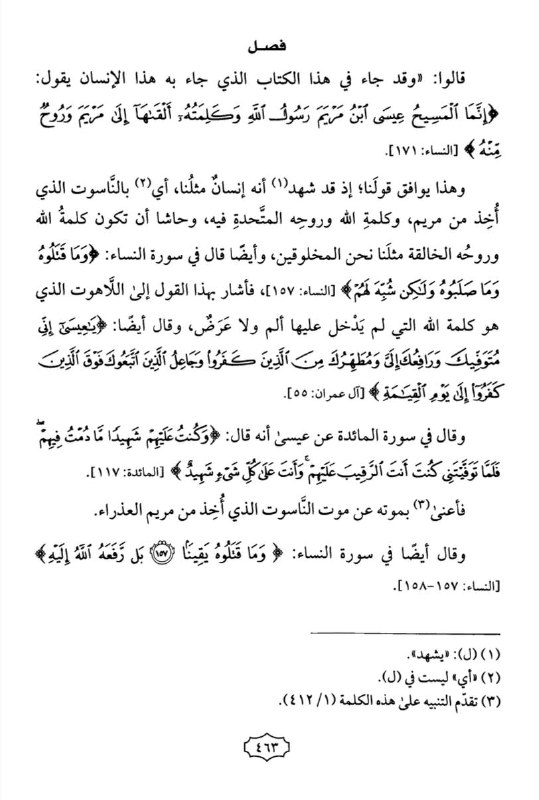
Book Identity:
-
Book Name: Al-Jawab as-Sahih liman baddala dina-l-Masih (The Correct Answer to Those Who Altered the Religion of Jesus) by Ibn Taymiyyah.
Core Theme: Deconstructing Christian Interpretations of Quranic Verses Regarding Jesus
This page addresses a new section (Fasl) where Christian polemicists cite verses from the Quran to argue that it validates their theological doctrines regarding the dual nature of Jesus—specifically his humanity (Nasut) and his divinity (Lahut).
The Christian Argument & Structural Misinterpretations:
-
The Argument for Dual Nature: They quote Surah An-Nisa: 171: “The Messiah, Jesus, the son of Mary, was but a messenger of Allah and His word which He directed to Mary and a soul [created at a command] from Him.” > * They argue that the phrasing acknowledges Jesus as a human born of Mary (Nasut), while simultaneously declaring him to be the uncreated Word and Spirit of God (Lahut), thereby aligning with Christian Christology.
The Islamic Refutation and Counter-Context:
The text systematically dismantles this interpretation by providing the proper Quranic context of other verses that definitively demonstrate Jesus’s absolute humanity and dependency on Allah:
-
Refutation of Christ’s Divinity on the Cross: The text quotes Surah An-Nisa: 157: ”…And they did not kill him, nor did they crucify him; but [another] was made to resemble him to them.” The author argues that this verse undercuts their theological dichotomy; it indicates that the painful experiences of the crucifixion did not touch a divine essence (Lahut), nor was there a merging of the divine with the human that suffered on a cross.
-
The Reality of Death and Resurrection: The author references Surah Ali ‘Imran: 55: “[Mention] when Allah said, ‘O Jesus, indeed I will take you and raise you to Myself and purify you from those who disbelieve…’” This text highlights his elevation by Allah, showcasing a position of being acted upon rather than acting as a deity.
-
Witness Testimony of a Created Servant: The page cites Surah Al-Ma’idah: 117, where Jesus speaks of his limited earthly presence: “And I was a witness over them as long as I was among them; but when You took me up, You were the Observer over them…” The text explains this explicitly means his physical passing/ascension applies to his created human form (Nasut) taken from the Virgin Mary, behaving as a human witness rather than an omnipresent divine entity.
-
Absolute Rejection of Death: The page concludes by reiterating Surah An-Nisa: 157–158: “And they did not kill him, certainly. Rather, Allah raised him to Himself.” This solidifies the argument that Jesus was a protected prophet saved by divine intervention, entirely separate from the concepts of incarnate sacrifice.
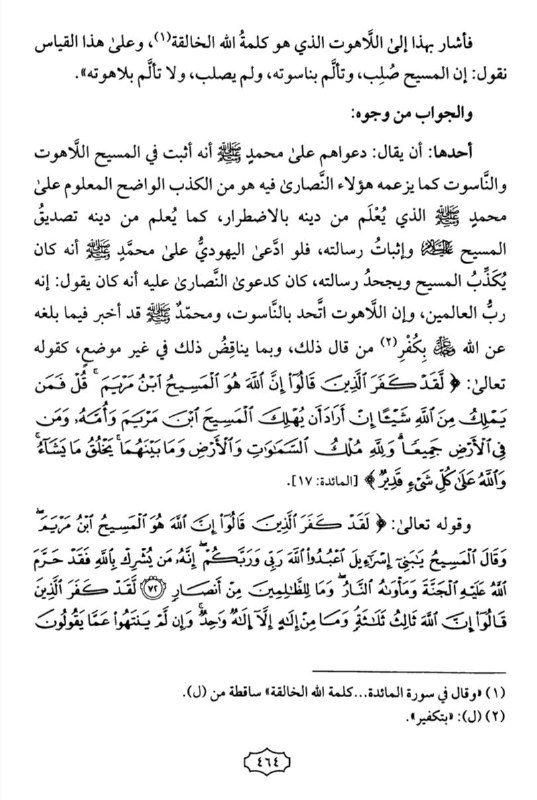
Book Identity:
-
Book Name: Al-Jawab as-Sahih liman baddala dina-l-Masih (The Correct Answer to Those Who Altered the Religion of Jesus) by Ibn Taymiyyah.
Core Theme: Theological Refutation of the “Lahut and Nasut” (Divine/Human) Union
This page continues the systematic breakdown of the Christian claim regarding the dual nature of Jesus, delivering a direct logical and textual counter-attack (Al-Jawab min wujuh).
Key Arguments & Logical Refutations:
-
The Fallacy of Scriptural Confirmation: The author tackles the claim that Prophet Muhammad ﷺ or the Quran somehow verified the union of the divine (Lahut) and human (Nasut) natures. He notes that if a group fabricates claims against the Prophet’s explicit words, it is no different than if a group from among the Jews claimed that Muhammad ﷺ actually verified their rejection of Jesus—both are clear falsehoods contradicted by the entire Islamic message.
-
The Contradiction of Sovereignty: If Christians claim that Jesus is the “Lord of the Worlds” due to this divine union, it directly clashes with what Allah revealed to His Prophet. The author asserts that the Quran explicitly declares anyone who holds such a belief to be a disbeliever (Kafir).
Explicit Quranic Proofs Against Christ’s Divinity:
To completely nullify the idea of an incarnate divinity, the text quotes decisive verses from Surah Al-Ma’idah:
-
Absolute Divine Power Over Creation: > “They have certainly disbelieved who say, ‘Allah is the Messiah, the son of Mary.’ Say, ‘Then who could prevent Allah at all if He intended to destroy the Messiah, the son of Mary, or his mother or everyone on the earth?’” (Surah Al-Ma’idah: 17).
- Significance: The text emphasizes that Jesus and Mary are entirely dependent on the will of Allah and possess no shared sovereignty, as to Allah belongs the dominion of the heavens and the earth.
-
The True Message of Jesus: > “They have certainly disbelieved who say, ‘Allah is the Messiah, the son of Mary,’ while the Messiah has said, ‘O Children of Israel, worship Allah, my Lord and your Lord.’ Indeed, he who associates others with Allah - Allah has forbidden him Paradise, and his refuge is the Fire.” (Surah Al-Ma’idah: 72).
-
Rejection of the Triune Godhead:
The page concludes by trailing into verse 73, which seals the absolute condemnation of the Trinity: “They have certainly disbelieved who say, ‘Allah is the third of three.’ And there is no god except one God…”
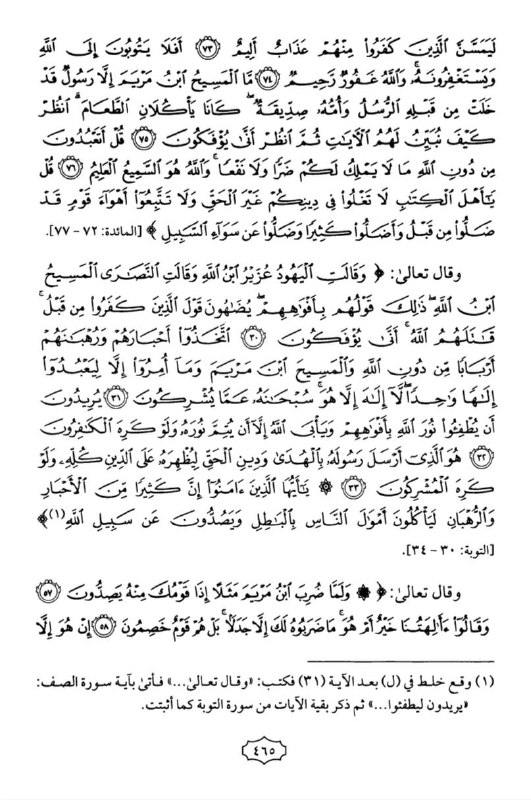
Book Identity:
-
Book Name: Al-Jawab as-Sahih liman baddala dina-l-Masih (The Correct Answer to Those Who Altered the Religion of Jesus) by Ibn Taymiyyah.
Core Theme: Scriptural Refutation of the Divinity and Crucifixion Doctrines
This page continues compiling definitive Quranic evidence to reject Christian Christological doctrines (such as the Trinity and the divinity of the Messiah) by emphasizing the structural, human attributes of Jesus and his mother as detailed in the text.
Key Arguments & Textual Evidence:
-
The Humanity of Jesus and Mary: The page opens by trailing the conclusion of Surah Al-Ma’idah: 73–75. It references the explicit description of their physical, biological needs: “The Messiah, son of Mary, was not but a messenger; [other] messengers have passed on before him. And his mother was a supporter of truth. They both used to eat food.” > * Theological Argument: The author utilizes this verse to show that an entity dependent on food to survive inherently lacks absolute self-sufficiency and therefore cannot possess a divine nature (Lahut).
-
Rejection of False Worship: The text references Surah Al-Ma’idah: 76–77, where Allah asks: “Do you worship besides Allah that which holds for you no possibility of harm or benefit?” It warns the People of the Book against exceeding the bounds of truth in their religion and following the whims of people who went astray before them.
Broader Contextual Proofs Against Christian Clergy and Beliefs:
The author transitions to Surah At-Tawbah to highlight the systemic deviations within the historical development of the Christian faith:
-
The Claim of Divine Sonship: The text quotes Surah At-Tawbah: 30, which addresses the verbal assertions made by different groups: “The Jews say, ‘Ezra is the son of Allah’; and the Christians say, ‘The Messiah is the son of Allah.’ That is their statement from their mouths; they imitate the saying of those who disbelieved before [them].”
-
Exploitation by Clergy: The page concludes by citing Surah At-Tawbah: 34, explicitly warning against the corruption of religious authorities: “Indeed, many of the scholars and the monks devour the wealth of people unjustly and avert [them] from the way of Allah.” This serves to undermine the spiritual authority of those who institutionalized the theological changes.
Book Identity:
-
Book Name: Al-Jawab as-Sahih liman baddala dina-l-Masih (The Correct Answer to Those Who Altered the Religion of Jesus) by Ibn Taymiyyah.
Core Theme: The Meaning of “The Holy Spirit” (Ruh al-Qudus) and Refuting Claims of Incarnation
This page addresses the theological concept of being supported by the Holy Spirit (Ruh al-Qudus), clarifying its linguistic and religious application to show that it represents divine assistance rather than a literal union of human and divine essences.
Key Hadith Evidences & Prophetic Support:
The text brings forth verified narrations to prove that the Holy Spirit supports righteous human servants of Allah, notably the Prophet’s companion and poet, Hassan bin Thabit:
-
First Narration: A Sahih tradition from Abu Hurairah stating that the Prophet ﷺ said to Hassan bin Thabit: “Answer on my behalf; O Allah, support him with the Holy Spirit.”
-
Second Narration: A report from Sahih Muslim where Aisha () heard the Prophet ﷺ say to Hassan: “The Holy Spirit will continue to support you as long as you are defending Allah and His Messenger.”
-
Third Narration: A report from the Sahihayn (Bukhari and Muslim) from Al-Bara bin Azib where the Prophet ﷺ told Hassan: “Satirize them—or lampoon them—and Gabriel is with you.”
-
Identification of the Spirit: Based on these texts, the author confirms that the Holy Spirit is explicitly Angel Gabriel (), who descends with divine revelation and aids the messengers and their defenders.
Theological Refutation of Divine Union (Lahut and Nasut):
Ibn Taymiyyah applies these evidences to counter Christian Christological arguments:
-
No Divine Union for Hassan: Every inhabitant of the Earth knows that when Hassan bin Thabit was aided by Angel Gabriel, it did not cause a union between a divine nature (Lahut) and his human nature (Nasut).
-
Not Unique to Jesus: Therefore, the fact that Jesus () was uniquely supported or filled with the Holy Spirit does not imply or necessitate a metaphysical mixing of divinity with his humanity.
-
Shared Prophetic Trait: The People of the Book themselves acknowledge that other prophets—such as David ()—as well as the Disciples (Al-Hawariyyun), were also supported and touched by the Holy Spirit, yet they do not claim divinity for them.
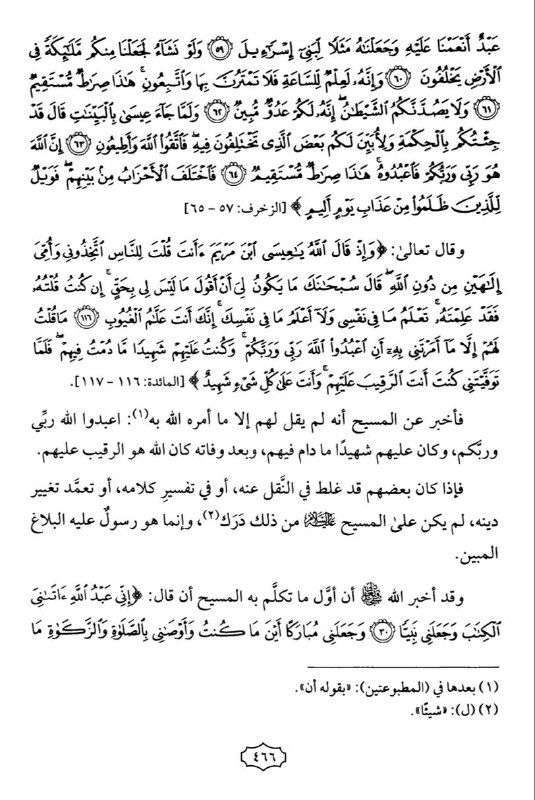
Book Identity:
-
Book Name: Al-Jawab as-Sahih liman baddala dina-l-Masih (The Correct Answer to Those Who Altered the Religion of Jesus) by Ibn Taymiyyah.
Core Theme: The Servant Status of Jesus () and Scriptural Protection from Distortion
This page relies heavily on explicit Quranic passages from Surah Az-Zukhruf, Surah Al-Ma’idah, and Surah Maryam to emphasize that Jesus () never preached his own divinity, but rather explicitly established his position as a created, mortal servant of God.
Key Quranic Proofs and Theological Arguments:
- The Prophetic Status and Purpose of Jesus:
The page lists consecutive verses from Surah Az-Zukhruf (59–65) to delineate his role:
- _"He [Jesus] was not but a servant upon whom We bestowed favor, and We made him an example for the Children of Israel."_ (Verse 59).

- _"And when Jesus came with clear proofs, he said, 'I have come to you with wisdom and to make clear to you some of that over which you differ, so fear Allah and obey me.'"_ (Verse 63).

- _"Indeed, Allah is my Lord and your Lord, so worship Him. This is a straight path."_ (Verse 64).- The Final Testimony of Disavowal:
The text quotes the foundational verses from Surah Al-Ma’idah (116–117), showing the future cross-examination of Jesus on the Day of Judgment:
- _"And [beware the Day] when Allah will say, 'O Jesus, Son of Mary, did you say to the people, "Take me and my mother as deities besides Allah?"' He will say, 'Exalted are You! It was not for me to say that to which I have no right...'"_ (Verse 116).

- _"I said not to them except what You commanded me - to worship Allah, my Lord and your Lord. And I was a witness over them as long as I was among them...'"_ (Verse 117).
The Author’s Analysis on Scriptural Alteration:
-
The Prophet Exempt from Follower Mistakes: Ibn Taymiyyah points out that Jesus () explicitly states he only delivered what he was commanded (“worship Allah, my Lord and your Lord”).
-
Accountability for Distortions: If later generations fell into error, made mistakes in transcribing texts, or intentionally sought to alter his religion after his ascension, the blame falls entirely on them. No blame attaches to the Messiah (), as his only structural duty was clear delivery of the message (Al-Balagh al-Mubin).
The First Miraculous Words of the Messiah:
- Declaration from the Cradle: The page concludes by citing the historic first words spoken by Jesus as an infant in Surah Maryam: 30: “He [Jesus] said, ‘Indeed, I am the servant of Allah. He has given me the Scripture and made me a prophet…’”. This seals the argument that his identity as a created servant was present from the very beginning of his earthly manifestation.
Book Identity:
-
Book Name: Al-Jawab as-Sahih liman baddala dina-l-Masih (The Correct Answer to Those Who Altered the Religion of Jesus) by Ibn Taymiyyah.
Core Theme: The True Meaning of “The Holy Spirit” (Ruh al-Qudus) and Refuting Divine Union
This page addresses the theological concept of being supported by the Holy Spirit (Ruh al-Qudus). The author leverages established Islamic textual evidences to demonstrate that this support refers to divine assistance via an angel rather than a physical or metaphysical fusion of human and divine essences (Lahut and Nasut).
Key Hadith Evidences and Prophetic Support:
Ibn Taymiyyah cites three authoritative narrations showing that the Holy Spirit supports ordinary righteous human servants, focusing on the Prophet’s companion and poet, Hassan bin Thabit:
-
First Narration (Sahih Bukhari/Muslim): Abu Hurairah narrated that the Prophet ﷺ explicitly prayed for his companion, stating: “Answer on my behalf; O Allah, support him with the Holy Spirit.”
-
Second Narration (Sahih Muslim): Aisha () reported that the Prophet ﷺ told Hassan: “The Holy Spirit will continue to support you as long as you are defending Allah and His Messenger.”
-
Third Narration (Al-Sahihayn): Al-Bara bin Azib narrated that the Prophet ﷺ explicitly identified the spirit to Hassan, saying: “Lampoon them, and Gabriel is with you.”
-
Identification of the Spirit: Combining these texts, the author establishes that the Holy Spirit is textually defined as Angel Gabriel (), who acts as a distinct celestial messenger assisting human beings.
Theological Arguments Against Christian Christology:
The author uses these definitions to construct a logical counter-argument against Christian claims regarding Jesus’s divinity:
-
No Ontological Change for Hassan: It is universally recognized that when Hassan bin Thabit was aided by Angel Gabriel, it did not cause a divine nature (Lahut) to merge with his human identity (Nasut).
-
Not Unique to Jesus: Consequently, scriptural statements saying Jesus () was strengthened or filled with the Holy Spirit do not prove a unique metaphysical union or incarnation of God within him.
-
Shared Trait Among Prophets and Disciples: The author concludes by noting that the People of the Book themselves acknowledge that other biblical figures—such as David () and the Disciples (Al-Hawariyyun)—were filled with or supported by the Holy Spirit, yet they do not attribute divinity to them.
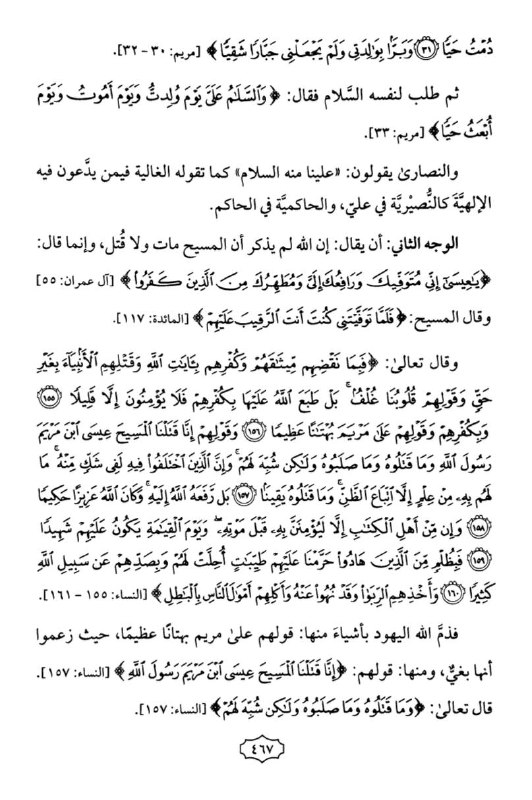
Book Identity:
-
Book Name: Al-Jawab as-Sahih liman baddala dina-l-Masih (The Correct Answer to Those Who Altered the Religion of Jesus) by Ibn Taymiyyah.
Core Theme: Scriptural & Miraculous Proofs of Jesus’s Status as a Servant Prophet
This page continues compiling verses from Surah Maryam and Surah Ali ‘Imran to demonstrate that Jesus’s miraculous nature and signs were entirely granted by Allah’s permission, explicitly confirming his status as a dependent servant rather than a divine entity.
Key Quranic Proofs and Theological Arguments:
- The Message from the Cradle:
The page continues quoting the foundational speech of infant Jesus from Surah Maryam (31–33):
- _"And He has made me blessed wheresoever I may be and has enjoined upon me prayer and zakah as long as I remain alive."_ (Verse 31)

- _"And [made me] dutiful to my mother, and He has not made me a wretched tyrant."_ (Verse 32)

- _"And peace is on me the day I was born and the day I will die and the day I am raised alive."_ (Verse 33)

- _Theological Argument:_ The author emphasizes that an entity commanded to perform regular physical acts of worship like prayer (_Salah_) and charity (_Zakah_) is structurally a servant showing dependency on a higher Creator, which invalidates claims of his divinity.- The Explicit Decree of Truth:
The text quotes Surah Maryam (34–35) to seal the matter of his identity:
- _"That is Jesus, the son of Mary - the word of truth about which they are in dispute."_ (Verse 34)

- _"It is not befitting for Allah to take a son; Exalted is He! When He decrees a matter, He only says to it, 'Be,' and it is."_ (Verse 35)
Miracles Restricted by Divine Permission (Bi-Idhni-Allah):
- Analysis of Surah Ali ‘Imran (49–51):
The author references the passage where Jesus lists his miracles to the Children of Israel (creating birds from clay, healing the blind and the leper, and raising the dead). The author stresses that the text explicitly repeats the phrase “by permission of Allah” (Bi-Idhni-Allah) after these actions.
- The Ultimate Conclusion: > The page concludes by trailing into verse 51, showcasing the absolute, overarching command Jesus delivered to his followers: “Indeed, Allah is my Lord and your Lord, so worship Him. That is a straight path.”
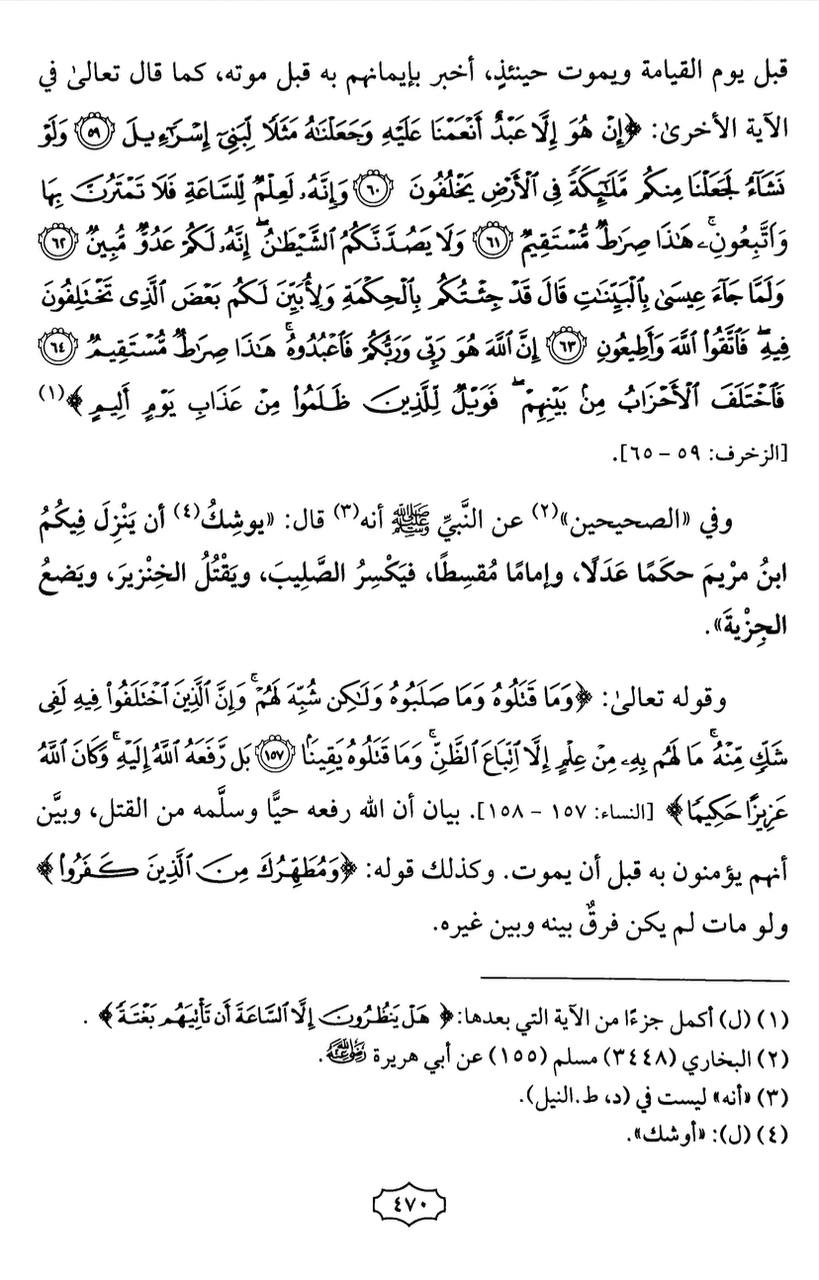
Book Identity:
-
Book Name: Al-Jawab as-Sahih liman baddala dina-l-Masih (The Correct Answer to Those Who Altered the Religion of Jesus) by Ibn Taymiyyah.
Core Theme: The Continuation of Jesus’s Declaration of Servanthood and Monotheism
This page concludes the textual evidence from Surah Ali ‘Imran and shifts into logical analysis to show that Jesus’s performance of miracles does not grant him divinity, as he explicitly directed all worship away from himself and toward Allah alone.
Key Textual Evidence & Context:
- The Command to Worship the Lord:
The page opens with the completion of Surah Ali ‘Imran (51–53):
- _"Indeed, Allah is my Lord and your Lord, so worship Him. That is a straight path."_ (Verse 51)

- _"But when Jesus felt disbelief from them, he said, 'Who are my supporters for [the cause of] Allah?' The disciples said, 'We are supporters for Allah. We have believed in Allah and testify that we are Muslims [submitting to Him].'"_ (Verse 52)

- _"Our Lord, we have believed in what You revealed and have followed the messenger, so register us among the witnesses [to truth]."_ (Verse 53)
The Author’s Theological Analysis:
Ibn Taymiyyah delivers a direct breakdown of how these verses fundamentally dismantle Christian Christology:
-
Absolute Monotheism in Speech: The text highlights that Jesus explicitly declared Allah to be both his Lord and their Lord. He did not call people to worship himself, nor did he claim any share in divinity.
-
The Status of the Disciples: The author points out that the disciples—the closest companions of Jesus—declared themselves to be Muslims (those who submit to the one God). Their prayer was directed to Allah (“Our Lord…”) and they viewed Jesus purely as a Messenger (“…and have followed the messenger”), not as God incarnate or the Son of God.
-
Miracles are Not Proof of Divinity: The text notes that while Jesus was given great signs, he always bound them to the condition of being “by the permission of Allah.” Therefore, performing these signs was a proof of his status as a true Prophet of God, not an indicator of a divine nature (Lahut).
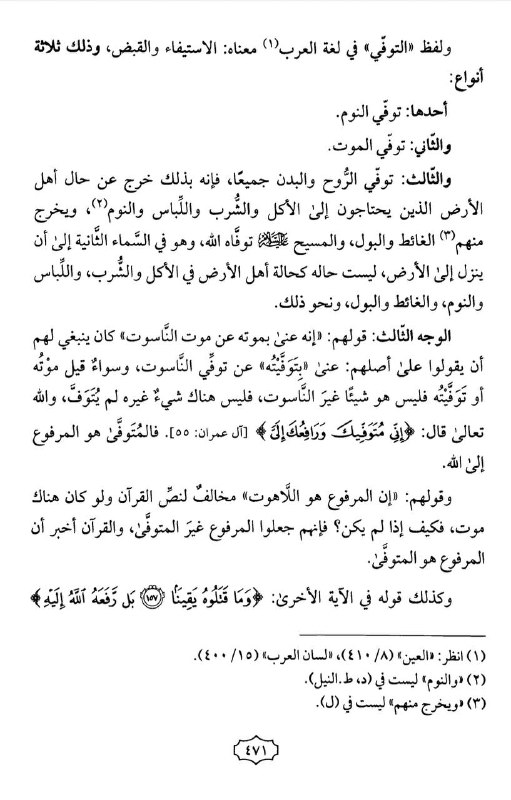
Book Identity:
-
Book Name: Al-Jawab as-Sahih liman baddala dina-l-Masih (The Correct Answer to Those Who Altered the Religion of Jesus) by Ibn Taymiyyah.
Core Theme: The Paradox of Attributing Divinity to a Messenger
This page continues the theological critique of Christian Christology, arguing that the structural traits, commands, and actions of Jesus () as recorded in the scriptures inherently contradict any claims to his personal divinity.
Key Arguments & Logical Breakdowns:
-
The Absurdity of a Messenger Worshipping Himself: > The author points out a massive internal logical flaw in the Christian claim. If they believe Jesus is God, it creates a paradox: how can a messenger be sent by God, tell people to worship God (“worship Allah, my Lord and your Lord”), and perform acts of worship himself, if he is that very God? A deity does not send himself as a literal submissive messenger to command obedience to himself under the guise of another.
-
The Reality of Prophetic Intercession and Submission:
The text analyzes the relationship between a prophet and the Creator. Jesus explicitly bound his support and miracles to the decree of Allah. His prayers, supplications, and reliance on divine permission (Bi-Idhni-Allah) are the ultimate evidence of his dependency.
-
Refuting the Distortion of Textual Context: > Ibn Taymiyyah argues that Christian polemicists ignore the clear, foundational baseline (Al-Asl) established by Jesus regarding absolute monotheism, choosing instead to over-interpret specific metaphorical expressions or miracles out of context to build a doctrine of divinity.
-
The Direct Commandment:
The page concludes by emphasizing that the true path brought by the Messiah was nothing other than pure submission—directing the creation to worship the Creator alone, which matches the core message brought by Prophet Muhammad ﷺ.
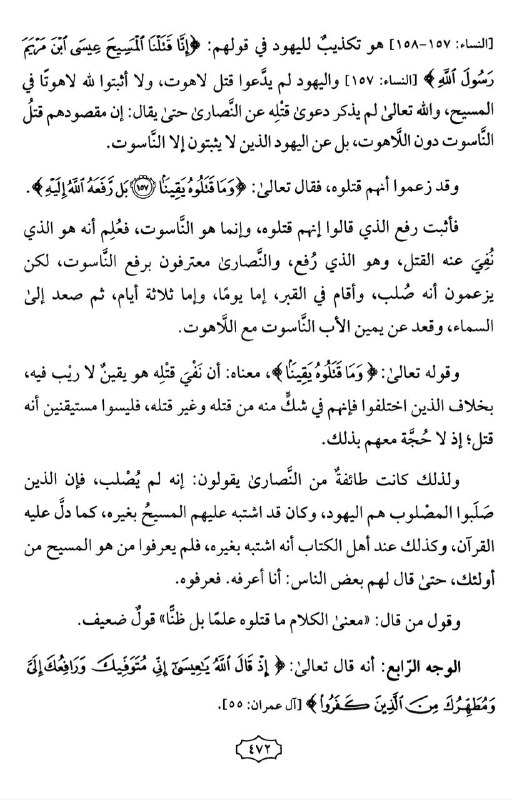
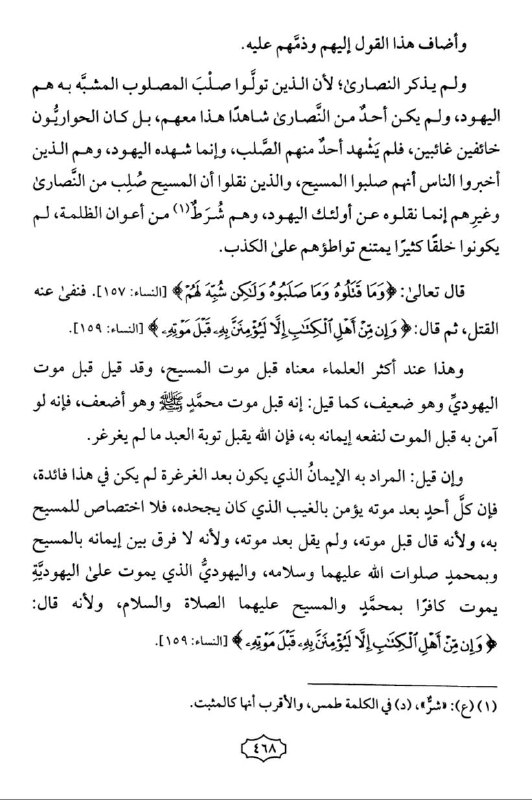
Book Identity:
-
Book Name: Al-Jawab as-Sahih liman baddala dina-l-Masih (The Correct Answer to Those Who Altered the Religion of Jesus) by Ibn Taymiyyah.
Core Theme: The Paradox of Crucifixion Beliefs and the Islamic Refutation
This page continues detailing the fourth perspective (Al-Wajh al-Rabi’) in dismantling Christian narratives surrounding the crucifixion, analyzing the internal theological contradictions between the concepts of Lahut (divinity) and Nasut (humanity) during the events of the cross.
Key Arguments & Theological Analysis:
- Rejection of Divinity on the Cross:
The page opens by referencing Surah An-Nisa: 157–158. The author clarifies that the Jews did not claim to kill a divine entity (Lahut), nor do Christians believe the divine fatherly essence itself was crucified. Therefore, any claim of death or crucifixion strictly falls upon the human nature (Nasut).
- The Christian Narrative vs. Islamic Elevation:
The text analyzes the Christian claim that Jesus died, was buried for three days, ascended to heaven, and sat at the right hand of the Father. The author counters this with the explicit Quranic text: “Rather, Allah raised him to Himself.” (Surah An-Nisa: 158). This proves that the one who was preserved and elevated is the same entity whom the persecutors aimed to kill, invalidating the notion of a successful execution.
- Linguistic Certainty of “They Killed Him Not”:
The verse “And they did not kill him, certainly” (Wama qataluhu yaqina) signifies absolute, unwavering truth. The author contrasts this with those who hold differing, speculative views, asserting that they are trapped in doubt and lack any definitive textual proof or valid argument for their claims.
- The Reality of the Substitution (Shubbiha Lahum):
The text notes that a faction of Christians themselves historically acknowledged that the physical person crucified on the cross was an individual made to resemble Jesus, rather than Jesus himself. This directly aligns with the Quranic explanation that the matter was obscured and confused for them.
Conclusion:
The author transitions into a deeper exploration of Surah Ali ‘Imran: 55: “Indeed, I will take you and raise you to Myself and purify you from those who disbelieve…” to further unpack the linguistic meaning of Al-Tawaffi (taking/gathering) and how it refutes literal death prior to ascension.
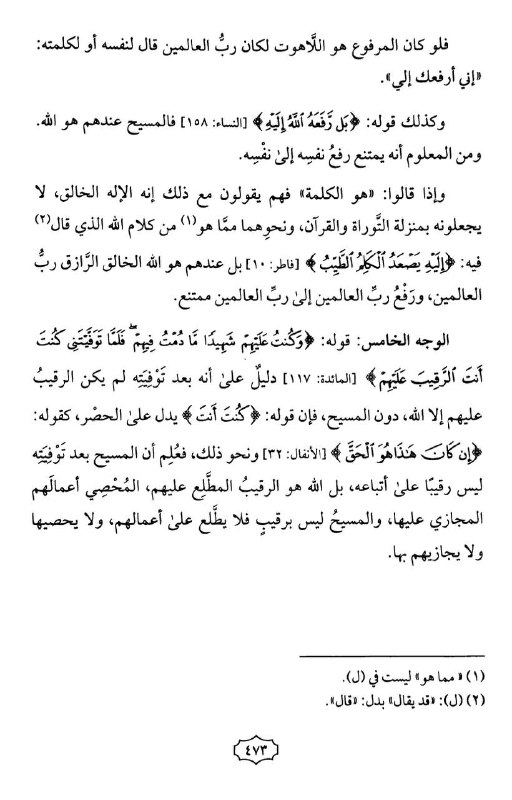
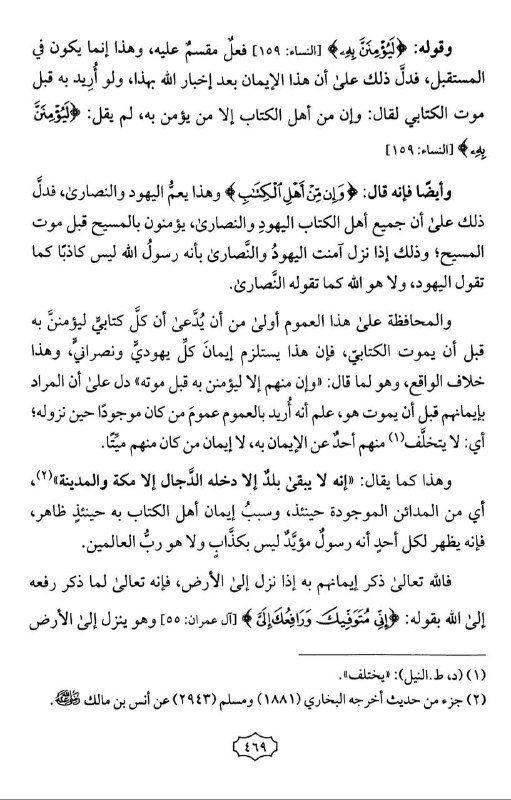
Book Identity:
-
Book Name: Al-Jawab as-Sahih liman baddala dina-l-Masih (The Correct Answer to Those Who Altered the Religion of Jesus) by Ibn Taymiyyah.
Core Theme: Grammatical and Contextual Refutation of the Absolute Faith of the People of the Book
This page delivers a detailed textual analysis of Surah An-Nisa: 159 to demonstrate that the ultimate submission of the Jews and Christians occurs dynamically in the future (upon Jesus’s second coming), rather than verifying their contemporary altered doctrines.
Key Linguistic and Grammatical Arguments:
- The Future Tense of the Vow (Fi’l Muqsam ‘Alayh):
The author breaks down the mechanics of the verse: “And there is none from the People of the Book but that he will surely believe in him before his death.” (Surah An-Nisa: 159).
- _The Grammatical Rule:_ The heavy emphasis noun combined with the verb (_Layyu'minanna bihi_) dictates an action that will explicitly transpire in the **future**. It is a divine prediction of what will happen after Allah informs us of it, not a validation of their past historical beliefs.- The Generality of the Scope (‘Umum):
The phrase “And from the People of the Book” encompasses both Jews and Christians generally. It establishes that a monumental shift in belief will apply universally to those alive at that specific period.
Theological Implications of Jesus’s Descent:
- Correcting Both Extremes Simultaneously:
When Jesus () descends to earth, his presence will force an immediate correction of the two conflicting theological deviations:
- **The Jewish Correction:** They will abandon their slander and realize he is a true, validated Messenger of Allah, not a liar.

- **The Christian Correction:** They will abandon their exaggeration and realize he is a created servant of Allah, not God incarnate.- The Analogy of the Dajjal’s Global Reach:
The author presents an analogy based on a well-known narration: “There will be no town that the Dajjal (Anti-Christ) will not enter, except Mecca and Medina.”. Just as the physical presence of the Dajjal will be an undeniable, visible reality for all towns existing at that time, the physical descent of Jesus will serve as an unmissable, clear proof (Zahir) that compels everyone alive to believe in his true status.
Conclusion:
The page wraps up by connecting this future belief with his ultimate bodily descent to the earth, linking it to Surah Ali ‘Imran: 55 (“Indeed, I will take you and raise you to Myself…”), confirming that his final earthly death has not yet occurred.
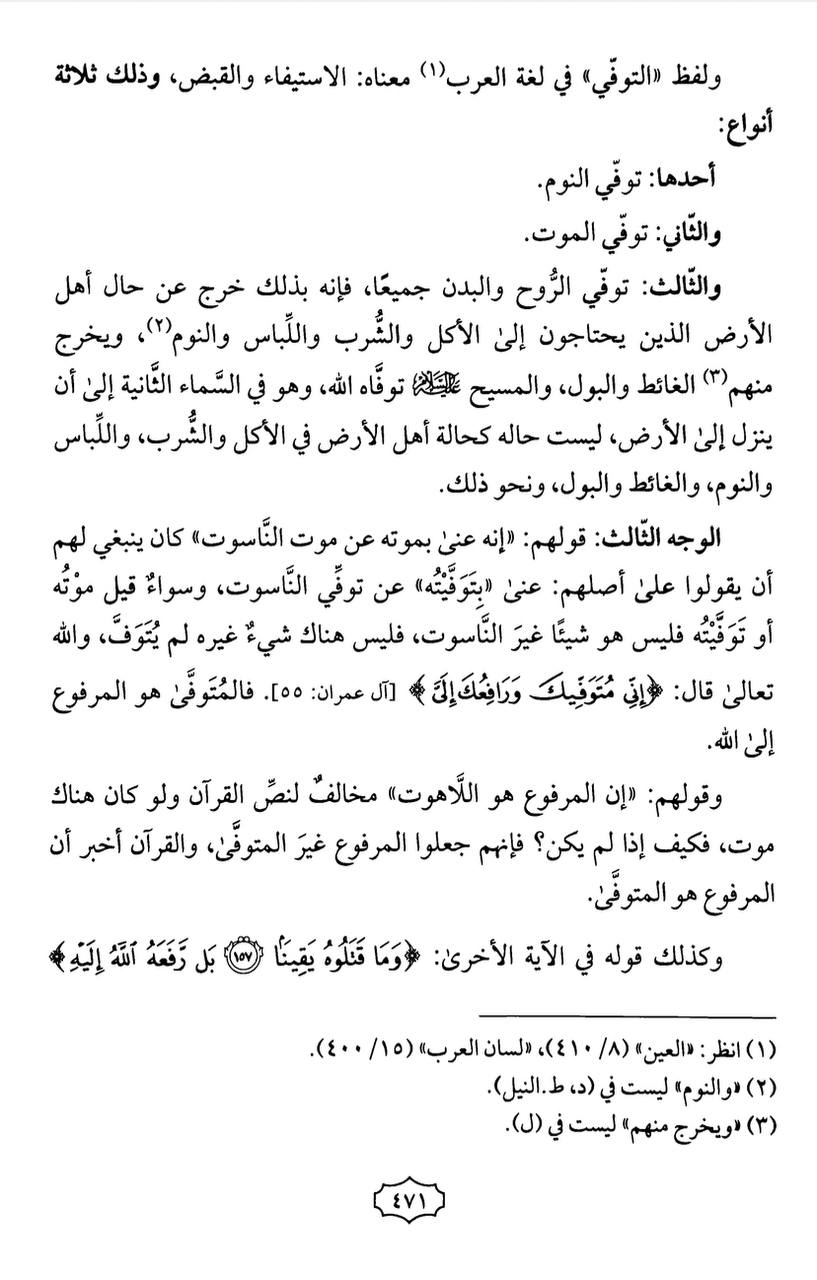
Book Identity:
-
Book Name: Al-Jawab as-Sahih liman baddala dina-l-Masih (The Correct Answer to Those Who Altered the Religion of Jesus) by Ibn Taymiyyah.
Core Theme: The Theological Absurdity of a Self-Raising Deity and the Limit of Witnessing
This page presents the final aspects of the fourth perspective (Al-Wajh al-Rabi’) and introduces the fifth perspective (Al-Wajh al-Khamis) to systematically dismantle Christian claims concerning the crucifixion, ascension, and divinity of Jesus ().
Key Arguments & Theological Breakdowns:
- The Paradox of Self-Elevation:
The author presents a sharp logical dilemma regarding the ascension:
- If Christians claim that the entity raised to heaven was the divine nature (_Lahut_), it implies that God raised Himself to Himself.

- _The Logical Flaw:_ It is a known intellectual impossibility for an absolute, self-sufficient Lord of the Worlds to "raise" Himself to Himself or address Himself with the command: _"Indeed, I will raise you to Myself."_

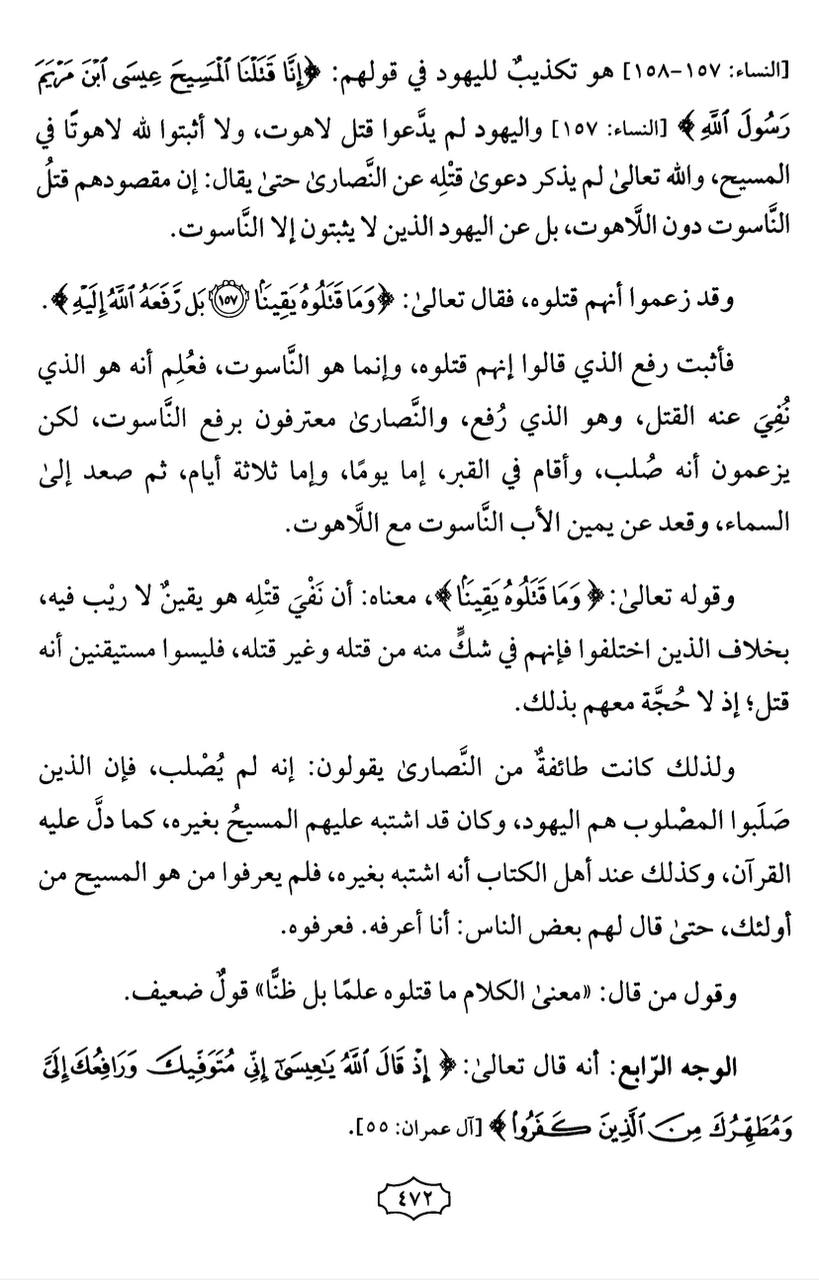
- Therefore, the text explicitly positions Jesus as a separate, dependent being who is acted upon by the Creator, completely invalidating his status as the Lord of the Worlds.- The Fallacy of the “Word” Being the Creator:
The text addresses the Christian defense that Jesus is the literal “Word” (Al-Kalimah). Ibn Taymiyyah argues that they do not treat it as a speech characteristic of God (similar to how the Torah and Quran are regarded as the speech of God). Instead, they claim the Word is the Sustainer and Creator Himself. Yet, scriptural mechanics show words ascending to God (e.g., “To Him ascends good speech” — Surah Fatir: 10), meaning speech is a creation or attribute directed toward the Lord, not the Lord Himself.
The Fifth Perspective: The Limits of Prophetic Witnessing:
- Analysis of Surah Al-Ma’idah: 117:
The author transitions into the fifth perspective, focusing on Jesus’s explicit statement: “And I was a witness over them as long as I was among them; but when You took me, You were the Observer over them…”
- The Logical Conclusion:
This verse establishes a strict boundary on Jesus’s awareness. If he were divine, his observation of his followers would be continuous, eternal, and absolute. By stating that his personal oversight ceased the moment he was taken up (Tawaffi), he confirms his limited, human capacity as a messenger. Any deviations, dynamic textual changes, or false worship practiced by his followers after his departure were entirely hidden from him, proving he lacks the all-knowing nature of Allah.
Book Identity:
-
Book Name: Al-Jawab as-Sahih liman baddala dina-l-Masih (The Correct Answer to Those Who Altered the Religion of Jesus) by Ibn Taymiyyah.
Core Theme: Deconstructing the “Word of God” Concept & The Finality of Jesus’s Human Limitations
This page continues the fifth perspective (Al-Wajh al-Khamis) and transitions into the sixth perspective (Al-Wajh al-Sadis), focusing on a linguistic and theological deconstruction of what it truly means for Jesus () to be referred to as the “Word” (Kalimah) or “Spirit” (Ruh) from Allah.
Key Arguments & Theological Breakdowns:
- The Limit of the Messenger’s Witness:
The page opens by finalizing the argument on Surah Al-Ma’idah: 117. The author reiterates that Jesus explicitly stated: “I was a witness over them as long as I was among them.” This confirms that his direct knowledge and accountability were restricted to his physical time on Earth. It proves he lacks the divine attribute of continuous, omnipresent oversight (Al-Raqib), which belongs exclusively to Allah after Jesus was taken up.
- The True Meaning of the “Word” (Al-Kalimah):
The author counters the Christian claim that Jesus being the “Word” makes him the Creator. He provides a crucial linguistic framework:
- When something is attributed to Allah, it falls into two categories: either it is a dependent attribute existing within Him (like His knowledge or speech), or it is a distinct, created entity existing outside of Him (like the "Camel of Allah" or the "House of Allah").

- Jesus is called the "Word" because he was brought into physical existence out of nothingness directly through the divine command **"Be"** (_Kun_), without the standard human intermediary of a biological father. Therefore, he is a _product_ of the Word, not the uncreated Word itself.
The Sixth Perspective: The Reality of Creation and Sustenance:
- The Physical Attributes of a Servant:
The author introduces the next systematic counter-argument, highlighting that Jesus () experienced the inescapable physical laws of human creation: he was contained in a womb, was born, grew from childhood to adulthood, required food and drink for sustenance, and experienced physical movement from one location to another.
- The Logical Conclusion:
An entity subject to change, development, physical boundaries, and dependency on external nutrition cannot fundamentally be the eternal, unchanging, self-sufficient Lord of the Universe who sustains all of creation.
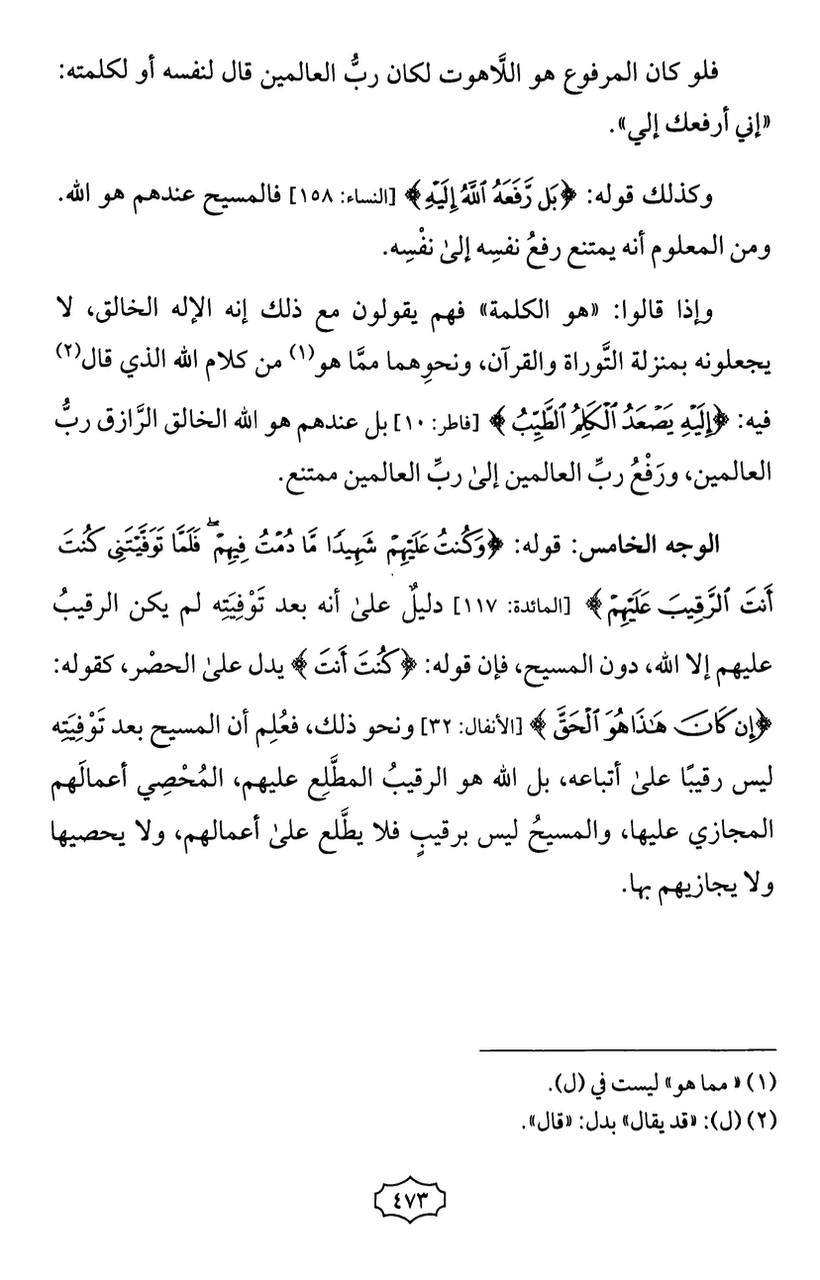
Book Identity:
-
Book Name: Al-Jawab as-Sahih liman baddala dina-l-Masih (The Correct Answer to Those Who Altered the Religion of Jesus) by Ibn Taymiyyah.
Core Theme: Refuting Christian Interpretation of Surah Al-Fatiha
This page introduces a new section (Fasl) dedicated to analyzing and dismantling a specific claim made by Christian polemicists regarding the opening chapter of the Quran, Al-Fatiha.
The Christian Argument Regarding Al-Fatiha:
-
The Claim: Christian writers argue that when Muslims pray in Al-Fatiha to be guided to “the path of those upon whom You have bestowed favor, not of those who have evoked [Your] anger or of those who are astray,” the group referred to as “those upon whom favor was bestowed” explicitly means the Christians (Al-Nasara).
-
Their Tripartite Division of Nations: They argue that during the era of Prophet Muhammad ﷺ, there were three primary religious blocks on Earth:
-
The Jews (Al-Yahud): Identified by them as those who earned divine wrath (Al-Maghdubi ‘alayhim) for rejecting prophets.
-
The Idolators (‘Ubbad al-Asnam): Identified as those who are completely astray (Al-Dallin).
-
The Christians (Al-Nasara): Left over as the only logical group matching “those upon whom favor was bestowed” (Al-Mun’ami ‘alayhim).
-
-
Linguistic Note: They try to back this up by claiming that the Arabic word Al-Sirat (path) comes from the Latin/Roman word Strata (Isbtrata).
The Author’s Preliminary Refutation:
Ibn Taymiyyah immediately calls this argument an extreme manifestation of ignorance (Fart jahl). He notes that the absolute falsity of this claim is clear to any rational person acquainted with the basic tenets of Islam:
-
Universal Islamic Consensus: Every single Muslim, whether common or scholar, holds a fundamental piece of necessary knowledge (‘Ilm daruri): that Prophet Muhammad ﷺ explicitly declared the Christians to be disbelievers (Kafir) who have gone astray.
-
The Contradiction of Islamic Law: The Prophet ﷺ fought against them, levied the jizyah tax upon them, took their wealth, and permitted military struggle (Jihad) against them. Therefore, it is a massive internal contradiction to claim that Islamic ritual prayers command Muslims to supplicate 17 times a day to follow the path of Christians.
Refuting the claim that Jesus, peace be upon him, is the Spirit of God and His Word
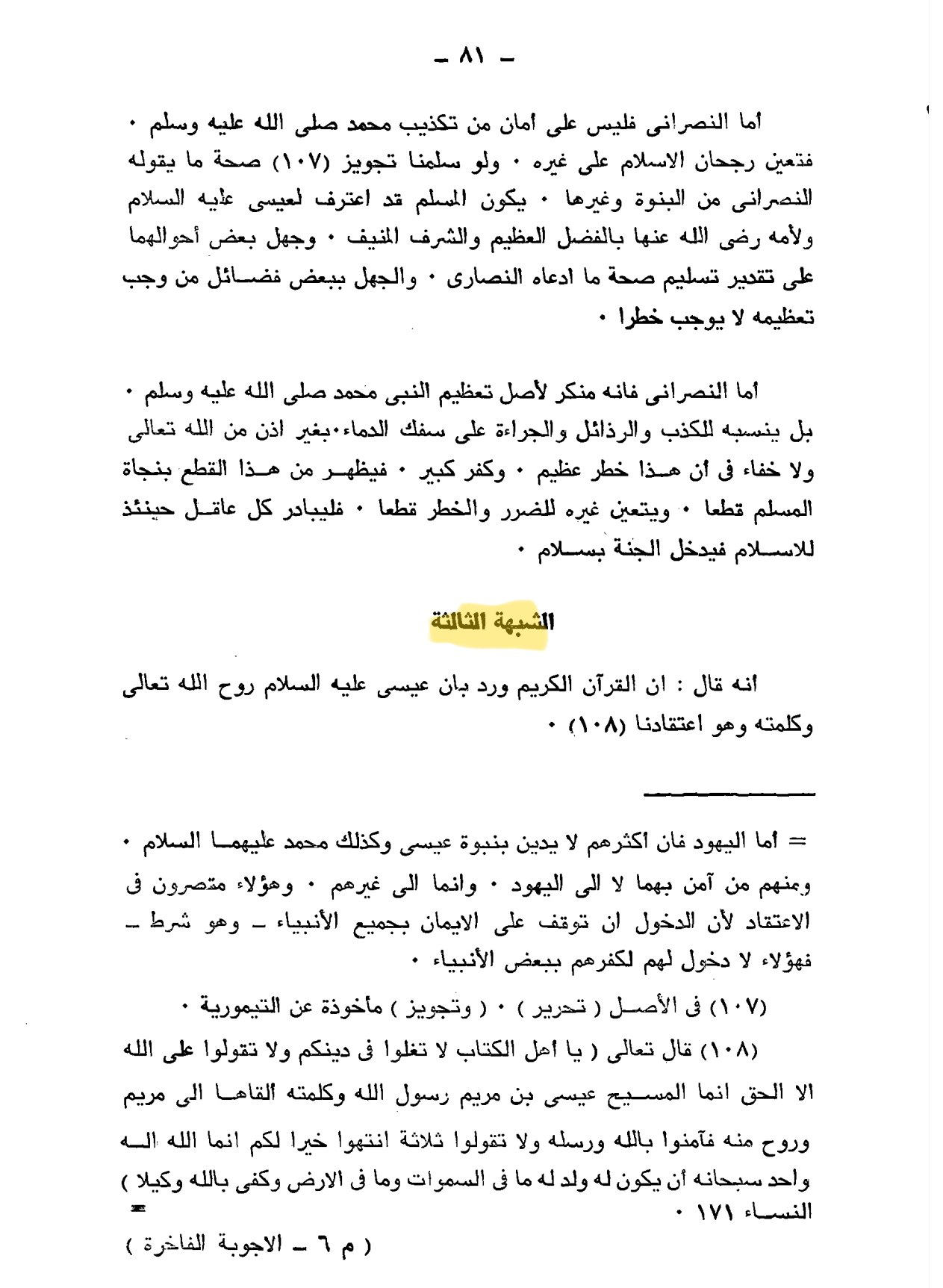
-
Book Title: Al-Ajwiba al-Fakhira ‘an al-As’ila al-Fajira (The Magnificent Answers to the Insolent Questions) by Al-Qarafi (d. 684 AH).
-
Theological Arguments: > * Christian vs. Muslim Beliefs: The text contrasts the Christian denial of Prophet Muhammad’s prophethood with the Muslim acceptance of Jesus as a highly revered prophet, along with the honor given to his mother, Mary. It argues that even if Christian claims were hypothetically granted validity, a Muslim remains secure in their faith, whereas a Christian’s denial of Muhammad carries severe spiritual risk.
- Call to Islam: The author concludes the second point by urging rational individuals to embrace Islam to ensure their ultimate salvation.
-
The Third Misconception (الشبهة الثالثة): > * The text introduces a new theological objection raised by critics regarding the Quranic description of Jesus as “a spirit from God and His word” (روح الله تعالى وكلمته), which aligns with Christian beliefs.
-
Footnotes & Citations: > * Includes editorial notes on textual variations.
- Cites Surah An-Nisa (4:171) to contextualize the Islamic perspective on Jesus, explicitly refuting the concept of the Trinity and emphasizing strict monotheism.
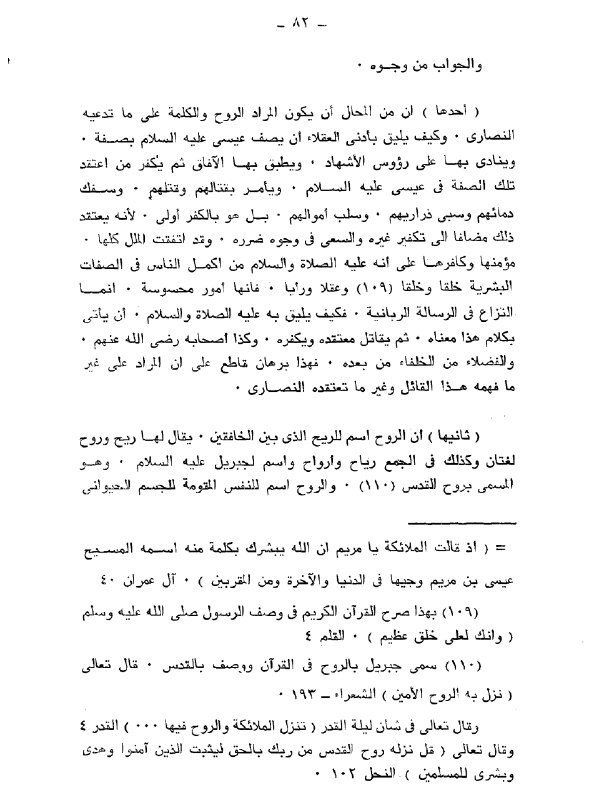
-
Book Title: Al-Ajwiba al-Fakhira ‘an al-As’ila al-Fajira (The Magnificent Answers to the Insolent Questions) by Al-Qarafi.
-
Refutation of the Third Misconception (والجواب من وجوه): This page outlines the multi-faceted Islamic theological response to Christian claims regarding the Quranic phrases “Spirit” (الروح) and “Word” (الكلمة) associated with Jesus:
-
First Aspect (أحدها): It argues that it is impossible and logically inconsistent for these terms to mean what Christians claim. The author states it is irrational for the Prophet to describe Jesus with a certain attribute publicly, only to subsequently declare anyone who holds that specific belief an infidel, fight them, and seize their property. Therefore, the intended meaning must be completely different from Christian dogma.
-
Second Aspect (ثانيها): A linguistic and semantic breakdown of the word “Spirit” (Ruh). The author explains that Ruh can mean wind/breeze, it is used as a name for the Angel Gabriel (the Holy Spirit / Ruh al-Qudus), and it refers to the life-giving soul within a physical body.
-
-
Footnotes & Citations: > * Links to Surah Ali ‘Imran (3:45) regarding the glad tidings of a “Word” from Allah named the Messiah, Jesus son of Mary.
-
Links to Surah Al-Qalam (68:4) praising the character of Prophet Muhammad.
-
Cites various Quranic verses where “Spirit” refers to Gabriel or divine decree, including Surah Ash-Shu’ara (26:193), Surah Al-Qadr (97:4), and Surah An-Nahl (16:102).
-
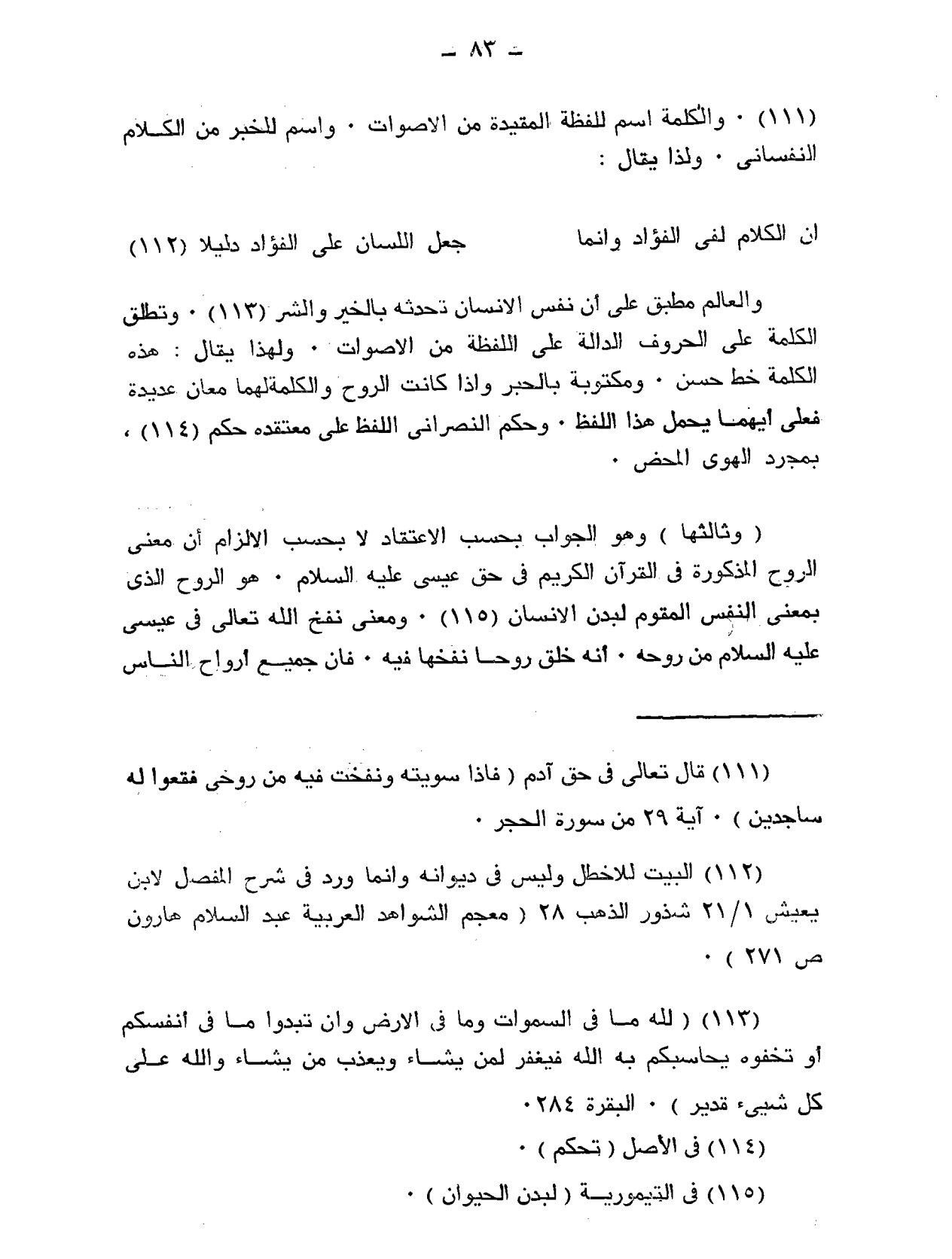
-
Book Title: Al-Ajwiba al-Fakhira ‘an al-As’ila al-Fajira (The Magnificent Answers to the Insolent Questions) by Al-Qarafi.
-
Refutation of the Third Misconception (Continued):
-
Linguistic Definitions (الكلمة): The text continues defining “the Word” (al-Kalimah), explaining it as an utterance made of sounds, or as internal, psychological speech (al-kalam al-nafsani). It quotes poetry emphasizing that true speech originates in the heart, and the tongue is merely its indicator. It notes that words can also refer to physical script written in ink.
-
The Polysemy of “Spirit” and “Word”: Because both Ruh (Spirit) and Kalimah (Word) carry multiple meanings, the author argues that a Christian’s insistence on applying their specific theological interpretation to the Quranic text is based purely on whim (al-hawa al-mahd), rather than objective evidence.
-
Third Aspect (وثالثها): This point addresses the actual intended Islamic belief regarding the “Spirit” mentioned in connection to Jesus. It states that Ruh here means the life-giving human soul. The phrase “Allah breathed into Jesus from His spirit” (نفخ الله تعالى في عيسى عليه السلام من روحه) signifies that Allah created a specific soul and breathed it into him, just as He creates the souls of all human beings.
-
-
Footnotes & Citations: > * Cites Surah Al-Hijr (15:29) regarding the creation of Adam: “So when I have proportioned him and breathed into him of My spirit…” to demonstrate that being attributed to Allah’s spirit is a token of honor in creation, not divinity.
-
Provides a literary/poetic attribution note regarding the verse on speech and the heart.
-
Cites Surah Al-Baqarah (2:284) regarding Allah’s knowledge of what is within human souls.
-
Includes editorial notes comparing manuscript variations (e.g., al-Taymuriyya copy).
-
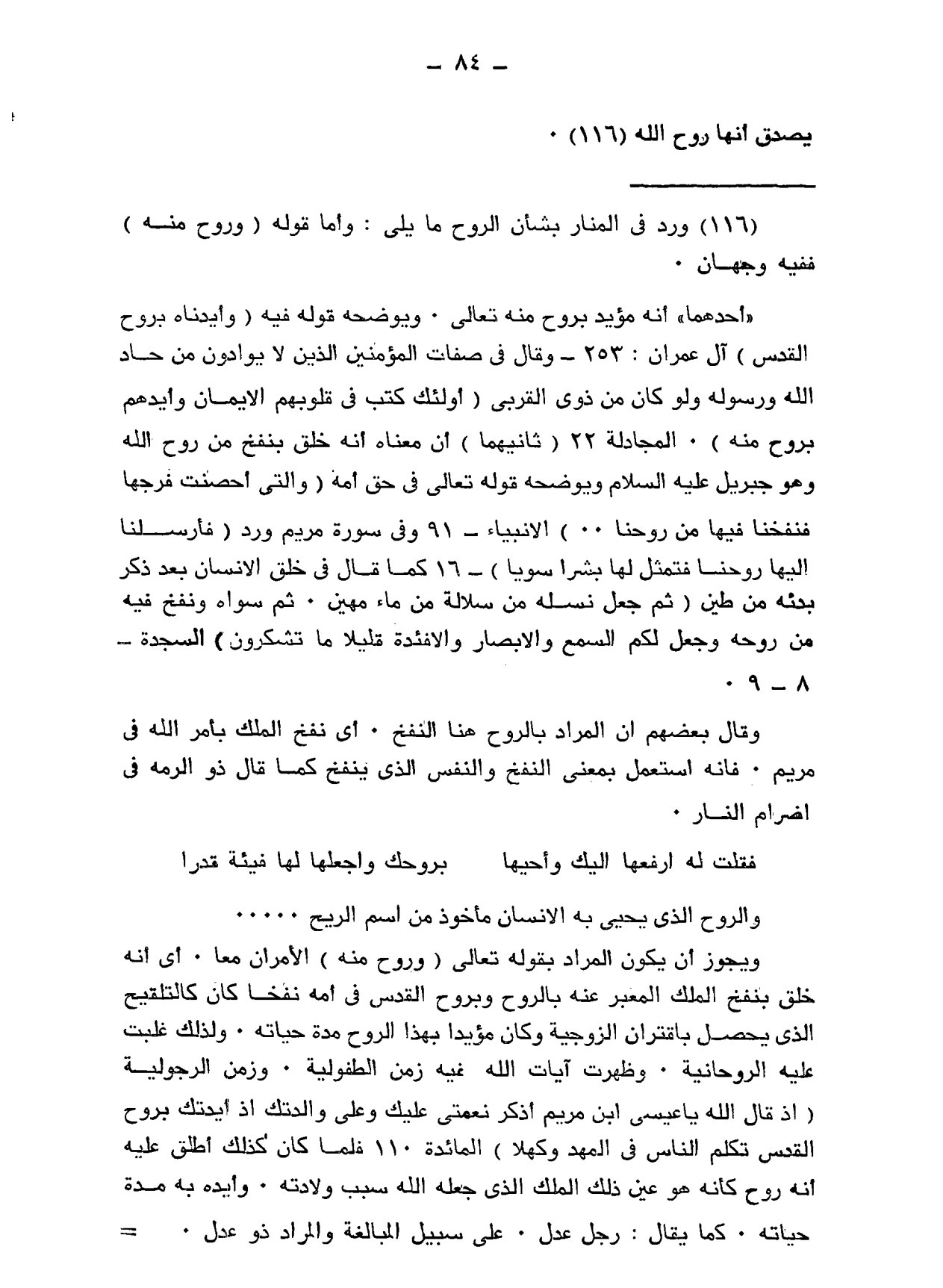
-
Book Title: Al-Ajwiba al-Fakhira ‘an al-As’ila al-Fajira (The Magnificent Answers to the Insolent Questions) by Al-Qarafi.
-
Analysis of the Phrase “A Spirit From Him” (وروح منه): This page delves heavily into a lengthy scholarly footnote (116) citing Al-Manar, which details two interpretive angles regarding this description of Jesus:
-
First Aspect: It signifies that Jesus was supported and strengthened by a spirit from Allah, similar to how true believers are aided by a spirit from Him, as mentioned in Surah Al-Mujadilah (58:22).
-
Second Aspect: It means he was created via a breath of life from the spirit of Allah, executed by the Angel Gabriel. This is contextualized using Surah Al-Anbiya (21:91) and Surah Maryam (19:16-17) regarding Mary, alongside Surah As-Sajdah (32:8-9) to show that blowing life into a body applies to general human creation from clay as well.
-
-
Alternative Interpretations of “The Breath” (النفخ): > * Some scholars state the “breath” implies an angel blowing life into Mary by Allah’s command, comparing the usage of the word to poetic Arabic metaphors for kindling a fire.
- Another view suggests combining both aspects: Jesus was uniquely created through the breathing of the Holy Spirit (Gabriel) into his mother—acting like a metaphysical fertilization—causing a dominant spiritual nature to manifest in him throughout his infancy, childhood, and manhood.
-
Footnotes & Citations: > * Cites Surah Al-Ma’idah (5:110): “O Jesus, Son of Mary, remember My favor upon you and upon your mother when I supported you with the Pure Spirit and you spoke to the people in the cradle and in maturity…” > * Explains the linguistic hyperbolic use of calling Jesus “a spirit” because his creation and support were so fundamentally tied to the Angel Gabriel (the Spirit), matching classic Arabic rhetorical styles (e.g., calling an exceptionally just man “justice itself”).
-
Book Title: Al-Ajwiba al-Fakhira ‘an al-As’ila al-Fajira (The Magnificent Answers to the Insolent Questions) by Al-Qarafi.
-
Linguistic Possession and Genitive Construction (الإضافة): The text explains that in the Arabic language (Lisan al-Arab), attributing a spirit to Allah (e.g., “spirit of Allah”) does not imply divinity or literal physical possession. It presents linguistic analogies, showing how an object can be grammatically linked to a person or thing merely by association, proximity, or comparison, rather than literal part-whole ownership. Therefore, every living being’s soul is inherently created and owned by Allah.
-
Alternative Meaning - Mercy (الرحمة): Some commentators state that “Spirit” in these contexts signifies divine mercy, supported by Surah Maryam (19:21) (“…a sign for the people and a mercy from Us”).
-
The Categories of Life (والحياة قسمان): The author links the concept of spirit to life, dividing it into two categories:
-
Physical/Sensory Life (حسية): That by which a human feels, perceives, thinks, and remembers.
-
Spiritual/Abstract Life (معنوية): That by which a human becomes merciful, wise, virtuous, and beloved among creation. Divine revelation is called a “spirit” in this sense, as cited in Surah Ash-Shura (42:52) (“And thus We have revealed to you an inspiration [spirit] of Our command”) and Surah An-Nahl (16:2). Both forms of life were perfectly realized in Jesus.
-
-
Refutation of Partition/Divinity (من التبعيض): > * The author addresses the Christian argument that the preposition “from” (min) in “a spirit from Him” (minhu) implies that Jesus is a literal physical part or fragment of God.
- Historical Debate: The text recounts a historical debate where a Christian physician questioned Ali ibn Husayn al-Waqidi al-Marwazi, using this verse to argue Jesus is part of God. Al-Waqidi refuted this by citing Surah Al-Jathiyah (45:13): “And He has subjected to you whatever is in the heavens and whatever is on the earth, all from Him [jamī’an minhu].” Al-Waqidi argued that if min meant physical partition, then the entire heavens and earth would also be literal parts of God, which is absurd. Convinced by this logic, the Christian physician embraced Islam, much to the joy of Caliph Harun al-Rashid.
-
Book Title: Al-Ajwiba al-Fakhira ‘an al-As’ila al-Fajira (The Magnificent Answers to the Insolent Questions) by Al-Qarafi.
-
The Purpose of Specifying Jesus (أما تخصيص عيسى): The page starts by clarifying that while all human souls are created by Allah, Jesus was specifically singled out with the phrase “a spirit from Him” to signify his high status, honor, and noble station (li-tanbih ‘ala sharaf ‘Isa). The author provides Quranic analogies where general concepts are assigned specifically to individuals to highlight their unique status, such as:
-
Surah Al-Anfal (8:41): ”…Our servant…” (referring to Prophet Muhammad).
-
Surah Al-Hijr (15:42): ”…My servants…” (referring to the righteous protected from Satan).
-
-
The Theological Meaning of “The Word” (وأما الكلمة): Islamicly, calling Jesus “the Word” means he was created directly through Allah’s divine decree: “Be, and he was” (كن فيكون), bypassing standard biological intervention.
-
Comparative Philosophy of “The Word” (Logos) in Footnote 121: A detailed editorial note analyzes how the concept of “the Word” (al-Kalimah / Logos) evolved across ancient history and different creeds:
-
Ancient Greek Philosophy: It traces the term back to Heraclitus (c. 500 BCE), who viewed the “Word” as an eternal, cosmic rational power, wisdom, and the divine spirit animating all existence, aligning with his pantheistic views.
-
Anaxagoras: The note mentions that for Anaxagoras, the Word was seen as the governing, ordering force of the universe, closely tied to the “Divine Intellect.”
-
-
Book Title: Al-Ajwiba al-Fakhira ‘an al-As’ila al-Fajira (The Magnificent Answers to the Insolent Questions) by Al-Qarafi.
-
Evolution of “The Word” (Logos) in Philosophical and Religious Traditions (Footnote Continued): This page continues the detailed modern editorial footnote tracing how different traditions define “the Word” (al-Kalimah):
-
Stoic Philosophy (الرواقيين): For the Stoics, the Word represents the governing mind of the cosmos (al-‘aql al-mudabbir), or the universal intellect that feeds all partial human minds, equating God with Nature in a pantheistic framework.
-
Jewish Philosophy & Philo (اليهودية): The concept shifted from being merely an expression of God’s creative power to representing the “Divine Intellect.” Jewish philosopher Philo added layer upon layer of meaning, describing the Word as the intermediary between God and the universe, the “first-born son of God,” the divine image, the ultimate reality of truths, the eldest angel, and the primordial man created in God’s image.
-
Christian Theology (المسيحيين): According to Gospel commentators, “the Word” refers specifically to the Messiah (Jesus). The text states that in Christian dogma, it does not mean an abstract attribute like wisdom or speech—as it is deemed illogical to say a text or an abstract trait literally “became flesh.” Instead, it is a hypostasis. It notes that Jewish populations familiar with Greek philosophy came to call the expected Messiah “the Word.”
-
-
Biblical Cross-References Cited in Text: > * Explains the Christian view that Jesus is called “the Word” because through him, God spoke to humanity, citing Hebrews 1:1-2, and because he reveals the thoughts, will, and actions of God to mankind just as human words reveal human thoughts.
- Mentions the theological reconciliation of terms like “Son of God” and “Word of God,” asserting that these titles reject any physical, carnal lineage, citing Romans 11:34 (“For who has known the mind of the Lord? Or who has been his counselor?”) via Christian exegesis (Al-Kanz al-Jalil).

-
Book Title: Al-Ajwiba al-Fakhira ‘an al-As’ila al-Fajira (The Magnificent Answers to the Insolent Questions) by Al-Qarafi.
-
Comparative Analysis of “The Word” in Pagan Religions (Footnote Continued): This page continues the modern editorial note, arguing that the concept of “the Word” (al-Kalimah) within Jewish and Christian theology shares roots with ancient pagan beliefs:
-
Ancient Egyptian Religion: Priests at the Memphis temple used “the Word” to express a holy trinity: the first created the second, the second with the first created the third, forming a single nature. It recounts a narrative where a high priest describes a supreme entity consisting of God, the Word, and the Holy Spirit.
-
Cross-Cultural Parallels: The text explicitly notes that calling the second hypostasis of a trinity “the Word” is of Egyptian pagan origin. It adds that similar concepts are found in ancient Indian antiquities, Greek mythology (Apollo), and Alexandrian theology before Christ, where Plato taught that “the Word” is the second god and the first-born son of God.
-
Persian Tradition: Cites scholar Higgins (The Anglo-Saxons) stating that the Persians called Mithra “the Word” and the “Mediator” or “Savior of the Persians.”
-
Ancient Egyptian Theology Details: Cites scholar Bonwick (Egyptian Belief) on how the ancient Egyptian theology of the Word taught that everything came into being through it, that it emanated from God, and that it is God. It asserts that Plato, Aristotle, Chaldeans, and Egyptians held these beliefs long before Christian history.
-
-
Citations & References in Text: > * Cites Myths of the Torah and the Bible by Doane (pp. 373, 473).
-
Cites Maurice’s Indian Antiquities (p. 127).
-
Cites Higgins’ The Anglo-Saxons (p. 162).
-
Cites Bonwick’s Egyptian Belief and Modern Thought (p. 402).
-
-
Book Title: Al-Ajwiba al-Fakhira ‘an al-As’ila al-Fajira (The Magnificent Answers to the Insolent Questions) by Al-Qarafi.
-
Main Text - Logical Refutation of Incarnation: The author argues that calling Jesus “the Word” simply means he was brought into existence when Allah said “Be” (Kun) inside his mother’s womb, a designation meant purely for his honor. He logically attacks Christian incarnation theology:
-
It is rationally impossible for an attribute of God (like speech or a divine property) to physically detach, move, and settle into the human nature (nasut) of Jesus.
-
Attributes cannot transfer from one entity to another (just as one person’s knowledge cannot literally jump into someone else’s mind), nor can attributes move in physical space, because movement is a physical property of bodies, and divine attributes are not physical bodies.
-
He concludes that anyone deeply well-versed in the subtleties, metaphors, and linguistic constraints of the Arabic language (Lisan al-Arab) will clearly see that the text does not support the Christian theological interpretation.
-
-
Footnote - Historical Roots of the Logos Concept (Continued): The editorial note continues tracking the ancient Near Eastern and philosophical roots of the term:
-
Assyrian & Chaldean Beliefs: Mentions that the ancient Assyrians called the Word “Marduk,” viewing him as the first-born son of God, and addresses a historical prayer showing their reliance on him as a life-giver and creator. It also cites scholar Doane noting that the Chaldeans repeatedly viewed the Word as the creator and ruler of the world.
-
Critique of the Gospel of John: The note highlights that the usage of “the Word” by John the Evangelist (Yuhanna) was preceded by these ancient pagan creeds. It points out a logical contradiction in the phrasing “In the beginning was the Word, and the Word was with God, and the Word was God”: the preposition “with” (‘inda) implies distinct separation and creation, which contradicts co-eternity and absolute oneness. Therefore, the Messiah has a known, finite beginning as a created being.
-
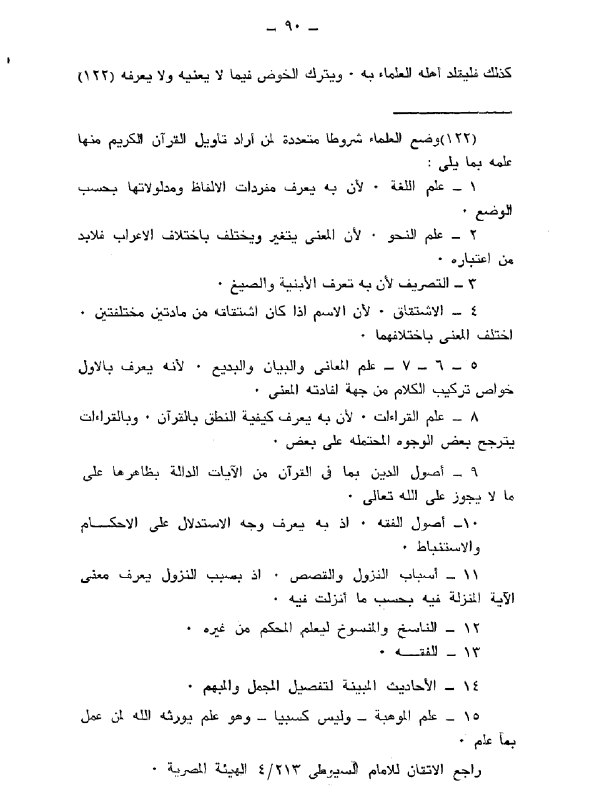
-
Book Title: Al-Ajwiba al-Fakhira ‘an al-As’ila al-Fajira (The Magnificent Answers to the Insolent Questions) by Al-Qarafi.
-
Main Text Conclusion: The main body text concluding the section advises that non-experts should follow and defer to qualified scholars (al-ulama), and avoid delving deeply into complex theological matters that do not concern them or that they do not fully understand.
-
Footnote 122 - The 15 Qualifications for Quranic Exegesis (Tafsir): The bulk of this page consists of an extensive modern editorial footnote outlining the strict scholarly conditions required for anyone attempting to perform allegorical interpretation (ta’wil) or commentary on the Quran. It lists 15 foundational sciences:
-
Philology/Lexicography (علم اللغة): To know vocabulary words and their original designated meanings.
-
Grammar (علم النحو): To understand how changes in grammatical syntax alter the meaning.
-
Morphology (التصريف): To know word structures, derivations, and formulas.
-
Etymology (الاشتقاق): To distinguish meanings when words share roots or have distinct roots.
-
6, & 7. Rhetoric (علم المعاني والبيان والبديع): To comprehend sentence properties, clarity of expressions, and stylistic embellishments.
-
The Variant Recitations (علم القراءات): To know how the Quran is pronounced and how variants weigh text interpretations.
-
Theology/Principles of Religion (أصول الدين): To prevent interpreting the literal text in ways that inappropriately anthropomorphize or contradict the nature of Allah.
-
Principles of Jurisprudence (أصول الفقه): To grasp methodologies for legal deduction and inference.
-
Contexts of Revelation (أسباب النزول والقصص): To understand the historical reasons and contexts behind when verses were revealed.
-
Abrogation (الناسخ والمنسوخ): To know which rulings are textually modified or replaced.
-
Jurisprudence (الفقه): To understand derivative practical laws.
-
Prophetic Traditions (الأحاديث المبينة): To reference Hadiths that clarify detailed, ambiguous, or summarized Quranic passages.
-
The Science of Divine Endowment (علم الموهبة): A non-acquired, spiritual knowledge gifted by Allah to those who act sincerely upon what they know.
-
-
Cross Reference: The footnote directs readers to check Imam al-Suyuti’s classic work, Al-Itqan fi ‘Ulum al-Qur’an (4/213, Egyptian General Book Authority).