Does the Quran Insult People? Dog, Donkey, and Zaneem Refuted
·20 min read·4321 words
The ignorant among the people continue to raise their worn-out doubts about the Glorious Quran. They have failed to produce anything like it, and they have failed to cast doubt on its infallibility. They have even been unable to offer constructive criticism of the scientific, metaphysical, and even numerical miracles it contains. So they have resorted to their worn-out doubts again — not only to make Muslims doubt their religion, but also to plant these doubts in the ears of truth-seekers to turn them away from Islam and its greatness. But the truth is not tainted by the corruption of the minds of its opponents.
This post addresses the following five doubts in full:
Al-A’raf: “Like the dog!”
Al-Jumu’ah: “The example of those who were entrusted with the Torah and then did not uphold it is like that of a donkey carrying books.”
Al-Qalam: “A preventer of good, an aggressor, a sinner, harsh, and, moreover, an illegitimate child.” — where al-Walid ibn al-Mughirah is described, with the claim that zaneem means born out of wedlock.
Hud: “The curse of God be upon the wrongdoers.”
Al-Baqarah: “And they said, ‘Our hearts are wrapped [in coverings].’ Rather, God has cursed them for their disbelief, so little do they believe.”
Al-A’raf 7:176 — “Like a Dog”
Al-A’raf compares people to dogs — is this an insult? The Quran uses the simile of a panting dog to describe certain people.
Let us return to the context of the verse to see who it is speaking about:
Al-A’raf 7:175–176 And recite to them the story of the one who We gave him Our signs, but he detached himself from them; so Satan pursued him, and he became one of those who went astray. (175) And if We had willed, We could have elevated him thereby, but he clung to the earth and followed his own desires. So his example is like that of a dog: if you chase it, it pants, or if you leave it alone, it pants. That is the example of the people who denied Our signs. So relate the stories that perhaps they will reflect. (176)
This verse is a parable for evil scholars to whom God grants knowledge, yet they refuse except to go astray. He likened them to a dog because it pants whether tired or at rest, and these people pant after worldly things, their knowledge not deterring them.
Sheikh al-Sha’rawi When you sit and a dog approaches you, and you scold, chase, or reprimand it — that is the phrase “you are pushing it,” meaning you are pushing or reprimanding it; that is why it pants. If you leave the dog alone and do not reprimand it, it will still pant, because it is in its nature to always pant. This characteristic is unique to dogs, as they always breathe rapidly while sticking out their tongues. We know that animals only pant when they are startled and run to escape pain or harm from another creature. When an animal runs, it needs energy, so the heart beats hard to pump blood, along with its nutrients, throughout the body. The heart must cooperate with the lungs, which supply the blood with air. We observe that when a living being sits still, it does not notice its breathing, but when it runs, it notices that the chest cavity contracts and expands to draw oxygen from the air and deliver it to the blood in a quantity appropriate for the new movement. Animals only do this when they are hungry, tired, or under attack — but the dog alone does it whether hungry or full, thirsty or not, being reprimanded or not. He is always panting.
Why does God, Glory be to Him, liken such a person to a panting dog? Because the one who appears in this way is always disliked; he follows his desires and is controlled by his lusts. When he fulfils a lust now, he wonders if he will do the same tomorrow. Lust takes over all his time, so he lives in constant distress — afraid that he will miss out on bliss or that some pleasure will slip away — and his condition becomes like that of a dog panting, whether safe or not, hungry or not, thirsty or not.
Al-A’raf 7:176 {…So his example is like that of a dog: if you chase it, it pants, or if you leave it alone, it pants. That is the example of the people who denied Our signs. So relate the stories that perhaps they will reflect.}
This is the fate of those who denied the signs.
The Bible itself uses the same type of comparison. 2 Peter 2:22 states: “They have been afflicted by what is in the true parable: ‘A dog that has returned to its vomit,’ and ‘A sow that has washed itself back into the mire.’” And Matthew 7:6 records: “Do not give what is holy to dogs, nor cast your pearls before swine, lest they trample them under their feet, and turn and tear you to pieces.”
Al-Jumu’ah 62:5 — “Like a Donkey Carrying Books”
Al-Jumu’ah compares people to a donkey — is this an insult? The Quran likens those who were given the Torah but did not uphold it to a donkey carrying books.
Al-Jumu’ah 62:5 The example of those who were entrusted with the Torah and then did not uphold it is like that of a donkey carrying books. Wretched is the example of the people who deny the signs of Allah. And Allah does not guide the wrongdoing people.
Firstly, this is the most accurate, closest, and most similar description of them. What is the difference between a person who possesses knowledge but does not benefit from it, and a donkey that constantly suffers from carrying heavy books without understanding their contents?
Secondly, Sheikh al-Sha’rawi continues his commentary, saying:
Sheikh al-Sha’rawi {The example of those who were entrusted with the Torah and then did not carry it is like that of a donkey carrying books…} [Al-Jumu’ah: 5]. Does a donkey deserve blame when it carries books because it does not understand what is in them? The answer is no — because its role is not to understand the contents of the books, but rather its role is simply to carry what is on it. It is as if the truth is saying: do not be like the donkey that is content with merely carrying the books. I want you to carry the methodology and benefit from the legislation it contains. So these examples are not a condemnation of the dog, nor are they a condemnation of the donkey. Rather, they are a condemnation of those who imitate them.
Thirdly, it is not only the Quran that uses such comparisons — the prophets of the Bible also spoke this way:
Matthew 7:6 “Do not give what is holy to dogs, nor cast your pearls before swine, lest they trample them under their feet, and turn and tear you to pieces.”
Matthew 23:17 “You foolish and blind men! Which is greater, the gold or the temple that worships the gold?”
Luke 24:25 “He said to them, ‘You foolish men and slow of heart to believe all that the prophets have spoken!’”
Mark 8:33 “Then he turned and saw his disciples and rebuked Peter, saying, ‘Get behind me, Satan!’”
James 4:4 “You adulterers and fornicators, do you not know that friendship with the world is enmity with God? Therefore, whoever wants to be a friend of the world makes himself an enemy of God.”
Al-Qalam 68:13 — The Meaning of Zaneem
Al-Qalam calls al-Walid ibn al-Mughirah “an illegitimate child” — God insulted his mother The claim that the Holy Quran insulted al-Walid ibn al-Mughirah and called him “the son of adultery” in the interpretation of verse 13 of Surat Al-Qalam (cruel, moreover, an illegitimate son) is a false, fabricated, and slanderous claim against the Book of God.
Al-Qalam 68:10–16 And do not obey every habitual swearer, contemptible — (10) a slanderer, going about with malicious gossip — (11) a preventer of good, an aggressor, a sinner — (12) cruel, and after that, — (13) because he has wealth and children — (14) when Our verses are recited to him, he said, “Legends of the former peoples.” (15) We will brand him on the snout. (16)
Is it conceivable that God would describe one of His servants as “the son of adultery,” when God Himself says in the Quran:
Al-Nahl 16:90 Indeed, Allah orders justice and good conduct and giving to relatives, and forbids immorality and wrongdoing and oppression. He admonishes you that perhaps you will be reminded.
We all know also that God has forbidden falsely accusing chaste women of adultery without evidence. So how could God contradict His own words — far be it from Him — and describe the mother of al-Walid ibn al-Mughirah as an adulteress?
The point of contention regarding the word zaneem in Al-Qalam 68:13
To answer this claim, we return to the books of exegesis that interpreted the meaning of the word with sound chains of transmission. After that, we examine the origin of this story and where it came from.
First: The Prophet ﷺ Explained the Meaning of Zaneem
Section marker
The Prophet ﷺ himself explained the term zaneem in multiple narrations:
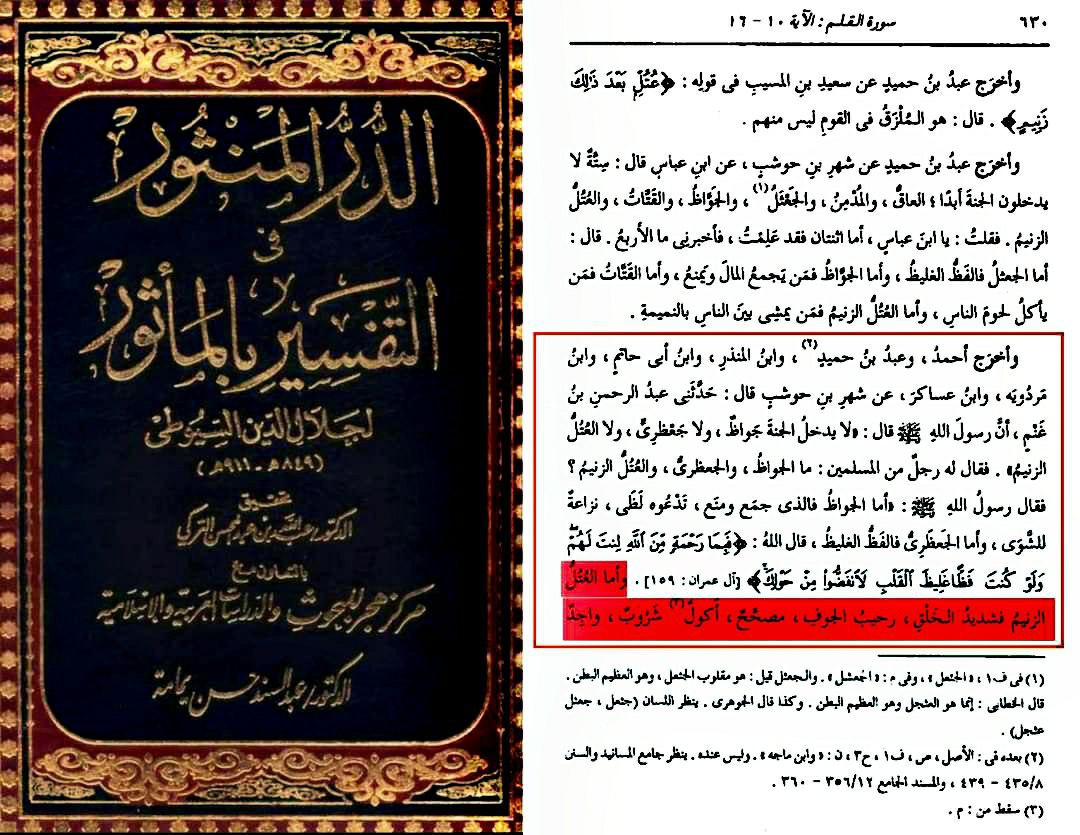
Narrated by Abd al-Razzaq, Ibn Jarir, and Ibn al-Mundhir — on the authority of Zayd ibn Aslam The Messenger of God ﷺ said: “The heavens weep for a servant whom God made healthy in body, made his stomach soft, and gave a portion of the world, yet he was unjust to people. That is the cruel, wicked one.”
Source confirmation image
Narrated by Ibn Abi Hatim — on the authority of al-Qasim, freed slave of Muawiyah, and Musa ibn Uqbah The Messenger of God ﷺ was asked about the cruel, wicked one, and he said: “He is the obscene, vile one.”
Source confirmation image
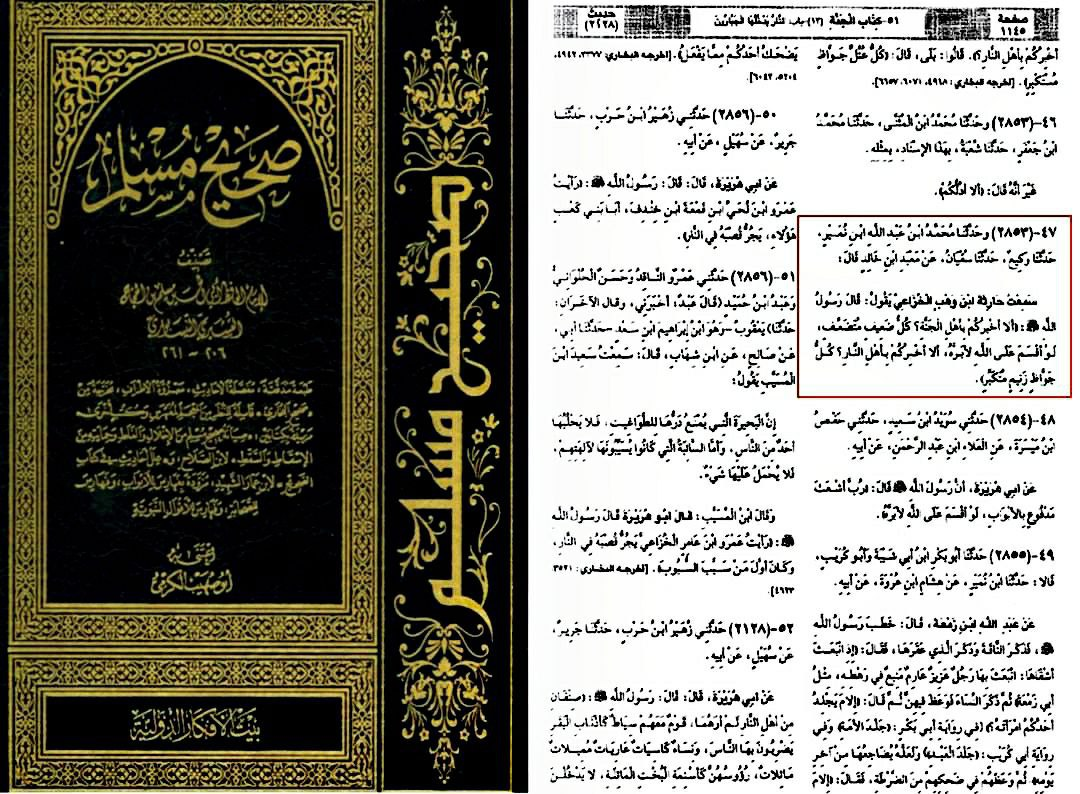
Sahih Muslim 2853 — Narrated by Muhammad ibn Abdullah ibn Numayr, from Waki’, from Sufyan, from Ma’bad ibn Khalid — on the authority of Haritha ibn Wahb al-Khara’i The Messenger of God ﷺ said: “Shall I not tell you about the people of Paradise? Every weak and humble person who, if he were to swear by God, God would fulfil his oath. Shall I not tell you about the people of Hell? Every arrogant, wicked, and proud person.”
Source confirmation image
Therefore, from these narrations we conclude that ==zaneem does not mean “son of adultery,” but rather it means “oppressor,” “obscene,” and “vile.”==
Second: What the Commentators Said About Zaneem
Section marker
If we return to the books of exegesis, we find the following interpretations of the word zaneem:
Sahih al-Bukhari 4917 — On the authority of Ibn Abbas, narrated by Mujahid ibn Jabr al-Makki “Harsh, moreover, and of illegitimate birth” [Al-Qalam: 13]. He said: A man from Quraysh who had a wattle like the wattle of a sheep.
Grade: Sahih · Bukhari
Mujahid al-Makhzumi (d. 104 AH) — one of the oldest exegeses of the Quran Quoting Ibn Abbas: Zaneem is the man known for evil, just as a sheep is known by its wattle.
Muqatil ibn Sulayman (d. 150 AH) — one of the old exegeses of the Quran The meaning of zaneem is that at the base of his ear was something like the wattle of a sheep — like the wattle that hangs from the jaws of a sheep — an addition to his creation.
Majd al-Din al-Fayruzabadi — Tafsir al-Qur’an {Zaneem} is someone attached to a people but not one of them. It is said that he is known for his disbelief, polytheism, immorality, depravity, and evil. He is also called a zanmah, like the zanmah of a goat.
Sheikh Muhammad Ali al-Tantawi (d. 2010) — Al-Wasit Commentary, former Sheikh of Al-Azhar Zaneem is someone attached to a people without being one of them. Rather, he is an outsider among them, as if he were among them like a zanmah — which is the skin hanging from the throat of a goat or sheep.
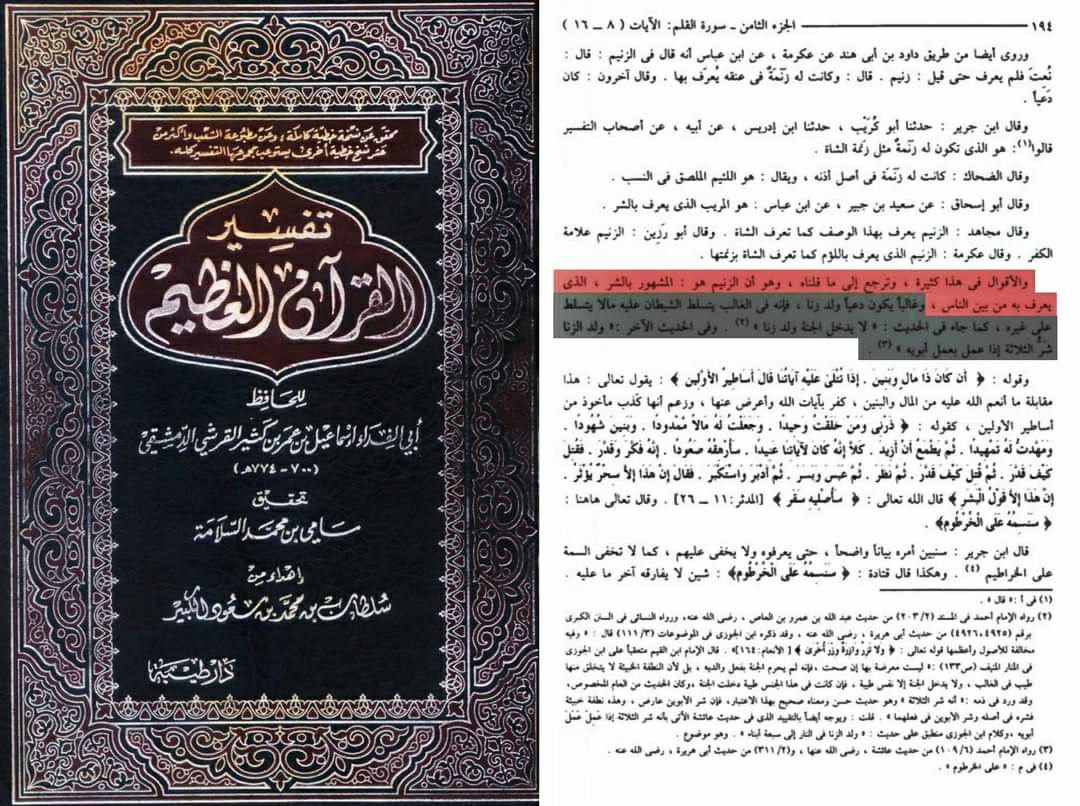
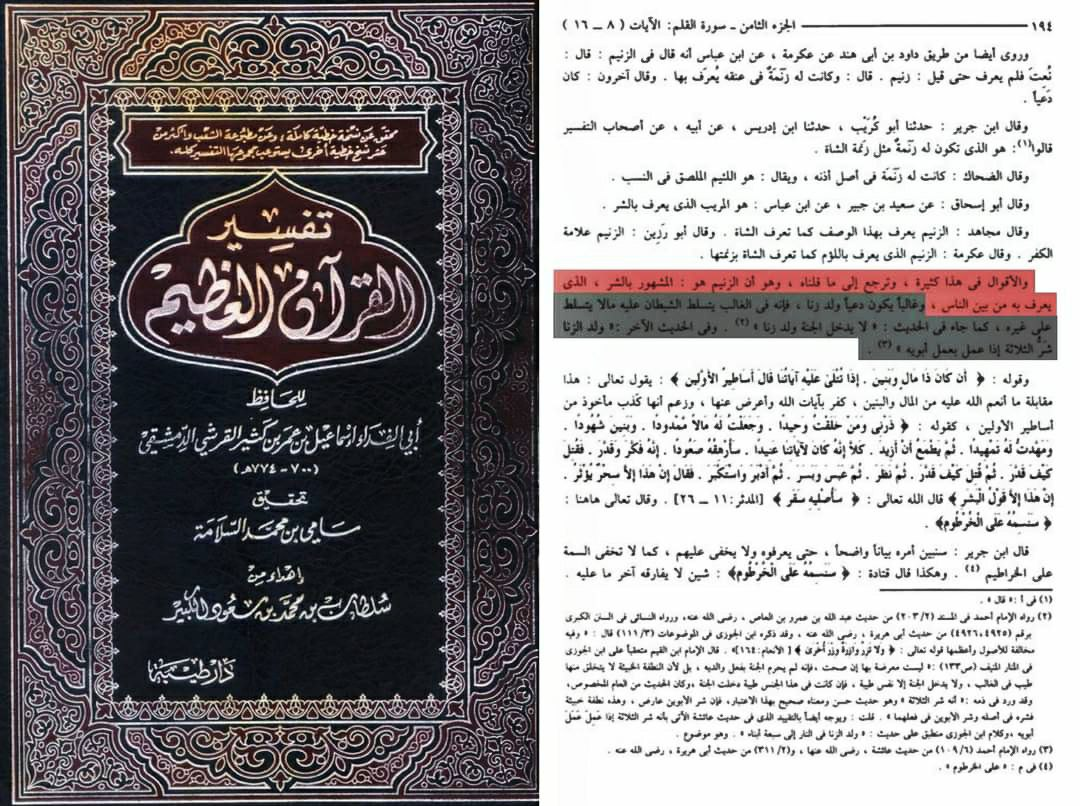
Ibn Kathir — Tafsir al-Qur’an al-Azim “…and the statements on this are many, and they go back to what we said, which is that the zaneem is: the one who is known for evil, by which he is known among the people.”
Ikrimah The zaneem is he who is known for his meanness, just as a sheep is known by its wattle.
Al-Suyuti — Al-Itqan fi Ulum al-Qur’an {Zaneem}: Oppressor.
For the sake of scientific honesty, some commentators did mention that the word zaneem means the son of adultery. This is undoubtedly a mistake and an error regarding the Book of God — but it was not their own statement; rather, it was a transmission from others. For example, we find that Al-Qurtubi, in his interpretation of the previous verse, transmits the following statement from Al-Hasan ibn Ahmad Al-Hamdani: “His father only claimed him after eighteen years” — referring to al-Walid ibn al-Mughirah. Because of this error by some commentators, some Muslim sheikhs on satellite channels also transmitted this meaning. Unfortunately, these sheikhs and others like them fit the description in the Prophet’s hadith ﷺ:
“God does not take away knowledge by snatching it from people, but He takes it away by taking away the scholars, until when no scholar remains, people will take ignorant leaders who will be asked questions and will give rulings without knowledge, thus going astray and leading others astray.”
These are the ignorant leaders whom the Prophet ﷺ warned against — they transmit narrations without verifying their authenticity.
Third: The Narrations That Mention Zaneem as “Son of Adultery” — and Why They Are Rejected
Section marker
To be honest, some commentators have mentioned that the meaning of zaneem is “the illegitimate child.” We mention it here, but we do not accept it — first because it contradicts what the Messenger ﷺ himself said in his explanation of zaneem, and second because we will clarify the origin of this doubt.
For example, Ibn Kathir said, after his words above: “And he is often an illegitimate child, for Satan often has more power over him than over others, as it came in the hadith: ‘The illegitimate child will not enter Paradise,’ and in the other hadith: ‘The illegitimate child is the worst of the three if he acts like his parents.’”
Source confirmation image
This interpretation is invalid because the two hadiths it relies on are weak. The hadith “The child of adultery will not enter Paradise, nor will any of his descendants, up to seven generations” — narrated by Abu Hurairah — was graded by al-Albani in Al-Silsilah Al-Da’ifah (no. 1287) as false. As for the hadith “The child of adultery is the worst of the three” — it refers to a specific individual who used to harm the Prophet ﷺ, as mentioned in the statement of Aisha (may God be pleased with her), or it refers to one who acts like his parents as narrated from Sufyan and others, or it refers to the worst of the three in terms of lineage since he has no lineage.
Other classical commentaries define zaneem as one who is falsely attached to a people:
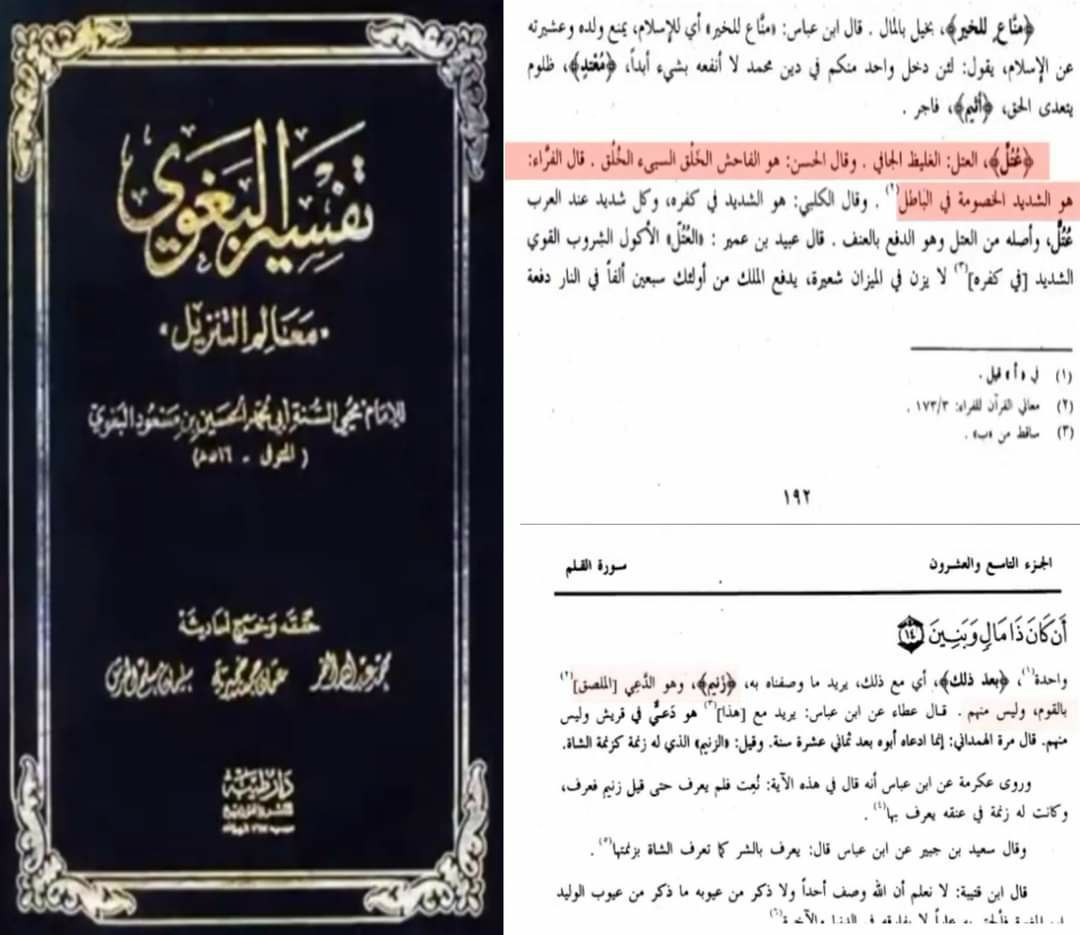
Al-Baghawi {Zaneem} is the one who is falsely attached to the people but is not one of them.
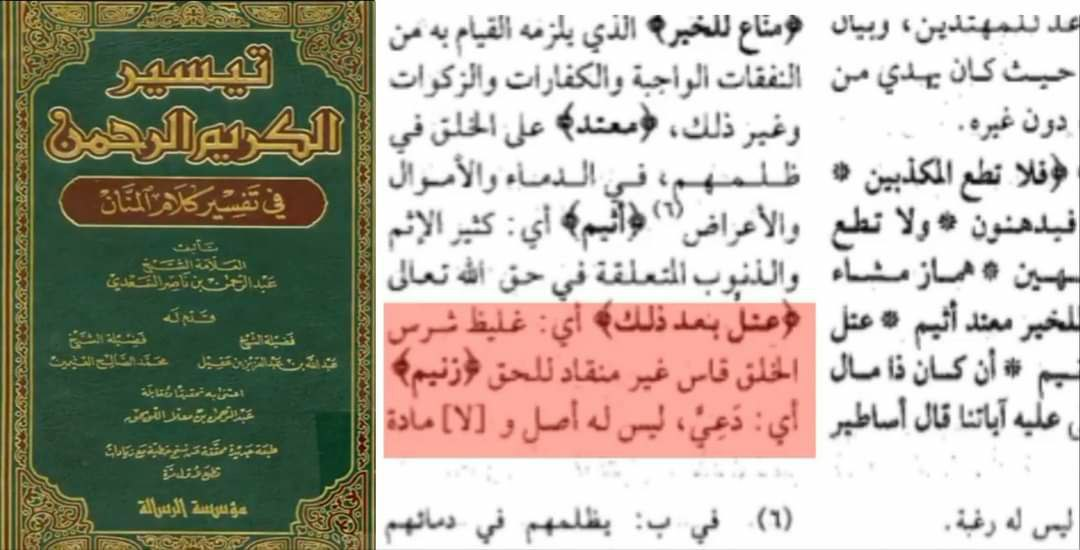
Taysir Kalam al-Rahman {Zaneem} means: falsely attached, he has no origin.
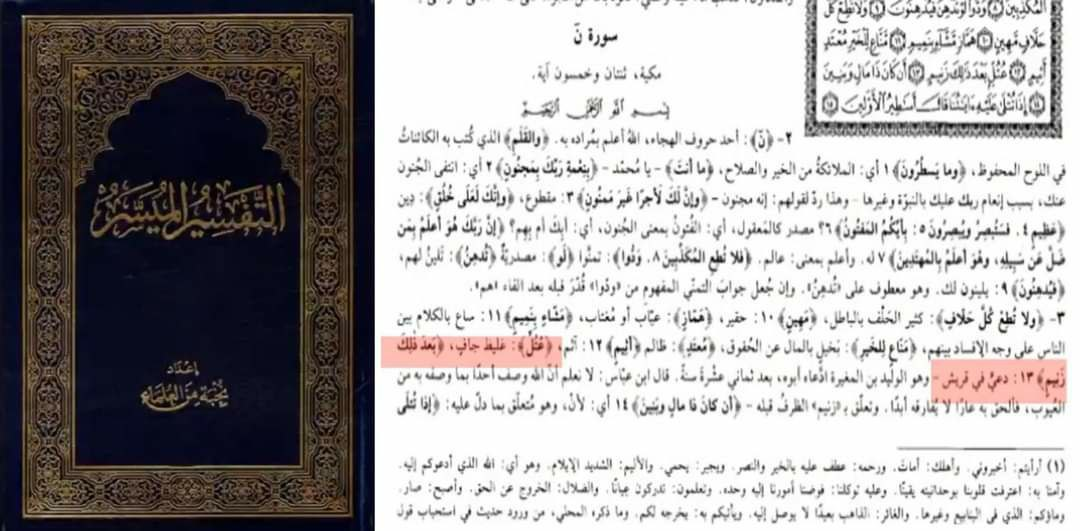
Al-Tafsir al-Muyassar {Zaneem}: falsely attached to the Quraysh.
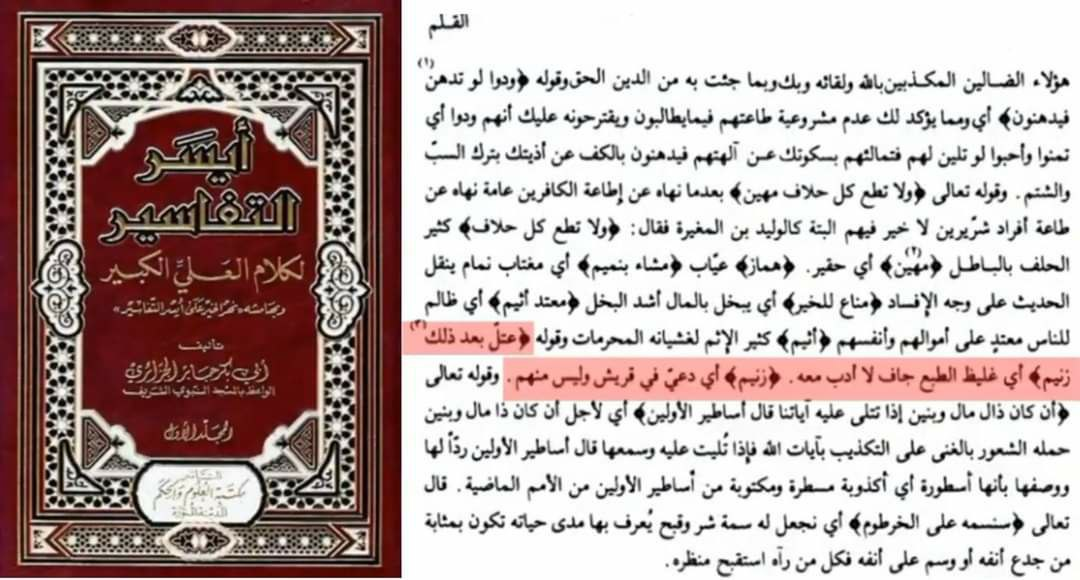
Aysar al-Tafasir {Zaneem} means: falsely attached to the Quraysh and is not one of them.
Fourth: The Linguistic Evidence — What the Dictionaries Say
The dictionary Taj al-Arus provides an explanation of the word zaneem with more than one meaning, but it never states that this word means “illegitimate child.”
Zaneem — Lexical Entries Lisan al-Arab: Al-Zaneem is one who has two wattles in his throat.
Al-Wasit Dictionary: Al-Zaneem: one with a wattle. Al-Zaneem: the illegitimate child, the one attached to a people. Al-Zaneem: the mean person known for his meanness or evil. (And in the Holy Quran: Al-Qalam, verse 13: “cruel, moreover, an illegitimate child.”)
Al-Ra’id Dictionary: (1) Zaneem: mean. (2) Zaneem: attached to a people who are not his and do not need him.
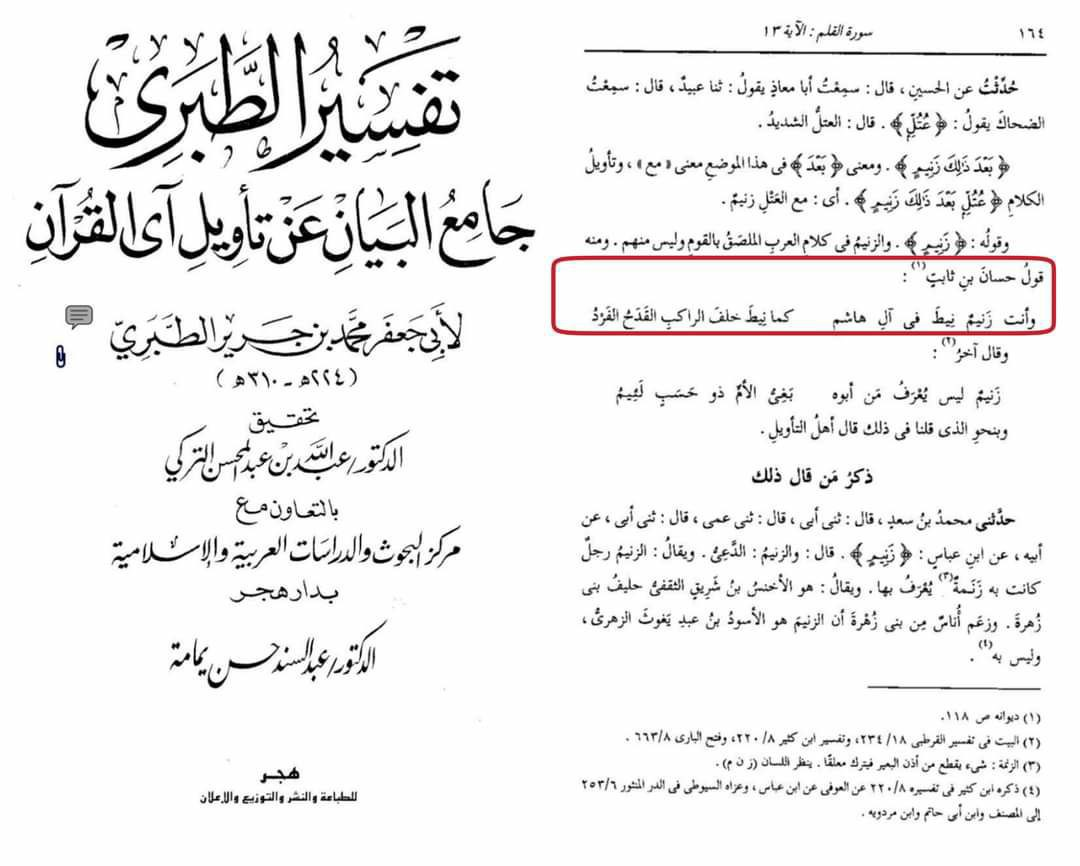
We also find in Al-Tabari’s interpretation of the verse a verse by Hassan ibn Thabit from a poem entitled “The People Know That Ibn Hashim”, in which he says the following about Abu Sufyan: “And you are a zaneem attached to the family of Hashim, just as a single cup is attached behind a rider.”
It is inconceivable that Hassan ibn Thabit would describe Abu Sufyan in this verse as an illegitimate child — given that Abu Sufyan was a Companion of the Prophet ﷺ, studied under him, learned from his character, and Hassan himself was known as “the Prophet’s poet.”
Source confirmation image
Fifth: Where Did the Fabricated Story Come From?
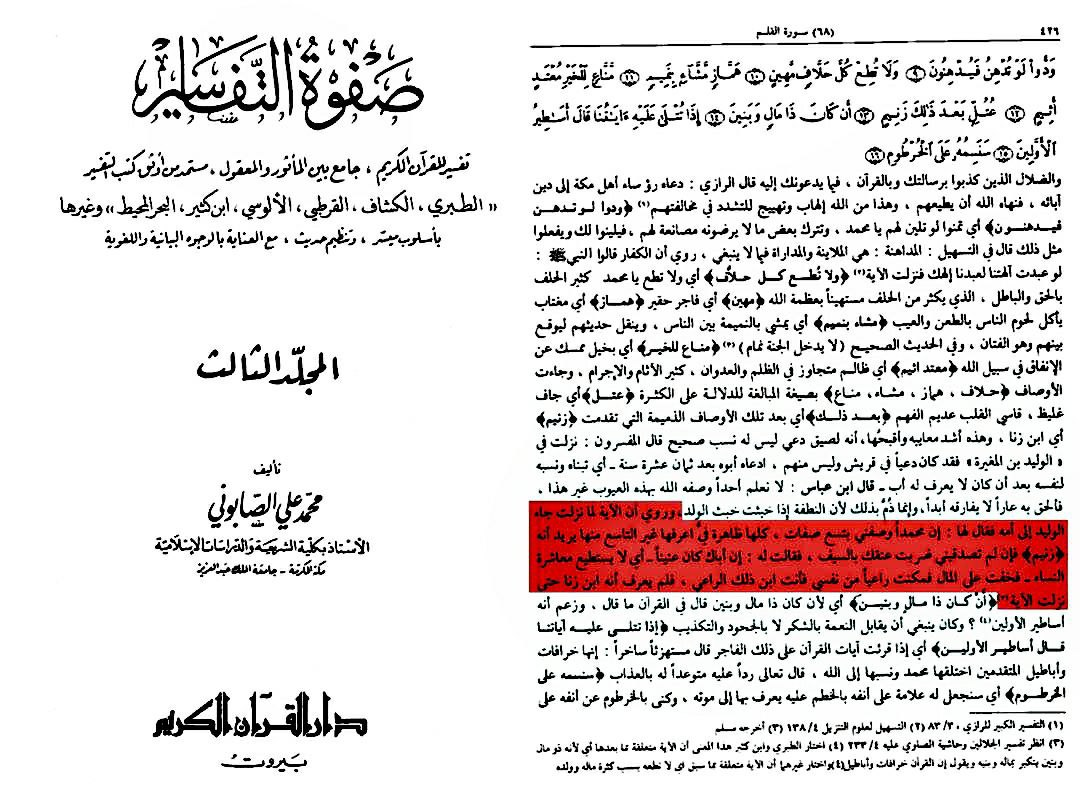
Some books of exegesis — such as Safwat al-Tafasir by Sheikh al-Sabuni, and Al-Kashshaf by al-Zamakhshari — narrate the story of al-Walid ibn al-Mughirah’s mother confessing to her son that he was illegitimate. The author of this story is unknown, and some commentators have included it in their books without any chain of transmission or attribution to the narrator. Note the phrase “It is narrated that when the verse was revealed…” — who narrated it? This narration has no identified source. The fabricated story goes as follows:
Safwat al-Tafasir — al-Sabuni (transmitted without chain) This verse was revealed concerning al-Walid ibn al-Mughirah. He was a preacher among the Quraysh, though not one of them. His father claimed him after eighteen years, meaning he adopted him and attributed him to himself, even though his father was unknown. Ibn Abbas said: “We do not know of anyone else whom God described with these defects except him.” Thus, he was branded with a shame that would never leave him. He was condemned for this because if the seed is corrupt, the child will be corrupt. It is narrated that when the verse was revealed, al-Walid came to his mother and said to her: “Muhammad described me with nine characteristics, all of which I recognise, except the ninth — meaning that he is illegitimate. If you do not believe me, I will behead you.” She replied: “Your father was impotent — meaning he could not have intercourse with women. I feared for my wealth, so I allowed a shepherd to have intercourse with me, and you are the son of that shepherd.” He did not know that he was illegitimate until then.
This story has no known author, no chain of transmission, and its content is internally incoherent. The truth is that al-Walid ibn al-Mughirah was neither an outsider among the Quraysh, nor an unknown figure — he was one of their leaders. Al-Walid ibn al-Mughirah was the brother of Hisham ibn al-Mughirah, the father of Abu Jahl. This means al-Mughirah had another son besides al-Walid, and this son was the leader of Banu Makhzum. If al-Walid were illegitimate, he would not have been their leader. Furthermore, how could his lineage have been unknown for seventeen or eighteen years among all of Quraysh? Al-Walid ibn al-Mughirah also had many brothers — which is clear evidence of the story’s fabrication.
The Arabs were known for their memorisation of and pride in their lineage. We find Imam al-Bukhari in his Sahih — under the chapter “The Beginning of Revelation” — narrating a hadith on the authority of Ibn Abbas and Abu Sufyan ibn Harb, about the story of Heraclius, the Roman emperor, when he inquired about the Prophet ﷺ, his attributes, and his character. The hadith, as narrated by Abu Sufyan, states: ”…Then the first thing he asked me was, ‘What is his lineage among you?’ I replied, ‘He is of noble lineage among us.’” History books also mention a man named Abu Jahm ibn Hudhayfah from the tribe of Quraysh, who was knowledgeable about genealogies and whom Quraysh consulted on such matters. Is it conceivable that no one knew the lineage of al-Walid ibn al-Mughirah — a leader among them — for eighteen years?
It therefore seems that the author of this story was a heretic who intended only one thing by fabricating it: to cast doubt on the lineage of the Companion Khalid ibn al-Walid — since al-Walid ibn al-Mughirah, concerning whom the verse was revealed, was his father.
Source confirmation image
Al-Bukhari says in his Sahih, in the Book of Tafsir, under the chapter “Harsh and then illegitimate,” Hadith No. 4917 — explaining the meaning of the word zaneem with a chain of narration from Ibn Abbas, who said: “A man from Quraysh who has a wattle like the wattle of a sheep.”
Taj al-Arus dictionary entry for the word zaneem
The dictionary Taj al-Arus also provides an explanation of the word zaneem in more than one way and with more than one meaning. It never states that this word means “son of adultery.”
Conclusion on Zaneem The term zaneem does not mean “illegitimate child.” It means: the man who is known for evil — that is, he has a sign of his evil and immorality by which he is known among the people, just as the sheep is known by the wattle (zanmah) — a piece of skin that hangs from the sheep’s ear or throat. This is what the Prophet ﷺ stated, what Sahih al-Bukhari records from Ibn Abbas, and what the earliest tafsir authorities — from Mujahid to Ibn Kathir — all affirm.
Conclusion marker
Hud 11 — “The Curse of God Be Upon the Wrongdoers”
Surah Hud contains the phrase “the curse of God be upon the wrongdoers” — is this hateful language? Critics claim that God cursing wrongdoers in the Quran constitutes inappropriate or hateful expression.
La’nah (Curse) A curse (la’nah) is expulsion from God’s mercy. The Quran clarifies for us the categories deserving of being cursed, as a warning and admonition, so that we may distance ourselves from those characteristics and avoid being expelled from His mercy.
Narrated by Ahmad and al-Tirmidhi, authenticated by al-Albani The Prophet ﷺ said: “A believer is not one who taunts, curses, is obscene, or is foul-mouthed.”
This hadith shows that the Quran’s statement of divine curse is of an entirely different nature from personal cursing, which is forbidden for believers. The Quran identifies consequences of wrongdoing — it does not model cursing as a human behaviour.
Furthermore, God also curses in the Bible:
Genesis 5 “And he called his name Noah, saying, ‘This one will comfort us concerning our labor and the toil of our hands because of the ground which the Lord has cursed.’”
Judges 9:57 “God repaid all the wickedness of the people of Shechem on their own heads; the curse of Jotham son of Jeroboal came upon them.”
Psalm 59:12 “The sin of their mouths is the speech of their lips. Let them be taken in their pride, and in the curse, and in the lie they speak.”
Galatians 3:10 “For all who are of the works of the law are under a curse, for it is written: ‘Cursed is everyone who does not continue to do everything written in the Book of the Law.’”
2 Kings 2:24 “Then he turned around and looked at them and cursed them in the name of the Lord. Then two bears came out of the woods and devoured forty-two of their children.”
Nehemiah 13:2 “Because they did not meet the Israelites with bread and water, but hired Balaam to curse them — but our God turned the curse into a blessing.”
Galatians 3:13 “Christ redeemed us from the curse of the law by becoming a curse for us, for it is written: ‘Cursed is everyone who is hung on a tree.’”
In the opinion of any reasonable person, it is better to worship the one who curses than to worship the one who is cursed — and yet it is Galatians 3:13 itself that states Christ became a curse.
Al-Baqarah 2:88 — “God Has Cursed Them for Their Disbelief”
Al-Baqarah 2:88 says God cursed a group for their disbelief — is this religious hatred? The verse states God has cursed those who said “our hearts are wrapped,” which critics present as divine hatred toward a people.
Al-Baqarah 2:88 And they said, “Our hearts are wrapped [in coverings].” Rather, God has cursed them for their disbelief, so little do they believe.
Firstly, a curse is expulsion from God’s mercy. In this verse God Almighty clarifies a category deserving of curse — as a warning and admonition — so that we may distance ourselves from those characteristics and avoid being expelled from His mercy.
Secondly, the Prophet ﷺ said: “A believer is not one who taunts, curses, is obscene, or is foul-mouthed” — narrated by Ahmad and al-Tirmidhi, and authenticated by al-Albani. This makes clear that divine cursing, as a statement of consequence, is not the same as the personal cursing forbidden to believers.
Thirdly, God also curses in the Bible — as the verses cited above in the previous section demonstrate. The same principle operates across both scriptures.
In any reasonable evaluation: it is better to worship the one who curses than to worship the one who is cursed.
Galatians 3:13 “Christ redeemed us from the curse of the law by becoming a curse for us, for it is written: ‘Cursed is everyone who is hung on a tree.’”