

Does the Qur’an Make a Mistake in Inheritance Shares? Refuting the ʿAwl Objection
Inheritance Shares Over 100%? The Qur’an, ʿAwl, and the False Claim of a Mathematical Error
Critics claim that the Qur’an contains a mathematical contradiction in its inheritance laws because some combinations of heirs appear to produce shares that exceed the available estate.
The common example is this: a man dies leaving behind three daughters, his parents, and his wife. The critic then adds the shares as follows: the daughters receive two-thirds, the parents together receive one-third, and the wife receives one-eighth. The total becomes more than the estate itself.
This is then presented as a “mathematical error” in the Qur’an.
The objection is weak because it treats inheritance law as if it were a childish fraction worksheet, not a legal system involving entitlement, debts, bequests, blocking, residual heirs, and proportional adjustment when multiple valid rights compete over a limited estate.
The Core Objection
The Qur’an allegedly assigns fixed inheritance shares that can add up to more than 100% of the estate. Therefore, according to the critic, the Qur’an contains a numerical contradiction.
The critic’s mistake is assuming that every inheritance case must close like a fixed accounting table before any legal mechanism is applied. That is not how inheritance law works.
The Qur’an establishes legal shares and categories of entitlement. Islamic law then applies those shares to actual cases, including cases where the estate is insufficient to satisfy every valid share in full.
The Qur’anic Shares Being Discussed
Allah instructs you concerning your children: for the male is the share of two females. If they are women, more than two, then they receive two-thirds of what he left; and if she is one, then she receives half. And for his parents, for each one of them is one-sixth of what he left if he had a child.
But if you have a child, then they receive one-eighth of what you leave, after any bequest you made or debt.
The verses establish the shares. They also explicitly state that inheritance is distributed after debt and bequest. That alone proves the critic’s “fixed spreadsheet” reading is too shallow. The estate is not distributed in isolation from legal conditions.
What Is ʿAwl?
ʿAwl is the proportional reduction of inheritance shares when the valid fixed shares of the heirs exceed the available estate. Instead of cancelling one heir’s right arbitrarily, the estate is distributed proportionally among all entitled heirs.
ʿAwl is not a correction of the Qur’an. It is the legal implementation of Qur’anic shares when multiple valid claims overlap and the estate cannot satisfy all of them in full.
If a man dies owing several creditors and his estate cannot cover all debts, no serious judge says, “This is a mathematical contradiction.” The judge distributes the available estate proportionally among the creditors. The shortage does not disprove the law; it merely requires a rule of distribution.
The same applies to inheritance.
The Worked Mathematical Example
Take the common example:
- Three daughters
- Father
- Mother
- Wife
The apparent shares are:
| Heir | Share before ʿawl | Base denominator 24 | After ʿawl |
|---|---|---|---|
| Three daughters | 2/3 | 16/24 | 16/27 collectively |
| Father | 1/6 | 4/24 | 4/27 |
| Mother | 1/6 | 4/24 | 4/27 |
| Wife | 1/8 | 3/24 | 3/27 |
| Total | — | 27/24 | 27/27 |
The original total is 27/24, which is greater than the estate. Through ʿawl, the denominator is increased from 24 to 27, and each heir receives a proportionally reduced share.
The shares do not disappear. They are proportionally reduced. The daughters keep the largest portion, the parents keep their fixed entitlements in proportion, and the wife keeps her entitlement in proportion. The estate is fully distributed without arbitrarily deleting any heir.
This is not a mathematical error. It is proportional legal distribution.
Why This Is Not a Contradiction
The critic assumes that the Qur’an must list every possible inheritance scenario with a final arithmetic table for each case. That is a false assumption.
Legal texts do not work like that. They establish principles, categories, entitlements, and constraints. Jurists then apply those principles to real cases.
The Qur’an gives legal entitlements. ʿAwl explains how those entitlements are applied when the estate is insufficient to satisfy every share in full.
If rejecting ʿawl, the critic must answer a harder question: which heir should lose his or her share, and by what proof?
That is where the anti-ʿawl position breaks down. If every heir has a valid share, then arbitrarily protecting some heirs while pushing the shortage onto others is less just, not more just.
The Debt Analogy
The cleanest analogy is debt.
Suppose a man dies leaving AED 100,000, but he owes AED 150,000 to several creditors. The court does not say the law of debt has collapsed. It distributes the available AED 100,000 proportionally.
Likewise, if an estate cannot satisfy all inheritance shares in full, the solution is proportional reduction.
ʿAwl preserves every valid claim by reducing all affected shares proportionally. Rejecting ʿawl forces the shortage onto selected heirs without a consistent proof.
This is why the accusation of “mathematical error” is amateurish. It confuses competing legal claims with arithmetic contradiction.
The Shia Claim That ʿUmar Invented ʿAwl
Some Twelver Shia polemicists claim that ʿUmar ibn al-Khaṭṭāb رضي الله عنه invented ʿawl in inheritance and introduced something into the religion.
This claim is weak. The issue arose because real inheritance cases occurred where the fixed shares exceeded the estate. ʿUmar رضي الله عنه did not invent a new religion. He judged a real legal case that required a ruling.
This Arabic scan introduces the issue as “Claim 51”: the Shia allegation that ʿUmar ibn al-Khaṭṭāb رضي الله عنه invented ʿawl in inheritance. It functions as the title page for the refutation and frames the discussion around whether ʿawl was a baseless innovation or a valid legal solution for cases where inheritance shares exceed the available estate.
The next scan presents the actual polemical claim being answered.
This page cites a Shia author, Muḥammad Ṭāhir al-Qummī al-Shīrāzī, fromKitāb al-Arbaʿīn, claiming that ʿUmar altered rulings and that one example was ʿawl in inheritance. It also cites the statement attributed to Ibn ʿAbbās about those whom Allah placed first and those whom Allah delayed. The page uses this material to present the accusation that ʿUmar was the first to introduce ʿawl.
The First Answer: Reduction of Shares Is Already Known in Inheritance Law
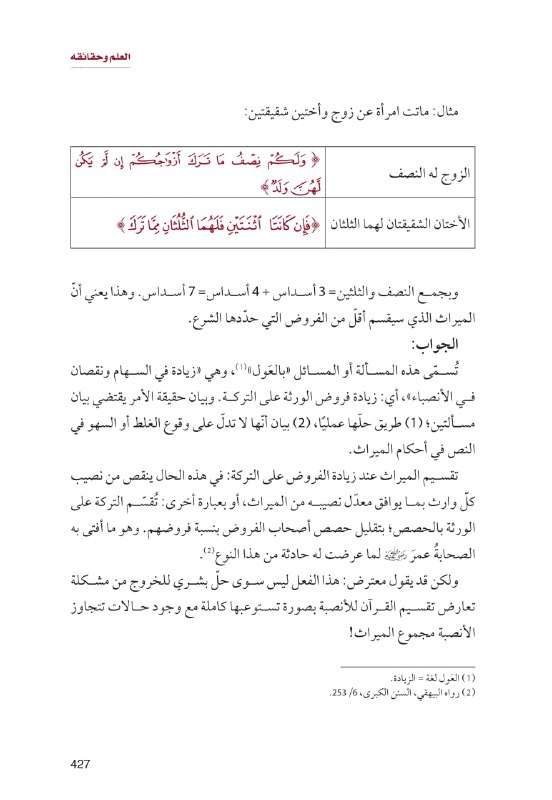
The Arabic refutation explains that ʿawl means the shares exceed the estate, causing a shortage. This does not mean the Qur’an is wrong. It means multiple valid shares have gathered over an insufficient estate.
This page begins the detailed answer. It defines ʿawl as the situation where the fixed shares of the heirs exceed the estate, causing a shortage. It gives examples involving heirs such as a wife, sisters, and a mother, and then explains that such a case appeared during the time of ʿUmar رضي الله عنه. The important point is that ʿawl is not treated as textual corruption, but as a legal response to a real inheritance case where multiple valid shares overlap.
Reduction in inheritance is not foreign to Islamic law. Shares can decrease because of the presence of children, parents, siblings, or stronger heirs. A husband may move from one-half to one-fourth. A wife may move from one-fourth to one-eighth. A mother may move from one-third to one-sixth. This already proves that “fixed share” does not mean “never affected by legal context.”
The Companion-Era Reasoning
When ʿUmar رضي الله عنه faced the case, he consulted and judged according to legal reasoning. The reasoning was simple: if all heirs have valid claims, the shortage should be shared.
This scan continues the report of ʿUmar رضي الله عنه consulting the Companions when faced with an inheritance case where the shares exceeded the estate. It includes the analogy attributed to al-ʿAbbās رضي الله عنه: if someone dies leaving six dirhams but owes more than six, the debts are not paid in full to one side while the rest are abandoned. Instead, the shortage is shared. This supports ʿawl as proportional legal distribution, not arbitrary invention.
That analogy destroys the objection. If proportional reduction is just in debt settlement, it is not absurd in inheritance when multiple valid shares compete over a limited estate.
The Companions Did Not Stay Silent Over an Innovation
One Shia argument says: if ʿawl was new, why did the Companions remain silent?
The answer is that they did not view it as a baseless innovation. They saw it as a valid legal solution to an actual inheritance problem.
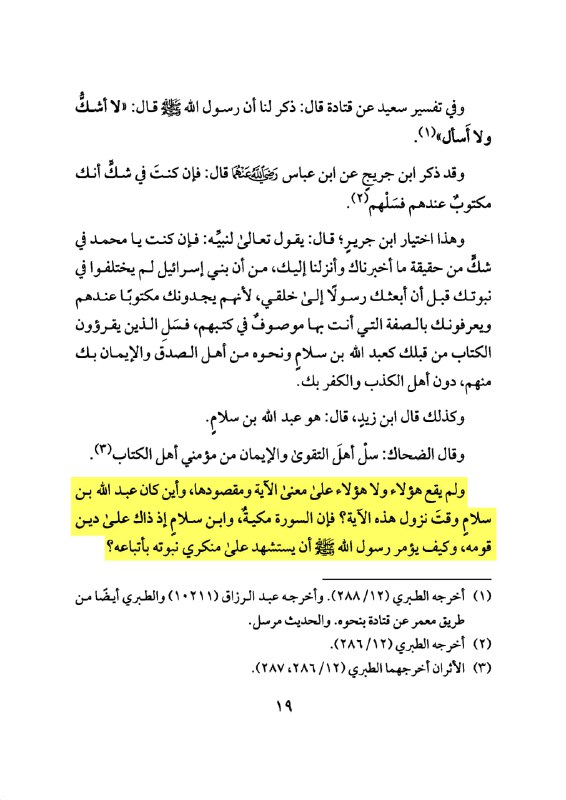
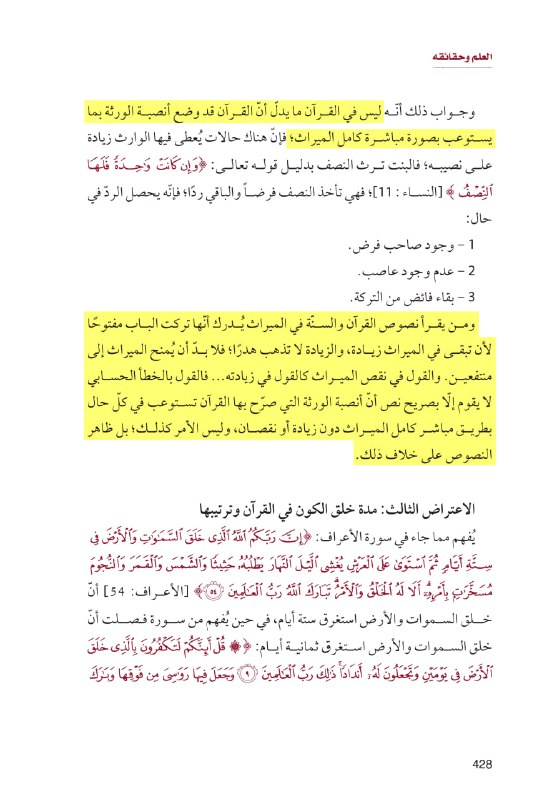
This scan responds to the claim that the Companions stayed silent about an innovation. It argues that they did not object because there was no baseless innovation to object to. The page also explains that reduction of shares is already present in inheritance law, such as the husband moving from one-half to one-fourth, the wife from one-fourth to one-eighth, and the mother from one-third to one-sixth. The page’s point is that reduction due to legal context is already part of the inheritance system.
The mistake is treating every reduction as an attack on the Qur’an. In reality, reduction happens because the Qur’an itself assigns shares within a legal structure.
Types of Reduction in Inheritance
The Arabic refutation then explains that reduction may happen through several mechanisms: blocking, crowding, agnatic entitlement, and ʿawl.
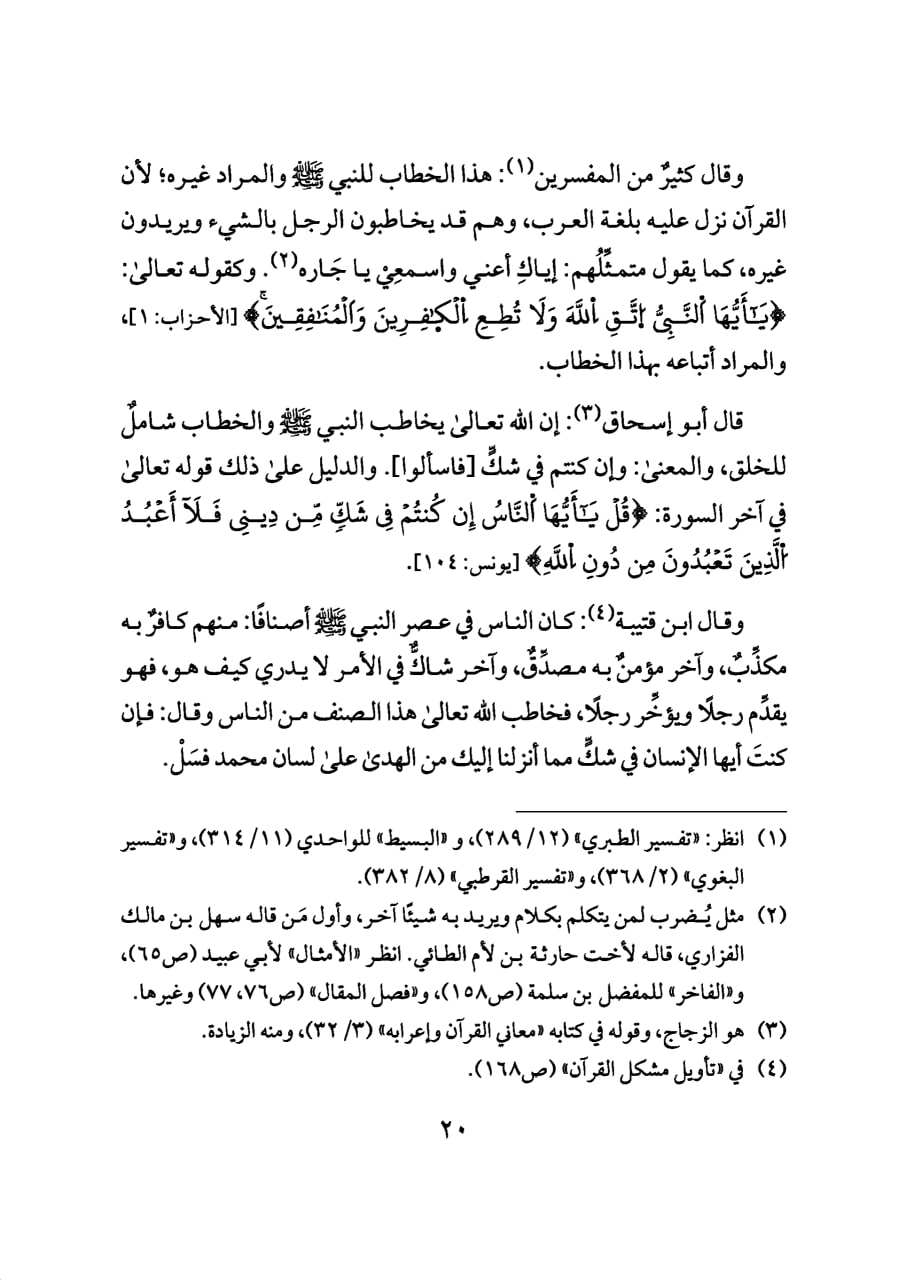
This page expands the argument that reduction can occur due to crowding and legal context. It explains that shares may be reduced when multiple heirs share one portion, when agnatic heirs compete, or when fixed-share heirs are present in a case of ʿawl. The highlighted section states that when fixed shares exceed the estate, each heir’s portion is reduced by the required amount. This directly supports the principle that ʿawl is a normal legal consequence of overlapping claims.
So the objection “ʿawl reduces shares” proves nothing. Islamic inheritance already includes cases where shares are increased, decreased, blocked, or returned depending on the heirs present.
The Hadith About Fixed Shares and the Remainder
“Give the fixed shares to those entitled to them, and whatever remains is for the closest male relative.”
Grade: Ṣaḥīḥ.
This hadith shows that fixed-share heirs are recognized first. It does not mean every apparent fraction in every possible case must independently close without legal mechanisms.
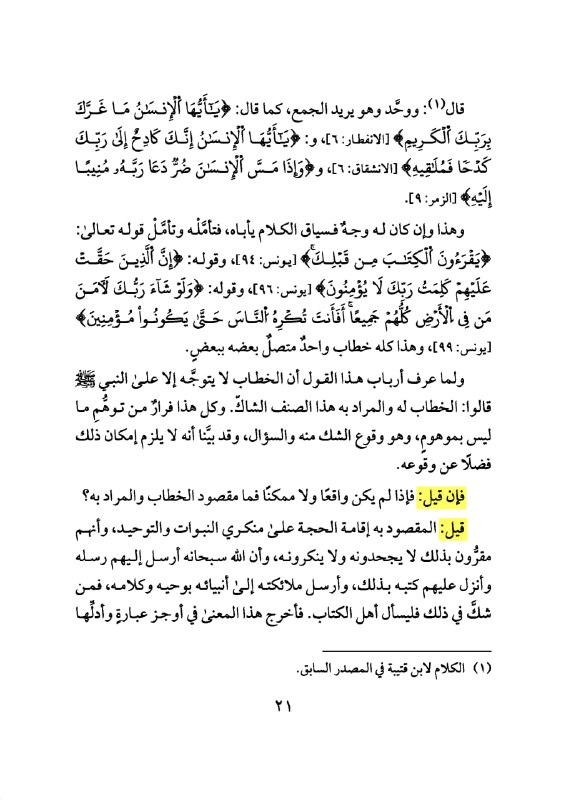
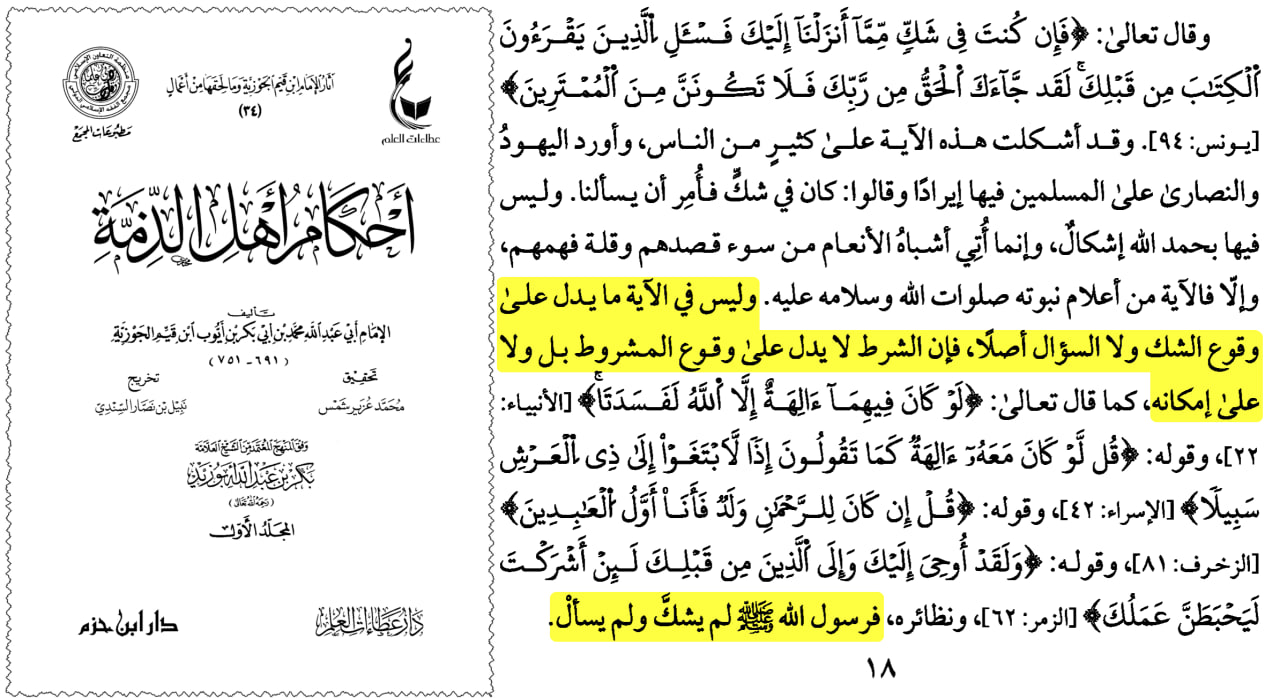
This scan uses the hadith principle of giving the fixed shares to their rightful people and then giving what remains to the closest male relative. The page argues that the fixed-share heirs are recognized first, but when the estate cannot satisfy every share fully, the legal answer is not to erase some heirs. ʿAwl preserves all valid claims by distributing the shortage proportionally.
The hadith also refutes the critic who asks, “Who gets the rest?” The remainder is not an unsolved contradiction. Islamic law has rules for residual inheritance.
The Debt Analogy Repeated
The Arabic refutation repeatedly uses the same strong legal analogy: when debts exceed the available estate, the estate is divided proportionally among creditors.
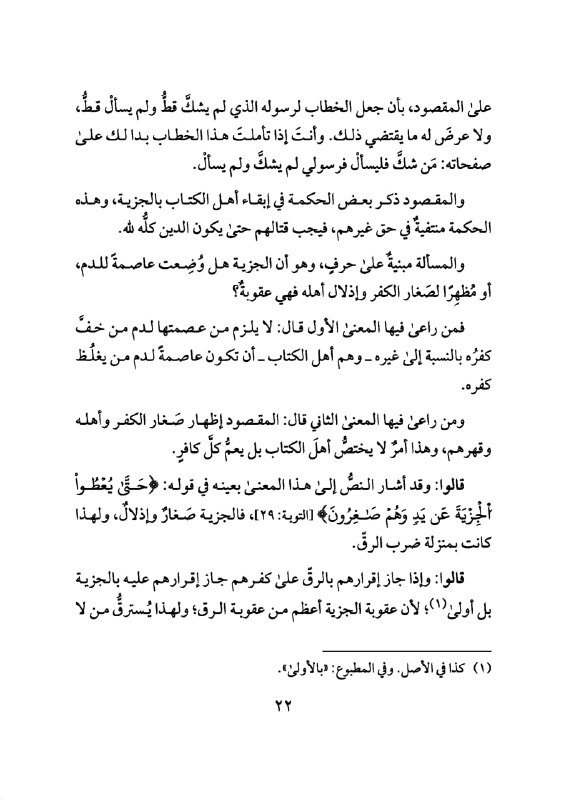
This page continues the legal reasoning for ʿawl and emphasizes the debt analogy. If a dead person owes several creditors and the estate is insufficient, the money is divided among them proportionally. The page argues that inheritance works similarly when multiple valid heirs have fixed rights. The estate’s insufficiency does not invalidate the rights; it only requires proportional distribution.
This is the strongest answer to the entire objection. If the critic understands debt settlement, he already understands ʿawl.
Ibn ʿAbbās and the Difference of Opinion
The Shia polemic often appeals to the reported disagreement of Ibn ʿAbbās رضي الله عنهما.
But this does not prove a contradiction in the Qur’an. At most, it proves a juristic disagreement over how to handle shortage in specific inheritance cases.
The disagreement is not over whether the Qur’an contains an arithmetic mistake. The disagreement is over how to implement valid shares when they exceed the estate: should the shortage be shared proportionally, or should some heirs be prioritized over others?
That is a legal disagreement about application. It is not proof that the Qur’an is mathematically wrong.
Rejecting ʿAwl Creates a Worse Problem
If someone rejects ʿawl, he still has to solve the shortage. The shares still exceed the estate in certain cases.
There are only two options:
- Reduce everyone proportionally.
- Give some heirs their full shares and force others to absorb the shortage.
The second option is arbitrary unless there is clear evidence specifying which heirs must lose and why.
Rejecting ʿawl does not remove the shortage. It merely pushes the shortage onto selected heirs. That is less coherent than proportional reduction because it protects some claims while weakening others without a consistent principle.
This is why ʿawl is not an embarrassment. It is the more legally coherent solution.
The Shia Counter-Problem
The Shia objection is not principled because Twelver Shia inheritance law itself qualifies the apparent wording of inheritance texts.
The Arabic PDF points out several examples.
First, some Shia rulings give certain exclusive estate items to the eldest son, such as weapons, garments, books, the ring, or similar items. If the Qur’an speaks generally about inheritance, then reserving special property for the eldest son is also a legal qualification of the apparent text.
Second, Shia law is known for restricting the wife’s inheritance from land itself, while giving her value from certain property-related materials in some cases. If the Qur’an gives the wife a share of what the husband leaves, then excluding land from that share is also a qualification of the apparent text.
Third, Shia inheritance law still uses mechanisms such as return, exclusion, prioritization, and legal interpretation. So the Shia polemic cannot honestly accuse Sunnis of “changing the Qur’an” merely because Sunnis apply ʿawl.
The Shia polemic attacks Sunnis for applying ʿawl, yet Shia inheritance law itself restricts and qualifies apparent inheritance texts. Therefore, the objection is selective, not principled.
If legal qualification is allowed in their system, they cannot pretend that every Sunni legal qualification is automatically an innovation.
Translation-Based Confusion
Some older responses to this objection leaned heavily on the claim that walad means “one child” rather than “children.” That is not the strongest way to answer the objection.
The safer answer is this: inheritance terms must be read through Arabic, Qur’anic usage, Sunnah, and the applied legal system of farāʾiḍ. A critic who relies on one English translation and then claims the Qur’an has a mathematical error is not doing serious analysis.
The answer does not need to depend on forcingwalad into a narrow English singular reading. The stronger answer is ʿawl: the shares are valid legal entitlements, and when they exceed the estate, the estate is distributed proportionally.
This matters because weak arguments make the refutation vulnerable. The core refutation should be built on law, not on an overstrained translation point.
The Case of Kalālah
Another objection claims that a man dies leaving a mother, a wife, and two sisters. The critic adds the shares as follows: the mother receives one-third, the wife receives one-fourth, and the two sisters receive two-thirds. The total exceeds the estate.
The problem is that the verse used for the sisters concerns kalālah.
Kalālah refers to a person who dies leaving no direct ascendants or descendants in the relevant inheritance context. In other words, the case being discussed excludes parents and children.
They ask you for a ruling. Say: Allah gives you a ruling concerning kalālah. If a man dies leaving no child but has a sister, she receives half of what he left.
The critic manufactures a contradiction by combining shares from different legal scenarios. He counts the mother while using a verse whose legal scenario excludes the relevant parental inheritance case.
The objection mixes separate inheritance cases. A kalālah scenario is not the same as a case where the mother is alive as an inheriting parent. The contradiction exists only in the critic’s reconstruction.
Do Siblings Inherit Only When There Are No Direct Heirs?
The critic also argues that siblings can inherit only if there are no direct heirs, then tries to create a contradiction with other verses.
This fails because the critic inserts restrictions into the text and then blames the Qur’an for the result.
If the critic’s contradiction depends on adding the word “only” in a way the verse does not require, the contradiction is not in the Qur’an. It is in the critic’s inserted assumption.
This is a repeated pattern: he builds a rigid rule from one passage, applies it outside its legal context, then accuses the Qur’an of inconsistency.
Did the Sibling Share Suddenly Double?
The critic claims that 4:12 and 4:176 contradict each other. He says that 4:12 gives a brother or sister one-sixth each, while 4:176 gives two-thirds.
The answer is simple: the cases are not the same.
If they are two females, then they receive two-thirds of what he left.
The relevant phrase in 4:176 is about two sisters. The critic acts as if it refers to one brother and one sister. That is not careful reading.
Two sisters are not the same case as one brother and one sister. The critic tears a phrase away from its condition, ignores the wording, and then pretends the Qur’an contradicted itself.
Classical commentators also distinguish between maternal siblings in 4:12 and full or paternal siblings in 4:176. But even before appealing to that tafsīr distinction, the critic’s argument already fails because he has confused two different cases.
The Rāzī Explanation
Some commentators, including al-Rāzī, explain that 4:12 and 4:176 discuss different classes of siblings. According to this explanation, 4:12 concerns maternal siblings, while 4:176 concerns full siblings or paternal siblings.
If this explanation is accepted, there is no problem.
But even if the critic rejects that commentary, his objection still fails because the literal wording of the verses does not support his claim. The two passages are not describing the same sibling configuration.
The tafsīr distinction between maternal siblings and full or paternal siblings explains why the shares differ. The critic dismisses this as an invented solution, but his own reading already fails even before that explanation is needed.
The critic wants to ignore the commentators when they explain the text, then appeal to commentators when he thinks they help his objection. That is not consistent methodology.
One Year’s Maintenance and the Widow’s Share
Another objection claims that 2:240 contradicts 4:12. The critic says a widow cannot receive both one year’s maintenance and one-eighth or one-fourth of inheritance because these are different amounts.
This confuses inheritance with bequest.
Those among you who die and leave wives should make a bequest for their wives: provision for one year without expulsion.
Waṣiyyah means a bequest. It is not the same legal category as a fixed inheritance share.
The widow’s one-year maintenance concerns provision or bequest. The widow’s inheritance share concerns distribution after debts and bequests are handled.
A bequest and an inheritance share are not the same thing. The critic creates a contradiction only by collapsing two different legal categories into one.
The critic’s appeal to Yusuf Ali’s footnote also fails. Yusuf Ali discussed whether the provision was abrogated by the widow’s inheritance share. He did not say that the verses are mathematically contradictory.
Abrogation Is Not Contradiction
The critic repeatedly assumes that if Muslim scholars discuss abrogation, this means they admitted contradiction.
That is false.
In Islamic legal usage, abrogation can refer to replacement, specification, restriction, or clarification of a previous ruling. It does not automatically mean contradiction.
If a general ruling is later specified by a more detailed ruling, that does not mean the two rulings contradict each other. It means one explains or limits the application of the other.
This matters because the critic uses the word “abrogation” as if it automatically means “error.” That is ignorant.
Does 4:7 Contradict 4:11?
The critic claims that 4:7 gives men and women equal shares, while 4:11 gives the male twice the share of the female.
This is another forced reading.
For men there is a share of what parents and near relatives leave, and for women there is a share of what parents and near relatives leave.
This verse says men have a share and women have a share. It does not say the shares are equal.
One verse establishes that both men and women inherit. Another verse specifies the ratio in a particular case. There is no contradiction between saying “both receive a share” and saying “one share is twice the other.”
The critic mistakes parallel wording for equal quantity. That is bad reading.
”Daughters Only” Means No Sons
Another objection claims that if one daughter receives half and a son receives twice a daughter’s share, then one son and one daughter would receive 150% of the estate.
This is absurd.
The verse first gives the general rule: when sons and daughters inherit together, the male receives the share of two females. Then it discusses cases where only daughters remain.
The daughter receiving half applies when there is one daughter and no son. It does not apply to a case where a son is also present. When a son is present, the rule is that the male receives the share of two females.
The critic confuses two separate cases and then blames the Qur’an for his confusion.
”Who Gets the Rest?”
The critic complains that in some inheritance cases, the listed shares do not exhaust the entire estate. He asks: “Who gets the rest?”
This is not a contradiction. It is a request for legal detail.
Islamic law has rules for residual heirs. The hadith of Ibn ʿAbbās already explains that after fixed shares are given, the remainder goes to the closest male relative in the relevant legal structure.
The remainder is not an unsolved Qur’anic contradiction. It is handled by the rules of residual inheritance in Islamic law.
A critic who asks “who gets the rest?” has not found an error. He has merely discovered that inheritance law contains more than one verse.
Islamic Law Is Not Based on the Qur’an Alone
The Qur’an was revealed with the Prophet ﷺ as its teacher and explainer. Islamic law includes the Qur’an, Sunnah, consensus, juristic principles, and applied legal reasoning.
Demanding that the Qur’an list every possible inheritance case is childish. No legal system works by listing every conceivable scenario in one book.
A complete guidance does not mean every technical case is listed in one verse. It means the religion contains the principles and mechanisms needed to judge actual cases.
The critic himself admits that Muslim jurists have found accepted ways to distribute inheritance. That admission destroys the idea that the system is incoherent.
Bequests and the Claim of Injustice
The critic complains that Islamic law allows a person to bequeath up to one-third of his property and claims this can lead to injustice.
This objection is weak because Islamic law does not treat bequests as a tool to destroy the rights of heirs. Bequests are regulated, debts are considered, heirs have rights, and the wider Qur’anic ethic commands good treatment of parents and relatives.
The critic also ignores that his own Biblical framework does not provide a stronger inheritance ethic.
The Bible Double Standard
The critic complains that the Qur’an gives a woman half the share of her brother in a particular case. But the Biblical inheritance framework cited in the raw material is far harsher against women.
The Biblical inheritance law gives priority to sons. If a man has no son, inheritance passes to his daughter. If he has no daughter, it passes to his brothers, then paternal uncles, then the nearest clan relative.
The daughters of Zelophehad are allowed to marry, but within the clan of their father’s tribe, so that the inheritance remains within the tribe.
So the critic complains that the Qur’an gives a woman half the share of her brother, while the Biblical framework can exclude daughters when sons exist and can restrict daughters’ marriages to preserve tribal inheritance.
A Bible-based critic has no serious ground to attack the Qur’an for giving women inheritance when his own cited Biblical framework gives priority to male heirs and can leave women with less.
The Qur’an gives a woman inheritance as a daughter, mother, sister, and wife. The Biblical framework cited by the critic does not offer the same comprehensive structure.
The Jesus Inheritance Report
The critic also needs to explain the Gospel report in which Jesus عليه السلام refuses to judge an inheritance dispute.
A man asks Jesus to tell his brother to divide the inheritance with him. Jesus replies by asking who appointed him as judge or arbitrator over them.
Muslims believe Jesus عليه السلام stood for justice. But a Christian critic who attacks the Qur’an over inheritance law should first explain why the Gospel report presents Jesus refusing to settle an inheritance dispute.
The point is not to attack Jesus عليه السلام. The point is to expose the critic’s double standard.
The Hadith About the Nearest Male Relative
The critic objects to the hadith that says fixed shares are given first and then the remainder goes to the closest male relative. He imagines a remote male relative receiving what he thinks should go to a daughter.
This is a caricature of Islamic inheritance law.
The hadith does not erase fixed shares. It comes after fixed shares are distributed. The critic stretches a legal principle into an absurd scenario and then blames Islam for his own misunderstanding.
The hadith does not cancel the daughter’s fixed share. It explains what happens to the remaining estate after fixed shares are distributed according to the legal structure of inheritance.
Again, the Biblical comparison does not help the critic. In Numbers 27, if a man has no children, inheritance can pass to brothers or paternal relatives, while the wife and mother are not listed in the same Qur’anic way as fixed inheritors.
The Critic’s Method Is Hostile, Not Serious
The critic wants to treat the Prophet ﷺ as a successful businessman when making one point, then interpret the Qur’an as if its author could not understand basic fractions when making another point.
That is not consistent.
If a critic assumes that the Prophet ﷺ authored the Qur’an, and also admits that he was a successful businessman, then pretending he could not understand simple division is dishonest. Even a hostile critic must assume a minimum level of competence in the text he is reading.
The critic does not read the inheritance verses as a legal system. He isolates fragments, ignores conditions, relies on translation, inserts assumptions, and then calls his own confusion a contradiction.
This is not scholarship. It is polemical arithmetic.
Why Translation Reliance Is Dangerous
The critic relies heavily on translation, especially where the translation helps him create a problem. But serious analysis of Qur’anic inheritance requires Arabic, legal context, and comparison between translations.
In Biblical studies, critics demand attention to Hebrew, Aramaic, and Greek. The same standard applies to the Qur’an. A person who cannot read Arabic and relies on one English rendering should not rush to accuse the Qur’an of mathematical incompetence.
If original languages matter in Biblical studies, they matter in Qur’anic studies too. Translation-based polemics are weak unless checked against the Arabic and the legal tradition.
The critic’s selective use of translations shows that his diligence was directed toward finding errors, not toward finding truth.
The Pattern Behind All the Objections
The inheritance objections repeatedly follow the same pattern:
The critic mixes different cases, ignores legal conditions, treats bequest as inheritance, treats abrogation as contradiction, treats translation as the original, ignores residual inheritance, and assumes every case must close as a simple fraction table.
None of that proves an error in the Qur’an.
It proves the critic does not understand farāʾiḍ.
Farāʾiḍ is the Islamic science of inheritance shares. It is a specialized legal discipline dealing with fixed heirs, residual heirs, blocking, return, debts, bequests, and distribution rules.
A critic who does not understand farāʾiḍ should not pretend he has found a basic mathematical error in the Qur’an.
Practical Verification Tool
For readers who want to test inheritance scenarios practically, use an inheritance calculator and compare the results with the rules of farāʾiḍ.
This is not the foundation of the argument. The foundation is the Qur’an, Sunnah, and Islamic legal reasoning. The calculator is only a practical aid for seeing how cases are distributed.
Final Refutation
There is no mathematical contradiction in the Qur’an’s inheritance laws.
The alleged contradiction appears only when the critic treats legal shares as isolated fractions and ignores the legal system that applies them. When shares exceed the estate, ʿawl proportionally reduces the shares. When shares do not exhaust the estate, residual inheritance rules distribute the remainder. When bequests and debts exist, they are handled before inheritance. When different sibling cases appear, they must not be mixed. When abrogation or specification is discussed, it must not be misrepresented as contradiction.
The Qur’an did not fail arithmetic. The critic failed legal reading.
ʿAwl is not a correction of the Qur’an. It is the proportional implementation of valid inheritance rights when the estate is insufficient. The objection collapses because it confuses legal entitlement with a simplistic spreadsheet calculation.