In the Name of Allah, the Most Merciful, the Most Compassionate
Praise be to Allaah, Lord of the Worlds, and prayers and peace be upon the most honourable of Messengers, upon his family and companions, and upon those who follow them in righteousness until the Day of Judgment. As for what follows:
My brothers, the slanderers continue to spread falsehoods about the great personality of the Messenger. They do not hesitate to lie and deceive, especially the Christians, the worshippers of the cross. However, it is impossible for anyone to diminish the status of the greatest Messenger.
They have spread falsehoods in the issue of the captivity of our mother Safiyyah and the Battle of Khaybar, which reveal their ignorance and hatred of Islam. In order to expose this falsehood and reveal their malice, here are some lines in which we will, with Allaah’s permission, return their plots back to their throats and silence their mouths in this issue, relying on sound evidence and proven narrations, not on weak narrations.
The Doubt as They Mentioned It
First, we begin by clarifying the doubt, which is as follows, as they mentioned it:
Ibn Ishaq said: When the Messenger of Allah - may Allah bless him and grant him peace - conquered Al-Qamus, the fortress of Banu Abi Al-Haqiq, Safiyyah bint Huyayy ibn Akhtab was brought to the Messenger of Allah - may Allah bless him and grant him peace - and another with her. Bilal passed by them, and he was the one who brought them to the dead Jews. When the one with Safiyyah saw them, she cried out, slapped her face, and threw dirt on her head. When the Messenger of Allah - may Allah bless him and grant him peace - saw her, he said, “Get this devil away from me.” He ordered Safiyyah to be placed behind him. He threw his cloak over her, and the Muslims knew that the Messenger of Allah - may Allah bless him and grant him peace - had chosen her for himself.
Kinanah ibn Al-Rabi’ was brought to the Messenger of Allah - may Allah bless him and grant him peace - and he had the treasure of Banu Al-Nadir with him, so he asked him about it. He denied that he knew where it was, so a Jewish man came to the Messenger of Allah (peace and blessings of Allah be upon him) and said to the Messenger of Allah (peace and blessings of Allah be upon him): I saw Kinanah going around this ruin every morning. The Messenger of Allah (peace and blessings of Allah be upon him) said to Kinanah: Tell me, if we find it with you, should I kill you? He said: Yes.
So the Messenger of Allah (peace and blessings of Allah be upon him) ordered the ruin to be dug up and some of their treasure was taken out. Then he asked him about the rest, but he refused to give it back. So the Messenger of Allah (peace and blessings of Allah be upon him) ordered him to give it back. Al-Zubayr ibn al-Awwam used to strike his chest with a flint until he almost died. Then the Messenger of Allah, may Allah bless him and grant him peace, handed him over to Muhammad ibn Maslama, who struck his neck with his brother Mahmud ibn Maslama.
After that, they brought this narration from the biography of Ibn Hisham, objecting to the capture of the Mother of the Believers Safiyyah, may Allah be pleased with her, the killing of her family, and the taking of their money.
The Response to the Doubt
We begin by saying, after praising Allah and praying for our master the Messenger of Allah, that the researcher of the truth should have examined the sources and verified the narrations so that he can make a judgment after the picture is complete and the narrations are collected and verified.
I say that this is the method of the researcher of the truth. As for those who only want to distort, you see them clinging to anything that serves their purpose, whatever it may be.
The first thing we do is review what is in the story and how it happened from the reliable sources and correct narrations. As you know, the books of biography, including the biography of Ibn Hisham, contain weak narrations and unsubstantiated narrations. So we begin by mentioning the story and its reasons from the reliable sources and authentic narrations.
The Battle of Khaybar and Its Causes
Dr. Al-Mubarakfuri says in his book, Al-Raheeq Al-Makhtum, about the causes of this battle:
“When the Messenger of Allah, may Allah bless him and grant him peace, was reassured about the strongest wing of the three parties, which was the Quraysh, and was completely safe from it after the Treaty of Hudaybiyyah, he wanted to hold the two remaining wings - the Jews and the tribes of Najd - accountable so that security and peace would be achieved, calm would prevail in the region, and the Muslims would be free from the continuous bloody conflict and would convey the message of Allah and call to Him.
Since Khaybar was the ball of intrigue and conspiracy and the center of military provocations, and the source of harassment and the incitement of wars, it was the first worthy of the Muslims’ attention.
As for Khaybar being of this nature, we should not forget that the people of Khaybar were the ones who formed the parties against the Muslims, and incited Banu Qurayzah to treachery and betrayal, then they began to communicate with the hypocrites - the fifth column in the Islamic community - and with Ghatafan and the Bedouins of the desert - the third wing of the parties - and they themselves were preparing for battle, so they threw the Muslims with these actions, they were in continuous trials, until they devised a plan to assassinate the Prophet, may God bless him and grant him peace.
In response, the Muslims were forced to send continuous missions and to kill the heads of these conspirators, such as Salam bin Abi Al-Huqaiq and Aseer bin Zarim. However, the duty of the Muslims towards these Jews was greater than that, and they were slow in carrying out this duty because a greater, stronger, more stubborn and more obstinate force than them - Quraysh - was confronting the Muslims. When this confrontation ended, the atmosphere cleared for holding these criminals accountable, and the Day of Judgment approached for them.
From the above, it is clear that the Messenger, may God bless him and grant him peace, in this raid was in the process of repelling aggression and eliminating the den of corruption. Can the Messenger, may God bless him and grant him peace, be blamed for resisting falsehood and wanting to eliminate it? Who has the slightest degree of objectivity to describe what the Messenger, may God bless him and grant him peace, did? It is the right thing to do and sound natures respond to it.”
A Comparative Text Cited in the Discussion
1 Now the Lord spoke to Moses, saying, 2 “Avenge the children of Israel of the Midianites, and then you shall be gathered to your people…” 7 So they fought against Midian, as the Lord commanded, and killed every male. 8 And the kings of Midian they killed in addition to their slain: Evi, Rekem, Zur, Hur, and Reba, five kings of Midian. And Balaam the son of Beor they killed with the sword.
9 And the children of Israel took the women of Midian and their little ones captive, and plundered all their cattle, and all their flocks, and all their goods. 10 And they burned all their cities where they dwelt, and all their strongholds with fire. 11 And they took all the spoil, and all the plunder, both of men and of beasts. 12 And they brought the captives, the plunder, and the spoil to Moses and Eleazar the priest and to the congregation of the children of Israel, to the camp, to the plains of Moab, which are by the Jordan near Jericho.
…15 And Moses said to them, Have you saved all the females alive? 16 For these, according to the word of Balaam, caused the children of Israel to commit treason against the Lord in the matter of Peor, and there was a plague in the congregation of the Lord. 17 Now therefore, kill every male among the little ones, and every woman who has known a man by lying with a male, kill her. 18 But all the little ones among the women who have not known a man by lying with a male, keep alive for yourselves…
28 And offer a tribute to the Lord: Of the men of war who go out to battle, one person out of every five hundred, of the people, of the oxen, of the donkeys, and of the sheep. 29 Of their half you shall take and give them to Eleazar the priest as an offering to the Lord.
From the text we can clearly say that the women who have known a man by lying with a male are killed immediately after the male children are killed, and the men, of course, killed their hearts, and the little women were not left as captives for the children of Israel. All this is by direct divine command from the God of the Christians, Jesus, the God of love.
But the Messenger, may God bless him and grant him peace, did not kill anyone except those who fought him or deserved to be killed. The claim that the Prophet killed all the people of Khaybar is a clear slander. Rather, the Messenger of God made peace with them after he had defeated them over the palm trees of Khaybar. They would take half and the Muslims would take half.
Jabir said:
“God bestowed the spoils of Khaybar on His Messenger, may God bless him and grant him peace. The Messenger of God, may God bless him and grant him peace, confirmed them and made it between us and them. He sent Abdullah bin Rawahah to estimate it for them. Then he said, ‘O group of Jews, you are the most hated people to me. You killed the prophets of God and lied about God Almighty. My hatred for you does not make me treat you unfairly. I have estimated twenty thousand wasqs of dates. If you wish, then it is yours, and if you refuse, then it is mine.’ They said, ‘This is how the heavens and the earth were established.’” Narrated by Ahmad, and his men are the men of the Sahih.
So look at how the Messenger dealt with the people of Khaybar and how he was just with them despite everything they did against Islam and the Muslims and against the Prophet personally. After all this, there is nothing left for any fair-minded person except to praise the treatment of the Prophet, may God bless him and grant him peace, and how he was just, fair, and merciful as he is.
The Capture of the Mother of the Believers Safiyyah, May Allah Be Pleased With Her
Now, praise be to God, we will discuss the story of the capture of the Mother of the Believers Safiyyah, which we will cite from the authentic narrations.
Sahih al-Bukhari, Vol. 1, P. 321
905 Musaddad narrated to us, Hammad narrated to us, on the authority of Abdul Aziz bin Suhaib and Thabit al-Banani, on the authority of Anas bin Malik:
Then the Messenger of God, may God bless him and grant him peace, prayed the dawn prayer at dawn, then he rode and said, “God is Great, Khaybar has been destroyed. When we descend upon a people’s courtyard, evil is the morning of those who were warned.”
So they went out running in the streets and said, “Muhammad and Khamis.” He said, “and Khamis is the army.”
So the Messenger of God, may God bless him and grant him peace, defeated them, killed the fighters and took the children captive. So Safiyyah became the wife of the Messenger of God, may God bless him and grant him peace. Then he married her and made her freeing her as her dowry.
Abdul Aziz said to Thabit, “O Abu Muhammad, did you ask Anas what her dowry was?” He said, “Her dowry was herself.” So he smiled.
Sahih al-Bukhari, Vol. 2, P. 778
2120 Abdul Ghaffar bin Dawud narrated to us, Ya’qub bin Abdul Rahman narrated to us, on the authority of Amr bin Abi Amr, on the authority of Anas ibn Malik, may God be pleased with him, said:
Then the Prophet, may God bless him and grant him peace, came to Khaybar, and when God opened the fortress for him, he was told of the beauty of Safiyyah bint Huyayy ibn Akhtab, whose husband had been killed and who was a bride, so the Messenger of God, may God bless him and grant him peace, chose her for himself and went out with her until we reached the dam of al-Rawha’. She was undressed and he consummated the marriage with her.
Then he made a hais on a small mat, then the Messenger of God, may God bless him and grant him peace, said: Inform those around you. That was the feast of the Messenger of God, may God bless him and grant him peace, for Safiyyah.
Then we went out to Medina. He said: I saw the Messenger of God, may God bless him and grant him peace, wrapping a cloak behind him for her, then he sat down, then his camel, and he put his knee down, and Safiyyah put her foot on his knee until she got on.
Sahih al-Bukhari, Vol. 3, P. 1059
2736 Qutaybah narrated to us, Yaqub narrated to us, on the authority of Amr, on the authority of Anas ibn Malik, may God be pleased with him:
That the Prophet, may God bless him and grant him peace, said to Abu Talhah: Then look for a young boy from among your boys to serve me until I go out to Khaybar.
So Abu Talhah went out with me behind me, and I was a young boy who had reached puberty, so I served the Messenger of God, may God bless him and grant him peace. When he descended, I often heard him say:
“O God, I seek refuge in You from worry, grief, helplessness, laziness, miserliness, cowardice, the burden of debt, and being overpowered by men.”
Then we went to Khaybar, and when it was conquered… Allah’s Messenger (may peace be upon him) mentioned to him the beauty of Safiyyah bint Huyayy ibn Akhtab, whose husband had been killed and who was a bride, so the Messenger of Allah (may peace be upon him) chose her for himself and went out with her until we reached the dam of As-Sahba’. She was undressed and he consummated the marriage with her.
Then he made a hais on a small mat. Then the Messenger of Allah (may peace be upon him) said, “Announce to those around you.” That was the feast of the Messenger of Allah (may peace be upon him) for Safiyyah.
Then we went out to Medina. He said, “I saw the Messenger of Allah (may peace be upon him) wrapping his cloak around her behind him, then he sat down, then his camel, and he put his knee on it, and Safiyyah put her foot on his knee until she got on. We went on until we came to Medina. He looked at Uhud and said, ‘This is a mountain that loves us and we love it.’ Then he looked at Medina and said, ‘O Allah, I forbid what is between its two lava plains as Ibrahim forbade Mecca. O Allah, bless them in their mudd and their sa’.’”
Sahih al-Bukhari, Vol. 4, P. 1539
3964 Sulayman ibn Harb narrated to us. Hammad ibn Zayd narrated to us from Thabit from Anas (may Allah be pleased with him) who said:
Then the Prophet (may peace be upon him) prayed the dawn prayer near Khaybar in the early morning. Then he said, Allah is the Greatest! Khaybar has been destroyed. When we descend upon a people’s courtyard, evil is the morning of those who were warned.
They went out running in the streets. The Prophet, may Allah bless him and grant him peace, killed the fighters and took the children captive. Among the captives was Safiyyah, so she went to me. Then she went to the Prophet, may Allah bless him and grant him peace, and he made her freedom her dowry.
Then Abdul Aziz bin Suhaib said to Thabit, “O Abu Muhammad, you said to Anas, ‘What is her dowry?’” Thabit moved his head in confirmation.
3965 Adam narrated to us, Shu’bah narrated to us, on the authority of Abdul Aziz bin Suhaib, who said:
I heard Anas bin Malik, may Allah be pleased with him, say: Then the Prophet, may Allah bless him and grant him peace, took Safiyyah captive, then he freed her and married her.
Thabit said to Anas, “What is her dowry?”
He said, “He gave her herself as a dowry.” So he freed her.
Sahih al-Bukhari, Vol. 4, P. 1542
Qutaybah bin Sa’id narrated to us, Ya’qub bin Abd al-Rahman narrated to us, on the authority of Abu Hazim, who said, Sahl bin Sa’d, may Allah be pleased with him, told me that the Messenger of Allah, may Allah bless him and grant him peace, said on the day of Khaybar:
“Then I will give this banner tomorrow to a man at whose hands Allah will grant victory, who loves Allah and His Messenger, and Allah and His Messenger love him.”
He said:
So he spent the night there. People were wondering all night who would be given it. When morning came, the people went to the Messenger of God, may God bless him and grant him peace, all of them hoping to be given it.
He said, “Where is Ali ibn Abi Talib?”
They said, “He is, O Messenger of God. He complained of his eyes.”
He said: So they sent for him and he was brought. The Messenger of Allah, may Allah bless him and grant him peace, spat in his eyes and prayed for him, and he was healed as if he had never been sick. Then he gave him the banner.
Ali said: O Messenger of Allah, shall I fight them until they are like us?
He said: “Go slowly until you descend upon their courtyard, then call them to Islam and inform them of what is required of them from the right of Allah in it. By Allah, if Allah guides one man through you, it is better for you than having red camels.”
3974 Abd al-Ghaffar ibn Dawud narrated to us. Yaqub ibn Abd al-Rahman narrated to us. Ahmad ibn Isa narrated to us. Ibn Wahb said: Yaqub ibn Abd al-Rahman al-Zuhri narrated to me on the authority of Amr, the freed slave of al-Muttalib, on the authority of Anas ibn Malik, may Allah be pleased with him, who said:
Then we came to Khaybar, and when Allah opened the fortress for him, he mentioned to him the beauty of Safiyyah bint Huyayy ibn Akhtab, whose husband had been killed and she was a bride. The Prophet, may Allah bless him and grant him peace, chose her for himself.
He went out with her until we reached the dam of al-Sahba. She was undressed and the Messenger of Allah, may Allah bless him and grant him peace, consummated the marriage with her.
Then he made a hais on a small cloth and said to me: Announce to those around you. So that was it. And his feast was on Safiyyah, then we went out to the city and I saw the Prophet, may God bless him and grant him peace, wrapping his cloak behind him for her, then he sat down, then his camel, and he put his knee on it, and Safiyyah put her foot on his knee until she got on.
Sahih Muslim, Vol. 2, P. 1043
1365 Zuhair bin Harb told me, Ismail, meaning bin Aliyah, told us, on the authority of Abdul Aziz, on the authority of Anas:
Then the Messenger of God, may God bless him and grant him peace, invaded Khaybar. He said: We prayed the dawn prayer near her in the early hours of the morning. The Prophet of God, may God bless him and grant him peace, rode and Abu Talhah rode, and I was riding behind Abu Talhah.
The Prophet of God, may God bless him and grant him peace, ran through the alley of Khaybar, and my knee was touching the thigh of the Prophet of God, may God bless him and grant him peace, and the lower garment was pulled back from the thigh of the Prophet of God, may God bless him and grant him peace. I could see the whiteness of the thigh of the Prophet of God, may God bless him and grant him peace.
When he entered the village, he said: God is Great, Khaybar is ruined. When we alight in the courtyard of a people, evil is the morning of those who were warned. He said it three times.
He said: And the people went out to their work. They said: Muhammad, by God, said Abdul Aziz, and some of our companions said Muhammad and Al-Khamis.
He said: We seized her by force and gathered the captives. Then Dihya came to him and said: O Messenger of God, give me a slave girl from the captives.
He said: Go and take a slave girl.
So he took Safiyya bint Huyayy. Then a man came to the Prophet of God, may God bless him and grant him peace, and said, “O Prophet of God, I have given Dihya Safiyyah bint Huyayy, the master of Qurayzah and Nadir, and she is not fit for anyone but you.”
He said, “Call her to him.”
So he brought her. When the Prophet, may God bless him and grant him peace, looked at her, he said, “Take a slave girl from the captives other than her.”
He said, “And free her and marry her.”
Thabit said to him, “O Abu Hamza, what is her dowry?”
He said, “Herself.” Free her and marry her.
When he was on the road, Umm Sulaym prepared her for him and presented her to him at night. Then the Prophet, may God bless him and grant him peace, became a bride.
He said, “Whoever has something, let him bring it.” He spread out a mat. He said: So a man brought dried yogurt, a man brought dates, and a man brought ghee. They mixed hays, and it was the feast of the Messenger of God, may God bless him and grant him peace.
Sahih Muslim, P. 1045
Further narrations continue with the same meaning:
Then he freed Safiyyah and made her freedom her dowry.
And in the hadith of Muadh, from his father, he married Safiyyah and made her dowry her freedom.
Also:
The Messenger of God, may God bless him and grant him peace, said: Then for the one who frees his female slave and then marries her, he has two rewards.
And also from Anas:
A beautiful slave girl fell into the lot of Dihya, so the Messenger of Allah, may Allah bless him and grant him peace, bought her for seven heads. Then he gave her to Umm Sulaym to make her for him and prepare her.
The people said, “We do not know whether he will marry her or take her as a slave girl.” They said, “If he keeps her away, then she is his wife, and if he does not keep her away, then she is a slave girl.” When he wanted to ride, he kept her away, so she sat on the back of the camel, and they knew that he had married her.
And also:
Safiyyah went to Dihya in his share, and they began to praise her, then the Messenger of God, may God bless him and grant him peace, said: Then they say: We have never seen anything like it among the captives.
So he sent for Dihya and gave him what he wanted, then he gave her to my mother and said: Fix her.
Then the Messenger of Allah, may Allah’s peace and blessings be upon him, left Khaybar until he had her on his back, then he dismounted and pitched a tent over her.
When morning came, the Messenger of Allah, may Allah’s peace and blessings be upon him, said: Whoever has extra provisions, let him bring them to us.
That was the feast of the Messenger of Allah, may Allah’s peace and blessings be upon him.
Sahih Ibn Hibban, Vol. 10, P. 390
4530 Ahmad ibn Ali ibn al-Muthanna told us: Muhammad ibn Abd al-Malik ibn Zanjawayh told us: Abd al-Razzaq told us: Muammar told us, on the authority of Thabit, on the authority of Anas ibn Malik, who said:
When the Messenger of Allah (may Allah’s peace and blessings be upon him) conquered Khaybar, al-Hajjaj ibn ‘Alat said: “O Messenger of Allah, I have wealth in Mecca and I have family there, and I want to come to them…”
…Then Al-Hajjaj came and told him that the Messenger of God, may God bless him and grant him peace, had conquered Khaybar and taken their wealth as booty, and God’s shares had flowed into their wealth.
The Messenger of God, may God bless him and grant him peace, chose Safiyyah bint Huyayy and took her for himself and gave her the choice between freeing her and being his wife or joining her family.
She chose that he free her and be his wife.
What Becomes Clear From the Previous Authentic Narrations
From the previous authentic narrations, it becomes clear that the Mother of the Believers, Safiyyah, was among the prisoners as a result of the Prophet’s raid, may God bless him and grant him peace, on Khaybar.
At first the Prophet did not have any special interest in her or anyone else, but as soon as one of the companions came to him asking for a woman from the captives, he said to him:
“Go and take whatever you want.”
Here it becomes clear that the Prophet was not concerned with this matter at all, as he did not inspect the captives nor did he select from them.
But what happened is that the companions objected to Duhayyah taking Safiyyah because she was the daughter of the chief of the people, and Duhayyah taking her would be preferential to him over the rest of the Muslims, so the Muslims requested that she be the share of the Prophet, may God bless him and grant him peace, as it was a wise decision so that no one among the Muslims would be favored by taking her.
It becomes clear how the companions focused on her lineage and not her beauty, so they said:
“How can he take her when she is the daughter of the chief of the people?”
Also, the Prophet taking her would be an honor to her and her status, so who could deal with her as the Prophet, may God bless him and grant him peace, did, especially since she was the daughter of the chief of the people.
As for her father and husband, they were killed in the war, and Lady Safiyyah had no involvement in the matter, as the Prophet, may God bless him and grant him peace, did not know of her existence among the captives at all, had it not been for the intervention of the companions after Duhayyah took her.
Why the Prophet Freed Her and Married Her
Then let us stop at an important issue, which is why the Prophet, may God bless him and grant him peace, freed her and married her, even though he could have kept her as a slave.
Isn’t the Prophet’s behavior evidence of his honoring her? Would Dihya have acted in the same way?
From this it becomes clear why the Prophet, may God bless him and grant him peace, chose her.
In fact, the narration of Ibn Hibban in his Sahih explicitly mentions from the same companion who narrated the story of the captivity of our mother Safiyyah, Anas, may God be pleased with him, that the Messenger of God, may God bless him and grant him peace, gave her the choice between freeing her and becoming a wife or joining her family, so she, may God be pleased with her, chose the Messenger of God as his wife.
This narration was narrated by others besides Ibn Hibban, Ahmad, Abu Ya’la, Al-Bazzar, and Al-Tabarani, and its men are the men of the Sahih. It is a sound and proven narration.
The View of Our Mother Safiyyah, May Allah Be Pleased With Her
I will now mention to you the opinion of our mother Safiyyah, may God be pleased with her, regarding her husband, so that we may cut off the tongue of every evil liar.
Majma’ Al-Zawa’id, Vol. 9, P. 15
On the authority of Safiyyah bint Huyayy, she said:
I have not seen anyone with better character than the Messenger of God, may God bless him and grant him peace. I saw him ride with me from Khaybar on the back of his camel at night… I fell asleep and the back of the saddle hit my head and he touched me with his hand saying, “Oh, this one, take it easy, oh daughter of Huyayy, take it easy.”
Then when Al-Sahba’ came, he said, “I apologize to you, Safiyyah, for what I did to your people. They said such and such to me.”
Narrated by Al-Tabarani in Al-Awsat and Abu Ya’la in an abbreviated form.
Majma’ Al-Zawa’id, Vol. 9, P. 252
And on the authority of Safiyyah, she said:
I went to the Messenger of Allah (peace be upon him), and there was no one among the people more hateful to me than him.
He said: Your people did such and such.
She said: I did not get up from my seat, and there was no one among the people more beloved to me than him.
In another narration from her:
I have never seen anyone with a better character than the Messenger of Allah (peace be upon him). I saw him ride with me from Khaybar on the back of his camel at night, and I began to doze off. He would hit the back of the saddle on my head and touch it with his hand, saying: “Oh, this one, take it easy, daughter of Huyayy.”
When he came to Al-Sahba’, he said: “I apologize to you, Safiyyah, for what I did to your people. They said such and such to me.”
Is there anything left for the worshipper of the cross after the statement of the Mother of the Believers Safiyyah (may Allah be pleased with her) that she had never seen anyone with a better character than him?
Look at how she herself understood what the Messenger of Allah (peace be upon him) did to the people of Khaybar, and they were her people, and how the Prophet (peace be upon him) comforted her and took care of her feelings while she was a captive in his possession.
Final Reflection
Finally, brothers, we thank God for making us followers of this great Messenger and making Lady Safiyyah our mother.
She is the one who saw in a dream before the Prophet (peace and blessings of God be upon him) invaded Khaybar the truth of the Prophet and that he was a Messenger. It was only when the noble Messenger offered her marriage that she agreed without hesitation.
On the authority of Ibn Omar, he said:
There was greenness in Safiyyah’s eyes, so the Prophet (peace and blessings of God be upon him) said to her: “What is this greenness in your eyes?”
She said: “I said to my husband: I saw in a dream as if a moon fell into my lap, so he slapped me and said: Do you want the king of Yathrib?”
She said: “What was more hateful to me than the Messenger of God (peace and blessings of God be upon him) killing my father and my husband? He kept apologizing to me and saying: O Safiyyah, your father incited the Arabs against me, and he did and did until that left me.”
Narrated by Al-Tabarani and his men are the men of Sahih.
So praise be to God for the blessing of Islam, and that is enough of a blessing. Our final supplication is that all praise is due to God, Lord of the Worlds.
This is what was made easy for me in this situation. I sought to be brief and not to be long-winded. If what I planned is true, then it is from God, and if it is otherwise, then it is from myself and Satan.
Additional Notes @kufrcleaner
Islam fought slavery in all its forms.
It dried up its sources and made it an expiation for major sins.
It made it beloved, making the freeing of slaves one of the most beloved and important deeds to God.
Islam did not permit captivity except for the infidels and polytheists who were with them during the war, including children and women.
This was a form of intimidation for the infidels,
and a form of reward for the sincere mujahideen,
and a guarantee that their lineage would not be cut off when they feared that and when they were prolonged in the land of war.
It is not permissible for a Muslim to take captive non-combatants or those who did not fight them for the sake of religion, nor to rape them, steal from them, or expose them to harm in any way.
It set conditions for intercourse, which are:
Istibra’ (purification): meaning that he waits until the captive woman menstruates to ensure that she does not become pregnant.
That the captive woman does not belong to anyone else, but to him only, especially as his wife, and she is not a commodity for the Muslims, so she has rights over him. Here Islam honored her with protection and care.
If the female captive has intercourse with her owner and she gives birth to a child, it is not permissible to sell her for fear of separating her from her child. Rather, her owner may free her and take her as a special wife if her righteousness is proven. If he does not do so, she becomes free upon his death.
If she is taken captive with her husband, it is not permissible for their owner to have intercourse with her in any way or form, or even separate them.
Have you seen, my brother, the mercy of Islam?
Among the conditions for that is that:
she should not be his relative or related by blood or kinship.
And that she should not be a partner between him and another, in which case it is not permissible for him to have intercourse.
And that she should not be his wife’s sister, or that he should marry her sister, even if her sister is a slave like her.
So if these conditions are proven, he wants to have intercourse with her as a right of possession, not as a wife.
And all of these conditions were established by Allah, the All-Knowing, in His noble religion to ensure that their chastity is not violated and to ensure that their rights are preserved.
And you will not find a religion that has honored them except Islam.
And the subject is long, so if you want more clarification, do so.
It is followed with the issue of female captives among non-Muslims.
As for the Issue of Captives Among Christians
And read, if you wish, the words of the Lord in the Book of Deuteronomy [20:10]:
{When you go to war against your enemies, and the Lord your God gives you victory over them, and you take some of them captive, 11 and one of you sees among the captives a beautiful woman, and he falls in love with her and marries her, 12 and when he brings her into his house, he shall let her shave her head and trim her nails, 13 and he shall take off his clothes. He shall take her captive and leave her in his house for a month, mourning her father and mother. Then after that he shall live with her and she shall be his wife. 14 But if she does not please him after that, he shall divorce her and she shall go where she wishes. He shall not sell her for silver or enslave her, for he has humiliated her.}
So why this brutality when God has humiliated her before Him? And where are her rights that Islam has established???
And they did not forbid captivity:
{But the women, the children, the livestock, and all the spoils that are in the city, you shall take as plunder for yourselves. And enjoy the spoils of your enemies which the Lord your God has given you.} [Deuteronomy 20:14]
And this is the prophet of God David, peace be upon him, they say about him:
{And David also took concubines and wives from Jerusalem after he came from Hebron, and there were also sons and daughters born to David.} [2 Samuel 5:13]
And so the answer ended in a way that satisfied everyone.
Quicker Version
The Doubt Regarding the Marriage of the Prophet to Safiyyah Bint Huyayy ( Brief)
One of the doubts that Christians frequently repeat is the claim regarding the marriage of the Prophet Muhammad, peace and blessings be upon him, to our mother Safiyyah bint Huyayy.
They claim that the Prophet, peace and blessings be upon him, killed her husband, took her captive, and violated her while she was still in her waiting period.
To respond to this ignorance and misunderstanding, we say — and Allah is the Grantor of success:
First: Distortion of the Historical Text
Christians, as is often their custom, distort the wording of the narration.
They alter the word “qutila” (“was killed”) into “qatala” (“he killed”), so that those being deceived imagine that the Prophet, peace and blessings be upon him, personally killed her husband with his own hand.
The original wording is with a passive form:
“Her husband was killed, and she was a bride.”
The difference is significant. However, this distortion is necessary for them in order to deceive common people.
What is established in the books of Seerah is that the Prophet, peace and blessings be upon him, granted the people of Khaybar security and made peace with them on the condition that they leave Khaybar and take only what their camels could carry.
The Messenger of Allah, peace and blessings be upon him, stipulated that they must not hide or conceal anything. If they concealed anything, then the covenant and treaty would be nullified.
When it became clear that Kinanah, the husband of Safiyyah, had broken the covenant and betrayed the agreement, the treaty no longer applied to him. His execution was therefore due to betrayal and violation of the pact.
doubts regarding prophet marriage with safiyyah bint huyayy
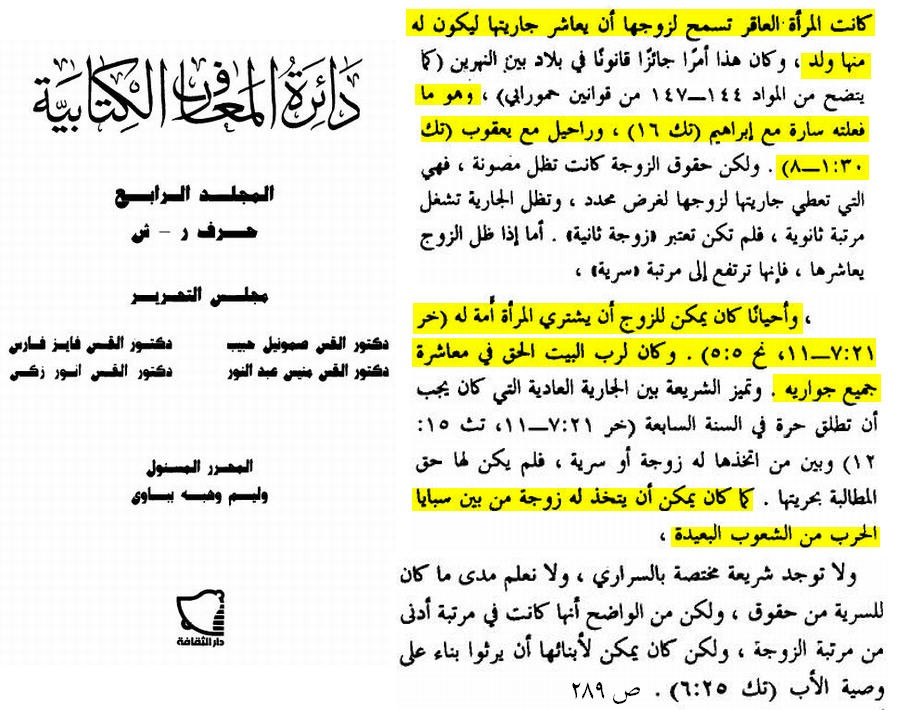
[!The text says ancient societies allowed men to have relations with female servants and captives, who had lower status than wives. It gives examples from Book of Genesis and explains that such women sometimes became secondary wives or concubines.]
Second: Captives and Right-Hand Possessions Exist in the Christian Scriptures
It is ironic when Christians object to captives and right-hand possessions, because such rulings already exist in their own scriptures. Islam did not invent this matter.
For example, in the Book of Deuteronomy 20:14:
“But the women, the little ones, the livestock, and all that is in the city, all its spoil, you shall take as plunder for yourself. And you may use the spoil of your enemies which the Lord your God has given you.”
Likewise, in 2 Samuel 5:13:
“And David also took concubines and wives from Jerusalem after he came from Hebron, and sons and daughters were born to David.”
Thus, the law regarding captives and right-hand possessions was not invented by Islam. Rather, it already existed in previous laws.
Islam later introduced legislation encouraging emancipation, freeing slaves, contracts of manumission, and many paths toward freedom — matters not present in earlier legal systems.
If the ruling of the Bible had been applied to Lady Safiyyah bint Huyayy, she would have been killed without mercy because she had been married.
This is stated in Numbers 31:17–18:
“Every woman who has known man by lying with a male, kill her. But all the children of the women who have not known lying with a male, keep alive for yourselves.”
Why, then, do they object to her marriage to the leader of the Islamic nation, yet not object to the ruling in their own scripture that would have required her death?
Third: The Claim Regarding the Waiting Period
Another claim Christians repeat is that the Messenger of Allah, peace and blessings be upon him, married Safiyyah bint Huyayy before her waiting period had ended.
The Jews did not have the same concept of waiting periods as in Islamic law. Rather, they had a period of mourning, which lasted only seven days.
The evidence for this appears in 2 Samuel 11:26–27:
“And when Uriah’s wife heard that Uriah her husband was dead, she mourned for her husband. And when the mourning was over, David sent and took her to his house, and she became his wife, and bore him a son.”
Tadros Yacoub Malti says in his commentary:
“Bathsheba heard of the death of her husband — whom David caused to be killed — so she mourned for him for seven days according to the ancient custom, then David took her as his wife.”
It was mourning, not a waiting period.
Even so, it is narrated in Sahih Muslim, on the authority of Anas ibn Malik:
“Then he gave her — meaning Safiyyah — to Umm Sulaym to prepare her for him and observe her waiting period in her house.”
Al-Nawawi explained this by saying that the meaning of “observe her waiting period” here is that she would undergo purification, since she was a captive and needed to be confirmed free of pregnancy before marriage.
When that period ended, Umm Sulaym prepared her and adorned her according to the custom of a bride.
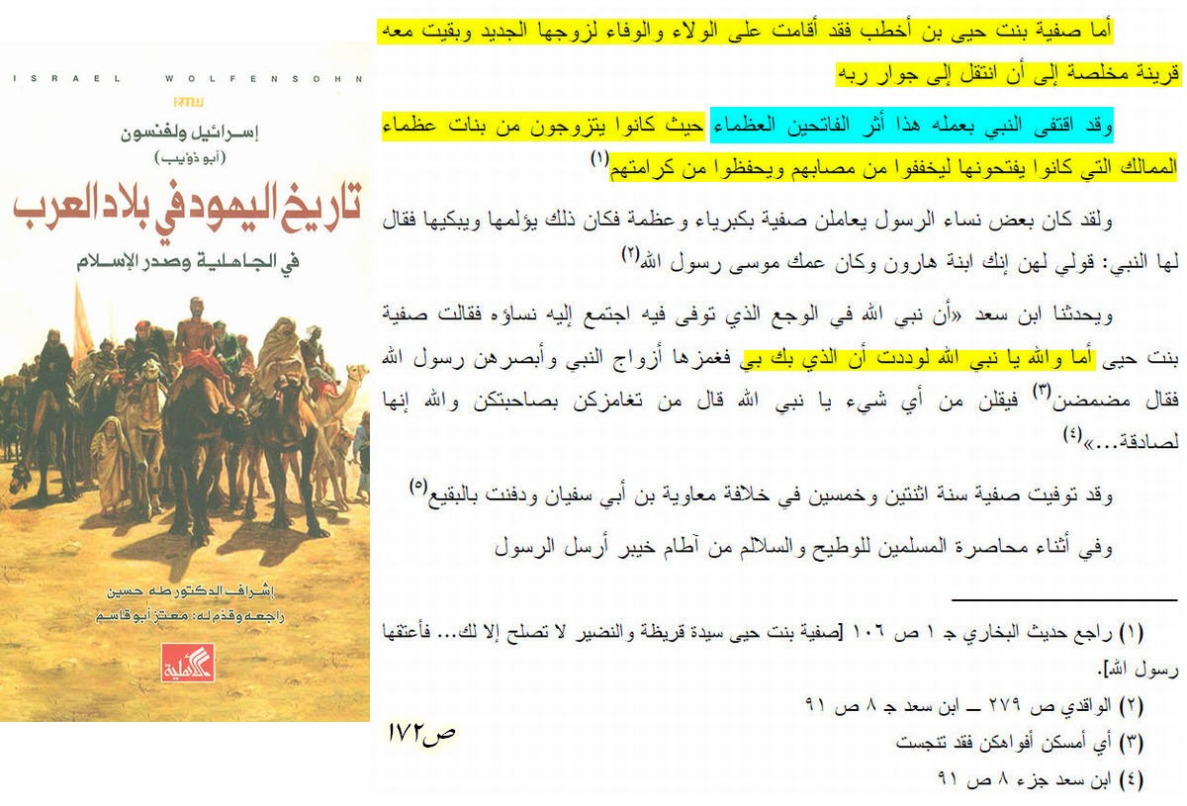
The Jewish historian Israel Wolfenson wrote in his book History of the Jews in the Arab Countries:
“As for Safiyyah bint Huyayy ibn Akhtab, she remained loyal and faithful to her new husband and remained with him as a faithful wife until he passed away. In this action, the Prophet followed the example of great conquerors, who married the daughters of noble families in order to ease their suffering and preserve their dignity.”
doubts regarding prophet marriage with safiyyah bint huyayy 1
[!The text says Safiyyah bint Huyayy remained loyal to her new husband and tribe after marriage. It presents her marriage as similar to the practice of conquerors marrying noble women from defeated peoples to preserve their dignity and status. It also notes that she was honored among the Prophet’s wives and remained deeply devoted to him.]
In Judaism, a woman mourns for seven days and does not observe a waiting period after her husband’s death; she simply mourns. This is what Safiyyah (may God be pleased with her) did before her conversion to Islam and her marriage to the Prophet
Fourth: Safiyyah Herself Chose the Prophet
Let us leave aside all outside claims and instead look at what Lady Safiyyah bint Huyayy herself chose.
It is narrated in Sahih Ibn Hibban:
“The Messenger of Allah chose Safiyyah bint Huyayy for himself and gave her the choice between him freeing her and her becoming his wife, or joining her people. She chose him freeing her and her becoming his wife.”
The Prophet, peace and blessings be upon him, gave her a choice.
She could have returned to her people, or she could have accepted marriage to him. She chose the Prophet, peace and blessings be upon him.
A person given two options chooses what they see as better.
It is also narrated from Lady Safiyyah bint Huyayy in Majma’ al-Zawa’id:
“I have never seen anyone with better character than the Messenger of Allah, may Allah bless him and grant him peace.”
Thus, it was Lady Safiyyah herself who chose marriage to the Prophet, peace and blessings be upon him.
Finally: A Claimed Prophecy in the Psalms
A text appears in Psalm 45 45:9:
“Kings’ daughters are among your concubines. The queen is set at your right hand with abundant gold.”
The question may then be asked:
Who, if anyone, fulfilled this description more completely than Prophet Muhammad, peace and blessings be upon him?