Gospel of John 1 28

❤️
Gospel of John 1-28:-
This took place in Bethabara beyond the Jordan, where John was baptizing. (John 1:28 AVD)
SCR John 1:28 Ἰωάννης βαπτίζων
This is a common text in the hands of Christians today.
But the problem is that the word (Bethany = Bethabara ) is a distortion and ancient manuscripts have revealed to us that the original reading is (Bethany = Bethany ). Textual criticism scholars have revealed the reason for the distortion: This Bethany does not exist at the Jordan crossing as the text tells us, and because it was common among the common people in the third century AD that the place of baptism was “Bethany”, Origen changed the text from “Bethany” to “Bethany”!!
…Based on all the rules of textual criticism and the testimony of all critical versions and critical commentaries, the “Bethany” reading is without a doubt the most correct.
The Manuscripts that Testify to the Bethany Reading Are the Oldest and Best. The Best Evidence is Greek, the Best is Latin, Syriac, and Coptic
The Bethany Reading Has the Testimony of All the Alexandrian, Western, Byzantine and Caesarean Textual Families
#The Bethany reading is the most difficult reading for the copyist: - Meaning that if the original reading was “Bethany” then why would the Christian copyist change the text to Bethany?? Especially since there were rumors spreading among people that the name of the baptism place was Bethany. There is no justification for disagreement. If the original reading was “Bethany” then the copyist would change it to Bethany because he did not find this village at the Jordan crossing.
We Will See in This Research the Following: -
1The most important evidence for this chapter of the Gospel of John are: - Papyrus 66, Papyrus 75, Sinaiticus, Vaticanus, Alexandrian, Ephraimus, Washington, Latin a, b, e. The Bethany reading is found in all of these.
2The oldest Greek manuscripts support the Bethany reading.
3The oldest Latin manuscripts in favor of Bethany
4The oldest Coptic manuscripts in favor of reading
5The oldest evidence of the Alexandrian text, the Byzantine text, and the Western text is in favor of reading
6The consensus of all textual criticism scholars on the authenticity of the reading of “Bethany.”
7All critical versions agree on the correctness of the reading of “Bethany.”
8Origen’s testimony that the Bethany reading exists in all the manuscripts in his possession is decisive.
9The Bethany manuscripts extend from the third to the fourteenth century.
What they said about this problem:
1Origen from the 3rd century: Almost all manuscripts have “Bethany” written in them.
2Scholar Bruce Metzger: The “Bethany” reading is the oldest and has the widest attestation.
3Scholar Wielden Felker : The most, best, and most diverse manuscripts support the Bethany reading. External and internal evidence is in its favor.
4Scholar Philip Comfort : The Bethany reading chosen by the critical versions is the correct one.
5The Net Bible version : In light of the very strong attestation in favor of the Bethany reading, it is the correct reading
. 6Brecher : The word Bethany should be read Bethany.
7Philip Schaff : There is no doubt that the reading “Bethany” is not authentic.
8Robert Jameson and David Brown : According to all the best and oldest manuscripts, it should be written “Bethany” instead of “Bethany”.
9Matthew the Poor : The name in most and most important manuscripts is “Bethany”.
10Ellicott : Bethany should be Bethany.
11Vincent : The correct reading is Bethany.
12Barnes : There is no doubt that the reading “Bethany” is correct.
13Bengel : (Bethany is the reading represented by most manuscripts) .
14Adam Clarke : The Bethany reading is the correct reading according to the testimony of the best critics.
Text in English Translations
English Versions that Chose to Read Bethany: 27 Versions
ASV John 1:28 These things were done in Bethany beyond the Jordan, where John was baptizing.
BBE John 1:28 These things took place at Bethany on the other side of the Jordan, where John was giving baptism.
CEB John 1:28 This encounter took place across the Jordan in Bethany where John was baptizing.
CJB John 1:28 All this took place in Beit-Anyah, east of the Yarden, where Yochanan was immersing.
CSB John 1:28 All this happened in Bethany across the Jordan, where John was baptizing.
CSBO John 1:28 All this happened in Bethany across the Jordan, where John was baptizing.
DBY John 1:28 These things took place in Bethany, across the Jordan, where John was baptising.
DRA John 1:28 These things were done in Bethania, beyond the Jordan, where John was baptizing.
ERV John 1:28 These things were done in Bethany beyond Jordan, where John was baptizing.
ESV John 1:28 These things took place in Bethany across the Jordan, where John was baptizing.
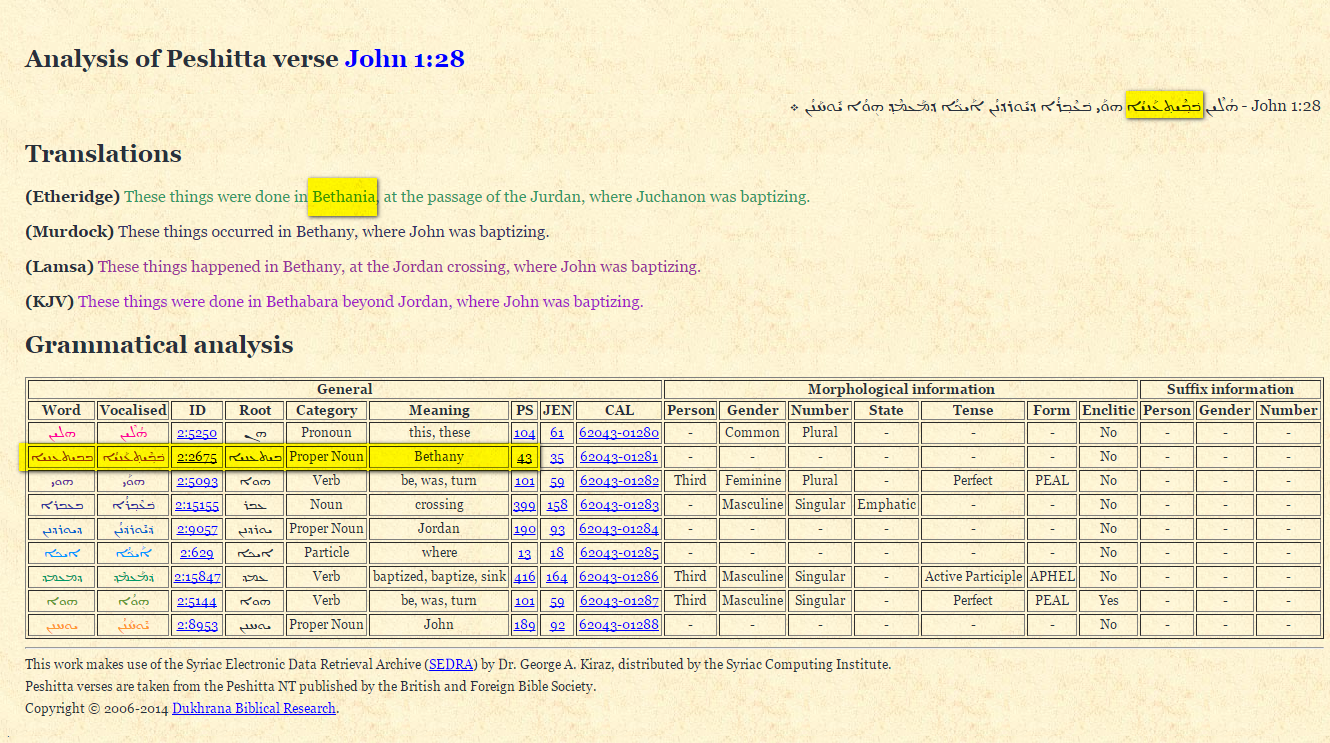
ETH John 1:28 These things were done in Bethania, at the passage of the Jurdan, where Juchanon was baptizing.
GWN John 1:28 This happened in Bethany on the east side of the Jordan River, where John was baptizing.
MGI John 1:28 These [things] happened in Bethany at the crossing of the Jordan where John was baptizing.
MIT John 1:28 These events occurred at Bethany on the east bank (of the Jordan River), where John was baptizing.
MRD John 1:28 These things occurred in Bethany, where John was baptizing.
NAB John 1:28 This happened in Bethany across the Jordan, where John was baptizing.
NABO John 1:28 This happened in Bethany across the Jordan, where John was baptizing.
NAS John 1:28 These things took place in Bethany beyond the Jordan, where John was baptizing.
NAU John 1:28 These things took place in Bethany beyond the Jordan, where John was baptizing.
NET John 1:28 These things happened in Bethany across the Jordan River where John was baptizing.
NIB John 1:28 This all happened at Bethany on the other side of the Jordan, where John was baptising.
NIRV John 1:28 This all happened at Bethany on the other side of the Jordan River. That was where John was baptizing.
NIV John 1:28 This all happened at Bethany on the other side of the Jordan, where John was baptizing.
NJB John 1:28 This happened at Bethany, on the far side of the Jordan, where John was baptising.
NLT John 1:28 This encounter took place in Bethany, an area east of the Jordan River, where John was baptizing.
NRS John 1:28 This took place in Bethany across the Jordan where John was baptizing.
RSV John 1:28 This took place in Bethany beyond the Jordan, where John was baptizing.
TNIV John 1:28 This all happened at Bethany on the other side of the Jordan, where John was baptizing.
Copies that Chose to Read Bayt Abra: - Ten Copies
KJG John 1:28 These things were done in Bethabara beyond Jordan, where John was baptizing.
KJV John 1:28 These things were done in Bethabara beyond Jordan, where John was baptizing.
LEW John 1:28 These things he spake in Beth ‘Abara beyond Jordan, where John was baptizing.
TNT John 1:28 These thinges were done in Bethabara beyonde Iordan where Iohn dyd baptyse.
WEB John 1:28 These things were done in Bethabara beyond Jordan, where John was baptizing.
YLT John 1:28 These things came to pass in Bethabara, beyond the Jordan, where John was baptizing,
RWB John 1:28 These things were done in Bethabara beyond Jordan, where John was baptizing.
PNT John 1:28 These things were done in Bethabara beyond the Jordan, where John baptized.
NKJ John 1:28 These things were done in Bethabara beyond the Jordan, where John was baptizing.
GNV John 1:28 These things were done in Bethabara beyond Iordan, where Iohn did baptize.
The Text in Arabic Translations: -
#The only Arabic translation mentions reading the verse of a lesson:-
[Van Dyke][Jn. 1.28][This took place in Bethany beyond the Jordan, where John was baptizing.]
Seven Arabic Translations Mention the Bethany Reading: -
[Shared][Jn. 1.28][All this took place in Bethany, beyond the Jordan, where John was baptizing.]
[Simplified][Jn. 1.28][This was in the village of Bethany on the east bank of the Jordan River. John was baptizing there.]
[Jesus][Jn. 1.28][This took place in Bethany beyond the Jordan, where John was baptizing.]
[Life][Jn.1.28][This took place in Bethany, beyond the Jordan, where John was baptizing.]
[Sarah][Jn. 1.28][All this took place in Bethany, beyond the Jordan, where John was baptizing.]
[Sharif][Jn. 1.28][This happened in the village of Bethany, which is on the east side of the Jordan River, where John was immersing people in water.]
[Paulian] [John 1:28] [This took place in Bethany, beyond the Jordan, where John was baptizing.]
The Text in the Greek Critical Versions. All Critical Versions Chose the Reading Bethany = Βηθανίᾳ
UBS version - W&H version - Tschendorff TIS version - NA28 version - Von Soden version - Triggles TR version
Link to browse critical copies
https://www.academic-bible.com/en/home/scholarly-editions/greek-new-testament/greek-new-testament/
http://studybible.info/version/
BNT John 1:28 These things happened in Bethany beyond the Jordan, where John was baptizing.
GNT John 1:28 These things happened in Bethany beyond the Jordan, where John was baptizing.
TIS John 1:28 These things happened in Bethany beyond the Jordan, where John was baptizing.
TRG1 John 1:28 These things happened in Bethany beyond the Jordan, where John was baptizing.
VST John 1:28 These things happened in Bethany beyond the Jordan, where John was baptizing.
WHT John 1:28 These things happened in Bethany beyond the Jordan, where John was baptizing.
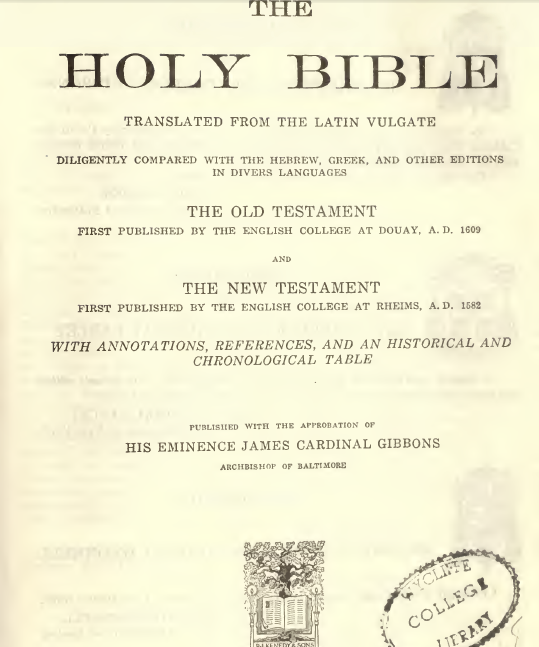
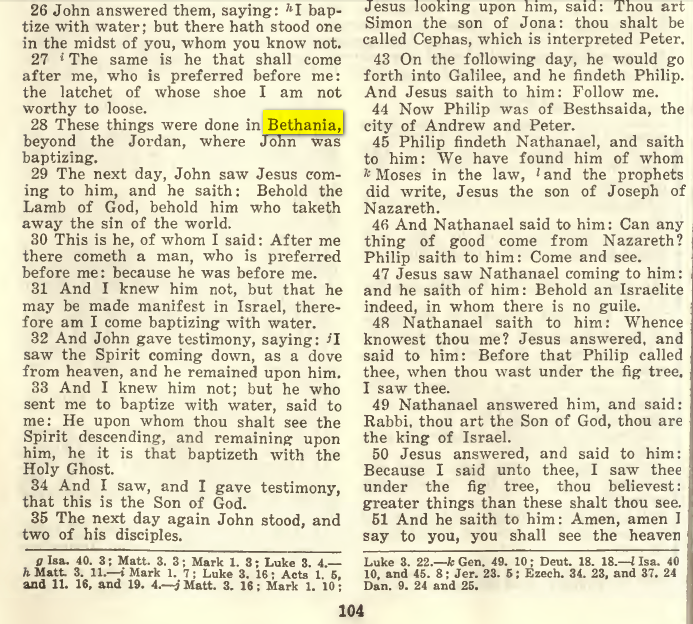
The Text in the Latin Vulgate
Bethany
http://studybible.info/Vulgate/John%201
These things were done in Bethany beyond the Jordan, where he was.
John the Baptist
The Text in the Syriac Peshitta
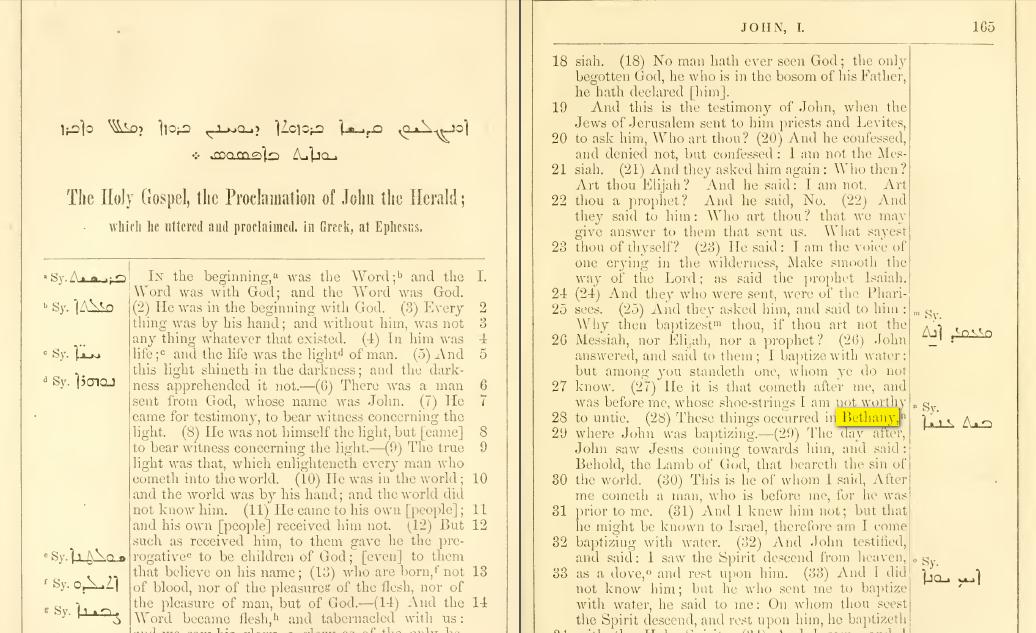
The Text in the Most Important Manuscripts
(1) The Sinaiticus manuscript, 4th century
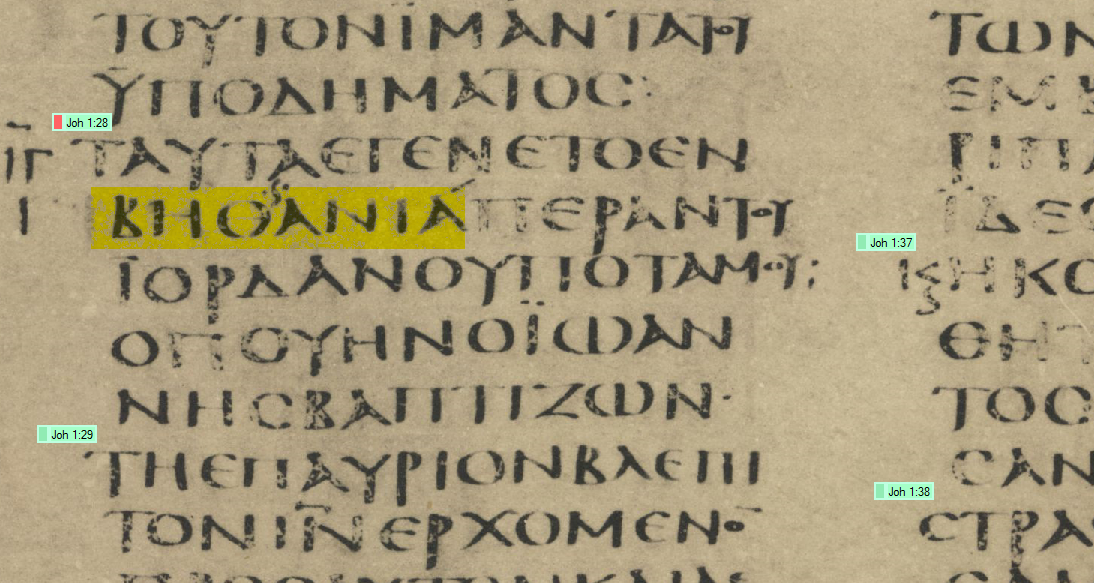
(2) Vatican Manuscript, 4th Century
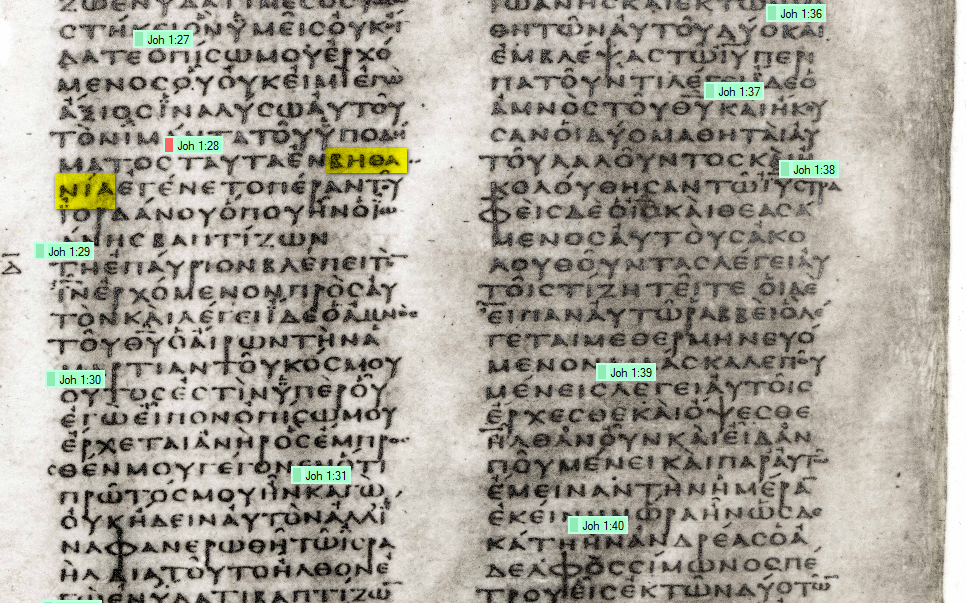
(3) Alexandria, 5th Century
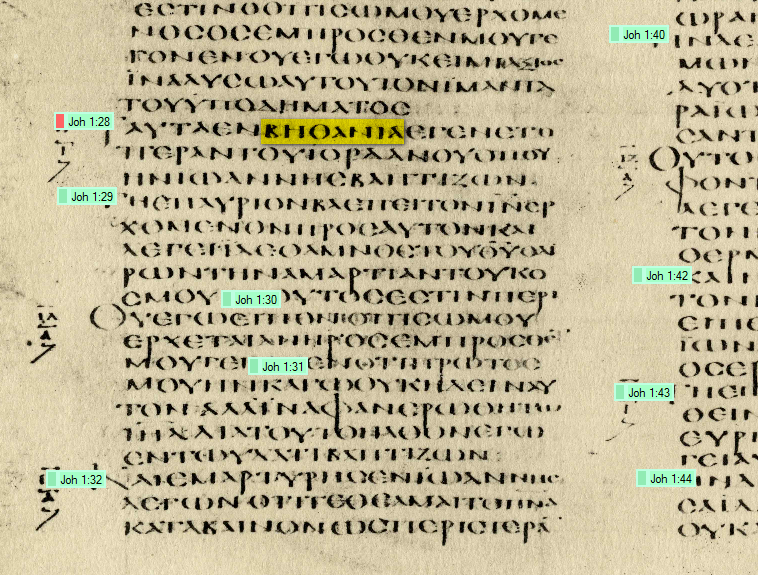
(4) Washington Manuscript, 5th Century
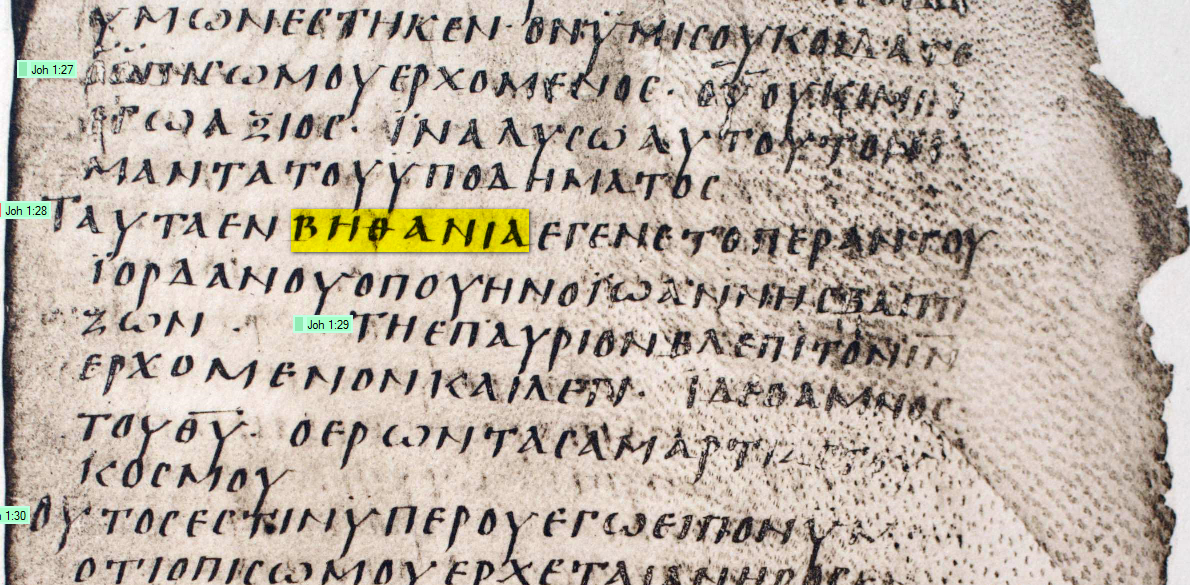
(5) Papyrus 66 3rd Century
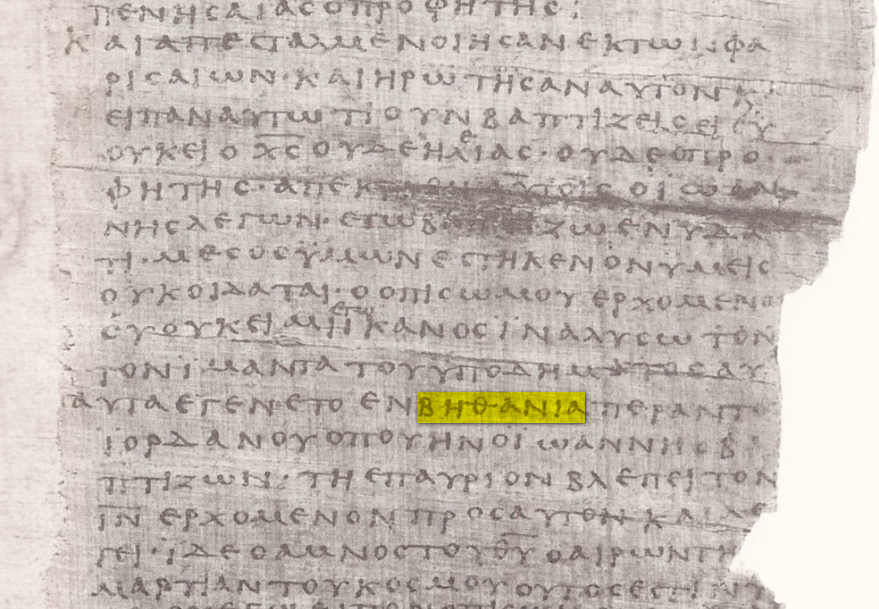
(6) Papyrus 75 BC
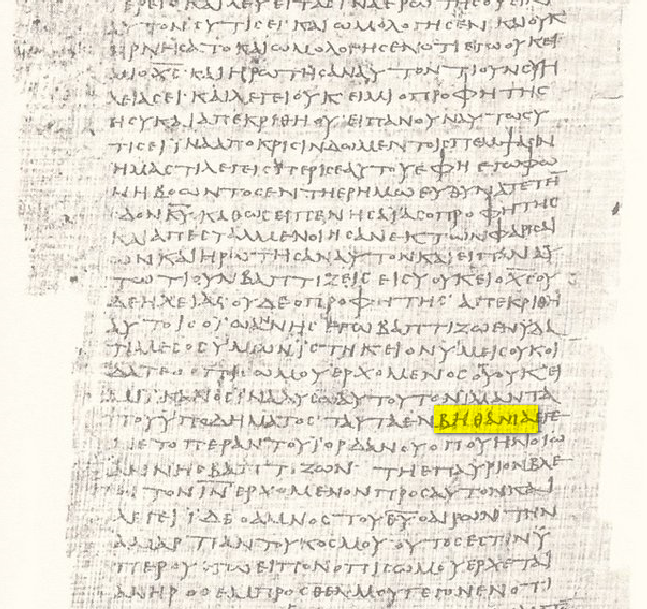
(7) The Bohairic Coptic Manuscript
http://www.calloflove.net/copticlibrary/downloadholybible.htm#Download the New Testament in Bohairic Coptic
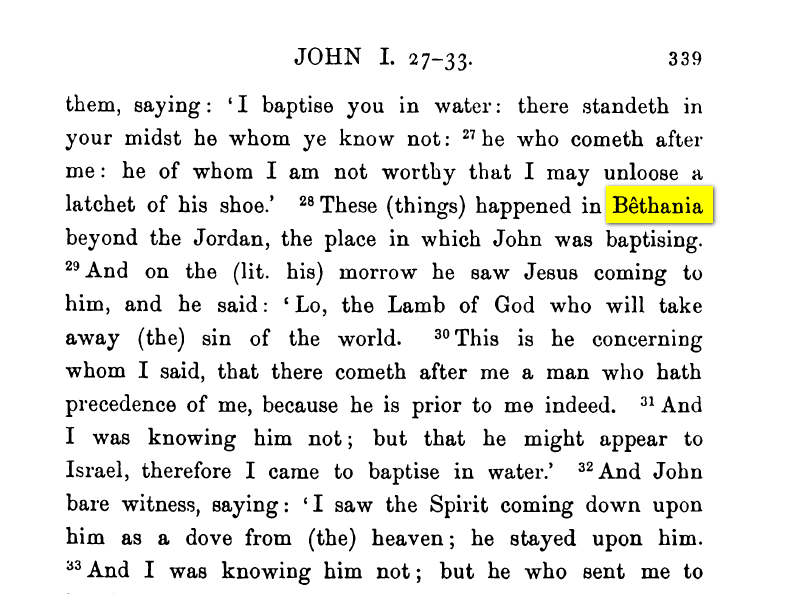
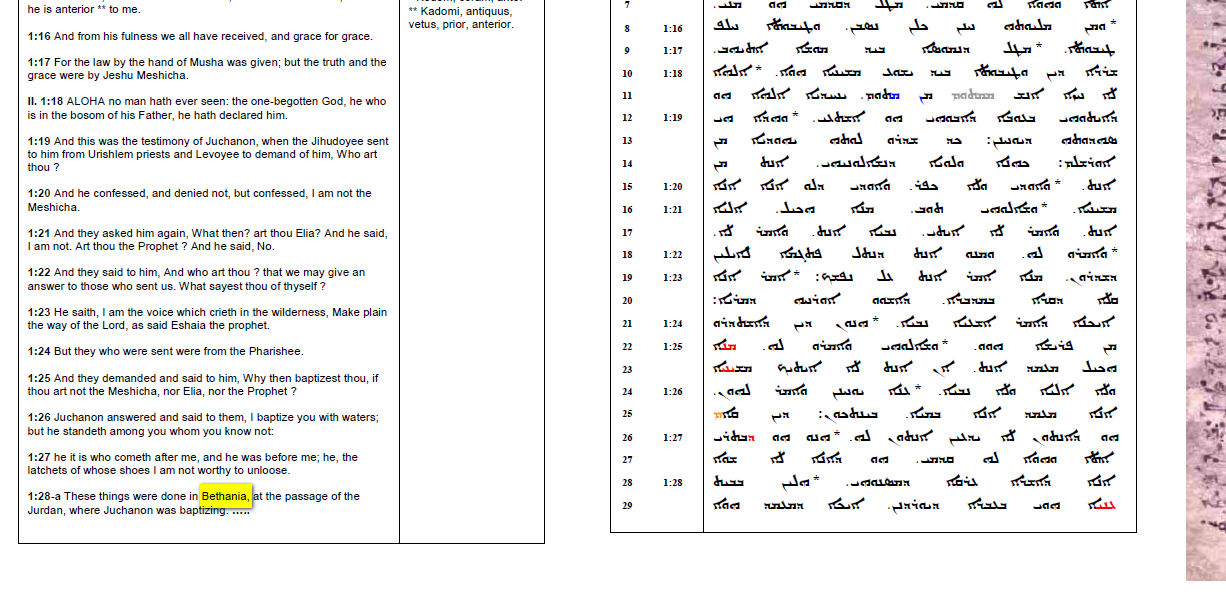
(8) Syriac Khabur from the Twelfth Century
http://www.dukhrana.com/khabouris/
{Embed}
http://www.dukhrana.com/khabouris/
Transcription of the Khabouris Codex
Khabouris Codex Transcription, Peshitta New Testament
First, the Manuscripts Supporting Each Reading: -
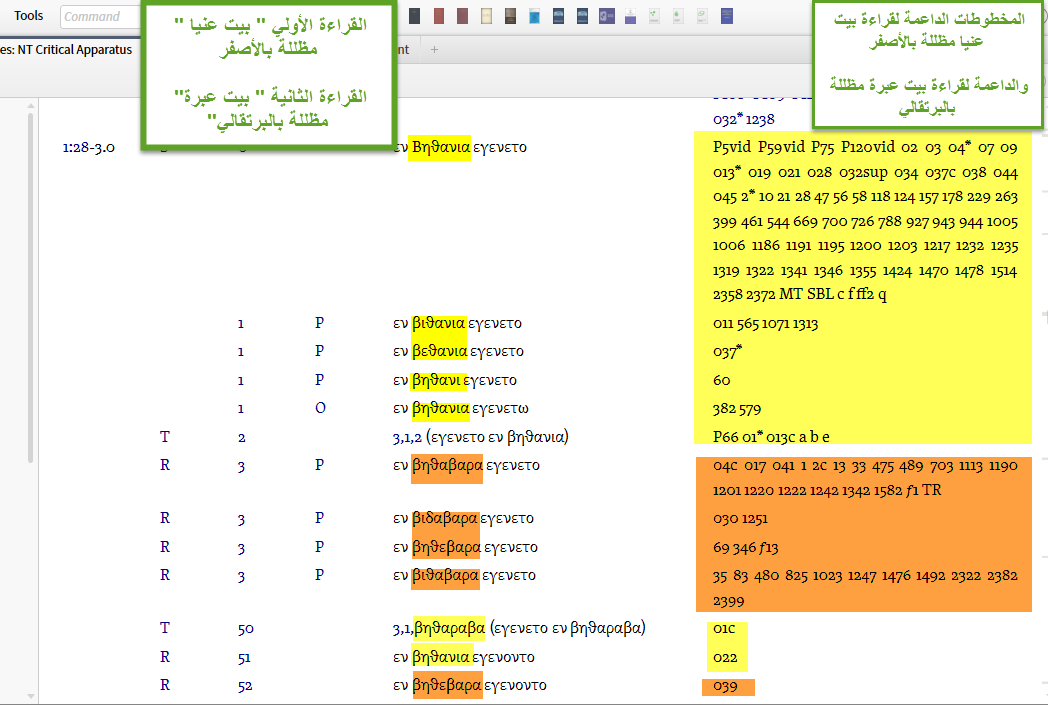
1Supporting manuscripts for each reading from the CNTTS device
cash
H. Milton Haggard Center for New Testament Textual Studies. (2010). The Center for New Testament Textual Studies: NT Critical Apparatus (Jn 1:28). New Orleans Baptist Theological Seminary.
Reading (Bethany = Bethany):-
P5vid P59vid P75 P120vid 02 03 04* 07 09 013* 019 021 028 032sup 034 038 044 045 2* 10 21 28 47 56 58 118 124 157 178 229 263 399 461 544 669 700 726 788 927 943 944 1005 1006 1186 1191 1195 1200 1203 1217 1232 1235 1319 1322 1341 1346 1355 1424 1470 1478 1514 2358 2372 MT SBL c f ff2 q
#Reading (A House of Lesson = βιδαβαρα):-
04c 017 041 1 2c 13 33 475 489 703 1113 1190 1201 1220 1222 1242 1342 1582 ƒ1030 125169 346 ƒ13 35 83 480 825 1023 1247 1476 1492 2322 2382 2399
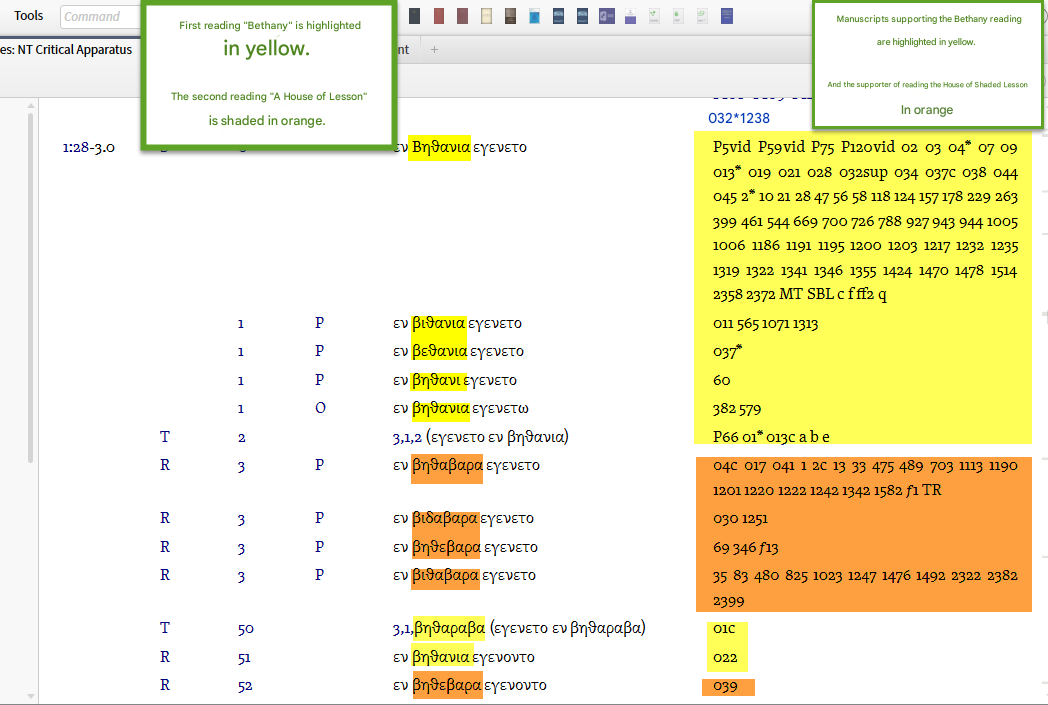
2-
Supporting Manuscripts for Each Reading from Richard Wilson’s Critical Apparatus
NEW TESTAMENT MANUSCRIPTS
by text type of manuscript
curatore Richard Wilson
(ἐν Βηθανίᾳ ἐγένετο ] Alex: ( p 66 ) ( א * ) A B L Δ Ψ * 157 1006 1241 1243 1342 cop bo WH NR text CEI Riv TILC Nv NM Alex/Cæs: Origen Alex/Byz: C* X 579 892 text Cæs: 205 565 1071 1424 Eusebius Cæs/Byz: 700 West: W supp ( it a ) it aur ( it b ) it c ( it e ) it f it ff2 it l it q ( it r1 ) vg Augustine Ambrosiaster Heracleon according to Origen Byz: E F G H ( N ) Θ 063 28 75 597 1009 1010 1195 1216 1242 1253 1344 1365* 2148 2174 Byz pt Byz 2005 Lect syr p syr pal (mss) syr h slav Chrysostom ( Epiphanius ) Nonnus ?: p 59 vid mss according to Origen ( mss according to Chrysostom )
ἐν Βηθαβαρᾷ ἐγένετο] Alex: (א2) Tvid Ψc 083 33 (copsa(ms)) copsa(mss) Cyril NRmg Alex/Cæs: Origen Alex/Byz: C2 (892v.r.) Cæs: f13 1 (13) (828) arm geo Eusebius West: 1292 1505 (1646*) 1646c (syrs) (syrc) Byz: (K) (Π*) Πc 0141 180 1079 1230 1365c 1546 Byzpt (pc) l70(c) l770 l773 l1231 lAD (syrpal(ms)) (syrh(mg)) (Epiphanius) ς ND Dio ?: 0113 mssaccording to Origen (mssaccording to Chrysostom)
See A Student’s Guide to New Testament Textual Variants
ὁ ] Alex: p 66 p 75 א B WH Alex/Byz: C West: W supp Byz: pc
omits ] Alex: A L T Ψ 33 Cæs: f1 f13 Byz: Θ Byz ς).
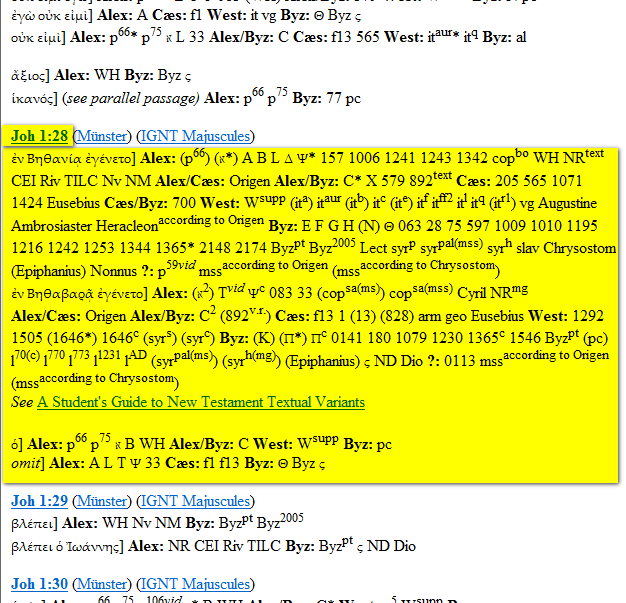
2-
Supporting Manuscripts for Each Reading from Richard Wilson’s Critical Apparatus
NEW TESTAMENT MANUSCRIPTS
by text type of manuscript
curatore Richard Wilson
(ἐν Βηθανίᾳ ἐγένετο ] Alex: ( p 66 ) ( א * ) A B L Δ Ψ * 157 1006 1241 1243 1342 cop bo WH NR text CEI Riv TILC Nv NM Alex/Cæs: Origen Alex/Byz: C* X 579 892 text Cæs: 205 565 1071 1424 Eusebius Cæs/Byz: 700 West: W supp ( it a ) it aur ( it b ) it c ( it e ) it f it ff2 it l it q ( it r1 ) vg Augustine Ambrosiaster Heracleon according to Origen Byz: E F G H ( N ) Θ 063 28 75 597 1009 1010 1195 1216 1242 1253 1344 1365* 2148 2174 Byz pt Byz 2005 Lect syr p syr pal (mss) syr h slav Chrysostom ( Epiphanius ) Nonnus ?: p 59 vid mss according to Origen ( mss according to Chrysostom )
ἐν Βηθαβαρᾷ ἐγένετο] Alex: (א2) Tvid Ψc 083 33 (copsa(ms)) copsa(mss) Cyril NRmg Alex/Cæs: Origen Alex/Byz: C2 (892v.r.) Cæs: f13 1 (13) (828) arm geo Eusebius West: 1292 1505 (1646*) 1646c (syrs) (syrc) Byz: (K) (Π*) Πc 0141 180 1079 1230 1365c 1546 Byzpt (pc) l70(c) l770 l773 l1231 lAD (syrpal(ms)) (syrh(mg)) (Epiphanius) ς ND Dio ?: 0113 mssaccording to Origen (mssaccording to Chrysostom)
See A Student’s Guide to New Testament Textual Variants
ὁ ] Alex: p 66 p 75 א B WH Alex/Byz: C West: W supp Byz: pc
omits ] Alex: A L T Ψ 33 Cæs: f1 f13 Byz: Θ Byz ς).
Translation with Slight modification:-
The reading (ἐν Βηθανίᾳ ἐγένετο = was in Bethany) is found in the following evidence: -
First: Evidence of the Alexandrian text family:
1Papyrus 66 from the third century
2The Sinaiticus manuscript from the fourth century
3The Vatican manuscript from the fourth century
4The Alexandrian manuscript from the fifth century
5The Washington manuscript from the fifth century
6-Manuscript L from the eighth century
7Delta manuscript from the ninth century
8Ibsi manuscript from the ninth century
9Small-letter manuscripts from after the ninth century 157 1006 1241 1243 1342
10The Bohairic Coptic Manuscript
note :
1Manuscript 1342 from the fourteenth century
2The author placed the Alexandrian manuscript among the evidence of the Alexandrian text, contrary to what is known about it being among the evidence of the Byzantine text in the Gospels specifically.
Second: Evidence of the mixed Caesarean-Alexandrian text family:
Origen, 3rd century
Thirdly, evidence of the mixed Alexandrian-Byzantine text family:
1The Ephraimite manuscript from the fifth century
2Manuscript X from the eighth century!?
3Small letter manuscripts from after the ninth century 579-892 text
Fourth: Evidence of the Caesarean text family:
1Small-letter manuscripts after the ninth century 205 565 1071 1424
2Eusebius of Caesarea
Note: Manuscript 1071 from the twelfth century
Fifth: Evidence of the mixed Byzantine-Caesarian text family:
Manuscript 700, 11th century
Sixth: Evidence of the Western Text Family:
1Washington Manuscript from the beginning of the third century “correction by a later copyist”
2The Latin manuscript A Versilensis from the fourth century
3The Latin manuscript AUR from the seventh century
4Latin b Veronensis from the 5th century
5-Latin Culbertinus from the 12th century
6-Latin e Platinus from the fifth century
7-Latin manuscript f from the ninth century
8Latin manuscript ff2 from the fifth century
9The Latin manuscript l from the seventh century
10-Latin manuscript q from the seventh century
11The Latin manuscript ri from the seventh century
12-Augustine
13-Ambrosiaster
14-Heraclion
Seventh: Evidence of the Byzantine text family:
1Manuscript E from the eighth century
2-Manuscript F from the ninth century
3-Manuscript G from the ninth century
4-Manuscript H from the ninth century
5-Manuscript N from the sixth century
6Theta manuscript from the ninth century
7-Manuscript 063 from the ninth century
8A number of manuscripts in small letters from after the ninth century 28 75 597 1009 1010 1195 1216 1242 1253 1344 1365* 2148 2174
7Church liturgical writings
8The Syriac Peshitta manuscript from the fifth century
9Palestinian Syriac from the sixth century
10-Heraclian Syriac from the 7th century
11Slavonic manuscripts
12John Chrysostom
Note: Manuscript 2174 from the thirteenth century.
3-
List of Supporting Manuscripts for Each Reading of the Famous UBS Critical Edition
Affiliated with the Union of Bible Societies
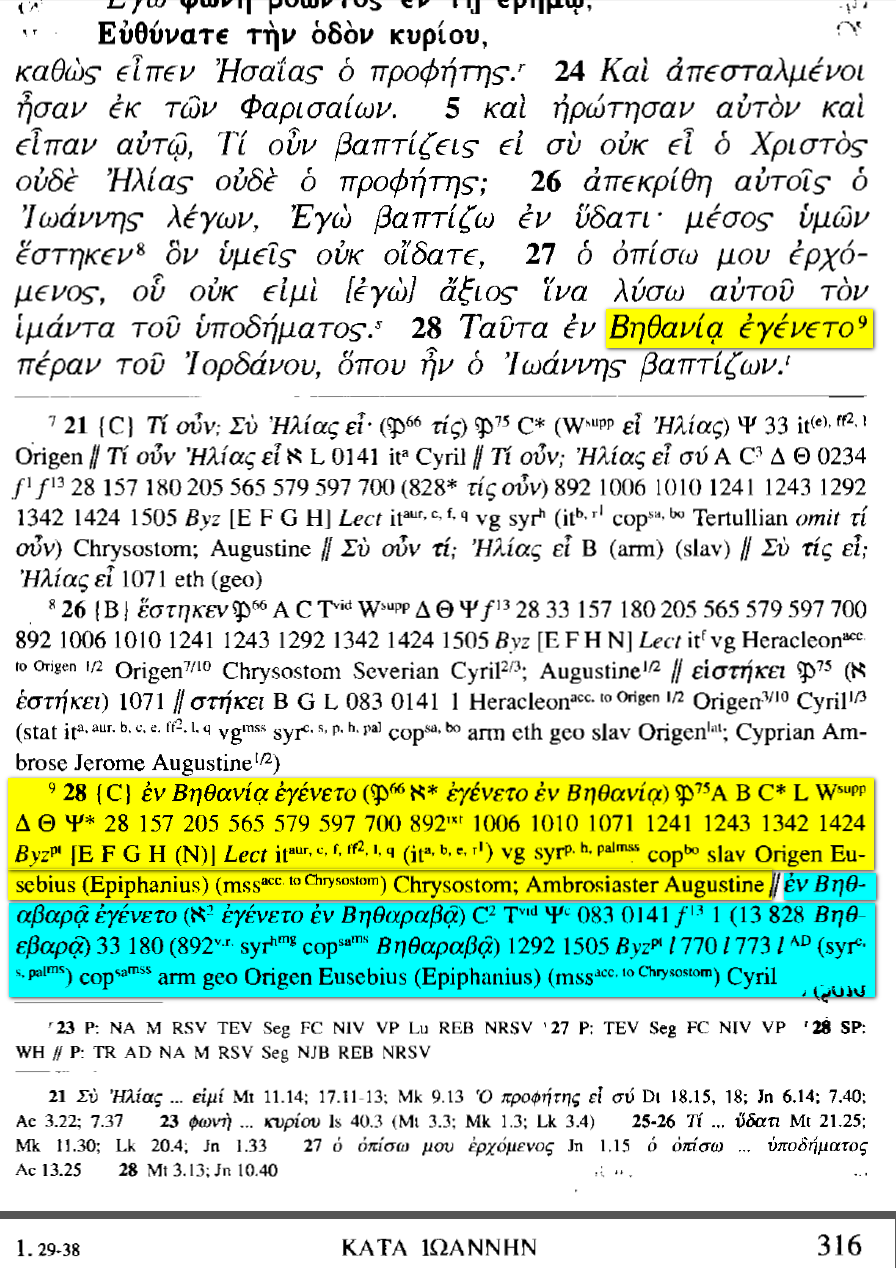
The Committee Chose the Reading “Bethany” as the Most Correct Reading
Translation:-
( The reading “Bethany” is found in the following manuscripts:
Papyrus 75 BC
Papyrus 66 BC
Sinaiticus Q4
Vatican Council 4
Ephraimite 5th century
Alexandria 5th District
- Manuscript L, Q8
-Washington Q5 “Later Copyist”
Delta Q9
-Theta Q9
-Ebsi Q9
-Several small-letter manuscripts
-Several Byzantine manuscripts with capital letters E, F, G, H, N
-Several Latin manuscripts: a,b,c,e,f,ff2,aur,r1
Peshitta Syriac, Heraclean Syriac
Bohairic Coptic
Slavonic manuscripts
-Origen, Eusebius, John Chrysostom, Augustine
Reading the verse of a lesson found in the following manuscripts:
A late copyist added it to the Sinaiticus.
A late copyist added it to the Ephraimites.
-A late copyist added it to the Ibsi manuscript.
- Manuscript 083 Q5-Q6
-Manuscript 0141 Q10
-Family manuscripts No. 13 from after the eleventh century - Manuscript No. 1, Q12
Sinaitic Syriac 4th century
Syriac Curitonianus, 5th century
-Palestinian Syriac, 6th century, in the margin - Margin of Upper Egyptian Coptic
Late Armenian and Georgian
-Origen, Eusebius, and Cyril
4-
Supporting Manuscripts for Each Reading from the Eighth Critical Edition of Tischendorf
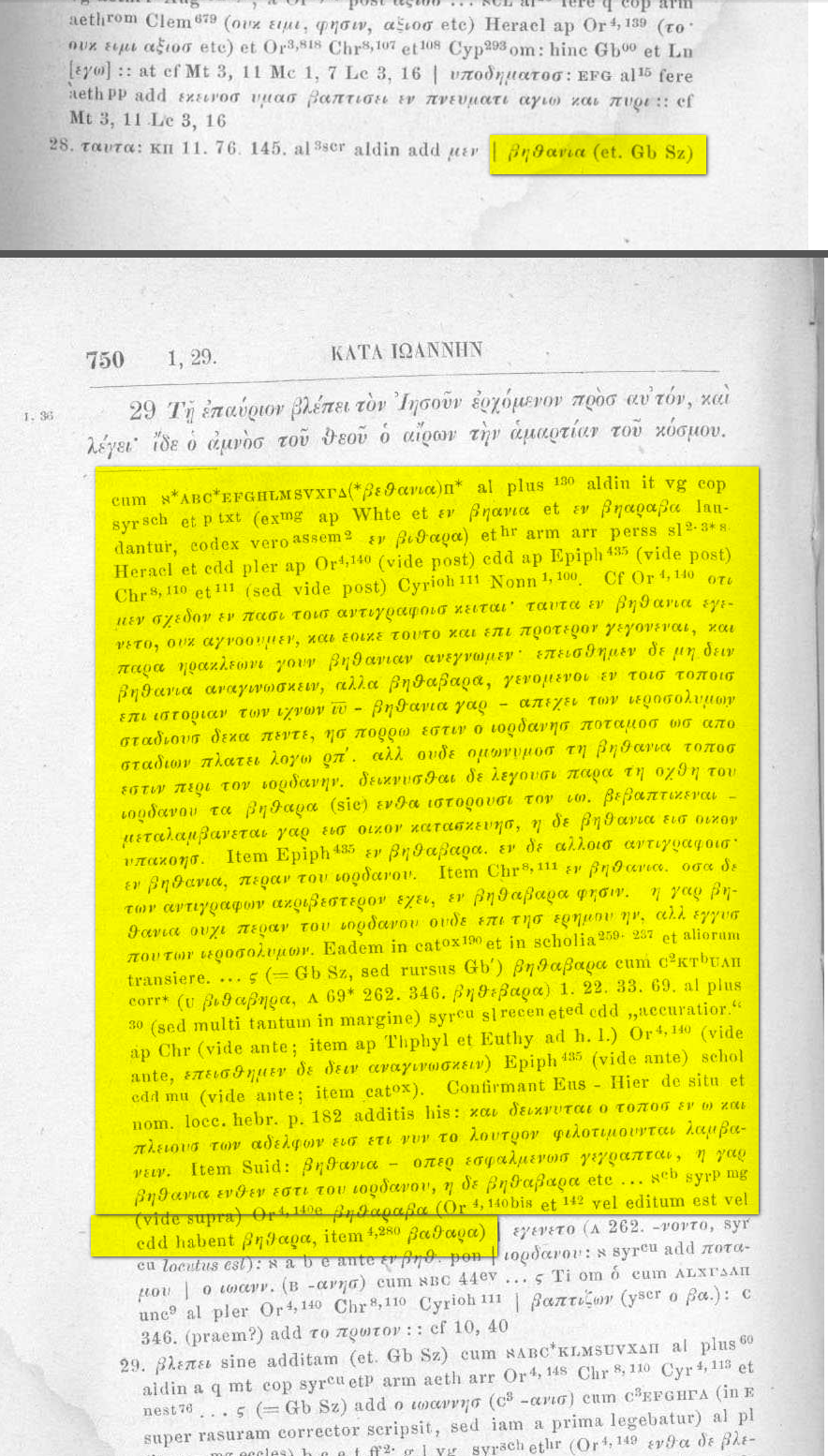
5-
List of Manuscripts Supporting Each Reading from the NA28 Critical Device
(Nestle Aland 28 Cash Copy)
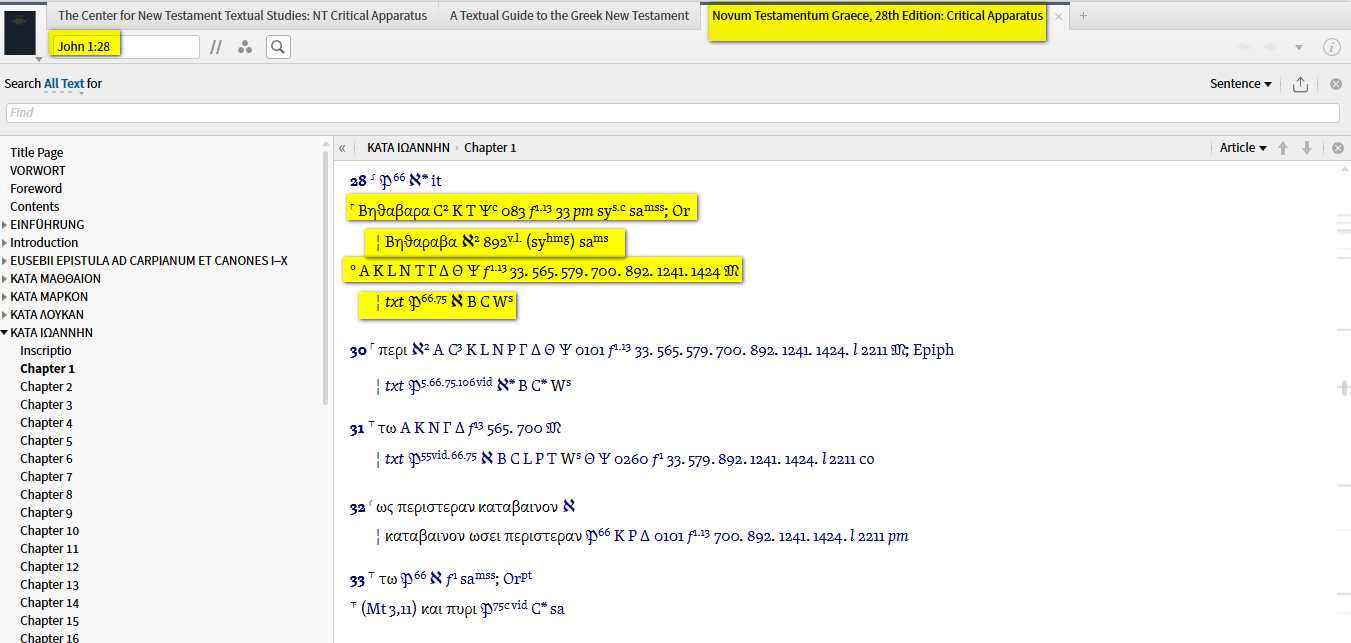
List of Witnesses for Every Reading of the World David Robert Palmer
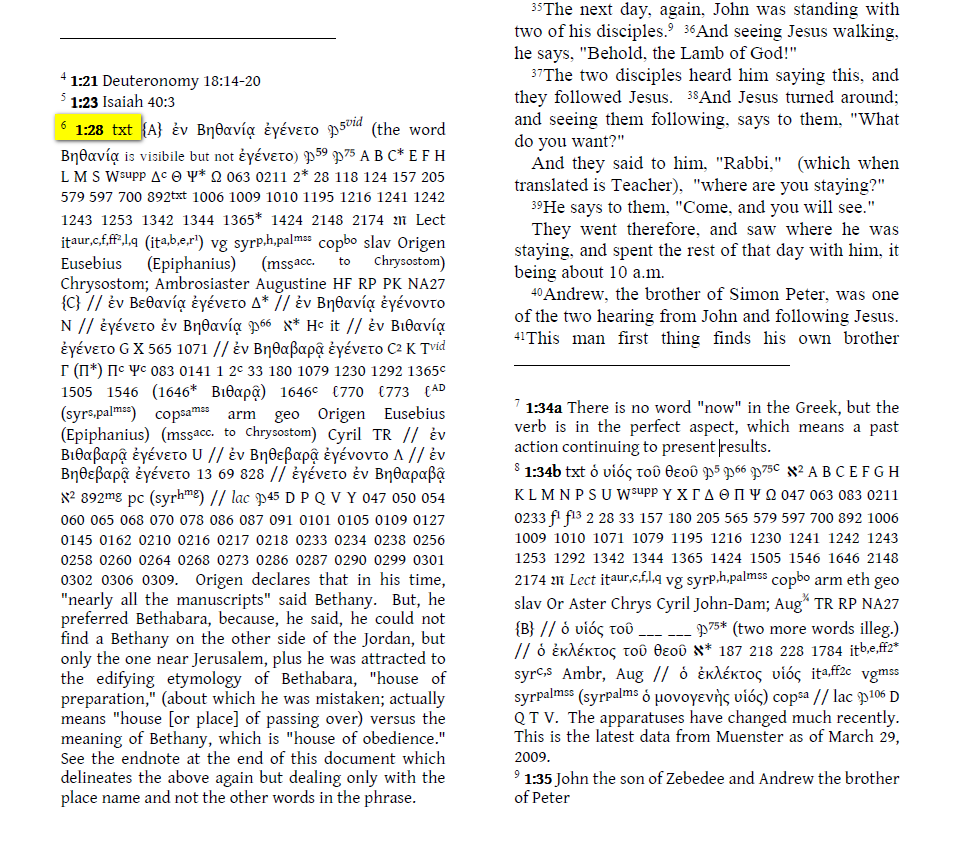
And others…
Second: Critical Comments
1-
Critical Comments by Bruce Metzger
Omanson, R. L., & Metzger, B. M. (2006). A Textual Guide to the Greek New Testament: an adaptation of Bruce M. Metzger’s Textual commentary for the needs of translators (pp. 199–200). Stuttgart: Deutsche Bibelgesellschaft.
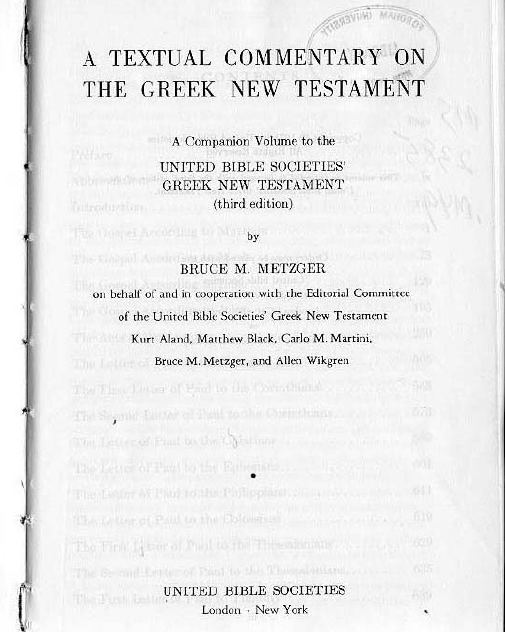
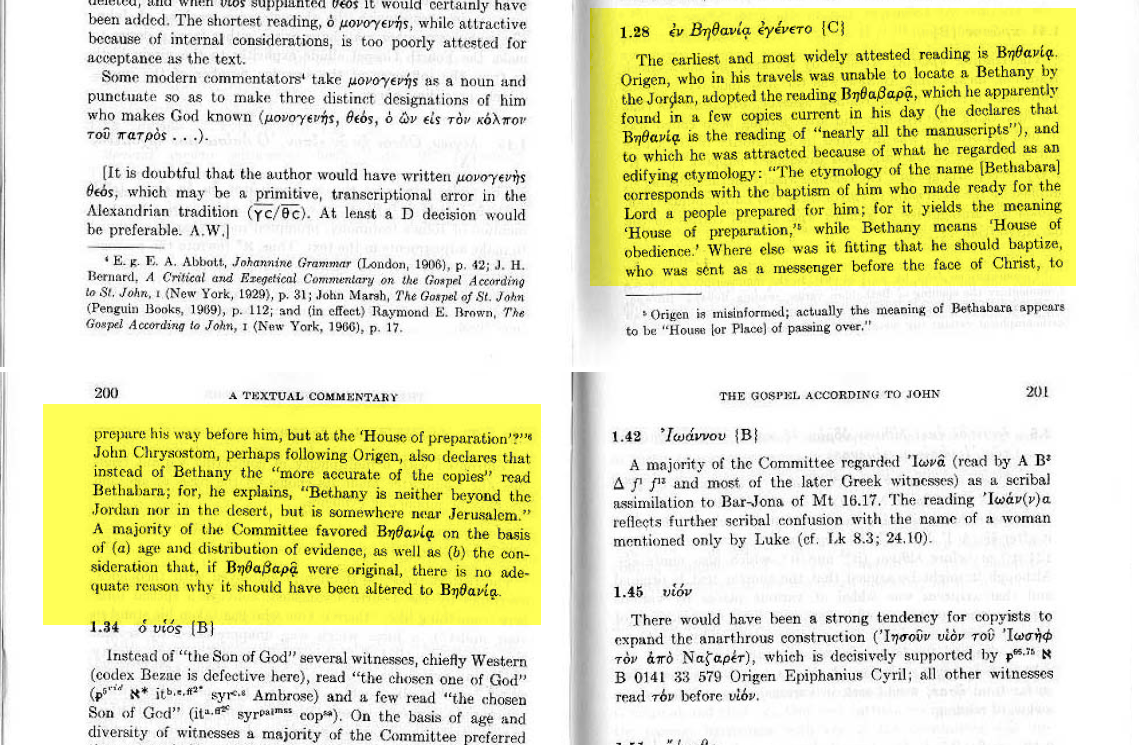
(The Bethany reading is the oldest and has the widest attestation.
If the original reading was Bethany, there would be no justification for the scribes to change it to Bethany.
Origen, in his travels in the third century, was unable to determine its location, saying, “Its location today is unknown, and it should not be confused with Bethany mentioned in John 11:1 and 18.”
Origen chose to read the Beth-i-Abra as found in the few manuscripts he knew, and because he believed that the meaning of “Beth-i-Abra” was “the house of preparation,” he says: “Where would the person who came before Christ to prepare the way for him be baptized except in the “house of preparation”?”John Chrysostom follows Origen and states that the more accurate manuscripts contain the reading “Bethabara,” saying: “Bethabara is not located in the Jordan desert, but near Jerusalem.
The majority of the Textual Criticism Committee chose the reading “Bethany” for the following reasons:
1Time and distribution of evidence for this reading
2If Bethabara was the oldest, then there is no justification for changing it to Bethany.
2-
Critical Comments by Wielend Felker
A Textual Commentary
on the
Greek Gospels
Vol. 4
John
BY
WIELAND WILLKER

(Βηθαβαρᾷ appears on the Madaba mosaic map (ca. 560 CE), which is located on the floor of the Greek Orthodox church in Madaba near Amman. It mentions the St. John monastery to. and above it (next to the Western bank of the Jordan) in smaller letters: Βηθαβαρᾷ.
It is noteworthy that the excellent manuscripts 029 and 083 support Βηθαβαρᾷ.Origen (Jo Comm. book 6), who was under the probably mistaken notion that the only Bethany was that near Jerusalem (he couldn’t find a Bethany near the Jordan in his travels), opted for Bhqabara/ which he apparently found in some copies (Bhqani,a| is found in “nearly all the manuscripts”). He explained it (wrongly) allegorically as oi=koj kataskeuh/j (“house of the preparation”), but it actually means “house of passing over”. It has been suggested that Origen actually created this reading, but this is not clear. Note that Origen once writes the curious ta. Bhqabara/. He writes:
“These things were done in Bethabara, beyond Jordan, where John was baptizing.” We are aware of the reading which is found in almost all the copies, “These things were done in Bethany.” This appears, moreover, to have been the reading at an earlier time; and in Heracleon we read “Bethany.” We are convinced, however, that we should not read “Bethany,” but “Bethabara.” We have visited the places to enquire as to the footsteps of Jesus and His disciples, and of the prophets. Now, Bethany, as the same evangelist tells us, was the town of Lazarus, and of Martha and Mary; it is fifteen stadia from Jerusalem, anti the river Jordan is about a hundred and eighty stadia distant from it. Nor is there any other place of the same name in the neighborhood of the Jordan, but they say
The etymology of the name, too, corresponds with the baptism of him who made ready for the Lord a people prepared for Him; for it yields the meaning “House of preparation,” (oi=koj kataskeuh/j) while Bethany means “House of obedience” (oi=koj u`pakoh/j). Where else was it fitting that he should baptize, who was sent as a messenger before the face of the Christ, to pre pare His way before Him, but at the House of preparation (kataskeua,sai)? And what more fitting home for Mary, who chose the good part, which was not taken away from her, and for Martha, who was cumbered for the reception of Jesus, and for their brother, who is called the friend of the Saviour, than Bethany, the House of obedience? Thus we see that he who aims at a complete understanding of the Holy Scriptures must not neglect the careful examination of the proper names in it. In the matter of proper names the Greek copies are often incorrect, and in the Gospels one might be misled by their authority.” that Bethabara (ta. Bhqabara/) is pointed out on the banks of the Jordan, and that John is said to have baptized there.
It is interesting though that nowhere in the early sources and also not in any of the pilgrims reports a Bethany “beyond the Jordan” is mentioned. On the other hand there is no reason to consider Bethany simply a corruption. It is explicitly labeled as the Bethany “beyond the Jordan”, to distinguish it from the Bethany near Jerusalem. John is quite exact regarding John the Baptist’s places, compare Jo 3:23 and 10:40.
External arguments: More, more better and more diverse manuscripts support Bethany, Bethabara also has some good and diverse support, but not as much as Bethany.
Internal arguments: Bethany is clearly the harder reading and was a stumbling block, not only for Origen, but also for other church fathers.
If Bhqabara/ was original, there would have been no reason for a change. It is not clear if Origen made this reading up, it is possible. The “but they say” seems to point to a local tradition, which Origen ascertains.
It should be noted that Origen based his solution to the Bethany problem on hearsay only. It should also be noted that the Bhqabara/ on the Madaba map is west of the Jordan.It is also interesting to note that Livias, the place of Herod Antipas’ summer residence, which is across the Jordan, has originally been called Bhqaramaqa, (Josephus, Bell II 59, Ant XVII 277, XVIII 27).
Weiss (Lk Com.) suggests Judges 7:24 (Baiqhra) as a possible reference, but marks it with a question-mark. Note that in the manuscripts of Origen’s commentary the spelling varies and Bhqara/| and Baqara/| are also found.
Burkitt thinks that because both Sy-S and Origen have Bhqabara/, this indicates a common source: “This source seems to have been not documentary evidence, but local identification. […] We cannot doubt that the author of the Fourth Gospel wrote ‘Bethany beyond Jordan.’ On the other hand we have the cult of ‘Bethabara’, developed before the time of Origen, perhaps at a pre-Christian holy place. The cult led to the identification of ‘Bethany’ with ‘Bethabara’ and finally it influenced some texts of the Gospels.” (Evangelion Intro, p. 308-9).
Pierson Parker suggests that pe,ran tou/ VIorda,nou does not refer to Bhqani,a|, but to o[pou h=n o` VIwa,nnhj bapti,zwn and gives the translation: “These things took place in Bethany, which is across from the point of the Jordan where John had been baptizing.” (This has already been suggested by E.G. Paulus in 1828!) It is quite unlikely that John would have described Bethany this way though.
R. Riesner suggests that the place “beyt abarah” originally indicated the crossing of the Jordan by the Israelites and also the crossing of the Jordan by Eliah and Elisah, so two crossings have been remembered here. This could explain Origen’s plural ta. Bhqabara, a place of several fords.
Rainer Riesner argues for Bhqani,a| = Batane,a( Batanai,a (the region Batanaea). This identification is as early as J. Lightfoot (1658). There are two places that are relevant. One, called Bhqabara/, is the place of Jesus’ baptism, which is at the traditional place. The other is the place where John is questioned by the Pharisees in Jo 1:19-28. This is the Batanaea in the north. Here John worked, too. The problem arose (according to Riesner) due to the misunderstanding that in the following verses Jesus’ baptism is reported. This is not the case, John only gives an account of what happened at an unknown time earlier. The time table and circumstances in Jo 1 fit much better if everything happens in the north (compare Riesner, Bethanien, p. 73ff.). It also fits good to the time table of Jo 11 (p. 71 ff.).
Furthermore the region of Batanaea is known in Arabic as el-Betheneyeh, which comes nearest to the Evangelist’s Bethania (compare Brownlee).
Against this view is the fact that representatives of the Pharisees and others from Jerusalem came to investigate John’s baptizing, apparently in great numbers. Although it would have been possible for them to find John in Batanaea in the north, a location closer to Jerusalem seems more likely.
S.G. Brown notes that the most common position today is Wadi Kharrar/Gharrar (Tell el-Kharrar), “a site in Jordan across from Jericho, where four springs merge into a stream that flows into the Jordan river.” […] “a site opposite (and just over 1 km south of) Jericho, 7.3 km north of the Dead Sea and 1.5 km east of the river. It is between the two fords across from Jericho, a little closer to the Makhadat Hajla ford. The ongoing excavation of the site has ‘uncovered a 1st CE settlement with plastered pools and water systems that were used almost certainly for baptism, and a 5th-6th CE late Byzantine settlement with churches, a monastery, and other structures probably catering to religious pilgrims.’ This site has been the traditional location of Jesus’ baptism since at least the early 4th CE (the pilgrim of Bordeaux, 333 CE).”
Starting 1997, excavations took place for several years in the region of the Jordan north of the Dead Sea. The Jordanian team has identified nearly 20 related sites within an area stretching some four kilometers east of the Jordan River, mostly along the south bank of Wadi el-Kharrar, including the above mentioned 1st CE settlement. More sites remain to be discovered through systematic surveying. The excavators believe that the village of Bethany beyond the Jordan was located at or around the natural hill at Tell el-Kharrar. The main complex, still being excavated and investigated, comprises structures on and around a small natural hill located two kilometers east of the Jordan River, adjacent to the spring and small oasis at the head of the Wadi Kharrar. The recent excavations have identified a settlement that was inhabited from the time of Christ and John the Baptist (early Roman era), throughout most of the Byzantine period, into the early Islamic era, and again in Ottoman centuries.
“Bethany/Bethabara may also have referred to a region, rather than only a specific settlement. Western travelers to the region at the turn of the century reported that the Greek Orthodox clerics and monks who lived in the south Jordan Valley, and the native valley residents themselves, referred to the whole area around the river and east along the Wadi el-Kharrar as Bethabara. Thus the original settlement was known as Bethany beyond the Jordan during and immediately following the days of Jesus and John the Baptist in the 1st Century AD; after the 3rd Century AD it was more commonly known as Bethabara, and by the 6th Century AD it had become known as Aenon and Safsafa. The general area from the river eastwards associated with the ministry of John the Baptist and the baptism of Jesus is known as el-Maghtas today in Arabic.” (Jordanian Department of Antiquities)
In the end there are several good arguments, but none is so far completely convincing. A settlement and baptism site has been found beyond the Jordan, and it makes perfectly good sense that this was the main area where John was baptizing, but we don’t know (from external sources) if this site was named “Bethany”.
Wherever Bethany was located, both external arguments and internal arguments favor the reading Bethany at Jo 1:28.)
3Flip Comfort Comments:-
NEWTESTAMENT
TEXT &TRANSLATION
COMMENTARY
PHILIP W. COMFORT

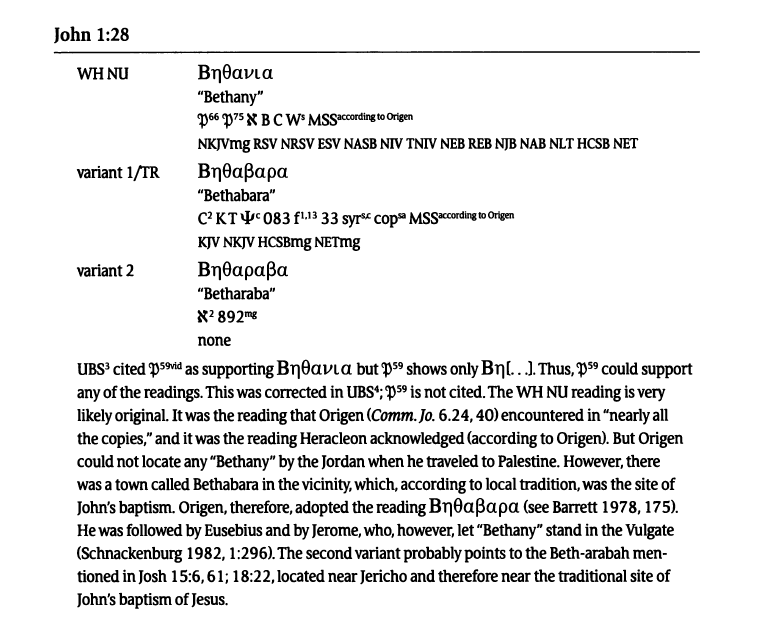
The WH NU reading is very likely original. It was the reading that Origen (Comm. Jo. 6.24,40) encountered in “nearly all the copies,” and it was the reading Heracleon acknowledged (according to Origen). But Origen could not locate any “Bethany” by the Jordan when he traveled to Palestine. However, there was a town called Bethabara in the vicinity, which, according to local tradition, was the site of John’s baptism. Origen, therefore, adopted the reading BrjGaPapa (see Barrett 1978,175). He was followed by Eusebius and by Jerome, who, however, let “Bethany” stand in the Vulgate (Schnackenburg 1982,1:296). The second variant probably points to the Beth-arabah mentioned in Josh 15:6,61; 18:22, located near Jericho and therefore near the traditional site of John’s baptism of Jesus.
(4) Comment on the Net Bible Version
{Embed}
NET Bible : The Biblical Studies Foundation
NET Bible : new Bible translation, free Bible software, Bible studies and related Bible materials, .
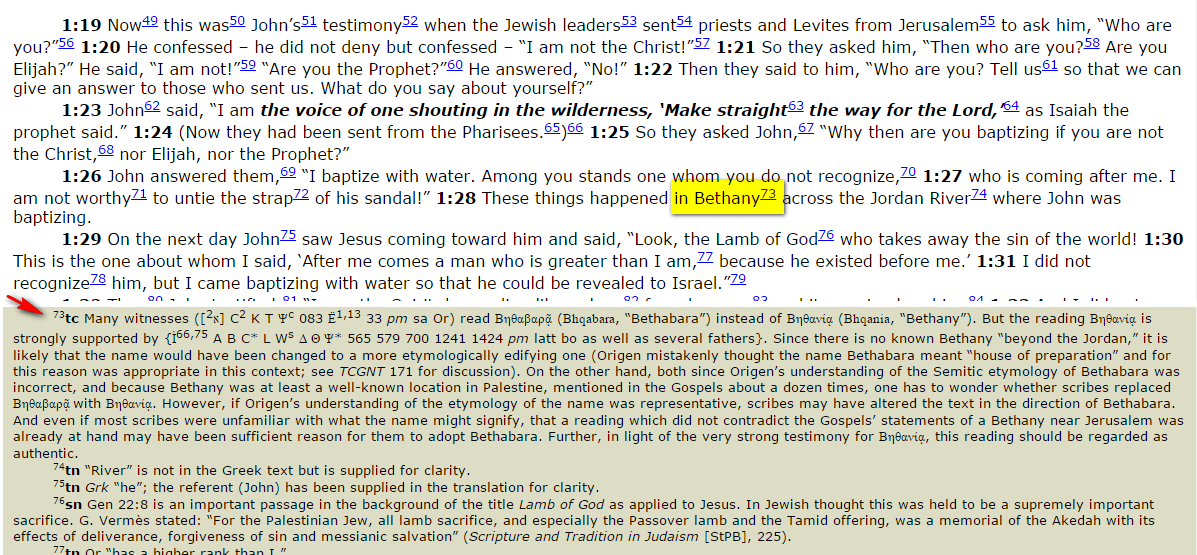
Many witnesses ([א2] C2 K T Ψc 083 Ë1,13 33 pm sa Or) read Βηθαβαρᾷ (Bhqabara, “Bethabara”) instead of Βηθανίᾳ (Bhqania, “Bethany”). But the reading Βηθανίᾳ is strongly supported by {Ì66,75 A B C* L Ws Δ Θ Ψ* 565 579 700 1241 1424 pm latt bo as well as several fathers}. Since there is no known Bethany “beyond the Jordan,” it is likely that the name would have been changed to a more etymologically edifying one (Origen mistakenly thought the name Bethabara meant “house of preparation” and for this reason was appropriate in this context; see TCGNT 171 for discussion). On the other hand, both since Origen’s understanding of the Semitic etymology of Bethabara was incorrect, and because Bethany was at least a well-known location in Palestine, mentioned in the Gospels about a dozen times, one has to wonder whether scribes replacedΒηθαβαρᾷ with Βηθανίᾳ. However, if Origen’s understanding of the etymology of the name was representative, scribes may have altered the text in the direction of Bethabara. And even if most scribes were unfamiliar with what the name might signify, that a reading which did not contradict the Gospels’ statements of a Bethany near Jerusalem was already at hand may have been sufficient reason for them to adopt Bethabara. Further, in light of the very strong testimony for Βηθανίᾳ, this reading should be regarded as authentic.
**(Some evidence reads “Bethlehem,” but the strongest evidence supports the reading “Bethany . ”)
Because there is no village called Bethany on the borders of the Jordan, the word was changed to Bethabara because it is more appropriate from a linguistic derivation point of view - as Origen made a mistake in explaining the meaning of Bethabara, which is that it means the house of preparation -…
In light of the very strong evidence in favor of the Bethany reading, it is the correct reading.
**
(5) Preacher’s Comment in His Interpretation
Preacher’s Complete Homiletical Commentary
PART I
THE PROLOGUE
CHAPTER Joh
THE ETERNAL NATURE AND INCARNATION OF THE WORD
(Joh . In Bethabara should be read ἐν βηθανίᾳ—in Bethania, or Bethany beyond Jordan. The change of name from the Bethany of the oldest MSS. seems to have been effected by Origen. In his day the name had been obliterated from the region of the Jordan; but finding that tradition pointed to a place called Bethabara as that where John baptised, he inserted that name. But, according to Godet, “As to the Bethany near the Jordan, it is more probable that its name is derived from Beth-Onijah ( אניה-navis), place of the ferry-boat. )
6Philip Schaff’s Interpretation
Schaff’s Popular Commentary on the New Testament
(John 1:28. These things were done in Bethany beyond Jordan. There can be no doubt that Bethabara is not the true reading in this verse. Origen, writing in the third century, states that he found Bethany in almost all copies of the Gospel. This statement is decisive. It cannot be set aside, nor indeed is it even lessened in weight, by the fact that Origen himself, owing to his inability to identify Bethany, believed Bethabara to be the place intended. ).
7Interpretation Of Robert Jameson and David Brown
Jamieson, Robert, D.D.; Fausset, A. R.; Brown, David. “Commentary on John 1:28”. “Commentary Critical and Explanatory on the Whole Bible”.
(28. Bethabara—Rather, “Bethany” (according to nearly all the best and most ancient manuscripts); not the Bethany of Lazarus, but another of the same name, and distinguished from it as lying “beyond Jordan,” on the east).
8Commentary By Matti El-Meskeen

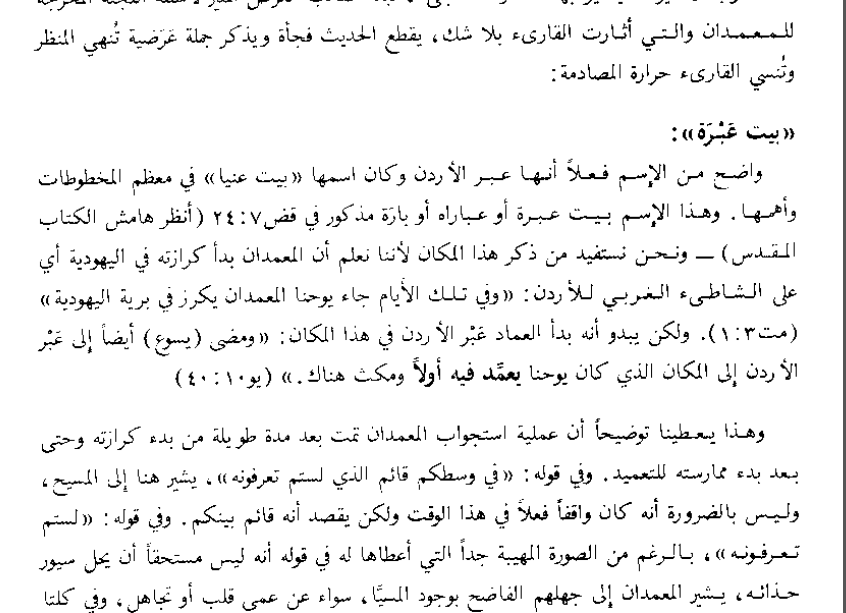
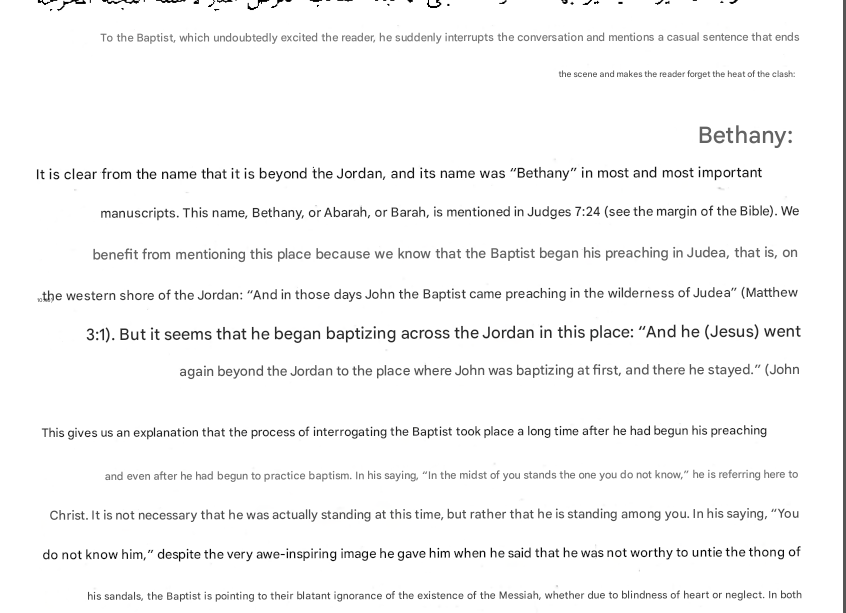
9Ellicott’s Interpretation
Ellicott’s Commentary for English Readers
“Bethabara must be Bethany. Origen found the reading Bethany in almost all manuscripts, but he did not find its location, so he expected it to be Bethabara, which he had heard from widespread tradition as the place of John’s baptism, and the fathers followed him in that…”
We cannot justify Origen’s decision to reject the testimony of all manuscripts.)
10Vincent’s Interpretation
Vincent, Marvin R. DD. “Commentary on John 1:28”. “Vincent’s Word Studies in the New Testament”
Verse 28
Bethabara ( βηθαναρᾷ )
The correct reading is βηθανία , Bethany. Not the Bethany of John 11:18, but an unknown village.)
11Barnes’ Interpretation
Barnes, Albert. “Commentary on John 1:28”. Barnes’ Notes on the New Testament.
(In Bethabara - Almost all the ancient manuscripts and
versions, instead of “Bethabara” here, have “Bethany,”
and this is doubtless the true reading).
( Bethany is the reading of the mass of authorities.)
13Adam Clarke’s Interpretation
Clarke, Adam. “Commentary on John 1:28”. “The Adam Clarke Commentary”
(These things were done in Bethabara - It is very probable that the word Bethany should be inserted here, instead of Bethabara. This reading, in the judgment of the best critics, is the genuine one. The following are the authorities by which it is supported: ABCEGHLMSX, BV, of Matthai, upwards of a hundred others, Syriac, Armenian, Persic, Coptic, Slavonic, Vulgate, Saxon, and all the Itala, with some of the most eminent of the primitive fathers, before the time of Origen, who is supposed to have first changed the reading. ..There was a place called Bethany, about two miles from Jerusalem, at the foot of the mount of Olives. But there was another of the same name, beyond Jordan, in the tribe of Reuben. It was probably of this that the evangelist speaks; and Origen, not knowing of this second Bethany, altered the reading to Bethabara. )
14Alford Henry’s Comment: -
Alford, Henry. “Commentary on John 1:28”. Greek Testament Critical Exegetical Commentary.
(the common reading, βηθαβαρᾷ, is owing to a conjecture of Origen…
It will be seen that his testimony is decisive for the universality and authority of βηθανίᾳ, while for the other he only produces a tradition, and that only at second-hand; “they say that such a place is shewn.”)
Second: The Collapse of the Rules of the Nasib Currency
…There is no disagreement among scholars about the existence of many important differences between the manuscripts of the Bible, but the disagreement is over other things: -
Can the text of the New Testament be reliably reconstructed?
If possible, what are the rules that can be followed?
The overwhelming majority of textual criticism scholars adopt the following rules:
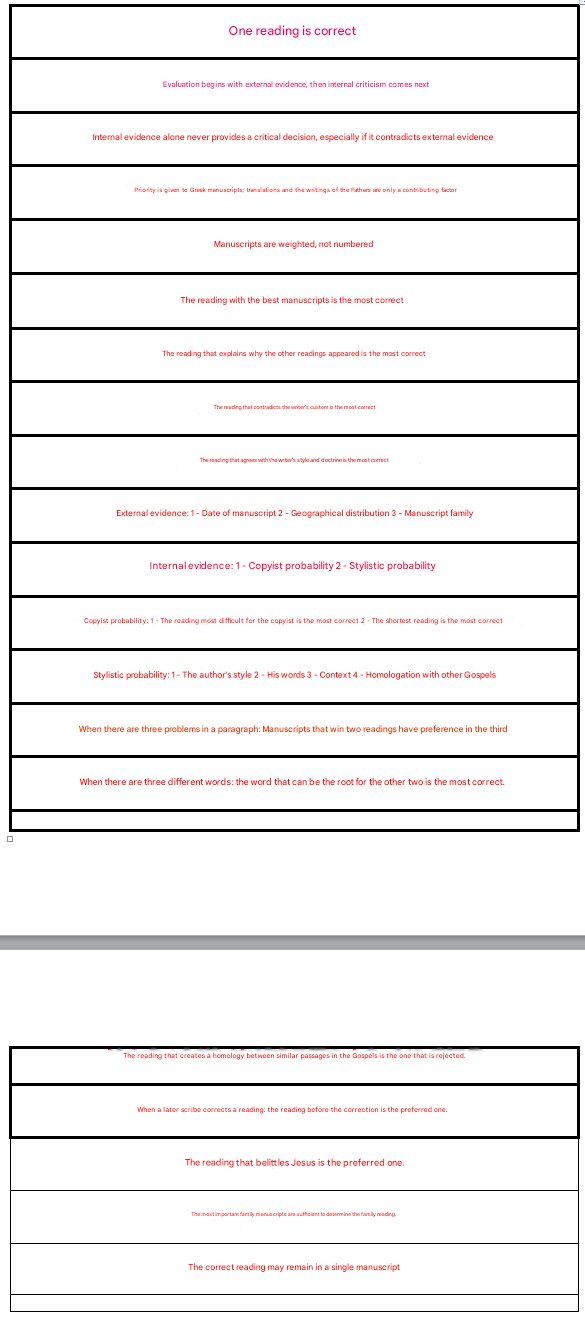
Accordingly, most scholars say that the manuscripts of the early Alexandrian text are superior, and that the evidence of the Byzantine text is later evidence.
Defenders of the authenticity of the Byzantine text (similar to the present text) argue that it is the most ancient manuscript.
But no one has ever claimed that the Byzantine text possesses manuscripts older than those we have.
.
The situation has become that the Alexandrian text manuscripts are the oldest and most scholars prefer them.
The Byzantine text manuscripts are the most recent and are supported by a small number of scholars.
But a new doctrine has emerged from some Christian people that no one has ever spoken of in the East or the West, which is:
(The current Byzantine text is supported by the oldest and most complete manuscripts.)
No one has ever said that.
This pattern of lying was followed by a series of lies. This person considered the Latin manuscripts to be from the second century! (Although they are not a Byzantine text)
The Tatian Diatessaron from the 2nd century!
And the Peshitta from the second century!
Even the Arabic translations of the Diatessaron date back to the second century!!
Of course, this statement can only be made by someone who deliberately misleads… these dates have never been mentioned by any scholar, whether a supporter of the critical text or the traditional text.
But I say: -
O followers of this school of thought… O supporters of the textual criticism, which is not textual criticism, now you have come across a problem that is supported by all the evidence that you have given priority and utmost importance.
The critical apparatus of this ostracist critic:
1The ancient Latin manuscripts date back to the second century.
2The Peshitta Khaburs dates back to the second century.
3The Washington Manuscript dates back to before the second century.
4The Arabic translations of the Diatessaron date back to the second century.
5The Latin Vulgate is more important than the Alexandrian Greek.
Now all these manuscripts chose to read (Bethany), so do you recognize the superiority of the Bethany reading??
This problem puts him in an awkward position, as he will contradict the testimony of all the manuscripts that he considers the best evidence.
Then, continuing to fabricate the rules of textual criticism, he belittled the Alexandrian manuscripts, which are almost unanimously agreed upon as superior by all textual criticism scholars. He belittled the accuracy of Sinaiticus and Ephraim… But here in this problem, we see him clinging to them, even though they bear witness to the reading of “Bethany,” but he clings to the change that occurred to them by a late copyist from the sixth and seventh centuries who wrote “Bethabara” in the margin… So now he is citing the margin of Sinaiticus…
Why did you contradict the testimony of the testimony of Al-Khabouris, which you have always filled the world with…which is the manuscript that has no value at all in the science of textual criticism and dates back to the twelfth century?
You will contradict the testimony of the ancient Latin which you made from the second century? And the Vulgate? And the Peshitta which you made from the second century?
The New Testament likened the Christian apostle Paul to a donkey that finds it difficult to resist its driver’s blows. The Bible says, “It is hard for you to kick against the goads.” Goads are whips used to strike animals, and the animals are unable to repel them even by kicking.
I borrow this analogy and say to the owners of the Nasibi criticism (It is difficult for you to kick against the goads even if you kicked all day long).
Responses and Comments: -
These are some of the defenses offered by some Christian followers of Textual Criticism and the responses to them: - 1The reading “Bethlehem” is present in the Ephraimite manuscript from the fifth century, and it is present in the margin of Sinaiticus as a correction by the original copyist! *The response: - 1Many manuscripts suffered from the problem of correctors.. And the corrector, as Robert Waltz’s Encyclopedia of Textual Criticism tells us: is a person who changes a good early reading and replaces it with a later, bad one in order to transform the manuscript to support the circulating text of a later time.
(We donʼt know how or whether early manuscripts were
corrected. In a scriptorium, however, it was the practice that a
manuscript be checked as soon as it was finished. This was the
task of the straightener, literally “one who straightens,” which
we might loosely render as “guy supposed to make this thing
right.” The diorthotes was often a scribe specially trained to
find and rectify mistakes, though we often find a scribe acting
as his own diorthotes).
The Encyclopedia of New Testament Textual Criticism,PG213
Among the most important manuscripts that suffered from this issue are the Sinaiticus and the Ephraimites.
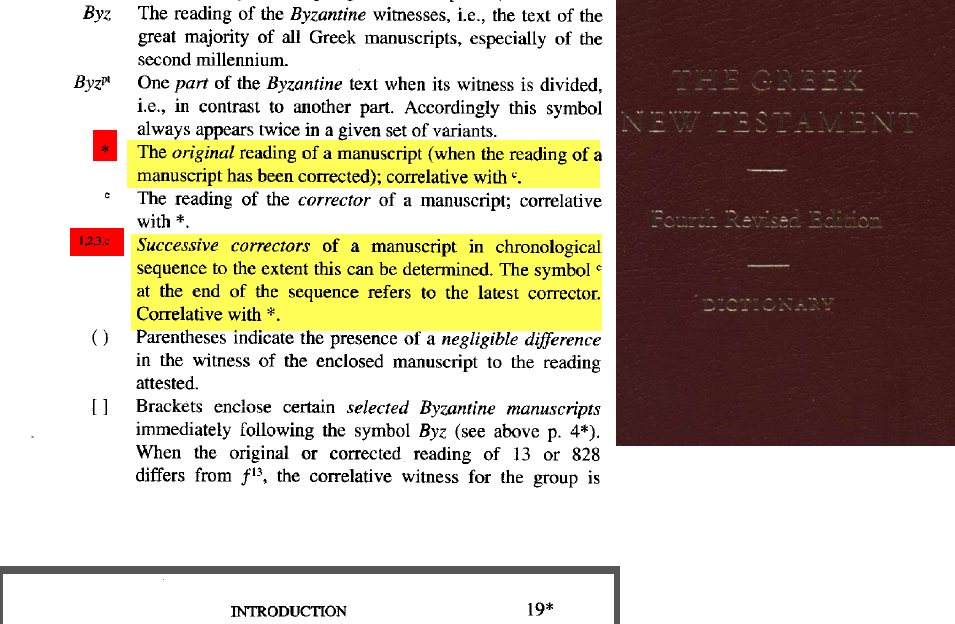
Attached is a list of the correctors, their dates, and their symbols from the book The Text of the New Testament by Kurt Aland.
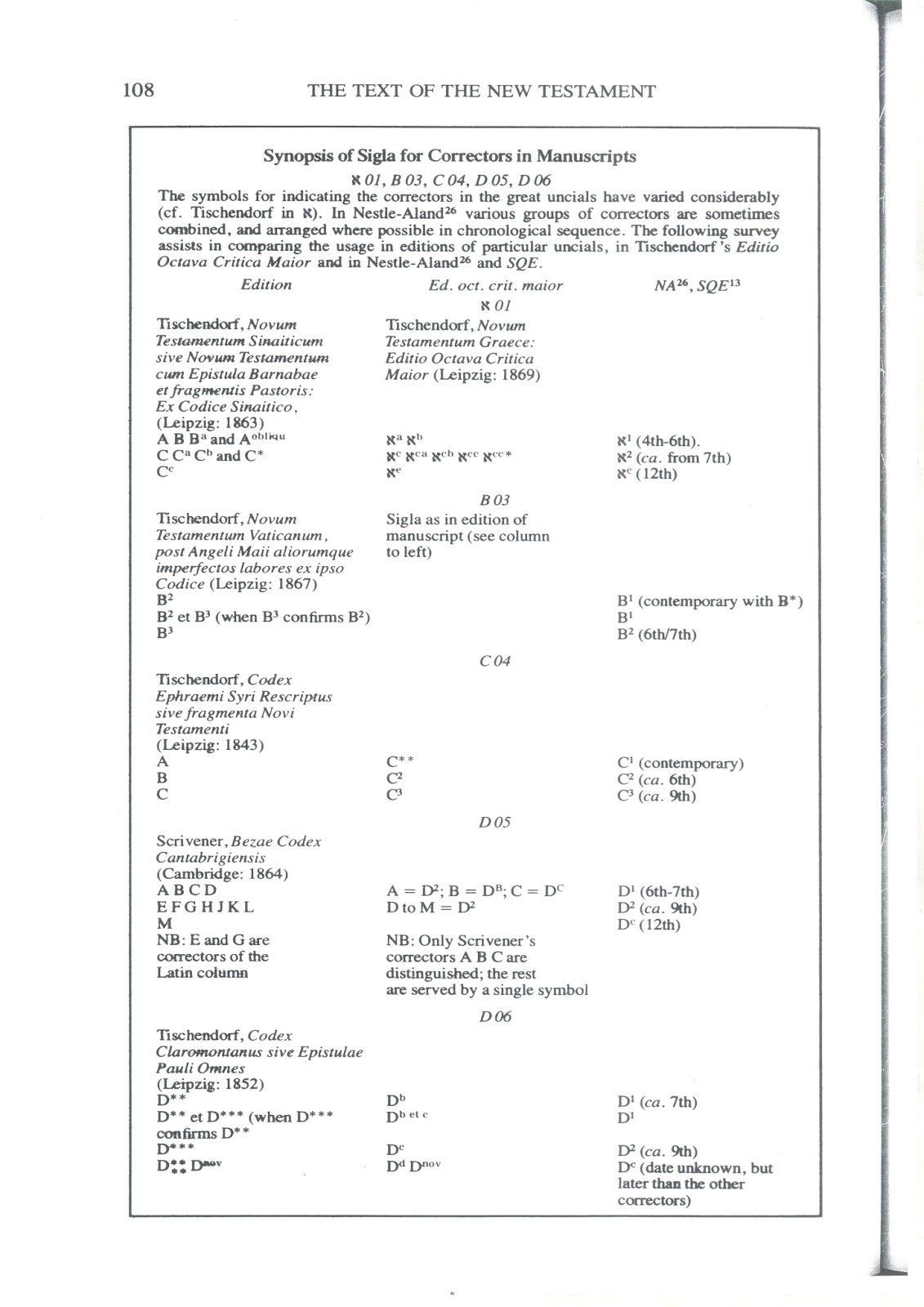
2All critical versions have placed Sinaiticus and Ephraimite as evidence for the reading “Bethany” as shown in the research.. This is enough to end the issue
|
3The UBIS committee that used the two manuscripts as evidence for the reading “Bethany” explained that the reading “Bethabara” found in Ephraimite is a change from scribe number C2 who is from the sixth century… It also stated that the correction found in the margin of Sinaiticus is the work of the scribe called X2 who is a person from the seventh century! And not the original scribe Attached is a photo showing the committee’s statement that the original reading in the two manuscripts is “Bethany”
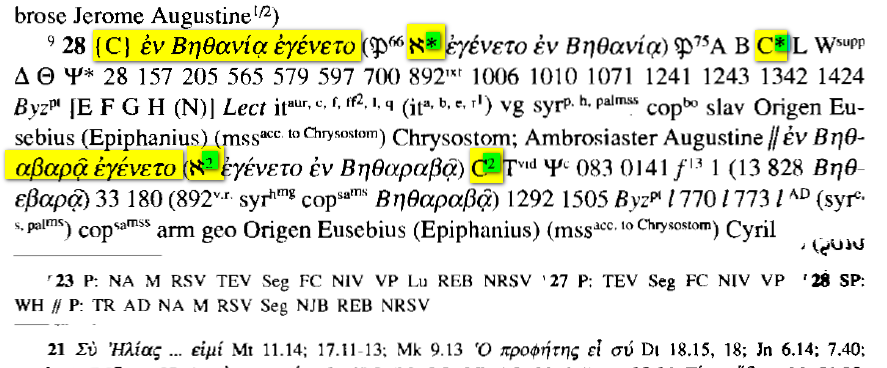
2The Sinaiticus correction dates back to the fourth century! This is wrong. The corrector dates back to the seventh century and is symbolized by X2 according to some or XCa according to others. I have attached a photo with the names of the correctors and their dates from the book Text of the New Testament by Kurt Aland above. Below are five versions and critical comments that mention the corrector’s symbol:
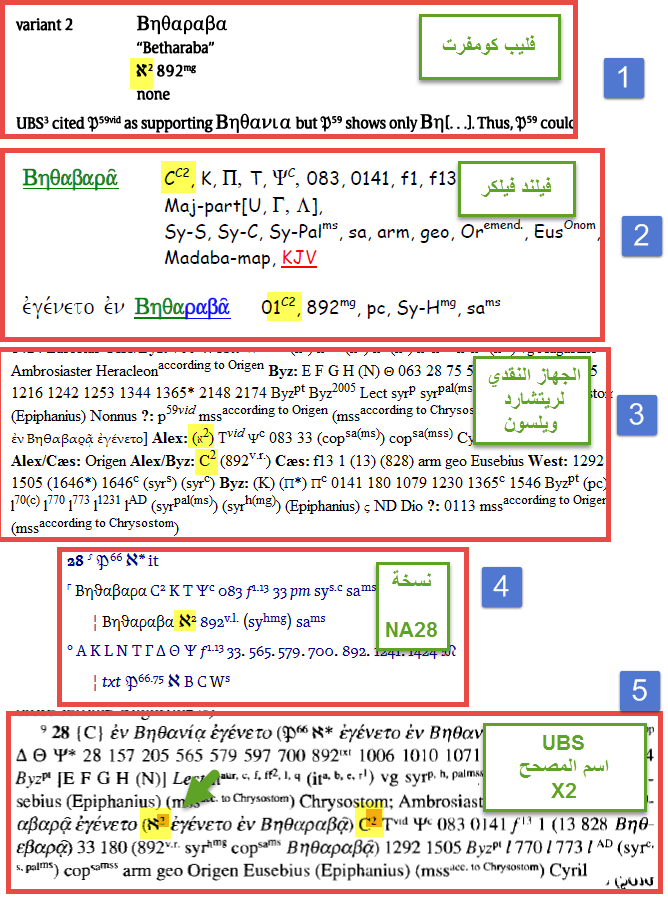
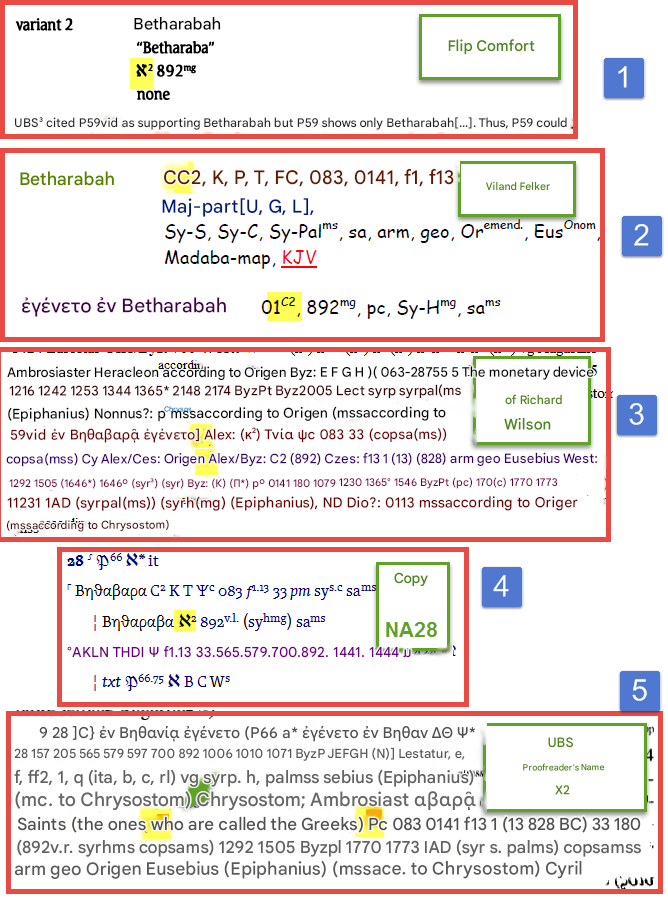
3The Text is Found in the Upper Egyptian Coptic Manuscript from the Third Century?
…This is incorrect. The Upper Egyptian manuscript called the Crosby Schoyen dates back to the beginning of the quarter century, not the third. Furthermore, it is a translation of an Alexandrian text, while all the original language Alexandrian manuscripts differ from it. It is well established among all textual critics that priority is given to manuscripts in the original language, not to translations.
Let us take, for example, the Encyclopedia of Textual Criticism:
The importance of translations and quotations from the Fathers is limited to knowing the history of the text and not to determining the original reading.
The Encyclopedia
of New Testament Textual Criticism
by Robert B. Waltz
Inspired by Rich Elliott
Pg 9
The ancient translations of the Greek New Testament. These are highly valuable in some ways — they are usually early (the oldest Latin, Syriac, and Coptic versions date from the second to fourth centuries, and the Armenian probably to the fifth), and we know what part of the world they come from. But they also have drawbacks: No translation, even if precise and literal (and not all these translations are) can exactly render the wording of the Greek original. Also, the versions have a textual history of their own, which means we have to reconstruct their readings. Finally, it is worth remembering that, although a version may exist in thousands of copies, it is usually translated from no more than a handful of Greek originals***. Thus the versions are very important for determining the history of a variant reading, but sometimes less useful for determining the original text….. Hence the Fathers, like the versions, are best used to establish the history of the text.
Another Testimony from the Scholar Benjamin Warfield (priority for Greek manuscripts)
AN INTRODUCTION TO THE TEXTUAL CRITICISM OF THE NEW TESTAMENT
BENJAMIN B. WARFIELD, DD.
Professor of New Testament Criticism in the Western Theological
Seminary, Allegheny, U.S.A
PG 16
THE first duty of the student who is seeking the true text of the New Testament is obviously to collect and examine the witnesses to that text. Whatever professes to be the Greek New Testamentis a witness to its text. Thus we observe that copies of the Greek Testament are our primary witnesses to its text. The first duty of the textual critic is, there fore, to collect the copies of the Greek Testament, and,comparing them together, cull from them all their various readings
And many other certificates…
There is no dispute among scholars on this issue.
4Reading A Verse of a Lesson Found in Armenian and Georgian Manuscripts from the Fifth Century
..We do not have any Armenian or Georgian manuscripts from the fifth century.. The available manuscripts start from the tenth century.
Neither it nor Armenian has any value in reconstructing the text.
5Reading Bethany is a Copyist Error?
A copyist error in all early manuscripts over six centuries, and it remains until the fourteenth century… It is clearly a strange coincidence that all of these people make mistakes.
Wrong in all languages. Strange coincidence too.
In any case, there is no verbal similarity for us to say that an error occurred, and if this was an error, it would challenge the infallibility of the book at its core, as the spread of the “error” in almost all the manuscripts of the first six centuries, the most important and best, and in all languages, families and levels. This matter makes the claim that (the spread was sufficient to protect the book from distortion) a fallen claim, as it did not protect it from errors for six centuries.
There is also a clear reason for the change mentioned by scholars and we have explained it.
6Net Bible, Viland Felker “Walker” and Philip Comfort testify to the reading of Beit Abra!
The words of the three are explained above in detail and their testimony is clear to read Bethany without any ambiguity.
7The name of Beit Abra is found on a map drawn on the tiles of a church in Jordan from the sixth century!!
Anyone who finds information in his Bible will certainly adopt it, and with the Bethany reading appearing strongly in the Byzantine text starting from the sixth century, it was natural for any Christian to rely on information from the (late Byzantine) Bible in drawing his map of Palestine…
This map has nothing to do with text recovery. What do we gain from the presence of the town name Bethabara on a map? What concerns us is the biblical manuscripts.
There is no need to abandon the overwhelming evidence of the first five centuries and rely on something that is a reflection of later Byzantine readings.
This testimony is against the Bethany reading, because it proves the existence of the town of Bethany at the Jordan crossing - as the claimant imagines - and therefore what is the justification for changing the Bethany reading to Bethany?? There is none… Therefore, the Bethany reading does not explain the emergence of the Bethany reading, but the opposite is true. Therefore, the Bethany reading becomes more subject to the important rule of transcriptional probability (the reading that explains the emergence of other readings that are more difficult for the copyist will be the preferred reading).
8Eusebius and Jerome testified to the reading of Beth Israel.
None of them relied on manuscript evidence, but rather on intuition and conjecture alone. They considered that the correct reading should be Beit Ibara because there is no Bethany on the borders of the Jordan!!
Jerome wrote (Bethany) in the Vulgate, which means that he explicitly acknowledges its superiority in terms of manuscripts…
finally …
The following is Required of a Christian
1One textual critic said that the reading of Bayt Ibra is authentic.
2One textual critic said that the oldest manuscripts testify to the reading of Beit Ibrah.
3One critical edition chose the reading of Bayt Abra as the correct reading.
4One Greek manuscript before the sixth century to read the House of Lestrade
5One reason why the copyist changed the reading of Beit Abarah to Beit Aniyah
TOP
.