

Hadith: 'Were It Not for Bani Israel, Meat Would Not Spoil' — Explained
The hadith “Were it not for the Children of Israel, meat would not spoil” is among the narrations that modernists, Quranists, and rationalists have seized upon to attack the transmission of the Prophetic Sunnah. Their claim is simple: meat spoilage is a biological fact governed by bacteria and decomposition — it cannot have a historical human cause rooted in the behaviour of a particular people. Therefore, they argue, the hadith contradicts reason, nature, and experimental science, and must be rejected or used to discredit its transmitters — including Abu Hurairah (RA), Imam al-Bukhari, and Imam Muslim. This article examines and dismantles that claim in full, presenting the hadith text, its transmission, the scholarly responses to the objection, the three classical interpretations of the meaning, and the precise Arabic linguistic analysis that resolves the apparent difficulty once and for all.
Abu Hurairah (RA) reported that the Messenger of Allah ﷺ said:
“Were it not for the Children of Israel, meat would not spoil. And were it not for Eve, no woman would ever betray her husband.”
Grade: Sahih · Al-Bukhari (3330, 3399) and Muslim (1470)
The Objection and Its Origins
Prominent voices in the modernist and rationalist camp have stated this objection plainly. Abdul Hakim Al-Fitouri said: “The spoilage and rot of meat has no relation to religion, region, or color. Rather, it is subject to factors determined by modern science, such as bacteria, viruses, and other things. Perhaps part of this narrative is a product of religious and sectarian racism, because the smell of sectarian conflict between Muslims and others — especially Jews — is clear and evident in it.”Civil Dialogue Magazine, Second Article, Issue 2612, published 10/4/2009 AD
Dr. Yusuf al-Qaradawi went so far as to say in a televised interview: “Al-Bukhari made a mistake, and the sheikh of al-Bukhari who took it from him made a mistake, and the sheikh of his sheikh also made a mistake.” He then called for specialists to reconsider the hadith’s authenticity on account of its alleged violation of natural laws.
Others on social media repeated the same claim: that meat spoiled in the time of Moses, and before and after him, and that nothing in the hadith can be correct if understood literally.
For further video explanations of this hadith, see:
Dismantling the Illusion: Six Critical Responses
The objection contains several fallacies. Each is addressed in turn.
Where Were the Masters of Reason for Fourteen Centuries?
The most immediate question to put to the objectors is this: the most intelligent scholars in Islamic history — hadith masters, jurists, linguists — all received, authenticated, and transmitted this hadith without finding anything objectionable in it. Is it conceivable that the entire chain of scholarship from the Companions down to al-Bukhari and Muslim, and every commentator after them, missed what a modern rationalist has supposedly discovered? Abu Bakr Ibn al-Arabi (d. 543 AH) addressed exactly this kind of objection in his time:
The Transmission Forecloses the Error Argument
Those who say Abu Hurairah erred or that al-Bukhari erred do not know — or deliberately ignore — that this narration is preserved in the collection of Hammam ibn Munabbih, the eminent Tabi’iA Tabi’i is a member of the generation that followed the Companions; Hammam ibn Munabbih was among the earliest to write down hadiths directly from Abu Hurairah who recorded in writing what he heard directly from Abu Hurairah (RA). His written collection, known as Al-Sahifah al-Sahihah, eliminates any possibility of error through forgetfulness. Furthermore, the narration was transmitted by Hammam alongside several other prominent and trustworthy Tabi’in, completely precluding any reasonable suspicion of collective error on their part.
The Literal Reading Is Not the Only Reading — Nor Was It Ever
The objectors have committed the most elementary error in hadith interpretation: they imposed the most literal possible reading on a text and then declared the text false.
The scholars state plainly: no one — not Abu Hurairah, not al-Bukhari, not any Muslim commentator — ever understood this hadith to mean that meat physically could not rot before the time of Moses. It is impossible that something so obvious as the decomposition of flesh would be hidden from the Companions and the Tabi’in and all who followed them. The article’s own analysis states:
On the Possibility of Accelerated Decay as a Divine Punishment
It is also logically sound — and not precluded by modern science — that God created causes that accelerated the spoilage of meat at a particular time, or created new microbes that increased the severity and speed of putrefaction in a manner not present before. The article notes:
There is a distinction, moreover, between the decomposition of a body over time and the rapid, foul-smelling putrefaction of stored meat — these are not identical processes, and the objector has conflated them. The claim that putrefaction as we know it today is an eternal, universal, and unchanged biological constant is not something experimental science can demonstrate for prehistoric or ancient times — it is an assumption of uniformitarianism, not a proven fact.
The Scholars’ Three Interpretations of the Hadith’s Meaning
Classical scholars have documented three distinct and complementary interpretations of this hadith, none of which require the literal reading the objectors falsely impute.
First interpretation: As a punishment for the Children of Israel’s distrust of Allah’s promise — that He would send down quail regularly, so they had no need to store it — meat became rotten when stored from that point onwards. This is the opinion of Qatada ibn al-Nu’man and al-Qurtubi, among others.
Second interpretation: People used to eat only fresh meat at the time, without storing it, but Banu Isra’il were the ones to start storing meat until it went rotten. Had they not begun the habit of storing meat, meat would not have rotted in this way. This is the opinion of Wahb ibn Munabbih and Abu Nu’aym al-Asfahani.
The third interpretation is transmitted by Shaykh Muhammad Taqi Usmani in his commentary to Sahih Muslim:
Usmani then transmits the narration of al-Aini from Qatadah explaining the Sinai context:
The Arabic Linguistic Evidence Clinches the Matter
The most decisive resolution of the objection comes from the precise Arabic meaning of the word in the hadith itself.
This linguistic point is confirmed by Al-Raghib al-Asfahani in his Mufradat:
The pre-Islamic Arab poet Tarafa ibn al-Abd (d. 60 BCE) used the word in precisely this sense in his diwan:
This is further confirmed by Al-Suyuti in Al-Muzhir (1/368) and Al-Zamakhshari in Al-Faiq fi Gharib al-Hadith (1/399).
The hadith therefore is not about meat decomposing in the biological sense — it is about the specific phenomenon of stored-meat putrefaction becoming a general practice, which the Children of Israel initiated through their greedy hoarding.
The Three Classical Interpretations in Full
First Interpretation: God’s Wisdomin Making Meat Perishable as a Check on Stinginess
This interpretation holds that God Almighty, knowing in advance the stinginess and hoarding that would emerge among the Children of Adam — most notably the Children of Israel — decreed that meat would spoil, in order to prevent the wealthy from hoarding it indefinitely at the expense of the poor. Support for this reading comes from a narration transmitted by Abu Nu’aym in Al-Hilya (4/37):
The lesson is that the spoilage of meat is itself a mercy — a divine mechanism preventing the concentration of food in the hands of the miserly at the cost of those who need it.
Second Interpretation: Accelerated Putrefaction as a Divine Punishment
When God sent down manna and quails to the Children of Israel in the Sinai, He guaranteed them a continuous supply. They were commanded not to store it — particularly the quail meat. They disobeyed out of distrust in God’s promise and began to hoard, and God afflicted their stored meat with rapid spoilage beyond anything previously known.
Ibn al-Malik (d. 854 AH) states:
Under this interpretation, the hadith means: were it not for the Children of Israel introducing — and being punished for — the practice of storing quail meat, the specific form of rapid and foul-smelling putrefaction that resulted would not have become a feature of meat storage generally.
Third Interpretation: They Were the First to Spread the Sunnah of Hoarding
The Children of Israel, due to their stinginess and greed, were the first people to hoard food beyond their needs — including meat — as a general social practice. They spread this bad custom, which was previously unknown or uncommon. Their hoarding became the origin of meat spoilage becoming widespread.
Al-Baydawi states:
Because they were known for their stinginess in storing food, the Arabs called them by a term meaning the hoarders. Thus it is correct to say about them: if it were not for them, meat would not have spoiled — meaning, if it were not for their spreading this greedy method of hoarding, its spoilage would not have become widespread, since this act was not known among people before them.
This interpretation is analogous to the Prophet’s ﷺ saying about Qabil (Cain): “No soul is unjustly killed except that the first son of Adam bears a share of the blame, for he was the first to establish the practice of killing.” The causal connection is that the Children of Israel established the practice that led to the consequence — not that they altered the biology of meat.
The Talmud Itself Confirms the Miracle
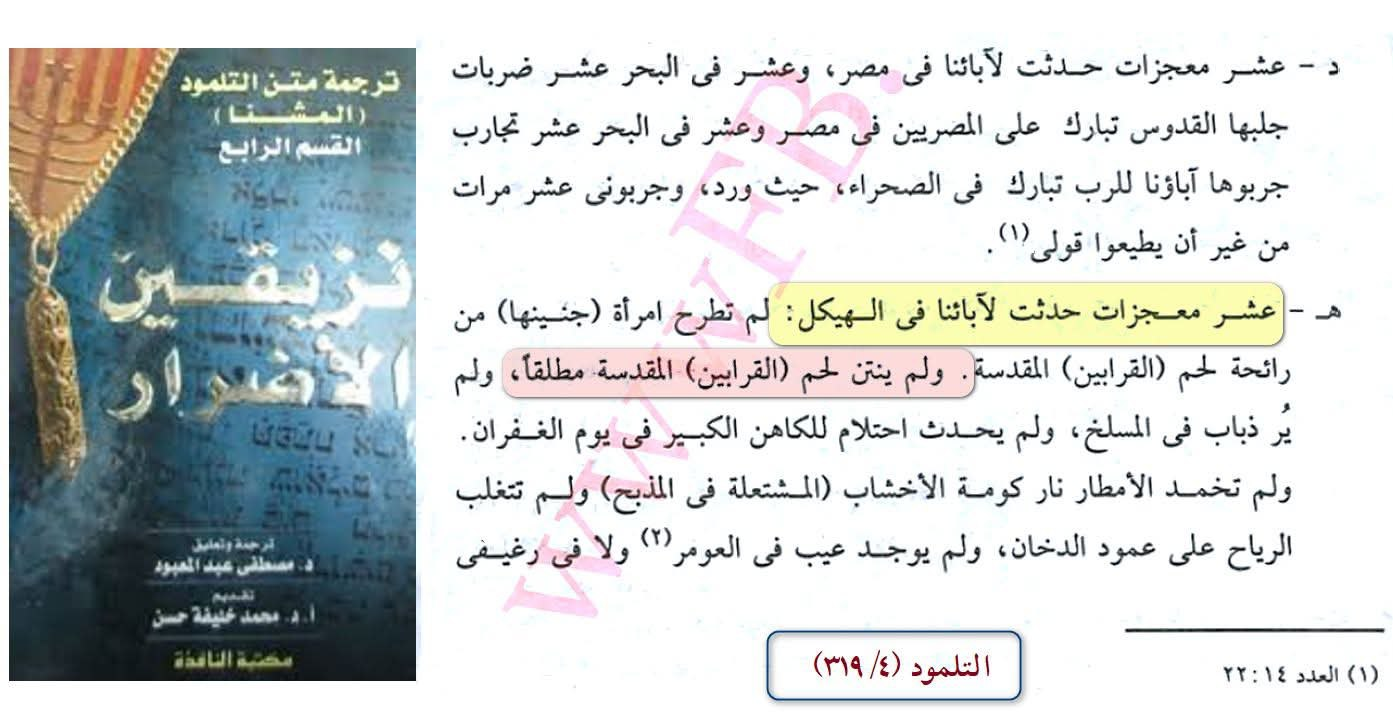
Remarkably, the Jewish tradition itself preserves a memory of this miracle. The article notes:
The sacrificial meat of the Children of Israel did not spoil — this was a miracle. When the priests and people corrupted the practice, turning sacrifices into a means of wealth and worldly gain and beginning to store them, God withdrew that blessing. From that point, the meat of sacrifices began to spoil like all other meat.
The image below is from a scholarly source elaborating on the hadith’s meaning in this context:
The Correct Disposition Toward Such Narrations
The article concludes with the principle that Abu Bakr Ibn al-Arabi stated and that every student of knowledge must internalize:
Those who make experimental science a ruler over revelation do not pay attention to the fact that it is impossible for revelation to stand on one side and reason and science on the other. Would they accept the hadith if experimental science confirmed it in their era? Or would they simply change their standard again? With this, their standard is not submission to revelation — it is the sciences of their era and their concerns about them.
The correct meanings are:
- The linguistic meaning: Khanaza refers specifically to putrefaction from hoarding, not generic decomposition. The Children of Israel were the first to spread the practice of storing meat, and their hoarding caused its widespread spoilage.
- The punishment meaning: God afflicted their stored quail meat with accelerated, abnormal putrefaction as a punishment for their distrust and hoarding — and this became the general condition thereafter.
- The miracle meaning: The sacrificial meat of the Children of Israel was miraculously preserved as long as their practice was sincere. When they corrupted it, the miracle was withdrawn — confirmed even by the Talmud itself.
The hadith does not pose a problem for reason or science, correctly understood. It posed no problem to the scholars of the Sunnah for fourteen centuries, and it poses no problem today.