

Harut, Marut, and Venus: Weak Hadith or Ka'b al-Ahbar?
The narrative that the planet Venus was originally a woman who seduced the angels Harut and Marut, and was subsequently transformed into a star, has no authentic prophetic basis. The hadith is weak in its chains of transmission, and even if one were to consider its authenticity, it is established from ((Ka’b al-Ahbar)) — not from the Prophet ﷺ. Some scholars have erred in their assessment by arguing that a companion cannot speak of the unseen and therefore the narration must be attributed to the Prophet. This argument is incorrect: the version of the narration actually attributed to the Prophet does not contain the transformation of the woman into the planet Venus, and that version is also weak. The story, in its full form including the Venus transformation, is an Isra’iliyyatIsra’iliyyat: narrations sourced from Jewish or Christian traditions — typically from Jewish converts to Islam such as Ka’b al-Ahbar and Wahb ibn Munabbih — that entered Islamic exegesis. Their presence in tafsir literature does not grant them prophetic authority. originating from Ka’b al-Ahbar.
The Quranic Context: Surah Al-Baqarah 2:102
The Quranic verse that forms the basis of exegetical discussion in this matter is the verse on Harut and Marut in Surah Al-Baqarah.
And they followed what the devils had recited during the reign of Solomon. It was not Solomon who disbelieved, but the devils disbelieved, teaching people magic and that which was revealed to the two angels at Babylon, Harut and Marut.
The Quran mentions Harut and Marut directly in this verse but says nothing about a woman being transformed into Venus. The elaborate narrative of the angelic temptation, the woman’s ascent, and her transformation into a star is exegetical material — not Quranic content — and its source is the critical question.
The Narrative as Found in the Exegetical Sources
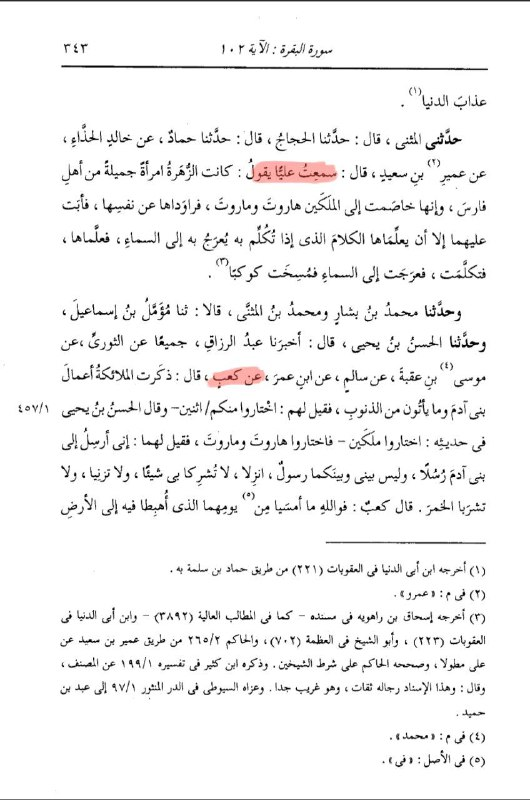
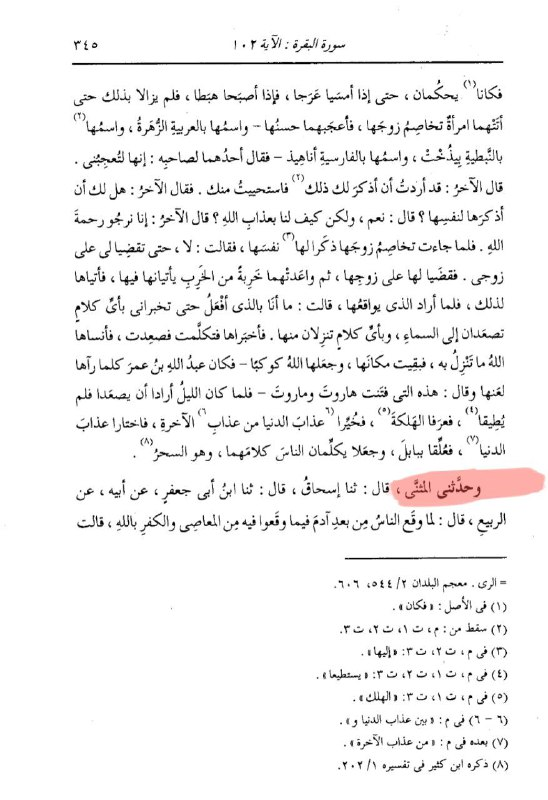
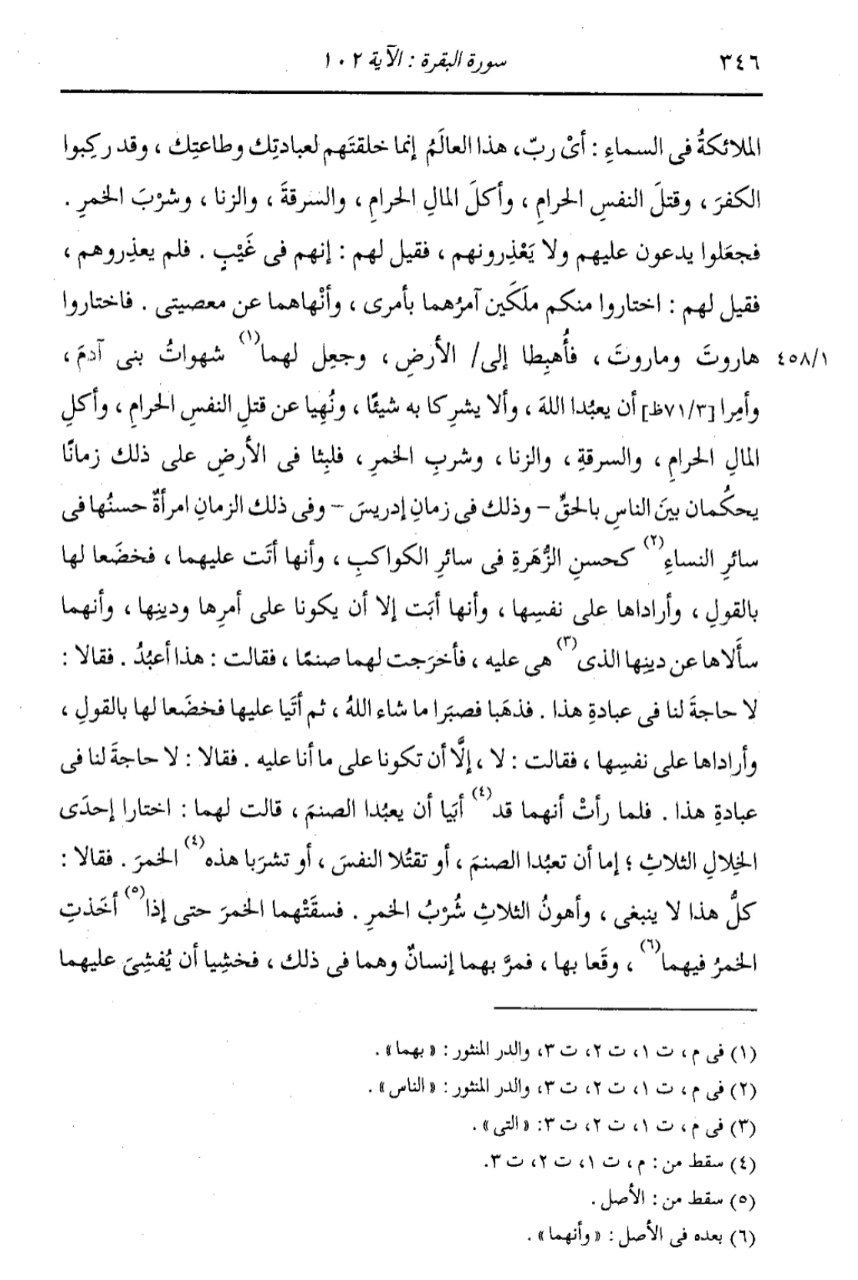
The tafsir literature contains an Isra’iliyyat narrative built around this verse. In this account, the angels question Allah about His patience with the sins of mankind. Allah responds that if He placed human desires within angels, they too would disobey. The angels are told to select two from among themselves to be sent down to earth. They choose Harut and Marut, sparing no effort in selecting the best candidates (فلم يألوا أن يختاروا). Sent down to judge justly among humans during the day, they remain obedient until they encounter a woman of extreme beauty — identified in the narrative as Al-Zuharah, Venus — who approaches them with a legal dispute. Overcome by a newly introduced human desire, they succumb to temptation and fall into sin, after which Al-Zuharah ascends back to the heavens and is transformed into the planet.
The following scans show the relevant source pages documenting this narrative and the critical apparatus surrounding it:
The analysis continues in the following source page:
Further primary source documentation from the same work:
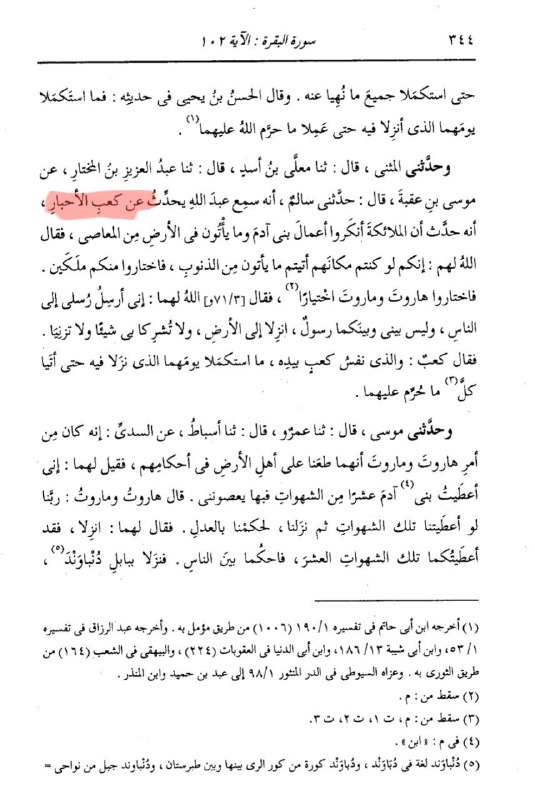
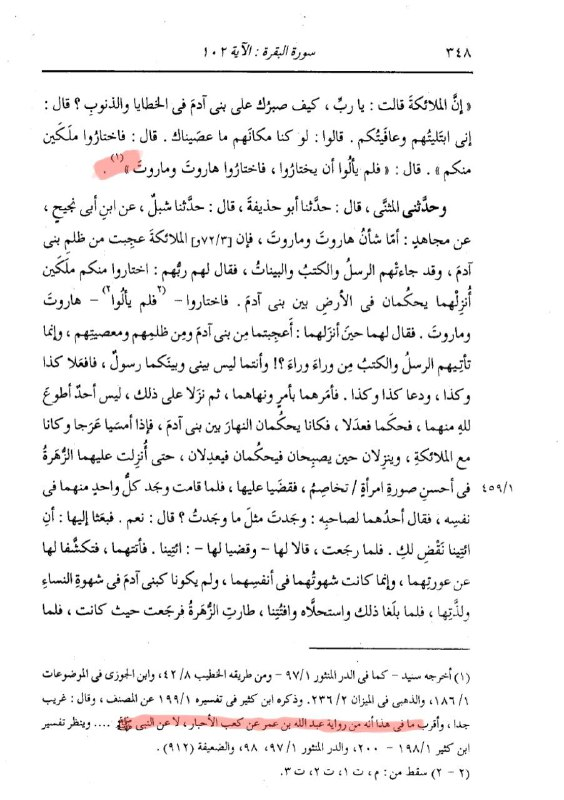
1. Context and Narrative of Harut and Marut
-
Source: The page discusses the exegesis of Surah Al-Baqarah: Verse 102 (page 348).
-
The Angelic Dialogue: It details an Isra’iliyyat narrative where angels question Allah about His patience regarding the sins of humankind despite their disobedience. Allah responds that if He placed human desires in angels, they would also disobey.
-
The Selection: The angels are told to select two from among them to be sent down to Earth. They choose Harut and Marut after sparing no effort in picking the best candidates (فلم يألوا أن يختاروا).
-
The Trial on Earth: Sent down to judge justly among humans during the day, they remain obedient until they encounter a woman of extreme beauty (identified as Al-Zuharah or Venus in human form) who approaches them with a legal dispute. Overcome by a newly introduced human desire, they succumb to temptation and fall into sin, after which Al-Zuharah ascends back to the heavens.
2. Footnotes and Critical Authentication
- Footnote 1 (Grading and Origin):
- The narration was extracted by Sanid, and cited in Al-Durr Al-Manthur, Al-Khatib, Ibn al-Jawzi in Al-Mawdu’at (Fabricated Hadiths), and Al-Dhahabi in Al-Mizan.
- Critical Verdict: Ibn Kathir mentions in his Tafsir that this report is extremely strange/anomalous (Gharib jiddan).
- True Attribution: The text highlights that the closest reality is that this story is from the narration of Abdullah bin Umar copying from Ka’b al-Ahbar (an Isra’iliyyat source), and NOT a prophetic tradition from the Prophet Muhammad ﷺ (من رواية عبد الله بن عمر عن كعب الأحبار، لا عن النبي ﷺ).
The Chain Evidence: Weakness and Fabrication
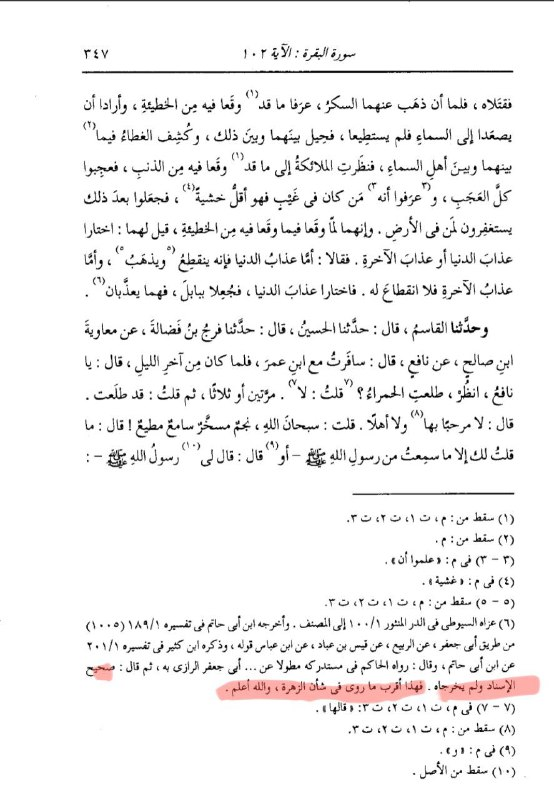
The classical hadith critics are unambiguous in their grading of the narrations underpinning this story. The documentation extends across multiple critical works, from Ibn al-Jawzi’s collection of fabricated hadiths to Al-Dhahabi’s Al-Mizan, and the consistent verdict is either da’ifDa’if: weak — a hadith whose chain of transmission contains a narrator of questionable reliability, an interruption, or another defect that prevents it from being used as evidence. or outright mawdu’Mawdu’: fabricated — a hadith whose chain contains a known liar or whose text contradicts established Islamic principles, rendering it inadmissible as evidence under any circumstances..
The following scan shows the chain analysis from the primary critical sources:
The critical apparatus continues across the next source page:
Further documentation from the manuscript sources:
The evidence continues in the following page:
Final source scan in this section:
The Conclusion: No Authentic Prophetic Hadith on Venus
The closest authentic narration does not contain the transformation of Venus at all. Everything specifically mentioning the woman’s transformation into the planet is sourced exclusively from Ka’b al-Ahbar, and there is no authentic hadith about it from the Messenger of God ﷺ.
The scholar’s argument that a companion cannot speak of the unseen — and therefore the narration must be elevated to prophetic status — does not hold. The version of the narration that is actually attributed to the Prophet ﷺ does not contain the Venus transformation. The transformation narrative belongs only to the Ka’b al-Ahbar version, which is an Isra’iliyyat account and carries no prophetic authority regardless of how it entered the tafsir literature.
For video discussions of this topic by classical scholars, see the following presentations: