How Christianity Was Forced on Egypt: Temple Destruction and Religious Coercion
·16 min read·3516 words
Christianity’s spread into Egypt was not a voluntary mass conversion — it was an imperial imposition enforced by law, military force, and the death penalty. This is not an Islamic polemical claim. It is the conclusion drawn by Coptic priests, Catholic historians, orientalists, and secular scholars alike, all citing the same chain of events: the decree of Emperor Theodosius, the demolition of temples, the closure of sanctuaries, the burning of the Library of Alexandria, and the murder of philosophers who resisted. The testimony gathered here comes from Christian sources themselves.
The Decree of Theodosius: Christianity by Imperial Edict
The foundational event in the forced Christianisation of Egypt is the imperial decree issued by Emperor Theodosius, which legally mandated Christianity as the sole permitted religion and ordered the closure of all pagan temples and shrines. This is not disputed — it is documented by Coptic historians writing approvingly of it.
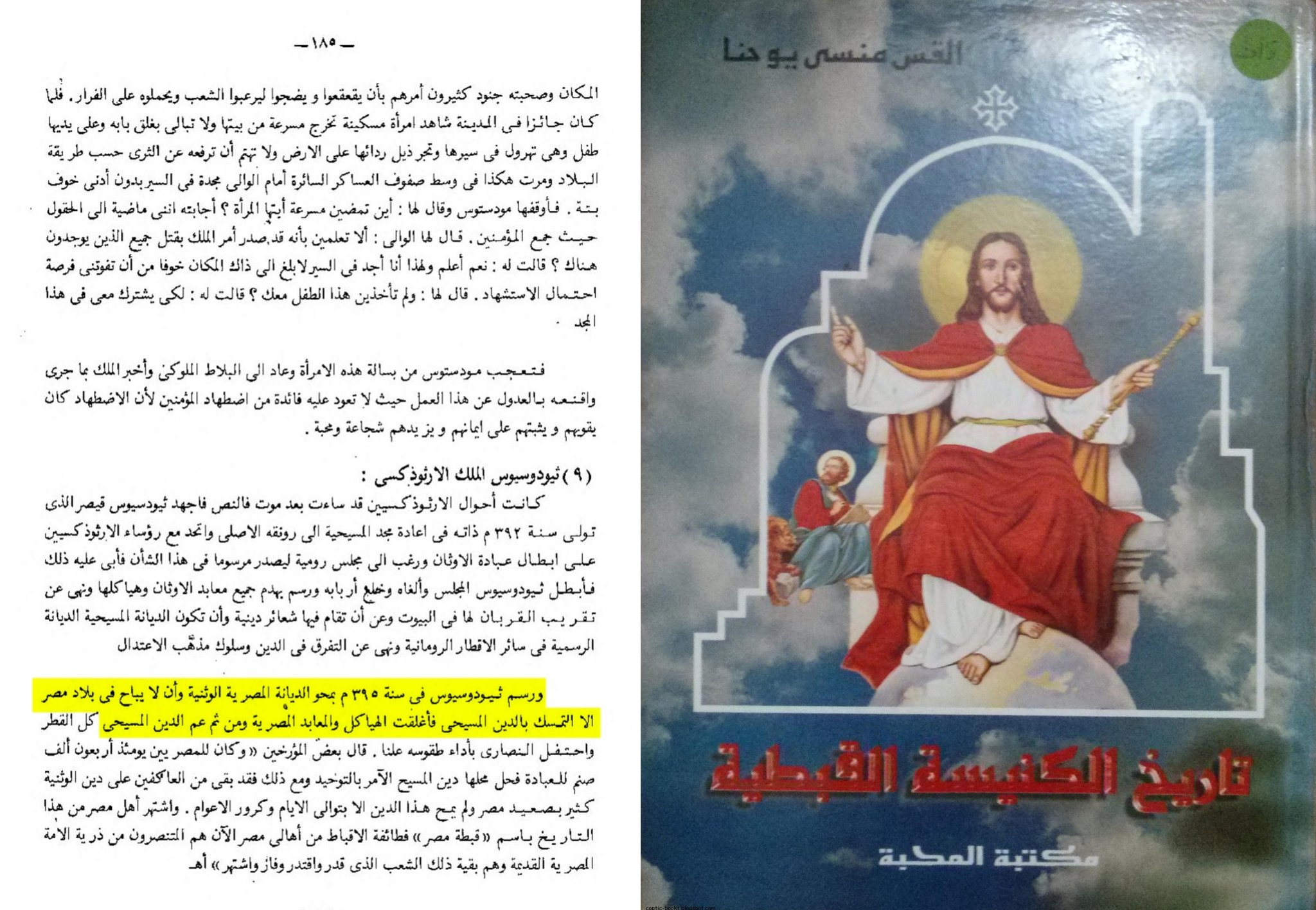
Father Mansa Yohanna, in his History of the Coptic Church, records the decree plainly:
Mansa Yohanna — History of the Coptic Church “And Theodosius decreed the abolition of the Egyptian religion and that nothing should be permitted in Egypt except adherence to the Christian faith, so the temples and Egyptian shrines were closed, and thus Christianity spread.”
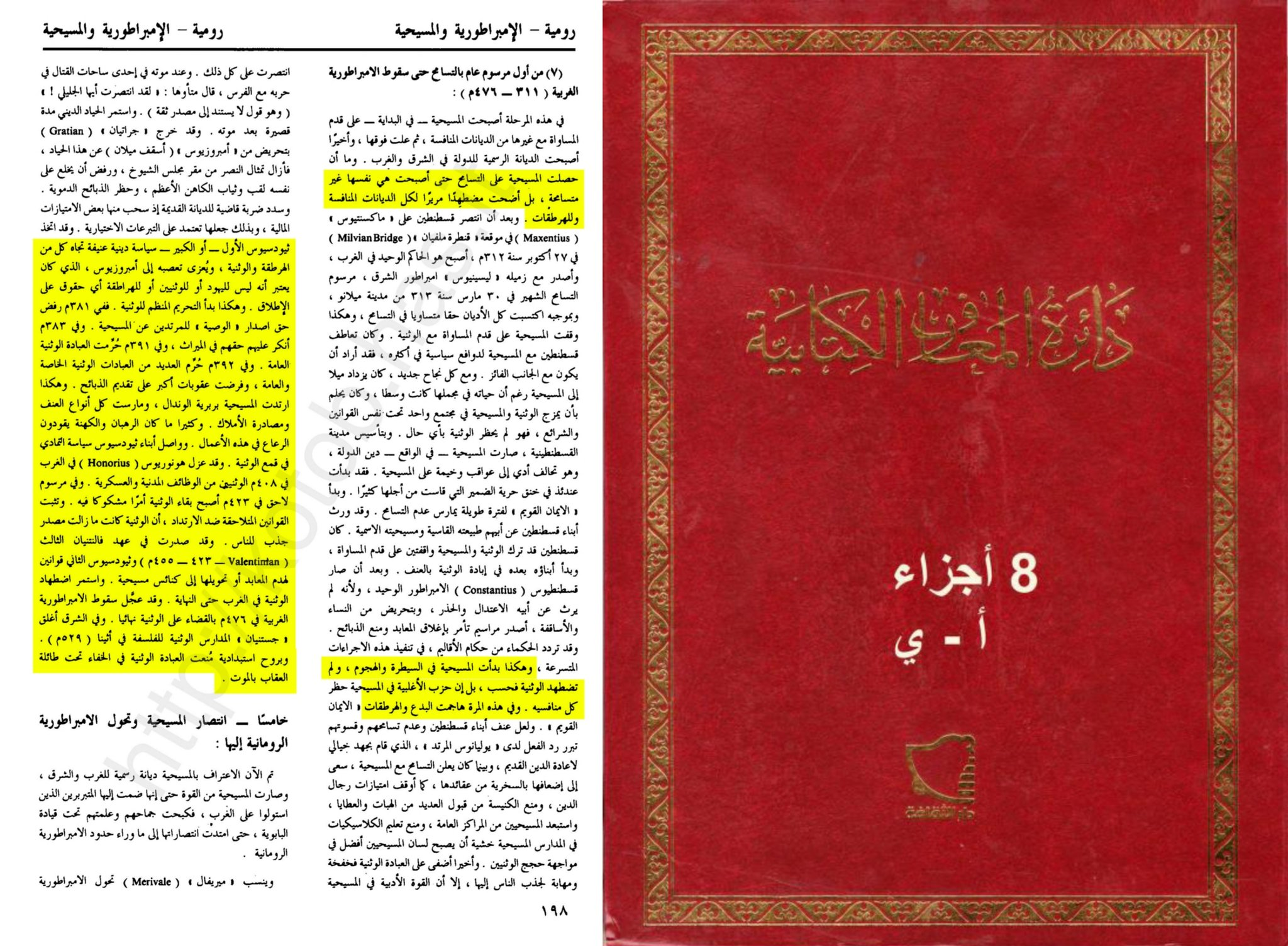
The following image reproduces the relevant passage from the source:
the spread of christianity through violence in egypt
Summary of Emperor Theodosius’ Decree (395 AD) In the year 395 AD, Emperor Theodosius issued a decree ordering:
The complete eradication of the pagan Egyptian religion.
A ban on practicing any religion in Egypt except for Christianity.
The closure of all ancient Egyptian temples and sanctuaries as a result of this mandate.
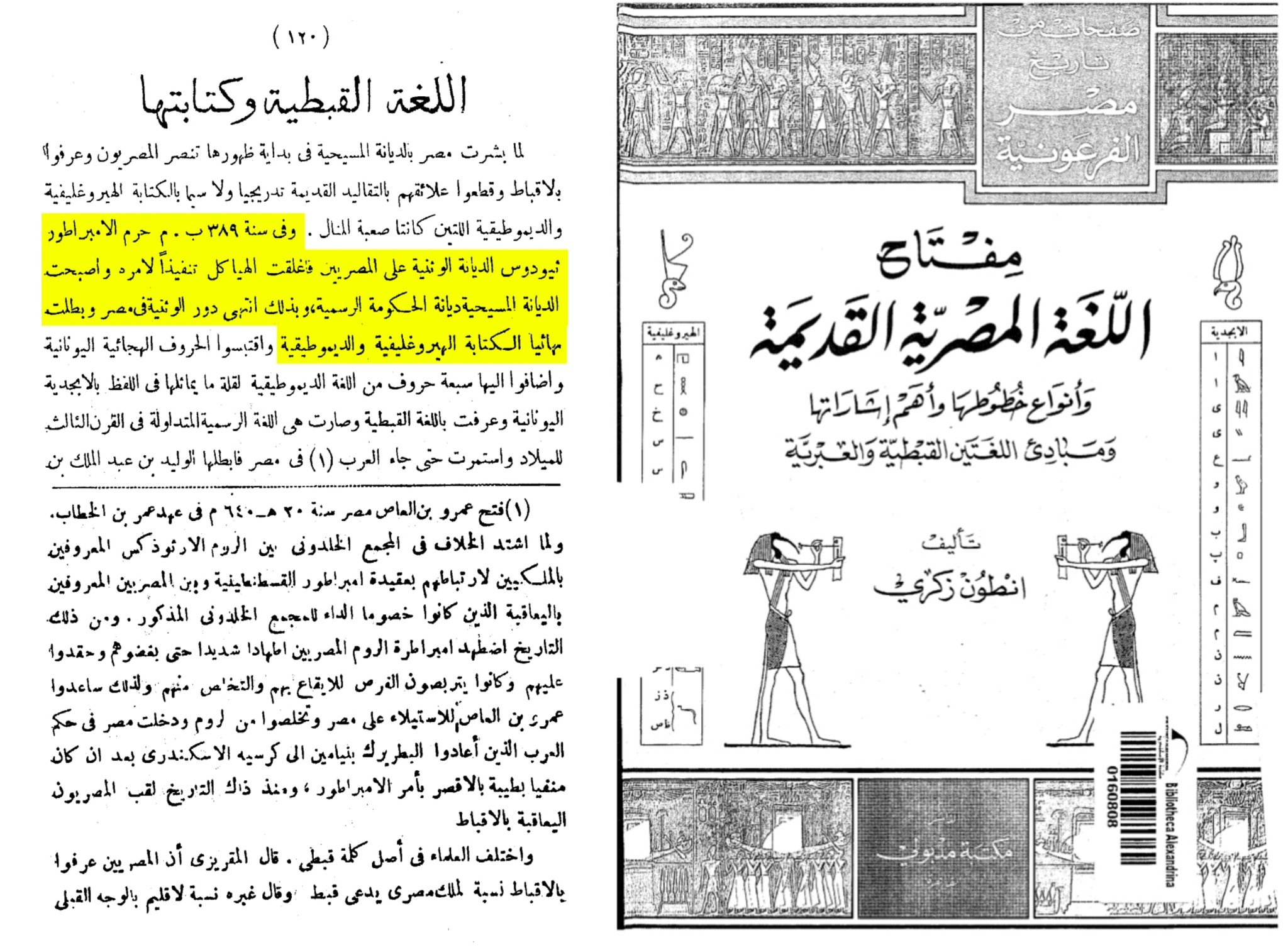
The Coptic writer Anton Zaki corroborates this account in full detail, adding that the forced adoption of Christianity also permanently erased the ancient Egyptian writing systems:
Anton Zaki — The Key to the Ancient Egyptian Language “The Emperor Theodosius prohibited the pagan religion among the Egyptians, so the temples and shrines were closed in implementation of his orders, and the Christian religion became the official religion of the government. Thus, the Egyptian religion came to an end, and the hieroglyphic and Demotic writing was completely abolished.”
The image below reproduces this passage from Anton Zaki’s work:
the spread of christianity through violence in egypt 1
Historical Shift in Religion and Writing (389 AD) The Key to the Ancient Egyptian Language (مفتاح اللغة المصرية القديمة) In the year 389 AD, the Roman Emperor Theodosius banned paganism in Egypt and ordered the closure of its temples. Christianity subsequently became the official state religion, effectively ending pagan practices. This shift also permanently halted the usage of ancient Egyptian scripts, specifically Hieroglyphic and Demotic writing.
The closure of temples and the abolition of the hieroglyphic script were not incidental — they were direct, documented consequences of a single imperial edict.
The Testimony of European Historians: Death for Worshipping Egyptian Gods
The account of coerced conversion is not limited to Coptic writers. The French historian Gustave Le Bon — writing in The Civilization of the Arabs — reaches the same conclusion, adding the critical detail that the death penalty was the punishment for anyone who continued to worship the gods of Egypt:
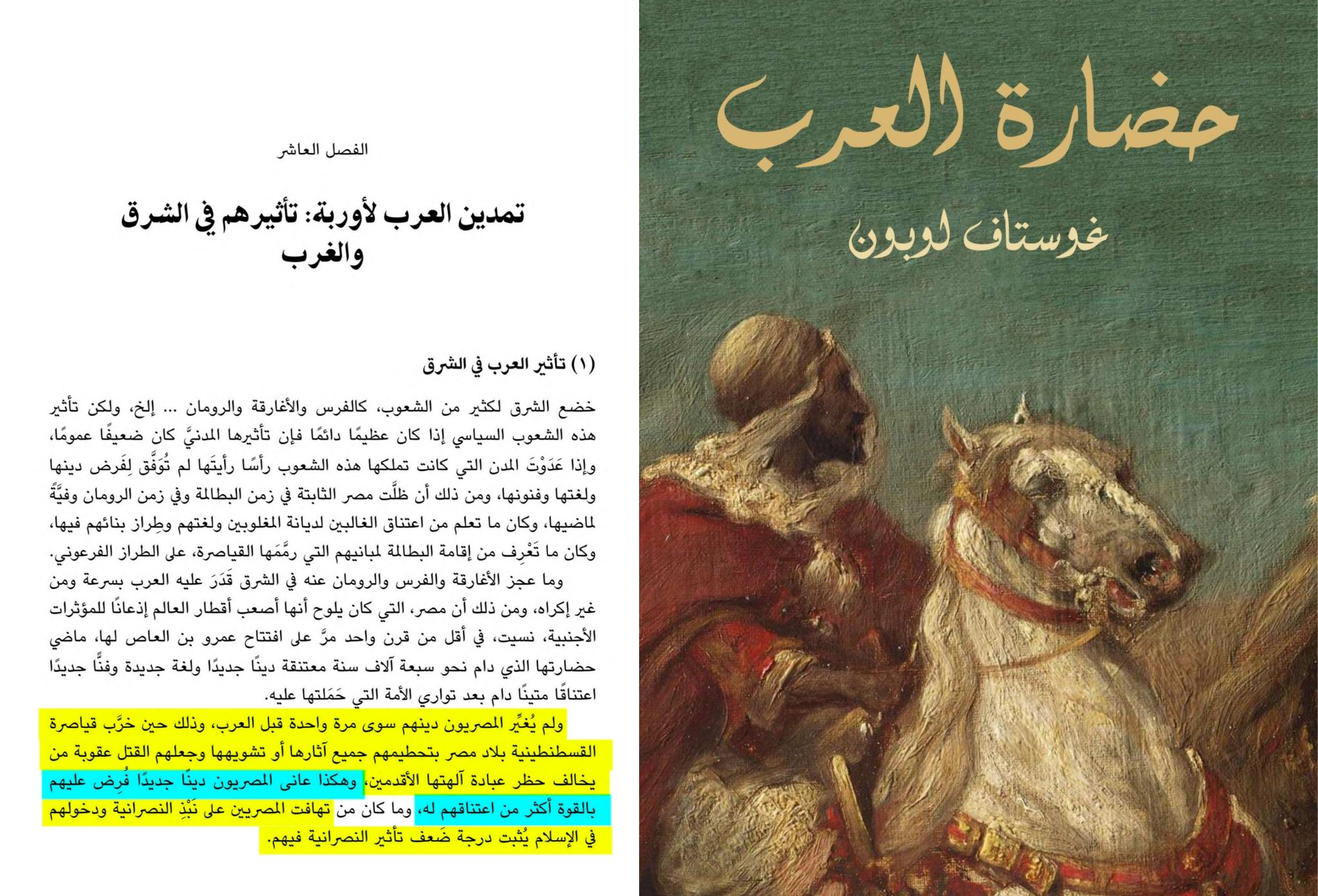
Gustave Le Bon — The Civilization of the Arabs “And the Egyptians did not change their religion except once before the Arabs, and that was when the Caesars of Constantinople devastated the land of Egypt by destroying all its monuments and making killing the punishment for anyone who violated the ban on worshiping its ancient gods, and thus the Egyptians suffered a religion that was imposed on them by force.”
The image below is from Le Bon’s work documenting this historical account:
the spread of christianity through violence in egypt 2
Book: The Civilization of the Arabs Historical Summary: Prior to the arrival of the Arabs, the Egyptians had only changed their religion once. This happened when the Byzantine emperors (the Caesars of Constantinople) devastated Egypt by destroying or defacing its ancient monuments and imposing the death penalty on anyone who continued to worship the ancient gods. Consequently, the Egyptians suffered heavily under a newly imposed religion that they were forced to adopt. The swiftness with which the Egyptians later abandoned Christianity and embraced Islam serves as proof of how weak the influence of Christianity actually was among them.
Le Bon continues with an assessment that places these events among the worst episodes of religious intolerance in recorded history. He does not soften his language:
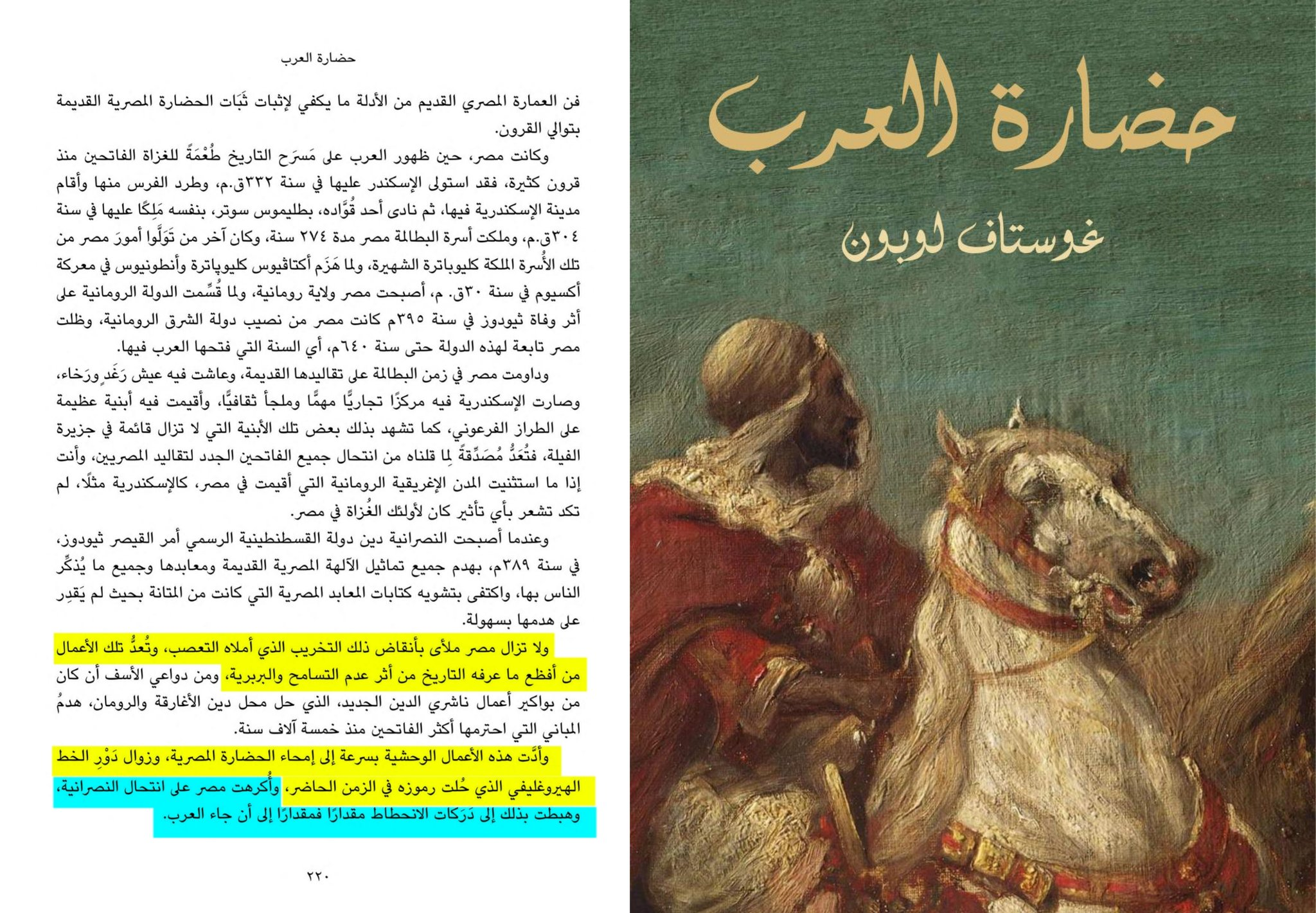
Gustave Le Bon — The Civilization of the Arabs “And Egypt remains filled with the ruins of that destruction dictated by fanaticism, and those acts are among the most horrific that history has known from the effects of intolerance and barbarism… and these acts led to the erasure of Egyptian civilization and the disappearance of the hieroglyphic script… and Egypt was forced to adopt Christianity and thus descended to the depths of misery, degree by degree, until the Arabs came.”
The image below reproduces this extended passage from Le Bon:
the spread of christianity through violence in egypt 3
Book: The Civilization of the Arabs Historical Summary: Egypt remains filled with the ruins resulting from destruction driven by religious fanaticism, an act considered among the most horrific examples of intolerance and barbarism in history. Regrettably, one of the earliest actions taken by the spreaders of the new religion (which replaced Greek and Roman paganism) was the demolition of ancient Egyptian structures that previous conquerors had respected for five thousand years. This destructive campaign quickly eradicated the ancient Egyptian civilization, ended the use of Hieroglyphic writing, and forced Egypt to adopt Christianity—causing the nation to sink into a deep decline until the arrival of the Arabs.
The Burning of the Library of Alexandria and the Murder of Hypatia
The violence of forced Christianisation was not limited to the demolition of temples and the criminalization of traditional worship. Christians in Alexandria burned the seats of learning and targeted philosophers who represented the old intellectual order. The Coptic bishop John of Nikiu records what happened:
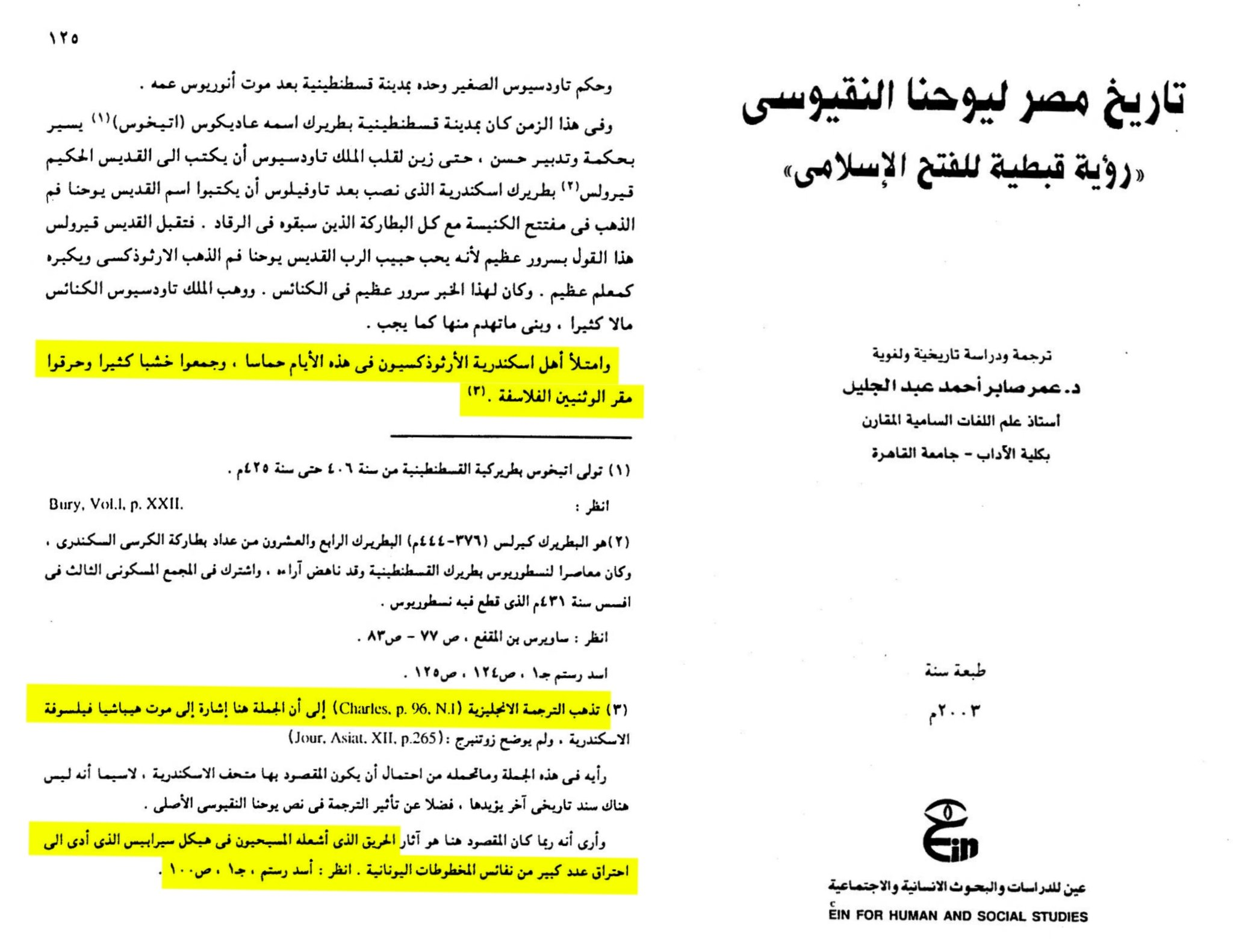
John of Nikiu — History of Egypt (Coptic Source) Christians gathered a large amount of wood and burned down the headquarters of the pagan philosophers.
The following image is from the History of Egypt by John of Nikiu, a Coptic bishop, referencing the burning of the philosophers’ halls and the events surrounding Hypatia:
the spread of christianity through violence in egypt 4
Book: The History of Egypt by John of Nikiu: A Coptic Perspective on the Islamic Conquest Historical Summary: During this period, the Orthodox people of Alexandria were filled with intense religious zeal. They gathered a large amount of wood and burned down the headquarters of the pagan philosophers.
According to the footnotes referencing historical commentary:
The English translation by Charles suggests this text refers to the historical event surrounding the death of Hypatia, the famous female philosopher of Alexandria.
Alternatively, the text may refer to the burning of the Serapeum temple by Christians, an event that tragically led to the destruction of a vast number of invaluable Greek manuscripts.
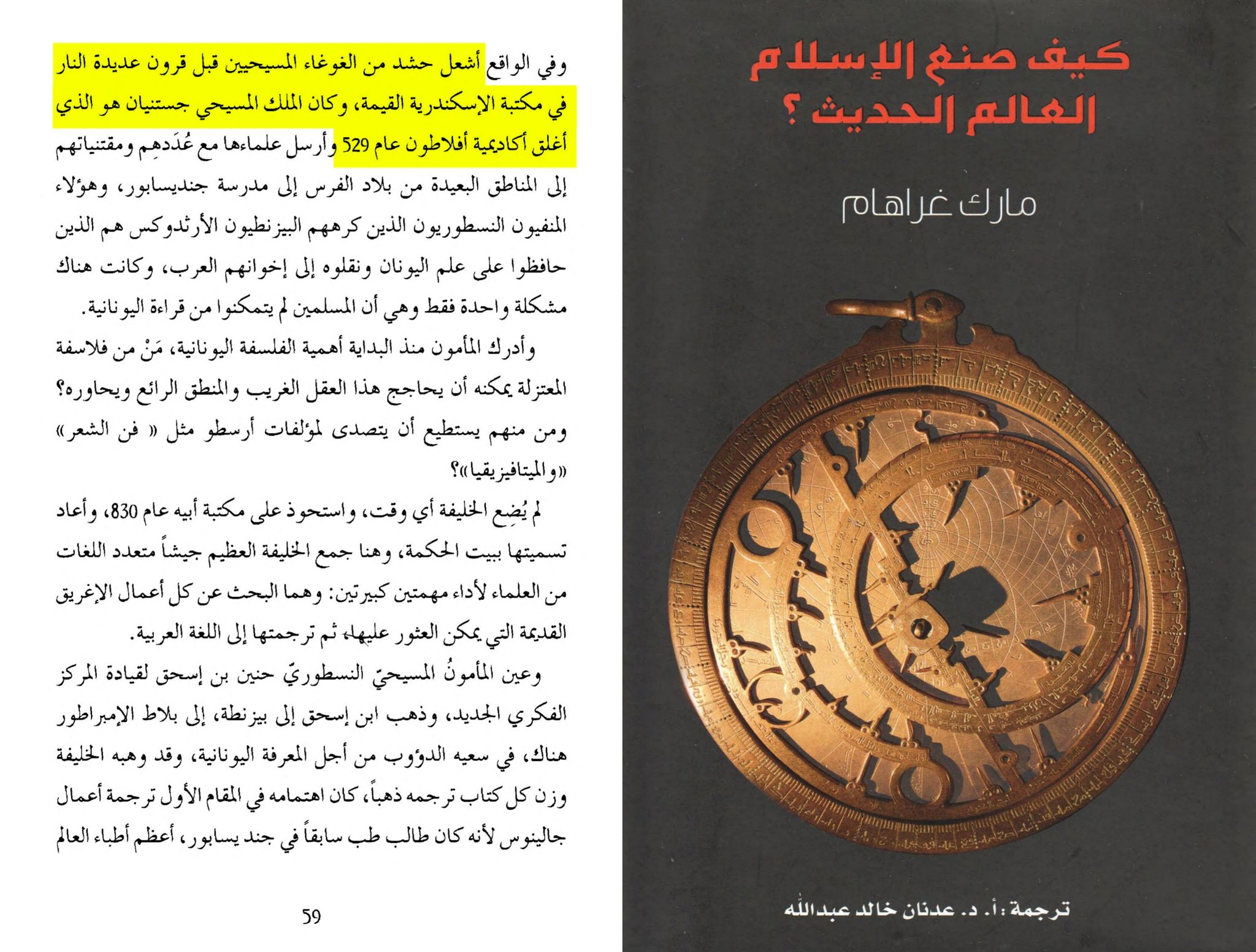
The scholar Mark Graham, in How Islam Created the Modern World, documents the subsequent destruction of Plato’s Academy by the Christian Roman Emperor Justinian:
Mark Graham — How Islam Created the Modern World Centuries prior, a mob of Christian zealots set fire to the invaluable Library of Alexandria. Later, in the year 529 AD, it was the Christian Roman Emperor Justinian who shut down Plato’s Academy, causing its scholars to be exiled along with their equipment and belongings to distant regions within the Persian Empire, specifically to the Academy of Gondishapur.
The image below is from Graham’s work documenting these events:
the spread of christianity through violence in egypt 5
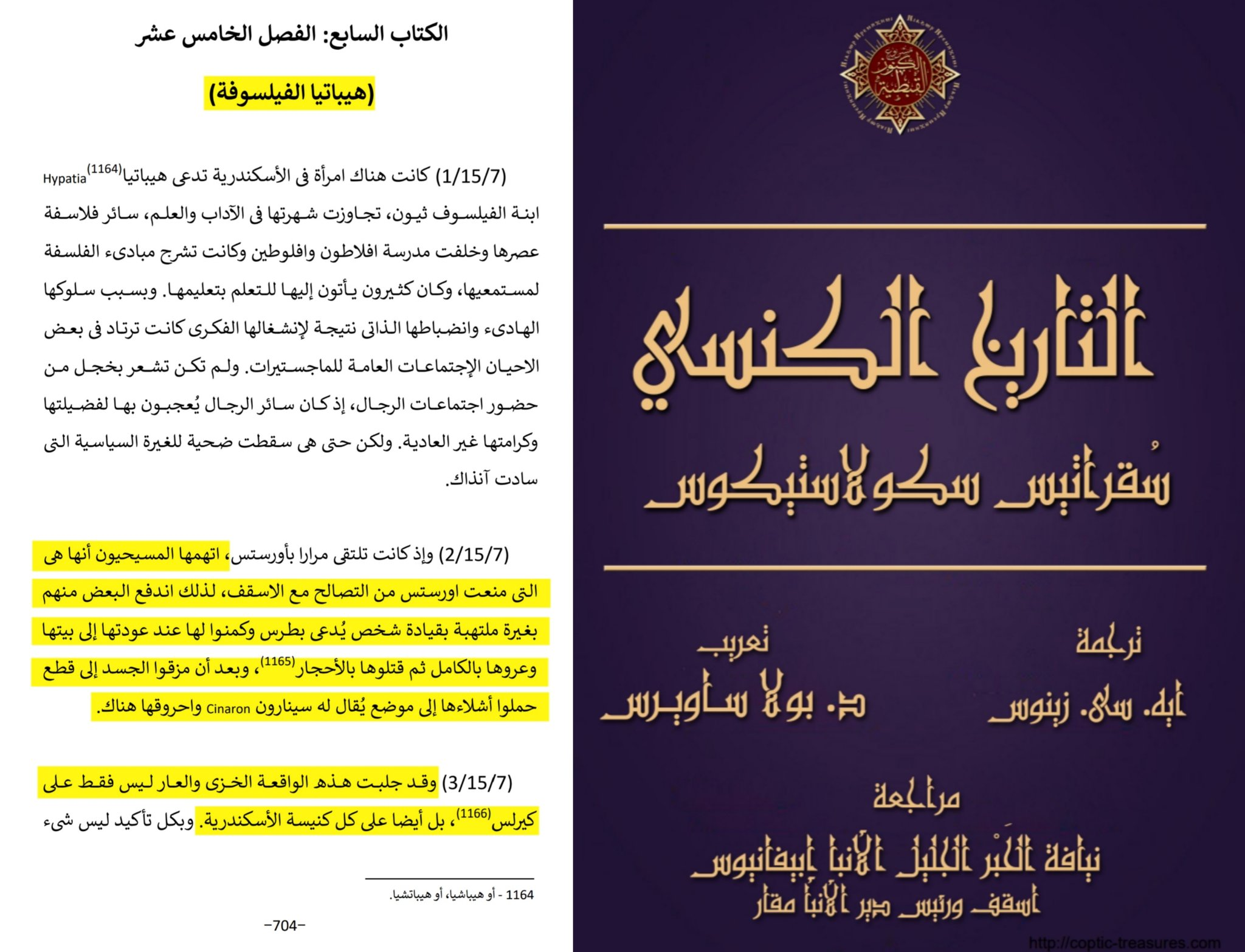
The murder of the philosopher Hypatia stands as one of the most documented acts of this campaign. Christians stripped her naked, stoned her, tore her body apart, and burned the remains — and the Coptic bishop Cyril, known in the church as “Pillar of Religion,” bore direct responsibility for inciting the mob against her. The ecclesiastical historian Socrates Scholasticus records the event:
Socrates Scholasticus — Ecclesiastical History Hypatia the Philosopher: Hypatia frequently met with Orestes (the Roman governor), leading Christians to accuse her of being the obstacle preventing a reconciliation between Orestes and the Bishop. Driven by intense, fiery zeal, a group of men led by an individual named Peter ambushed Hypatia on her way home. They dragged her out, stripped her completely naked, and murdered her with stones. After tearing her body to pieces, they took her remains to a place called Cinaron and burned them there.
The Aftermath: This tragic event brought immense shame and disgrace not only upon Cyril (the Bishop) but also upon the entire Church of Alexandria.
The image below is from Socrates Scholasticus’ Ecclesiastical History, the primary source on the murder of Hypatia:
the spread of christianity through violence in egypt 15
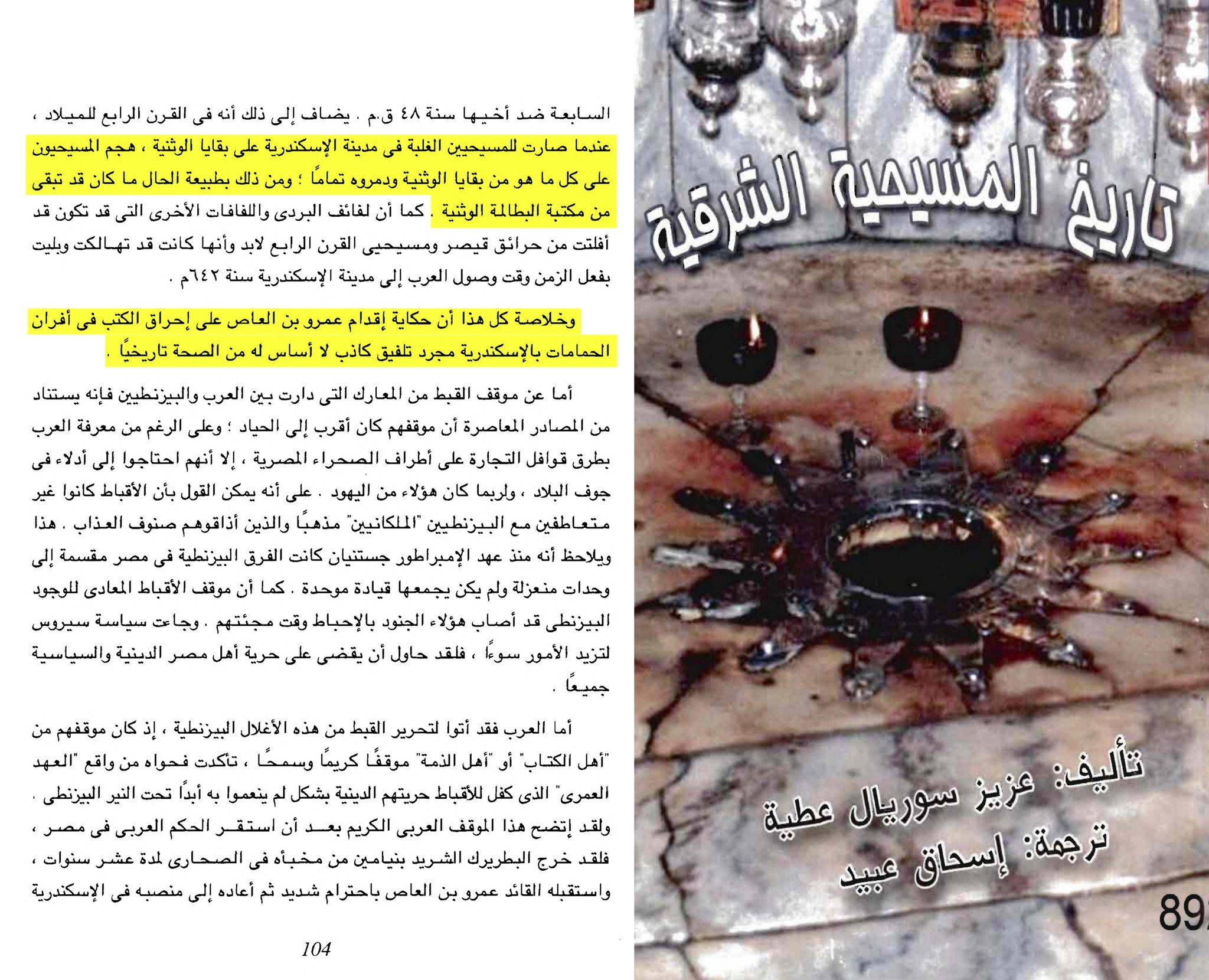
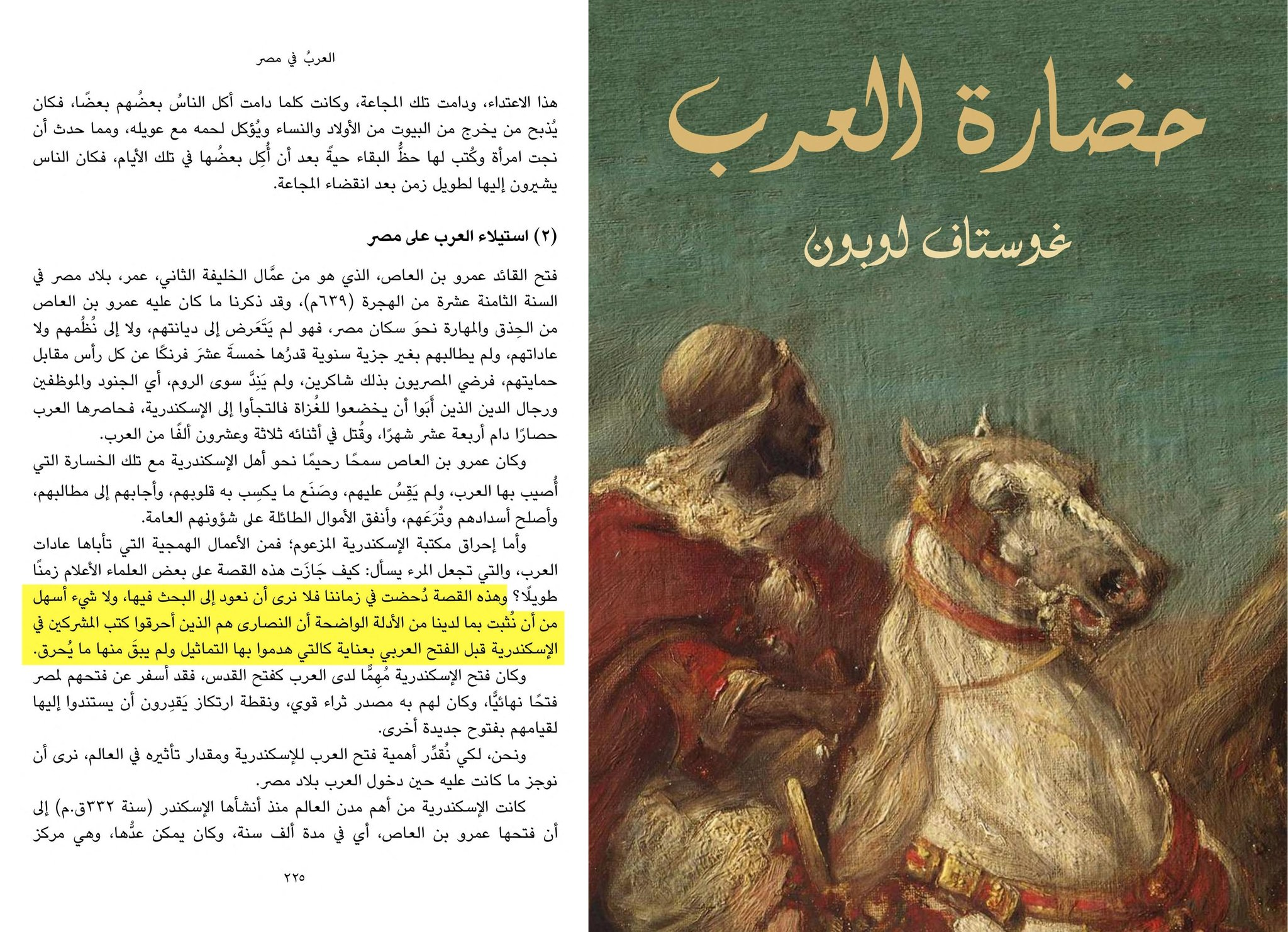
Regarding the Library of Alexandria itself, the historian Atiya in A History of Eastern Christianity confirms that Christians destroyed what remained of it in the fourth century:
Aziz Suryal Atiya — A History of Eastern Christianity In the fourth century AD, once Christians gained dominance over the remaining pagan factions in Alexandria, they launched an attack on what was left of pagan monuments and completely destroyed them. This destruction included any remnants that might have still existed from the Ptolemaic Library of Alexandria.
Consequently, the historical narrative claiming that Amr ibn al-Aas ordered the burning of books in the public bath furnaces of Alexandria is entirely false and has no historical basis.
The image below reproduces the relevant passage from Atiya’s work:
the spread of christianity through violence in egypt 16
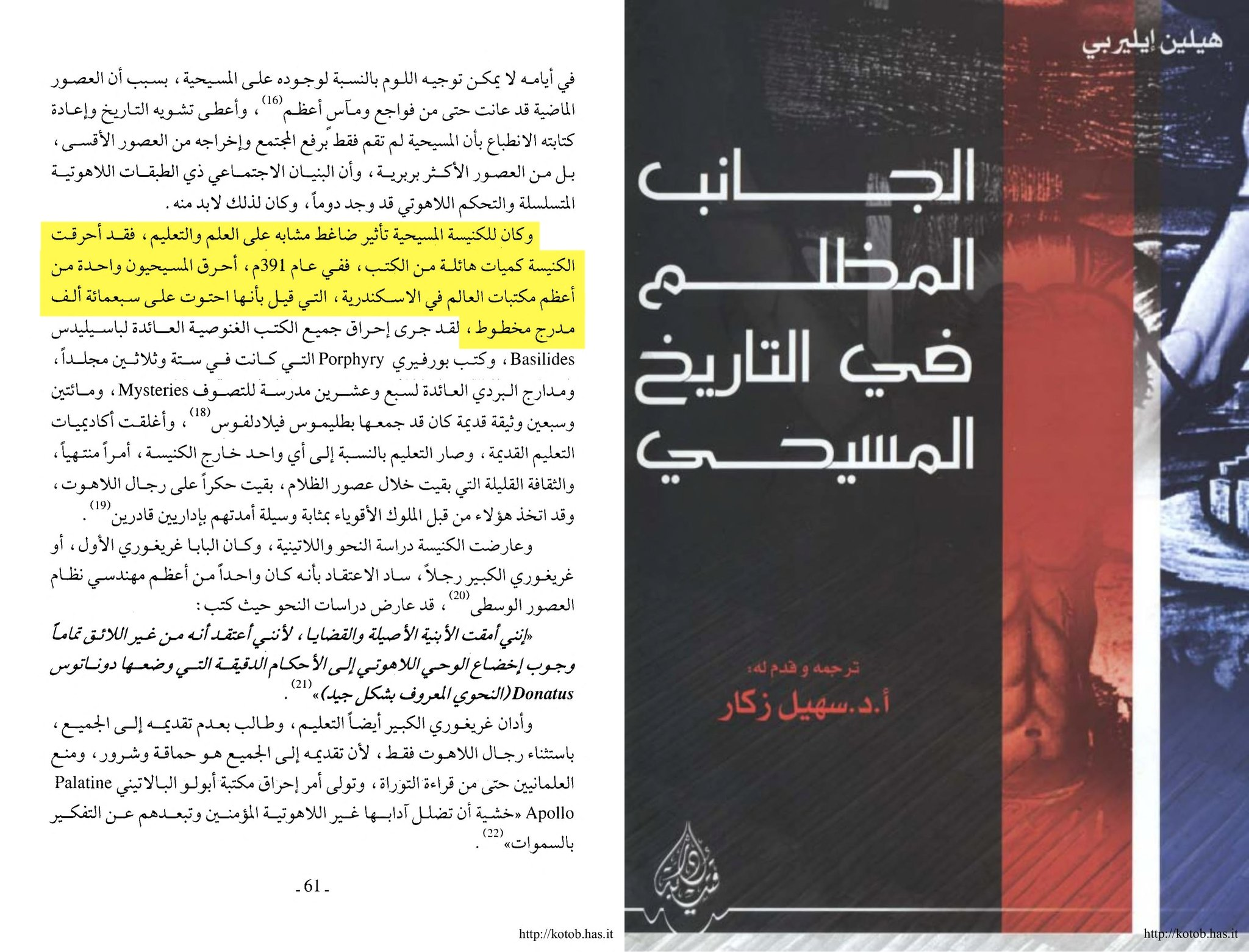
The scale of the destruction of manuscripts is documented further in The Dark Side of Christian History:
Helen Ellerbe — The Dark Side of Christian History The Christian Church had a suppressing effect on science and education, burning massive quantities of books. In the year 391 AD, Christians burned one of the greatest libraries in the world in Alexandria, which was said to contain 700,000 manuscripts. They also burned all Gnostic books belonging to Basilides, 36 volumes written by Porphyry, and 270 papyrus scrolls belonging to the Mysteries school of mysticism that had been collected by Ptolemy II Philadelphus. Furthermore, ancient academies of learning were closed down.
The image below is from Ellerbe’s work detailing the scale of manuscript destruction:
the spread of christianity through violence in egypt 17
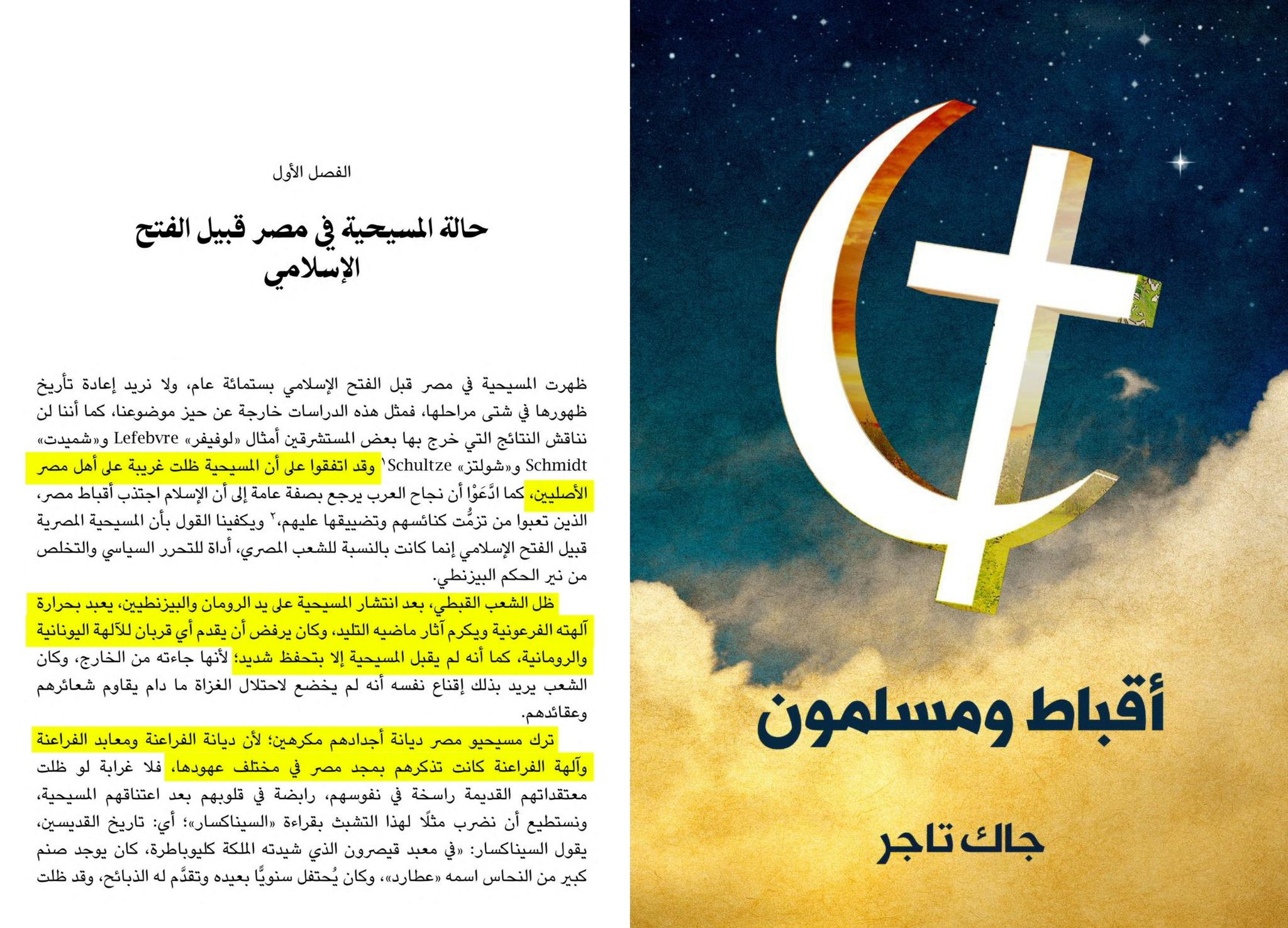
Christianity Remained Foreign to Egypt’s Native Population
Despite centuries of imperial enforcement, multiple scholars agree that Christianity never genuinely took root among the native Egyptian people. The conversion was coerced, not organic. Dr. Jack Trader concluded that Christianity remained foreign to Egypt’s native people, and that Egyptians continued secretly worshipping their ancestral gods even under penalty of death:
Dr. Jack Trader — Copts and Muslims: From the Arab Conquest to the Year 1922 Foreign orientalists agree that Christianity remained an alien concept to the native populations of Egypt even after its general spread by the Romans and Byzantines. The Egyptian people continued to fervently worship their ancient Pharaonic and Roman deities, and they only accepted Christianity with extreme reservation and skepticism. Because it was brought from the outside, the population convinced themselves that accepting it did not mean completely surrendering to the occupying forces.
The ancestors of Egypt’s Christians were forced to abandon their native faith through coercion. Despite this forced conversion, the ancient Pharaonic religion — with its temples and gods — remained deeply rooted in their hearts, serving as a constant reminder of Egypt’s historical glory.
The image below reproduces this passage:
the spread of christianity through violence in egypt 6
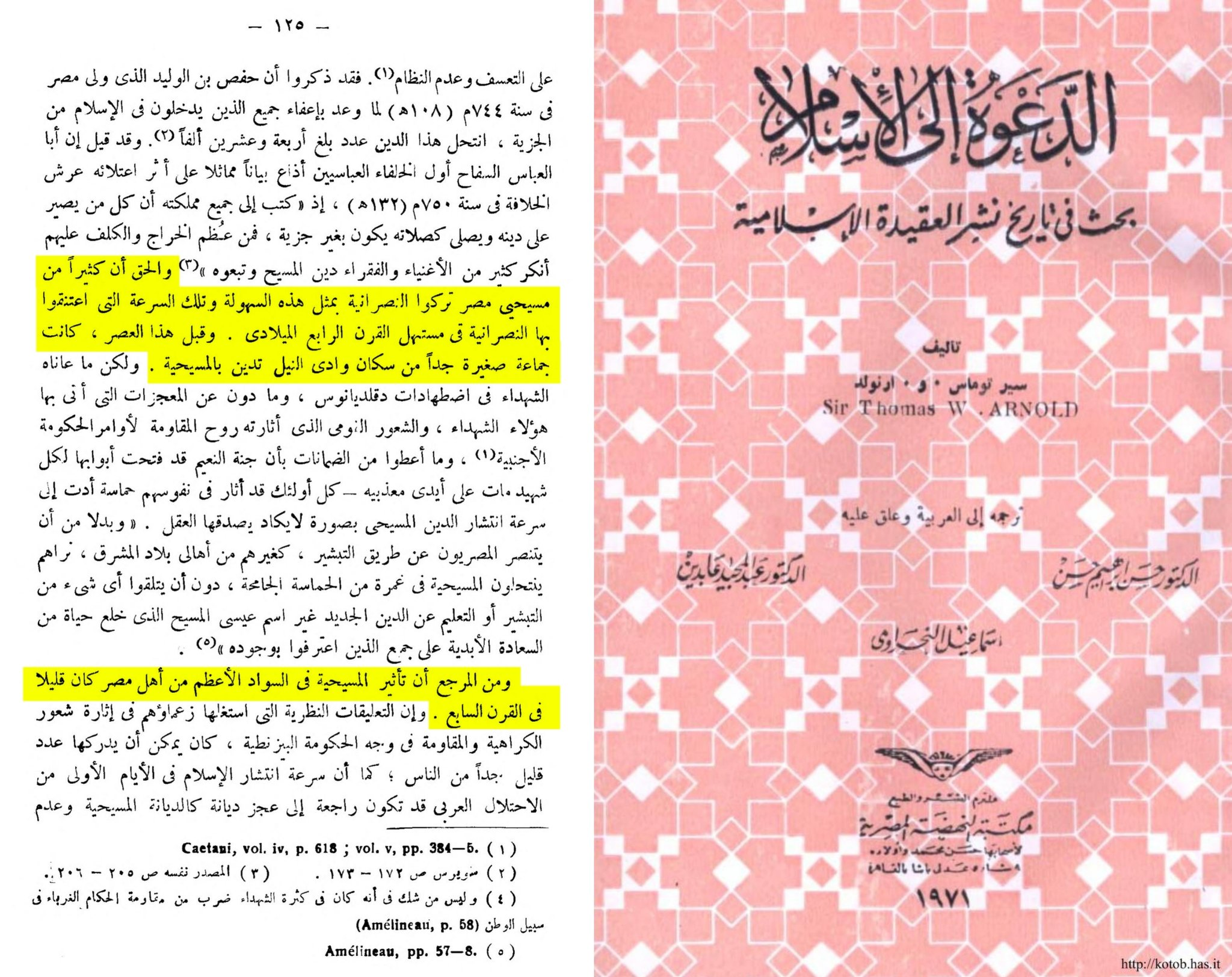
Sir Thomas Arnold — author of The Preaching of Islam — makes the further observation that the superficiality of Christianity’s hold on Egypt was proven by the ease with which Egyptians later embraced Islam:
Sir Thomas Arnold — The Preaching of Islam: A History of the Propagation of the Muslim Faith In truth, many of Egypt’s Christians abandoned Christianity with the same ease and rapid speed with which they had initially embraced it at the beginning of the fourth century AD. It is highly probable that the actual influence of Christianity remained very minimal among the vast majority of the Egyptian population during the seventh century.
The image below reproduces Sir Thomas Arnold’s assessment:
the spread of christianity through violence in egypt 7
Demolition of Pagan Temples: Christian Sources Confirm It
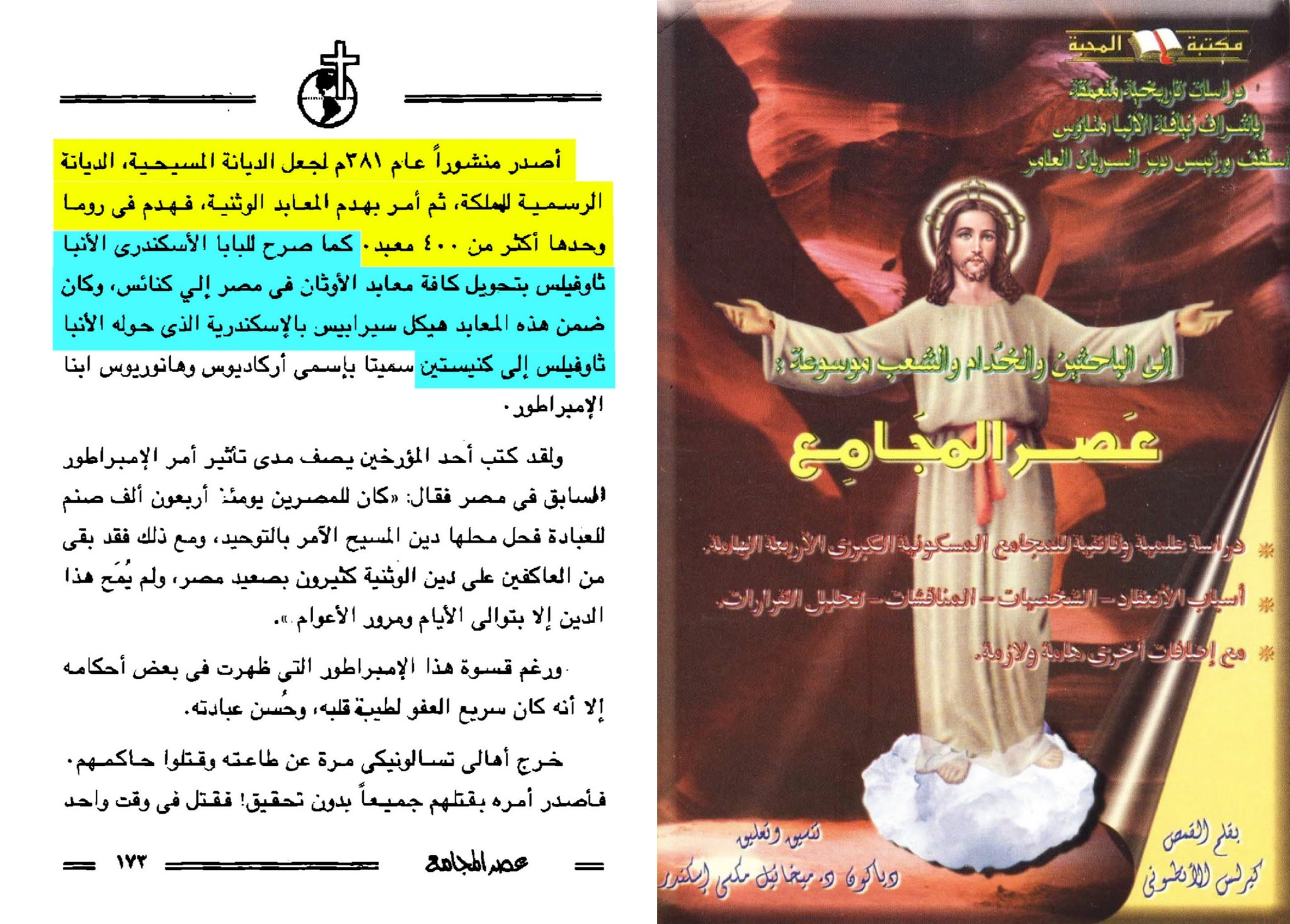
The decree of Theodosius in 381 AD led to the physical destruction of temples on an enormous scale. Father Cyril Antoine, in The Age of the Councils, records the numbers:
Cyril Antoine — The Age of the Councils In the year 381 AD, a decree was issued making Christianity the official religion of the empire. Subsequently, an order was given to demolish pagan temples, leading to the destruction of more than 400 temples in Rome alone. Pope Theophilus of Alexandria was also authorized to convert all pagan temples in Egypt into churches. Among these transformed structures was the Temple of Serapis (Serapeum) in Alexandria, which Pope Theophilus converted into two churches named after Arcadius and Honorius, the two sons of the Emperor.
The image below is from Cyril Antoine’s The Age of the Councils, documenting the demolition and conversion of temples:
the spread of christianity through violence in egypt 8
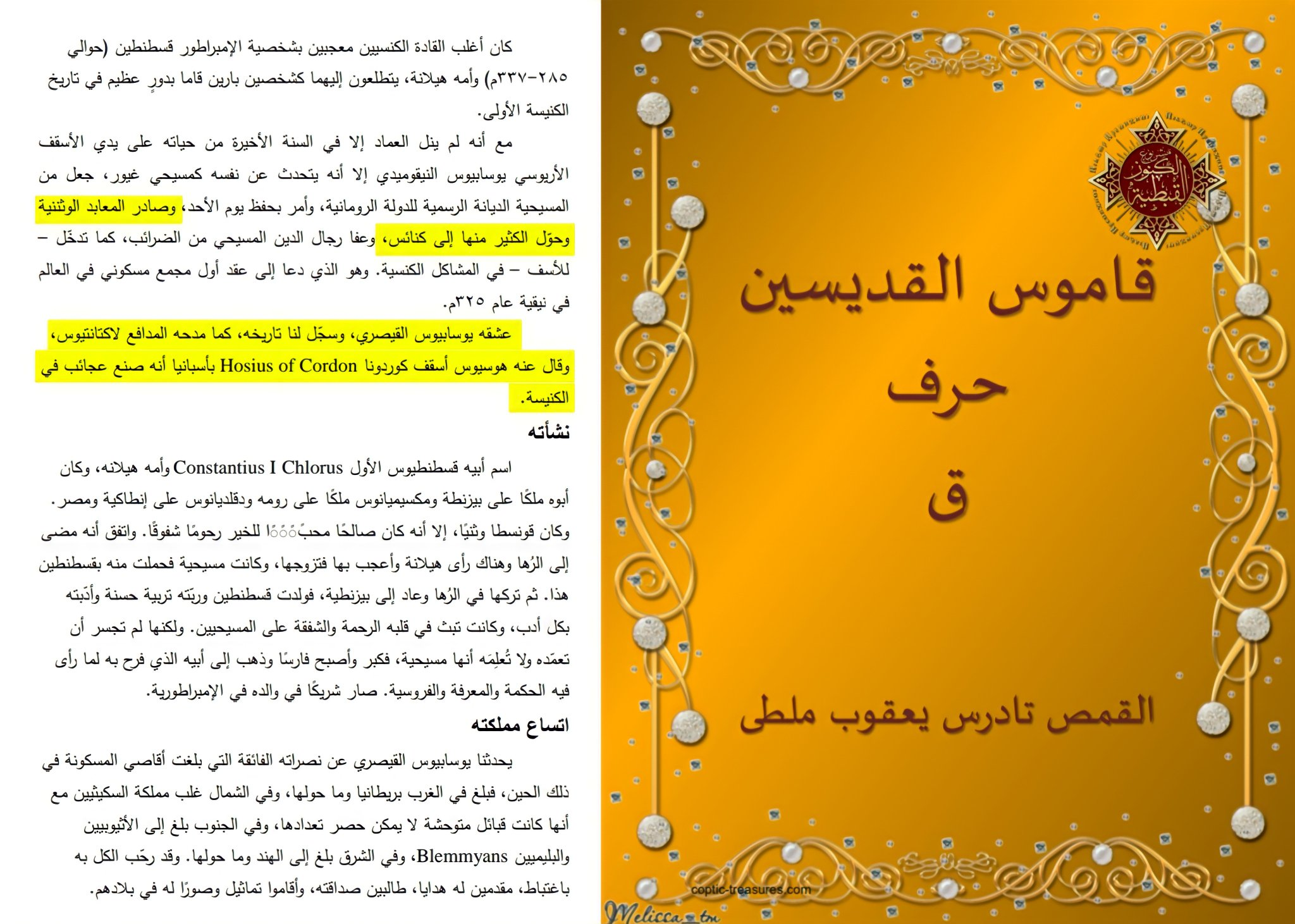
The seizure and conversion of temples was not incidental destruction — it was institutionally celebrated. The Coptic priest Tadros Yacoub Malaty records in his Dictionary of Saints that Constantine himself confiscated pagan temples and converted them into churches, and was praised for it by the church historian Eusebius of Caesarea:
Tadros Yacoub Malaty — Dictionary of Saints Emperor Constantine established Christianity as the official religion of the Roman Empire. As a zealous Christian ruler, he decreed the observance of Sunday as a day of rest, confiscated pagan temples (converting many of them into churches), and exempted Christian clergy from paying taxes.
The image below is from Father Tadros Yacoub Malaty’s Dictionary of Saints, documenting Constantine’s confiscation of temples:
the spread of christianity through violence in egypt 12
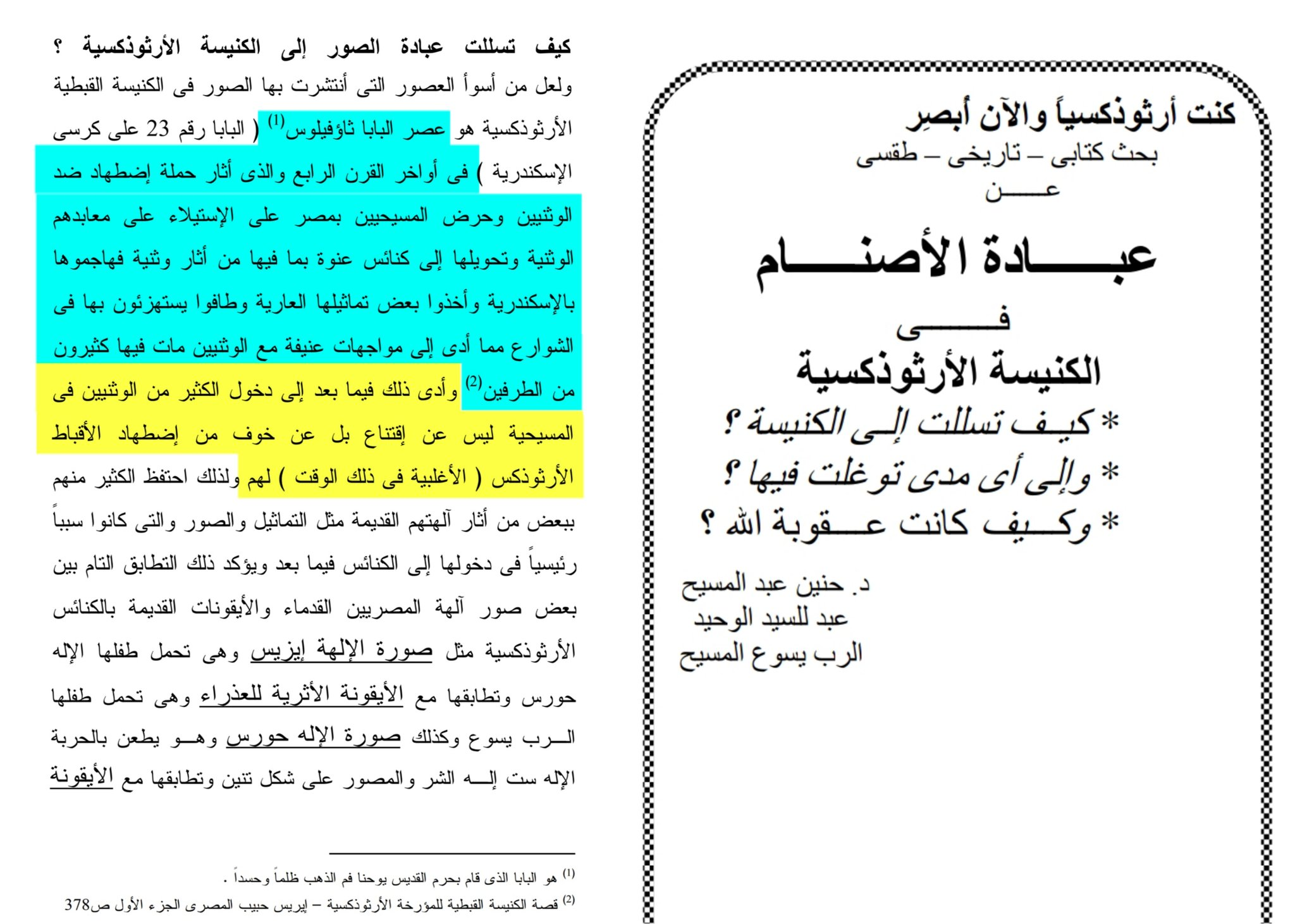
Dr. Hanin Abdul-Masih adds that the Coptic Orthodox themselves in the fourth century led active persecution campaigns against pagans, which drove their conversions through fear rather than conviction:
Dr. Hanin Abdul-Masih — I Was Orthodox and Now I See One of the worst eras regarding the introduction of images into the Coptic Orthodox Church was the reign of Pope Theophilus in the late fourth century. He incited Christians in Egypt to forcibly seize pagan temples and convert them into churches. This included attacking pagan monuments in Alexandria and parading their naked statues through the streets in mockery, which triggered violent clashes with pagans that left many dead on both sides.
This aggressive campaign eventually drove many pagans to join Christianity. However, they did so out of fear of persecution by the Orthodox Copts (who were the majority at the time) rather than actual conviction. Consequently, many of these converts secretly retained old habits and historical relics, such as statues and images of their former gods, which later became a major reason for the entry of imagery into Christian churches.
The image below reproduces this account from Dr. Abdul-Masih’s work:
the spread of christianity through violence in egypt 14
A Coptic Father’s Own Admission: Christianity Spread by the Sword
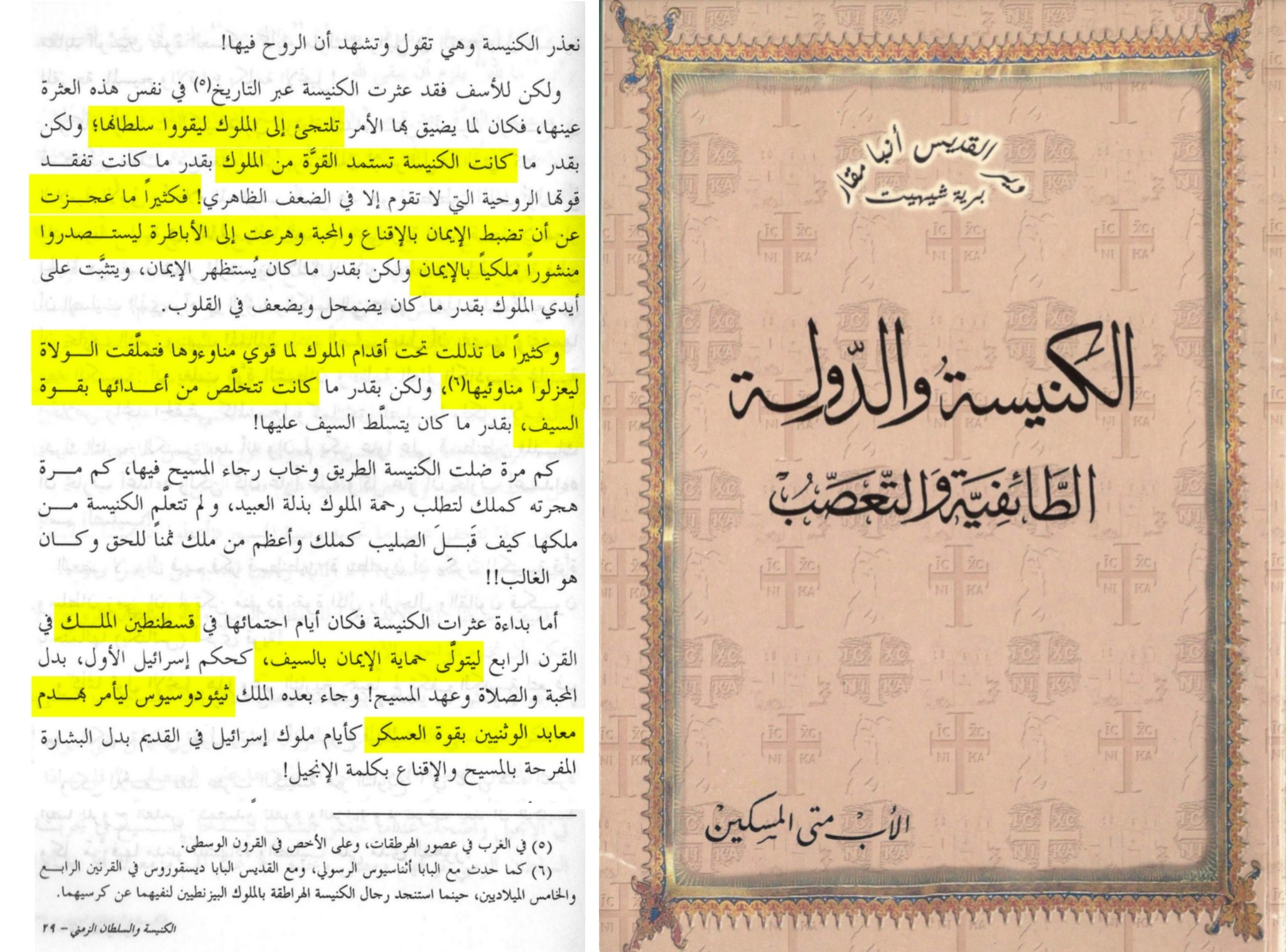
One of the most striking admissions in this record comes from Father Matthew the Poor, one of the most revered figures in the modern Coptic Church. Writing in The Church and the State, he acknowledges that Christianity spread through submission to political power and military enforcement rather than persuasion and love:
Father Matthew the Poor — The Church and the State: Sectarianism and Fanaticism Historically, whenever the Church faced inner struggles, it repeatedly turned to worldly rulers to reinforce its authority. Instead of relying on its spiritual strength, it drew power from monarchs. Whenever the Church failed to guide faith through persuasion and love, it rushed to emperors to extract royal decrees to enforce faith by proxy, often groveling before rulers to remove or exile political opponents. It frequently relied on the power of the sword to rid itself of adversaries.
This downward spiral began when the Church sought protection under the rulers of Constantinople in the fourth century, choosing the protection of the sword over the message of prayer and love. Following this path, King Theodosius eventually ordered the destruction of pagan temples using military force, mirroring ancient historical conquests instead of utilizing the joyful evangelism and persuasive words of the Gospel.
The image below reproduces this passage from Father Matthew the Poor’s work:
the spread of christianity through violence in egypt 9
The Inquisition Logic: Forced Baptism as a Doctrinal Duty
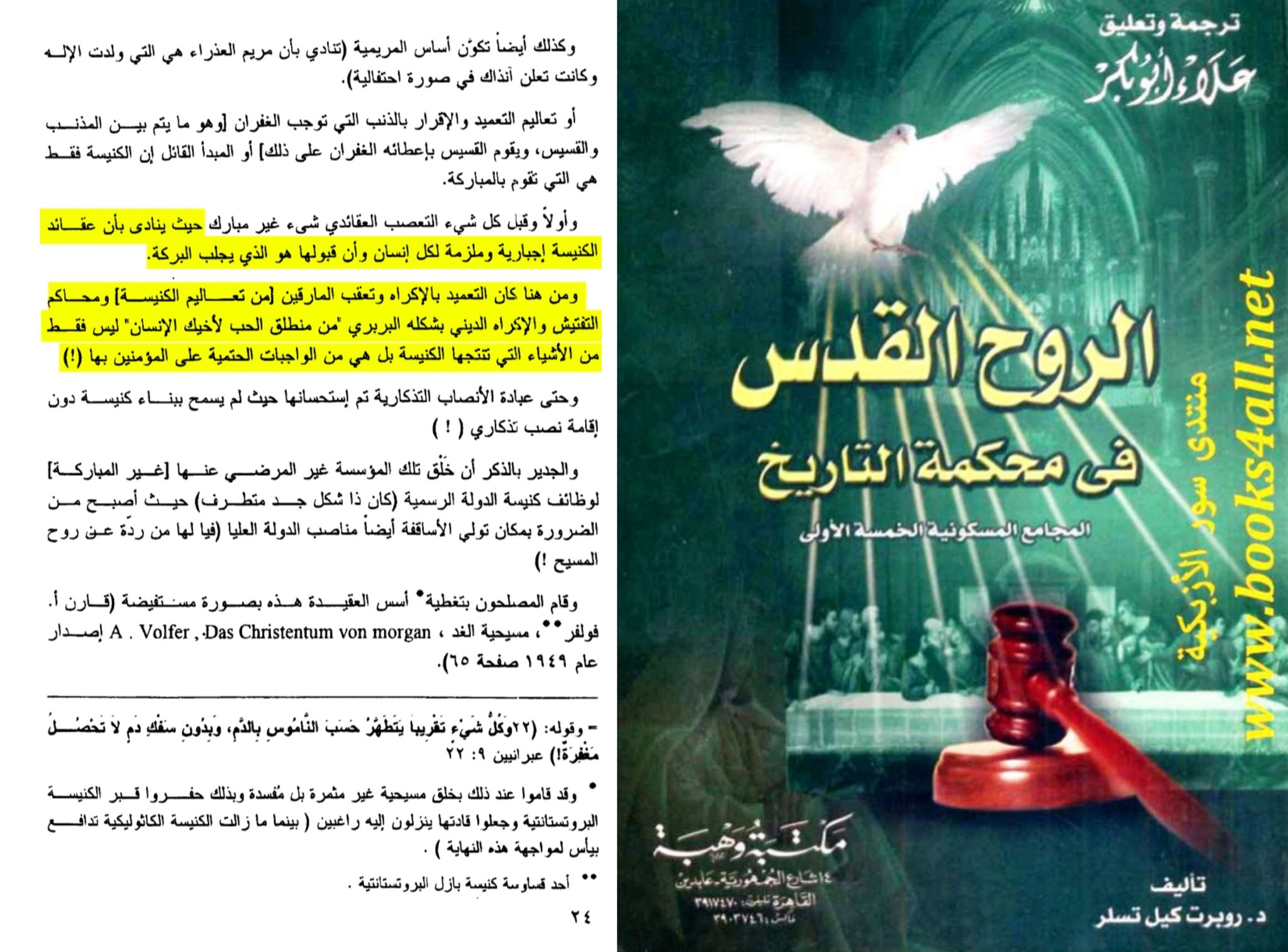
The coercion was not incidental to Christianity’s spread — it was, as Robert Kil Tseler documents in The Holy Spirit in the Court of History, the logical outcome of a theology that declared its doctrines mandatory for every human being:
Robert Kil Tseler — The Holy Spirit in the Court of History: The First Five Ecumenical Councils Above all, an unblessed dogmatic fanaticism emerged, loudly proclaiming that the doctrines of the Church were mandatory and binding for every single human being, and that accepting them was the sole path to receiving blessings. This rigid mindset birthed forced baptism, the tracking down of heretics (under the guise of Church teachings), the Inquisition, and religious coercion in its most barbaric form. Rather than being treated as outcasts to Christian principles, these extreme practices were promoted by the Church as absolute, mandatory duties for all believers from a flawed rationale of brotherly love.
The image below is from Tseler’s work on the rise of forced baptism and the Inquisition:
the spread of christianity through violence in egypt 13
The Biblical Encyclopedia further documents that once Christianity became dominant, it did not merely suppress paganism — it turned on all competing factions within and outside itself:
The Biblical Encyclopedia Christianity entered a phase of expansion driven by control and aggression. It did not merely suppress paganism; instead, the dominant orthodox majority aggressively persecuted all competing factions, targeting both internal heresies and rival sects. This harsh shift marked a significant departure from earlier tolerance, as the now-dominant religious authority actively sought to eliminate any dissenting beliefs or rival practices.
The image below reproduces this passage from the Biblical Encyclopedia:
the spread of christianity through violence in egypt 10
Why Egyptians Turned to Islam: The Catholic Historian’s Account
The final word belongs to a Catholic historian. Alfred Butler, in The Arab Conquest of Egypt, explains why Egypt’s intellectuals and people of discernment rejected Christianity and embraced Islam — not because of the sword, but because of what Christianity had done to itself:
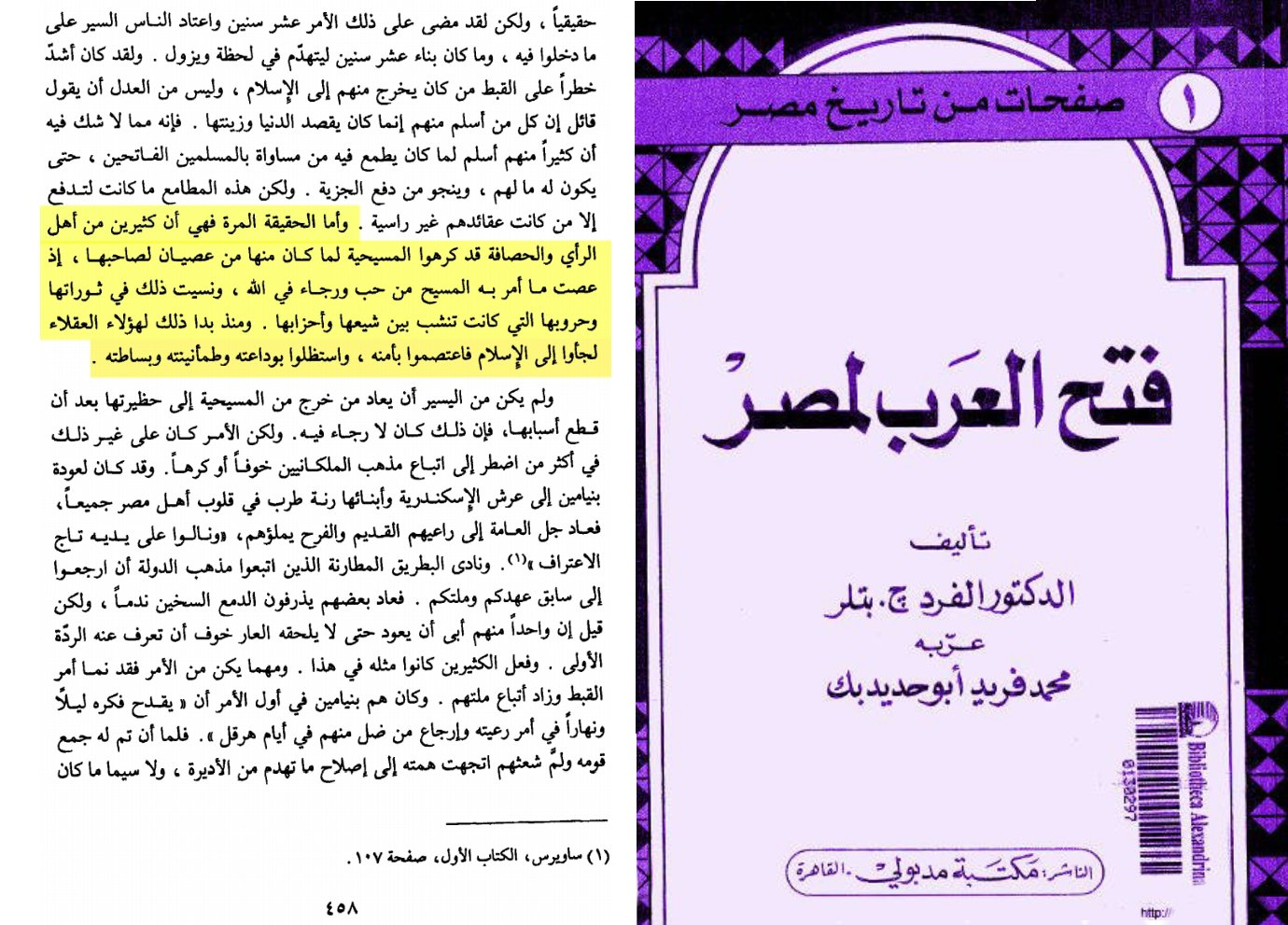
Alfred Butler — The Arab Conquest of Egypt The undeniable truth this time is that many of Egypt’s intellectuals, wise thinkers, and insightful individuals grew to resent Christianity. This resentment stemmed from how the religion had drifted away from the original teachings of Christ, which were rooted in love and hope in God. This corruption became evident during the sectarian revolts, internal conflicts, and wars that broke out between different Christian sects and political factions. Consequently, these wise individuals chose to turn to Islam, seeking refuge under its security, and finding peace in its tranquility and simplicity.
The image below reproduces Alfred Butler’s assessment from The Arab Conquest of Egypt:
the spread of christianity through violence in egypt 11
A second passage from Le Bon in The Civilization of the Arabs is reproduced below, confirming Butler’s point from a secular French perspective — the speed of Egypt’s embrace of Islam was the measure of how shallow the Christian imposition had been:
the spread of christianity through violence in egypt 18
Book: The Civilization of the Arabs Historical Summary: Before the arrival of the Arabs, the Egyptians had changed their religion only once. This occurred when the Byzantine emperors (the Caesars of Constantinople) devastated Egypt by destroying or defacing its ancient monuments and enforcing the death penalty for anyone who continued to worship the ancient gods. Consequently, the Egyptians suffered greatly under a newly imposed religion that they were forced to adopt. The speed with which the Egyptians later rejected Christianity and embraced Islam serves as evidence of how weak the actual influence of Christianity was among them.
Conclusion The historical record — sourced from Coptic priests, Catholic historians, orientalists, and secular European scholars — establishes the following facts without dispute:
Theodosius issued an imperial decree making Christianity the only legal religion in Egypt and ordering the closure of all temples and shrines.
The penalty for continuing to worship the gods of Egypt was death.
More than 400 temples were destroyed in Rome alone; Egyptian temples were seized and converted into churches by imperial and ecclesiastical order.
The Library of Alexandria and the philosophical institutions of the city were burned by Christian mobs.
The philosopher Hypatia was stripped naked, stoned, dismembered, and burned by Christians — with Bishop Cyril bearing responsibility for inciting the attack.
Christianity never genuinely took root among the native Egyptian population; it remained, as multiple scholars confirm, a foreign imposition.
The swiftness with which Egyptians embraced Islam — documented even by a Catholic historian — was the direct consequence of how hollow and coerced the Christian conversion had been.