Is the Diversity of Cat Species Evidence of Evolution
“Is the diversity of cat species evidence of evolution?
🪫 “Is the diversity of cat species evidence of evolution?”
First, we must establish a basis for the dialogue:
📌 The major causes of all these types of cats are:
Hybridization of different breeds, so that different traits are added between different breeds
Or domestication of cats (adapting them to humans to change their behavior),
so their size changes in response to females, for example,
or their appearance changes —
all of these changes occur within the framework of the same species .
🧬 Domestication has resulted in “dozens” of cat species from about 71 types ,
as reported in Nature Cat :
“Cat domestication and selective breeding have resulted in tens of breeds with major morphological differences.”
Of course, needless to say, this is adaptation , not evolution.
Behavioral change is related to epigenetics ,
with DNA remaining the same,
and activation and deactivation depending on the circumstances.
🪫 In addition to the potential for adaptive transfer of environmental information across generations,
there is an increased awareness that the parental environment may result in non-genetically transferred costs
that are expressed in the offspring, sometimes lasting for several generations.
{Embed}
https://www.nature.com/articles/s41598-019-44324-x
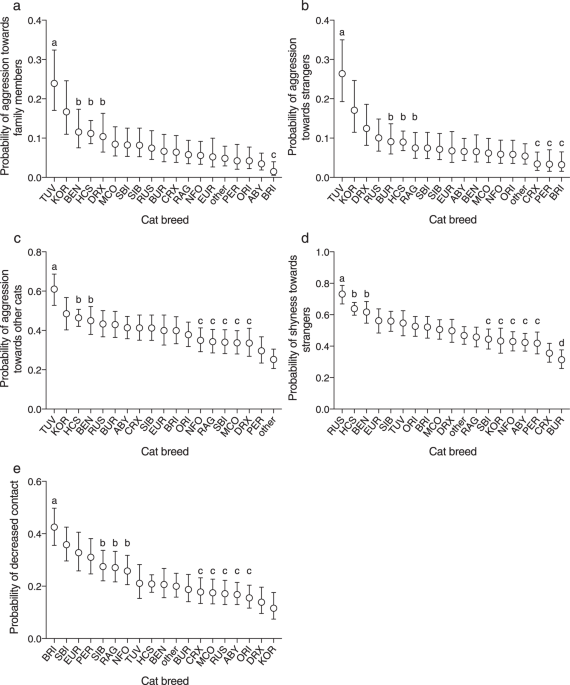
Breed differences of heritable behaviour traits in cats
Scientific Reports - Breed differences of heritable behaviour traits in cats
🪫 Translation:
Apart from the potential for transgenerational transmission of adaptive environmental information,
there is a growing awareness that the parental environment may result in non-genetic costs
that are expressed in offspring and may persist for several generations.
🧠 But let’s explain more about what this means:
Very briefly:
- Adaptive transmission of environmental information means that parents can pass on some of the experiences and adaptations they have acquired from their environment to their children,
not only through genes, but also through learning and experience.
- Non-genetic costs : These are environmental effects that can be passed on from one generation to the next,
but are not directly linked to genes.
These costs may be:
Psychological trauma
Unhealthy eating habits
Chronic diseases
Note that these experiences or responses are lost across generations if conditions change —
as we explained earlier.
🧬 Now that we’ve discussed the main reason for the diversity of cat species,
Let’s move on to the reason for the differences between some species.
Simply put:
The differences between some species within the same breed are merely a superficial similarity between organisms ,
and just because it aligns with evolutionary quibbles doesn’t mean it’s evidence of evolution.
When a failing student quibbles over an answer from multiple-choice questions and gets it right,
it doesn’t mean they’re diligent — look at the rest of the answers.
Likewise, in evolution:
look at the rest of the hypotheses that are in clear conflict with real science, and even with logic.
🪫 “Correct” evidence means that it cannot be challenged with sound logic.
We can explain this small diversity by creation , which is sound logic.
{Embed}
https://www.nature.com/articles/s41437-018-0113-y
Evolutionary consequences of epigenetic inheritance
Heredity - Evolutionary consequences of epigenetic inheritance