

Is the Hadith "Never Satisfied With Women" Authentic? What Scholars Say
The response to the claim that the Prophet was never satisfied with women
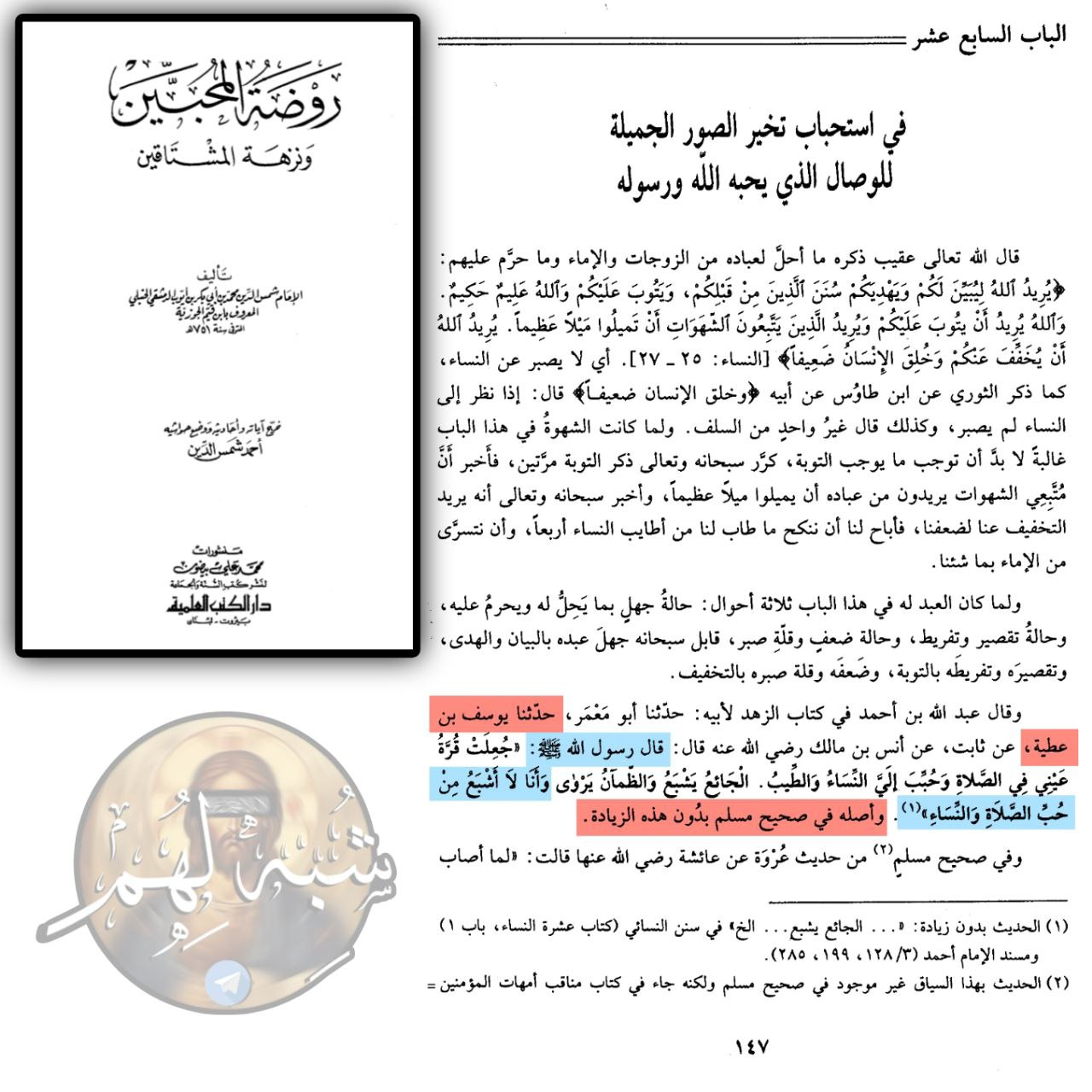
1. Book Details (Left Section)
-
Title: Rawdat al-Muhibbin wa-Nuzhat al-Mushtaqin (روضة المحبين ونزهة المشتاقين)
-
Author: Imam Ibn Qayyim al-Jawziyyah (Died in 751 AH)
-
Publisher: Dar al-Kutub al-Ilmiyyah (Beirut, Lebanon)
2. Context of the Page (Right Section - Page 147)
-
Chapter 17: Entitled “On the recommendation of choosing beautiful forms for connection that Allah and His Messenger love.”
-
Thematic Discussion: Discusses human desires, quoting Quranic verses from Surah An-Nisa (25–27) emphasizing that human beings were created inherently weak (وَخُلِقَ الْإِنسَانُ ضَعِيفًا), particularly regarding their patience and attraction toward women.
3. Explanation of the Highlighted Text
-
The Narration: Quotes a Hadith reported by Abdullah bin Ahmad in Kitab al-Zuhd from Anas bin Malik (RA) where the Prophet (ﷺ) states:
“Prayer has been made the cooling of my eyes, and women have been made dear to me. The hungry person is satisfied, and the thirsty person has his thirst quenched, but I am never satisfied with the love of prayer and women.”
-
Footnote Verification: > * Note 1: Clarifies that the standard core of the Hadith (“Prayer has been made the cooling of my eyes…”) is well-established in Sunan al-Nasa’i and Musnad Ahmad, but without the specific extension comparing it to hunger and thirst (“The hungry person is satisfied…”).
- Note 2: Directly addresses the main text’s claim regarding Sahih Muslim, clarifying that this specific context and phrasing is not present in Sahih Muslim.
The claim that the Prophet said, “I am never satisfied with women,” is an addition by Joseph, who is considered weak.
The narration in question has a weak chain of transmission (isnad) due to Yusuf.
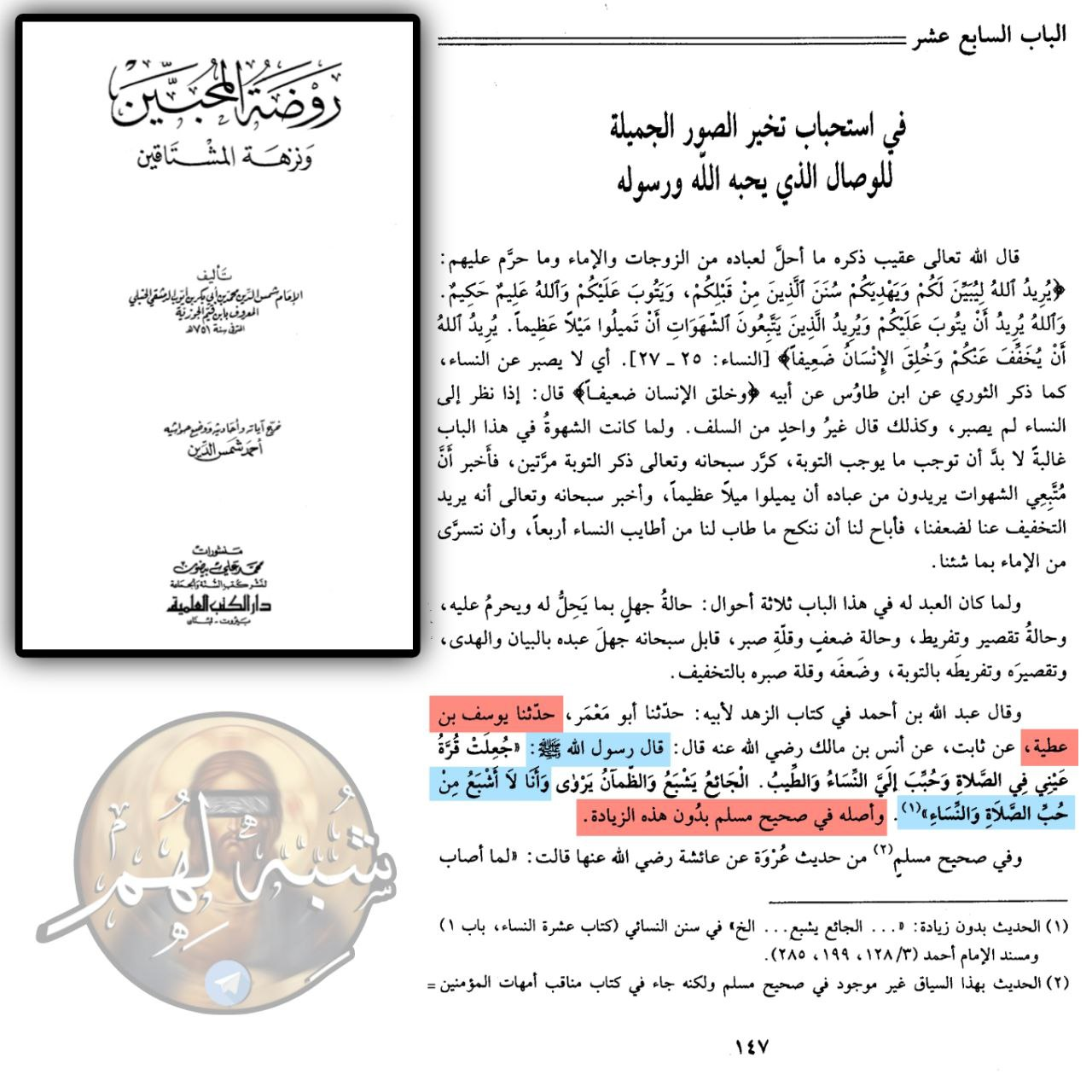
1. Book Details (Left Section)
-
Title: Rawdat al-Muhibbin wa-Nuzhat al-Mushtaqin (روضة المحبين ونزهة المشتاقين)
-
Author: Imam Ibn Qayyim al-Jawziyyah (Died in 751 AH)
-
Commentary/Footnotes: Ahmad Shams al-Din
-
Publisher: Dar al-Kutub al-Ilmiyyah (Beirut, Lebanon)
2. Context of the Page (Right Section - Page 147)
-
Chapter 17: Entitled “On the recommendation of choosing beautiful forms for connection that Allah and His Messenger love.”
-
Thematic Content: Discusses human desires and inclinations using Quranic verses from Surah An-Nisa (25–27). It highlights the verse stating that mankind was created inherently weak (وَخُلِقَ الْإِنسَانُ ضَعِيفًا), which early scholars like Sufyan al-Thawri interpreted as a specific lack of patience and strength regarding women.
3. Explanation of the Highlighted Text
-
The Narration: Quotes a text from Abdullah bin Ahmad’s Kitab al-Zuhd narrated by Anas bin Malik (RA) where the Prophet (ﷺ) states:
“Prayer has been made the cooling of my eyes, and women and perfume have been made dear to me. The hungry person is satisfied, and the thirsty person has his thirst quenched, but I am never satisfied with the love of prayer and women.”
-
Main Text Claim: The main text notes that the core basis of this Hadith is found in Sahih Muslim without the extra addition regarding hunger and thirst.
4. Critical Footnotes
-
Footnote 1: Clarifies that the standard authentic version of the Hadith (“Prayer has been made the cooling of my eyes…”) is well-recorded in Sunan al-Nasa’i and Musnad Ahmad, but explicitly lacks the extended comparison to hunger and thirst (“The hungry person is satisfied…”).
-
Footnote 2 (Correction): Directly corrects the author’s claim, noting that this specific phrasing and context is not present in Sahih Muslim at all, but rather originates in historical accounts regarding the virtues of the Mothers of the Believers.
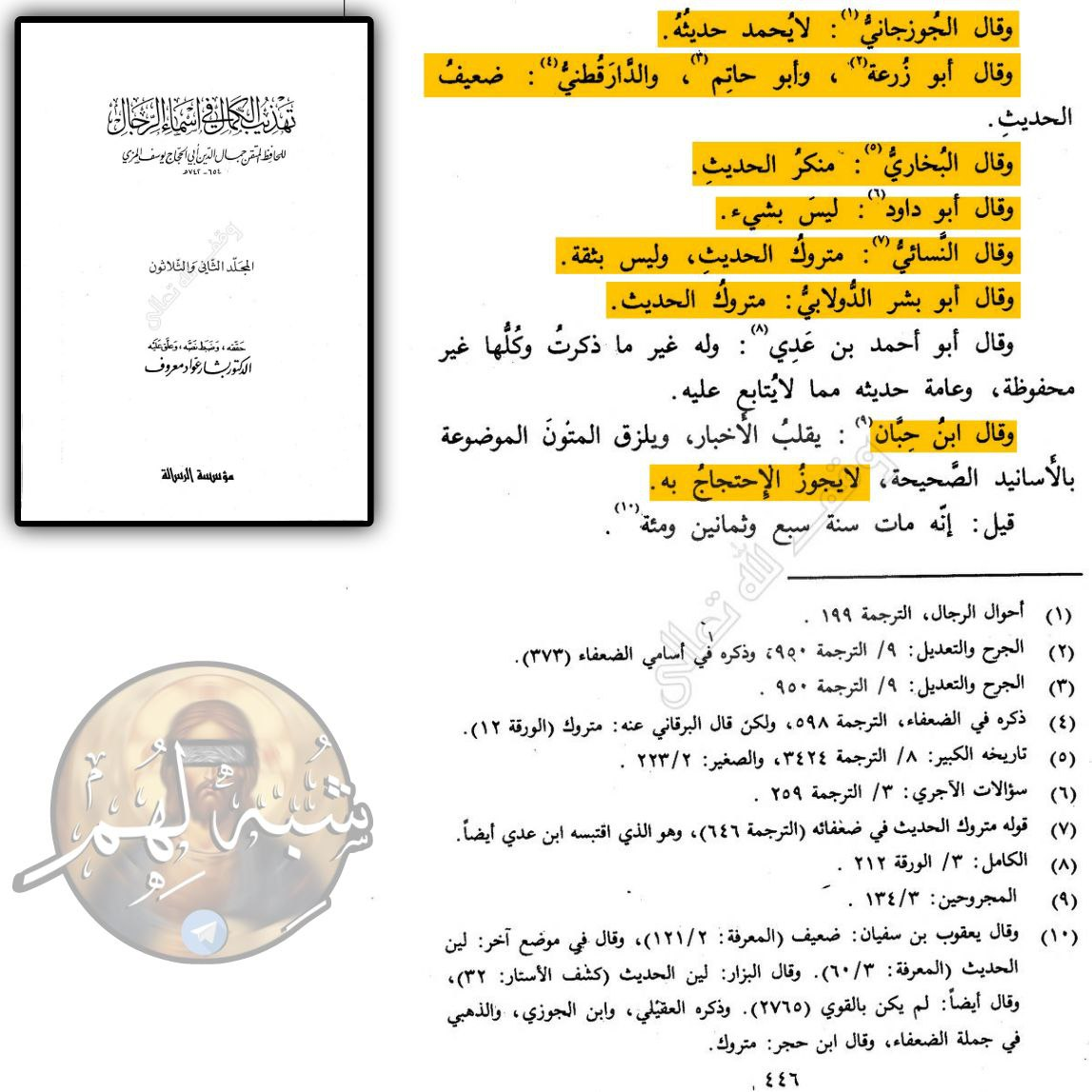
1. Book Details (Left Section)
-
Title: Tahdhib al-Kamal fi Asma’ al-Rijal (تهذيب الكمال في أسماء الرجال)
-
Author: Al-Hafiz Jamal al-Din Abi al-Hajjaj Yusuf al-Mizzi
-
Volume: Volume 32 (المجلد الثاني والثلاثون)
-
Investigator/Editor: Dr. Bashar Awad Marouf
-
Publisher: Mu’assasat al-Risalah
2. Scholarly Verdicts on the Narrator (Right Section - Page 446)
This page lists critical evaluations (Jarh wa-Ta’dil) from prominent historical Hadith critics condemning the reliability of a specific narrator:
-
Al-Juzajani: Stated that his Hadith is not praised.
-
Abu Zur’ah, Abu Hatim, and Al-Daraqutni: Collectively deemed him weak in Hadith (Da’if al-Hadith).
-
Al-Bukhari: Designated him as Munkar al-Hadith (a narrator of rejected/unacceptable reports).
-
Abu Dawud: Stated that he is “nothing” (Laysa bi-shay’).
-
Al-Nasa’i: Classified him as an abandoned narrator (Matruk al-Hadith) and explicitly stated he is not trustworthy.
-
Abu Bishr al-Dulabi: Also labeled him as an abandoned narrator (Matruk al-Hadith).
-
Abu Ahmad bin ‘Adi: Clarified that his narrations are unpreserved (Ghayr Mahfuzah) and the vast majority of his material is uncorroborated.
-
Ibn Hibban: Severely censured him, stating that he flips historical reports, attaches fabricated texts to authentic chains of transmission, and declared that it is completely impermissible to rely on him as scriptural proof.
3. Historical Timeline
- Death: The text notes a biographical opinion stating that the narrator passed away in the year 187 AH.
The scholars said regarding the ruling on using evidence for something without a chain of transmission (because he may use evidence from books such as Al-Sirah Al-Halabiyyah or Al-Bidayah wa Al-Nihayah, which is without a chain of transmission, and this is unacceptable and rejected).
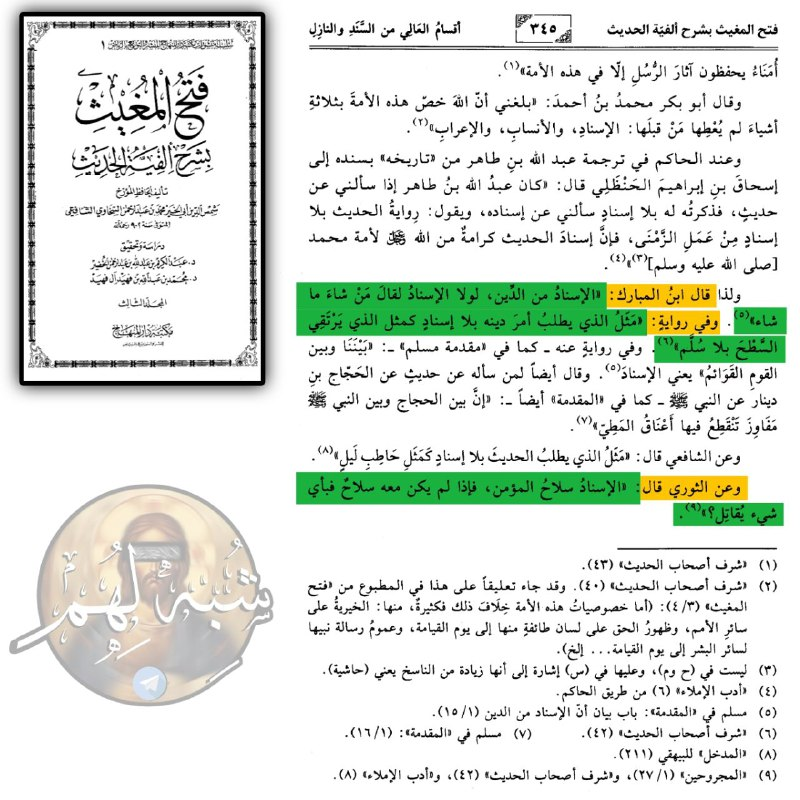
1. Book Details (Left Section)
-
Title: Fath al-Mughith bi-Sharh Alfiyyat al-Hadith (فتح المغيث بشرح ألفية الحديث)
-
Author: Shams al-Din Muhammad bin Abd al-Rahman al-Sakhawi (Died 902 AH)
-
Volume: Volume 3 (المجلد الثالث)
-
Editors/Investigators: Dr. Abd al-Karim al-Khudayr and Dr. Muhammad bin Abdullah bin Fuhayd
-
Publisher: Maktabat Dar al-Minhaj
2. Context of the Page (Right Section - Page 345)
-
Topic: Located under the section discussing the categories of High and Low chains of transmission (A’li and Nazil). It focuses heavily on the essential spiritual and scholastic role that chains of narration (Isnad) play in preserving Islamic knowledge.
3. Explanation of the Highlighted Sayings
The highlighted regions present famous statements from early generations of Islamic scholarship regarding the critical necessity of an Isnad:
-
Abdullah bin al-Mubarak: He famously declared: “The chain of transmission (Isnad) is part of religion; were it not for the Isnad, whoever wished would say whatever they wished.”
-
The Parable of the Ladder: A parallel narration describes the futility of studying religion without verification: “The likeness of the one who seeks a matter of his religion without an Isnad is like the likeness of one who climbs to the roof without a ladder.”
-
Sufyan al-Thawri: He underscored its defensive value to the intellectual tradition by saying: “The Isnad is the weapon of the believer; if he does not have a weapon with him, with what will he fight?”
In conclusion,the hadith is weak, and this particular addition is weak. What is wrong with a man loving women? Any man who doesn’t love women should consult a doctor