

Is the Narration About the Prophet and a Woman's Breast Authentic?
Scholarly Fact-Check: Is the Narration About Wiping a Woman’s Chest Authentic?
The Christian cited as evidence what Imam Abu Ya’la narrated in his Musnad, saying :
{Ishaq ibn Abi Isra’il told us, Hammad told us, Hanzalah told us, on the authority of Anas, that a woman came to the Prophet and he wiped her face. They used to come to him and he would wipe their faces and pray for them. She said: O Messenger of Allah, lower your hand. He said: So he pushed her away and said: Get away from me . } (1)
In response to this slander, I say:
First: The account is incorrect:
Its chain of transmission includes a weak, unreliable, and rejected narrator.
Chapter Topic
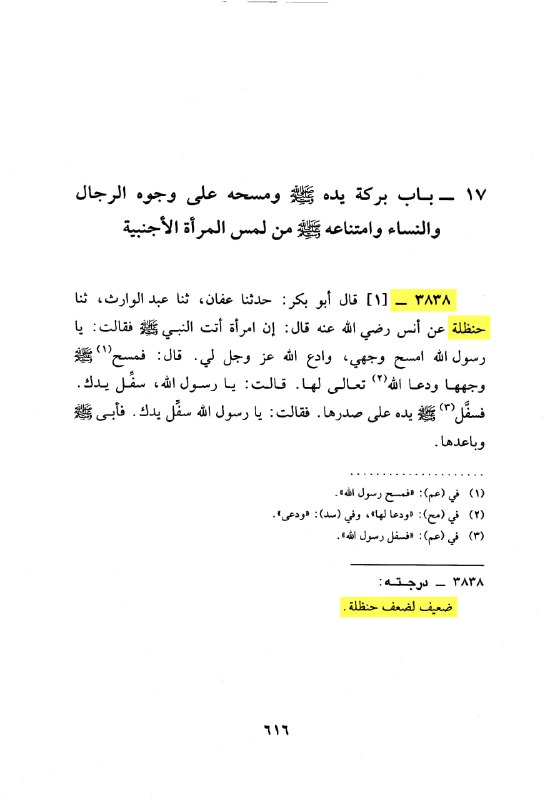
The chapter addresses the blessings tied to the hand of the Prophet Muhammad ﷺ when wiping the faces of individuals, while emphasizing his strict boundary regarding touching non-mahram (stranger) women.
Hadith Text (Narration 3838)
-
The Chain of Transmission: Narrated from Abu Bakr via Affan, Abdul Warith, and Hanzalah, on the authority of Anas bin Malik.
-
The Incident: A woman approached the Prophet ﷺ asking him to wipe her face and pray to Allah for her. He wiped her face and supplicated for her. When she requested him to lower his hand, he placed it on her chest. When she asked him to lower his hand even further, he refused and withdrew.
Hadith Evaluation and Grading
-
Final Ruling: The final section explicitly grades the narration as “ضعيف” (Weak).
-
Cause of Weakness: The textual note clarifies that the grading is due to the unreliability of the highlighted narrator, Hanzalah (“ضعيف لضعف حنظلة”).
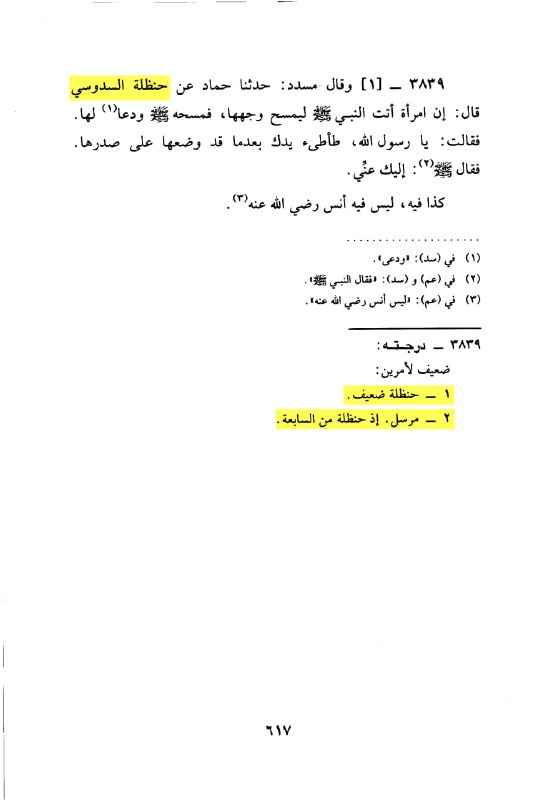
Hadith Text and Narrative
-
The Chain of Transmission: Reported by Musaddad via Hammad, on the authority of Hanzalah al-Sadusi.
-
Absence of a Companion: The text notes an important distinction from previous versions, explicitly stating that Anas bin Malik is not mentioned in this chain of transmission.
-
The Incident: A woman came to the Prophet Muhammad ﷺ asking him to wipe her face. He wiped her face and supplicated for her. After he placed his hand on her chest, she asked him to lower his hand, to which he responded, “Get away from me.”
Hadith Evaluation and Grading
-
Final Ruling: The narration is explicitly graded as “ضعيف” (Weak).
-
Reasons for Weakness: The analysis provides two distinct reasons for the weak classification:
-
Narrator Weakness: Hanzalah himself is evaluated as a weak narrator (“حنظلة ضعيف”).
-
Broken Chain: The narration is Mursal (disconnected), because Hanzalah belongs to the seventh generation/level of narrators (“مرسل. إذ حنظلة من السابعة”) and did not directly encounter the Prophet ﷺ.
-
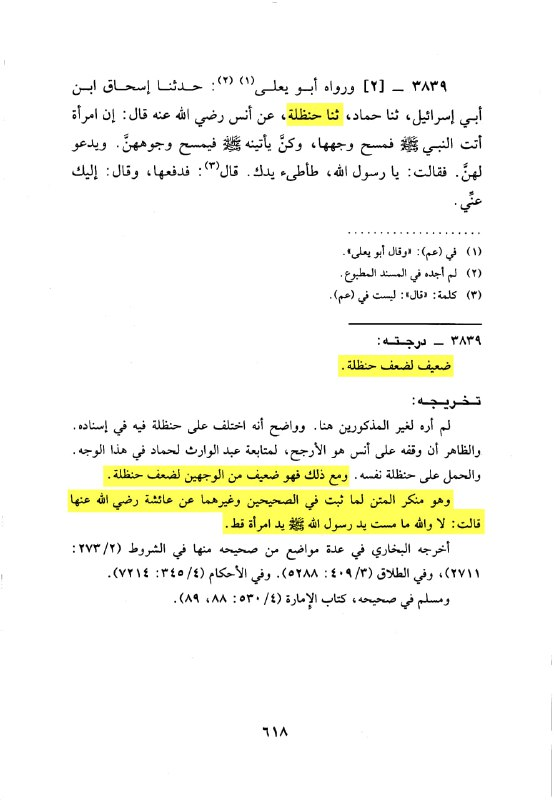
Hadith Text and Alternative Chain
-
The Chain of Transmission: This second version of narration 3839 is recorded via Abu Ya’la from Ishaq bin Abi Israel, through Hammad, on the authority of Hanzalah, from Anas bin Malik.
-
The Narrative: It mentions women coming to the Prophet Muhammad ﷺ so he could wipe their faces and supplicate for them. When a woman asked him to lower his hand, he pushed her away and said, “Get away from me.”
Hadith Evaluation and Grading
-
Final Ruling: The narration is graded as “ضعيف” (Weak).
-
Reason for Weakness: The analysis reiterates that the narration is weak from both reported routes specifically due to the weakness of the narrator Hanzalah (“لضعف حنظلة”).
Textual Analysis and Contradiction (Matn Critique)
-
Munkar Classification: The highlighted portion notes that the text is “منكر المتن” (denied/unacceptable in its textual content).
-
Contradiction with Authentic Sources: The content directly contradicts firmly established narrations in Sahih al-Bukhari and Sahih Muslim. Specifically, it goes against the authentic statement of Aisha, who stated: “No, by Allah, the hand of the Messenger of Allah ﷺ never touched the hand of a [non-mahram] woman.”
-
Canonical Cross-References: The bottom text provides specific volume and chapter references tracking Aisha’s authentic narration across multiple locations in Sahih al-Bukhari (Kitab al-Shurut, Kitab al-Talaq, Kitab al-Ahkam) and Sahih Muslim (Kitab al-Imarah).
Muslims only accept authentic hadiths in their religion, and these must meet five conditions :
1- Connection of the document.
2- The integrity of the narrators.
3- Verifying the narrators.
4- Absence of abnormality.
5- Absence of the cause.
Imam Abu Amr Ibn Al-Salah said: “As for the authentic hadith, it is the hadith with a chain of transmission that is connected by the transmission of trustworthy and precise individuals from one trustworthy and precise individual to the end of it, and it is not anomalous, nor defective.” (2)
The reason for the narration: Hanzala bin Abdullah Al-Basri Al-Sadusi.
Imam Abu al-Hajjaj al-Mizzi said:
Ali ibn al-Madini said: I heard Yahya ibn Saeed mention Hanzala al-Sadusi, and he said: I saw him and deliberately left him. I said to Yahya: Had he become confused? He said: Yes.
Abu al-Hasan al-Maymuni said, on the authority of Ahmad ibn Hanbal: His hadith is weak.
Abu Bakr al-Athram said: I asked Abu Abdullah about Hanzala al-Sadusi, and he said: Hanzala - and he prolonged his voice - then he said: That one is a denier of hadith, he narrates wonders.
Salih ibn Ahmad ibn Hanbal said, on the authority of his father: He is weak in hadith.
Abbas al-Duri said, on the authority of Yahya ibn Ma’in: He changed at the end of his life.
Abu Bakr ibn Abi Khaythama said, on the authority of Yahya ibn Ma’in: He is weak.
Al-Nasa’i said the same. (3)
Hanzala is very weak and confused, and his hadith is not acceptable. Therefore, the narration is invalid in terms of its chain of transmission.
Secondly: Other books that mention the novel:
I should also point out that some authors of books that mention this narration also mention it through the route of Hanzala al-Sadusi, such as the book Fawa’id Ibn Akhi Mimi al-Daqqaq. (4)
As for the other books that mention the narration, they are not reliable at all because they quote from these two books that we have already mentioned, such as:
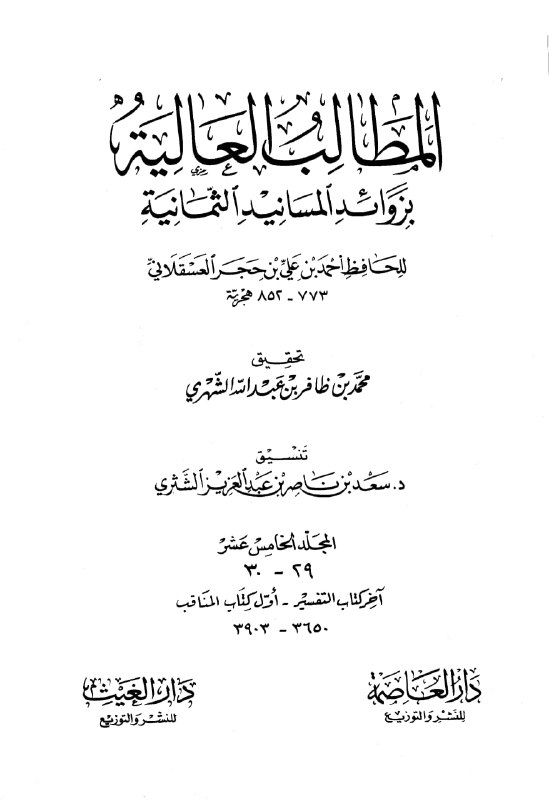
• The book “Al-Matalib Al-Aliyah bi-Zawa’id Al-Masanid Al-Thamaniah” by Imam Ibn Hajar Al-Asqalani. (5)
• The book Al-Maqsad Al-Ali fi Zawa’id Abi Ya’la Al-Mawsili by Imam Al-Haythami. (6)
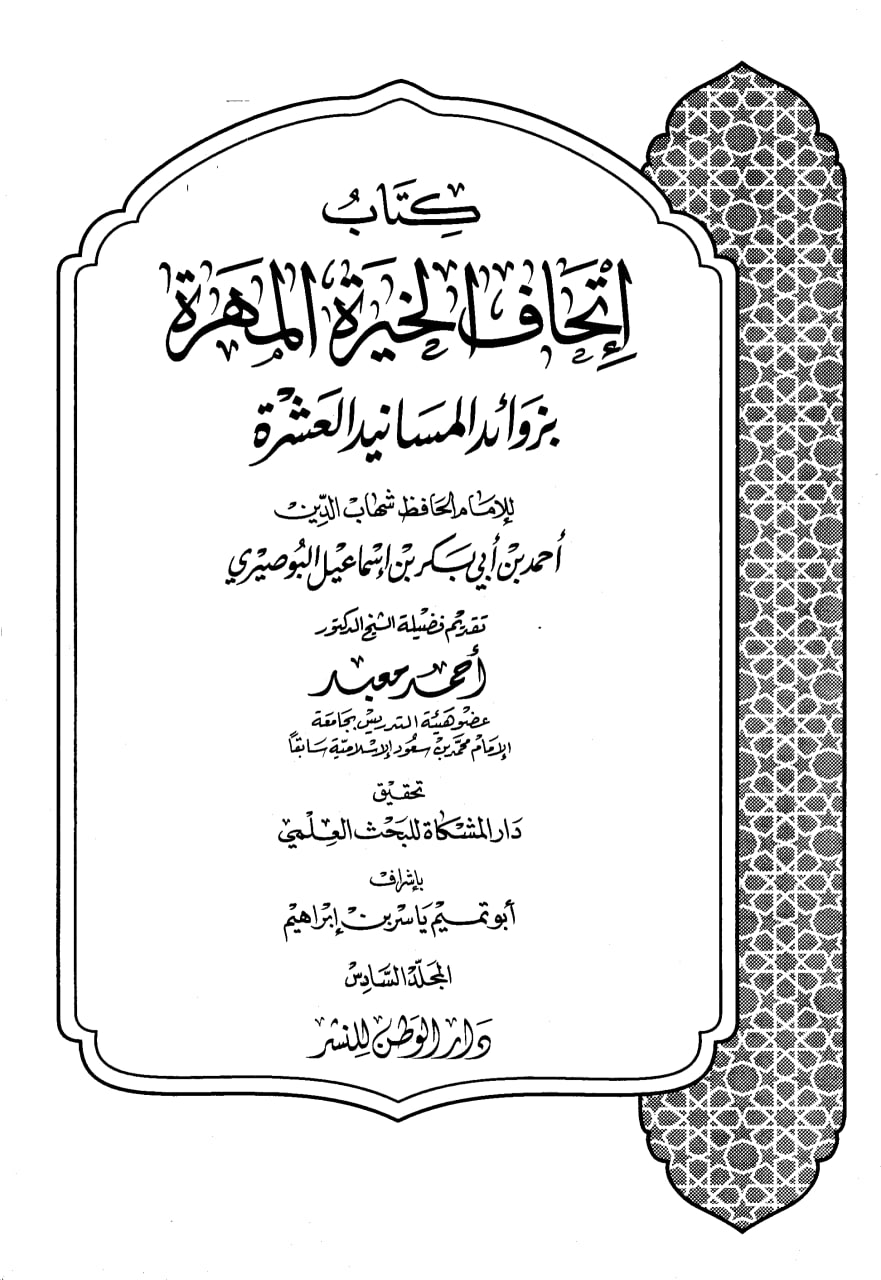
• The book “Ithaf al-Khayra al-Mahara bi-Zawa’id al-Masanid al-‘Ashara” by Imam al-Busiri. (7)
Imam al-Busiri said :
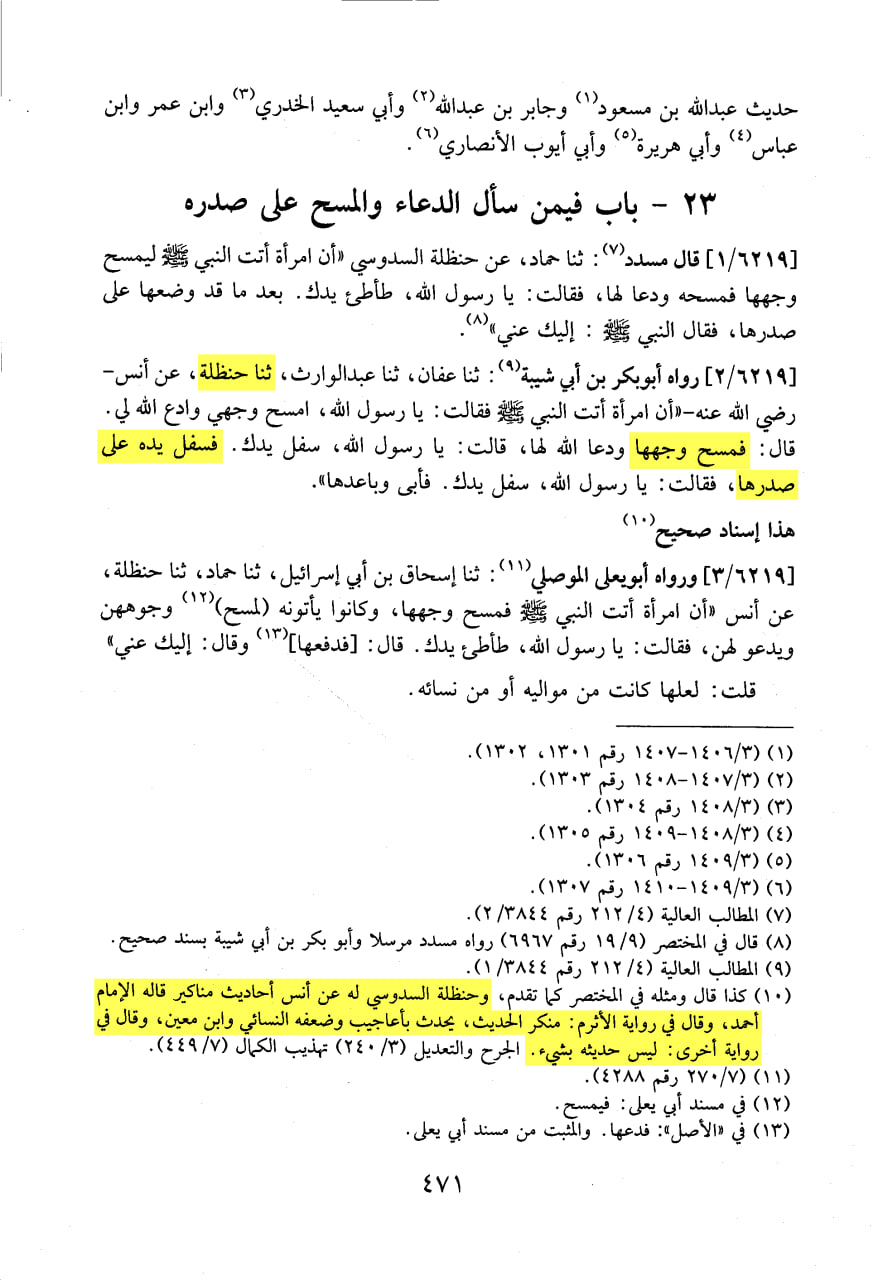
Abu Bakr (Ibn Abi Shaybah) said: Affan narrated to us, Abd al-Warith narrated to us, Hanzalah narrated to us, on the authority of Anas, who said: A woman came to the Prophet and said: O Messenger of Allah, wipe my face and pray to Allah for me. So he wiped her face and prayed to Allah Almighty for her. She said: O Messenger of Allah, lower your hand. So he lowered his hand on her chest. She said: O Messenger of Allah, lower your hand But he refused and distanced himself from her. (7)
This narration contains a strange addition to the first one, yet its chain of transmission includes the same weak narrator through whom this narration was transmitted, namely Hanzala.
Third: The investigators judge the account to be weak:
Scholarly researchers have judged this narration to be weak and incorrect:
Sheikh Hussein Salim Asad said:
{Its chain of transmission is weak due to the weakness of Hanzalah.} (8)
Sheikh Nabil Saad El-Din Jarar said:
{It was narrated by Abu Ya’la through the chain of transmission of Ishaq ibn Abi Isra’il, and Hanzala is weak.} (9)
Sheikh Muhammad Ibn Dhafer Al-Shahri said:
{Weak due to the weakness of Hanzalah}. (10)
Sheikh Abu Tamim Yasser Ibn Ibrahim said:
{And Hanzalah has some objectionable hadiths on the authority of Anas, as Imam Ahmad said. And in the narration of Al-Athram he said: He is an objectionable hadith narrator who narrates strange things. Al-Nasa’i and Ibn Ma’in considered him weak. And in another narration he said: He has no hadiths at all.} (11)
Sheikh Sayyid Kisrawi Hasan said:
{Its chain of transmission is weak, and the hadith is in Musnad Abi Ya’la, and I did not find it in Al-Haythami’s Majma’ Al-Zawa’id, and Ibn Hajar mentioned it in Al-Matalib Al-‘Aliyah and attributed it to Abi Ya’la. I said: In its chain of transmission is Hanzalah Al-Sadusi, and he is weak.} (12)
Fourth: The authentic Sunnah refutes the narration:
It has been proven to us Muslims, with conclusive evidence that leaves no room for doubt, that the Prophet, may God bless him and grant him peace, never touched a woman who was not a close relative.
And here, dear reader, is some of this evidence:
Imam Bukhari narrated in his Sahih:
From the hadith of the Mother of the Believers, Aisha, that when the Messenger of Allah, peace and blessings be upon him, received the pledge of allegiance from the women on Islam, he said to them: “Go, for I have received your pledge.” Aisha said: “No, by Allah, the hand of the Messenger of Allah, peace and blessings be upon him, never touched the hand of any woman except that he received their pledge verbally. By Allah, the Messenger of Allah, peace and blessings be upon him, did not take anything from the women except what Allah commanded him to say to them when he took their pledge.” Upon them: I have pledged allegiance to you verbally . (13)
Imam Ahmad narrated in his Musnad:
{ When Umaymah bint Ruqayqah came to pledge allegiance to the Messenger of God, may God bless him and grant him peace, she said to him: O Messenger of God, accept our pledge. He said: “I do not shake hands with women. My word to one woman is my word to a hundred women. ”} (14)
Indeed, the Messenger of God, may God bless him and grant him peace, forbade this for himself and for the Muslims:
Imam al-Tabarani narrated in his Great Dictionary:
On the authority of Ma`qil ibn Yasar: The Messenger of Allah, may God bless him and grant him peace, said: “For one of you to be stabbed in the head with an iron needle is better for him than to touch a woman who is not permissible for him .” (15)
Therefore, we say that this narrative, which the Christian uses as evidence, is invalid in both its chain of transmission and its content.
As for the chain of transmission, it contains a weak narrator who rejects hadiths, and as for the text, it contradicts the authentic and established Sunnah.
Fifth: I will condemn you by your own mouth.
Why does the Christian ignore the shameful and scandalous things in his book and turn a blind eye to them?
Has this Christian not seen the terrible sexual scandals that their book falsely and deceitfully attributes to the prophets of God?
And does someone whose house is made of glass go around throwing stones at people, O Christians?
The book that Christians believe in says:
King David was old and advanced in years. They covered him with clothes, but he could not get warm. His servants said to him, “Let them search for a young virgin for our lord the king. Let her stand before the king and be his nurse. Let her lie in your bosom, so that our lord the king may get warm. ” So they searched for a beautiful young woman throughout all the territory of Israel, and they found Abishag the Shunammite and brought her to the king. The young woman was very beautiful, and she was the king’s nurse and served him, but the king did not know her . (16)
And of course, according to their book, the Prophet David did not marry this Shunammite girl, but rather she was simply keeping him warm like this!
Father Tadros Yacoub Malaty says:
{ The Jewish historian Josephus says that this was used as a medical treatment for the elderly, which was for a nurse to sleep next to the elderly without being bound to him as a wife , and that this was known as a Greek medicine authorized by Galen . } (17)
It is known rationally that the Prophet David (according to their book) while he was sleeping would take this girl in his arms and place his hand on her whole body and not just on her chest!
Research references:
(1) Musnad Abi Ya’la by Imam Abi Ya’la al-Mawsili, Vol. 7, p. 270 , Dar al-Ma’mun for Heritage - Beirut, edited by: Hussein Salim Asad.
(2) The Sciences of Hadith by Imam Abu Amr Ibn Al-Salah, p. 11 , published by Dar Al-Fikr Al-Muasir - Lebanon, Dar Al-Fikr - Syria, edited by: Nour Al-Din Antar.
(3) Tahdhib al-Kamal fi Asma’ al-Rijal by Imam Abu al-Hajjaj al-Mizzi, Vol. 7, p. 448 , published by Mu’assasat al-Risalah – Beirut, edited by: Dr. Bashar Awad Ma’ruf.
(4) Benefits of Ibn Akhi Mimi Al-Daqqaq by Abu Al-Hussein Al-Baghdadi Al-Daqqaq, p. 262, no. 567 , Adwaa Al-Salaf edition - Riyadh, edited by: Nabil Saad Al-Din Jarar.
(5) The High Demands with Additions to the Eight Musnads by Imam Ibn Hajar Al-Asqalani, Vol. 15, p. 616 , Dar Al-Asimah Press, Saudi Arabia, edited by: Muhammad bin Dhafer Al-Shahri.
(6) Al-Maqsad Al-Ali fi Zawa’id Abi Ya’la Al-Mawsili by Imam Nur Al-Din Al-Haythami, Vol. 4, p. 354 , Dar Al-Kutub Al-Ilmiyya - Beirut, edited by: Sayyid Kasrawi Hassan.
(7) Ithaf Al-Khayrah Al-Maharah by Imam Al-Busiri, Vol. 6, p. 471 , Dar Al-Watan Publishing - Riyadh, edited by Dar Al-Mishkat, under the supervision of Abu Tamim Yasser bin Ibrahim.
(8) Musnad Abi Ya’la by Imam Abi Ya’la al-Mawsili, Vol. 7, p. 270 , Dar al-Ma’mun for Heritage - Beirut, edited by: Hussein Salim Asad.
(9) Benefits of Ibn Akhi Mimi Al-Daqqaq by Abu Al-Hussein Al-Baghdadi Al-Daqqaq, p. 262, no. 567 , Adwaa Al-Salaf edition - Riyadh, edited by: Nabil Saad Al-Din Jarar.
(10) The High Demands with Additions to the Eight Musnads by Imam Ibn Hajar Al-Asqalani, Vol. 15, p. 616 , Dar Al-Asimah Press, Saudi Arabia, edited by: Muhammad bin Dhafer Al-Shahri.
(11) Ithaf Al-Khayrah Al-Maharah by Imam Al-Busiri, Vol. 6, p. 471 , Dar Al-Watan Publishing - Riyadh, edited by: Dar Al-Mishkat, under the supervision of Abu Tamim Yasser bin Ibrahim.
(12) Al-Maqsad Al-Ali fi Zawa’id Abi Ya’la Al-Mawsili by Imam Nur Al-Din Al-Haythami, Vol. 4, p. 354 , Dar Al-Kutub Al-Ilmiyya - Beirut, edited by: Sayyid Kasrawi Hassan.
(13) Sahih al-Bukhari by Imam Muhammad Ibn Ismail al-Bukhari, p. 1347 , Hadith 5288 , published by Dar Ibn Kathir - Beirut.
(14) Musnad Ahmad by Imam Ahmad Ibn Hanbal, Vol. 44, p. 556 , published by Al-Risalah Foundation - Beirut, edited by: Shuaib Al-Arnaout and others.
(15) The Great Dictionary of Imam Sulayman ibn Ahmad al-Tabarani, Vol. 20, p. 211 , published by Ibn Taymiyyah Library, Cairo, edited by Hamdi ibn Abd al-Majid al-Salafi.
(16) The Christian Book – The Old Testament – First Book of Kings , Chapter 1, Numbers 1-4 , Van Dyck Translation, Bible Society Edition.
(17) The interpretation of the First Book of Kings by Father Tadros Yaqoub Malaty, p. 48 , published by Anba Rouis Press – Abbasia.
RELATED
Did the Prophet Touch a Woman’s Chest? A Weak Hadith Exposed