Job 10:10 and the Ancient Error of Embryology: The Bible Reflects Pre-Scientific Culture
·11 min read·2359 words
Job 10:10 contains a metaphor comparing the formation of a human being in the womb to the curdling of milk into cheese — a description that reflects the dominant pre-scientific theory of embryonic development prevalent from the third and fourth centuries BC through the seventeenth century, not a divinely revealed account of human development. This is confirmed by Christian commentators themselves, by the Jesuit monastic translation, and by the historian of embryology Joseph Needham.
The Biblical Text
Job 10:9–11 (ESV) Remember that you formed me like clay; will you then turn me back to dust? (9) Did you not pour me out like milk and curdle me like cheese? (10) You clothed me with skin and flesh, and knit me together with bones and sinews. (11)
The peoples of the Middle East, especially the Fertile Crescent, believed that the fetus is formed in the mother’s womb as a result of the man’s semen coagulating when it mixes with the woman’s blood — specifically her menstrual blood — and that this is the main reason a woman does not menstruate throughout her pregnancy. This is precisely what verse 10 indicates, likening the man’s semen to milk and its coagulation in the woman’s womb to the curdling of cheese.
This belief in the stages of fetal development was prevalent among ancient peoples from the third and fourth centuries BC until the seventeenth and eighteenth centuries. Among those who referenced this theory were Hippocrates, Aristotle, and Galen.
Scientific and Historical Context: The Coagulation Theory
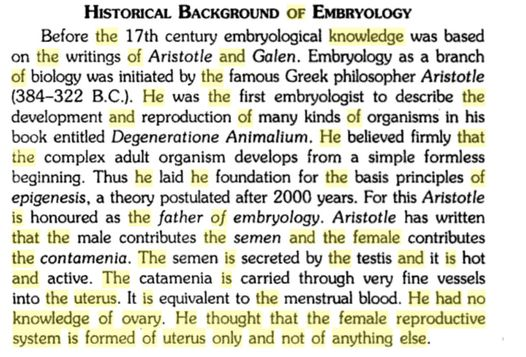
The following image shows the relevant passage from the Textbook of Embryology, page 2, documenting the state of embryological knowledge before the seventeenth century.
Textbook of Embryology page 2 documenting pre-17th century embryological knowledge based on Aristotle and Galen's coagulation theory
Textbook of Embryology, p. 2 Before the 17th century embryological knowledge was based on the writings of Aristotle and Galen. Embryology as a branch of biology was initiated by the famous Greek philosopher Aristotle. He was the first embryologist to describe the development and reproduction of many kinds of organisms in his book entitled “Degeneration Animalium.” He firmly believed that the complex adult organism develops from a simple formless beginning. Thus he laid the foundation for the basic principles of epigenesis, a theory postulated after 2000 years later. For this Aristotle is honored as the father of embryology. Aristotle has written that the male contributes the semen and the female contributes the catamenia. The semen contributes nothing material to the embryo.
From The Embryo Project Encyclopedia, written by Dorothy Regan Haskett, Valerie Racine, and Joanna Yang:
The Embryo Project Encyclopedia | Dorothy Regan Haskett, Valerie Racine, Joanna Yang Throughout his works, Aristotle expounded an empirical form of scientific investigation of the natural world and contributed to the field of embryology. His embryological work remained relevant for centuries, and during the seventeenth and eighteenth centuries, when new technologies became available for scientists to observe developmental processes, Aristotle’s theories resulted in early microscopic controversies. Observers reported what they claimed were miniature humans in either sperm or egg cells. In the late seventeenth century, the theory of preformation became popular among natural philosophers. The theory held that an embryo is a miniature version of an adult organism, and that the adult emerges as the embryo gets bigger. By the eighteenth century, preformation became the dominant theory of embryonic development, gaining proponents who dismissed Aristotle’s theory of epigenesis.
The similarity between Job 10:10 and the coagulation theory is due, as the context makes clear, to the fact that the writer of the Book of Job was influenced by the cultural atmosphere that prevailed when he wrote the book.
Christian Sources Confirming the Cultural Origin of Job 10:10
The Modern Interpretation of the Holy Bible — Book of Job, Pages 20–21
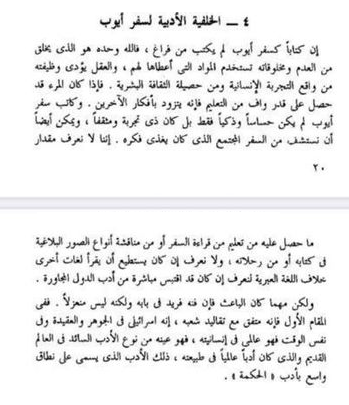
The following image shows the relevant passage from the modern interpretation of the Holy Bible, Book of Job, pages 20–21.
Modern interpretation of the Holy Bible, Book of Job pp.20–21, acknowledging the writer was shaped by the cultural ideas of his time
Modern Interpretation of the Holy Bible | Book of Job, pp. 20–21 A book like the Book of Job was not written in a vacuum. God alone is the one who creates from nothing, and His creatures use the materials that He gave them, and the mind performs its function from the reality of human experience and from the result of human culture. If a person has a sufficient amount of education, he is supplied with the ideas of others. The writer of the Book of Job was not only sensitive and intelligent, but he was experienced and cultured. We can also infer from the book the society that fed his thinking. We do not know how much he had from teaching, from reading, travel, or from discussing the types of rhetorical images in his book or from his travels. We do not know if he could read languages other than Hebrew, so we do not know if he quoted directly from the literature of neighboring countries. But whatever the motive, his art is unique in its genre. He is not isolated. In the first place, he is in agreement with the traditions of his people. He is Israeli in essence and belief, and at the same time universal in his humanity. He is a sample of the type of literature prevalent in the ancient world, which was universal in nature — that literature which is widely called “wisdom” literature.
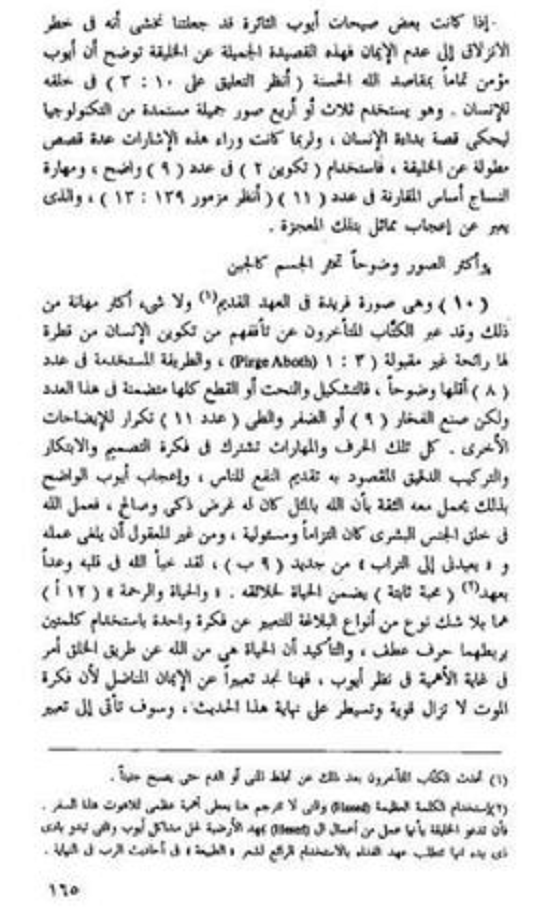
The same source, on page 165, addresses the cheese metaphor directly.
Modern interpretation of the Holy Bible, Book of Job p.165, identifying the cheese-curdling image as unique in the Old Testament and noting later writers spoke of the same coagulation theory
Modern Interpretation of the Holy Bible | Book of Job, p. 165 Job uses three or four beautiful images derived from technology to tell the story of the beginning of man, and the most obvious image is the body curdling like cheese (v. 10), which is a unique image in the Old Testament.
And in the margin of the page, commenting on this: “Later writers spoke after that about the clotting of semen or blood until it becomes a fetus.”
The Jesuit Monastic Translation — Page 1065, Commentary on Job 10:10
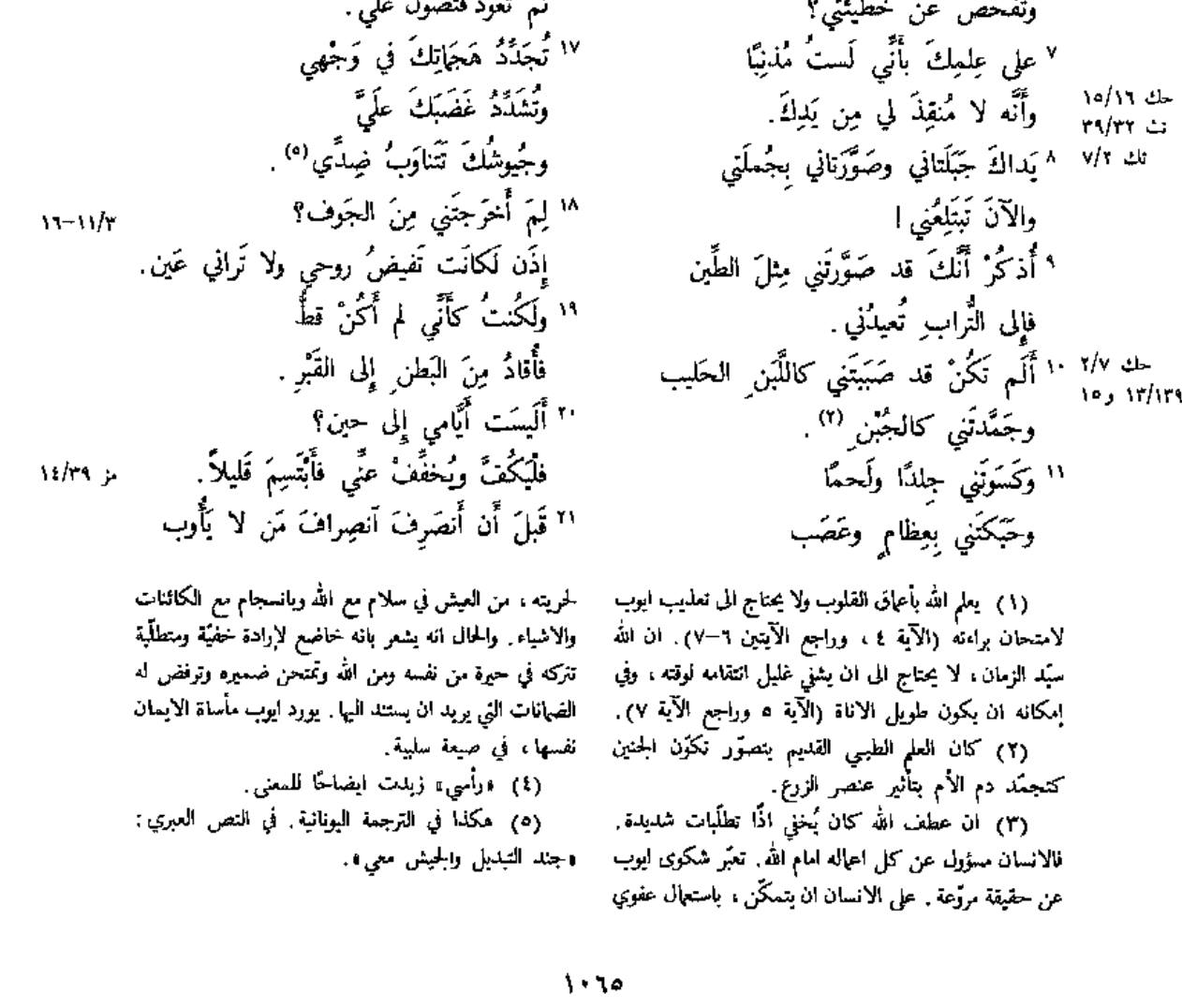
The following two images show the Jesuit monastic translation’s marginal commentary on Job 10:10.
Jesuit monastic translation page 1065 first image, with marginal commentary on Job 10:10 stating ancient medical science imagined fetal formation as coagulation of the mother's bloodJesuit monastic translation page 1065 second image, further context of the marginal commentary on Job 10:10
Jesuit Monastic Translation | p. 1065, margin comment on Job 10:10 Ancient medical science imagined the formation of the fetus as the congealing of the mother’s blood under the influence of the implantation element.
John Trapp Complete Commentary on Job 10:10
John Trapp | Complete Commentary on Job 10:10 — https://www.studylight.org/commentaries/jtc/job-10.html Thus, in a most modest manner, and with elegant metaphors, doth Job, as a great philosopher, set out man’s conception in the womb. Aristotle hath some such expression as this, but nothing so clear and full (Bodin. Theat. Natur., 434. Arist. de Gen. Anim. cap. 20).
George Haydock’s Catholic Bible Commentary on Job 10:10
George Haydock | Catholic Bible Commentary on Job 10:10 — https://www.studylight.org/commentaries/hcc/job-10.html The ancients explained our origin by the comparison of curdled milk, or cheese (Aristotle i. 10; Pliny, Natural History vii. 15), which the moderns have explained on more plausible principles.
Joseph Needham’s Confirmation: The Bible Copied Aristotle
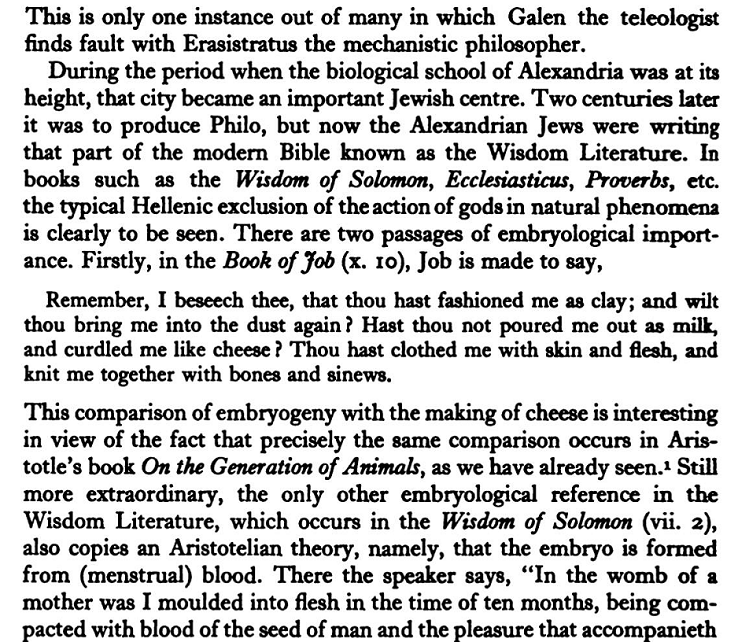
The historian Joseph Needham, in his book A History of Embryology, explicitly states that the theory adopted by the ancients about the stages of embryonic development is exactly what Job 10:10 indicates — and that the same idea appears in the Wisdom of Solomon, also copying an Aristotelian theory.
The following two images show the relevant passage from Needham’s History of Embryology.
Joseph Needham's History of Embryology first image, stating the cheese-curdling comparison in Job 10:10 occurs in the same form in Aristotle's On the Generation of AnimalsJoseph Needham's History of Embryology second image, continuing the passage on Job 10:10 and the Wisdom of Solomon copying Aristotelian embryological theory
Joseph Needham | A History of Embryology This comparison of embryology with the making of cheese is interesting in view of the fact that precisely the same comparison occurs in Aristotle’s book On the Generation of Animals, as we have already seen. Still more extraordinary, the only other embryological reference in the Wisdom Literature, which occurs in the Wisdom of Solomon (vii. 2), also copies an Aristotelian theory, namely, that the embryo is formed from (menstrual) blood.
The same idea is found in the Book of Wisdom, Chapter 7:
Wisdom 7:2 (Catholic Canon) And in a period of ten months she was made of blood by the seed of man and the pleasure that accompanies sleep.
And indeed we find the same idea also present in the New Testament. In the Gospel of John, Chapter 1:13: “Who were born, not of blood, nor of the will of the flesh, nor of the will of man, but of God.” Tertullian (second century) used this very text to confirm the idea of coagulation when the man’s semen meets the woman’s blood in her womb.
Tertullian | De Carne Christi, Chapter 19 — https://www.tertullian.org/articles/evans_carn/evans_carn_04eng.htm The material of the seed, which material it is agreed is the heat of the blood, as it was by despumation changed into a coagulator of the woman’s blood. For from the coagulator there is in cheese a function of that substance, namely milk, which by chemical action it causes to solidify.
Refuting the Missionary Counter-Argument: “Job Contradicted the Culture of His Time”
Some missionaries attempted to respond to criticisms of Job 10:10 by claiming that the text actually contradicted the prevailing belief of its cultural era — since the prevailing belief at the time, according to them, was the theory of the homunculus (the dwarf man), which holds that the man’s semen carries a miniature fetus that then settles in the woman’s womb and enlarges.
Job 10:10 contradicted its cultural era because the prevailing theory at the time was the homunculus theory, making the text uniquely prophetic
This claim is historically false on three counts
First: The homunculus theory did not become prevalent until the seventeenth and eighteenth centuries, after the microscope became available. Before that, from the third and fourth centuries BC onwards, the dominant theory was the coagulation theory of Aristotle and Galen — precisely what Job 10:10 reflects. The Textbook of Embryology, page 2, cited above, confirms this explicitly.
Second: The claim that Hippocrates, Aristotle, and Galen favored the homunculus theory is a complete fabrication. Aristotle is explicitly recognized as a supporter of epigenesis — the theory that the organism develops from a simple, undifferentiated beginning — not of preformationism. The Encyclopedia Britannica states:
Encyclopedia Britannica — https://www.britannica.com/science/embryology From the time of the Greek philosopher Aristotle it was debated whether the embryo was a preformed, miniature individual (a homunculus) or an undifferentiated form that gradually became specialized. Supporters of the latter theory included Aristotle; the English physician William Harvey, who labeled the theory epigenesis; the German physician Caspar Friedrich Wolff; and the Prussian-Estonian scientist Karl Ernst, Ritter von Baer, who proved epigenesis with his discovery of the mammalian ovum in 1827.
Third: As for Galen, he stated that the fetus’s body consists of two parts — one from the man’s semen and one from the woman’s blood — and never stated the homunculus theory. Meyer’s Essays on the History of Embryology, Volume 2 states:
Meyer | Essays on the History of Embryology, Volume 2 — https://embryology.med.unsw.edu.au/embryology/index.php/Meyer_-_Essays_on_the_History_of_Embryology_2 On the basis of their origin, Galen divided all parts of the body into two classes. One class of organs which was said to arise from sperm was called partes spermaticae, and the other class, partes sanguineae, because he believed they arose from the blood. This classification of Galen continued in use for several hundred years.
Fourth: As for Hippocrates, he stated that the fetus is formed by mixing the man’s water with the woman’s water, but he also stated that human flesh is formed as a result of the woman’s blood clotting in the womb and that bones are formed as a result of concentrated heat acting on the woman’s blood clotted in her womb. The Hippocratic Treatises “On Generation,” On the Nature of the Child, pages 7–8, state:
The Hippocratic Treatises | “On Generation,” On the Nature of the Child, pp. 7–8 The seed is contained in a membrane, and it breathes in and out. Moreover, it grows because of its mother’s blood, which descends to the womb. At this stage with the descent and coagulation of the mother’s blood, flesh begins to be formed with the umbilicus through which the embryo breathes and grows, projecting from the center.
And from the same source, page 9:
The Hippocratic Treatises | “On Generation,” On the Nature of the Child, p. 9 The bones grow hard as a result of the coagulating action of heat; moreover they send out branches like a tree. Both the interior and exterior of the body now begin to separate into parts more distinctly.
Karen Wellner’s article A History of Embryology (1959), by Joseph Needham, from The Embryo Project Encyclopedia confirms:
Karen Wellner | “A History of Embryology (1959), by Joseph Needham” — The Embryo Project Encyclopedia — https://embryo.asu.edu/pages/history-embryology-1959-joseph-needham The first written record of embryological research is attributed to Hippocrates (460 BC–370 BC) who wrote about obstetrics and gynecology. Hippocrates believed that the embryo began development by extracting moisture and breath from the mother and he identified a series of condensations and fires that were responsible for the development of bones, belly, and circulation in the embryo and fetus. He also supported the view that the human fetus gained nourishment by sucking blood from the placenta.
Conclusion The cheese-curdling metaphor of Job 10:10 reflects the coagulation theory of fetal development that was universally dominant from Aristotle and Hippocrates through the seventeenth century — not a divinely revealed description of embryology. This is confirmed by Christian commentators (John Trapp, George Haydock), by the Jesuit monastic translation’s own marginal notes, by the modern interpretation of the Holy Bible itself, and by the foremost historian of embryology, Joseph Needham, who explicitly identified the connection between Job 10:10 and Aristotle’s On the Generation of Animals. The missionary counter-argument — that the text contradicted its cultural era by avoiding the homunculus theory — is false: the homunculus theory was not prevalent until the seventeenth and eighteenth centuries, while Job’s text was written in an era when the coagulation theory was the universal consensus. The responses of the missionaries on this issue are nothing but illusions resulting from a deep ignorance of the ancient cultures and ideas related to the stages of fetal formation.