Mirza Ghulam Ahmad's Self-Contradiction on Jesus Being Alive in Heaven — From His Own Books
·12 min read·2654 words
How to Navigate This Note The Qadiani Accusation Against Muslims — the accusation that belief in Jesus’s bodily ascension is polytheism Mirza Affirms the Life of Jesus in Heaven — Barahin Ahmadiyya 1884 — Mirza’s own words for 52 years affirming exactly what he later called polytheism The Qadiani Missionary Book Confirms the Reversal — the official Ahmadiyya publication Life of Ahmad admitting the change Mirza Denounces the Belief He Held for 52 Years — the 1907 reversal and what it means for his claim to prophethood The Second Caliph’s Verdict — Mirza Was a Polytheist and Atheist — the Promised Reformer condemns his own father by his own standard Mirza’s Concealment of the Truth for Ten Years — Mirza’s own admission that he knew but deliberately hid his belief for a decade Jesus Lives in Heaven With a New Body — Mirza’s Final Position — how Mirza’s later theology still places Jesus in heaven with a body, contradicting his own accusation against Muslims Conclusion — what all of this establishes about Mirza’s claimed prophethood
The !!Qadiani!! accusation that Muslims who believe in the bodily ascension of Jesus, peace be upon him, are polytheists collapses the moment one opens the published books of Mirza Ghulam Ahmad himself — for he held and preached exactly that belief for fifty-two years of his life, including twelve years of his alleged prophethood, before reversing his position; and his own successor, the so-called Promised Reformer, explicitly called the earlier belief polytheism and atheism, thereby condemning Mirza by his own community’s standard.
The Qadiani Accusation Against Muslims
The Qadianis have always — in the past and in the present — denounced those Muslims who hold that Jesus, peace be upon him, did not die and that he was raised bodily to heaven. They falsely and slanderously accuse such Muslims of polytheism, of deifying Christ, peace be upon him, or of supporting the polytheistic beliefs of the Christians. The implication, taken to its logical end from some Qadiani writings, is that any human being who leaves the earth’s atmosphere becomes a god.
This article will demonstrate, from the writings of Mirza Ghulam Ahmad of Qadian himself — the prophet of the Ahmadiyya community known as Qadiani — the following:
Mirza continued for fifty-two years of his life to declare his belief in the immortality of Jesus Christ, peace be upon him, and that he is alive in his body in heaven.
Mirza continued for approximately twelve years of his alleged prophethood to believe in what he himself later called a polytheistic belief — and what his own successor called atheism — and continued to preach this belief, even though he later claimed that his God had sent him only to destroy it.
Mirza’s later opinion about the death of Christ, peace be upon him, still placed Jesus alive in heaven in a body — through Mirza’s own doctrine that souls require new bodies immediately after death.
Mirza Affirms the Life of Jesus in Heaven — Barahin Ahmadiyya 1884
^^In 1884, Mirza Ghulam Ahmad wrote in his book Barahin Ahmadiyya — the very book the Qadianis today claim defeated Christianity and established Mirza as a reformer — the following explicit affirmation of Jesus’s ascension and return:^^
Mirza Ghulam Ahmad — Barahin Ahmadiyya, Part 4, Page 431 (1884) Prophet Jesus, peace be upon him, left the Gospel in its incomplete form and was taken up to heaven, and the Gospel will remain incomplete for a long time in the hands of the people.
And on another page of the same book:
Mirza Ghulam Ahmad — Barahin Ahmadiyya, Part 4, Page 593 (1884) When Jesus, peace be upon him, returns to this world again, the religion will spread to all parts of the earth.
The following image shows the Urdu text of the first of these passages from Barahin Ahmadiyya, hosted on the Qadiani library at ahmadiyyalibrary.com:
Urdu text of Barahin Ahmadiyya Part 4 page 431, in which Mirza affirms that Jesus was taken up to heaven
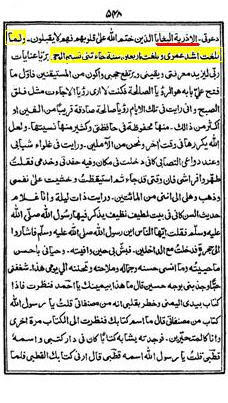
Mirza also records in his book Mirat Kamalat al-Islam, page 548, the year in which he claims revelation began:
Mirza Ghulam Ahmad — Mirat Kamalat al-Islam, p. 548 When I reached the prime of my life and reached forty years of age, the breeze of revelation came to me.
Mirza claimed to have begun receiving revelation around 1879 AD, meaning he continued to receive alleged prophetic revelation until 1891 AD without once denying or contradicting the belief in Jesus’s bodily ascension — the belief he would later call great polytheism. This alone is a sufficient refutation of his claim to prophethood. God Almighty does not accept disbelief for His servants. How then would He accept great polytheism from a sent prophet for twelve consecutive years?
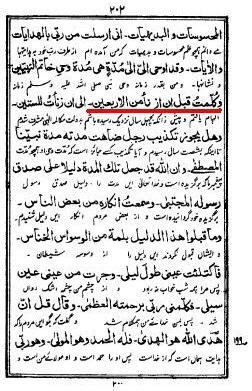
In 1902 AD, Mirza further wrote in his book The Miracle of Christ, page 202:
Mirza Ghulam Ahmad — The Miracle of Christ, p. 202 (1902) And it was revealed to me for a period of time, which is the period of the revelation of the Seal of the Prophets, and I spoke before I committed adultery from the age of forty until I committed adultery from the age of sixty.
The following image shows the Urdu text of this passage:
Urdu text of The Miracle of Christ page 202, in which Mirza describes the period of his revelation
The Qadiani Missionary Book Confirms the Reversal
The official Qadiani missionary book The Life of Ahmad, published by the Ahmadiyya Rabwa branch, contains the following remarkable admission:
The Life of Ahmad — Ahmadiyya Rabwa Branch, p. 40, Footnote 2 Ahmed (Mirza Ghulam Ahmad al-Qadiani) confirmed in his book Barahin Ahmadiyya, published in 1884 AD, the traditional belief that Christ is alive in heaven and will come back to earth — see page 361 and 499 in footnote 3. He was not afraid of rationality, which Sir Syed (Ahmed Khan) had previously bowed to in surrender. But in the year 1891 AD, when God told Ahmed that Christ had died, only then did he change his belief in this regard.
This admission from the Qadiani’s own missionary literature is decisive. Their own publication confirms that Mirza held the traditional Islamic belief in Jesus’s ascension and return from 1884 until 1891 — seven years after publishing Barahin Ahmadiyya and twelve years into his alleged prophethood.
Mirza Denounces the Belief He Held for 52 Years
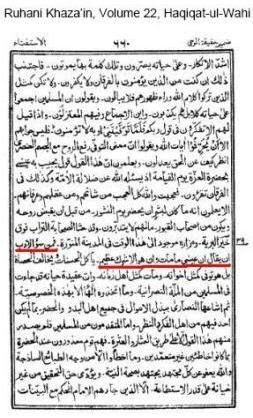
In his book Appendix to the Truth of Revelation, written in 1907 AD, Mirza wrote on page 660, line 12:
Mirza Ghulam Ahmad — Appendix to the Truth of Revelation, p. 660 (1907) It is bad manners to say that Jesus did not die, and that is nothing but great polytheism.
The following image shows the Urdu text of this condemnation from Appendix to the Truth of Revelation:
Urdu text of Appendix to the Truth of Revelation page 660, in which Mirza calls belief in Jesus's immortality great polytheism
According to Mirza’s own words in 1907, he had himself been guilty of bad manners and great polytheism for the first fifty-two years of his life — and for the first twelve years of his claimed prophetic mission.
The Second Caliph’s Verdict — Mirza Was a Polytheist and Atheist
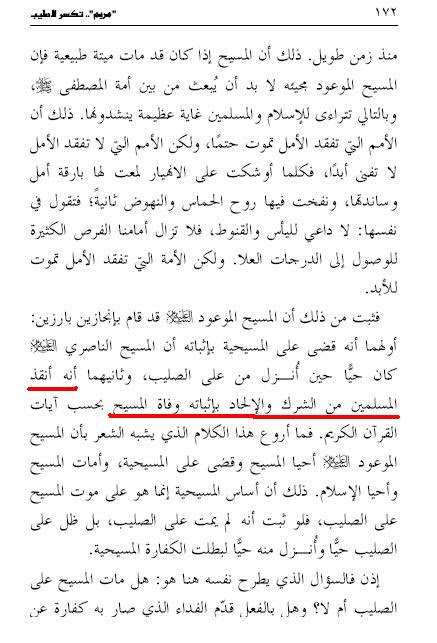
The second Qadiani Caliph — known within the community as the Promised Reformer — wrote the following about his father Mirza’s achievements:
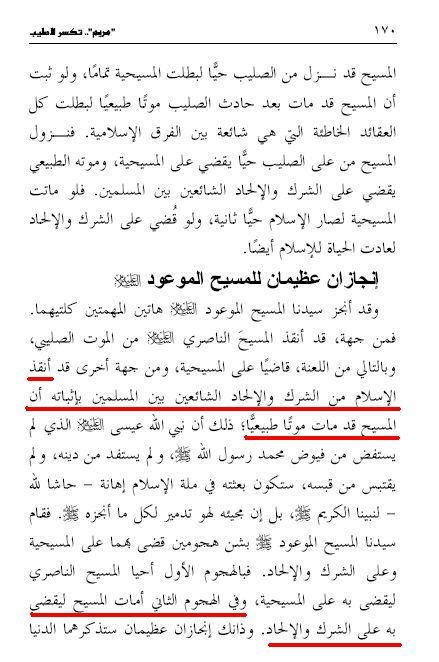
The Promised Reformer (Second Qadiani Caliph) — Mary Breaks the Cross, p. 170 He saved Islam from the polytheism and atheism prevalent among Muslims by proving that Christ died a natural death.
The following image shows the first relevant page from Mary Breaks the Cross:
First page from Mary Breaks the Cross in which the Second Caliph attributes to Mirza the saving of Islam from polytheism and atheism
The following image shows the second relevant page of the same work:
Second page from Mary Breaks the Cross continuing the Second Caliph's account of Mirza's achievement
The logical consequence of the Promised Reformer’s statement is inescapable: if the belief in Jesus’s immortality is polytheism and atheism, and Mirza himself held and preached that belief for fifty-two years of his life and twelve years of his alleged prophethood, then Mirza Ghulam Ahmad was himself a polytheist and an atheist for most of his life and for half of the period of his alleged mission. The son has condemned the father by his own pen.
Mirza’s Concealment of the Truth for Ten Years
The contradiction deepens further. Although Mirza claimed in later writings that God had sent him specifically to correct the belief in Jesus’s ascension, Mirza published his book Barahin Ahmadiyya in 1884 affirming the ascension and continued to publish and sell it without correction until 1891. He then claimed in an inspirational writing that he had known since 1881 — ten years before his public announcement — that Jesus, peace be upon him, would not return and that Mirza himself was the Promised Messiah. His own words on this concealment are recorded in Mirat Kamalat al-Islam:
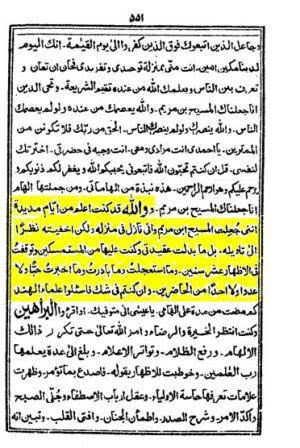
Mirza Ghulam Ahmad — Mirat Kamalat al-Islam, p. 551 (1893) By God, I knew for a long time that I had made the Messiah, son of Mary, and that I would reside in his house, but I concealed it in view of its interpretation. Rather, I did not change my belief and I was one of those who adhered to it. I stopped revealing it for ten years and I did not rush or hurry and I did not inform my beloved or my enemy or anyone present.
The following image shows the Urdu text of this admission:
Urdu text of Mirat Kamalat al-Islam page 551, in which Mirza admits concealing his belief for ten years
But Mirza’s own later writing directly contradicts this claim of concealment on account of interpretation. In his book Ayyam al-Sulh, page 271, written in 1899 AD, he said:
Mirza Ghulam Ahmad — Ayyam al-Sulh, p. 271 (1899) In the proofs of Ahmadiyya, I mistakenly interpreted death as the fulfillment of the full reward, and priests have sometimes used this against me. But they have no justification for what they say. I admit that I was wrong in that interpretation. The divine revelation was clear, but I am, like other humans, prone to mistakes and forgetfulness.
These two statements cannot both be true. In Mirat Kamalat al-Islam (1893), Mirza says he knew the truth from 1881 but deliberately concealed it for ten years without hurrying to reveal it. In Ayyam al-Sulh (1899), Mirza says he was genuinely wrong in his earlier interpretation and simply did not understand the clear divine revelation sent to him. Either Mirza was a deliberate deceiver who knew the truth and hid it, or he was a prophet who spent a decade unable to understand a clear revelation from God. The Qadianis must choose which of their prophet’s two self-descriptions they accept — and neither choice is flattering.
What this means is plain: Mirza claimed that the revelation telling him Jesus had died was clear — yet he did not understand it for ten years. This is the state of the man the Qadianis present as an inspired prophet receiving direct communication from God Almighty.
Jesus Lives in Heaven With a New Body — Mirza’s Final Position
Even after Mirza’s reversal on the death of Jesus, peace be upon him, his theology continued to place Jesus alive in heaven — now with a new body rather than his original one. In his book The Philosophy of Islamic Teachings, Mirza wrote:
Mirza Ghulam Ahmad — The Philosophy of Islamic Teachings The soul must always be accompanied by a body to perform its duties properly. It is true that this mortal body leaves the soul at death, but in the intermediate world it is replaced by a body — a last body.
And in his book The Secret of the Caliphate, page 373, Mirza wrote about the state of deceased prophets:
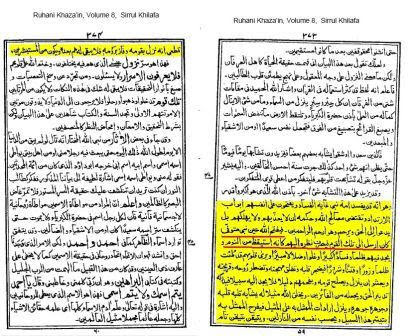
Mirza Ghulam Ahmad — The Secret of the Caliphate, p. 373 God opens the eye of a deceased prophet who was sent to those people, and he turns his gaze to them as if he had awakened from sleep and finds great injustice and corruption among them.
He adds on the following page:
Mirza Ghulam Ahmad — The Secret of the Caliphate, p. 374 This is the descent of Jesus, about which they differ.
The following image shows the Urdu text of these passages from The Secret of the Caliphate:
Urdu text of The Secret of the Caliphate pages 373-374, in which Mirza describes Jesus awakening in heaven and surveying the condition of his people
The gist of Mirza’s final position is therefore this: after Jesus, peace be upon him, died, he was given a new body in heaven — a body different in nature from the earthly body, but a body nonetheless. In heaven, Jesus sleeps, wakes up, opens his eyes, and looks at the condition of his people. This, according to Mirza, is not a deification of Christ.
According to Mirza’s own final theology, Jesus is present in heaven in a special super-body, sleeping and waking and observing the condition of his people — and this is not polytheism. But the opinion of those Muslims who say Jesus is present in heaven with an ordinary human body is polytheism and atheism.
The incoherence is complete. Mirza himself ends up with Jesus alive in heaven in a body — a body granted after death, capable of sleeping and waking and gazing upon the affairs of the living — and declares this to be orthodox. Meanwhile, Muslims who affirm Jesus’s presence in heaven with his original body are called polytheists. Mirza’s own theology provides more comfort to the Christian doctrine of the resurrection body than to the Islamic doctrine he claimed to be defending.
It is worth noting that the Christians themselves claim that Jesus, peace be upon him — after he died — appeared to his disciples in a luminous body different from his earthly body and was then taken up to heaven, where he remains alive and aware of the condition of his people. The opinion that matches the beliefs of the Christians in this regard, according to this comparison, is the final statement of Mirza Ghulam Ahmad — not the opinion of any Muslim scholar.
A Contradiction with the Quran Mirza’s claim that Jesus, peace be upon him, witnesses the condition of his people after his death contradicts the explicit statement of the Holy Quran. God Almighty says that Jesus will say on the Day of Judgment:
Al-Ma’idah 5:117 And I was a witness over them as long as I was among them. But when You took me up, You were the Observer over them, and You are Witness over all things.
Mirza himself acknowledged this Quranic contradiction. In his book Addendum to the Truth of Revelation, page 666, he wrote that Jesus, peace be upon him, would be a liar — God forbid — if he had known about the actions of his people after his death. Yet Mirza’s own doctrine in The Secret of the Caliphate has Jesus doing exactly that — awakening in heaven and gazing at the condition of his people. Mirza contradicted his own Quranic argument within his own books.
Conclusion — What Mirza’s Own Books Establish From Mirza Ghulam Ahmad’s own published writings the following points are established beyond dispute. First, Mirza affirmed the bodily ascension of Jesus and his return to earth for fifty-two years of his life and twelve years of his alleged prophethood. Second, Mirza’s own official missionary publication confirms this openly. Third, when Mirza reversed his position in 1891, his own successor the Promised Reformer declared the earlier belief to be polytheism and atheism — thereby condemning Mirza himself. Fourth, Mirza gave two mutually contradictory explanations for the reversal: in one he says he knew the truth for ten years and deliberately concealed it; in another he says he was simply wrong and failed to understand a clear revelation. Fifth, even Mirza’s final position still places Jesus alive in heaven in a new body, sleeping, waking, and observing his people — a position that contradicts the Quran’s own testimony about what Jesus will say on the Day of Judgment, as Mirza himself acknowledged. The Qadiani accusation of polytheism against Muslims who believe in the ascension of Jesus is an accusation that the pen of Mirza Ghulam Ahmad has written first against Mirza Ghulam Ahmad himself.