

Miskin vs Masakin: Do Qira'at Variants Contradict Each Other
The answer is that all Qira’at readings are divinely revealed and do not contradict each other. The difference between miskin and masakin is a difference of diversity and variation, not of contradiction and opposition. Classical scholars across multiple disciplines — Quranic recitation, grammar, jurisprudence, and tafsir — have addressed this exact variant with precision. What follows is a full compilation of their explanations.
The Principle: Qira’at Differences Are Not Contradictions
The foundational principle governing all variant readings was stated definitively by the major authorities of the field.
The Quranic basis for this principle is direct:
Do they not then reflect upon the Qur’an? Had it been from other than God, they would have certainly found therein much inconsistency.
Having examined all variant readings, classical scholars found that differences fall into one of three categories. Imam al-Dani stated in Jami’ al-Bayan: “The difference in meanings follows the difference in words in the seven letters.” He then classified all such differences into three types:
First: A difference in wording only — the meaning is one.
Second: A difference in both wording and meaning, with the possibility of their convergence in one thing, since their coexistence is not contradictory.
Third: A difference in both wording and meaning, with the impossibility of their coexistence in one thing — yet they agree in another aspect that does not necessitate contradiction.
The miskin/masakin variant falls squarely into the second category: two different wordings, two complementary meanings, no contradiction.
The Verse in Question
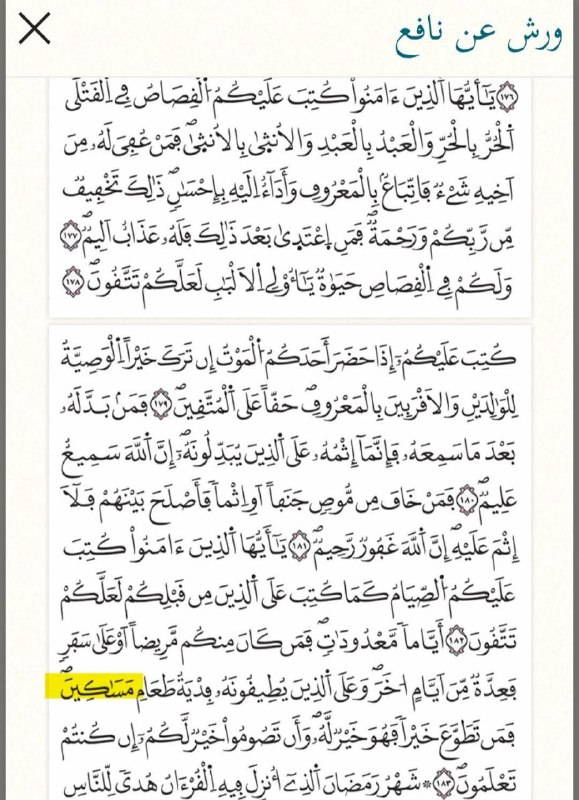
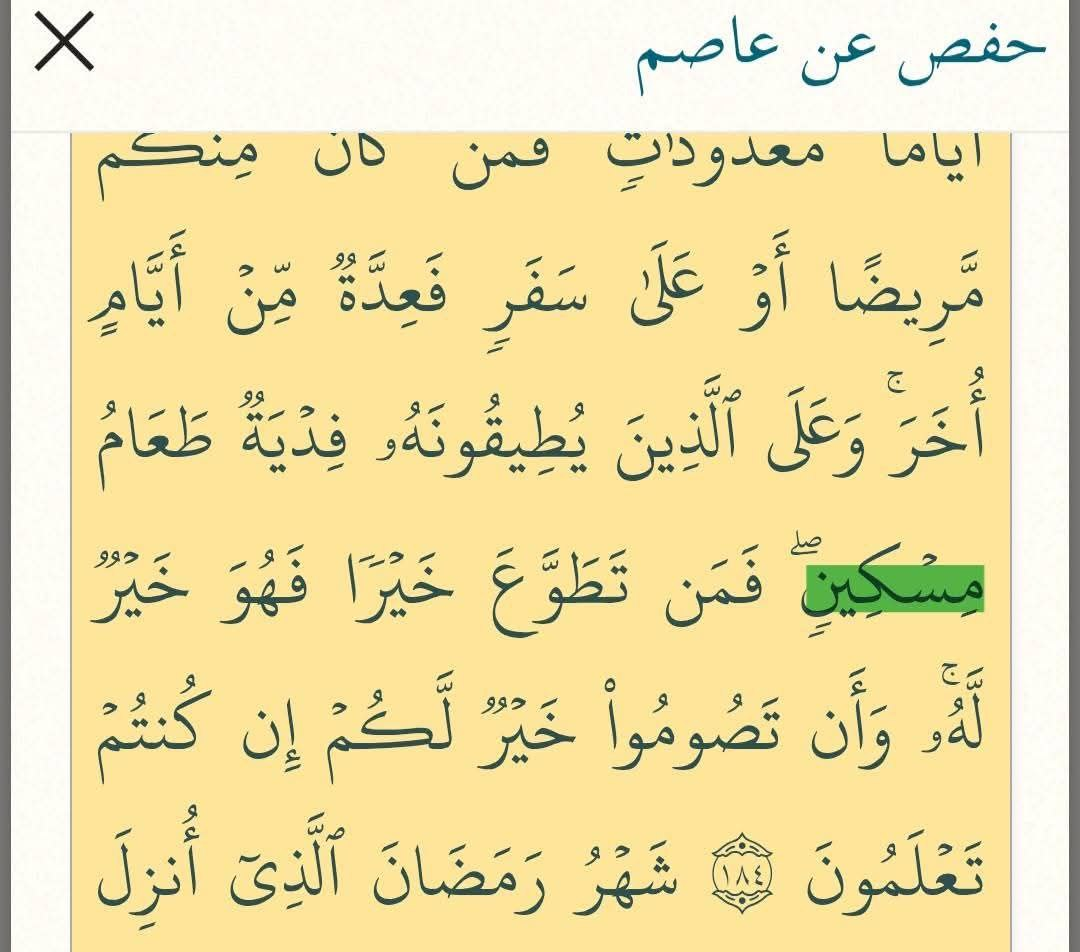
And upon those who are able to fast [with hardship] is a ransom — the feeding of a poor person.
The Hafs transmission reads the expiation recipient as singular (مِسْكِين — one poor person). The Warsh transmission reads it as plural (مَسَاكِين — the poor people). Both are authentic, canonical readings of the same verse.
Classical Scholars Explain the Two Readings
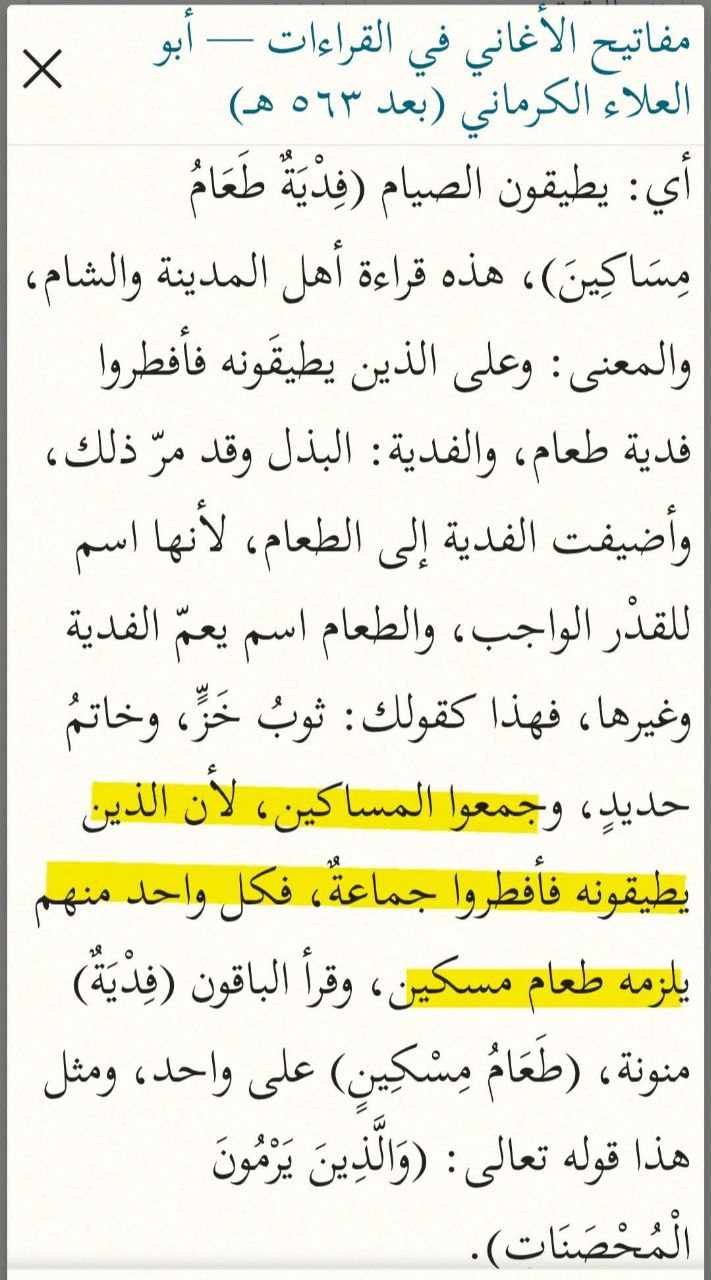
The following scan shows the source text from Mafatih al-Aghani fi al-Qira’at, explaining the grammatical basis for the plural reading.
-
The Plural Reading ({فِدْيَةُ طَعَامِ مَسَاكِينَ}): This variant uses the plural form Masakeen (المساكين — poor people) rather than the singular.
-
Grammatical and Contextual Reason: The plural is used here because the preceding conditional clause uses a plural verb: {لأَنَّ الَّذِينَ يُطِيقُونَهُ فَأَفْطَرُوا جَمَاعَةً} — “Because those who are [hardly] able to do it and broke their fast are a plural group.”
-
Individual Obligation Breakdown: Since a collective group broke their fast, each individual member within that group is responsible for feeding a single needy person.
-
The Alternate Group Reading Variant: The remaining readers (وقرأ الباقون) read the phrase using the nunation/tanween variant (فِدْيَةٌ طَعَامُ مِسْكِينٍ), keeping the obligation and the recipient in the singular format.
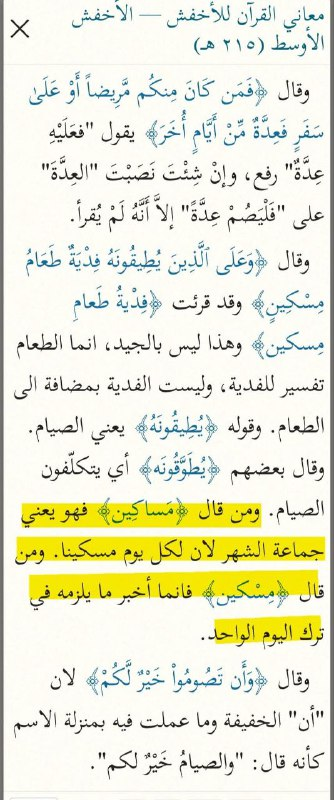
The following scan shows the source text from Ma’ani al-Quran by al-Akhfash al-Awsat, giving the grammatical implication of each reading.
-
The Plural Reading Variants (“Masakeen” / مَسَاكِينَ): Those who read using the plural form Masakeen intend it to signify the entire collection of the days of the month collectively (جماعة الشهر). The phrasing represents the total sum of needy people who will be fed across the full duration of missed fasting days.
-
The Singular Reading Variants (“Miskeen” / مِسْكِين): Those who read using the singular form Miskeen intend to specify the exact legal obligation pertaining to a single individual day (في ترك اليوم الواحد). It isolates the rule to clarify exactly what is mandatory upon the person for each specific day they break their fast.
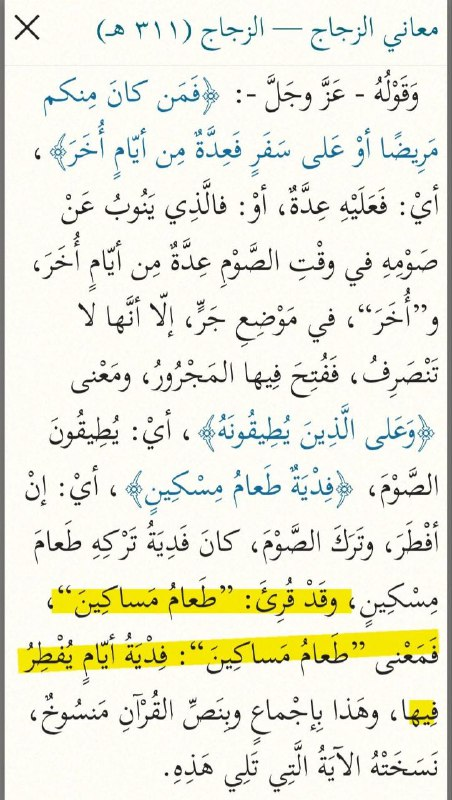
The following scan shows the source text from Ma’ani al-Zujaj, addressing the plural reading and its abrogation.
-
The Reading Variant: The text references the specific variant reading: {طَعَامُ مَسَاكِينَ} (“the feeding of poor people” — using the plural form).
-
The Core Meaning: Reading the phrase in the plural implies that the total expiation corresponds directly to the full sum of missed days: {فِدْيَةُ أَيَّامٍ يُفْطِرُ فِيهَا} — “the expiation for [all] the days in which he breaks his fast.”
-
Legal Status — Abrogation: The passage concludes by noting a unanimous scholarly consensus (وَهَذَا بِإِجْمَاعٍ) that this initial choice or ruling was ultimately abrogated (مَنْسُوخ) by the textual authority of the verse that immediately follows it.
The Explanations of the Major Tafsir and Qira’at Scholars
Imam al-Dani stated: “The singular refers to each day, while the plural refers to many days.”
Al-Akhfash stated: “Whoever reads ‘the poor’ (masakin) means the entire month, since each day has a poor person. Whoever reads ‘one poor person’ (miskin) is simply stating what is required of them for missing a single day.”
Al-Samin al-Halabi said in Al-Durr al-Masun (2/275):
Al-Tahir Ibn Ashur said in Al-Tahrir wa Al-Tanwir (2/167):
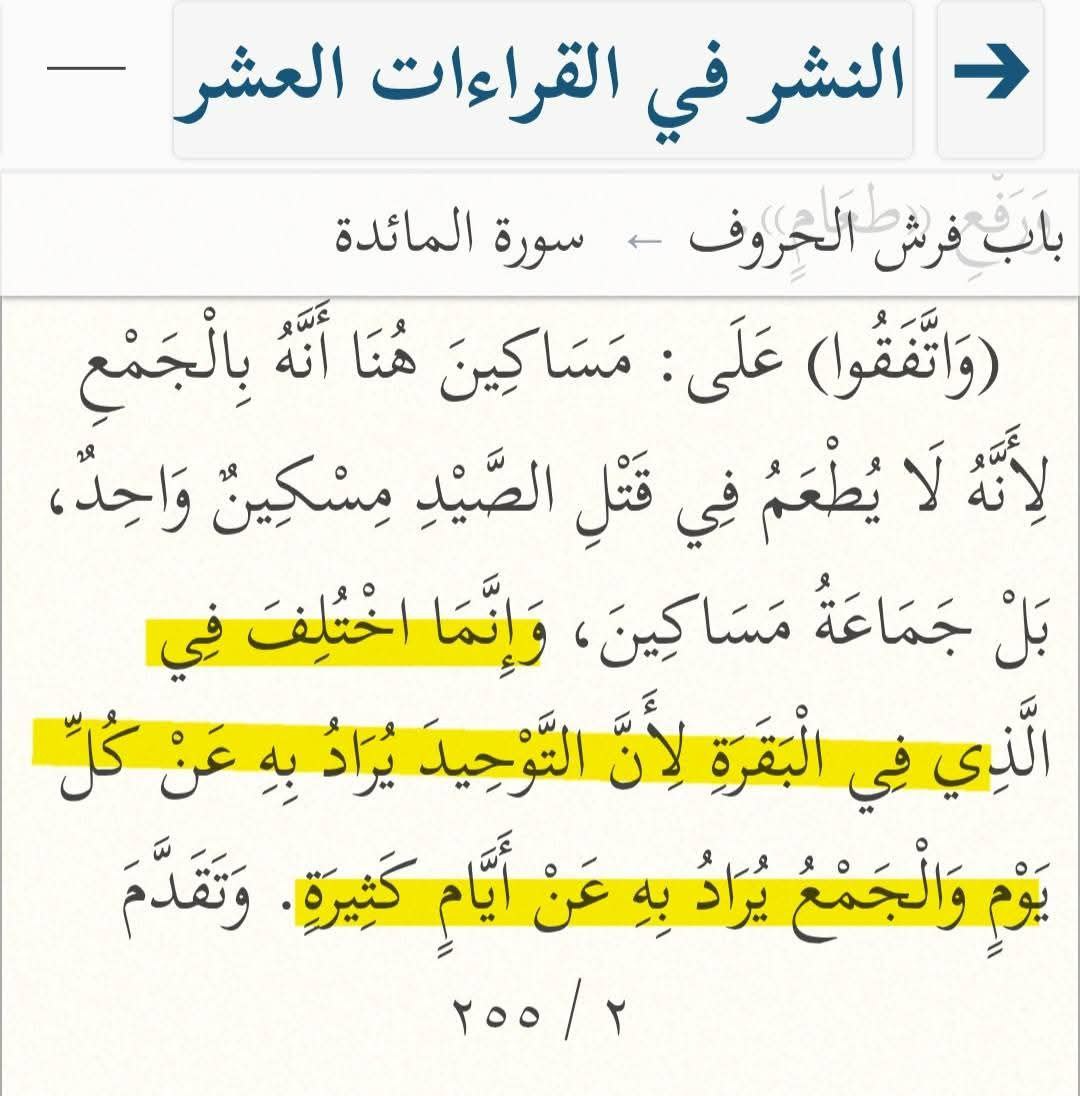
The following scan shows the source text from Al-Nashr fi al-Qira’at al-Ashr, explaining why consensus formed around the plural in Surah al-Ma’idah while disagreement occurred in Surah al-Baqarah.
-
Consensus on Plural in Surah Al-Ma’idah ({مَسَاكِينَ}): Scholars unanimously agreed on using the plural form Masakeen in Surah Al-Ma’idah regarding the penalty for hunting while in Ihram. This is because the penalty does not mean feeding just a single needy person; rather, a collective group of needy people (جَمَاعَةَ مَسَاكِينَ) must be fed.
-
Disagreement in Surah Al-Baqarah: The variance between singular and plural readings occurs specifically in Surah Al-Baqarah regarding the expiation for missed fasting days:
- The Singular Reading: Is intended to specify the exact legal obligation required for each individual day (يُرَادُ بِهِ عَنْ كُلِّ يَوْمٍ).
- The Plural Reading: Is intended to collectively denote the total penalty accumulated across a long span of many missed days (وَالْجَمْعُ يُرَادُ بِهِ عَنْ أَيَّامٍ كَثِيرَةٍ).
The following two scans show the additional primary-source documentation for these readings.
The following scan shows the final source documentation referenced in the analysis.
Conclusion: The Two Readings Are Complementary
There is no contradiction or conflict between the two readings. Each reading addresses a distinct legal scenario:
The singular reading (miskin) means: feeding one poor person for each day the fasting person breaks their fast — it specifies the per-day individual obligation.
The plural reading (masakin) carries one of two meanings:
- First: Whoever breaks their fast for the entire month, or for a number of days within it, must feed masakin equal to the number of days they broke their fast.
- Second: A group of people broke their fast — so-and-so, and so-and-so, and so-and-so — and this collective group is obligated to feed a collective group of masakin. When each one feeds a poor person, collectively they will have fed a group of poor people.
Both readings are true. Both are divinely revealed. Neither negates the other.
References
- Islam Q&A: توجيه قراءة “طعام مساكين”
- Video lecture: