

Quran 43:81 — Does It Suggest God Could Have a Son?
The verse of Az-Zukhruf 43:81 does not imply a conditional possibility of God having a son. Classical tafsir, through multiple lines of evidence — linguistic, contextual, and scholarly — establishes that the particle in (إِن) in this verse functions as a negative particle meaning “not”, and that the word “al-Abideen” (الْعَابِدِينَ) carries either the meaning of those who affirm tawhid or those who reject and are angered by the claim. Neither reading endorses the Christian position.
The Verse Under Analysis
Say: If the Most Merciful had a son, I would be the first to worship him. Exalted is the Lord of the heavens and the earth, Lord of the Throne, above what they describe.
The Objection
Al-Qurtubi’s Analysis — Multiple Scholarly Interpretations
Imam al-Qurtubi, may God have mercy on him, quotes Ibn Abbas, al-Hasan, and al-Suddi on the meaning of the phrase “if it were for the Most Merciful” in the verse, explaining that it means “it was not” (ma kana), with the negative particle “ma” being the second-person singular pronoun. This is supported by God’s statement: “And they have no knowledge of it. They follow only conjecture, and conjecture avails nothing against the truth.” [An-Najm 53:28]. Here, “in” is used in the sense of the negative particle “ma,” meaning “they follow only conjecture.” This usage is well-known in Arabic. He then quotes Mujahid as saying that God will be worshipped on the understanding that He has no son. He also quotes al-Suddi as saying that God alone will be worshipped, not the Messiah, on the understanding that he has a son. He further quotes a group of scholars who interpreted “the worshippers” as meaning those who are disdainful and angry. He then cites a poem by al-Farazdaq as evidence.
The following excerpt from Tafsir Al-Qurtubi presents the passage and its classical analysis:
The commentary continues with Qurtubi’s detailed breakdown of the linguistic and theological implications:
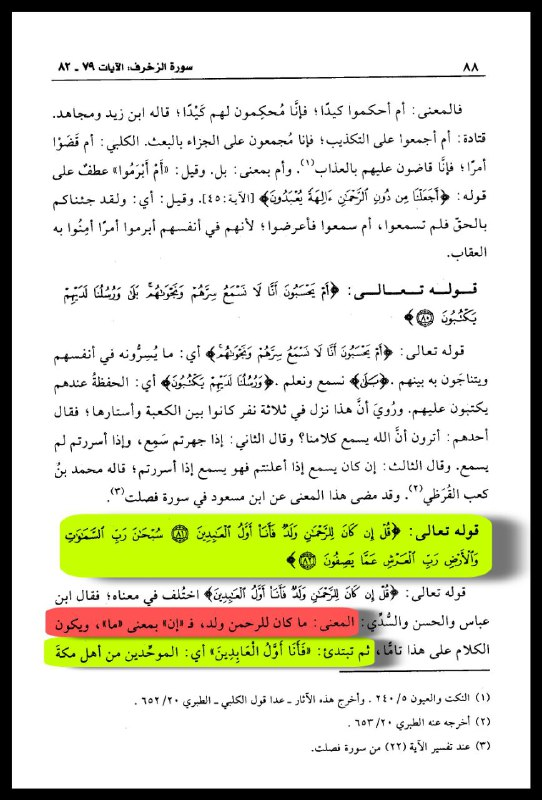
The highlighted text explains the theological implications and linguistic nuances of the verse {قُلْ إِن كَانَ لِلرَّحْمَٰنِ وَلَدٌ فَأَنَا أَوَّلُ الْعَابِدِينَ * سُبْحَانَ رَبِّ السَّمَاوَاتِ وَالأَرْضِ رَبِّ الْعَرْشِ عَمَّا يَصِفُونَ}:
-
Linguistic Meaning of “In” (إِن) [Red Box]: According to classical commentators Ibn Abbas, Al-Hasan, and Al-Suddi, the particle “In” (إِن) functions here as a negative particle meaning “Not” (ما).
- Therefore, the clause reads as a definitive declaration: “The Most Merciful has no son/child.” (ما كان للرحمن ولد).
-
Interpretation of “First of the Worshippers” [Lower Green Box]: Based on this negation, the sentence resets at {فأَنَا أَوَّلُ الْعَابِدِينَ}, meaning: “And I am the first of the monotheists/believers among the people of Mecca” (أي: الموحدين من أهل مكة) who testify to this absolute oneness.
-
Exoneration of the Divine [Upper Green Box]: The passage concludes by declaring Allah’s absolute perfection and glory (سُبْحَانَ) above the false physical attributes or offspring that the polytheists attribute to Him.
The analysis then turns to the alternative reading — that “in” is taken as a genuine conditional creating a rhetorical device of impossibility:
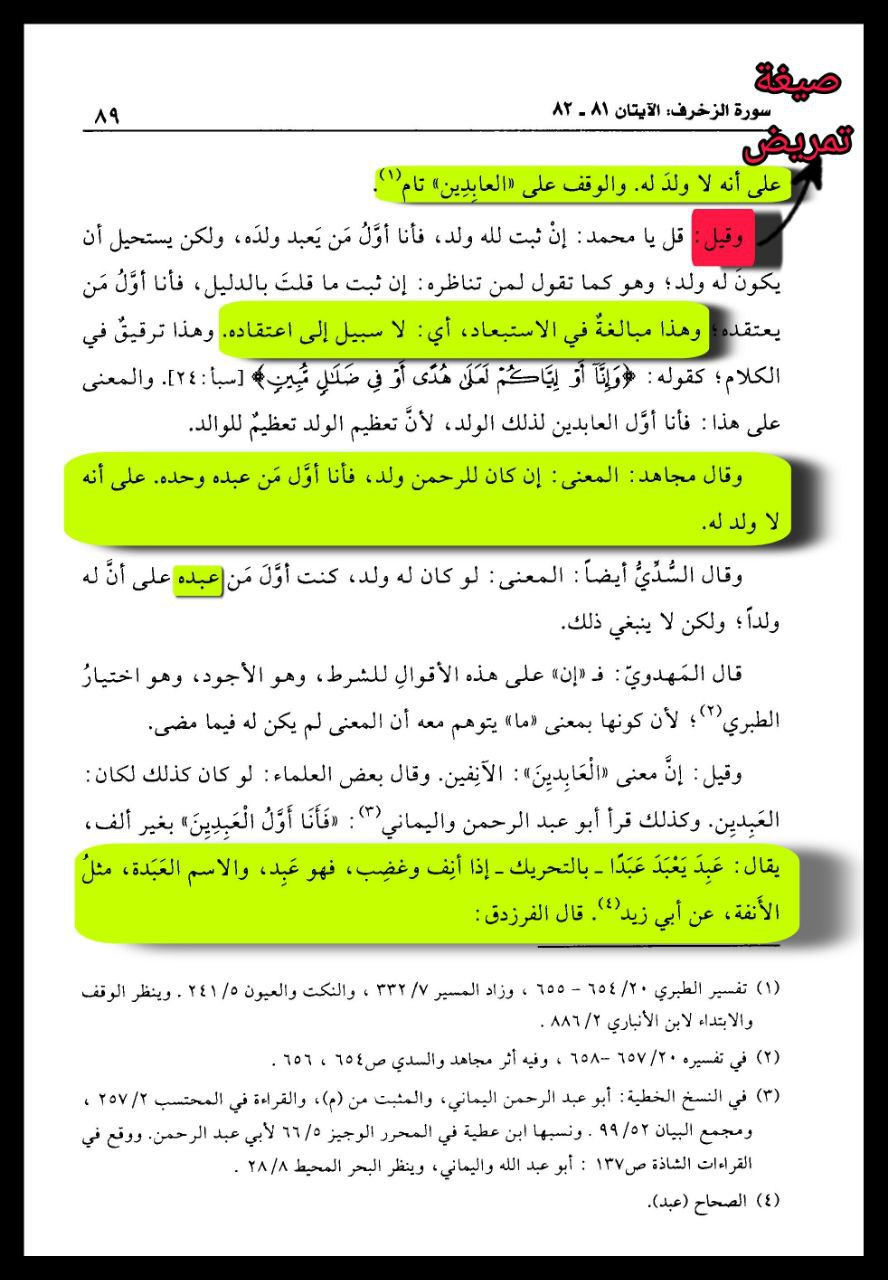
The text provides alternative linguistic and contextual perspectives on the condition {إِن كَانَ لِلرَّحْمَٰنِ وَلَدٌ} and the term {الْعَابِدِينَ}:
-
The Conditional Interpretation & Rhetorical Impossibility [Top Green Blocks]: > * If the particle “In” (إِن) is taken as a conditional (“If…”), the statement serves as a rhetorical exaggeration of impossibility (مبالغة في الاستبعاد).
- The meaning becomes: “If it were hypothetically possible for the Merciful to have a child, I would be the first to worship that child out of respect for the parent—but it is completely impossible for Him to have one.” > * This matches the view of Mujahid and Al-Suddi, emphasizing that there is absolutely no pathway to such a belief.
-
Linguistic Root Variant for “Al-Abideen” (الْعَابِدِينَ) [Bottom Green Block]:
-
The text highlights a distinct linguistic breakdown based on an alternative reading (Abideen without an extension, related to the root ‘abida عَبِدَ).
-
In this context, the verb عَبِدَ — يَعْبَدُ — عَبَدًا means to refuse, reject, or show anger/disdain (إذا أَنِفَ وغَضِبَ).
-
Therefore, under this linguistic variance, {فَأَنَا أَوَّلُ الْعَابِدِينَ} translates to: “Then I am the first to reject, deny, and be angered by [this false claim of a son].”
-
The philologists of classical Arabic — Al-Jawhari, Al-Kisa’i, Al-Farra, Al-Harawi, Ibn al-A’rabi, and Abu Ubaydah — all confirm this root meaning of disdain and anger. The following page of the tafsir records their precise definitions alongside a celebrated jurisprudential anecdote:
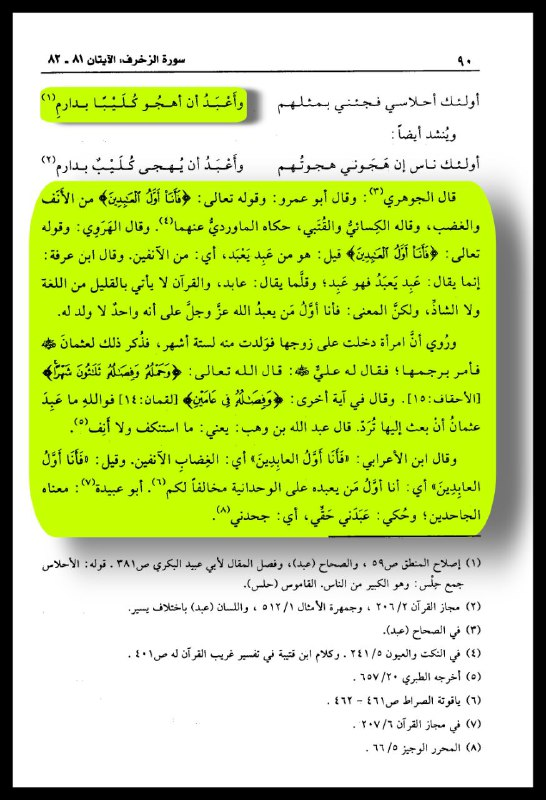
The text expands on the linguistic definitions of {الْعَابِدِينَ} in verse 81, providing authoritative Arabic root derivations and a famous legal anecdote:
-
Linguistic Root Meaning (Disdain & Anger): > * Major philologists, including Al-Jawhari, Al-Kisa’i, Al-Farra, and Al-Harawi, confirm that the phrase {فَأَنَا أَوَّلُ الْعَابِدِينَ} stems from the root meaning “disdain, pride, and anger” (مِنَ الأَنْفِ وَالْغَضَبِ).
-
Under this classical definition, it translates to: “I am the first to be angry and disdainful toward the claim that He has a son.”
-
Ibn al-A’rabi confirms this layout: “It means the first of those who are angry at this assertion.”
-
Abu Ubaydah presents a secondary variant: It means “the deniers” (الْجَاحِدِينَ), stemming from ‘abadani haqqi (he denied my right).
-
-
Legal & Jurisprudential Anecdote (Ali ibn Abi Talib’s Deduction):
-
The text inserts a landmark historical event regarding a woman who gave birth just 6 months into her marriage. Caliph Uthman ibn Affan initially ordered her stoned for suspected adultery.
-
Ali ibn Abi Talib intervened and stopped the execution by mathematically synthesizing two Quranic verses:
-
{وَحَمْلُهُ وَفِصَالُهُ ثَلَاثُونَ شَهْرًا} (Pregnancy and weaning take 30 months).
-
{وَفِصَالُهُ فِي عَامَيْنِ} (Weaning takes 2 years / 24 months).
-
-
By subtracting 24 months (weaning) from 30 months (total period), Ali proved that the minimum human gestation period can legally be 6 months. Uthman accepted this absolute proof and revoked his judgment.
-
The passage then moves to verse 82, explaining how it seals the entire discussion with a declaration of divine transcendence:
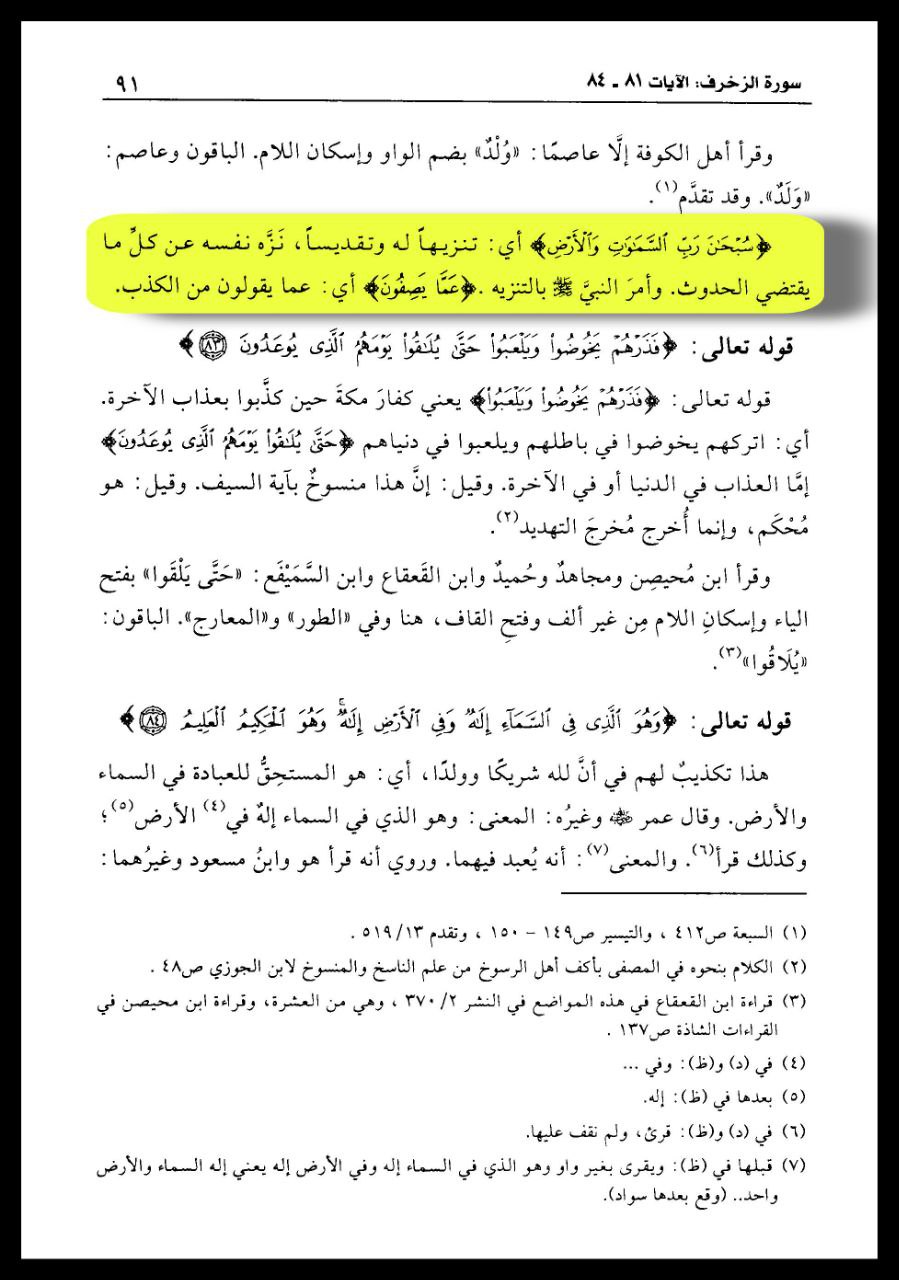
The highlighted text explains the theological concepts of exaltation and purification within the verse {سُبْحَانَ رَبِّ السَّمَاوَاتِ وَالأَرْضِ… عَمَّا يَصِفُونَ}:
-
Absolute Exaltation ({سُبْحَانَ رَبِّ السَّمَاوَاتِ وَالأَرْضِ}): This phrasing signifies the total exaltation, glorification, and purification (تنزيهًا له وتقديسًا) of Allah. It firmly declares that He is entirely free and exalted above any qualities or attributes that imply temporal creation, origination, or human-like need (كلّ ما يقتضي الحدوث), such as having offspring.
-
The Divine Command to the Prophet: The verse commands Prophet Muhammad ﷺ to continuously declare this purification and maintain Allah’s absolute transcendence over these false claims.
-
Rejection of Falsehood ({عَمَّا يَصِفُونَ}): This explicitly serves to clear and exonerate Allah from the fabrications, lies, and false descriptions (عما يقولون من الكذب) attributed to Him by the polytheists.