

Quran 57:25 Iron Sent Down from Sky: Atheist Objection Refuted
The Quran’s statement that iron was “sent down” refers to its celestial descent from the heavens, a meaning confirmed by classical Arabic linguistics, the consensus of exegetes, and modern astrophysical evidence. The claim that “sent down” merely means “created” collapses under scrutiny of the Arabic language and the contextual usage of the verb throughout the Quran.
“We have already sent Our messengers with clear evidences and sent down with them the Scripture and the balance that the people may maintain [their affairs] in justice. And We sent down iron, wherein is great military might and benefits for the people, and so that Allah may make evident those who support Him and His messengers unseen. Indeed, Allah is Powerful and Exalted in Might.”
The verse explicitly attributes iron to a divine act of “sending down” (أَنزَلْنَا), a phrase that carries specific spatial implications in Arabic. Modern science has independently confirmed that the iron present on Earth originated from extraterrestrial sources.
Modern astrophysics confirms that iron on Earth originated from supernova explosions billions of years ago. During a supernova, massive stars undergo catastrophic collapse, releasing tremendous energy and heavy elements — including iron — into space. This process is responsible for the formation of many elements in the periodic table. After the formation of the solar system, asteroids and comets collided with the early Earth, delivering iron and other elements to the planet’s surface.
This scientific account corroborates the Quranic description of iron being sent down from above. However, an atheist objection attempts to neutralize this correspondence by arguing that “sent down” in Arabic merely means “created.”
An atheist objection cites Quran 39:6 — “And He has sent down for you from the livestock eight pairs” — to argue that if “sent down” means celestial descent, then Muslims must also believe livestock descended from the sky. The objection concludes that “sent down” in 57:25 therefore means “creation” or “origination,” not literal descent.
The objection relies on a false equivalence between the metaphorical and literal applications of the verb. The verse on livestock employs the same verbal root, yet the context of each verse determines its specific referent.
“He created you from one soul. Then He made from it its mate, and He produced for you from the grazing livestock eight mates. He creates you in the wombs of your mothers, creation after creation, within three darknesses. That is Allah, your Lord; to Him belongs dominion. There is no deity except Him, so how are you averted?”
The response dismantles this equivocation through linguistic analysis, exegetical consensus, and the specific context of each verse.
Second: The majority of commentators agree that the descent of iron here refers to its descent from the sky, as mentioned in al-Kirmani’s Lubab al-Tafasir and Ibn Atiyyah’s al-Muharrar al-Wajiz fi Tafsir al-Kitab al-Aziz. Although the narrations supporting this are weak and unreliable, the commentators’ arguments are not limited to these narrations alone, but also include linguistic evidence, contextual clues, and other factors.
Third: If someone were to say that some commentators have stated here that “sending down” means creation, origination, or distribution, we acknowledge this meaning and there is no contradiction. For God Almighty created it and brought it into existence for us, and this does not contradict His sending it down from the sky. Ibn Taymiyyah, Ibn al-Qayyim, al-Sam’ani, and others have stated that iron descended from the sky.
Fourth: Regarding the sending down of livestock, Ibn Taymiyyah’s response was sufficient, as was Ibn al-Qayyim’s. The context of the verse, as explained in the sources, indicates that iron was sent down from the sky. In conclusion: if God says that He sent down something, then it truly was sent down. Just as iron was sent down, so too were livestock.
Iron descended from the sky — this is the primary meaning affirmed by linguistic evidence, exegetical consensus, and the verse’s context. The exegetical tradition establishes this reading independently of the weak narrations that some commentators also cited. Ibn Taymiyyah compiled the relevant verses to clarify the meaning of “sent down” as it applies to iron, demonstrating that the phrase consistently denotes descent from a higher realm. Ibn al-Qayyim and al-Sam’ani likewise affirmed that iron descended from the sky, grounding their position in the linguistic usage of the verb and the contextual indicators of the verse.
Science has now revealed that iron originated from celestial bodies, thus deepening our understanding of God’s statement. Yet this convergence is not the foundation of faith.
This post does not seek to prove the existence of scientific miracles or establish religion upon them. Scientific miracles are merely for reference, and our religion is not based on them, nor on the research of Mark and David, but rather on what God and His Messenger said.
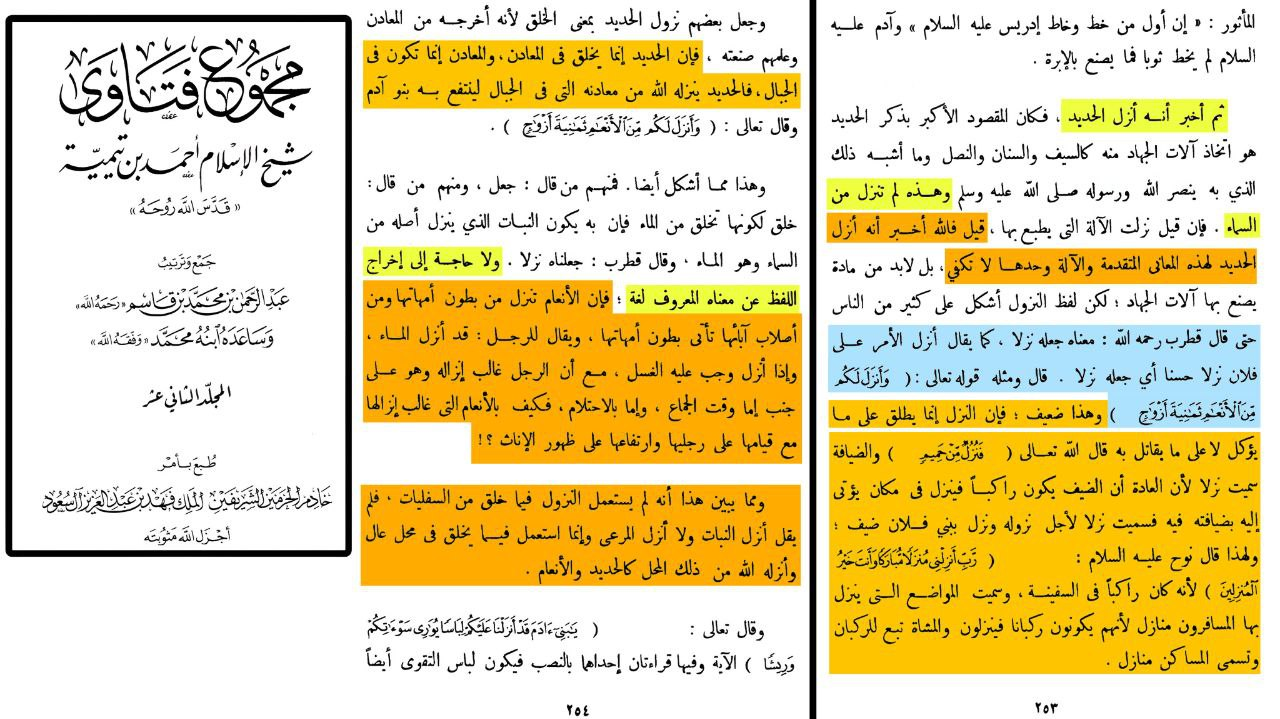
This page is from Volume 2 of “Majmu’ Fatawa Shaykh al-Islam Ahmad ibn Taymiyyah,” a foundational work of classical Islamic theology and jurisprudence.
The text engages in a sophisticated linguistic and theological discussion regarding the interpretation of the term “Anzalna” (We sent down) as it appears in the Quranic verse: {And He sent down for you of the grazing livestock eight mates} (Az-Zumar: 6).
-
Linguistic Analysis: Ibn Taymiyyah explores the different interpretations of “sending down” (inzal) offered by philologists and early exegetes. He addresses the view that “sending down” signifies “creation” (khalq), arguing that just as iron and vegetation are brought forth from the earth (or “sent down” from their source), livestock are similarly brought forth from the wombs of their mothers.
-
Refutation of Literalism: The author critiques the notion that “sending down” must always imply a physical descent from the sky. He demonstrates, through various Arabic linguistic usages, that the term can refer to the process of causing something to emerge or come into existence from its origin, specifically when referring to the emergence of livestock from their mothers.
-
Contextual Argumentation: He emphasizes that the context of the verse focuses on the blessings provided by Allah to humanity, illustrating that the term “inzal” is used in the Quran to convey the provision of sustenance and the creation of resources, rather than a literal spatial descent in every instance.
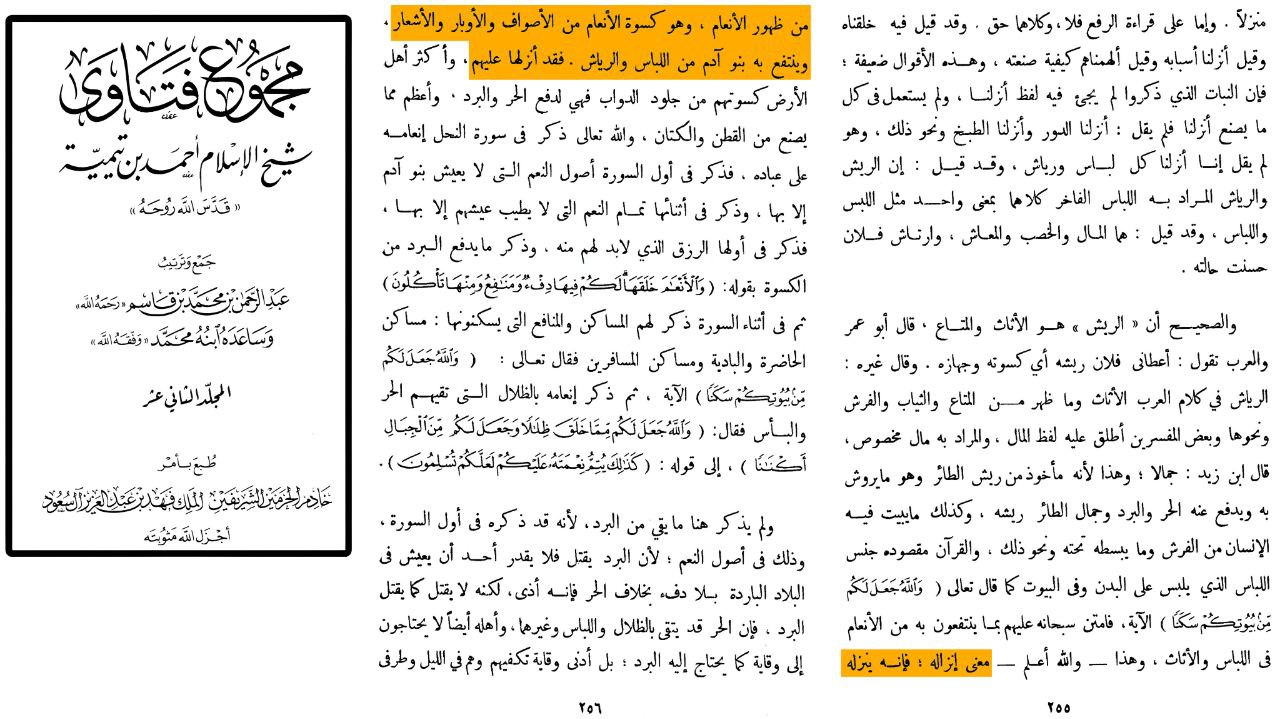
This page continues the theological discussion from the second volume of “Majmu’ Fatawa Shaykh al-Islam Ahmad ibn Taymiyyah.”
The text provides an analytical commentary on the concept of “Rish” (apparel/adornment) and “Anzalna” (We sent down) as referenced in the context of Allah’s blessings upon humanity:
-
Linguistic and Conceptual Analysis: The author examines the linguistic roots of “Rish,” noting that while some interpret it as clothing or luxury, its essential meaning relates to utility, comfort, and protection, such as the utility derived from the skins and wool of grazing livestock.
-
Theological Significance of Divine Provisions: Ibn Taymiyyah argues that these resources, whether they are livestock, clothing, or shelter, are described as being “sent down” from Allah because they originate from His command, creation, and sustenance for human survival. He contrasts this with the necessities of life (like protection from heat and cold), emphasizing that Allah created these as foundational graces.
-
Contextual Consistency: The author emphasizes that the Quranic usage of these terms underscores the intentional design behind the natural world, reinforcing the idea that Allah provided everything necessary for human habitation and welfare, and that these provisions—much like the livestock emerging from their mothers—are part of the divine order and mercy.
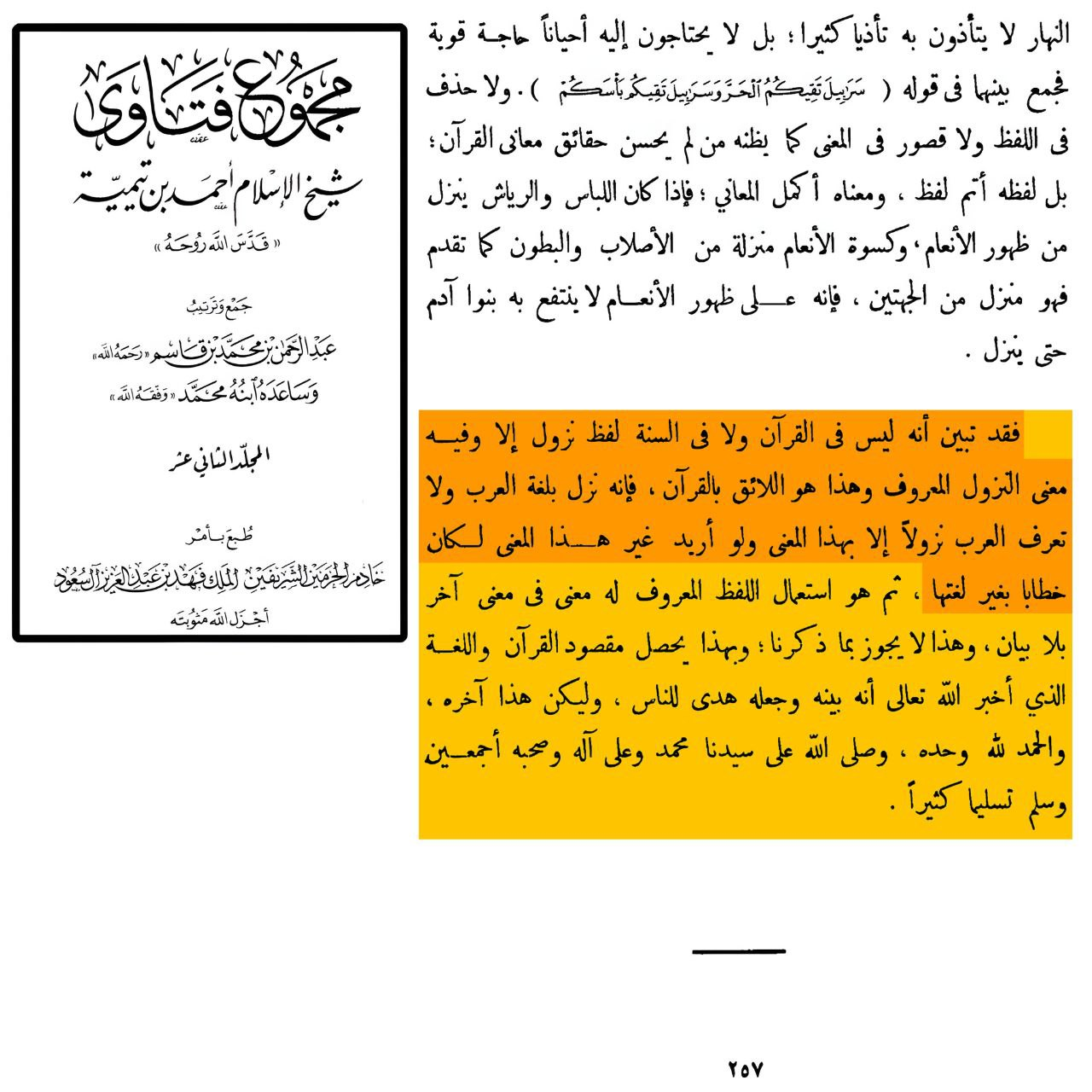
This page is from the second volume of “Majmu’ Fatawa Shaykh al-Islam Ahmad ibn Taymiyyah.” It concludes the author’s theological and linguistic analysis regarding the meaning of “Nuzul” (sending down) in the Quran, specifically in relation to provisions like livestock and clothing.
-
Synthesized Conclusion: The author concludes that the term “Nuzul” as used in the Quran and the Sunnah always retains its established linguistic meaning, which is appropriate for the context in which it is used. He argues that interpreting these verses through the lens of the Arabic language—as it was understood by the original speakers—is the only correct approach.
-
Refutation of Alternative Interpretations: Ibn Taymiyyah asserts that assigning a non-standard meaning to this term would essentially be addressing people in a language they do not recognize, which is inconsistent with the divine nature of the Quran.
-
Summary of Divine Wisdom: He reaffirms that the Quranic usage is precise and superior in meaning. When Allah speaks of “sending down” livestock or provisions, it refers to their emergence from their origins (such as from the wombs of mothers) to become beneficial resources for humanity. The author closes by emphasizing that this interpretation aligns with the guidance and wisdom intended by the revelation.
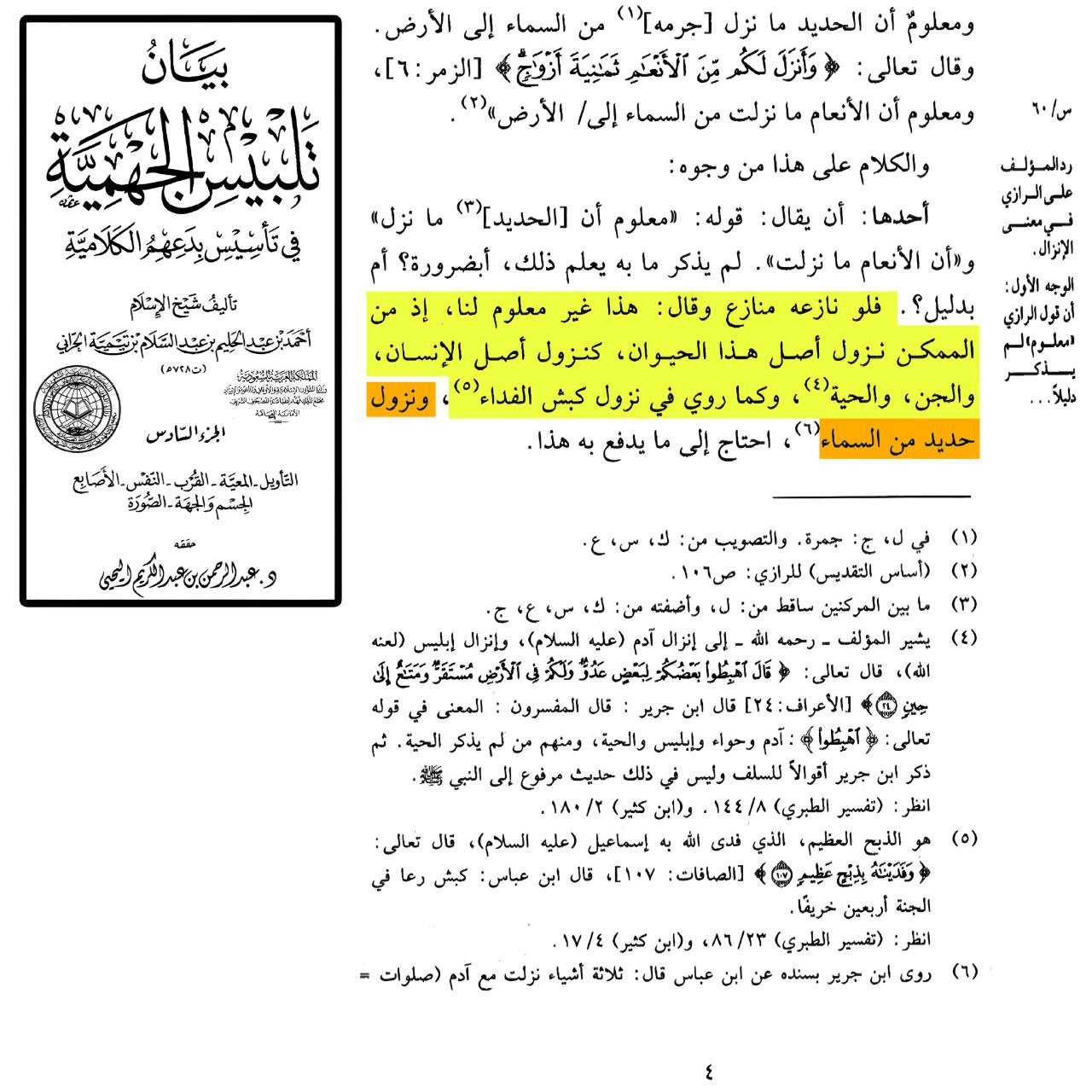
This page is from the fourth volume of “Bayan Talbis al-Jahmiyyah fi Ta’sis Bida’ihim al-Kalamiyyah” (An Explanation of the Deception of the Jahmiyyah in Establishing their Theological Innovations), authored by Shaykh al-Islam Ahmad ibn Taymiyyah.
The text engages in a rigorous theological and linguistic debate regarding the meaning of “Nuzul” (sending down) in the Quran, specifically addressing criticisms raised against the literal interpretation of the term.
-
Theological Debate: The author responds to the arguments of Fakhr al-Razi concerning the Quranic verse {And He sent down for you of the grazing livestock eight mates} (Az-Zumar: 6). Ibn Taymiyyah challenges the claim that the word “Nuzul” (to send down) must imply a physical descent from the sky.
-
Linguistic Defense: He argues that the term is used in the Arabic language to denote the process of causing something to emerge or come into existence from its source, rather than just physical movement. He provides analogies, such as the “sending down” of iron, to demonstrate that the term is used to describe the divine provision and the origin of resources for human survival.
-
Refutation of Critics: The author asserts that those who criticize this interpretation are misapplying their own theological frameworks to the clear, idiomatic usage of the Arabic language known to the original recipients of the Quran. He clarifies that “sending down” is an expression of Allah’s creative power and mercy in providing for humanity.
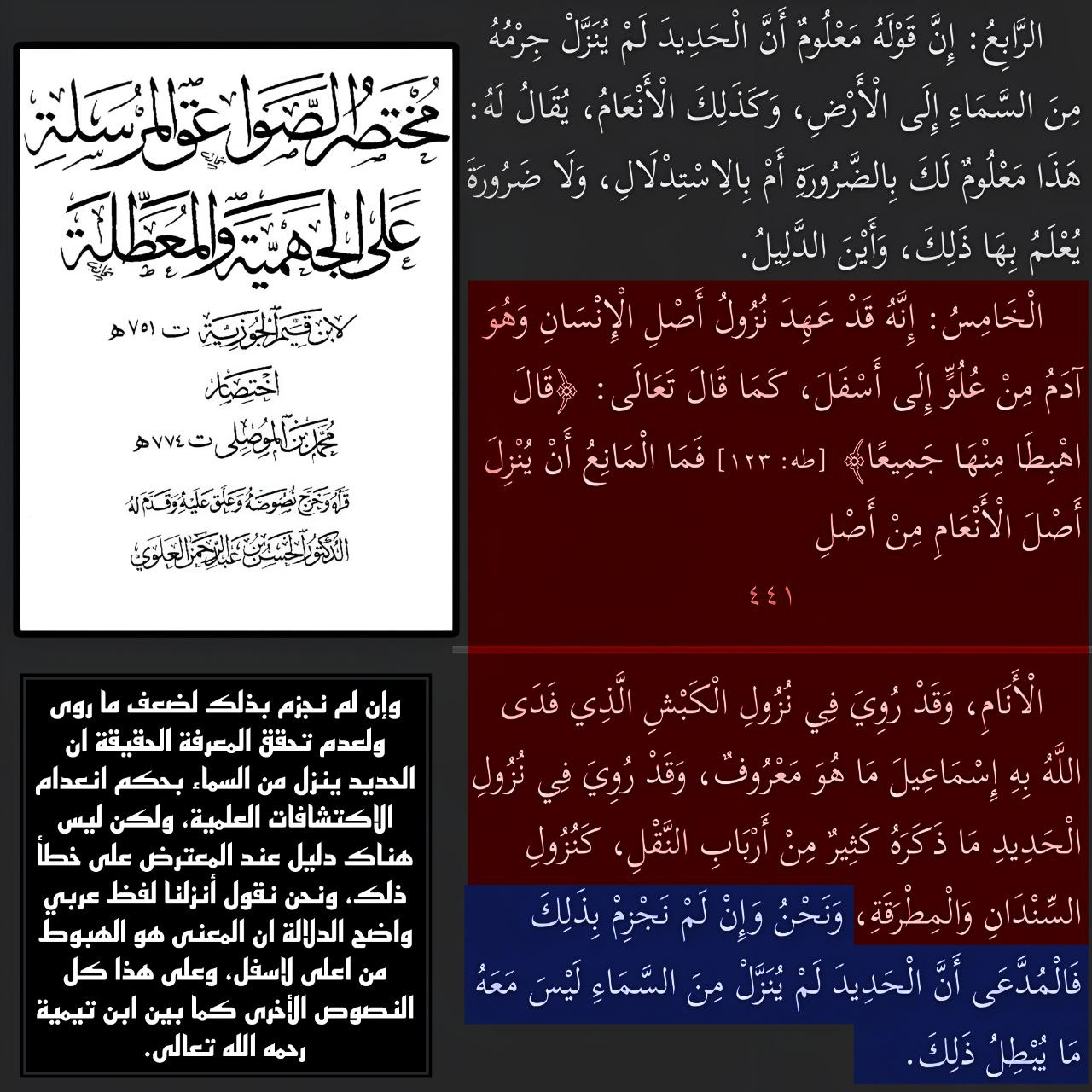
Based on the provided images from Majmu’ Fatawa by Shaykh al-Islam Ibn Taymiyyah and Mukhtasar Sawa’iq al-Mursala by Ibn al-Qayyim, the highlighted sections center on the theological and linguistic refutation of arguments that restrict the meaning of the Quranic term “Nuzul” (to send down) to physical descent from the sky.
-
Linguistic Precision: Ibn Taymiyyah and Ibn al-Qayyim argue that “Nuzul” in the Quran and Sunnah retains its established, idiomatic Arabic meaning, which is to cause something to emerge or come into existence from its origin.
-
Theological Analogies: To explain this, the authors utilize analogies that were well-understood by the original speakers of the Quran:
-
Livestock: Described as being “sent down” because they emerge from the wombs of their mothers to provide sustenance.
-
Iron: Referenced as being “sent down” from the earth (its source) to be utilized by humanity.
-
Clothing (Rish): Included as part of the divine provision that is “sent down” to provide utility and protection.
-
-
Refutation of Abstract Reinterpretation: The scholars maintain that imposing non-standard, complex theological meanings on these terms disconnects the Quran from the language of those it was revealed to. They argue that “sending down” is an expression of Allah’s creative command, wisdom, and mercy in providing everything necessary for human welfare, and that this interpretation is internally consistent with the language of the revelation itself.
These sections emphasize that the language of the Quran is deliberate and precise; interpreting these terms through the established norms of the Arabic language preserves the integrity of the divine message without the need for forced or abstract philosophical reinterpretations.
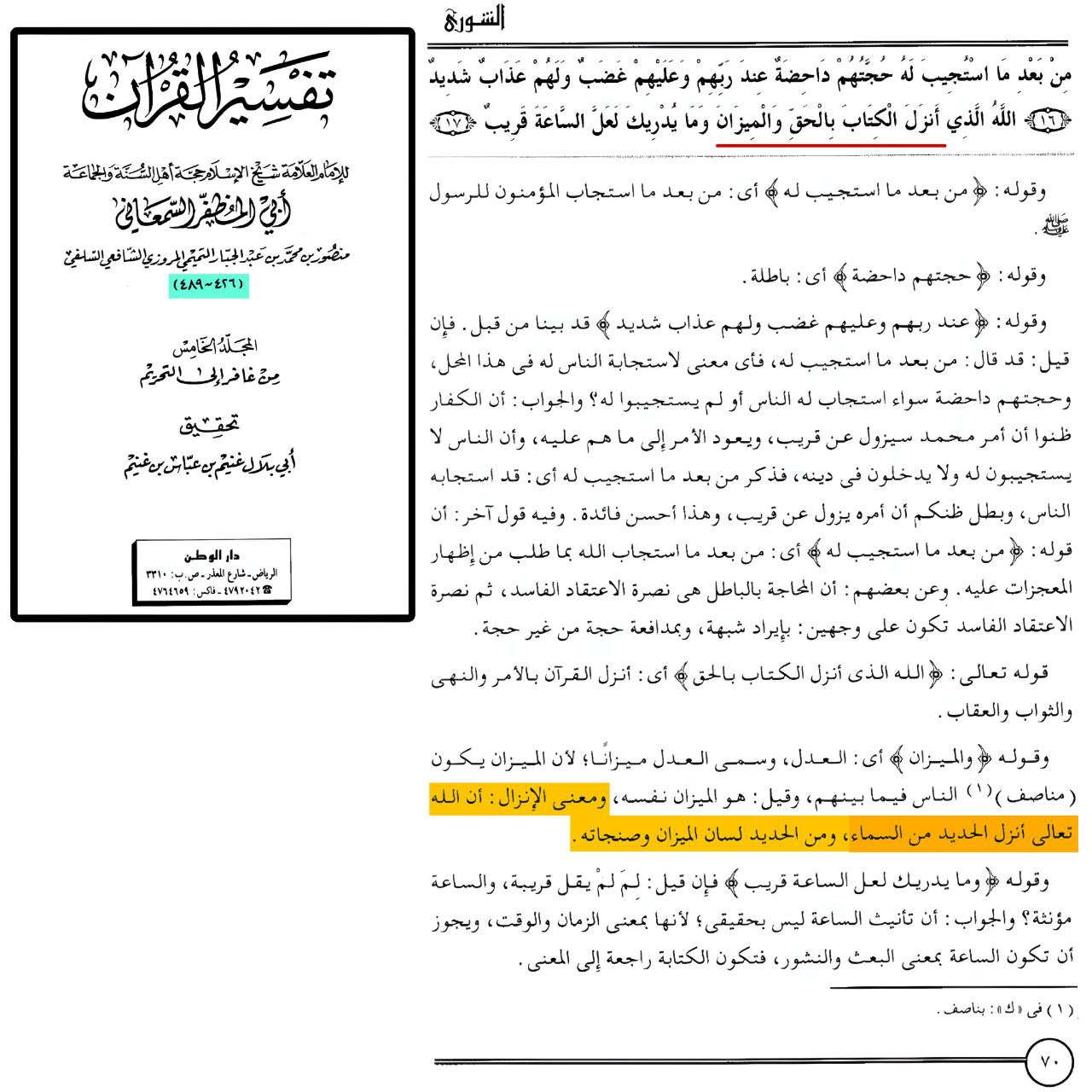
This page is from the fifth volume of Tafsir al-Qur’an by the scholar Abu al-Muzaffar al-Sam’ani, which covers the interpretation of Surah Ghafir (also known as Surah al-Mu’min).
-
Commentary on the Divine Balance: The text focuses on the interpretation of the Quranic phrase {And He sent down the Book in truth and the balance} (Ash-Shura: 17). It explains that the “balance” (al-mizan) represents justice and equity, as it is the tool by which people settle their affairs fairly.
-
Linguistic Analysis of “Inzal” (Sending Down): In the highlighted section, the author provides a specific interpretation for “sending down the balance.” He explains that it refers to the literal descent of iron—the material from which the physical beam and scales of the balance are fashioned—from the sky or, as discussed in related theological debates, brought into existence by Allah for the use of mankind.
-
Contextual Significance: By linking the physical material (iron) to the concept of justice (the balance), the author emphasizes that Allah provides both the moral framework (the Book) and the physical resources necessary for human society to function with justice and order.
-
Editorial Integrity: The footnotes and the scholarly structure of the text highlight its role as a classical reference that connects the physical manifestations of creation with divine providence and legislative guidance.
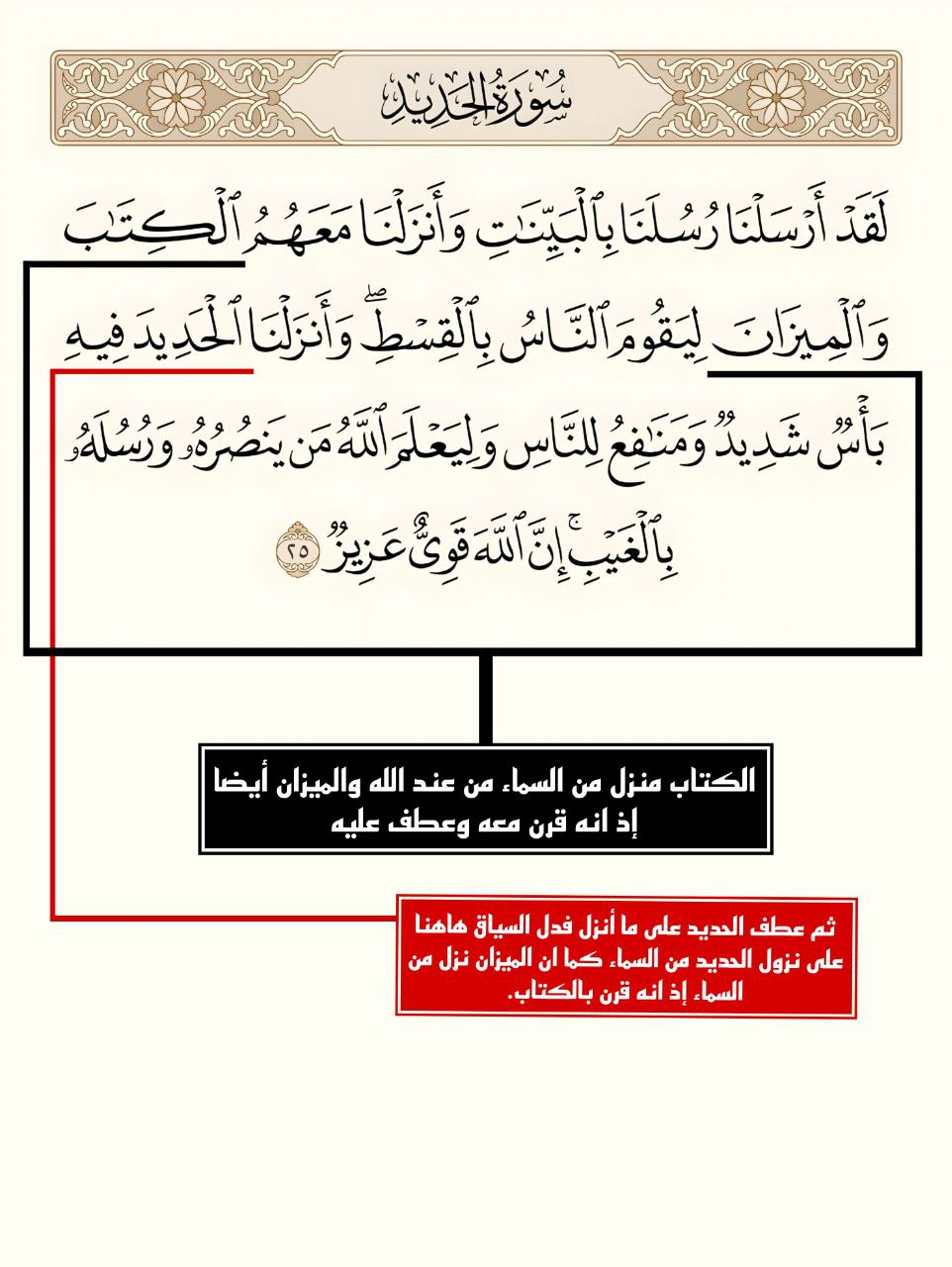
This image provides a structured breakdown of a key verse from Surah Al-Hadid (57:25): “We have already sent Our messengers with clear evidences and sent down with them the Scripture and the balance that the people may maintain [their affairs] in justice. And We sent down iron, wherein is great military might and benefits for the people…”
-
Analysis of “Inzal” (Sending Down): The diagram illustrates the grammatical and contextual connection between the objects mentioned in the verse—the Scripture (Al-Kitab), the balance (Al-Mizan), and iron (Al-Hadid).
-
Theological Argument: It highlights a specific exegetical interpretation which posits that since “the balance” and “iron” are conjoined to “the Scripture” in the verse, they are all categorized under the same divine action of “sending down” (inzal).
-
Conceptual Distinction: The diagram contrasts the “sending down” of the Book (which is revealed from the heavens) with the “sending down” of physical resources like iron, suggesting that the context of the verse necessitates understanding the latter as an emergence or provision granted by Allah for the establishment of justice and human welfare.
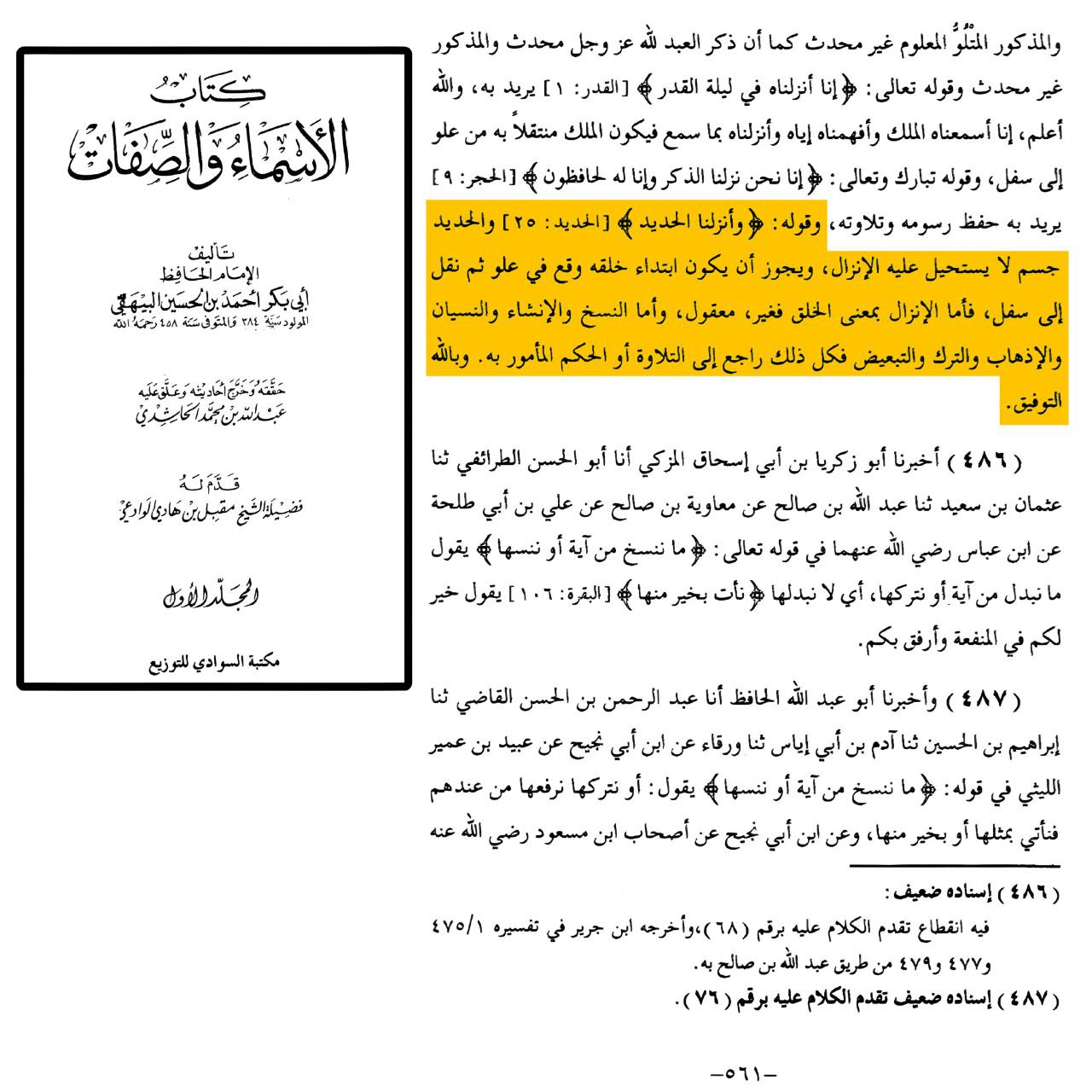
This page from the book Kitab al-Asma’ wa al-Sifat (The Book of Names and Attributes) by Imam al-Hafiz Abu Bakr Ahmad ibn al-Husayn al-Bayhaqi addresses theological discussions regarding the nature of Allah’s speech and revelation.
Theological Commentary
The author discusses the nature of the Quran as “revealed” (munazzal) speech. He explains that the act of revelation does not imply a physical movement or transition of a body from a higher location to a lower one, which would be impossible for Allah. Instead, the author clarifies that the “descent” refers to the communication of the message to creation, and mentions that terms like “abrogation” (naskh) and “forgetting” (insā’) mentioned in the Quran relate to the recitation and the rulings commanded, not to any change in the essence of Allah.
Hadith Narrations
The page contains two narrations (Hadith 486 and 487) concerning the interpretation of the Quranic verse: “We do not abrogate a verse or cause it to be forgotten…” (Surah al-Baqarah: 106).
-
Hadith 486: Narrated through Uthman bin Sa’id, reporting from Ibn Abbas, interpreting the verse as replacing a ruling with one that is more beneficial and easier for the people.
-
Hadith 487: Narrated through Ibrahim bin al-Husayn, reporting from Ibn Abi Najih on the authority of companions of Abdullah ibn Mas’ud, interpreting “forgetting” as removing a verse from their memories and replacing it with something equal or better.
Critical Notes
The author concludes the page by evaluating the authenticity of these narrations, noting that both Hadith 486 and 487 have “weak” (da’if) chains of transmission (isnad). He further notes that details regarding these narrations were discussed earlier in the text (specifically referenced as discussion point number 68 and 76) and mentions that they were recorded by Ibn Jarir al-Tabari in his Tafsir.
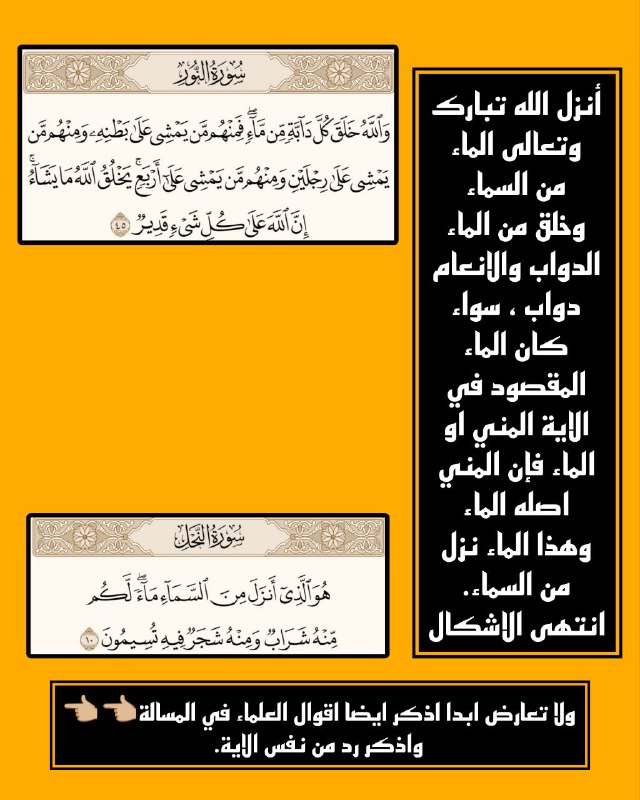
This image presents a theological reconciliation concerning the concept of creation from “water” as mentioned in the Quran, juxtaposing two specific verses to resolve a potential ambiguity.
Quranic References
-
Surah An-Nur (24:45): This verse states that Allah created every living creature from water, and describes the various forms of movement among creatures, including those that move on their bellies, on two legs, and on four legs.
-
Surah An-Nahl (16:10): This verse describes Allah sending down rain from the sky, which provides drink and sustains vegetation used for grazing.
Theological Explanation
The text block on the right addresses a potential interpretative question: whether the “water” mentioned in the context of creation refers specifically to rain water or to semen (al-mani). The argument posits that because semen originates from the body, and the body’s growth is sustained by food and nutrients that derive from the vegetation and water sent down from the sky, there is no contradiction. The author concludes that this reasoning resolves the perceived issue.
Methodological Note
The footer of the image provides a directive regarding scholarly research and argumentation, emphasizing the importance of two key practices:
-
Including the differing opinions of scholars on the issue.
-
Utilizing the specific Quranic verse itself as a source for refutation or clarification.
Did the Pharaohs Mention the Descent of Iron Before the Qur’An
— "Folklore, Myths, and Public Facilities":...
...t is required is the appropriate direction of each word in a way that does not contradict reality and a comprehensive view of all verses and investigating the evidence in every context. This is the...