

Quran on Pearls in Fresh Water: A Scientific Miracle
For over a thousand years, Quranic commentators were genuinely puzzled by two verses — one in Surat Fatir and one in Surat Ar-Rahman — that appeared to describe jewelry, including pearls, being extracted from both saltwater seas and freshwater rivers. The puzzle was straightforward: pearls were not known to come from fresh water. Classical scholars openly documented this interpretive difficulty, proposing linguistic workarounds to reconcile the text. Modern science has now fully resolved the dilemma by confirming that freshwater pearls are real — a geographical and biological fact unknown to any human in 7th-century Arabia.
The Two Verses That Puzzled Commentators for a Millennium
And the two seas are not alike: one is fresh and palatable, pleasant to drink, and the other is salty and bitter. And from each you eat tender meat and extract ornaments which you wear. And you see the ships plowing through them so that you may seek of His bounty; and perhaps you will be grateful.
From them both emerge pearls and coral.
These two verses, read together, assert that pearls and coral emerge from both the saltwater sea and the freshwater body. The italicized phrase {يَخْرُجُ مِنْهُمَا} — “there emerges from both of them” — is the crux of the debate, and it baffled interpreters for over a millennium.
Classical Scholars Openly Acknowledged the Difficulty
The following scan shows the passage from Fakhr al-Din al-Razi‘s Tafsir where he acknowledges the historical confusion, and the passage from Ibn Jarir al-Tabari where he documents the interpretive workaround used by early Arab linguists.
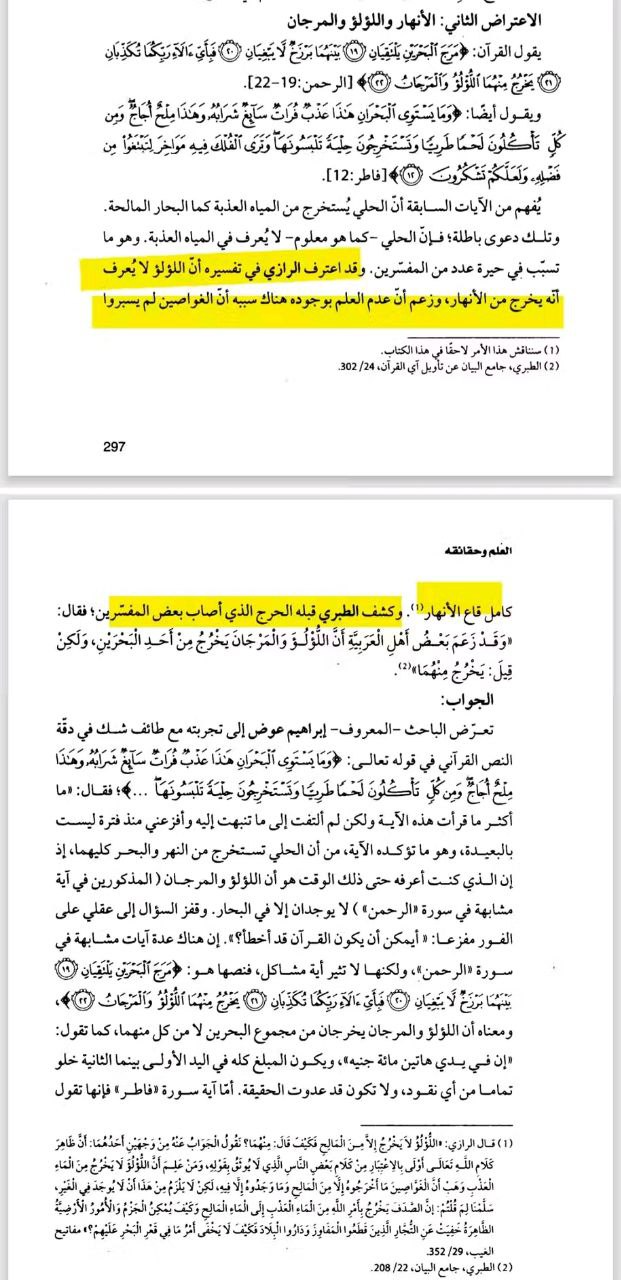
This linguistic workaround — essentially arguing the dual applies loosely to the system as a whole — was a concession born of empirical ignorance, not of textual necessity. The scholars knew the verse said both, but could not reconcile it with the reality they observed.
The Resolution: Abdullah Yusuf Ali and the Encyclopædia Britannica
The author of this research describes finding clarity after a prolonged state of confusion, through a footnote in Abdullah Yusuf Ali‘s English translation of the Quran.
The following scan shows the moment of resolution, where Yusuf Ali’s note on the verse categorizes the jewelry, and the consulted encyclopaedic references confirm the finding.
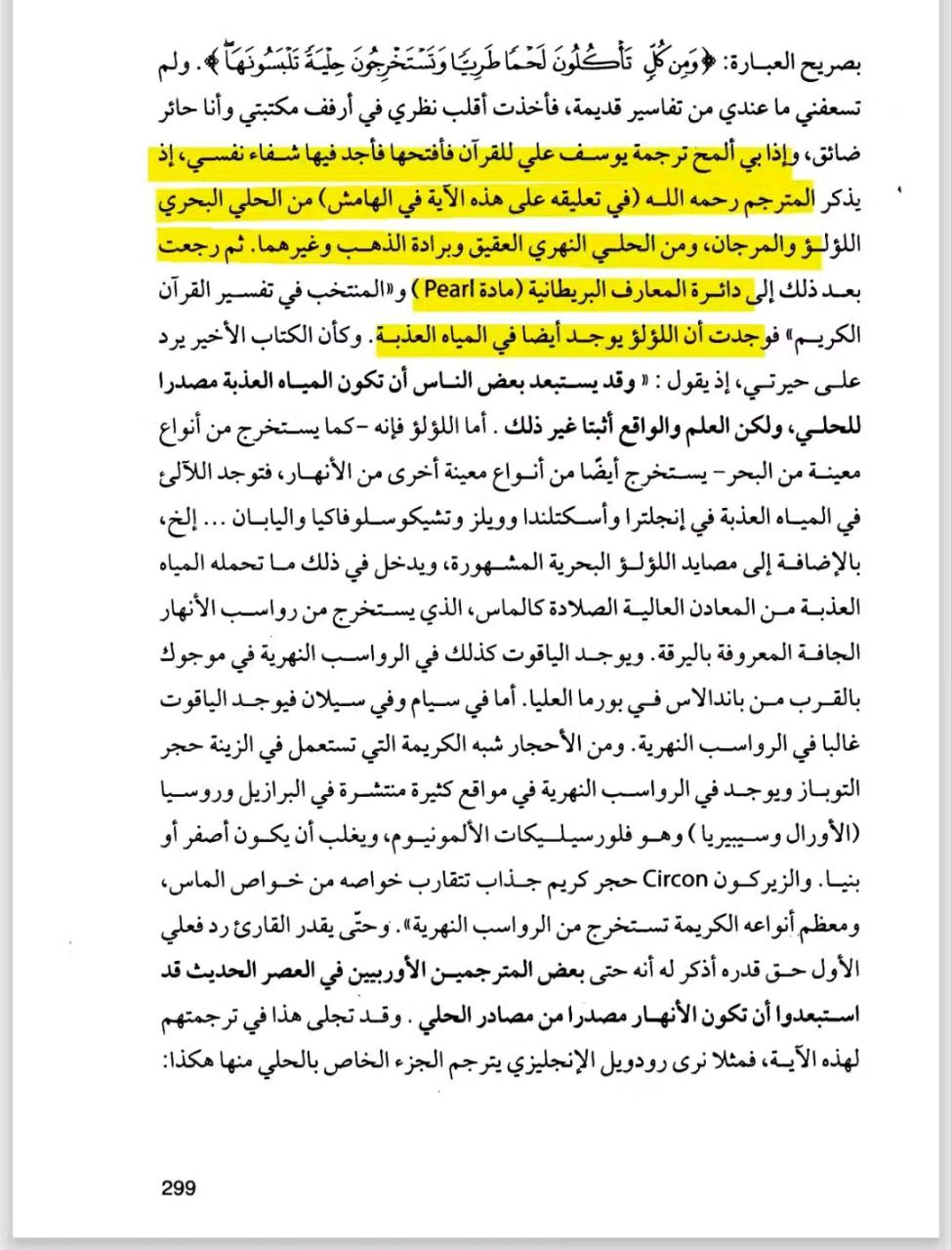
- Marine jewelry (الحلي البحري): Such as pearls and coral, extracted from saltwater seas.
- Riverine jewelry (الحلي النهري): Such as agate (carnelian) and gold dust/shavings, extracted from rivers.
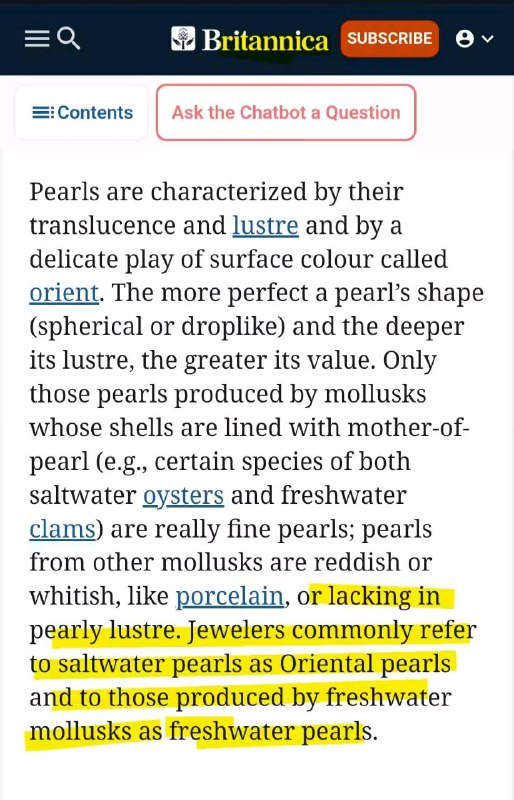
To verify this finding, the author then consulted the Encyclopædia Britannica under the entry “Pearl”, as well as the contemporary exegesis Al-Muntakhab fi Tafsir al-Quran al-Karim. Both authoritative references explicitly confirmed that pearls are indeed found in fresh waters (rivers) as well, completely resolving the initial skepticism regarding the scientific accuracy of the verse.
The Argument for Divine Origin
The following scan shows the author’s analytical conclusion regarding the historical and geographical significance of the Quranic claim.
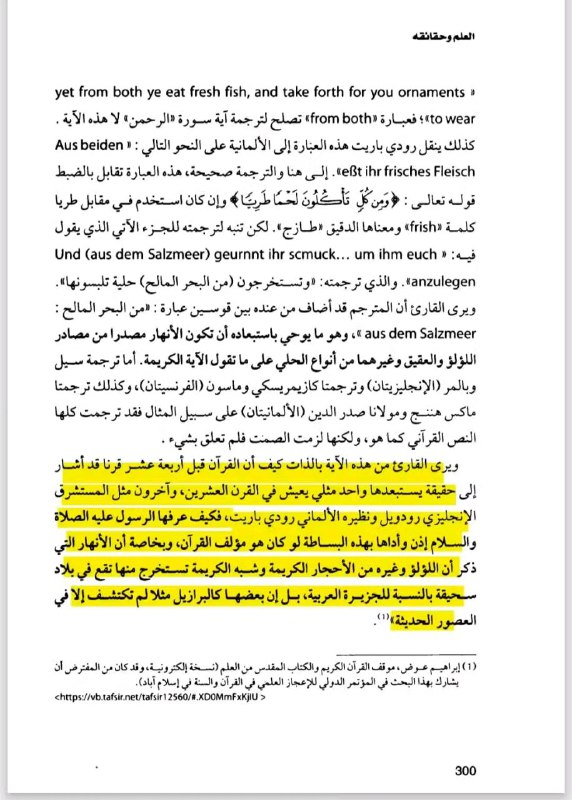
The reader can observe how the Quran, revealed fourteen centuries ago, pointed to a geographical and natural reality that 20th-century orientalists and translators — including Rodwell and Rudi Paret — initially considered highly improbable or dismissed entirely. The author argues that Prophet Muhammad ﷺ could not have known these subtle facts on his own with such simplicity. If the Quran were merely authored by a human in ancient Arabia, they would not have casually mentioned that rivers contain pearls and semi-precious gemstones.
This is especially true because the specific rivers yielding these precious stones are located in lands incredibly distant from the Arabian Peninsula — such as Brazil — and many of these deposits were not even discovered until modern times.
Al-Tabari on Coral, and the Amazon River Discovery
The question of coral (المرجان) adds a further dimension, since the Arabic term carries two possible meanings in the classical tradition.
The following scan shows al-Tabari’s linguistic analysis of the term Marjan, followed by the modern scientific report confirming coral in rivers.
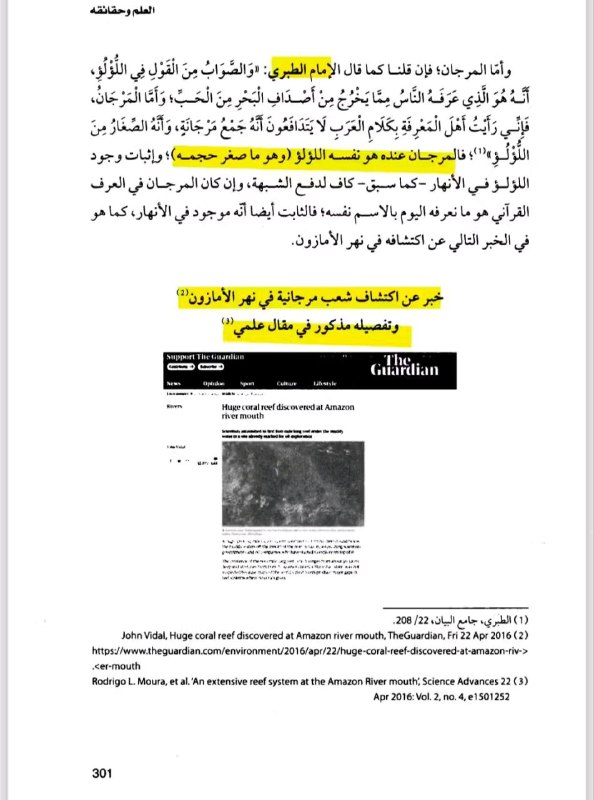
If Marjan is instead interpreted as what is commonly known today as coral reefs, modern empirical science provides a direct answer.
The following scan shows the additional documentary evidence and the Encyclopædia Britannica quotation confirming the distinction between saltwater and freshwater pearl types.
Conclusion
The interpreters were genuinely puzzled for over a thousand years because pearls were not known to come from fresh water during the classical era. Modern science has now confirmed that freshwater pearls are real and well-documented — a fact the Quran stated plainly fourteen centuries ago, in a claim that even sympathetic translators struggled to defend until the evidence caught up with the text.