Quran Really Wrong About Mary's Family(Academic RESPONSE FINAL
💠The Quran tells us that when Mary gave birth to Jesus, she brought him to her people, and they were shocked by what they saw so they said:
“O Mary! You have certainly done a horrible thing! O sister of Aaron! Your father was not an indecent man, nor was your mother unchaste.”
I will divide the thread into a brief refutation and a detailed one:
📌Briefly:
1The Prophet Muhammad himself stated that the Aaron mentioned in the verse was other than the Prophet Aaron.
2The word “sister” mentioned in the verse means “similar”
💠So the meaning of the verse will be:
“O one resembling Aaron in worship.”
Now let us dive into the depth of our topic
⏳First: Let us analyze the meaning of the verse word for word.
📍AWhat does “sister” mean?
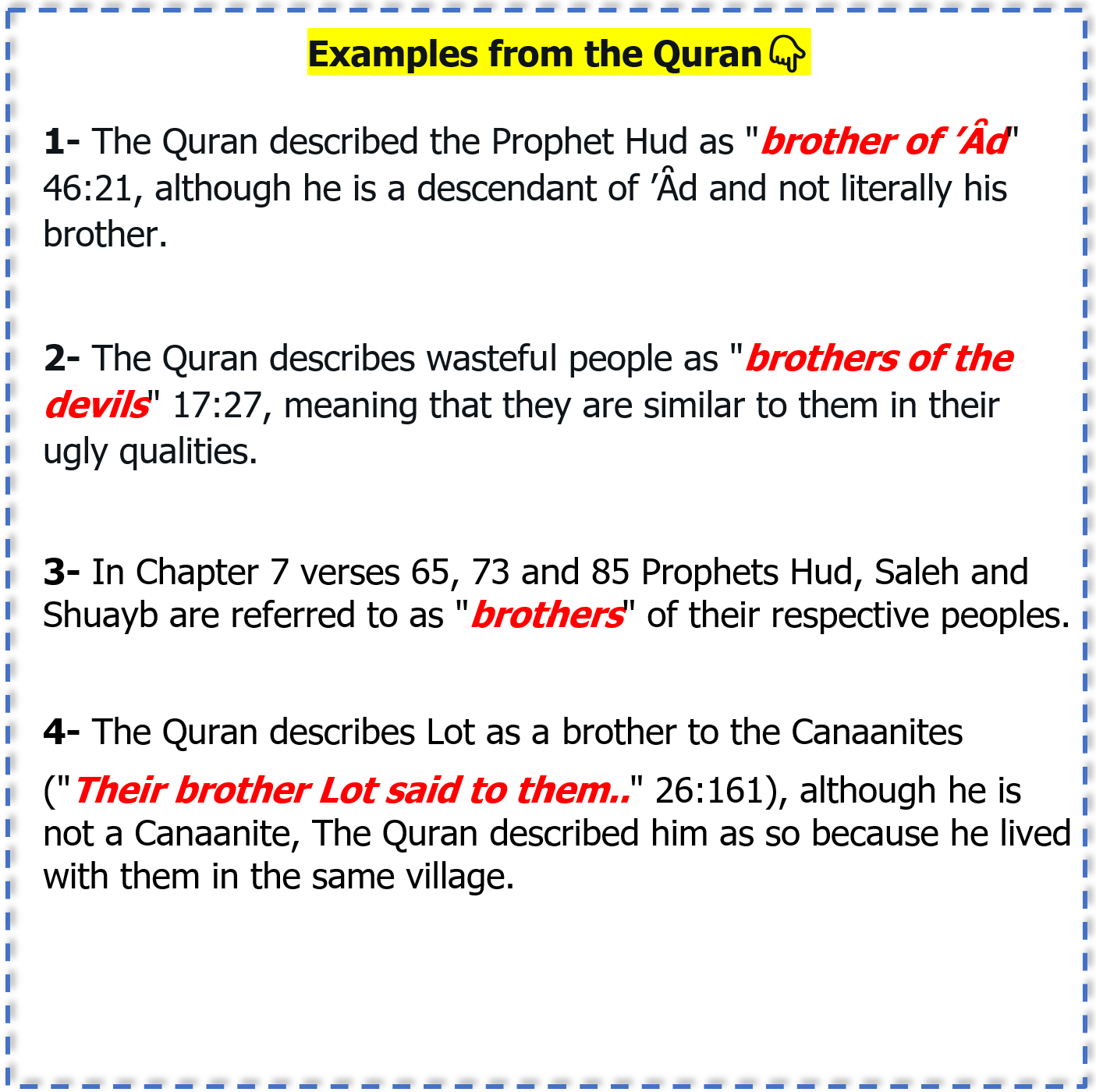
In the Arabic language the word (brother/sister) has several meanings, including:
- Blood brother or sister
- Brotherhood/sisterhood in clan and faith
- It’s used to indicate a similarity between two people whether in terms of attributes or actions
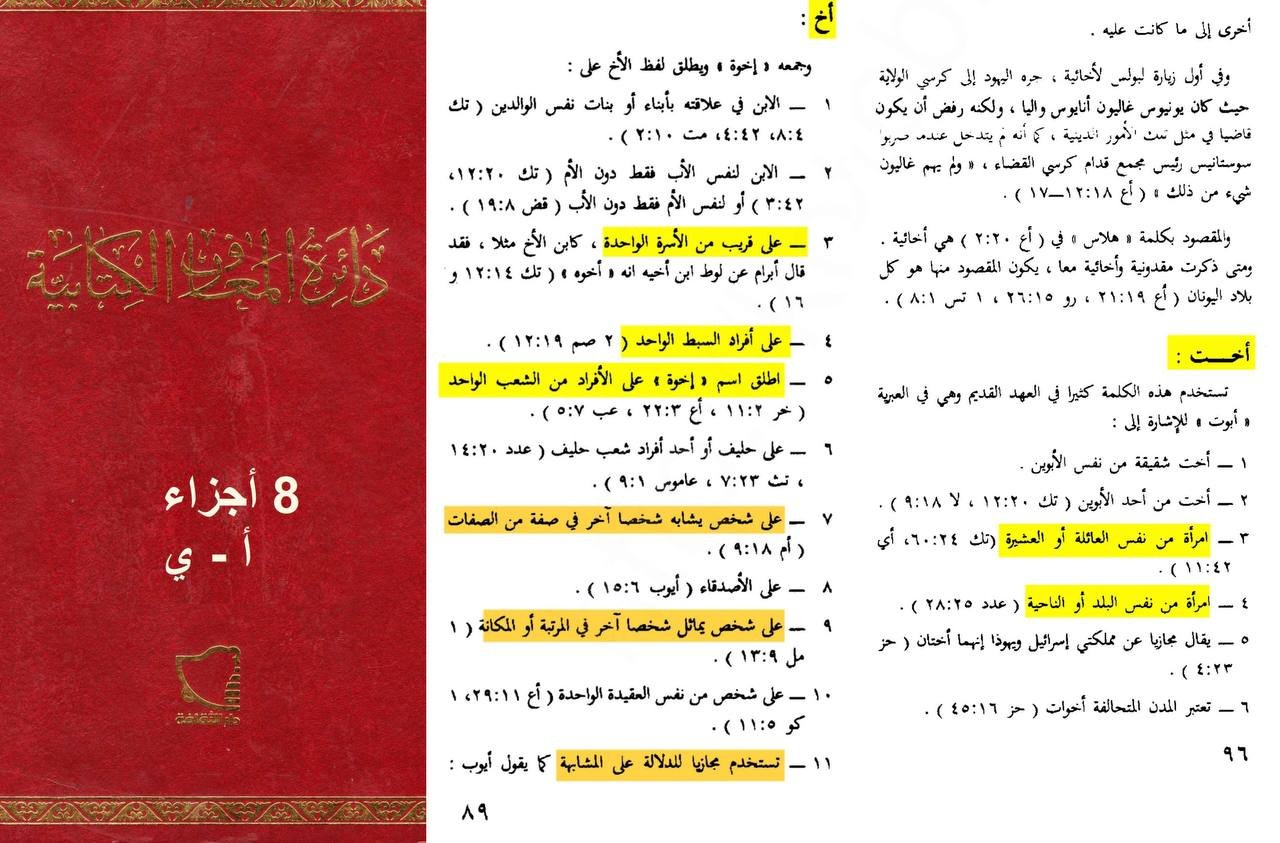
✅And so it is in the Bible.
The Arabic Biblical Encyclopedia mentioned several meanings for the word (brother/sister), including:
- A person from the same family, clan, or people.
- A person from the same country or district.
- A person similar to another person.
- It is used figuratively to indicate similarity.
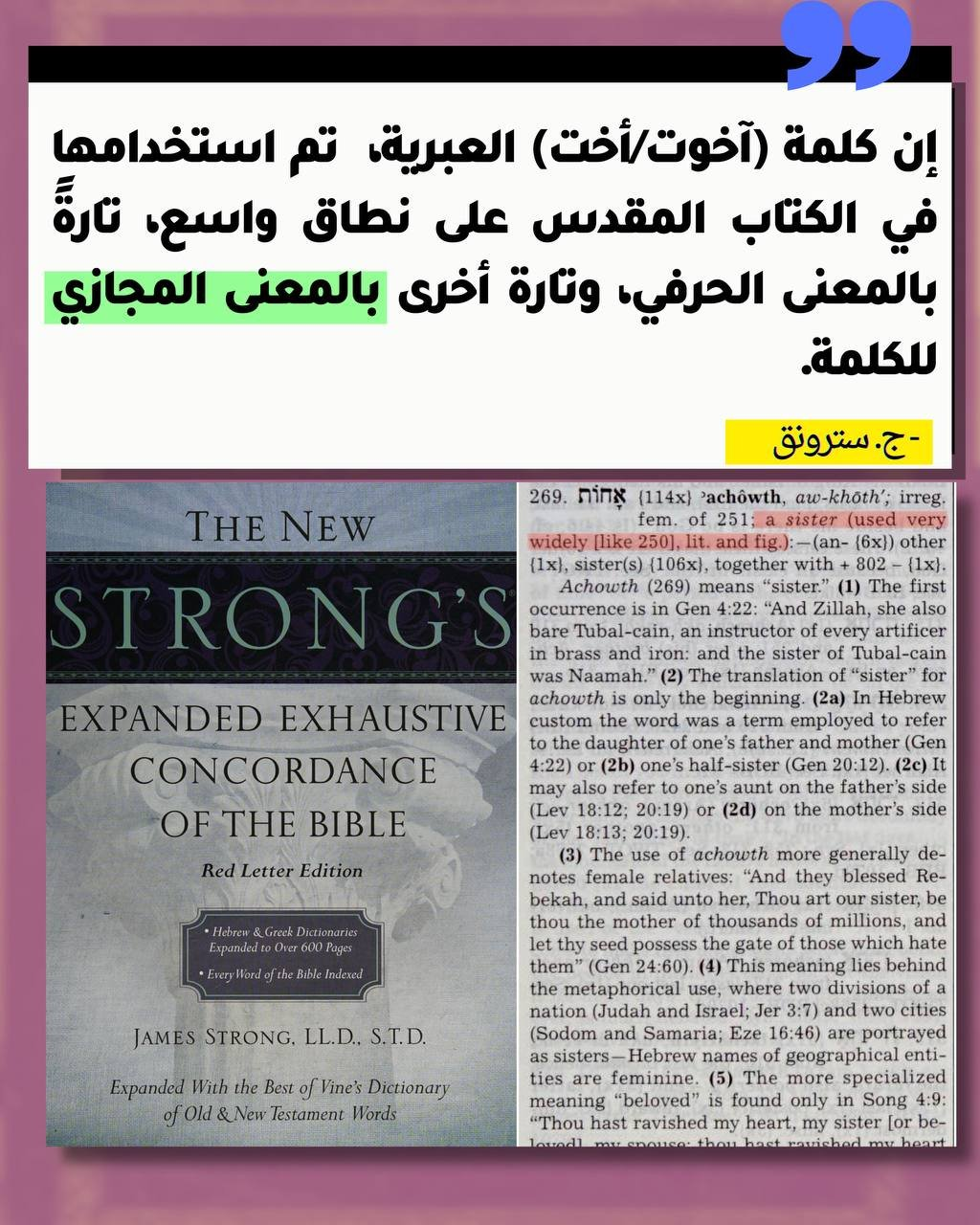
🔶 The New Strong’s Exhaustive Concordance Of The Bible very briefly describes the word אָחוֹת, “sister”, and says that it is widely used both literally and figuratively in the Hebrew Bible.
🔷For example, we read in Numbers 25:18 “…their sister Kozbi” although Kozbi is not literally the sister of the Midianites, but as Keil & Delitzsch says:
“(Their sister) i.e. one of the members of their tribe.”
💠So: the phrase “O sister of Aaron” from the linguistic and contextual aspect means:
“You are like the righteous man Aaron in his piety and righteousness, so how did you fall into the act of fornication?”
♦️ This is what most, if not all, of the great Quran interpreters said.
✅It is noteworthy that many Muslim and non-Muslim scholars have added another very possible meaning to the word “sister”.
They said that “the sister of Aaron” means “the descendant of Aaron” because, as we have seen above, in the Arabic language as in the Hebrew, the word “sister” may denote a distant kinship.
-
Muhammad Asad comments on the verse, saying:
“In ancient Semitic usage, a person’s name was often linked with that of a renowned ancestor or founder of the tribal line. Thus, for instance, a man of the tribe of Banu Tamim was sometimes addressed as “son of Tamim” or “brother of Tamim.” Since Mary belonged to the priestly caste, and hence descended from Aaron, the brother of Moses, she was called a “sister of Aaron,” in the same way as her cousin Elizabeth, the wife of Zachariah, is spoken of in Luke 1:5 as one of “the daughters of Aaron.” -
Ibn Kathir said, “This is like saying to somebody from the Tamimi tribe: O brother of Tamim [i.e. O descendant of Tamim]., or to somebody from the Mudari tribe: O brother of Mudar. [i.e. O descendant of Mudar]”
-
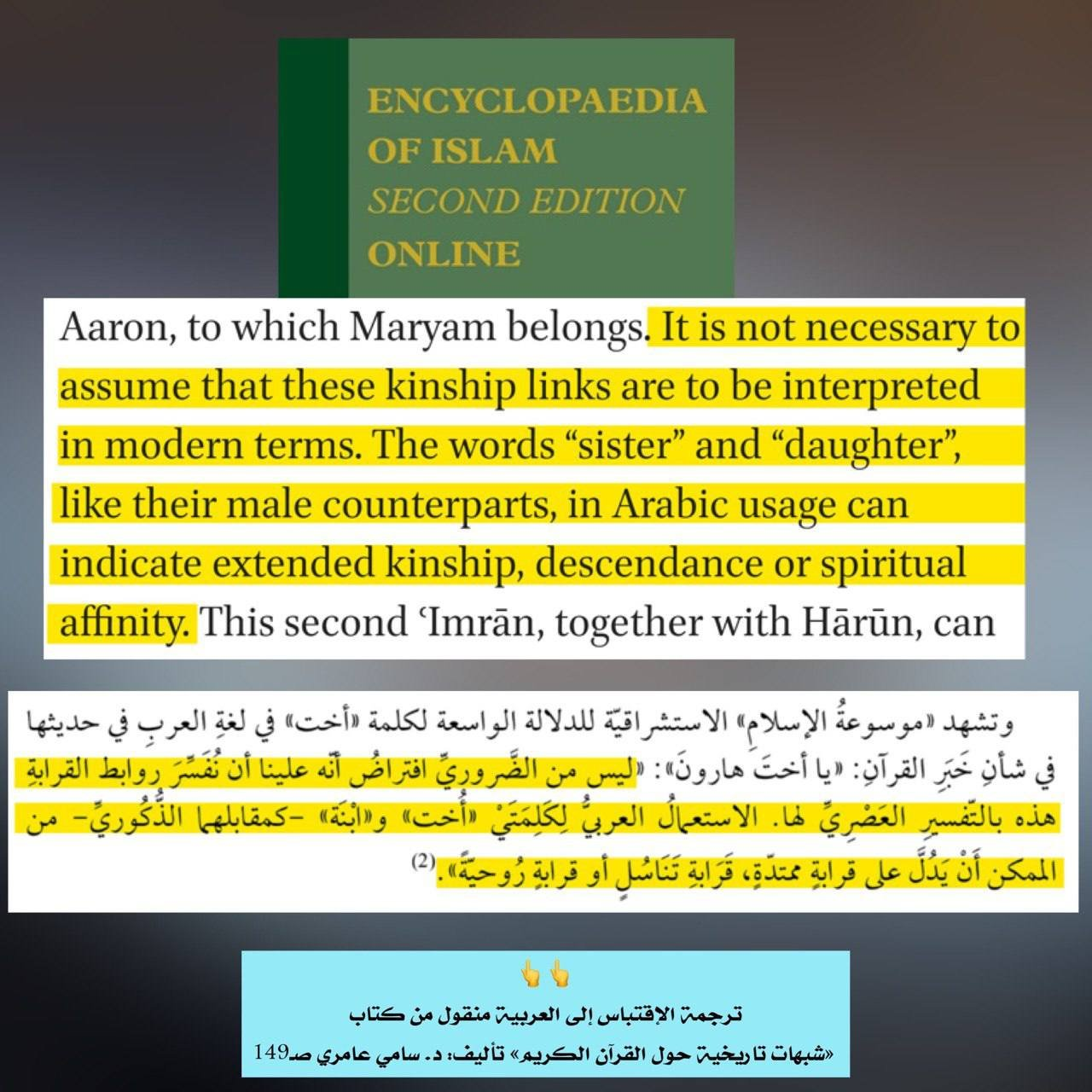
The Encyclopedia of Islam acknowledged the broad meaning of the word (sister أخت) in the Arabic language:
“It is not necessary to assume that these kinship links are to interpreted in modern terms. The words “sister” and “daughter”, like their male counterparts, in Arabic usage can indicate extended kinship, descendance or spiritual affinity… Muslim tradition is clear that there are eighteen centuries between the Biblical ‘Amram and the father of Maryam.”
]
BSo who is that Aaron mentioned in the verse?
The Prophet Muhammad PBUH himself answered this question and pointed out that Aaron is a righteous man whose parents named him after the well-known Prophet Aaron, so it is just a matter of similarity of names.
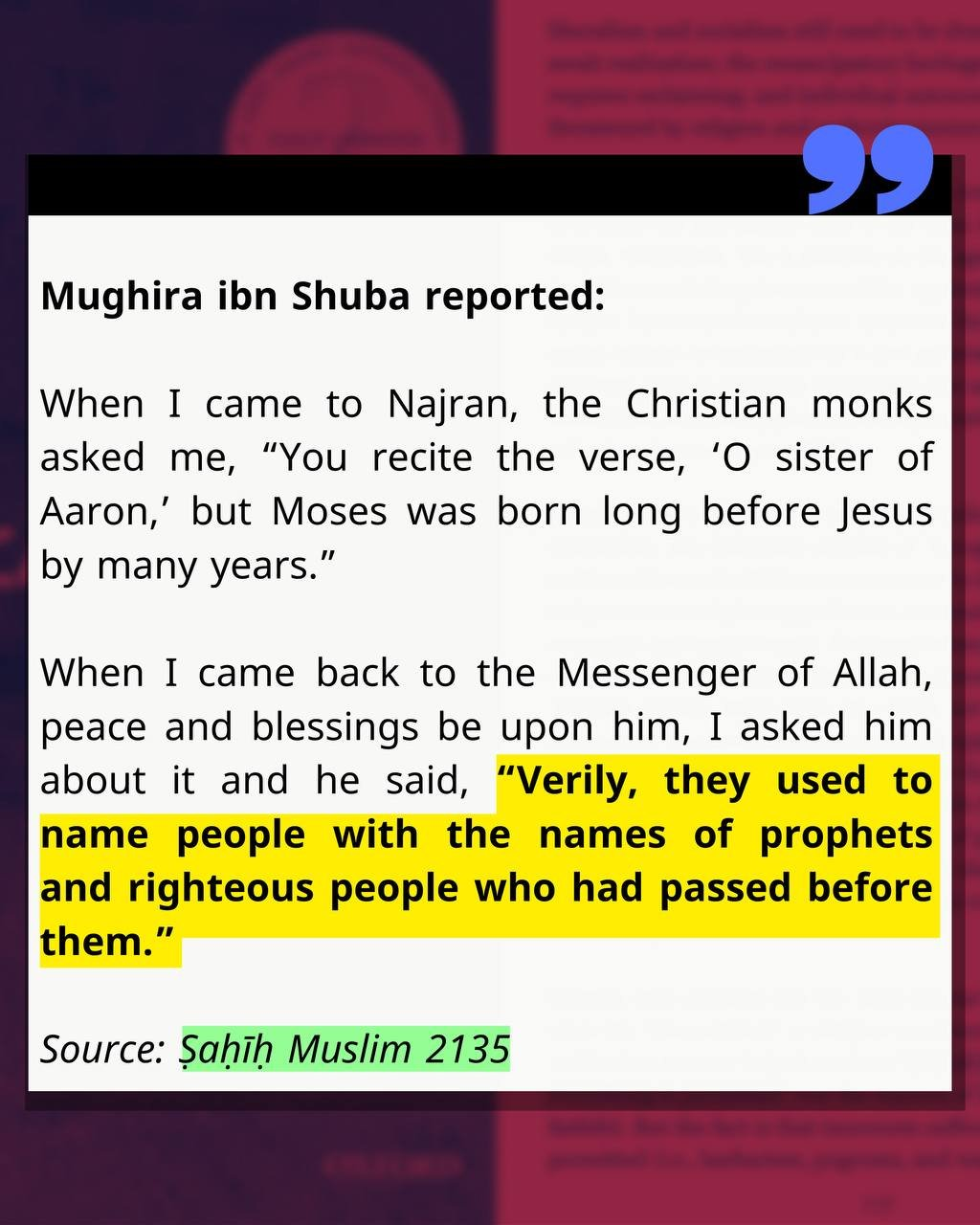
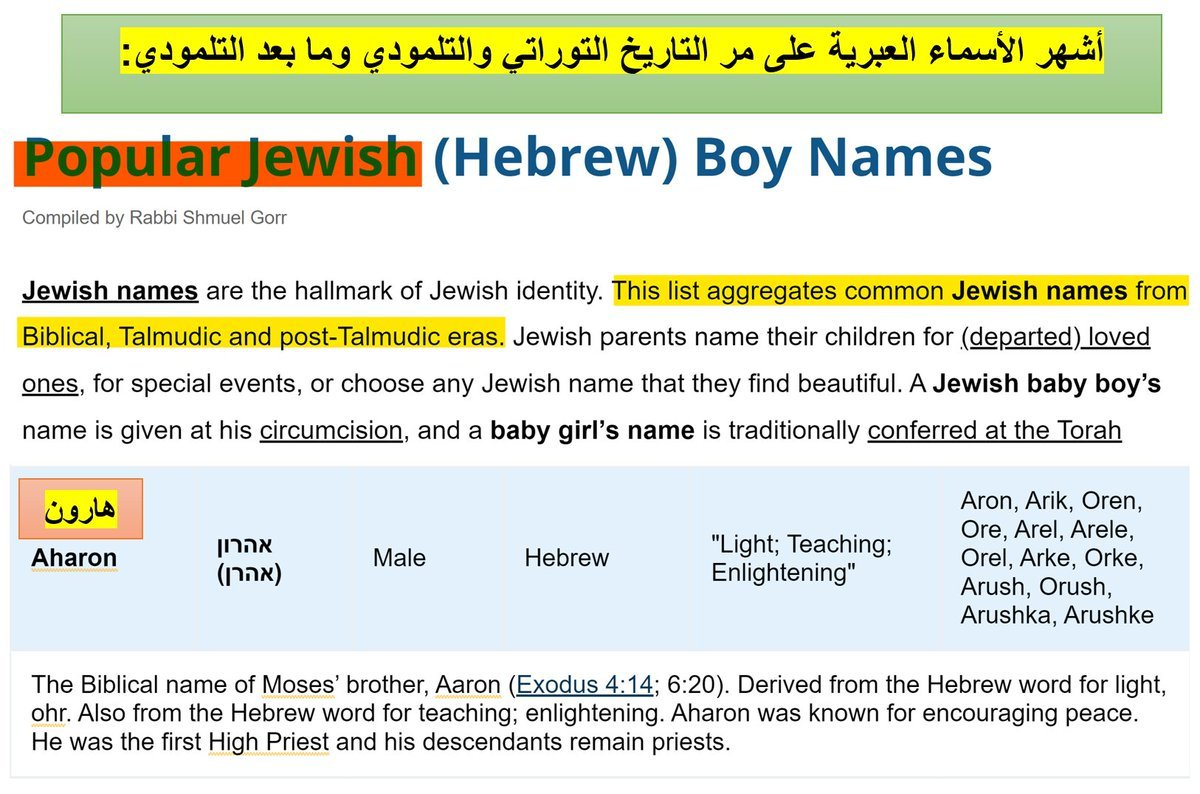
🔶This is a custom known and common among many nations, especially Arabs and Jews, since ancient times, and it continues to this day. And if you do a quick search on the famous biblical Jewish names, you will find the name (Aaron) ranked as one of the most common Hebrew names.
❌Professor Sean objected to this point and said: “As far as I know, is not confirmed in the actual onomastic data that we have from 1st century Palestine.”
Well, we don’t know much about first century Palestine, so you can’t invoke the silence of the archeology to support your claim.
⚠️ So the judgment on the validity of what the Prophet said about the Jews is related to the extent of plausibility that the Jews name their children after the names of the prophets and the righteous before them.
So is it impossible? Absolutely not.
Is it improbable? Also no.
It is, in fact, very likely.
✅ Because it is very conceivable and reasonable for any nation to name their children after the names of their heroic and influential historical figures such as kings, warriors, prophets, righteous people, etc.
🕌 As for the authenticity of the above hadeeth, it is definitively authenticated by scholars of hadeeth criticism.
And you do not have enough scholarly skill and knowledge to weaken the hadith above, which destroys your theory from its foundation.
🧵So far, we have provided an adequate response:
1- “Sister” means “similar/descendant”.
2Aaron who is mentioned in the verse is not the Prophet Aaron, and if some argue that he really is, then the verse will mean “O descendant of Aaron.”
⏳Second: Is there anything in the Quran indicating that its author confused the two Marys?
Absolutely not, and here’s why:
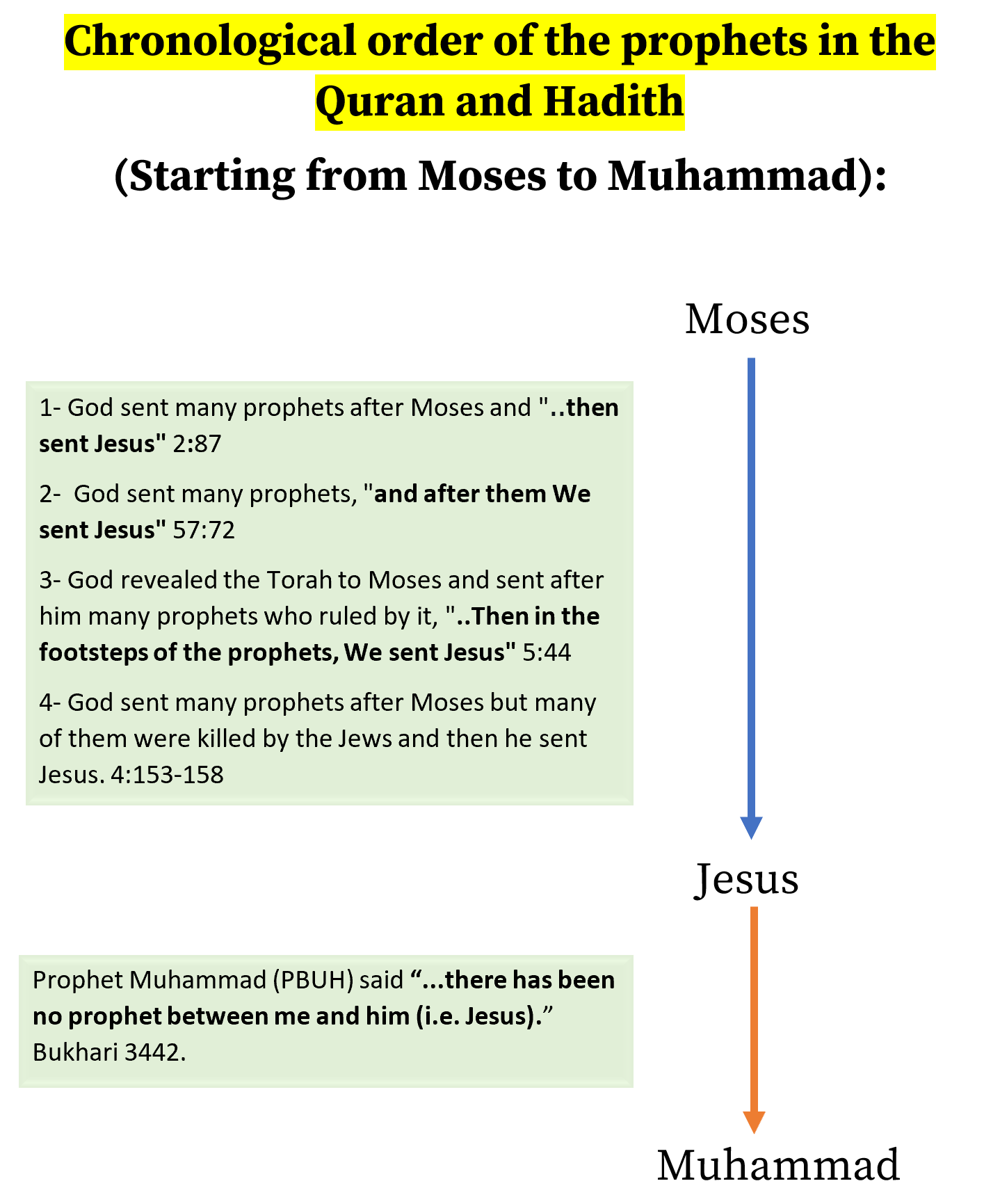
📌AThe Quran makes it clear that there were many prophets between Moses and Jesus, and that many historical events took place before Jesus, which necessitates that long centuries separated Moses and Jesus.
🟢- “Surely We gave Moses the Scripture and caused a train of Messengers to follow him and then sent Jesus, the son of Mary…” 2:87
🟡- “Then in the footsteps of these ˹prophets˺, We sent Our messengers, and ˹after them˺ We sent Jesus, son of Mary…” 57:27
🔴- “Indeed, We revealed the Torah, containing guidance and light, by which the prophets, who submitted themselves to Allah, made judgments for Jews. So too did the rabbis and scholars judge according to Allah’s Book… Then in the footsteps of the prophets, We sent Jesus, son of Mary, confirming the Torah revealed before him.” 5:44-46.
This verse explains that God revealed the Torah to Moses, then many prophets followed him, and they ruled by the Torah, then God sent Jesus after all of them.
🔵- And in the verses (4:153-158), the Quran explains why God cursed the unbelievers of the J,ews by listing their misdeeds in chronological order. So the Quran began by mentioning “Moses” and the incident of worshiping the calf, the entry of the Israelites into Jerusalem [at this time Moses was already dead, Bukhari 1339, Muslim 2372], the Jews breaking God’s covenant, killing many prophets who came after Moses, and finally mentioning Mary and Jesus.
🚧All of the above verses clearly and explicitly refer to the existence of many prophets between Moses and Jesus.
And let us bear in mind that Prophet Muhammad (PBUH) said “…there has been no prophet between me and him (i.e. Jesus).” Bukhari 3442. There is no doubt, then, that there were many prophets between Moses and Jesus.
📌BNow if we analyze the stories of Moses and Mary, we will notice the following:
The Quran mentioned their stories, starting from their birth, upbringing, and the events that followed.
🔷 Although the story of Moses is the most repeated in the Quran (he is mentioned 134 times by name), and although Mary is mentioned 31 times, and Jesus is mentioned 25 times, we do not find any overlap between the two stories at all.
🔶 We do not find any mention of Moses in the story of Mary, neither do we find any mention of Mary or Jesus in the story of Moses, despite the necessity of mentioning them if they were indeed one family and that they lived in one era.
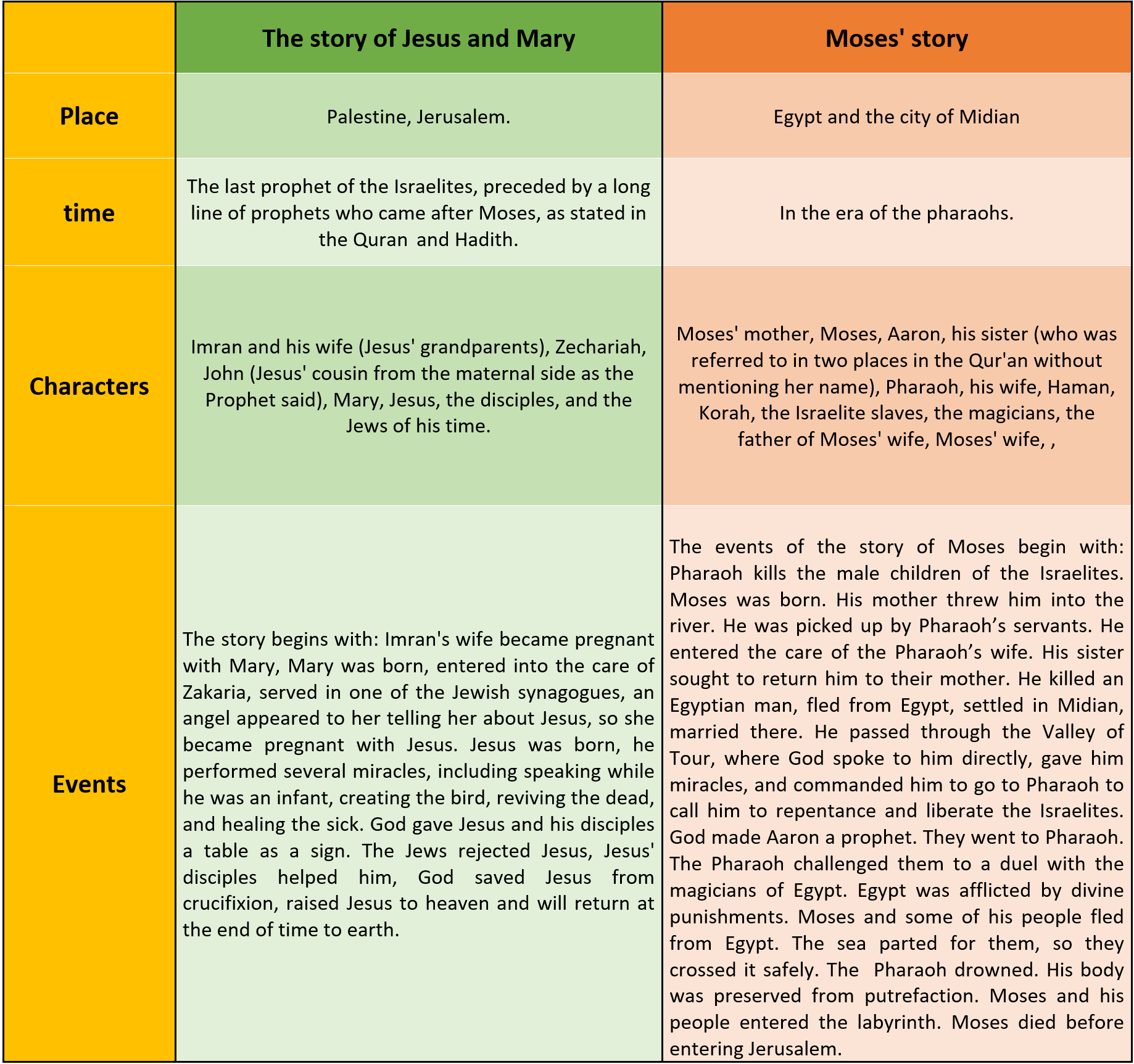
🟩The time and place of their stories are completely different, the events are different, and even the characters of the two stories are different.
See the attached picture for a comparison between the story of Moses and the story of Mary, the mother of Jesus.
CSurah Al-Imran (i.e. the chapter of the Imran family), which of course talks about the Imran family, never mentions the stories of Moses or Aaron or their father (whom the Bible calls Amram), or their sister at all.
Rather, it mentions the story of Mary’s birth, her entry into the care of Zakaria, her upbringing, and her pregnancy with Jesus.
Then the surah mentions the story of Jesus, his birth, his message, his miracles, his disciples, his people’s rejection of him and their attempt to kill him, God’s protection for him, and his ascension to heaven.
If the author of the Quran believed that Moses, Aaron, and their sister were part of the family of Imran (Jesus’ grandfather), then why on earth did he not mention their story at all in the chapter that was dedicated to talking about them ?!
And why does the Quran not say anything about Moses’ reaction to his sister’s virgin birth and his response to the Jews’ demand to apply the penalty of adultery to her according to his own law ?
The only answer is that the Quran did not confuse the two stories in the first place, but rather made a clear distinction between them.
This particular point shows how ridiculous the opponents of Islam are and proves that the Quran never confuses the family of Jesus with the family of Moses, otherwise it would have mentioned their story in an overlapping manner.
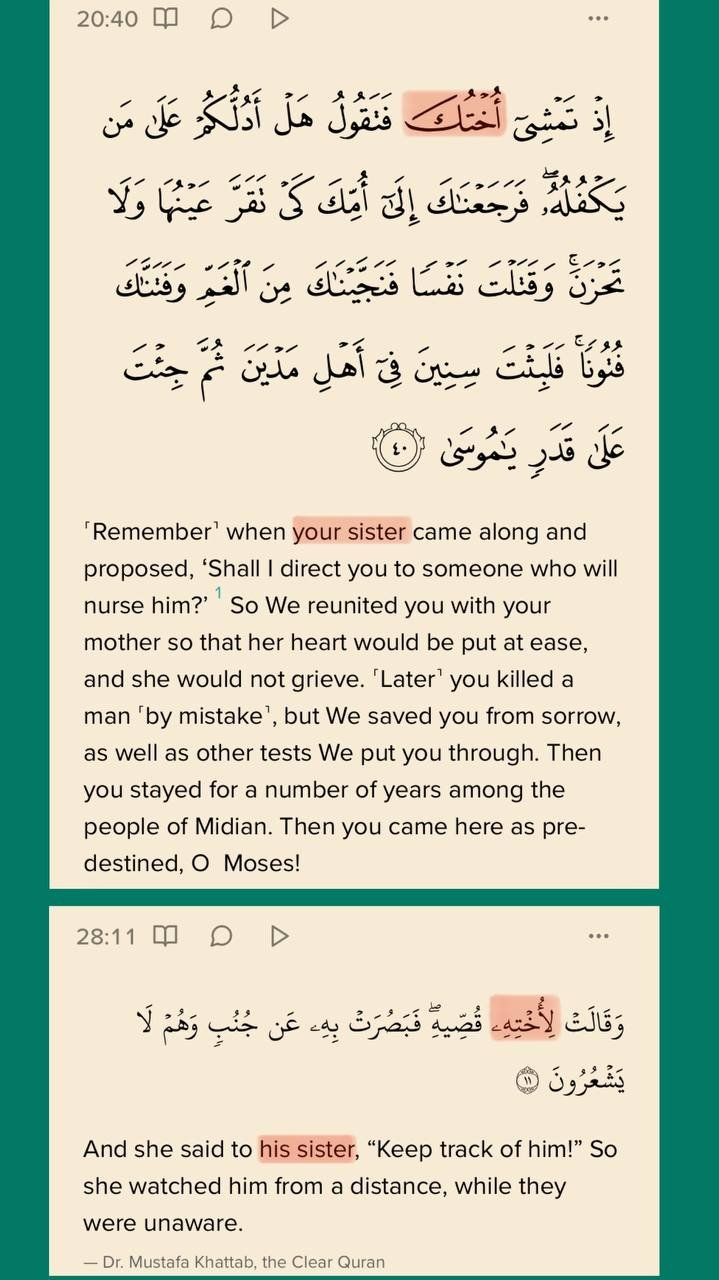
📌The Quran mentioned the real sister of Moses and Aaron twice (20:40 and 28:11), but her name was not mentioned at all.
In contrast, the Quran mentions the name of Mary 31 times. If Mary, the mother of Jesus, was the same as Mary, the sister of Moses, then this would be clear and explicit in the Quranic narrative.
However, the truth is that the Quran distinguishes between them by presenting different stories for both individuals and mentioning the name of Jesus’ mother only.
🤔Counter question:
Since missionaries and orientalists claim that Prophet Muhammad was well versed in the biblical, Talmudic, and even apocryphal traditions, and notwithstanding the fact that the alleged sources of the Quranic stories are written in five different languages and were not then translated into Arabic,
let us concede for the sake of argument that Prophet Muhammad did indeed possess these Knowledge, then how can it be correct to claim that a man who is well informed about the Judeo-Christian heritage is ignorant of something very obvious like that?
📜 As Theodor Nöldeke said:
“The most ignorant Jew could never have mistaken… Miriam the sister of Moses with Mary (= Miriam) the mother of Christ.”
⏳Third: Who are the Imran family?
📌 In the Quranic terminology, Al-Imran refers to the family of Jesus’ grandfather (Imran, his wife, and their offspring), and many commentators agree on this, and the proof is clear:
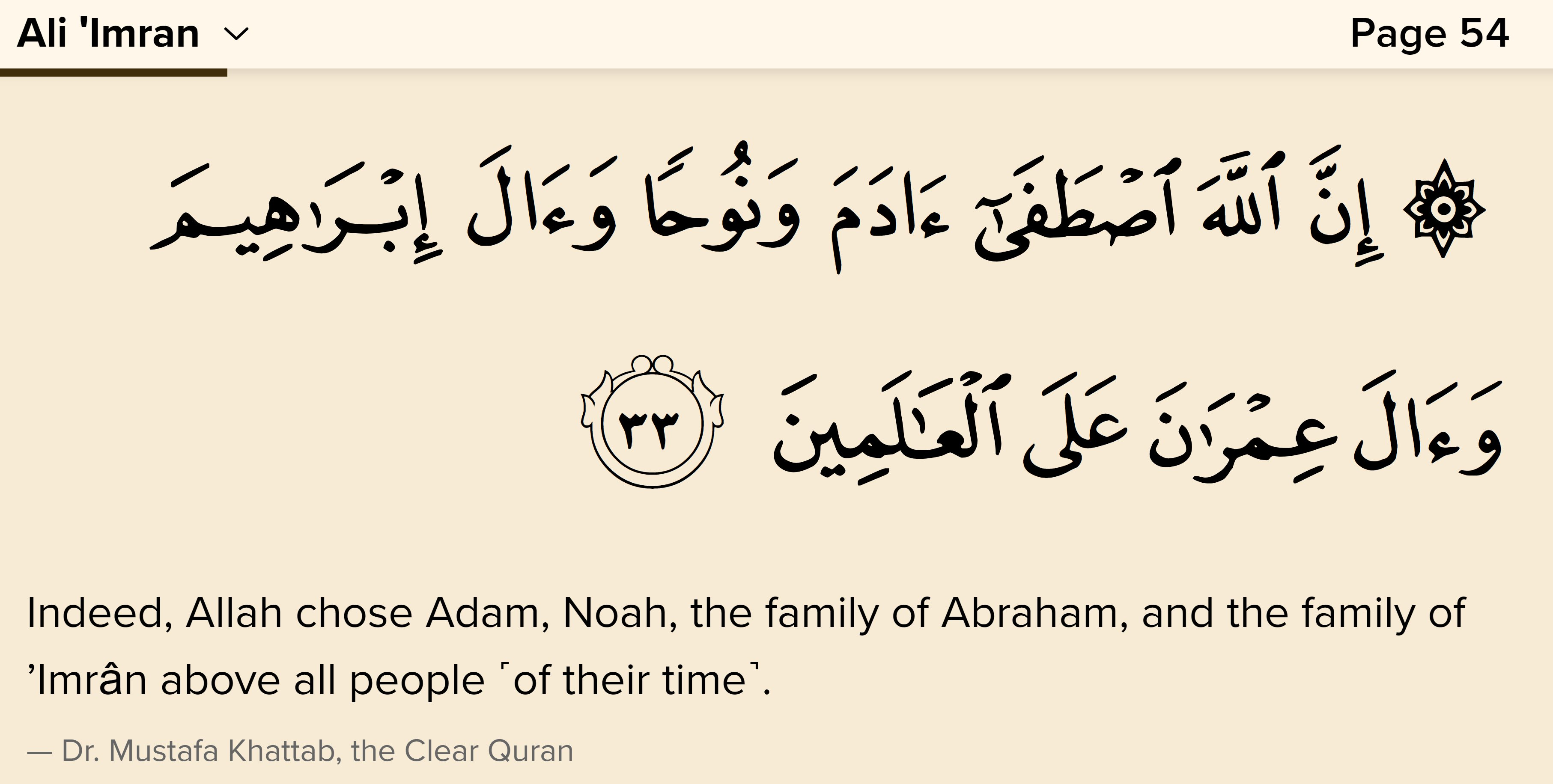
Which is that the verse that Professor Sean inferred to support his theory 3:33 is contained in Surat Al-Imran, which only spoke about the story of Jesus, his mother, his grandparents, and their relatives Zechariah and John the Baptist.
🤦♂️ One of the strange things that Professor Sean did is that he interpreted a Quranic term based on another book, the Talmud, thus implying that the Prophet of Islam had access to Talmudic knowledge.
If we agree, for argument’s sake, is it possible then, that someone who was able in some mysterious way to peruse the huge Talmud that is being printed today in dozens of volumes, and which was not then translated into Arabic, would be ignorant of something so obvious, such as that Jesus did not live in the time of Moses?!
❌Are you aware of the implications of your theory?
⚠️And if you say that perhaps the Prophet took this knowledge from the Jews who “lived with them”, then your problem will be greater, because how can someone who lived with the Jews and studied their heritage and knowledge from them -as the orientalists claimbe ignorant of such a clear and obvious thing?!
Your theory does not have a wide explanatory scope that explains many of the circumstances of the subject. Rather, your theory creates more problems than it solves, so it is incoherent and wrong.
https://discord.com/channels/1310948573768319047/1343865594654621717
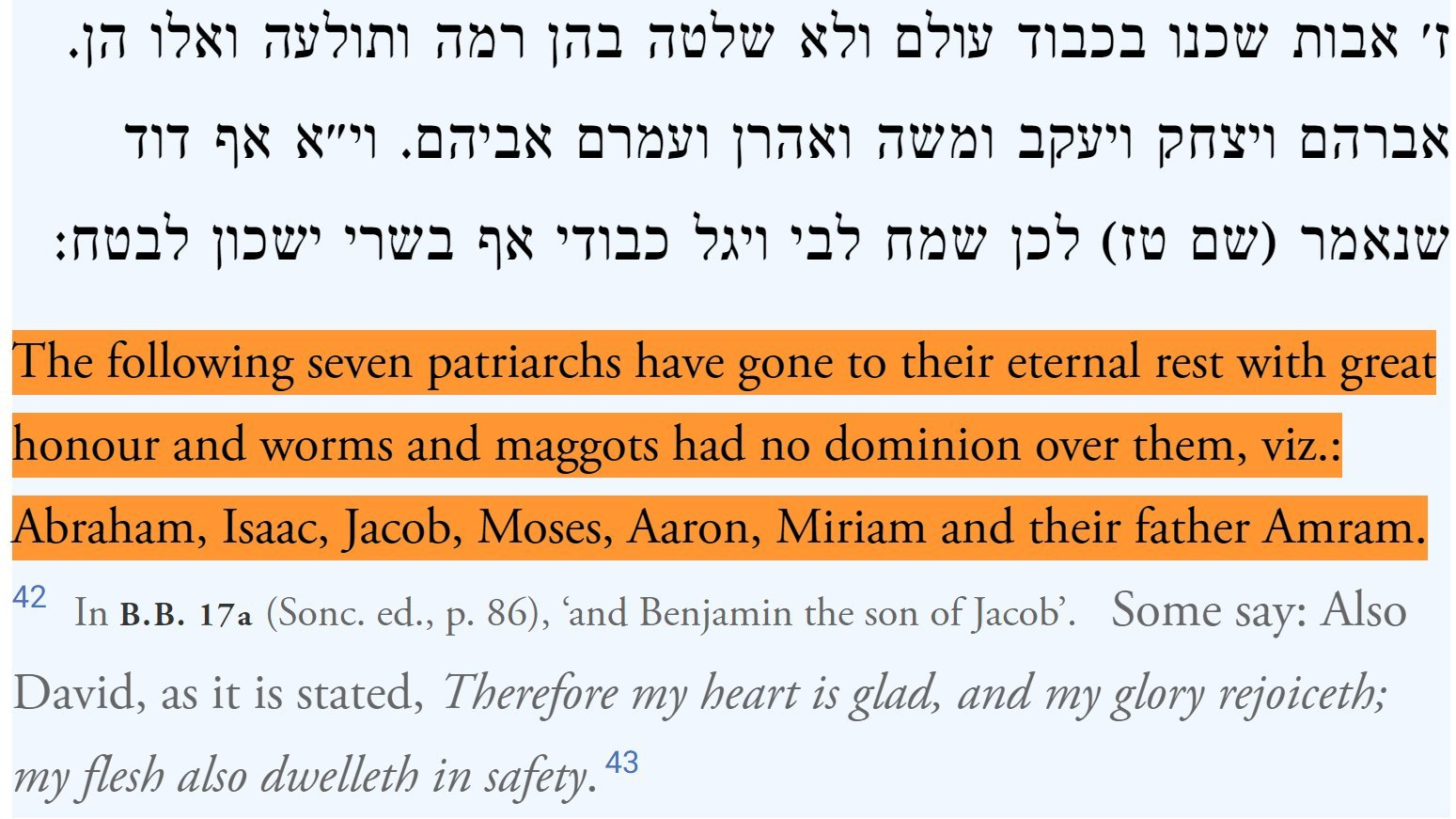
Moreover, the Talmudic text cited by Sean differs from the Quranic verse in several points:
1The contents of the two texts are different:
-
The Quranic verse talks about God choosing His prophets to make them people of righteousness, goodness, and piety, and thus they became better than other people.
-
As for the Talmud, it says that some patriarchs will not be eaten by worms in their graves !!
2The names mentioned in the two texts are different:
-
The Quranic verse mentions Adam, Noah, the family of Abraham (including Ishmael, Isaac, and all the prophets from their descendants), and the family of Imran.
-
As for the Talmud, it only mentions Abraham, Isaac, Jacob, Moses, Aaron, Miriam, and Amram, ignoring Ishmael, the eldest son of Abraham, and it does not mention Adam and Noah.
3The date of writing that Talmudic text is unknown:
It is not known exactly when that Talmudic text was written. The Talmud was written several centuries before Islam, and the writing did not end until about a century after the death of the Prophet.
The great critic Günter Stemberger said that the Babylonian Talmud was completed after the advent of Islam: “a date somewhere after the Islamic conquest seems to be more realistic”.
So you cannot claim that the Prophet Muhammad was influenced by that Talmudic text without first proving that it was written before Islam, and explaining how it reached the depths of the Arabian desert in Mecca.
We notice in the later orientalist writings that this accusation against the Quran was described as a false accusation.
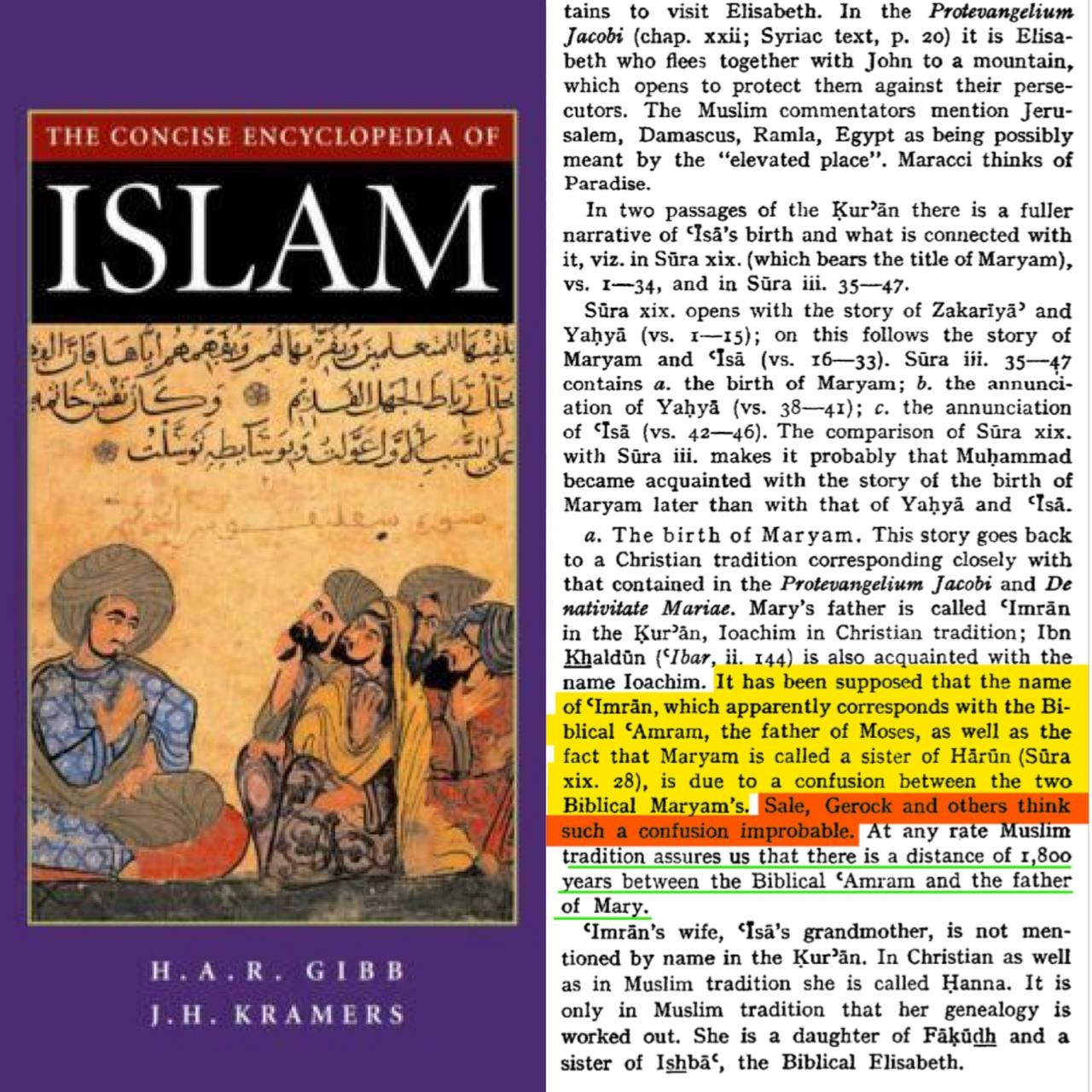
📚 H.A.R. Gibb and J.H. Kramers said:
“It has been supposed that the name of ‘Imrān, which apparently corresponds with the Biblical ‘Amram, the father of Moses, as well as the fact that Maryam is called a sister of Hārūn (Sura xix. 28), is due to a confusion between the two Biblical Maryam’s. Sale, Gerock and others think such a confusion improbable. At any rate Muslim traditions assures us that there is a distance of 1,800 years between the Biblical ‘Amram and the father of Mary.”
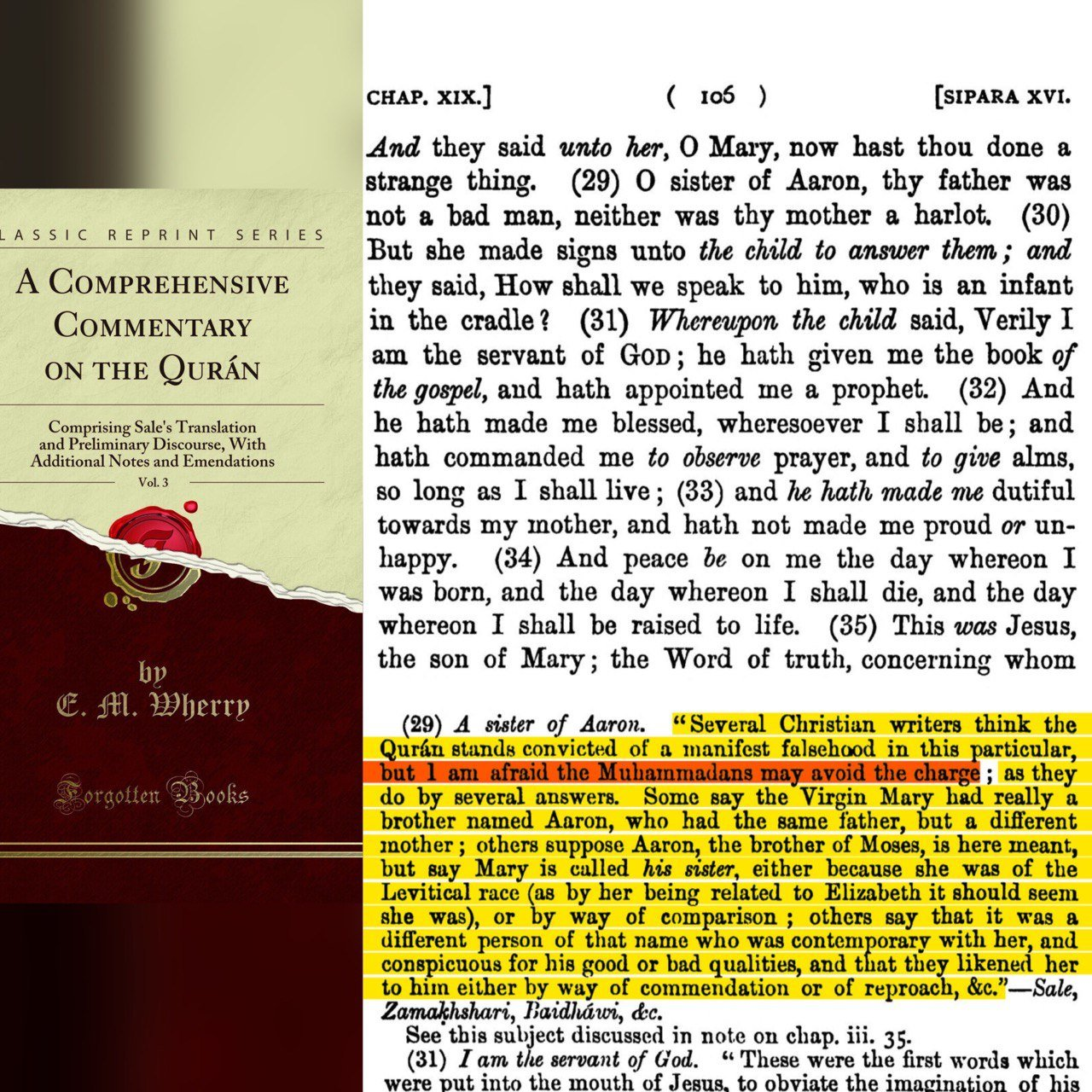
📚Orientalist George Sale said:
“Several Christian writers think the Quran stands convicted of a manifest falsehood in this particular, but I am afraid the Muhammadans may avoid the charge as they do by several answers. Some say the Virgin Mary really had a brother named Aaron, who had the same father, but a different nother; others suppose Aaron, the brother of Moses, is here meant, but say Mary is called his sister, either because she was of the Levitical race (as by her being related to Elizabeth it should seem she was), or by way of comparison; others say that it was a different person of that name who was contemporary with her, and conspicuous for his good or bad qualities, and that they likened her to him either by way of commendation or of reproach.”
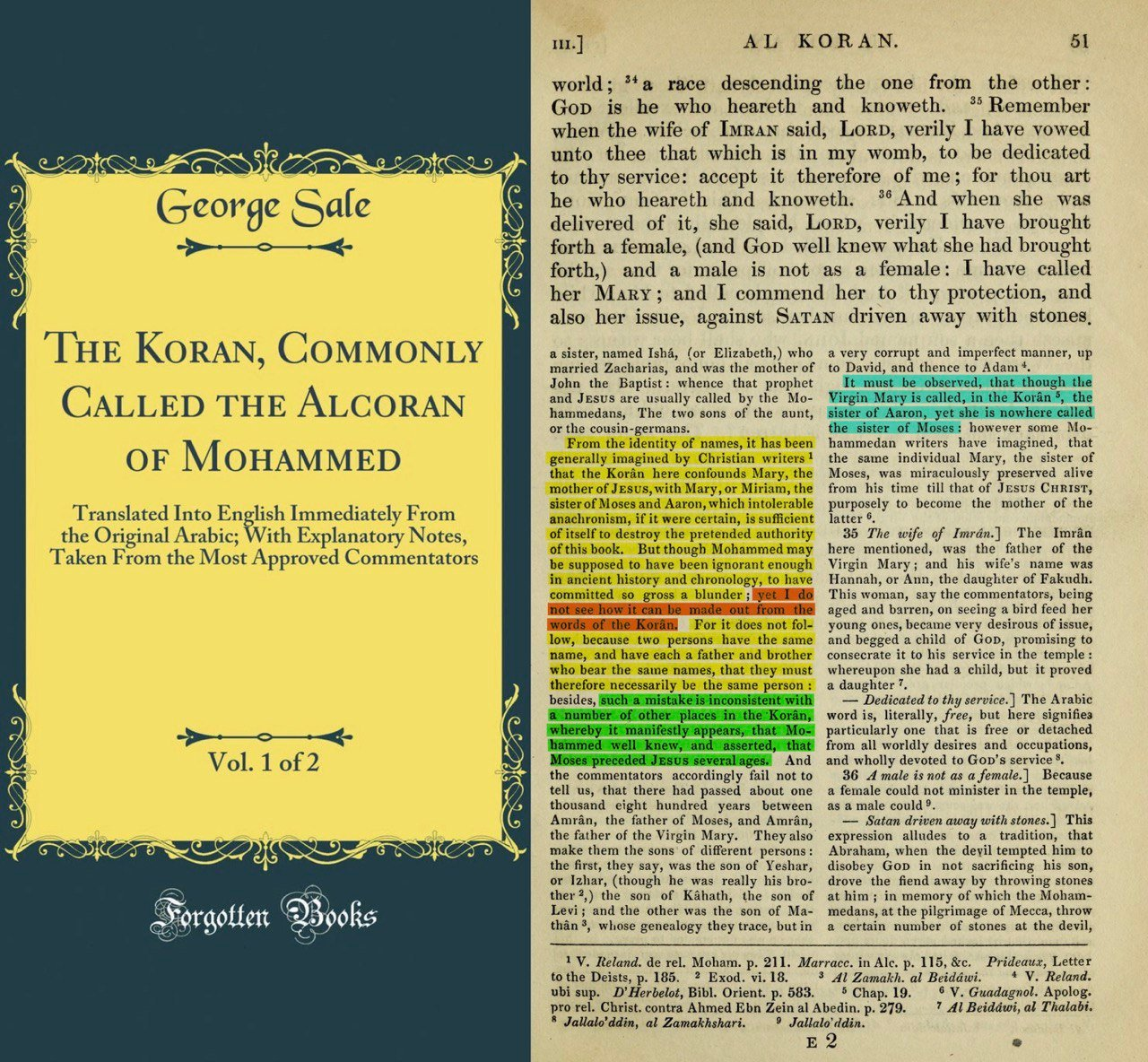
📚He also said:
“From the identity of names it has been generally imagined by Christian writers that the Koran here confounds Mary the mother of Jesus with Mary, the sister of Moses and Aaron; which intolerable anachronism, if it were certain, is sufficient of itself to destroy the pretended authority of this book. But though Mohammed may be supposed to have been ignorant enough in ancient history and chronology, to have committed so gross a blunder; yet I do not see how it can be made out from the words of the Koran.
For it does not follow, because two persons have the same name, and have each a father and brother who bear the same names, that they must therefore necessarily be the same person: besides, such a mistake is inconsistent with a number of other places in the Quran, whereby it manifestly appears, that Mohammed well knew, and asserted, that Moses preceded Jesus several ages.
And the commentators accordingly fail not to tell us, that there had passed about one thousand eight hundred years between Amran the father of Moses and Amran the father of the Virgin Mary… It must be observed that though the Virgin Mary is called in the Koran, the sister of Aaron, yet she is nowhere called the sister of Moses.”
⏳In Conclusion:
We proved that the verse “O sister of Aaron” does not mean a literal sister of the Prophet Harun, relying on the Arabic language, the Quranic context, and the hadith of the Prophet Muhammad himself.
Finally, I remind you all of the famous verse that establishes a strict rule in understanding the meanings of the Qur’an and is found in Surat Al-Imran itself:
He is the One Who has revealed to you ˹O Prophet˺ the Book, of which some verses are precise—they are the foundation of the Book—while others are elusive. Those with deviant hearts follow the elusive verses seeking ˹to spread˺ doubt through their ˹false˺ interpretations—but none grasps their ˹full˺ meaning except Allah. As for those well-grounded in knowledge, they say, “We believe in this ˹Quran˺—it is all from our Lord.” But none will be mindful ˹of this˺ except people of reason.
@everyone A COMPREHENSIVE N FINAL RESPONSE TO THIS CLAIM
https://discord.com/channels/1310948573768319047/1319042341377544283 HAS BEEN RE CHECKED N UPDATED
...ristian sect in Arabia is not a historical conclusion. It is a polemical fantasy built on weak assumptions. Related...