Quranic Meaning of Tawaffa: 5 Proofs It Does Not Always Mean Death
5 Examples of Quranic Ayat Where Linguists/Exegetes Did Not Interpret توفى as Death
5 examples of Quranic Ayat (not related to Isa ﷺ) where linguists/exegetes didn’t interpret توفى as death and associated it with both body and soul.
Table of Contents
- Ayah 16:32
- Ayah 7:37
- Ayah 4:97
- Ayah 8:50
- Ayah 3:193
- The Linguistic Meaning of توفى and استوفى
- تفعل and استفعال Can Share the Same Meaning
- Qadiani Claim Refuted
Ayah 16:32
This interpretation is mentioned by scholars like Ar-Razi and Al-Baydawi.
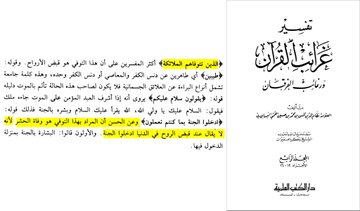
This Arabic scan discusses the phraseتتوفاهم الملائكة in Qur’an 16:32. The highlighted passage explains that the angels “take” or “receive” the righteous in the sense of driving them toward Paradise, not merely in the narrow sense of causing death. It also gives a linguistic explanation: Arabs may use the root وفى / توفى for gathering, completing, or taking something in full. So the scan supports the argument that توفى can carry the meaning of complete taking, gathering, or conveying — not only biological death.

This scan is fromTafsir al-Baydawi on Qur’an 16:32. The highlighted section records the explanation of تتوفاهم الملائكة طيبين, and it includes the interpretation that the angels take the righteous while they are in a good/pure state. It also preserves the interpretation that the angels lead or drive them toward Paradise, showing that the word توفى in this exegetical context is not restricted to the meaning “to die.” The important point is that al-Baydawi transmits a broader meaning: the angels fully take charge of them and direct them to their final blessed destination.
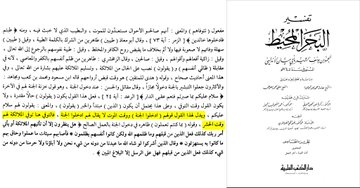
This scan is fromal-Bahr al-Muhit. The highlighted line discusses the phrase تتوفاهم الملائكة and records the view that the angels’ “taking” refers to driving them toward Paradise. The scan is useful because it shows that a major tafsir source preserved this non-death interpretation. The meaning here is not simply “the angels make them die,” but rather that the angels fully receive them and carry them to their final abode.
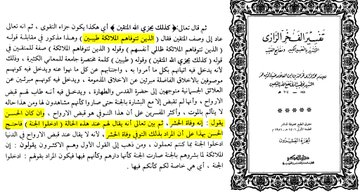
This scan is fromTafsir al-Razi / Mafatih al-Ghayb on Qur’an 16:32. The highlighted passage discusses تتوفاهم الملائكة and includes the explanation that the intended meaning may be the angels driving them to Paradise. Al-Razi also connects the wording to the broader Arabic usage of taking or receiving something fully. This scan supports the argument that even in classical tafsir, توفى was not treated as a word that must always mean death by itself.
Ayah 7:37
Az-Zajjaj interpreted it as “to subject them to severe torment” and “to gather all of them”.

This Arabic scan discusses Qur’an 7:37 and the phraseتتوفاهم رسلنا. The highlighted portion presents the interpretation that the messengers/angels “take” them in the sense of driving them to the Fire. The scan is important because it gives a clear example where توفى is explained not merely as death, but as the angels taking control of the person and moving them toward punishment. This weakens the claim that توفى has only one technical meaning.
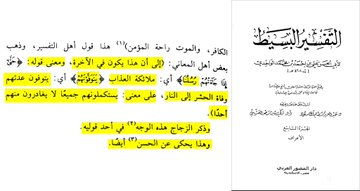
This scan is fromMa’ani al-Qur’an wa I’rabuhu by Az-Zajjaj. The highlighted text explains توفته الملائكة in connection with the angels taking the soul/person, but it also mentions another explanatory angle: the wording may refer to the person being brought under severe punishment, to the point that he is near death or overwhelmed by punishment. This proves that Az-Zajjaj did not reduce the term to one rigid meaning. He allowed a wider semantic range: taking, completing, seizing, gathering, or subjecting to punishment.
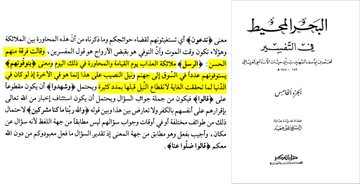
This scan discusses Qur’an 7:37 and the phraseتتوفاهم رسلنا. The highlighted part records the explanation that the “taking” can mean driving them to Hell. The value of this scan is that it shows the exegetical tradition understood توفى in some contexts as an action of full seizure and transfer to a destination, not simply death as an isolated event.

This scan repeats the relevant passage fromAz-Zajjaj. It again shows that يتوفونهم was not treated only as “they cause them to die.” The highlighted discussion connects the word with the angels fully taking the person and also with severe punishment. This supports the wider linguistic point: توفى is tied to full taking/completion, and death is only one possible application depending on context.
Ayah 4:97
This interpretation is mentioned by scholars like Ibn Al-Jawzi and Ibn Al-Mulaqqin.

This scan comments on Qur’an 4:97, where the phraseتوفاهم الملائكة appears. The highlighted portion records the interpretation that the angels’ taking of these people means driving them toward the Fire, not merely the moment of death. This is relevant because the verse concerns people wronging themselves, and the exegetical explanation connects توفى with the angels taking them into the consequence of their wrongdoing.
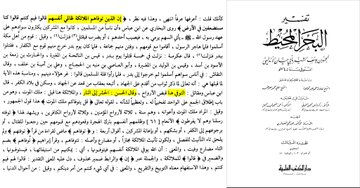
This scan is fromal-Bahr al-Muhit. The highlighted passage states that Al-Hasan interpreted توفاهم الملائكة as the angels driving them to Hell. This is a direct support for the article’s claim: classical exegetes sometimes explained توفى as full taking and conveying to punishment, not only as death.
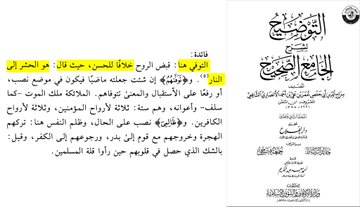
This Arabic scan discussesتوفاهم الملائكة in Qur’an 4:97. The highlighted passage connects the verse to people who wronged themselves and records explanations around the angels taking them. It includes the idea that the angels fully receive them at the end of their worldly term, and it also preserves the interpretation that this taking is connected to their being driven toward punishment. The scan therefore strengthens the claim that توفى can refer to a complete taking of the person, not only the technical meaning of death.

This scan is fromZad al-Masir by Ibn al-Jawzi. The highlighted passage discusses the wording توفاهم الملائكة and presents more than one interpretive direction. One explanation is the taking of souls, while another transmitted explanation is that the angels drive them to the Fire. This is important because Ibn al-Jawzi’s tafsir preserves the broader meaning and does not make توفى a word that must always mean death alone.
Ayah 8:50
This interpretation is mentioned by Abu Hayyan Al-Andalusi.
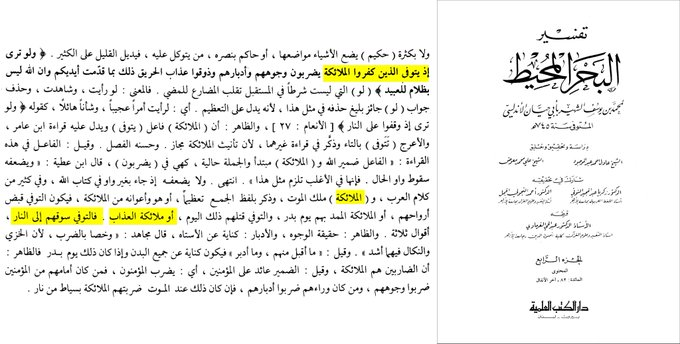
This scan is fromal-Bahr al-Muhit by Abu Hayyan al-Andalusi on Qur’an 8:50. The highlighted section discusses the angels taking the disbelievers and includes the explanation that تتوفاهم الملائكة can mean the angels drive them to the Fire. The scan is directly relevant because it gives another Qur’anic case where a major Arabic exegete reads توفى as full seizure and movement toward punishment, not merely death.
Ayah 3:193
This interpretation is also mentioned by Abu Hayyan Al-Andalusi.
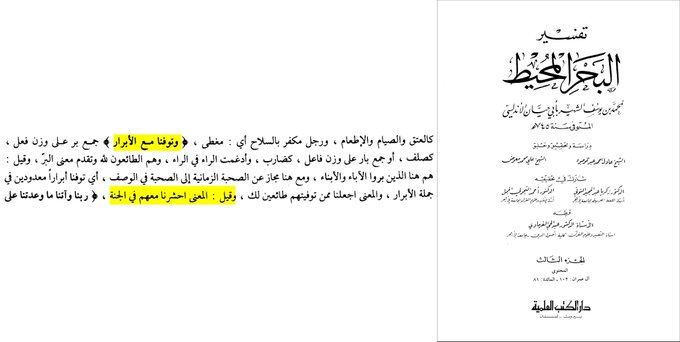
This scan is fromal-Bahr al-Muhit on Qur’an 3:193. The highlighted phrase is وتوفنا مع الأبرار. Abu Hayyan records that this can be understood as asking Allah to join us with the righteous in Paradise. This means the request is not merely “make us die,” but “take us fully and place/gather us with the righteous.” The scan supports the broader point that توفى can involve being gathered with a group in the Hereafter.
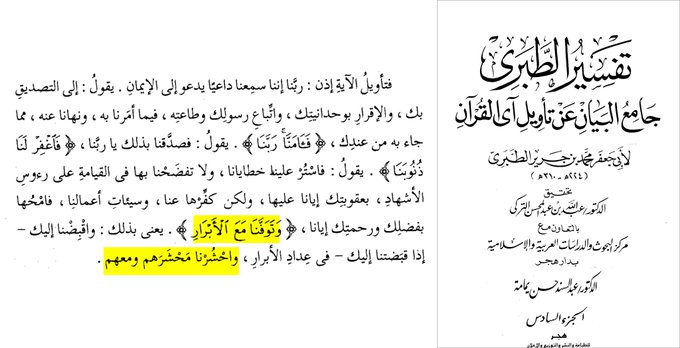
This scan is fromTafsir al-Tabari on Qur’an 3:193. The highlighted passage explains وتوفنا مع الأبرار as a request for Allah to take the believers while they are upon faith and then gather them with the righteous. The scan explicitly supports the argument that توفى here is connected with being brought into the company and final gathering of the righteous, not merely the act of death in isolation.
The Linguistic Meaning of توفى and استوفى
“To die” as a meaning of توفى is derived from these original meanings, that’s why Az-Zamakhshari mentioned “to die” as a FIGURATIVE meaning of توفى.

This Arabic scan gives lexical examples for the rootوفى and related forms. The highlighted material shows usage such as توفيت المال or similar expressions meaning taking or receiving something fully. It also mentions the usage توفي فلان when a person dies. The scan’s point is that death is connected to the idea of full taking: the person’s term, soul, or life is taken completely. So the linguistic root is broader than death itself.
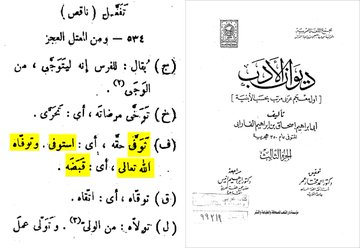
This scan is fromDiwan al-Adab. The highlighted entry explains توفى using استوفى, meaning to take in full or complete the taking. It also gives توفاه الله تعالى in the sense that Allah took him. This scan supports the claim that classical Arabic lexicons connect توفى and استوفى semantically, making it false to claim that the two are completely separate in usage.

This scan is fromMu’jam Maqayis al-Lughah by Ibn Faris. The highlighted portion explains the root وفى around the idea of completion, fulfillment, and making something whole. It includes usages such as fulfilling a covenant, completing something, and taking one’s due fully. This is a major linguistic proof because it establishes the base meaning of the root before later contextual meanings such as death.
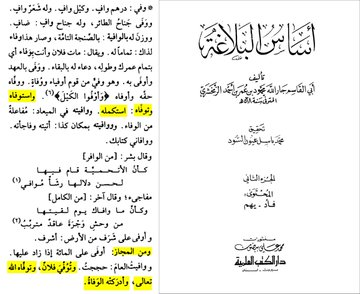
This scan is fromAsas al-Balaghah by Az-Zamakhshari. The highlighted portion gives expressions involving وفى, استوفى, and توفى, showing the shared meaning of taking, receiving, or completing something fully. It also treats death as a figurative or extended usage from this root meaning. This scan is especially strong because Az-Zamakhshari is a major linguistic authority, and he clearly connects the root to full taking/completion rather than restricting توفى to death.
تفعل and استفعال Can Share the Same Meaning
تقصى واستقصى
تعجل واستعجل
توفى واستوفى
Here, Educate yourself.
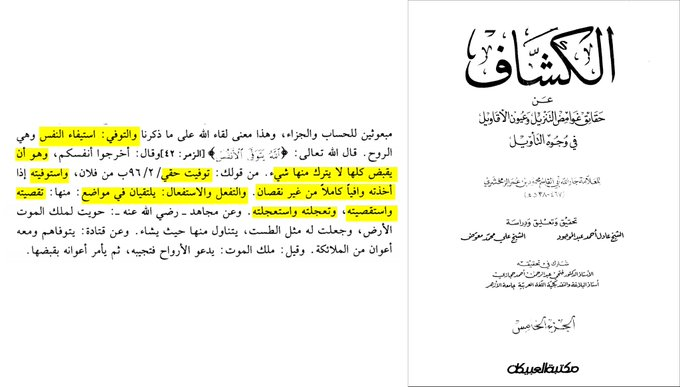
This scan is fromal-Kashshaf by Az-Zamakhshari. The highlighted text gives examples where forms like تفعّل and استفعل overlap in meaning. It specifically includes examples connected to توفى and استوفى, showing that Arabic usage does not require the two forms to be treated as totally unrelated. This scan directly attacks the claim that توفى and استوفى must always be separated in meaning.
Qadiani Claim Refuted
Qadianis repeatedly said that توفى and استوفى are totally different in usage.
Here, 2 linguistic authorities Al-Zamakhshari and Ibn Mandhour clearly stating the opposite and using them interchangeably in different contexts.
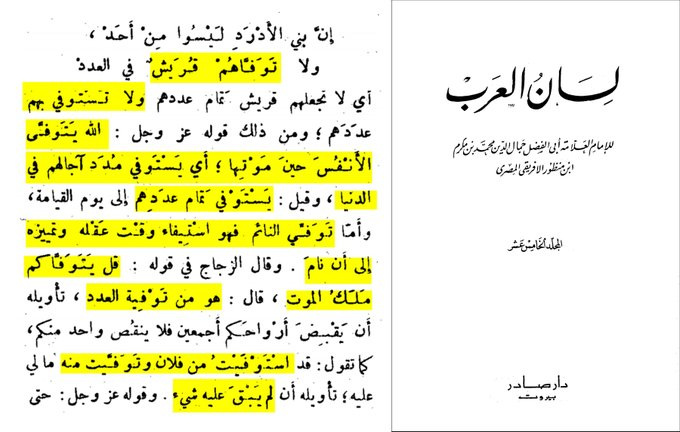
This scan is fromLisan al-Arab by Ibn Manzur. The highlighted text explains توفى through the meaning of استيفاء — taking or completing something fully. It discusses examples such as Allah taking souls, the completion of a person’s worldly term, and the taking connected with sleep. This scan is very important because Ibn Manzur does not present توفى as a word meaning death only. He grounds it in the wider meaning of full taking, completion, and fulfillment.
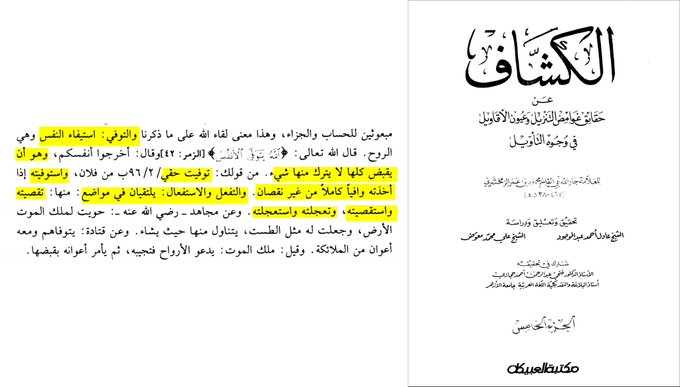
This scan again showsal-Kashshaf by Az-Zamakhshari. The highlighted section explains the shared usage between related Arabic verbal forms and includes the relationship between توفى and استوفى. The key point is that Az-Zamakhshari, a major authority in Arabic language and tafsir, uses these terms in overlapping ways. This directly refutes the Qadiani claim that the two are “totally different” in usage.
In multiple Qur’anic contexts, توفى was interpreted as:
- gathering,
- taking in full,
- receiving completely,
- driving to Paradise,
- driving to Hell,
- joining with the righteous,
- completing the appointed term.
Therefore, the claim that توفى must always mean death is linguistically weak and exegetically false.