

Quran's Layered Darkness in Deep Seas: Scientific Miracle
Surah An-Nur 40 describes layered darkness in the deep sea — waves above waves, clouds above them, and darknesses stacked one upon another — a precise description of oceanographic phenomena that science only discovered in the 20th century. This post examines the verse, the scientific confirmation, and the testimony of marine scientists and converts who recognized its accuracy.
The Quranic Verse
Allah the Almighty describes the state of the disbeliever with a vivid analogy drawn from the deep sea:
“Or [they are] like darknesses within a deep sea which is covered by waves, topped by waves, topped by clouds — darknesses, one upon another. When he puts out his hand, he can hardly see it. And he for whom Allah has not given light — for him there is no light.”
The miraculous Quranic depiction that no one denies except a denier: darknesses, one upon another.
The Scientific Confirmation: Layered Darkness in the Deep Sea
Modern oceanography has confirmed that the deep sea contains precisely the layered system the Quran described: internal waves beneath surface waves, light absorption creating graduated darkness, and distinct depth zones each with its own degree of illumination.
The verse contains with extreme precision the description of more than seven modern scientific facts that were not discovered except in the last two centuries after the development of modern marine sciences. The entire subject is limited only to His Almighty saying: darknesses, one upon another — Glory be to Him.
Internal Waves: Waves Above Waves
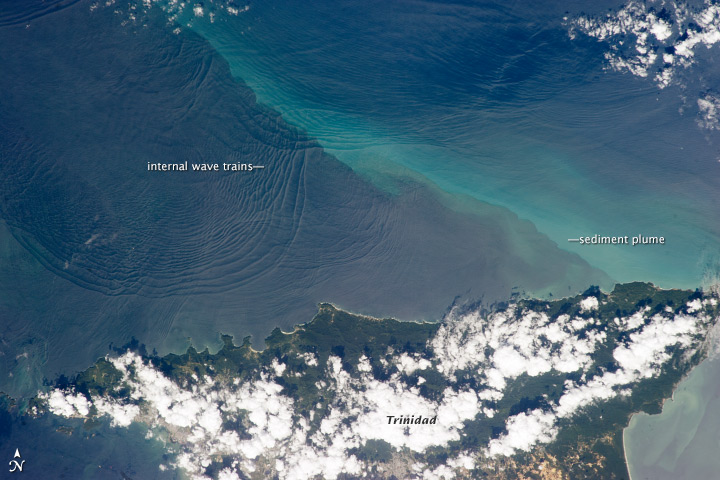
Satellites have proven that there are waves in the deep seas and oceans, an internal wave above which there is an external or surface wave. Man did not begin to notice and perceive these waves until the beginning of the twentieth century (1904 AD), specifically in a theoretical manner only. The first scientific explanation for them was given by Dr. V.W. Ekman in that year.
At the beginning of the discovery of the matter, skeptics said that scientists talk about currents, but the Quran talks about waves. When science recently discovered that they are indeed waves exactly like surface waves, and that they need that density gradient to even exist, the objection collapsed.
Internal waves in the ocean occur at the interface between layers of different water density — typically between warmer surface water and colder deep water. These waves are invisible from the surface but can be detected by satellite altimetry. They are physically identical to surface waves in their wave mechanics, but they propagate along density gradients rather than air-water interfaces.
The Quranic description of “a wave above which is a wave” corresponds precisely to this phenomenon: the surface wave visible to observers, and the internal wave beneath it, both coexisting in the same body of water.
Light Absorption and Graduated Darkness
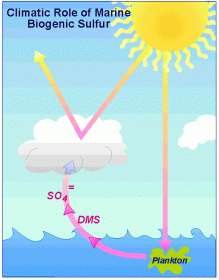
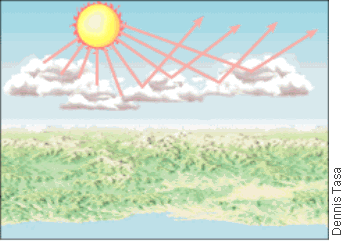
Experimental science has proven that surface waves reflect and scatter part of the sun’s rays outward, so the ocean absorbs part of the light and causes a percentage of the darkness under the ocean and its gradation. Man was not able to know this darkness until after 1930 AD, also theoretically, because divers had only descended to shallow depths of the oceans.
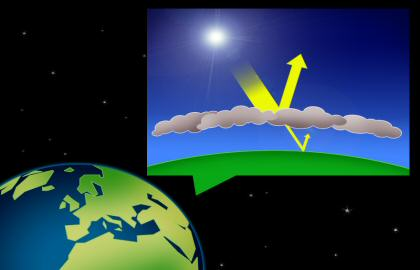
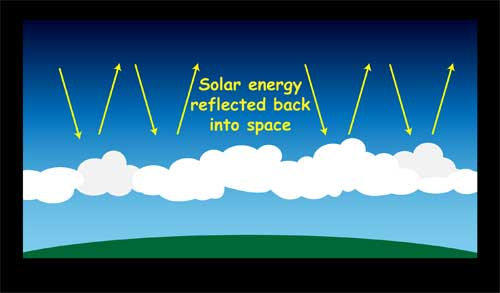
Experimental science has also proven that clouds reflect a percentage of sunlight and are also a cause of the darkness under the ocean.{{<http://oceanmotion.org/html/background/climate.htm}}>
The Depth Zones: Darknesses, One Above Another
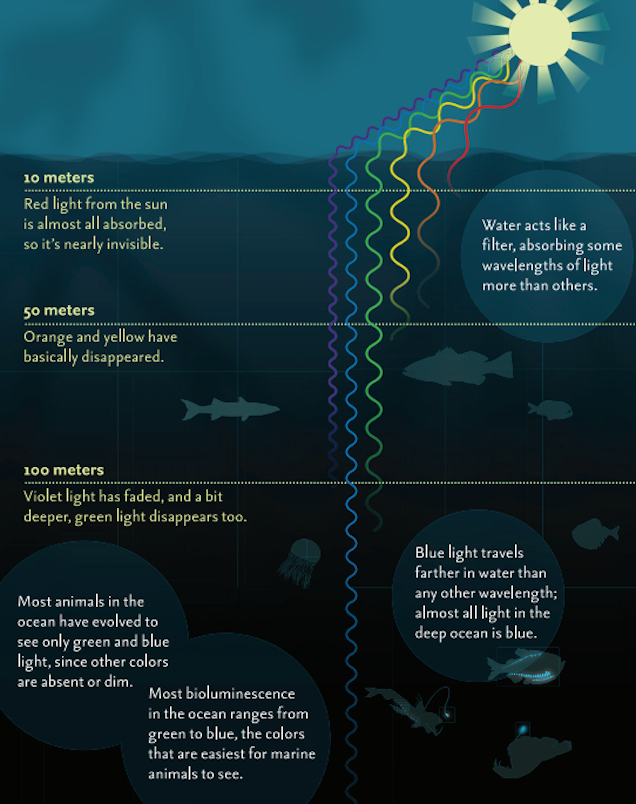
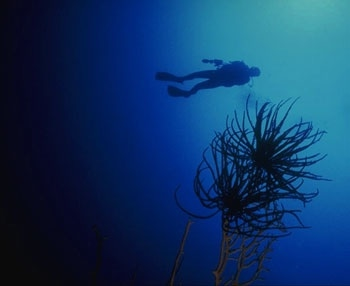
The darkness in the deep sea is layers, some above each other. These layers of gradually layered darkness, some above each other, are only found in the deep sea and the deep abyss only. Scientists liken this darkness to the stages of gradual darkness of the night completely and the blackness of the sky: sunlight, twilight, midnight, and lower midnight. It is exactly the same thing under the deep waters — but the strange thing is that these darknesses exist at the same time, one on top of the other.
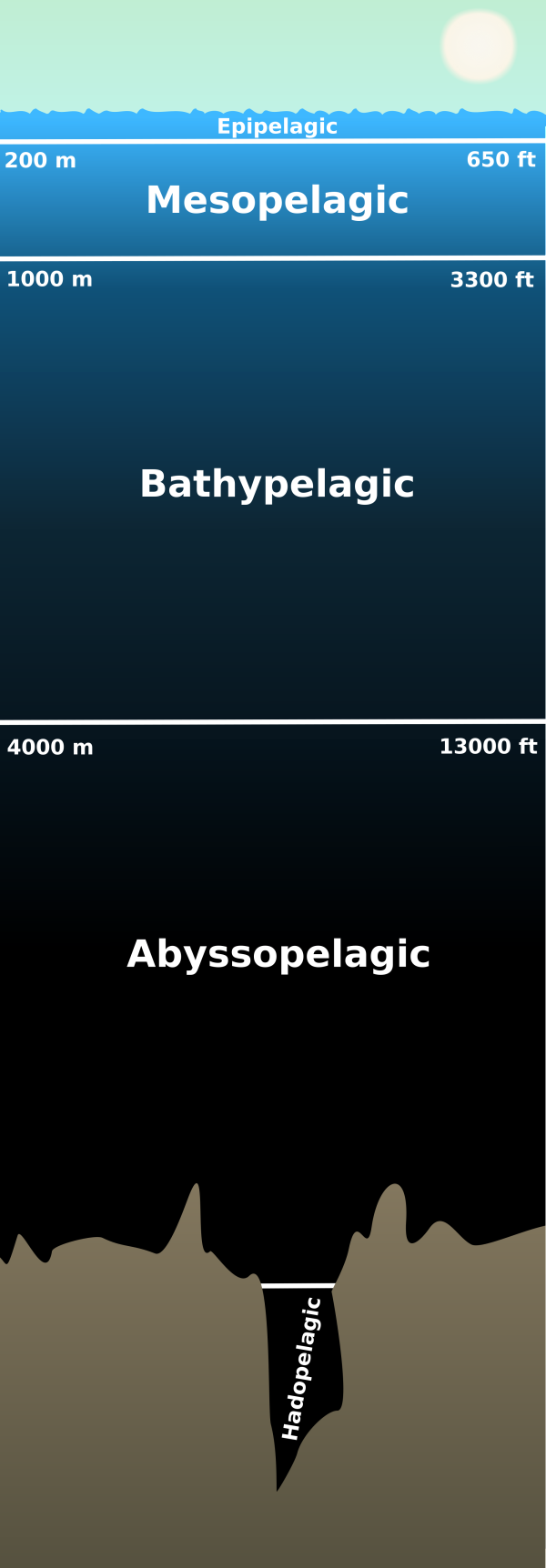
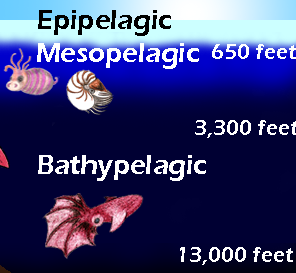
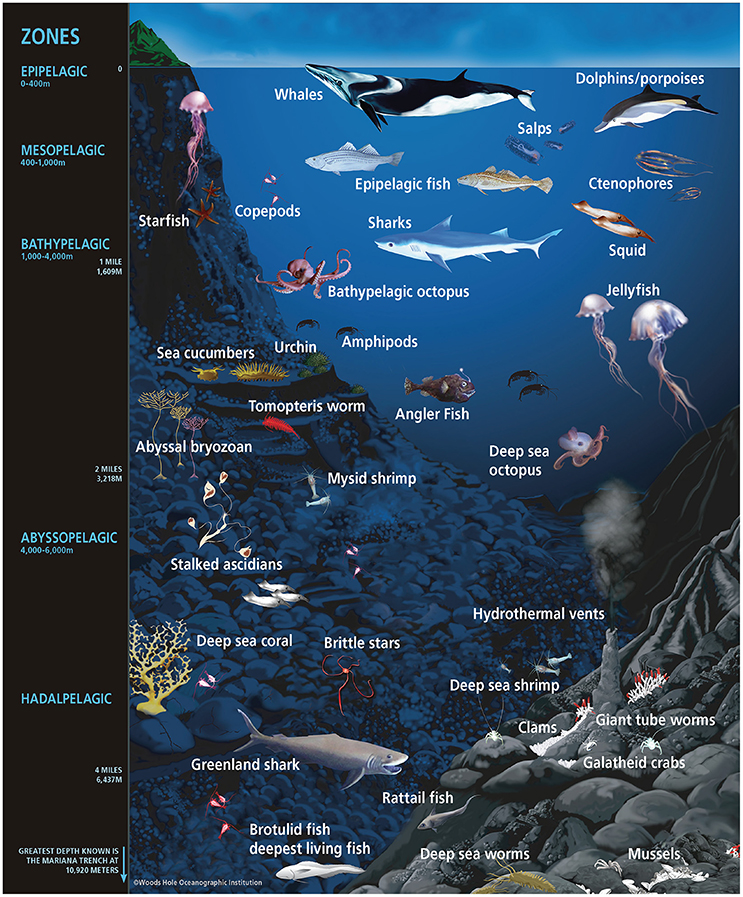
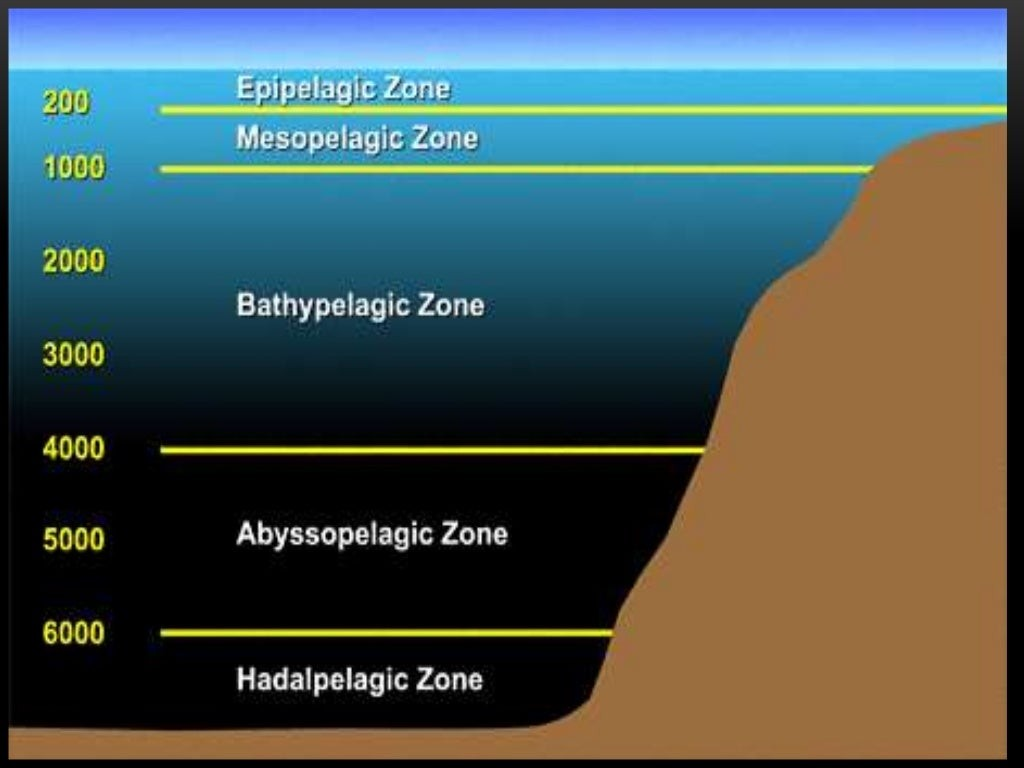
The pelagic zone is divided into distinct layers by depth, each with its own characteristic light conditions:
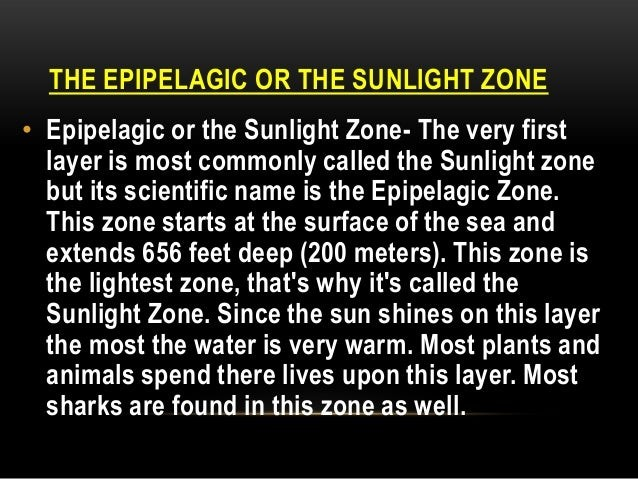
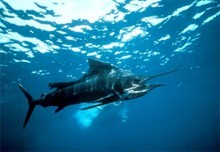
The Epipelagic Zone (Sunlight Zone) — located directly below the surface, extending to 200 meters depth. It is penetrated by sufficient sunlight for photosynthesis. Aquatic food chains of plant and animal plankton and small fish such as herring and sardines live near the surface. Larger fish such as tuna and swordfish feed on these small fish.{{<http://www.enchantedlearning.com/biomes/ocean/sunlit/}}>
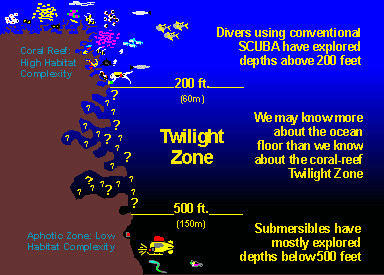
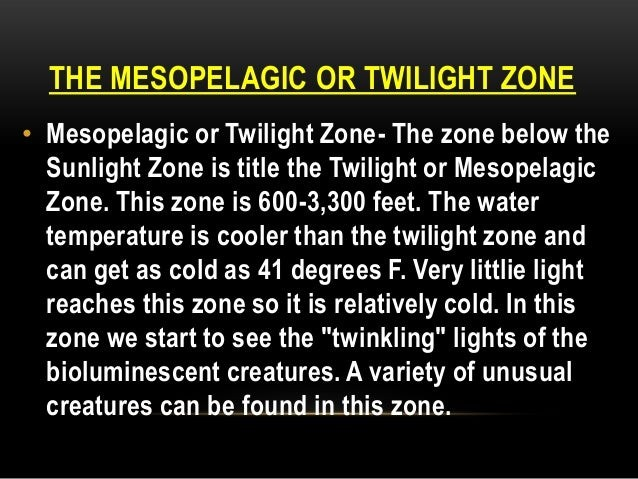
The Mesopelagic Zone (Twilight Zone) — extending from 200 meters to 1,000 meters below the surface. It is called the twilight zone because of the small amount of light that reaches it, so it looks like twilight at sunset. At its upper limit, a sharp decrease in oxygen content begins due to the absence of plants below 150 meters. The point of lowest oxygen content is at 700 to 800 meters depth.{{<https://en.wikipedia.org/wiki/Pelagic_zone}}>
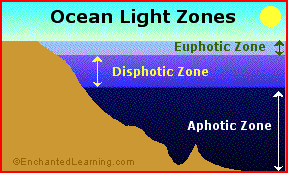
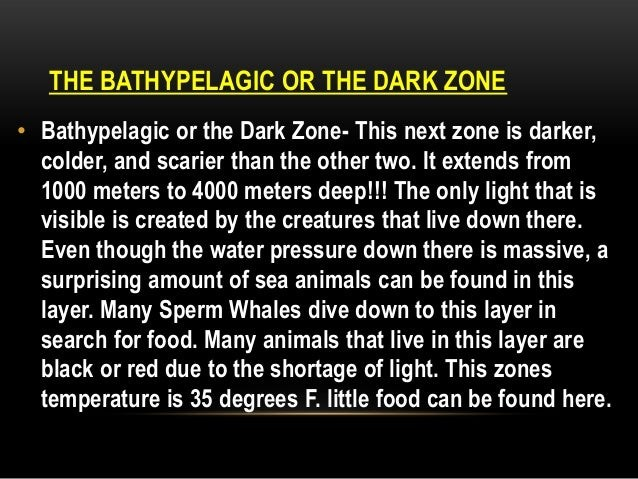
The Bathypelagic Zone (Midnight Zone) — extending from 1,000 meters to 4,000 meters below the surface. Its upper limit is the dividing line between the part that receives some sunlight (disphotic) and the completely dark part (aphotic). This layer and the one below it do not receive any sunlight at all — they are completely dark. The dissolved oxygen content increases due to low temperatures. Fish in this layer are blind. Shrimp species become predators of other organisms.{{<https://www.enchantedlearning.com/biomes/ocean/midnight/}}>
The Abyssopelagic Zone (Lower Midnight) — extending from 4,000 meters to the bottom, which may exceed 11,000 meters in some trenches. It is a completely dark layer, but its waters are slightly cooler and its oxygen content is higher due to low temperatures. It is home to highly specialized marine organisms around hydrothermal vents.{{<https://web.archive.org/web/20160527164921/http://oceanservice.noaa.gov/education/yos/resource/JetStream/ocean/layers_ocean.htm}}>
The Hadopelagic Zone — the deepest waters concentrated in trenches and valleys below the abyssal depths. Information about it and its creatures is very limited, but scientists confirm that living creatures exist even at these extreme depths.
These darknesses exist simultaneously, one atop the other — exactly as the Quran described fourteen centuries ago.
Only in Deep Abyssal Seas
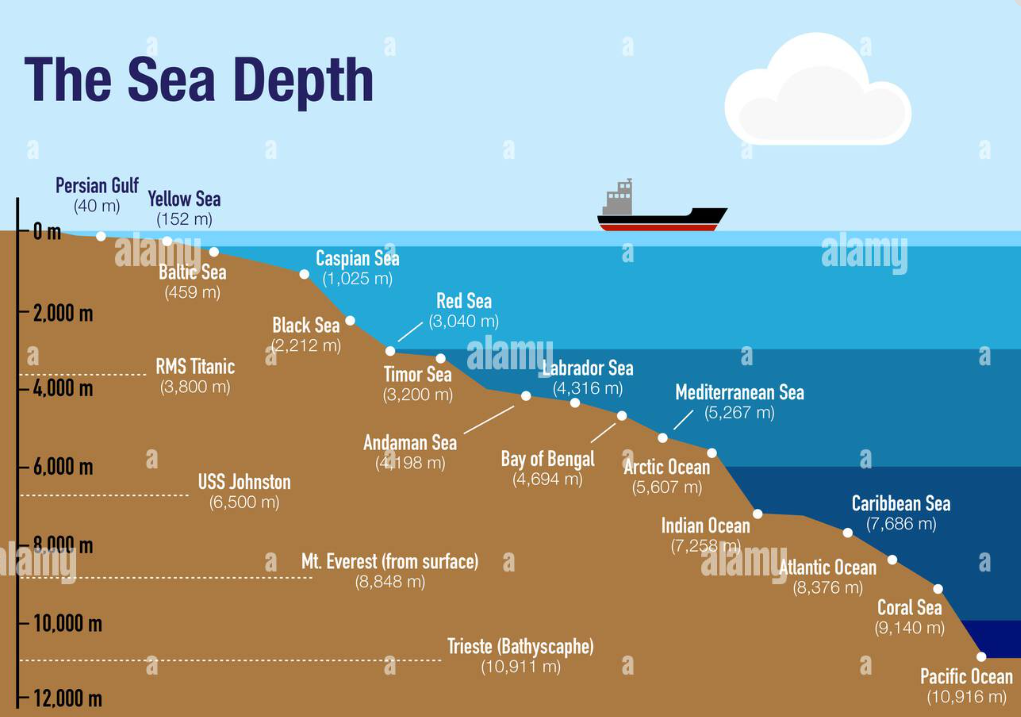
These dark layers are not present in all seas. Their existence is only valid in abyssal seas (oceans) whose depths range from 4,000 to 6,000 meters. If we tried to search for this darkness in the Red Sea, for example, we would not find this gradual darkness because the average depth is only 490 meters, and the maximum depth does not exceed 2,211 meters. After 2,000 meters, the sea still retains a percentage of light. Sunlight is not completely absorbed except at deep abyssal depths.
The Quran specified “a deep sea” (بحر لجي) — not merely any sea, but one of sufficient depth to produce the layered darkness described. This specificity is itself a precision that rules out lucky guesswork.
The Testimony of Dr. Gary Miller
Dr. Gary Miller, a mathematician and former Christian missionary who set out to find errors in the Quran, instead converted to Islam and documented its scientific precision in his book “The Amazing Quran.”
Dr. Miller says in his book: one of the points that confuses non-Muslims when they look closely at this book is that the Quran appears to them in a way other than what they expected. They were expecting an ancient book that was fourteen centuries old and came out of the Arabian desert. They were surprised that it was not at all what they expected. In addition, they expected that the book would talk about the desert from which it came. Yes, the Holy Quran talked about the desert in some of its Surahs, but it also talked about the seas, and the storms that occur there.
“Years ago, we received a story in Toronto about a merchant sailor who lived at sea. A Muslim gave him a translated copy of the Quran to read. The sailor knew nothing about the history of Islam, but he was interested in reading the Quran. When he finished reading it, he returned the copy to the Muslim and asked him, ‘Was Muhammad (PBUH) a sailor?’ He was deeply affected by what he read in the Quran about storms at sea… and when he was told the opposite and that the Messenger (PBUH) lived in the desert, this was enough for him to declare his Islam. He lived through storms at sea, and found the accuracy in their description in the Holy Quran, and he was certain that whoever wrote this description could only have witnessed it, and since the Messenger did not ride the sea, this must be from Allah, the Almighty.”


This sailor converted to Islam just as other people converted from marine scientists, physicists, doctors, historians, anatomists, and philosophers — and just as the Arabs converted in the desert 1400 years ago. The evidence from all this is that these people from different groups, from different times, from different scientific specializations, from different levels of awareness experienced the same thing: that the Quran touches their hearts as if it described what they cannot describe with tongues in a single sentence that sometimes does not exceed two words.
The Testimony of Professor Rao
When presented with the Quranic description of deep-sea phenomena, Professor Rao concluded that such detailed knowledge could not have existed in 7th-century Arabia and attributed it to a supernatural source. The most famous Arab space scientist at NASA, Farouk El-Baz, says that when these facts were presented to Professor Rao and he was asked about his interpretation of the phenomenon of scientific miracles in the Quran and Sunnah, and how Muhammad was informed of these facts more than 1,400 years ago, he replied:
“It is difficult to assume that this type of scientific knowledge existed at that time, a thousand and four hundred years ago, but some things deal with a general idea, but describing these things in great detail is difficult very much so, so this is definitely not a simple human science. The average person cannot explain these phenomena in that much detail, so I thought of a supernatural force outside of man, the information came from a supernatural source.”
The Scholarly Interpretation: Five Darknesses
The classical commentators identified five layers of darkness in the verse: the disbeliever’s speech, actions, entrance, exit, and final destination — each a darkness stacked upon the other.
Abi bin Kaab explained the verse with remarkable depth:
“He gave another example for the disbeliever, so he said: ‘Or like darknesses in a deep sea’ — the verse. So he is in five forms of darkness: his speech is darkness, his actions are darkness, his entrance is darkness, his exit is darkness, and his destination is to the darkness on the Day of Resurrection, to the Fire. Then darknesses will begin, one above the other, meaning they are darknesses, one above the other.”
The linguistic analysis of the verse is equally precise. Al-Zajjaj and Abu Ubaidah said: the meaning of “he could hardly see it” is that he did not see it. Al-Farra’ said: “Kad” is a connection, meaning he did not see it; as you say: “I could hardly recognize him.” Al-Mubarrad said: it means he did not see it except after great effort; as you say: “I almost saw you from the darkness,” and he saw it after despair and hardship.
An-Nahhas concluded: “The most correct of the sayings in this is that the meaning is he did not come close to seeing it, so if he did not come close to seeing it, then he did not see it with a distant or close vision.”
The Uniqueness of Quranic Description
The Quran’s description operates on multiple levels simultaneously — physical, psychological, conceptual, and scientific — and each reader comprehends it according to their own knowledge and consciousness. The description of the Holy Quran of the situation from the physical material aspect, the psychological aspect, the conceptual aspect, and the scientific aspect makes you feel while reading the Holy Verse as if you are seeing it with your own eyes and witnessing it in front of you. But this is not the greatest miracle in the subject. The miracle here is that, no matter how conscious you are, you will comprehend the scene according to your consciousness; no matter how knowledgeable you are, you will comprehend it according to your knowledge; and no matter what your environment is, you will comprehend it according to time and place. This different reception changes and is renewed every time you pass through a new stage of knowledge.
This is evidence that the Holy Quran is the word of God the Creator who was sent down to all the worlds without being restricted to an environment, time, or place.
“Blessed is He Who sent down the Criterion upon His Servant that He may be to the worlds a warner.”
Visual Documentation of the Depth Zones
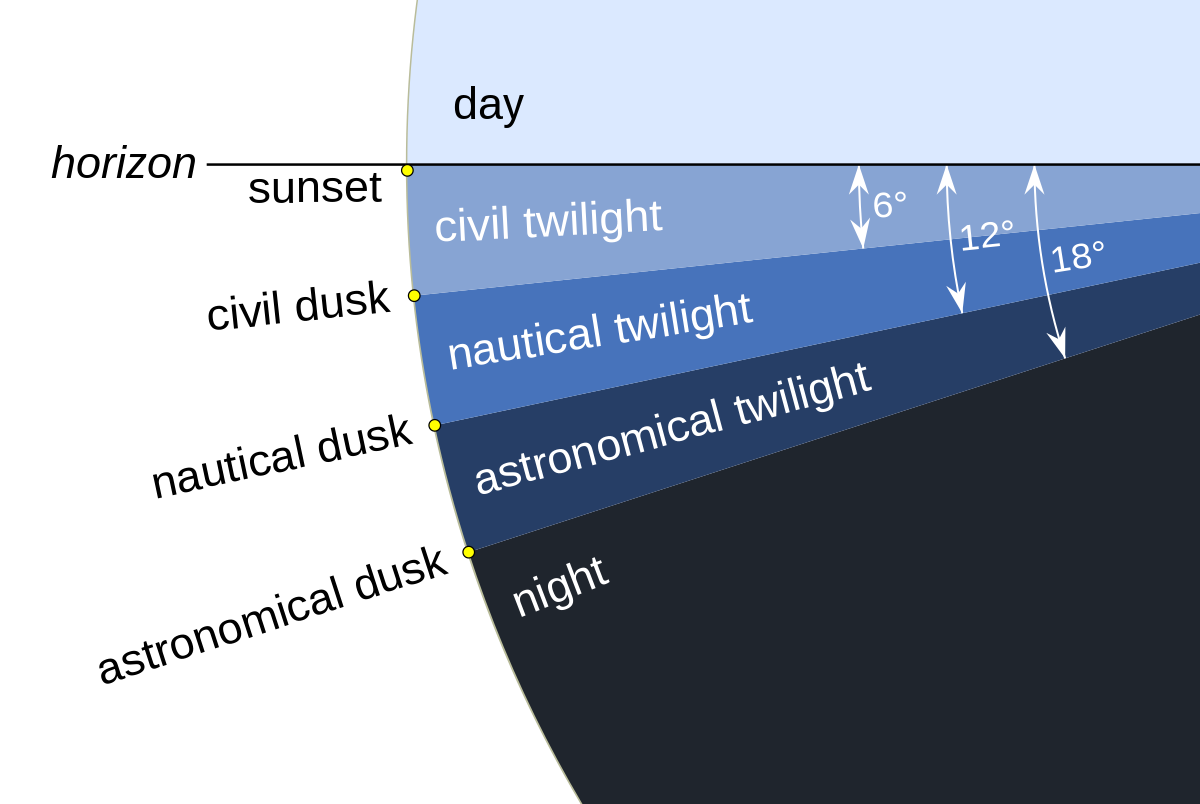
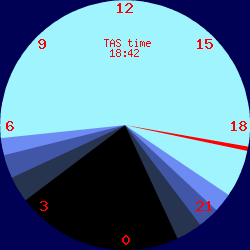
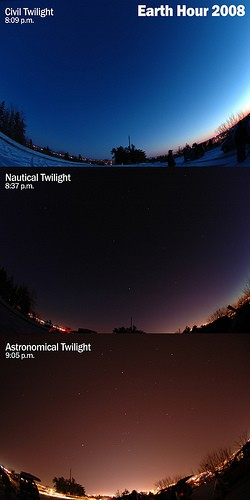
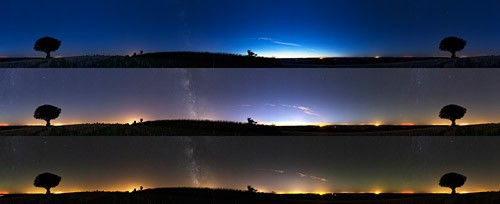
The following images illustrate the graduated darkness zones of the deep sea, corresponding to the Quranic description:

Conclusion
The Quran’s description of layered darkness in the deep sea — waves above waves, clouds above them, and darknesses stacked one upon another — is not poetic embellishment. It is a precise scientific description of phenomena that were unknown until the 20th century: internal waves discovered in 1904, graduated light absorption confirmed after 1930, and the distinct depth zones of the pelagic environment mapped by modern oceanography. The verse specified a “deep sea” (بحر لجي), not any shallow body of water, and described a system of simultaneous layered darkness that exists only at abyssal depths. That a book revealed in the Arabian desert fourteen centuries ago should contain this level of oceanographic precision is, in the words of Professor Rao, evidence of a supernatural source of knowledge.