

Refuting the “Chains Around Their Necks” Misinterpretation in Sahih al-Bukhari 4557
Refuting the “Chains Around Their Necks” Hadith Misuse
Critics of Islam frequently quote the narration:
“You are the best nation produced for mankind. You will bring them in chains around their necks until they enter Islam.”
They then claim this proves Islam spread through forced conversion.
This accusation completely collapses once the narration is examined in its actual context alongside:
- Qur’anic teachings,
- The explanation of classical scholars,
- And the historical reality of Islamic conquests.
The argument survives only by stripping the narration from its context and ignoring mainstream Islamic interpretation.
The Qur’an Explicitly Rejects Forced Conversion
The anti-Islamic interpretation directly contradicts clear and definitive Qur’anic verses.
“There is no compulsion in religion. Truth has become distinct from falsehood.”
“Would you compel the people so that they become believers?”
“The truth is from your Lord. Whoever wills — let him believe, and whoever wills — let him disbelieve.”
These verses are explicit.
A Muslim cannot interpret the hadith in a way that contradicts these clear Qur’anic principles.
Historical Reality Refutes the Claim
If Islam truly taught forced conversion, then the historical record would reflect it.
It does not.
Muslims conquered Egypt in the 7th century, yet large Christian populations remained Christian for centuries afterward and still exist today.
If Muslims were commanded to forcibly convert conquered populations:
- Christianity would have disappeared from Egypt immediately,
- Churches would not have survived,
- And Christian communities would not have continued existing under Muslim rule.
The same applies across:
- Syria,
- Iraq,
- Armenia,
- Persia,
- India,
- And many other regions ruled by Muslims.
The historical evidence directly contradicts the missionary narrative.
The Narration Does Not Mean Forced Conversion
The critics distort the meaning of the narration.
The hadith is not saying:
“People are forced to become Muslims.”
Rather, it refers to prisoners captured during warfare against Muslim armies.
Some of those prisoners later embraced Islam willingly after seeing:
- The character of Muslims,
- The truth of Islam,
- And the justice of the religion.
The “chains” were connected to captivity during war — not forced conversion.
Important Clarification: Athar vs Hadith
The wording commonly circulated online is actually an athar attributed to Abu Hurairah and not always quoted as a direct marfu‘ hadith from the Prophet ﷺ.
Critics often blur this distinction because they are more interested in rhetoric than accuracy.
However, even authentic prophetic narrations on this topic do not support forced conversion.
Ibn Hajar Explains the Meaning
Ibn Hajar al-Asqalani quoted Ibn al-Jawzi explaining the narration:
“Ibn al-Jawzi said:
Its meaning is that those people were captured and chained. Then when they came to know the truth and authenticity of Islam, they entered Islam willingly and thus entered Paradise.
Therefore, the coercion involved in captivity and chaining was merely the initial cause.”
— Fath al-Bari, Vol. 9, p. 266
This explanation completely destroys the missionary interpretation.
The coercion mentioned was:
- the coercion of military defeat and captivity,
- not coercion into belief.
Those are two entirely different things.
No classical scholar interpreted the narration as:
“Force non-Muslims to become believers.”
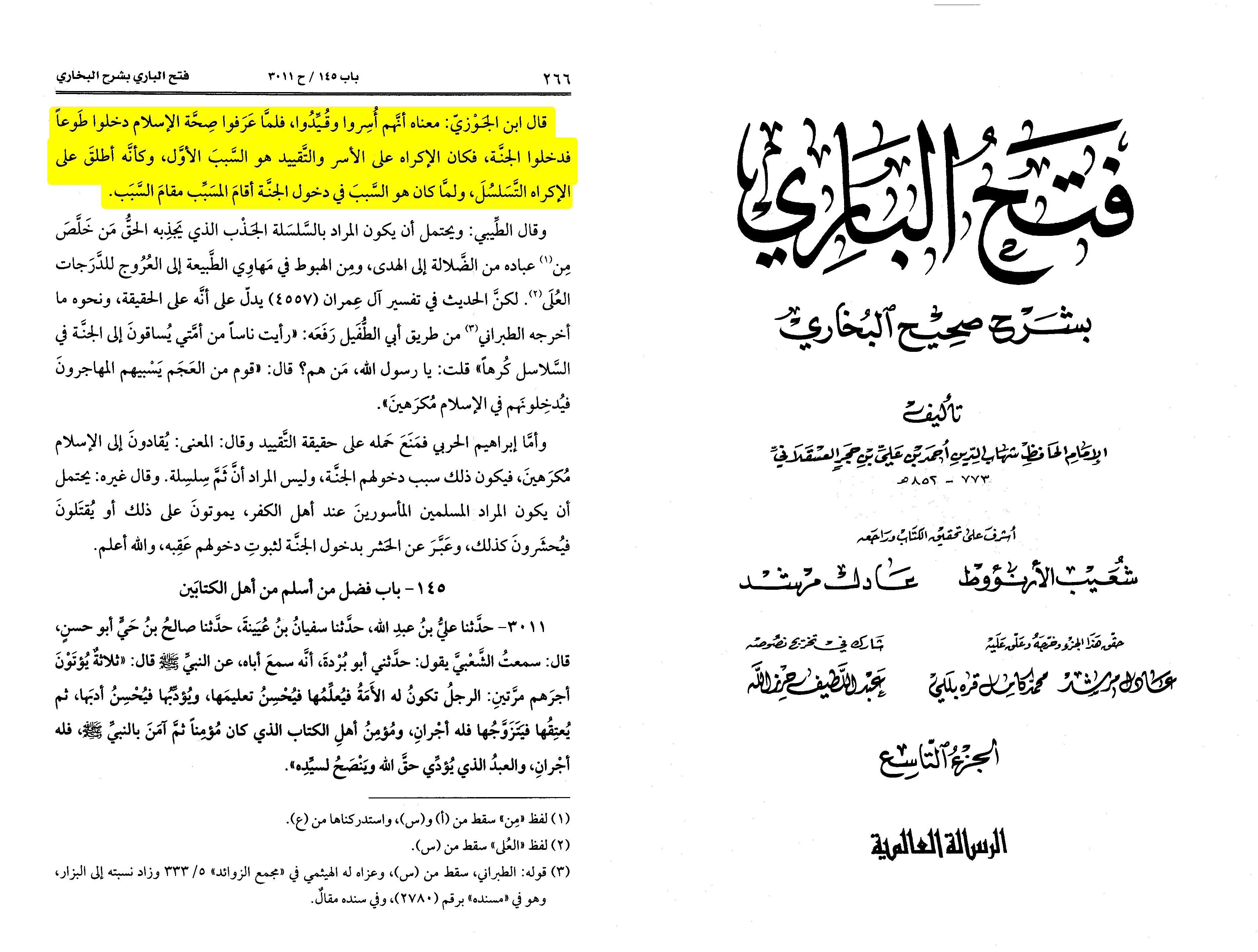
For your info:
This scan contains Ibn Hajar’s citation from Ibn al-Jawzi explaining that the people mentioned in the narration were war captives who later embraced Islam willingly after recognizing its truth. The “chains” refer to captivity during warfare, not forced religious conversion.
Supporting Narrations Clarify the Meaning
Another narration further explains the intended meaning.
“Will you not ask me why I laughed?”
They said:
“Why did you laugh, O Messenger of Allah?”
He said:
“I saw people from my nation being led to Paradise in chains — and how hateful that was to them!”
They said:
“Who are they?”
He said:
“A people from Persia who were taken captive by the Muhajirun and then entered Islam.”
This narration explicitly explains:
- They were prisoners captured in warfare,
- Islam was later presented to them,
- They accepted it willingly,
- And eventually entered Paradise.
This is the exact opposite of forced conversion.
The Missionary Reading Is Self-Contradictory
Missionaries and polemicists routinely:
- Ignore the Qur’an,
- Ignore classical scholarship,
- Ignore historical evidence,
- And impose their own interpretation onto the text.
But their interpretation creates contradictions:
- It conflicts with explicit Qur’anic verses,
- It conflicts with Islamic legal rulings regarding non-Muslims,
- It conflicts with actual Muslim history,
- And it conflicts with the explanations of the scholars themselves.
A reading that contradicts all four cannot be considered credible.
Conclusion
It refers to war captives who were brought into Muslim lands, later recognized the truth of Islam, accepted it willingly, and ultimately entered Paradise.
This is the explanation given by classical scholars such as Ibn al-Jawzi and Ibn Hajar al-Asqalani.
The Qur’an explicitly rejects compulsion in religion, and Islamic history confirms that Muslims did not forcibly convert conquered populations.
The missionary interpretation is based on removing the narration from its context and ignoring both scholarship and history.