

Refuting the Claim That “ʿUruban Atrāban” Means Prostitutes: Manuscripts,Imam Al Suyuti, Tafsir Evidence & Scholarly Consensus
The response to the claim that “Arabs of equal age” means “whore”.
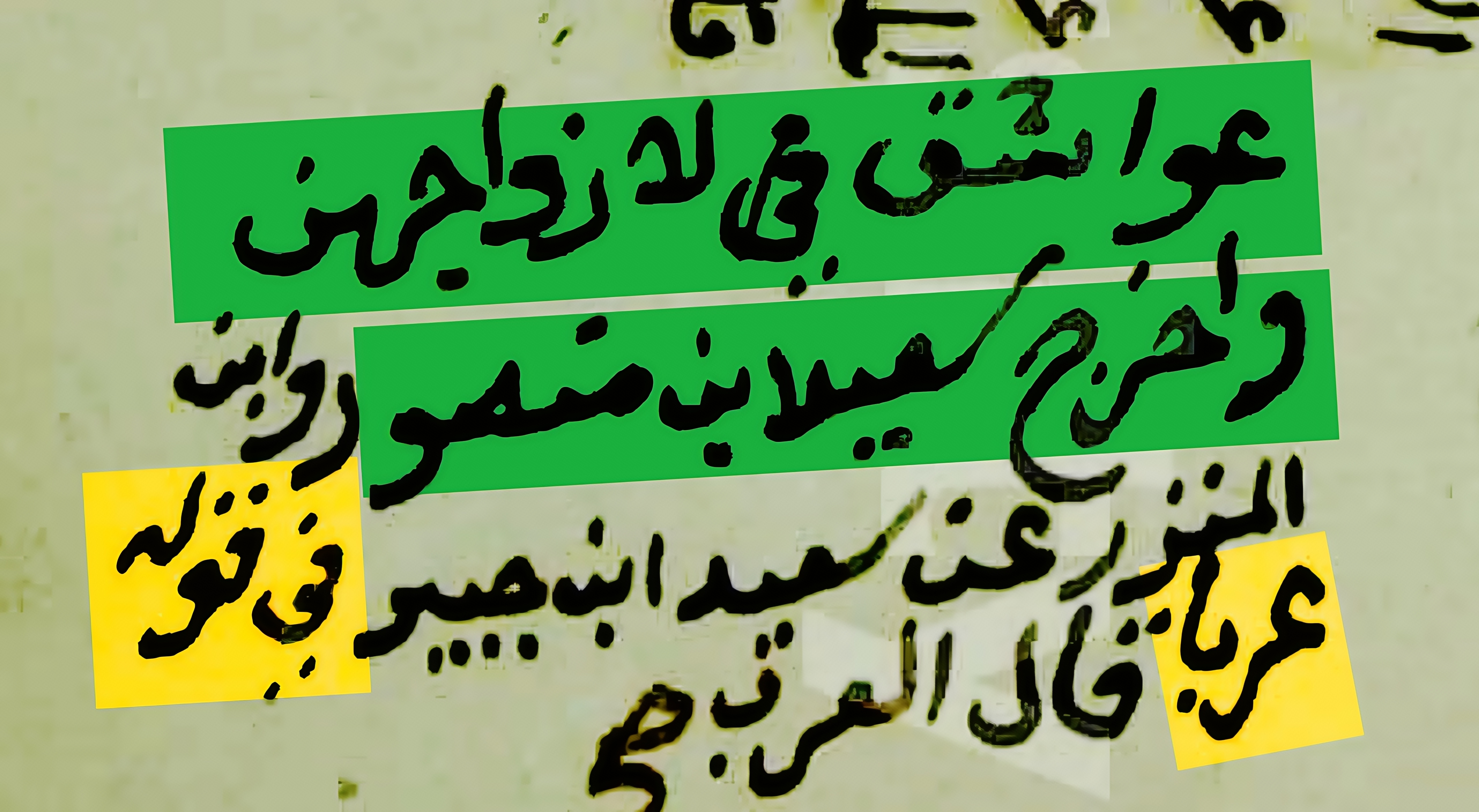
The book “Shaqa’iq al-Atrun fi Raqa’iq al-Ghanj” (The Book of Citron Poppies in the Delicacies of Coquetry), the original manuscript does not say “whore” but “coquettishness”.
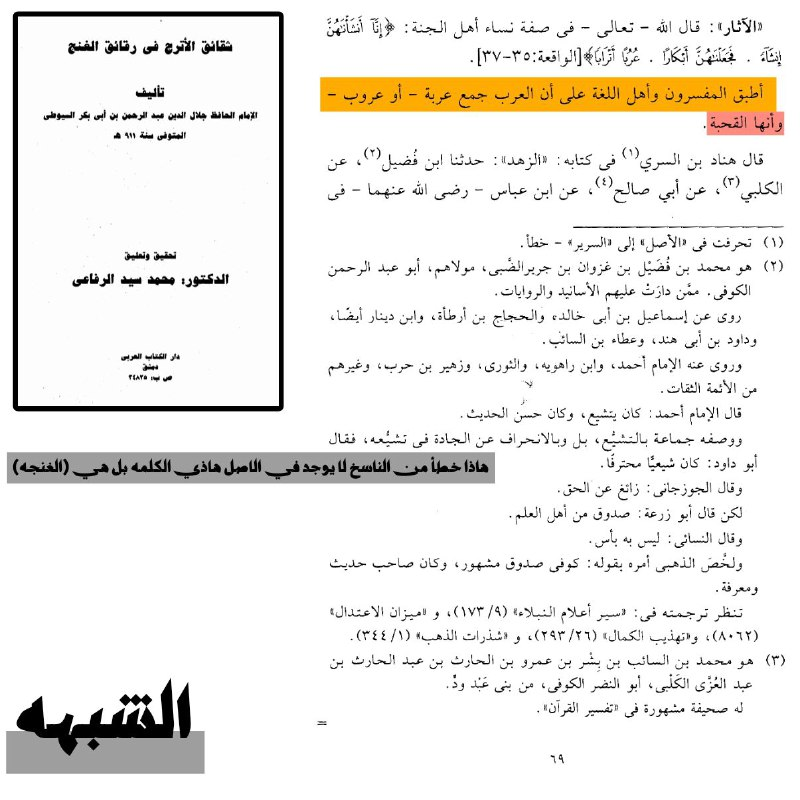
This text is an excerpt from the book “Shaqa’iq al-Utruj fi Raqa’iq al-Ghunaj” by Imam Jalal al-Din al-Suyuti. The page provides an interpretation of the Quranic verse: {Indeed, We have produced them in a [new] creation * And made them virgins * Devoted [to their husbands] and of equal age} (Al-Waqi’ah: 35-37). It explains that exegetes agree “al-‘urub” is the plural of “‘arub,” which refers to a woman who is affectionate and loving toward her husband. The text also includes editorial footnotes by Dr. Muhammad Sayyid al-Rifa’i, which provide linguistic corrections and detailed biographical information regarding the narrators of the mentioned Hadith (Muhammad ibn Fudayl and al-Kalbi), along with the assessments of scholars of Hadith criticism concerning them.
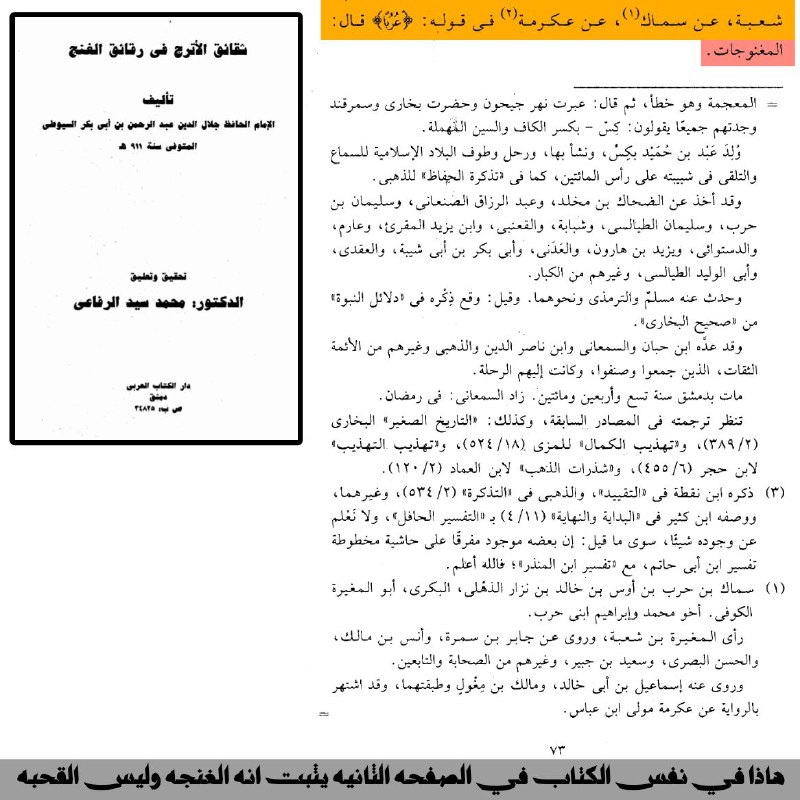
This page continues the editorial commentary from the same book, “Shaqa’iq al-Utruj fi Raqa’iq al-Ghunaj” by Imam Jalal al-Din al-Suyuti. It provides further linguistic clarification regarding the interpretation of the Quranic term ”{‘urub}” (affectionate women), noting a correction to ensure the term is understood as “al-ghunj” (coquetry/amorousness) rather than “al-ghunjah.” The text also includes biographical details and scholarly evaluations for the narrators mentioned in the chain of transmission, specifically Samak and Ikrimah, citing various biographical dictionaries and historical sources to authenticate their status and contributions to Hadith scholarship.On the second page, he says that they are the pampered ones.
And on the following page, he says “the coquettish one” and not “the whore”.
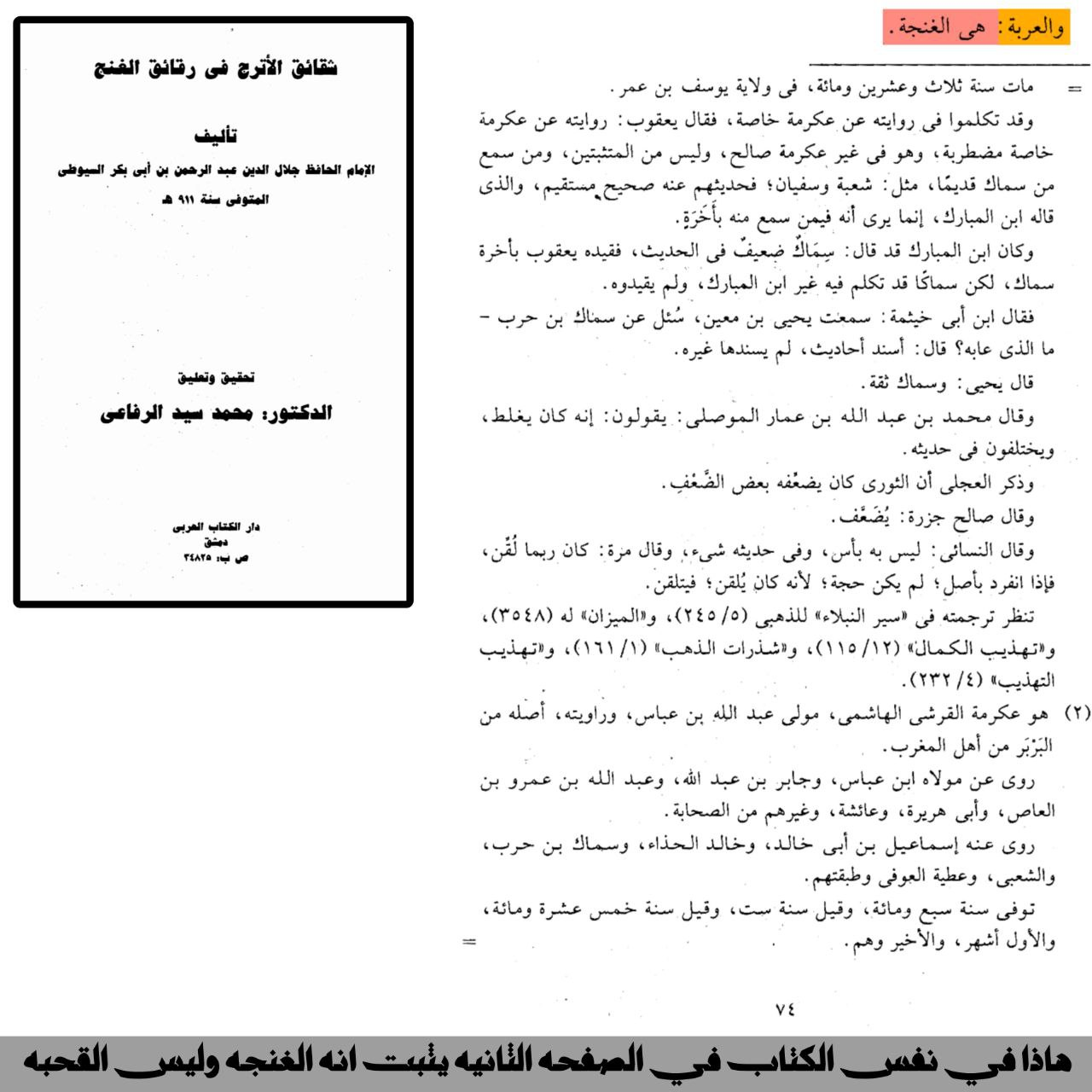
This page continues the scholarly discussion from “Shaqa’iq al-Utruj fi Raqa’iq al-Ghunaj” regarding the linguistic definition of the term “al-‘urub,” definitively confirming it as “al-ghunj” (coquetry). The text provides a detailed critical evaluation of the narrator Samak ibn Harb, citing the views of prominent scholars like Ibn al-Mubarak, Yahya ibn Ma’in, and al-Nasa’i regarding his reliability and tendencies in narration. Additionally, it offers a brief biographical entry on Ikrimah, the mawla of Ibn Abbas, detailing his lineage, his teachers among the Companions, his notable students, and the historical debate surrounding the date of his death.
In a second edition of the book by the editor Adel, the error was corrected in the same text.
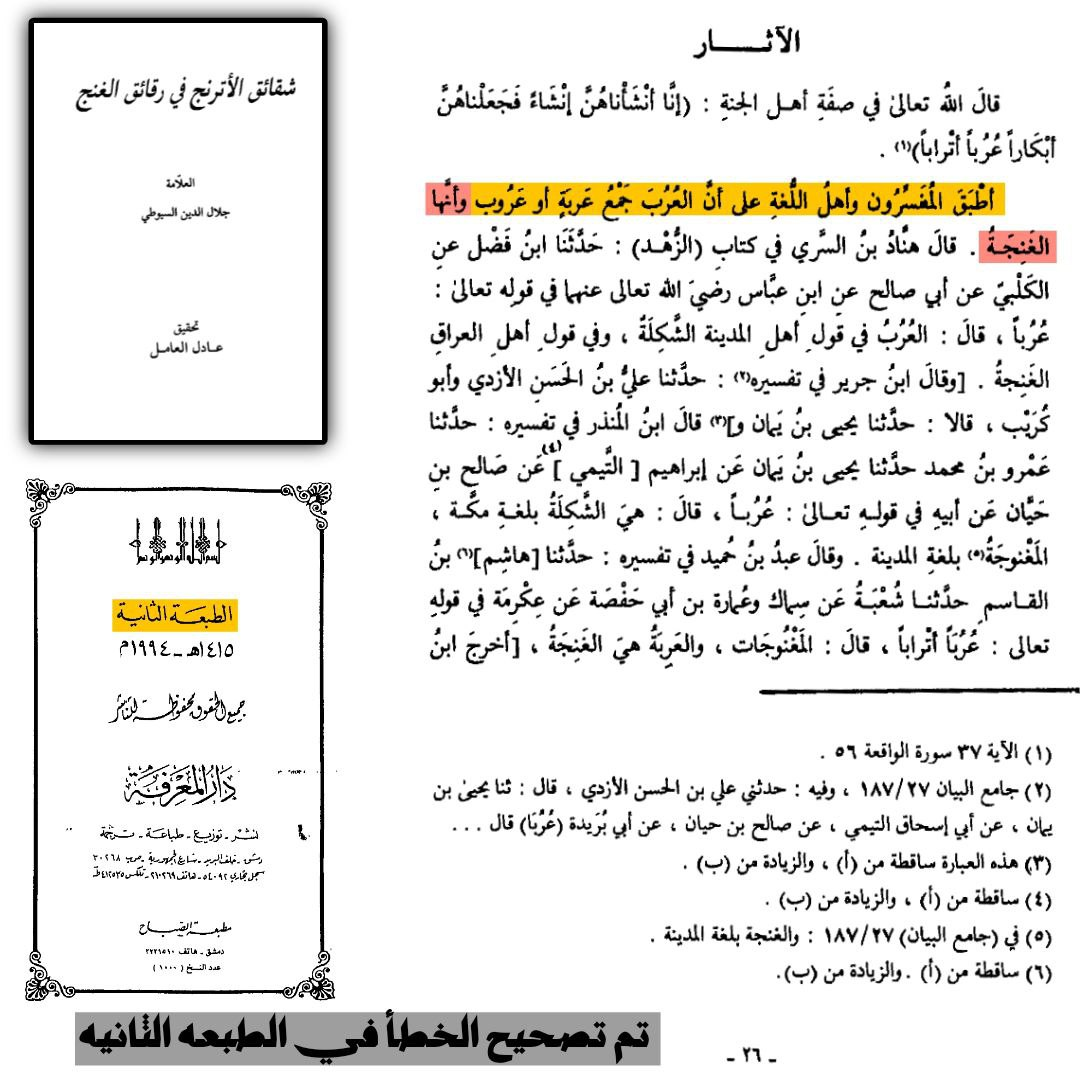
Likewise, in a third edition, the error was corrected by Jamil Abdullah.
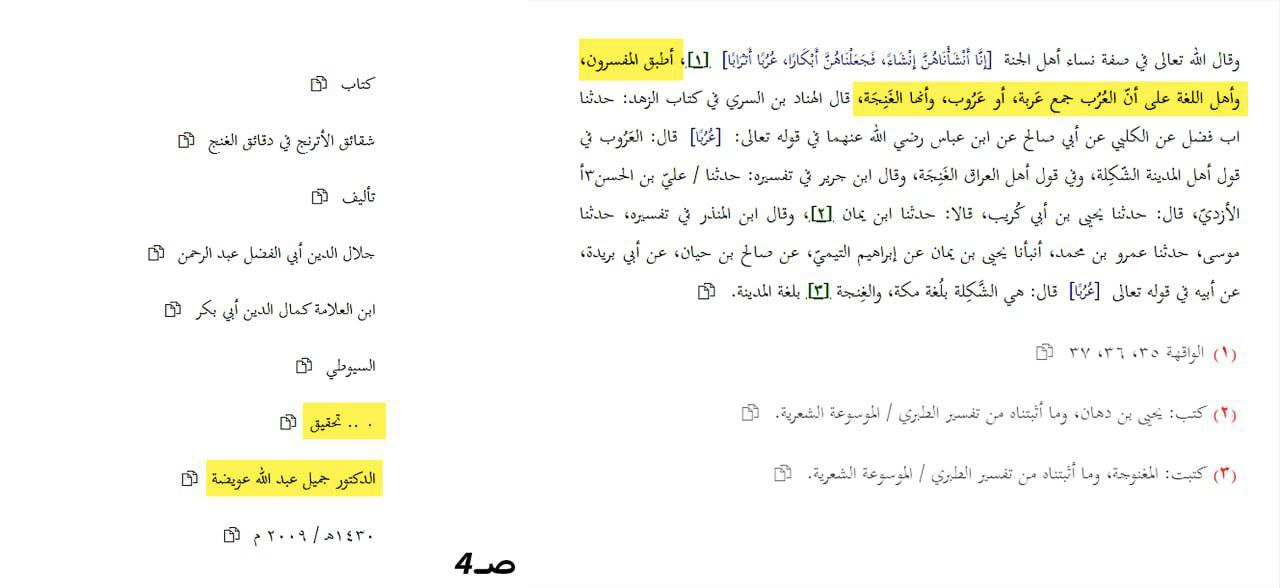
This page, identified as page 4 of the manuscript, is from the book “Shaqa’iq al-Utruj fi Raqa’iq al-Ghunaj,” authored by Jalal al-Din al-Suyuti and edited by Dr. Jamil Abdullah Uwaydah (published 1430 AH / 2009 AD).
The text provides an exegetical discussion regarding the Quranic verse {And made them virgins * Devoted and of equal age} (Al-Waqi’ah: 35-37). It establishes that linguistic scholars and exegetes agree that the term “al-‘urub” is the plural of “‘arub,” defined here as “al-ghunjah” (coquetry). The passage cites historical narrations from Ibn Abbas and others, noting that “al-‘urub” was understood as “al-mashkulah” (the shapely/alluring) in the dialect of the people of Mecca and as “al-ghunjah” in the dialect of the people of Medina. Footnotes in this edition cross-reference these definitions with the Tafsir of Al-Tabari and other literary encyclopedias to provide linguistic context.
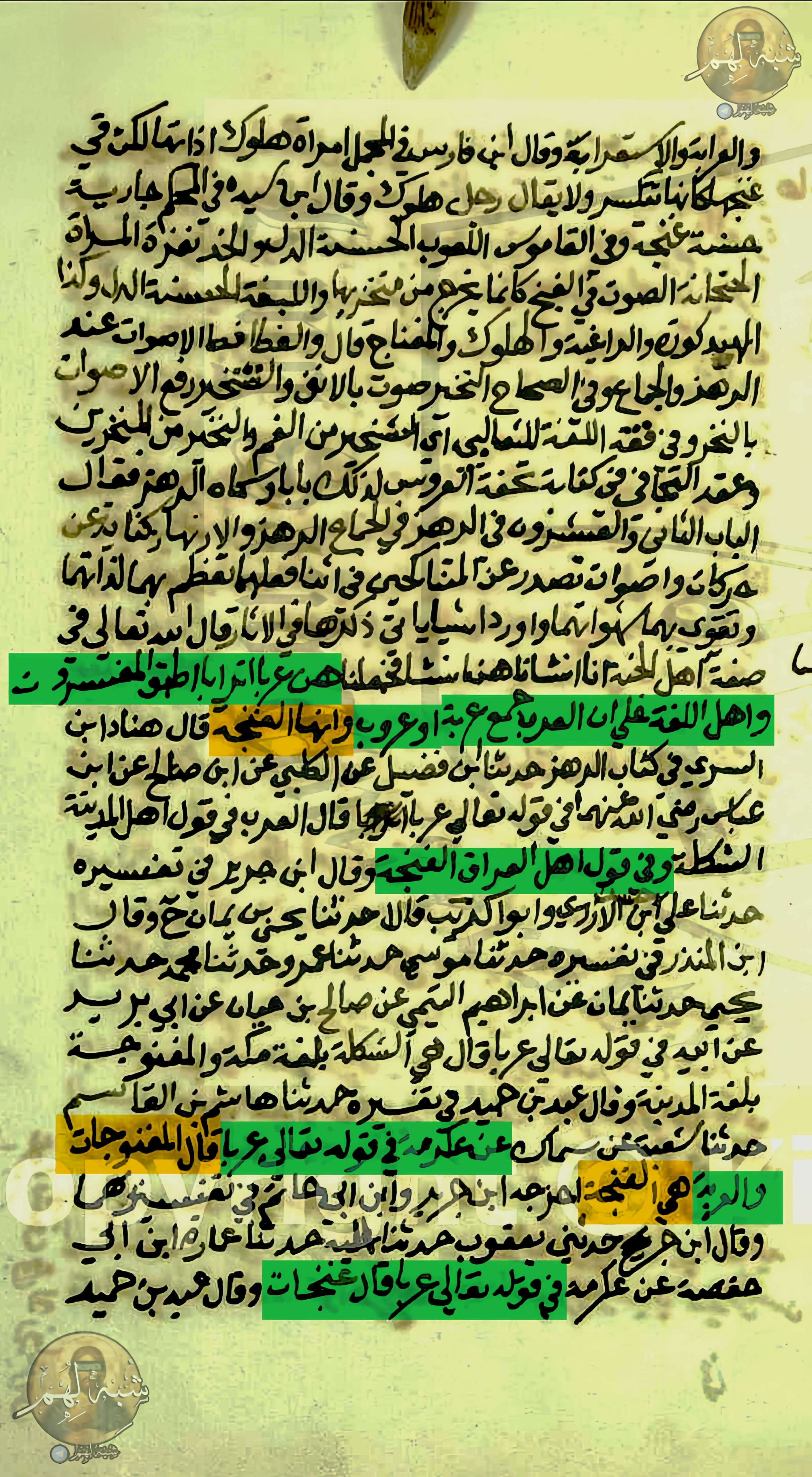
The manuscript of the book, in the same text, says “al-ghanjah” (the coquettish one) and not “al-qahbah” (the prostitute). Link to download the manuscripts of the book
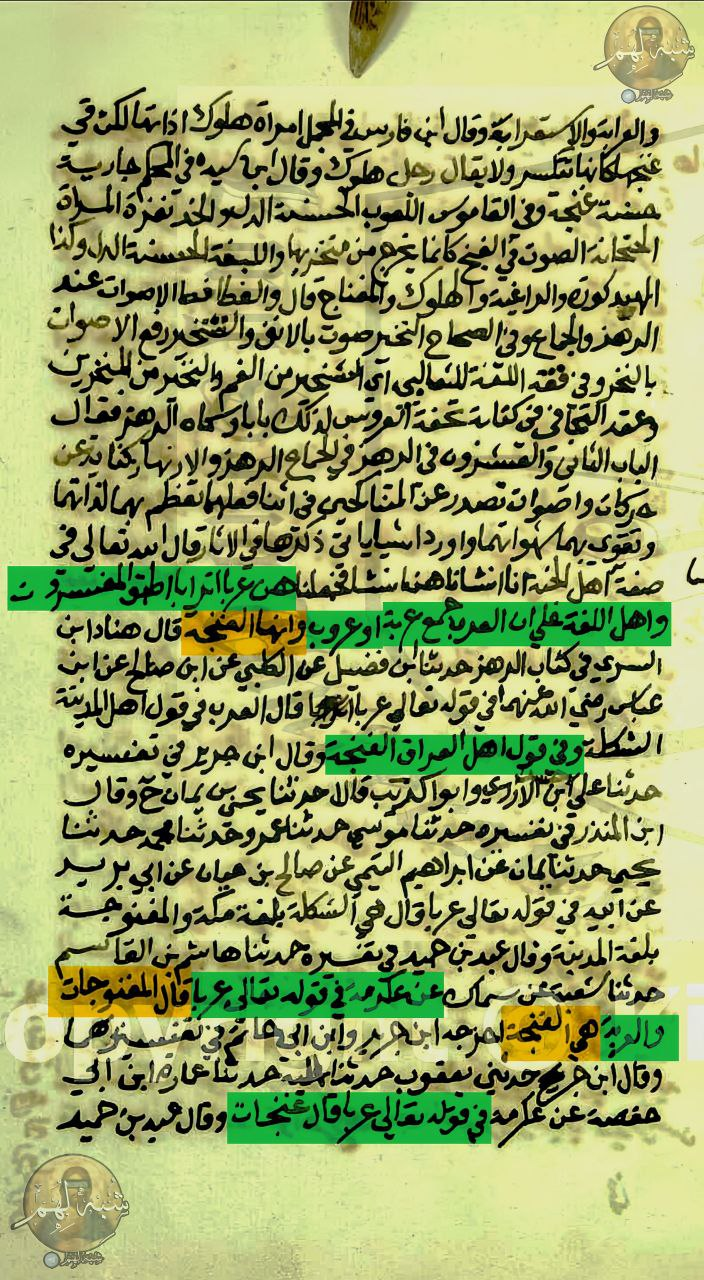
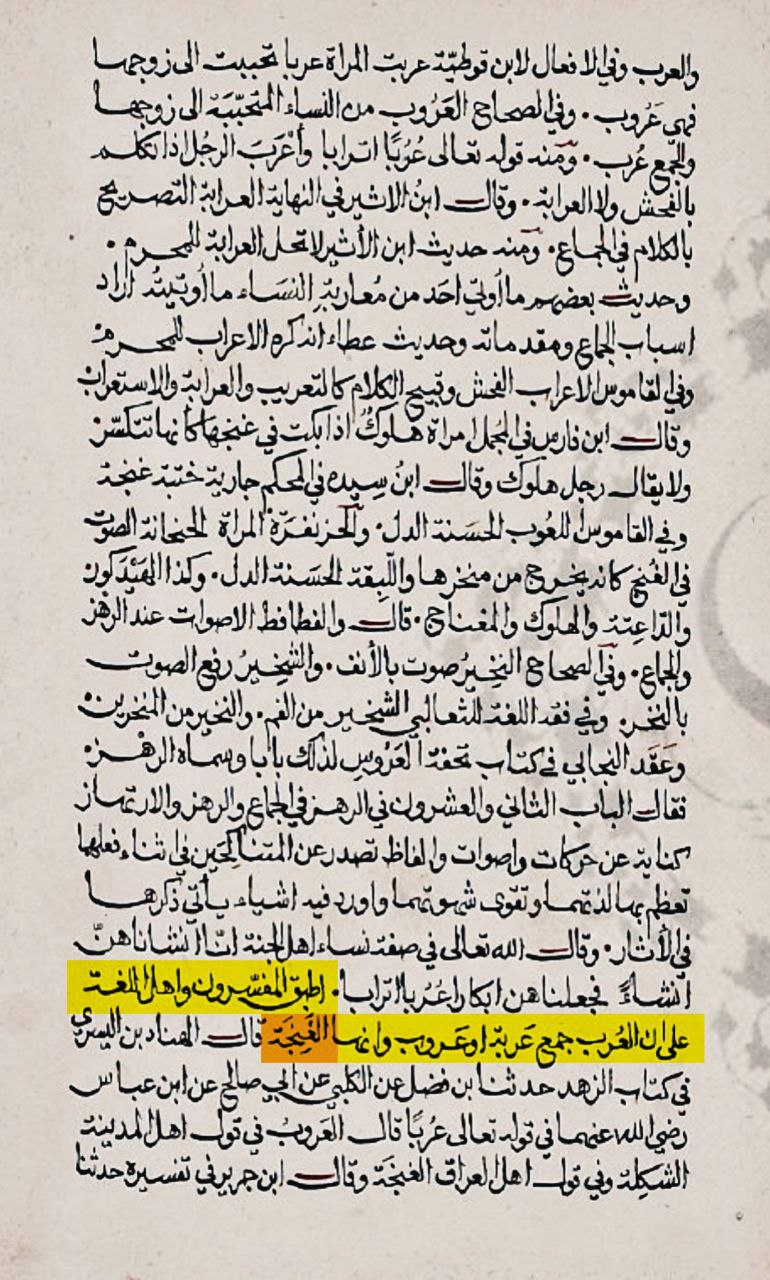
A second manuscript, using the same text, says “al-ghanjah” (the coquettish one) and not “al-qahbah” (the prostitute)
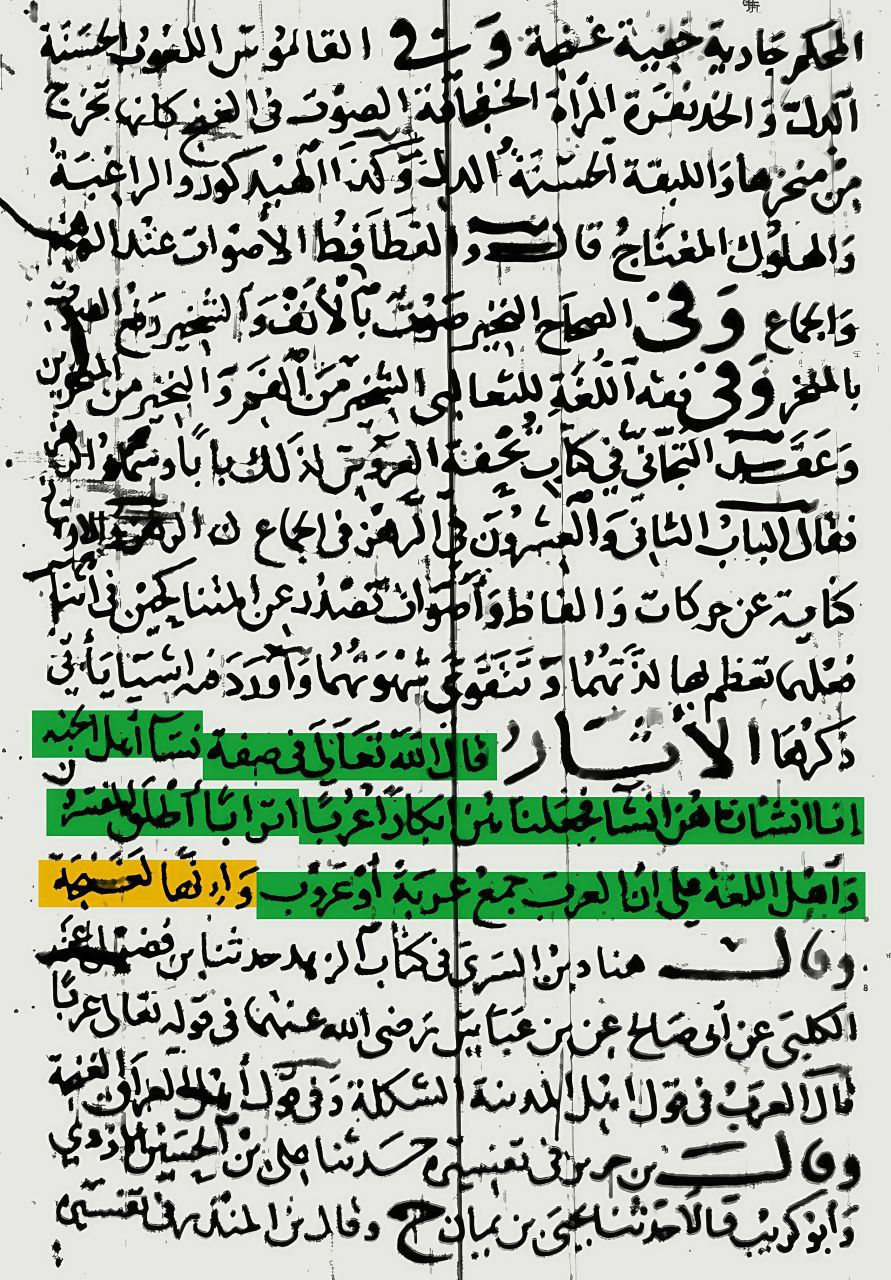
The third manuscript of the book, in the same text, says “al-ghanjah” (the coquettish one) and not “al-qahbah” (the prostitute)
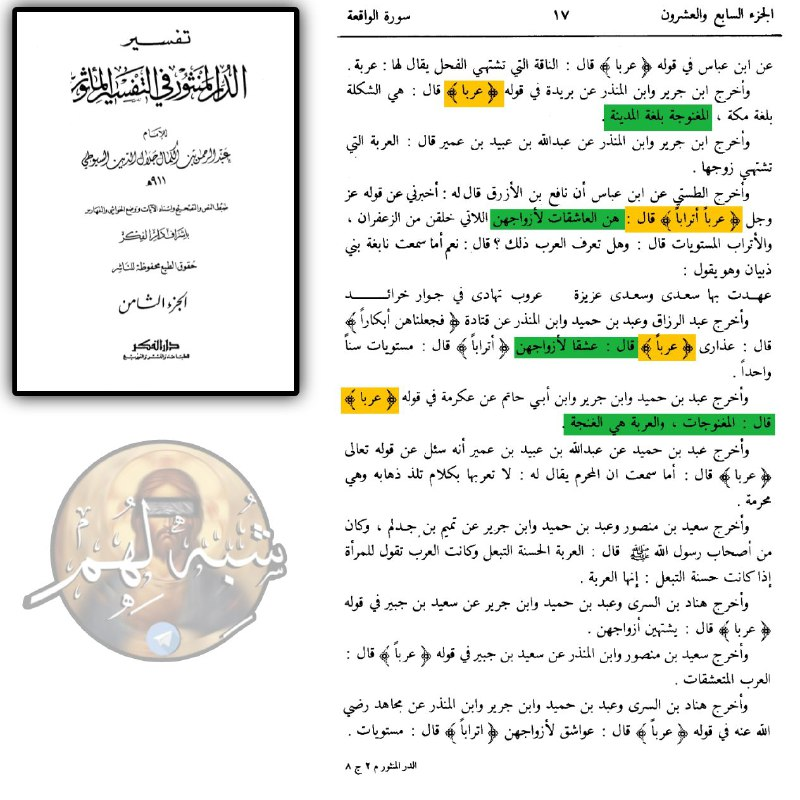
The text of the objection states: “The commentators agree, but where is the sexual intercourse?” Al-Suyuti, in his book “Al-Durr Al-Manthur,” says that it refers to a woman who is affectionate or loving towards her husband, or who is in love with her husband, and not a prostitute.
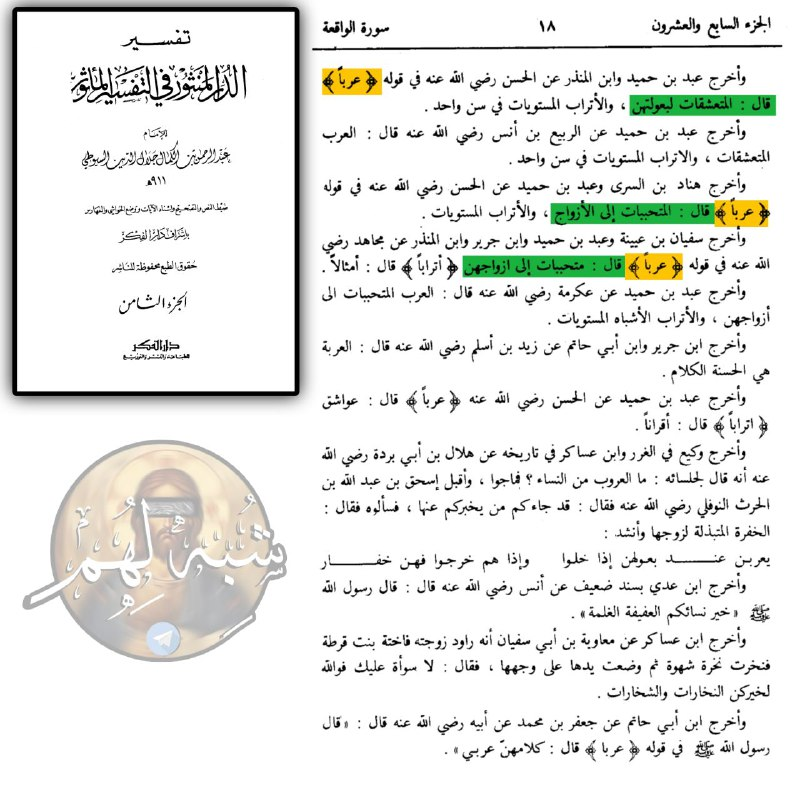
Ibn Kathir says: The woman who is affectionate towards her husband
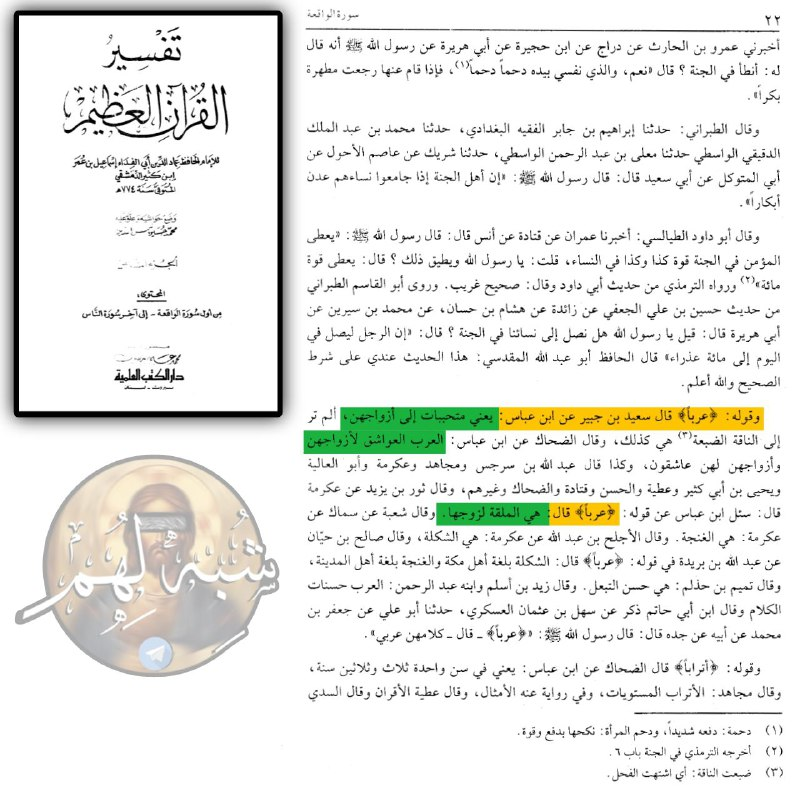
This page is an excerpt from “Tafsir al-Qur’an al-‘Azim” (commonly known as Tafsir Ibn Kathir), authored by Imam Isma’il ibn ‘Umar ibn Kathir.
The text provides detailed theological and linguistic commentary on the description of the women of Paradise as mentioned in Surah Al-Waqi’ah. It includes various Hadiths regarding the nature of their existence in the afterlife, highlighting their status as virgins.
A significant portion of the page is dedicated to the linguistic analysis of the Quranic term ”{‘urub}” (devoted/affectionate wives). It presents several scholarly interpretations attributed to early authorities such as Ibn Abbas, Al-Dahhak, Ikrimah, and Mujahid. These interpretations describe the term as referring to women who are:
-
Deeply loving and affectionate toward their husbands.
-
Alluring or coquettish (“al-ghunjah” or “al-maghnujah”).
-
Beautiful in speech and character.
The text notes that these terms were understood through the regional dialects of the time, such as those of the people of Mecca and Medina. Additionally, the term “{atrab}” (of equal age) is explained as meaning they are all thirty-three years old, sharing the same age.
Al-Baghawi says that a woman who is in love with her husband or who is affectionate towards her husband is called a coquettish woman, not a prostitute.
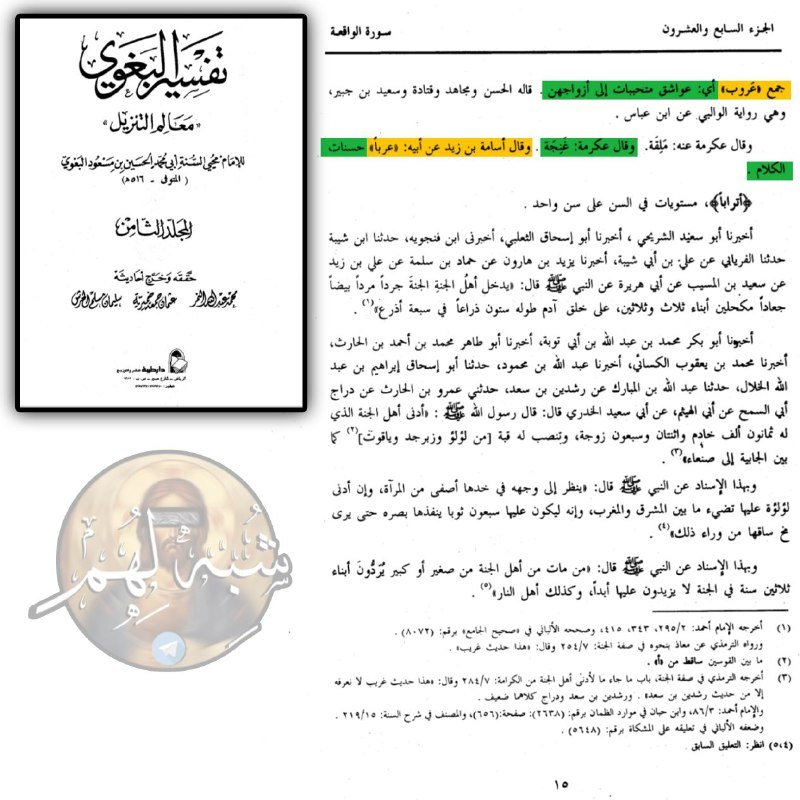
This page is from the eighth volume of “Tafsir al-Baghawi,” also known as “Ma’alim al-Tanzil,” authored by Imam al-Husayn ibn Mas’ud al-Baghawi.
The text provides commentary on the description of the people of Paradise from Surah Al-Waqi’ah. It details the linguistic meaning of ”{‘urub}” as women who are deeply affectionate and loving toward their husbands, citing various early scholars such as Al-Hasan, Qatadah, and Sa’id ibn Jubayr. It further interprets the term “{atrab}” as meaning all inhabitants of Paradise will be of the same age.
The page also includes several Hadiths attributed to the Prophet Muhammad concerning the physical appearance and state of the people of Paradise, including descriptions of them being thirty-three years old, their height, and the beauty of their spouses. Footnotes provide source verification from major collections like Musnad Ahmad and Al-Tirmidhi, offering brief critical assessments of the chains of narration (isnad) associated with these reports.
Al-Qurtubi.
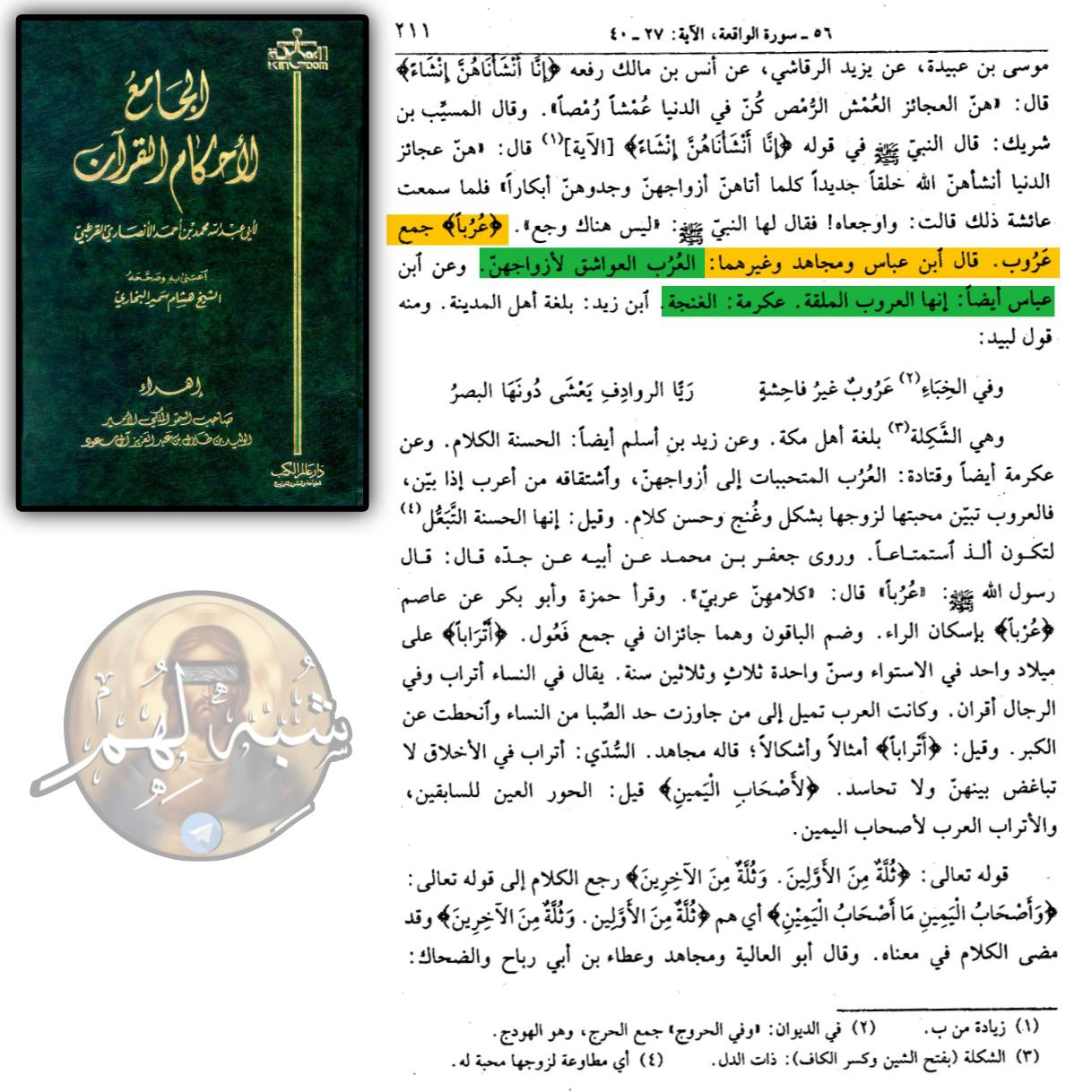
This page is from “Al-Jami’ li-Ahkam al-Qur’an” (commonly known as Tafsir al-Qurtubi), authored by Imam Abu ‘Abdullah Muhammad ibn Ahmad al-Ansari al-Qurtubi.
The text provides comprehensive commentary on verses 27-40 of Surah Al-Waqi’ah. Key highlights include:
-
Theological context: It discusses the transformation of women in Paradise, explaining that they are recreated as virgins regardless of their age or physical condition in this world, citing narrations from the Prophet Muhammad.
-
Linguistic analysis: It offers an in-depth breakdown of the term ”{‘urub},” defining it as women who are intensely affectionate and loving toward their husbands. The text cites diverse authorities such as Ibn Abbas, Ikrimah, and Zayd ibn Aslam to illustrate that the term implies coquetry (“ghunj”) and graceful speech.
-
Regional dialect variations: The author notes how the term was understood in different dialects of the time, such as “al-mashkulah” (the alluring) in the dialect of the Meccans and “al-ghunjah” in the dialect of the Medinese.
-
Age and equality: The term “{atrab}” is explained as meaning the women of Paradise share the same age (thirty-three years) and are peers, free from the animosity or jealousy that might exist between people in the earthly life.
-
Structural commentary: The page also begins the interpretation of the subsequent verses regarding the “people of the right hand” (Ashab al-Yamin), referencing previous scholarly discussions on the groups of the righteous.
Al-Saadi says that she is the wife who loves her husband, and he includes coquetry in that, and he did not say ugliness, as the investigator mistakenly reported.
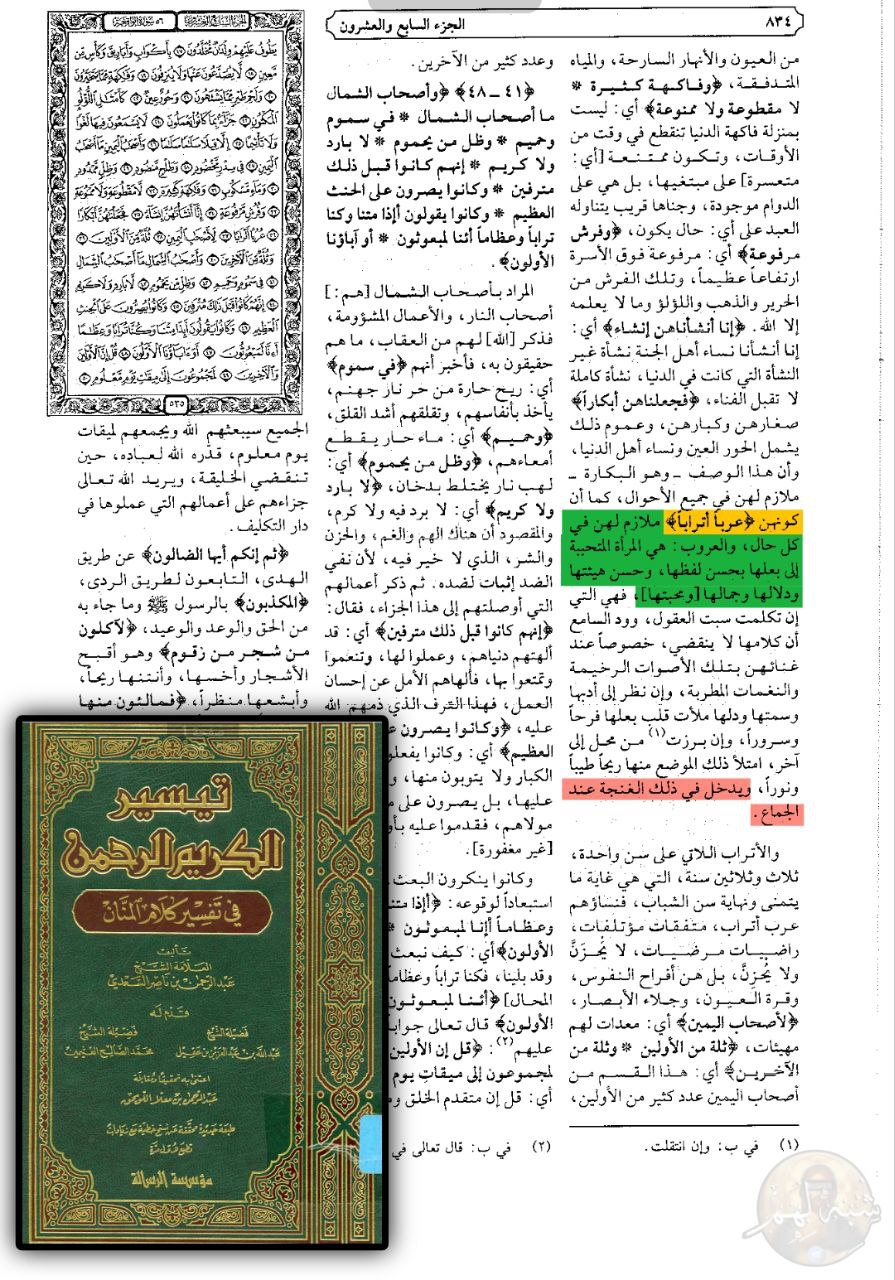
This page is from “Taysir al-Karim al-Rahman fi Tafsir Kalam al-Mannan,” authored by the scholar Abd al-Rahman ibn Nasir al-Sa’di.
The text provides detailed theological commentary on the latter portion of Surah Al-Waqi’ah:
-
Description of the hereafter: The author contrasts the states of the “people of the left hand” (Ashab al-Shimal), who face torment, with the descriptions of Paradise and its inhabitants.
-
Linguistic analysis of {‘urub}: The commentary focuses on the Quranic term ”{‘urub},” defining it as women who are inherently affectionate, alluring, and devoted to their husbands. It emphasizes that their speech is pleasant and their character is defined by “al-ghunj” (coquetry/amorousness), which serves as a source of joy and delight for their spouses.
-
Interpretation of {atrab}: The text clarifies that “{atrab}” refers to women who share the same age—specifically the age of thirty-three—which represents the prime of youth.
-
Theological synthesis: The author explains the state of the people of Paradise as being one of eternal satisfaction and beauty, contrasting this with the skepticism of those who doubted the resurrection, reinforcing the reality of the afterlife as described in the Quran.
Al-Tabari
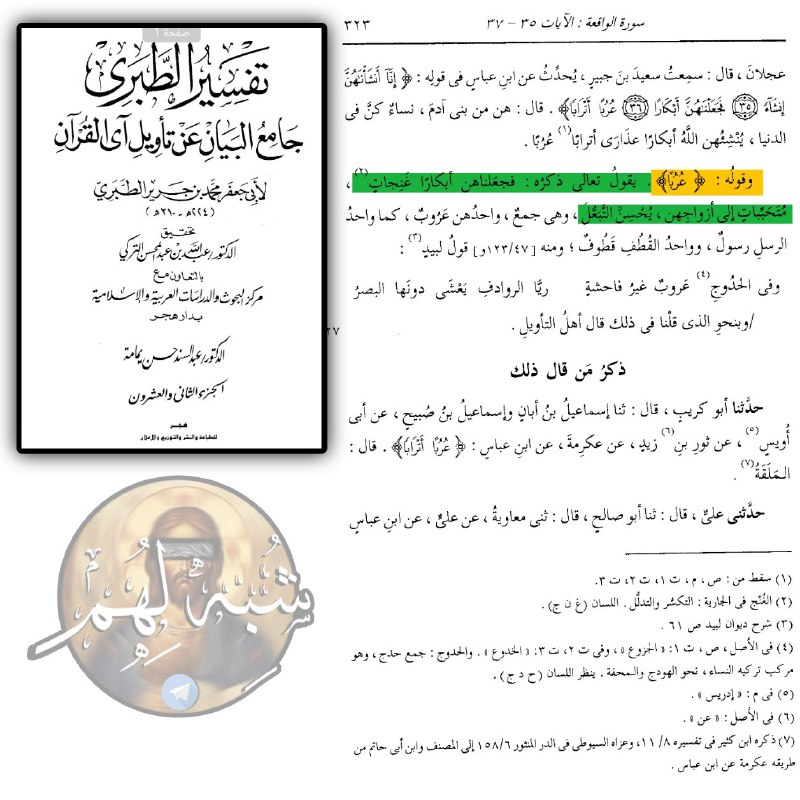
This page is from “Jami’ al-Bayan ‘an Ta’wil Ay al-Qur’an” (commonly known as Tafsir al-Tabari), authored by the renowned Imam Abu Ja’far Muhammad ibn Jarir al-Tabari.
The text provides foundational exegetical commentary on verses 35-37 of Surah Al-Waqi’ah. Key elements include:
-
Interpretation of {‘urub}: Al-Tabari explains that the term ”{‘urub}” refers to women who are “ghunjat” (coquettish/amorous) and deeply devoted and affectionate toward their husbands.
-
Scholarly narrations: The page includes chains of transmission (isnad) that trace these interpretations back to the Companion Ibn Abbas, providing early context on how the term was understood in relation to the behavior of the women of Paradise.
-
Linguistic support: The text cites classical Arabic poetry (specifically a line by the poet Labid) to illustrate the usage of the term in describing women in a way that conveys both modesty and allure.
-
Editorial notes: The footnotes provide critical definitions for terms like “al-ghunj” (defined as coyness and coquetry) and cross-references the manuscript’s variations, serving as a primary authority for subsequent Quranic commentaries.
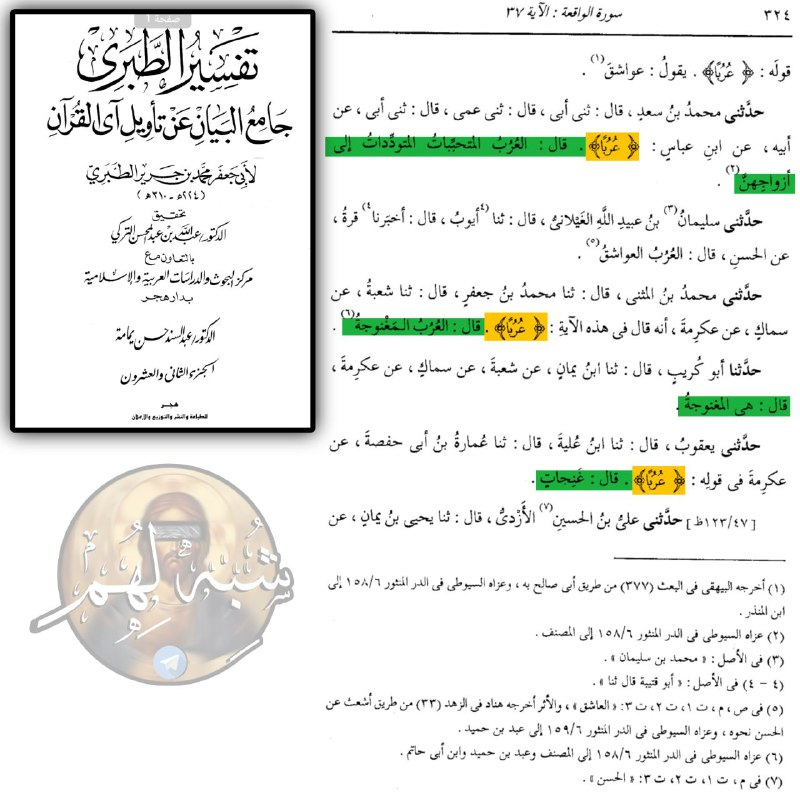
It focuses on synthesizing multiple early narrations to define the Quranic term ”{‘urub}”:
-
Diverse Scholarly Perspectives: The text presents various chains of transmission (isnad) that interpret ”{‘urub}” through synonyms such as “awashiq” (passionate lovers), “al-mutawaddidat ila azwajihin” (those devoted to their husbands), and “al-maghnujah” (the coquettish/alluring).
-
Consistency in Meaning: By compiling these reports from authorities such as Ibn Abbas, Al-Hasan, and Ikrimah, the author establishes a clear linguistic consensus that the term describes the affectionate, expressive, and loving nature of the women of Paradise toward their spouses.
-
Scholarly Rigor: The editorial footnotes provide essential context by linking these interpretations to other classical works, such as “Al-Durr al-Manthur” by Al-Suyuti and “Al-Ba’th” by Al-Bayhaqi, ensuring the reader understands the historical and academic pedigree of these definitions.
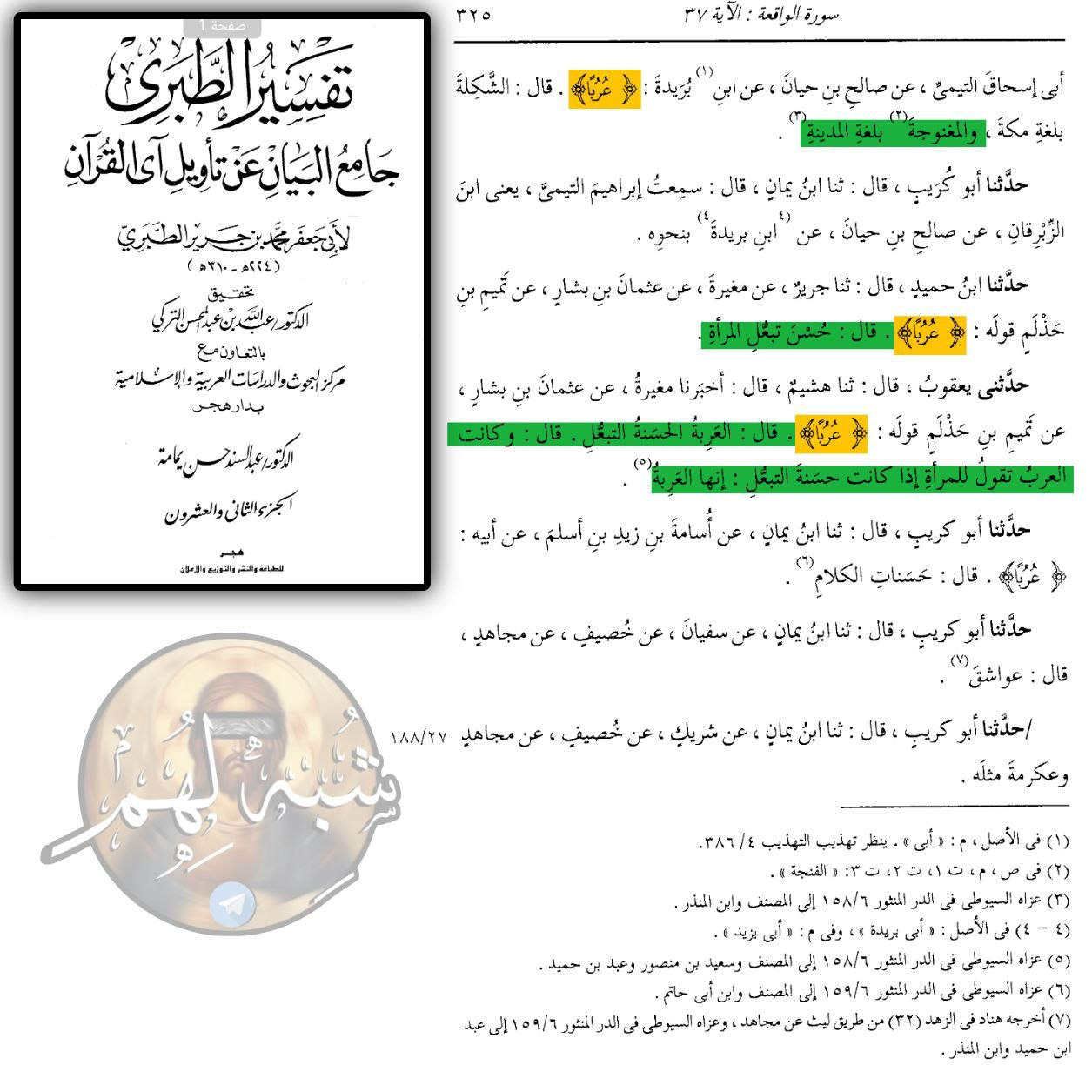
This page continues the scholarly examination of Surah Al-Waqi’ah from “Jami’ al-Bayan ‘an Ta’wil Ay al-Qur’an” by Imam al-Tabari.
It focuses on further linguistic and thematic analysis of the term ”{‘urub}”:
-
Dialectal and Regional Usage: The text highlights distinct regional interpretations of the term, noting that it was used to mean “al-mashkulah” (the alluring) in the dialect of Mecca, and “al-maghnujah” (the coquettish) in the dialect of Medina.
-
Character and Disposition: Multiple reports are cited to define ”{‘urub}” as women who exhibit “husn al-taba’ul” (good conduct and devotion toward their husbands), explaining that this was a term traditionally used by the Arabs to describe a woman who is exceptionally loving, attentive, and kind in her interactions with her spouse.
-
Scholarly Attributions: The page presents a series of chains of narration (isnad) that attribute these definitions to early Islamic scholars and authorities such as Mujahid, illustrating the consensus among the salaf (early generations) regarding the term’s meaning as a description of beauty, grace, and affection.
-
Editorial Documentation: The footnotes provide references to cross-check these narrations in other classical compilations, such as “Al-Durr al-Manthur” and “Al-Musannaf,” reinforcing the text’s academic integrity as a comprehensive exegetical resource.
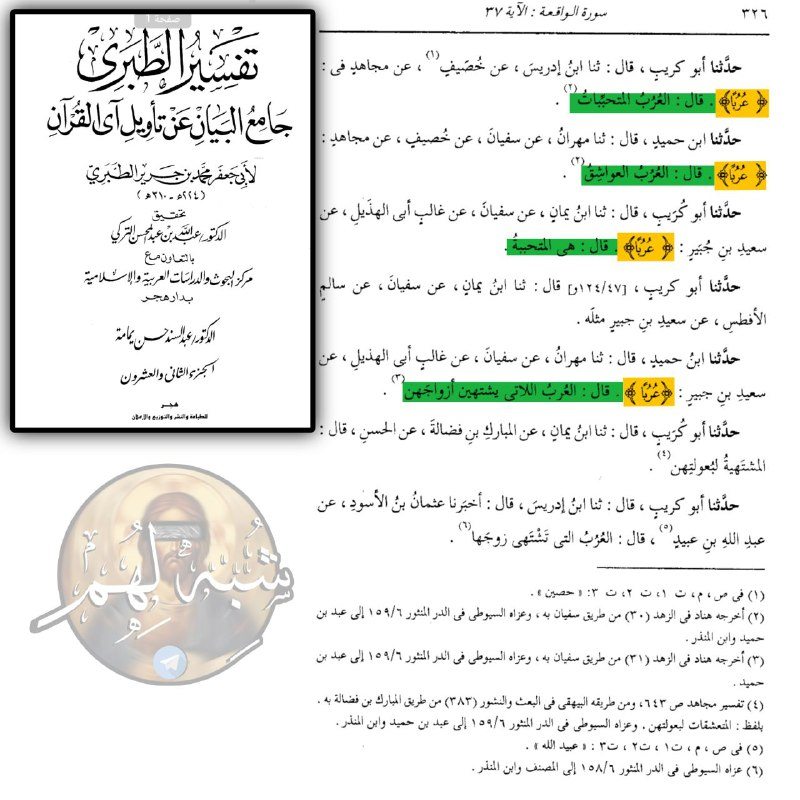
This page continues the scholarly examination of Surah Al-Waqi’ah from “Jami’ al-Bayan ‘an Ta’wil Ay al-Qur’an” by Imam al-Tabari.
It focuses on synthesizing multiple early reports to define the Quranic term ”{‘urub}”:
-
Diverse scholarly interpretations: The text presents several chains of transmission (isnad) that interpret ”{‘urub}” through synonyms including “al-mutawaddidat” (the loving/affectionate), “al-awashiq” (the passionate), and those who “yastahin azwajahun” (desire their husbands).
-
Consistency in meaning: By compiling these reports from authorities such as Mujahid, Sa’id ibn Jubayr, and Al-Hasan, the author establishes a clear linguistic consensus that the term describes women who are deeply devoted, affectionate, and expressive in their love toward their husbands.
-
Editorial documentation: The footnotes provide essential context by linking these interpretations to other classical compilations, such as “Al-Zuhd” by Hanad ibn al-Sari and “Al-Ba’th” by Al-Bayhaqi, ensuring the reader understands the historical and academic pedigree of these definitions.
Continuing the response to the misconception that Al-Suyuti’s statement “Atraba” means “the purebred”…: Since we have sufficiently addressed the misconception, for the sake of entertainment, we have decided to provide you with the response as well, taken from the fourth-year middle school Islamic Education textbook:
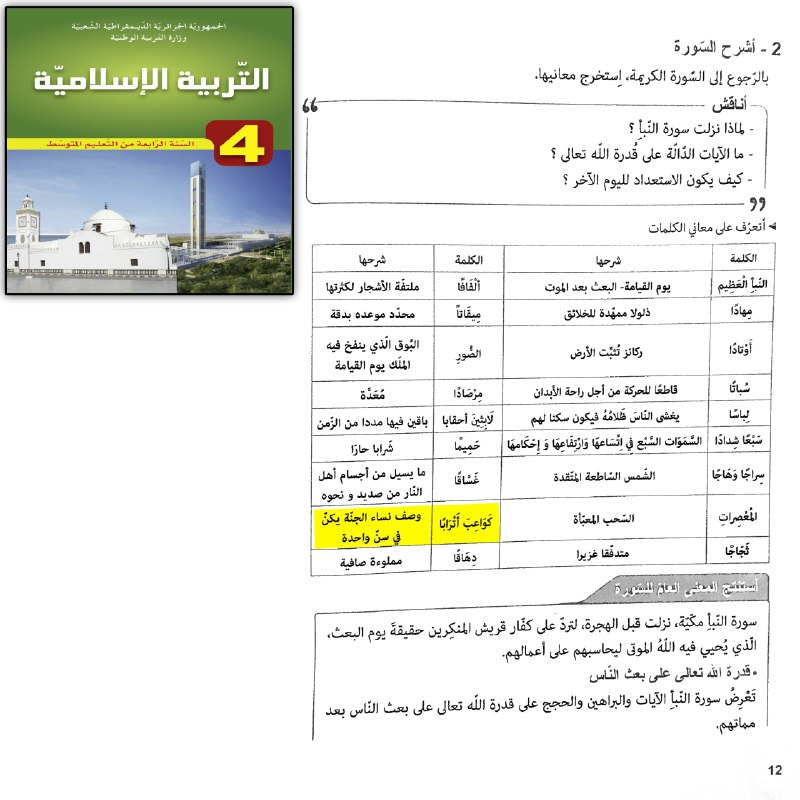
This page is from an Islamic Studies textbook for fourth-year intermediate students (Ministry of National Education, Algeria).
It provides an educational summary of Surah An-Naba’, focusing on the following:
-
Vocabulary Definitions: It contains a table defining key terms from the Surah, such as “An-Naba’ al-‘Azim” (the Day of Resurrection), “Awtadan” (mountains), and “Kawa’ib Atraba,” which refers to the women of Paradise being of equal, youthful age.
-
Thematic Analysis: The text outlines the core objectives of the Surah, noting that it was revealed in Mecca to address the disbelievers of the Quraysh who denied the resurrection.
-
Theological Purpose: It emphasizes that the Surah serves to illustrate Allah’s power to resurrect the dead to hold them accountable for their deeds and provides proofs of His omnipotence over all creation.
It should be noted that the book is falsely and deceitfully attributed to Imam al-Suyuti.
كتاب منسوب للحافظ السيوطي ! - الإسلام سؤال وجواب
The response to the claim that al-Suyuti said women in Paradise are prostitutes (for men only), after we published a previous response and proved that this was an error in the edition itself Dar al-Kitab al-Arabi edition], or more accurately, a scribal error. We obtained this from manuscripts of the book attributed to al-Suyuti himself, in which it was written (ghanjah instead of prostitute ). A second edition Dar al-Ma’rifah editioN corrected this error or scribal error. Now, for confirmation, this is a third edition the most recent available edition of the book: 1430 AH / 2009 CE, edited by Dr. Jamil Abdullah Awida, which corrected the scribal error that was in the first edition, just as the second edition did, and wrote ghanjah instead of prostitute . To see the previous response:
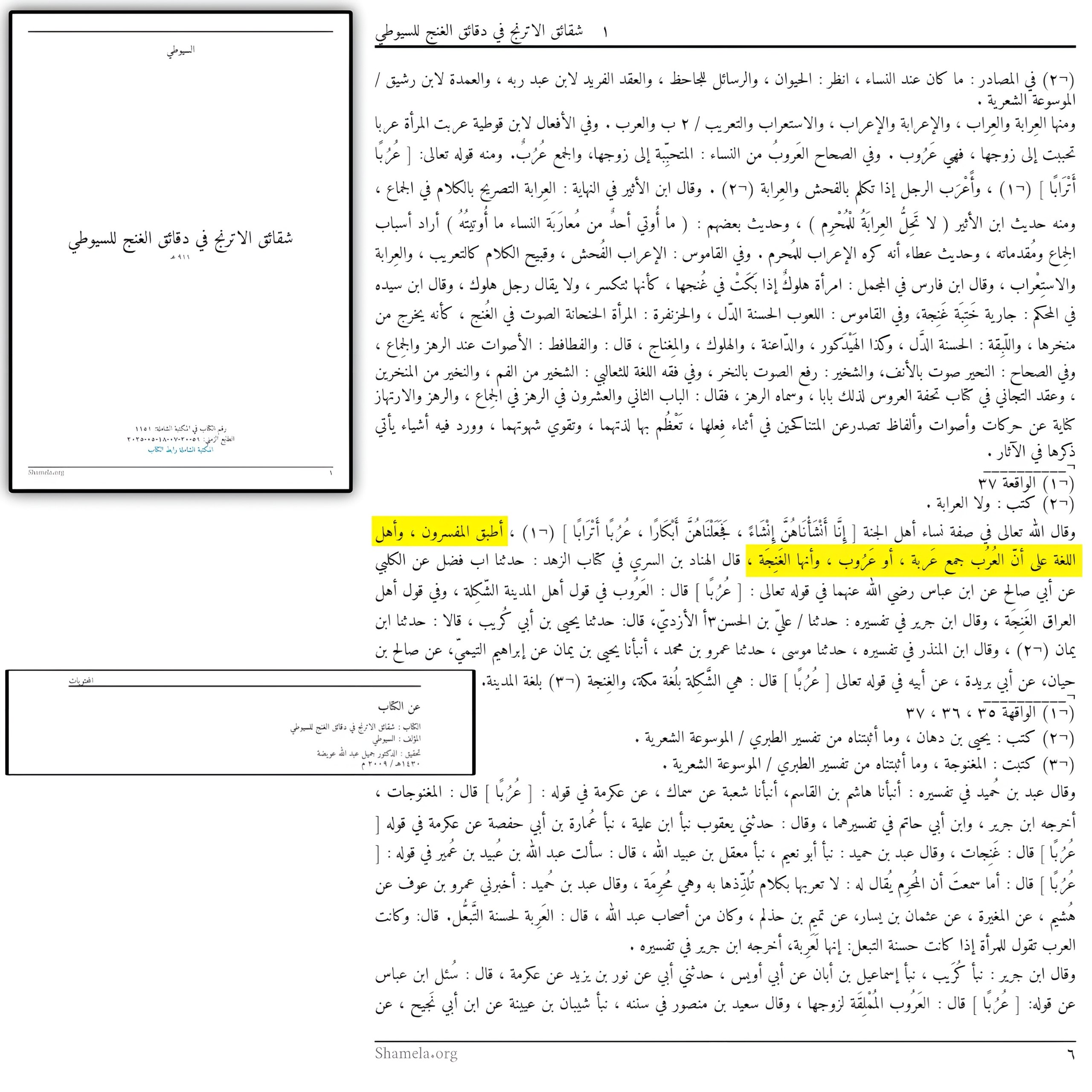
This page is from the digital version of “Shaqa’iq al-Utruj fi Raqa’iq al-Ghunaj” by Imam Jalal al-Din al-Suyuti, hosted on Shamela.ws.
It provides an extensive linguistic and exegetical analysis of the term ”{‘urub}” (Quran 56:37):
-
Linguistic Root and Usage: The text explores the root of the word, citing authorities like Ibn al-Athir, Al-Qamus (Al-Fairuzabadi), and Ibn Faris. It defines the term in relation to “al-ghunj” (coquetry/allure) and explains how these descriptors were used in classical Arabic to denote a woman who is exceptionally affectionate, graceful, and expressive in her love toward her husband.
-
Interpretive Consensus: The text reinforces that exegetes and linguists agree that ”{‘urub}” refers to women who are deeply loving, with regional dialectal nuances cited—such as being referred to as “al-mashkulah” in the Meccan dialect and “al-maghnujah” in the Medinese dialect.
-
Scholarly Reports: It compiles various narrations from the Prophet’s companions and successors (such as Ibn Abbas and Ikrimah), detailing their descriptions of the state of the women of Paradise. These reports emphasize that they are characterized by “husn al-taba’ul” (good conduct in marriage) and that their speech and behavior are entirely pleasing and delightful to their spouses.
-
Editorial Context: The footnotes provide references to other classical scholarly works, such as “Jami’ al-Bayan” (Tafsir al-Tabari) and various Hadith collections, to substantiate these interpretations and ensure historical accuracy.