

Refuting the “False Prophecy” Claim About Caesar and Khosrow in Sahih al-Bukhari
The following hadith is often cited by critics in an attempt to argue that the Prophet Muhammad ﷺ made a false prophecy:
The Messenger of Allah ﷺ said:
“When Khosrow is ruined, there will be no Khosrow after him; and when Caesar is ruined, there will be no Caesar after him. By Him in Whose Hand is my soul, you will spend their treasures in the cause of Allah.”
Critics argue that this prophecy failed because there were still Roman emperors (“Caesars”) after the death of the Prophet ﷺ. According to them, this would supposedly mean the hadith is historically inaccurate.
This objection collapses once the actual context of the hadith and the explanations of the earliest scholars are examined.
The Core Mistake in the Objection
The objection assumes that the Prophet ﷺ meant:
“No Roman emperor would ever exist again anywhere on earth.”
But this is not how the earliest Muslim scholars understood the narration.
The Prophet ﷺ was speaking specifically about the loss of Roman and Persian control over the regions bordering Arabia — namely Iraq and Ash-Sham (Greater Syria). The prophecy concerned the collapse of their authority in those territories, not the total extinction of every future ruler using those imperial titles.
This is exactly how the classical commentators explained the hadith.
Abu Hatim al-Razi’s Explanation
Abu Hatim al-Razi explained:
And his statement, ‘When Caesar is ruined there will be no Caesar after him,’ means in the land under his authority, namely Syria.
It does not mean that no one would ever be appointed as Khosrow or Caesar after them.”
He then clarified that the prophecy was fulfilled through the Muslim conquest of Iraq and Ash-Sham, after which neither empire regained authority over those regions.
This interpretation is extremely important because Abu Hatim al-Razi was among the earliest major hadith authorities and lived close to the era of Imam al-Bukhari.
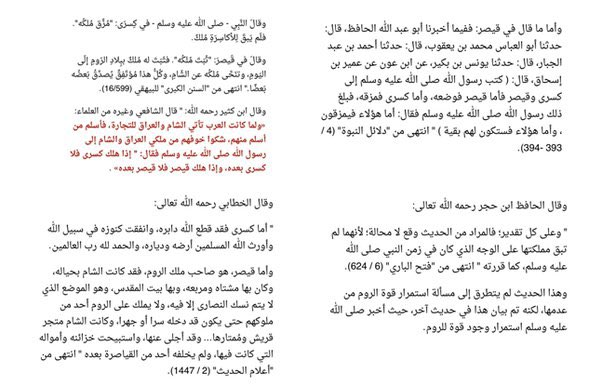
For your info:
This scan contains quotations from early scholars explaining that the hadith refers specifically to the disappearance of Persian and Roman authority from Iraq and Ash-Sham. The scholars explicitly reject the interpretation that no future ruler could ever bear the titles “Caesar” or “Khosrow” anywhere else.
Imam al-Shafiʽi’s Interpretation
Imam al-Shafiʽi also interpreted the hadith geographically rather than universally.
The explanation attributed to him states:
“What was intended is that Khosrow’s authority would not remain in Iraq and Caesar’s authority would not remain in Syria.”
This fits perfectly with the historical context.
At the time, the Quraysh depended heavily on trade routes into Iraq and Syria. After embracing Islam, some feared they would lose access to those regions because of hostility from the Persian and Roman empires.
The Prophet ﷺ reassured them that these empires would lose control over those lands.
This is precisely what later occurred.
Imam al-Khattabi’s Explanation
Imam al-Khattabi further clarified the narration:
“The meaning of ‘there shall be no Caesar after him’ is that there would not remain a Caesar possessing the same authority and dominance in that region.”
He then explained that the Caesar of that era was connected to Jerusalem and Ash-Sham, and after the Muslim conquest, Roman imperial authority never returned there again.
This is exactly what history records.
The Byzantine Empire survived elsewhere for centuries, but its authority over Ash-Sham was permanently lost.
That means the prophecy was fulfilled exactly as the early scholars understood it.
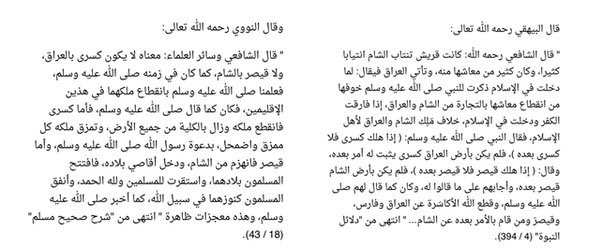
For your info:
This scan continues the quotations from the classical commentators, especially Imam al-Khattabi, who explains that the hadith refers to the removal of Roman political authority from Jerusalem and the surrounding lands of Ash-Sham, not the total disappearance of every emperor elsewhere in the world.
Additional Context From Other Narrations
The wording of related narrations further confirms this regional interpretation.
The Prophet ﷺ used the defeat of Khosrow and Caesar as reassurance concerning the safety and future expansion of the Muslims in Arabia and the surrounding territories.
The concern was political and military control over nearby lands — not whether future monarchs elsewhere might still inherit imperial titles.
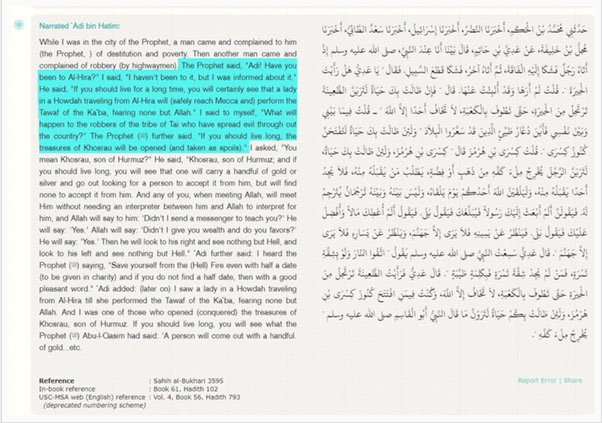
For your info:
This scan references narrations connected to Al-Hira in Iraq. The broader context concerns the collapse of Persian and Roman influence around the Arabian Peninsula and the security of Muslim access to those regions. This further supports the interpretation given by Imam al-Shafiʽi and the other scholars.
“Musnad Ahmad” (12/108, Al-Risalah edition): On the authority of Abu Hurayrah, that the Prophet, may God bless him and grant him peace, said: “When Khosrau perishes, there will be no Khosrau after him, and when Caesar perishes, there will be no Caesar after him. By Him in Whose Hand is the soul of Muhammad, you will surely spend their treasures in the way of God.” (1) Regarding his statement: “When Khosrau perishes…” Al-Hafiz said in “Al-Fath” 6/625-626: This has been questioned given the continued existence of the Persian Empire, since the last of them was killed during the time of Uthman. It has also been questioned given the continued existence of the Roman Empire. The answer to this is that what is meant is that neither Khosrau will remain in Iraq nor Caesar in Syria, and this Narrated by Al-Shafi’i: The reason for this hadith is that the Quraysh used to travel to Syria and Iraq as merchants. When they embraced Islam, they feared that their trade would cease due to their conversion. The Prophet (peace and blessings be upon him) said this to reassure them and give them glad tidings that their rule would be removed from the two regions mentioned. It has also been said that the wisdom behind Caesar’s kingdom remaining, though it was removed from Syria and its surrounding areas, while Chosroes’s kingdom was completely destroyed, lies in the fact that when Caesar received the Prophet’s letter (peace and blessings be upon him), he accepted it and almost embraced Islam. Chosroes, however, when the Prophet’s letter (peace and blessings be upon him) reached him, tore it up. The Prophet (peace and blessings be upon him) then prayed that his kingdom would be utterly destroyed, and so it was. Al-Khattabi said: Its meaning is: No Caesar after him will possess what he possessed, for he was in Syria, and there was Jerusalem, without which the Christians’ religious rites are not complete, and no one ruled over the Romans except that he had entered it, either secretly or openly. Then Caesar departed from it, and his treasuries were opened, and no Caesar succeeded him in those lands after him.
Explanation of the Hadith: “If Chosroes perishes, there will be no Chosroes after him; and if Caesar perishes, there will be no Caesar after him.” https://share.google/pW6iNu5C3ZrN3DTJA
حديث: إذا هلك قيصر فلا قيصر بعده. - الإسلام سؤال وجواب
مركز سلف للبحوث والدراسات حديث: «إذا هلك قيصر فلا قيصر» بيان ورفع إشكال - مركز سلف للبحوث والدراسات
Historical Fulfillment of the Prophecy
The prophecy was fulfilled with remarkable precision:
- The Sassanid Persian Empire permanently lost Iraq.
- The Byzantine Romans permanently lost Ash-Sham.
- Neither empire ever regained lasting control over those territories.
- The Muslims later spent the treasures of both empires in military campaigns and state expansion exactly as the Prophet ﷺ foretold.
The objection only works if one ignores:
- The historical context,
- The Arabic usage,
- The understanding of the earliest scholars,
- And the actual geopolitical circumstances being discussed.
Conclusion
The Prophet ﷺ was not claiming that no future Roman emperor or Persian ruler would ever exist anywhere in the world.
Rather, he was foretelling the collapse of Roman authority in Ash-Sham and Persian authority in Iraq — which is exactly what happened.
This is the understanding of early authorities such as Abu Hatim al-Razi, Imam al-Shafiʽi, and Imam al-Khattabi, and it matches the historical reality perfectly.