Reply to the Text _The Lord, the Lord, Said_ the End of the Illusion
https://heudis.blogspot.com/2025/01/15-proofs-christians-commonly-use.html
{Embed}
https://heudis.blogspot.com/2025/01/15-proofs-christians-commonly-use.html
15 proofs Christians commonly use
In this research we will try to shed light on the text that Christians cite to prove the divinity of Christ, which is “The Lord said to my Lord.”
We will use the following:
1The Christians’ view of this text.
2The Jews’ view of this text.
3The Jehovah’s Witnesses’ view of this text.
4The Muslims’ view of this text.
5What was previously said in response to this text.
6Refuting the opinions on this text.
7An overview of this text.
First: The Christians’ view of this text: -
First : The book by Father Abdel-Masih Basit Abu El-Khair, Did Christ say, “I am your Lord, so worship me ?” Under the title The Lord said to my Lord, Christ’s declaration of His divinity and lordship
, ” Here the Lord Jesus Christ confirms in His question to them that He is the Lord of David, seated at the right hand of the Majesty in the heavens. So who is the Lord of David ? The answer is: The Lord of David is God ! The book says: “Hear, O Israel: The Lord our God, the Lord is one.” (Deuteronomy 6:4), and also “The Lord your God you shall fear, and Him you shall serve.” (Deuteronomy 6:13; Matthew 4:10).” End.
Second: The book Theology of Christ by His Holiness Pope Shenouda under the title: The name Lord was given to Christ on occasions that indicate His divinity:
“Perhaps one of them is that question that puzzled the Lord the Pharisees, when they said that Christ is the son of David . “He said to them, “How then does David in the Spirit call Him Lord? Saying: “The Lord said to my Lord, ‘Sit at my right hand, until I make your enemies your footstool’ (Psalm 109:1) and no one was able to answer him a word” (Matthew 22:43-46). So David calls him his Lord , and the verse is made more powerful by his sitting at the right hand of God… ” End.
Third: Father Tadros Yacoub Malti’s interpretation of Psalm 110/1, quoting Saint Cyril of Jerusalem
: “Since this prophet was a king, who is he whom his Lord can call while he sits at the right hand of God except Christ, the Son of God, who is the King of Kings and Lord of Lords?” End
Fourth: The book Mary Magdalene and her relationship with Christ in response to The Da Vinci Code - Father Abdel-Masih Basit Abu El-Khair Chapter Four: The Early Church and its belief in the divinity of Christ :
“Then he explains the incarnation with more precision and detail, saying, ‘For the second time, Jesus appears not as the son of men, but as the son of God, who appeared in a physical form. And since it will be said that Christ is the son of David, David quickly prophesies, saying, “The Lord said to my Lord, ‘Sit at my right hand, until I make your enemies your footstool.’” For fear that sinners would misunderstand Jesus’ sonship. Have you seen how David gives him the name Lord for the name Son ?” End.
We will suffice with this, God willing, and I believe that it has become completely clear to the point that it does not accept any kind of argument or interpretation, that Christians believe that this text is the path to the divinity of Christ based on the use of the word “Lord” for Him through the Prophet David!
Second: The Jews’ opinion on this text:
Before I present to you the Jews’ opinion on this text, we must clarify a very important matter, which is: Why the Jews’ opinion? Is the Christians’ opinion not enough to judge this text? And which opinion is more reliable: the Jewish opinion or the Christian opinion?
The answer : In fact, there is a very important rule in judging beliefs and religions, the summary of which is ” We must understand the belief according to the people of the belief who believe in it, and not according to the understanding of other beliefs .”
And since this text is essentially a Jewish text, then the Jewish judgment on this text is stronger than the judgment of the Christians themselves. In fact, the Christians’ opinion on this text is in itself of no value, and we prove this by what is stated on the website of Anba Takla under the title: Frequently asked questions about Christianity and religious beliefs | Inquiries of Muslim brothers.
“Thank you, my brother, for your questions and your style of presentation.. But the only problem is that you are using a book that has nothing to do with Christianity to judge it!! Do you agree that I use the Holy Bible to judge the Quran?! Or that the Baha’is use their “Holiest Book” to judge Islam?! This is not correct.. Rather, the data of the religion is used to judge it itself.. and not the other way around.. So how can I trust a book that came after nearly six centuries , to judge a book that preceded it ?
In the same way that the Baha’i faith came to call for other things, while Islam views its prophet Muhammad as the Seal of the Prophets!! That is why Islam does not consider the Baha’i faith a heavenly religion, but rather a man-made religion.. So it is not correct for you to come to me with what the Holy Quran says, to try to prove Christianity wrong through it.. ” End. Anyone can easily claim anything they want after a period of time. !
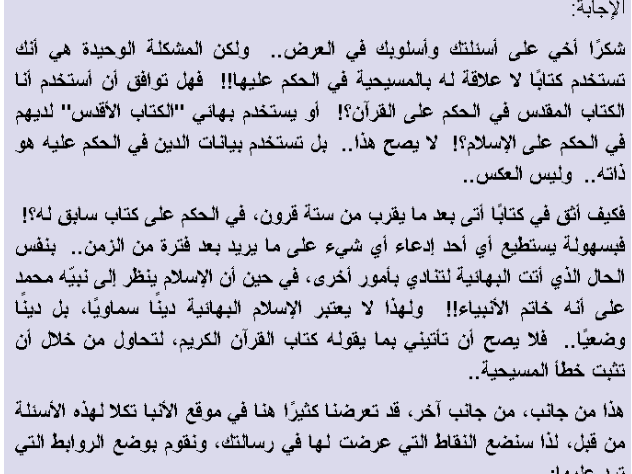
Summary: It is not possible to rely on understanding a verse in the Jewish faith through the point of view of another faith that came centuries later, such as Christianity, for example!
Now: What is the Jewish opinion of this text?
First: The interpretation of Rabbi Rashi, the most famous Jewish interpreter
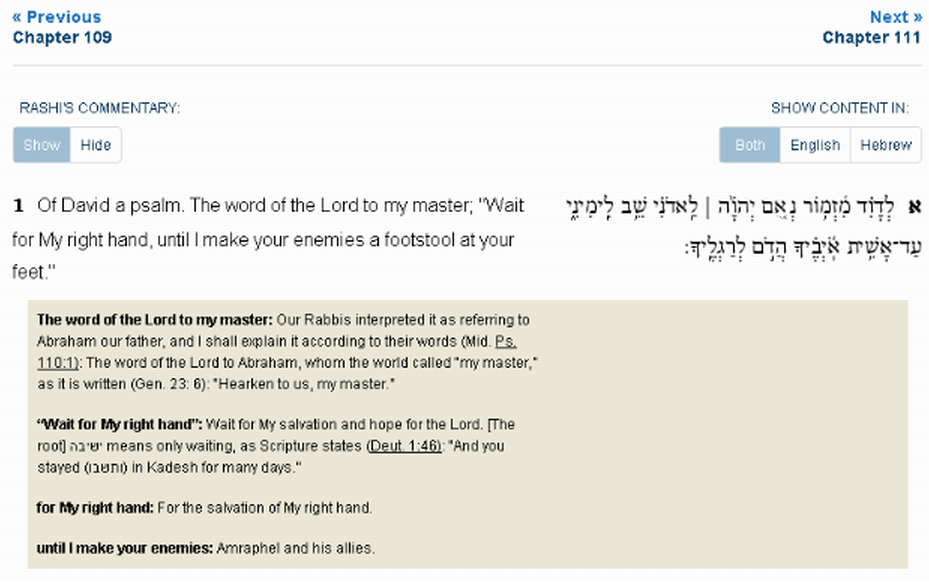
Translation :
“The word of the Lord to my lord”: Our rabbis have interpreted this as referring to our father Abraham , and I will interpret it according to their comments on Psalm 110:1:
The word of the Lord to our lord Abraham, whom the world calls my lord, as it is written in Genesis 23:
6: “Hear us, my lord, you are a prince from God among us. In the best of our graves bury your dead. Let none of us withhold his grave from you, lest you bury your dead.”
“Wait for my right hand”: I wait for my salvation and my hope in the Lord.
The root (of this word) in Hebrew means only “wait” (not sit).
The interpretation of “for my right hand”: for the salvation of my right hand, as the Book of Deuteronomy says (Deuteronomy 46:1): 46-1 And you sat (waited) in Kadesh many days, like the days that you sat. End.
: Secondly, Rabbi Zechariah said in the name of Rabbi Yishmael : The Holy One, put the blessing of Abraham before the blessing of existence, he had a priesthood in particular, and not from any of the other descendants of Shem. As it is said: “And he blessed him and said: Blessed be Abram, God Most High, maker of heaven and earth, and blessed be God Most High.” (Genesis 14:19-20). And Abraham said to him: And does he put the blessing of a servant before the blessing of his master? You must bless God first. Immediately the Holy One rose up, blessed is he, By giving Abraham the priesthood , as stated: “The Lord says to my Lord: Sit at my right hand, until I make your enemies your footstool” (Psalms 110:1), after that, it is written: “The Lord has sworn, and will not repent: You shall be a priest forever, for you are a king of righteousness.”
Third: The interpretation of Rabbi Ibn Ezra and Rabbi Radak
believed the psalm was
about
David, written by one of his servants. End
Fourth: The official Jewish website commented on the text The Lord said to my Lord: -
https://jewsforjudaism.org/knowledge/articles/psalm-110-a-jewish-perspective/
{Embed}
https://jewsforjudaism.org/knowledge/articles/psalm-110-a-jewish-perspective/
Psalm 110 - A Jewish Perspective
Let us find out the Jewish perspective of Psalm 110 which is often misquoted by Christians to be in their favour. Read on to find out.

read this
In Hebrew, it is not uncommon to have a word that can be divine or human depending on the context. An excellent example is the Hebrew “Elohim” which can mean either human judge or God. For example:
“In the beginning God created (Elohim)” Genesis 1:1
Then his master brought him to the judges (Elohim) Exodus 21:6
The first example refers to God, the second to the human judges. This word is also used to refer to idols.
It is important to note that Christian translations such as the Oxford Study Edition recognize the error in Psalm 110 and correctly translate it as “The Lord said to my Lord” with a lowercase “L.”
In the Hebrew Bible, the Tanakh uses the word “Adoni” over 130 times. In each case, it means “master” or “lord,” and refers to a human being. In addition to Psalm 110:1, the word “to my master” (ladoni) appears 20 times and always refers to a human being. Here are some examples.
“Hear us, my lord (Abraham)” Genesis 23 v.6
“Sarah bore a son to my lord (Abraham)” Genesis 24:36
“You must say, my lord, to Esaf” Genesis 32:5
“What can we say to the lord (Joseph)” Gen. 44:16
“I love my lord (slave owner)” Exodus 21:5
“Do not let the anger of my lord (Moshe) burn” 32:22
“To do this thing to my lord” (David) 1 Samuel 24:7
Now that it is clear that the Hebrew says “the LORD said to my lord (master),” it is important to understand who is speaking to whom.
Although the Psalms were composed by King David, they were often written in the third person, about himself. For example:
“Who let David go, his servant?” Psalm 144:10
This point is also supported by the fact that this psalm in Hebrew begins “L’David Mizmor” which means “Psalm of David”. L’David literally means “to David” or for him, it does not simply mean “the melodies” of David. This is similar to “L’Shlomo” meaning “of Solomon” in Psalm 72:1. This indicates that David was writing Psalm 110 about himself. End.
So the summary of the Jewish opinions. This text has nothing to do with Jesus Christ, neither near nor far. It is unfair or unjust for Christianity to come centuries after Judaism to interpret this text according to its own whims? Throwing the belief of the People of the Book themselves to the wall.
All this and we are only presenting the different opinions about this text and the refutation of the text has not yet begun.
Jehovah’s Witnesses’ view of this text:
It is known that the Jehovah’s Witnesses sect is a Christian sect - although many Christian sects excommunicate it and claim that it is a non-Christian sect - but this does not change anything in its being a Christian sect because all Christian sects excommunicate each other.
As for the Jehovah’s Witnesses’ view of this text, they generally believe in one true God who is unique in divinity, which is “Jehovah”, meaning the Father. As for Christ, they do not believe that he is a true God.
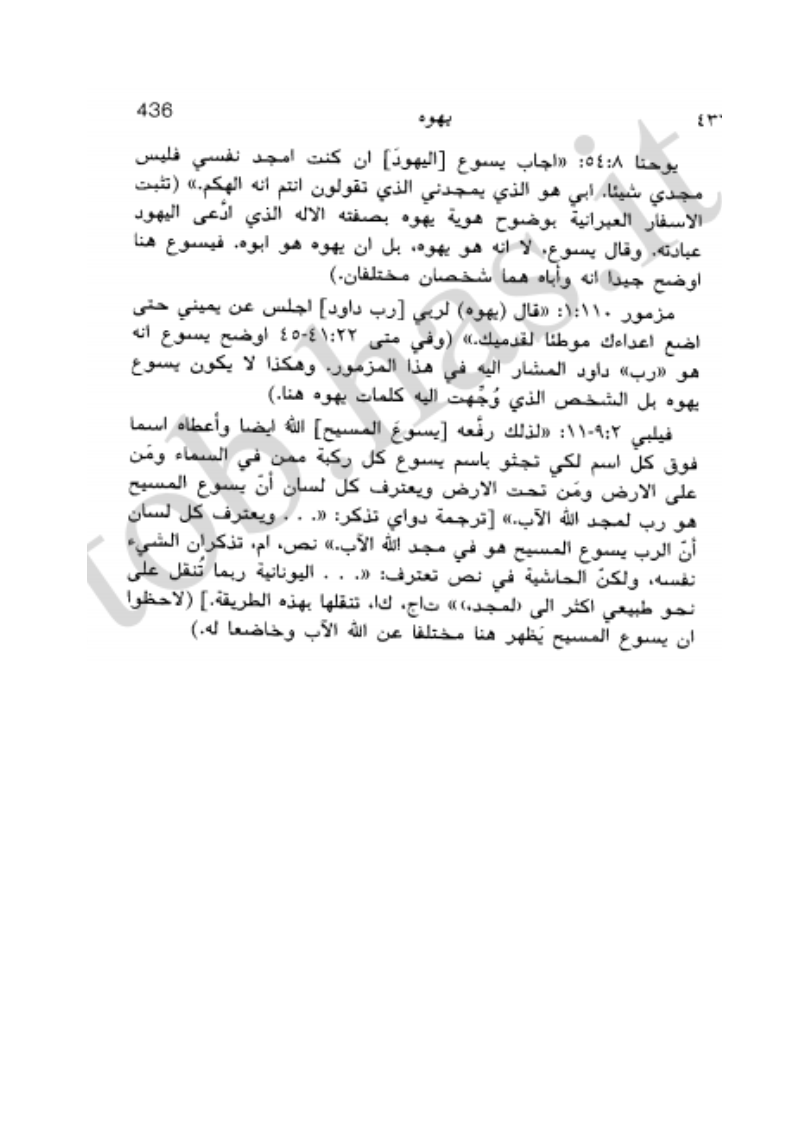
As for their opinion of this text, they confirmed in their official book that this text has nothing to do with the divinity of Christ, but rather they speak of only one God, which is Jehovah “the Father.” It is stated
in the book “Discussion in the Holy Scriptures” - written by Jehovah’s Witnesses - under the title “Jehovah” - page 436
Now
an important and fundamental question: If the three sects - Judaism, Christianity and Jehovah’s Witnesses - who believe in this text completely agree that the text is not agreed upon, then what does the difference regarding this text indicate?
Here, gentlemen, we are not talking about a secondary text, but rather a text upon which a complete doctrine is built, and the texts specific to the doctrine, according to Christian thought, must carry a clear divine revelation, and if they do not carry a clear divine revelation, then belief in them will not be possible.
I would like to present to you the opinions of Christian scholars on the subject of clarity in divine revelation and the consequences of lack of clarity? Is it possible to use reason to understand texts instead of direct revelation from God?
It is stated in the book “Introduction to the Truth of the Trinity” by Father Ibrahim Al-Qummus Azer:
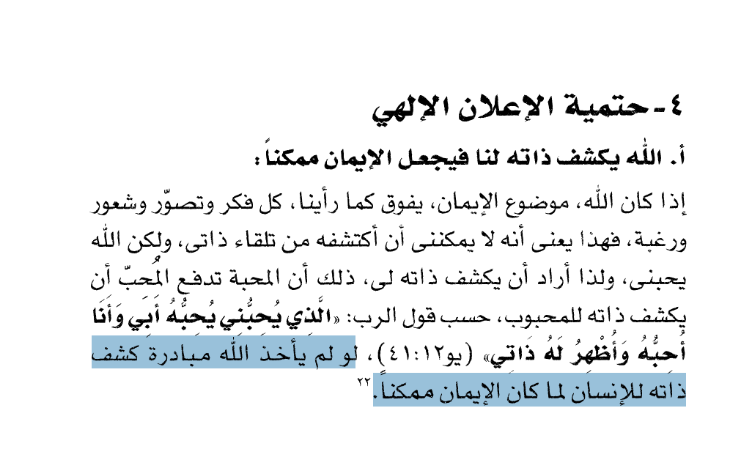
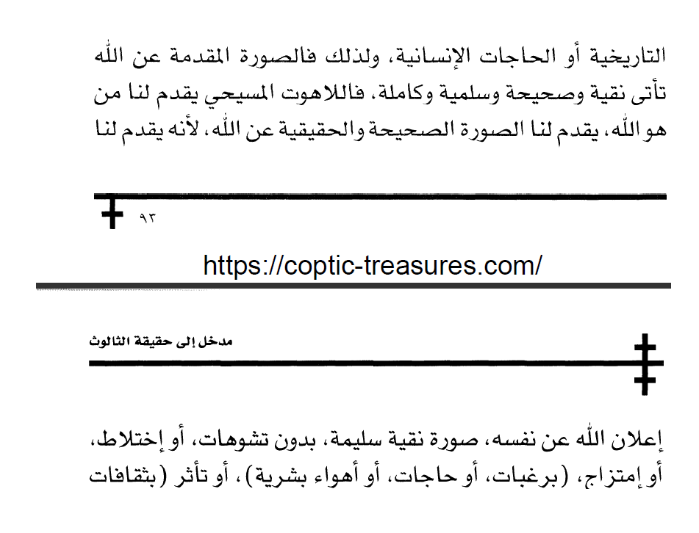
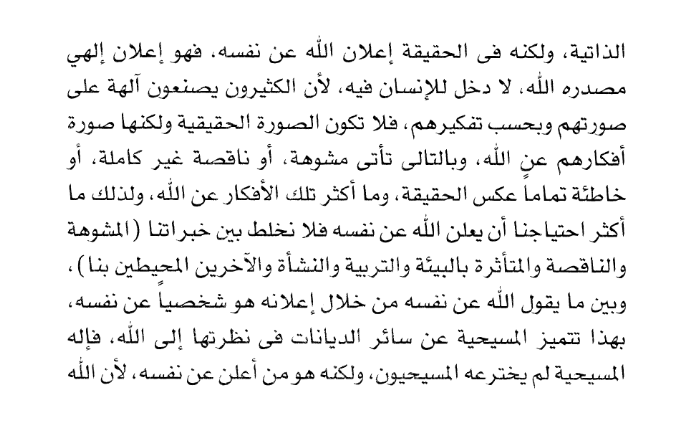
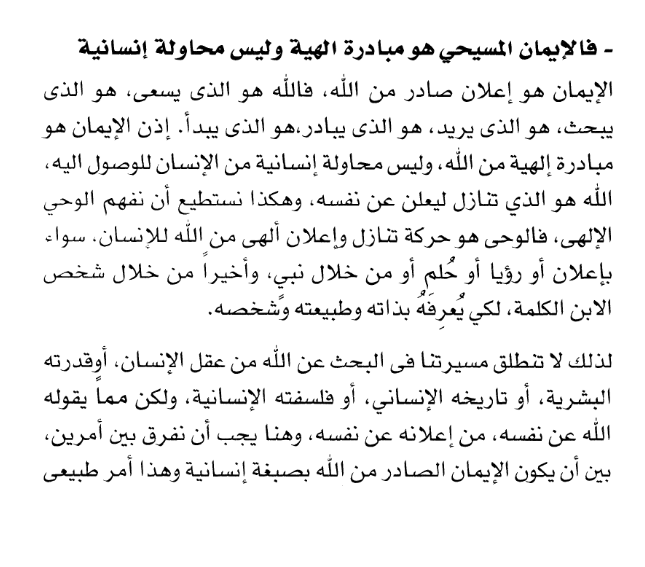
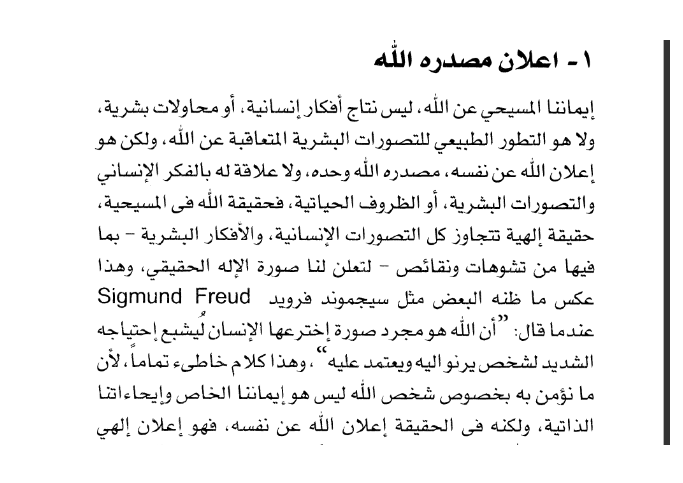
Information in the book:
- The doctrine is based on clear declarations from God Himself that do not contain ambiguity, difference, human perceptions, or interference by the human mind. If the doctrine was not clearly declared, then belief in it would not be possible.
If we apply this information to the text, we will find that :
This text contains difference and ambiguity and has many human interventions and even modifications according to each sect that believes in it. Therefore, it is an unclear declaration, and God declares His doctrine through clear declarations only. So how can we reconcile between God declaring the verses related to His doctrine clearly and between this text related to the doctrine being vague and unclear? Taking into account that if the text was not unclear, then it would not be possible to believe in it!
This is a question that I did not intend to respond to the text, but rather an invitation to think, nothing more.
Once again, we say that until now the text has not been responded to or refuted. All of this is just an introduction to the text and a presentation of opinions about it. In the next comment, we will begin responding to the text directly, God willing
Muslims’ opinion on this text:
1Dr. Munqidh Al-Saqqar - may Allah protect him - said:
The Christians’ evidence for the divinity of Christ is amazing. They have no problem explicitly denying Christ.
I have a text that they always like to cite, which is the Torah’s saying: (The Lord said to my Lord: Sit at my right hand, until I make your enemies your footstool).
According to the Church’s opinion, the text says God (to my Lord), meaning Christ.. I will put your enemies under your feet and humiliate them.
But if we asked the Jews, they would say: This is a prophecy about King Hezekiah.. who defeated his enemies, the Palestinians.. This is what the Jews, the people of the book, say.
Well, let’s assume that his saying (to my Lord) means Christ.. When were the enemies of Christ under his feet? When did he humiliate and defeat them?
No answer.
But if we asked Christ according to the Gospels about this text, we would hear an answer that would disturb the Church and its men.. He considers this text a prophecy about the coming Messiah.. the awaited Messiah.. or rather the awaited Prophet.. whom David describes in the biblical prophecy: (to my Lord), meaning my Lord.
Christ showed them (in the Gospels of Matthew, Mark and Luke) through this text that the coming Prophet or the awaited Messiah is not from the descendants of David, because David described him by saying (to my Lord), meaning my Lord… and a father does not say about his son (my Lord)… and from this Christ, peace be upon him, inferred that the awaited Prophet is not from the descendants of David.
It remains for us to say an important piece of information, which is that Christ, according to the consensus of Christians and the Gospels, is from the descendants of David, and they often called him: (Son of David) (Luke 18:38) (Mark 10:48).
In short, Christ tells them according to (Matthew, Mark and Luke): I am not the awaited Prophet because I am from the descendants of David, who described the awaited one as his Lord.
It remains to be noted that describing the awaited one as (Lord) does not mean his divinity, but according to the terminology of the Bible it means (Master) or (Teacher), and from it the saying of Mary Magdalene to Christ: (Rabboni which means Teacher) (John 20/14-16), this interpretation is according to the Bible, not from me.
2Dr. Wissam Abdullah in his famous debate with Father Abdel-Masih Basit Abu Al-Khair, Professor of Defensive Theology?
First: Your Excellency, the text does not say: “The Lord said to my Lord.” Your Excellency, return your Excellency. Go back to the Psalms, the text in the Psalm says “The Lord said to my Lord” and the version in Psalm 110:1, not to my Lord, to my Lord. But the Van Dyck translation is a wrong translation, so go back to the Jesuit translation. And here for you too, a second, I will give you the text in Hebrew, a second, I will give you the text in Hebrew. Here, your Excellency, here is the text in Hebrew. Because the Hebrew text says “Adonai” and “Adonai” does not mean my Lord. “Adonai” means my Lord, Father. So the Van Dyck translation is a deliberate mistranslation to prove the divinity of Christ. Here is the first thing. Here is the text in front of you. Enter this Hebrew, Hebrew and English.
Two, my honorable sir: If we read the text in the Gospel of Matthew. We read it from the Gospel of Matthew. What does the text say? “And while the Pharisees were gathered together.” No, no, we will answer from verse number 42 “And while the Pharisees were gathered together, Jesus asked them, What do you think about the Christ, whose son is he? They said, The son of David. He said to them, How then does David in spirit call him Lord?”
Dear Father, what is the meaning of “how, how, how?” Denouncing “saying, ‘The Lord said.’” Of course, Lord, this is wrong, my Lord. “Sit at my right hand, until I make your enemies your footstool. If David is his Lord, how can he call him Lord? If David is his father, how can he call him our Lord? If David calls him Lord, how can he be his son?” I am reading from memory. “If David calls him Lord, how can he be his son?” Well, how do we connect Jesus to David? The only solution is that he is attributed to David. What? First: Mary is not from the tribe of Judah, she is from the tribe of Levi. It has nothing to do with David, right? Through Joseph the carpenter, and therefore the Holy Bible attributes it to Joseph the carpenter, and Joseph the carpenter is not his father, and he has no relation to Jesus.
3The book of Sheikh Al-Balaghi and the Science of Comparative Religions - Orientalists’ Doubts about the Holy Quran - -Second Section-
“Al-Balaghi mentioned that the translations of the New Testament and the Psalms agreed to change the meaning of (my master) which is in the Hebrew translation (Hadon -) meaning master or lord - to the meaning of my Lord, and that they translated the tenth Psalm (52) after the hundredth and its text: Naom Jehovah Ladnai - meaning God inspired my master, to: The Lord said to my Lord. 53( The word (אָדון / Adon) in the Hebrew language means: master, lord, baal, lord, and it came in the Old Testament (334) times, it came in more than 100 places in the plural form (אֲ דונִים / Adonim): masters.
Its meanings differed, as follows: 1. It came in 6 places to indicate: ruler, chief, leader, as in: Genesis 8:9, 45, Jeremiah 21:105, 5:12 Psalms 5:34, 18:22. 2. It came in 26 places as a title of the Lord, including: Exodus 23:34, 17:23, Isaiah 1:7:114 Prince Psalms 33, 16:10, 3:24. It came in other places to indicate masters who own slaves, including: Genesis 13:33, 41, 29, 27, 25, 24:25, 1 Samuel 22:32, Exodus 15, 14)54(. This word also came compounded with other names, as proper nouns, such as: - (אֲ דנִי צֶדֶק Q): Master of Truth, in: Joshua 3.1, 10 ِ / Adoni-Zed (- אֲ דנִיקָם / Adoni-Qam): Master rose, in: Ezra: 13:8, 132. (- אֲ דנִיָּה اّ / Adoni): Jehovah is the Master, in: Nehemiah 17 : 10. ( - אֲ דנִירָ ם / Adoniram ): The High Lord, in: 1 Kings: 6.4 Ibn Shushan mentions that the word ( אָ ןדו / Adon ) is one of the ancient Semitic words, as it appeared in )55( Ugaritic meaning: father, chief, and Akkadian and Canaanite adannu meaning: strength, and it is found in )56( the Western Semitic languages, such as Phoenician, Punic, Nabataean and Palmyran with the same meaning. The word ( אֲ דונָי / Adonai ) is one of the names of the Lord, and it appeared in the Old Testament more than )
8 6: Isaiah, 22:5, 13, 10:4: Exodus, 31:27, 3:18 Genesis: of it, once (425 4:36 3, 25:3, 6: Ezekiel, 26:44 Jeremiah, 1:61)57(. As for the text of the first tenth verse in the 110th Psalm, its Hebrew text, with its revision and translation, is: םאֻ נְ יְהוָה אלַ דנִי בשֵׁ לֵימִינִי עַד אָ - שִׁ ית בֶ יְ א י@ הֲדם לְרַ גְלֶי
. D Ashit Ovikha Hdom Lr Naum Jehovah Ladoni Shev Limini A The Lord said to my lord (the king): Sit at my right hand, until I make your enemies your footstool. (Psalms 110:1) We agree with Sheikh Al-Balaghi in his translation of the word (אֲ דונִי / Adoni) in this verse as: My lord; this is because this word becomes a name of the Lord only if it comes in the form we mentioned previously, which is (ינָודאֲ / Adonai). Moreover, the context of the first verse in Psalm 110 does not allow for the Lord to say to the Lord! Is this reasonable, especially since (יהוה / Jehovah) is… The Hebrew God is called (Adonai) instead of the name (Yahweh) and the name (and that Adonai is pronounced in the Old Testament books/Masoretic text, instead of the name (Yahweh), such as: (- וַיְהוָ ה / יהוה) --- pronounced --- (אוַ דונָי F / Adonai) for (- לַ יְהוָ ה / ◌َ YHWH) --- pronounced --- (אל דונָי L / Donai) (- בַּ יְהוָ ה / Jehovah b) --- pronounced --- ( אבַּ דונָי f/ Adonai ) ( - מֵ יְהוָ ה / Jehovah m ) --- pronounced --- ( אֲ מֵ דונָי F / Adonai) ِ ( - הַ יְהוָ ה / Yahweh َ ه) --- pronounced --- (אהַ דונָי F / Adonai) ”
What was said about the text:
Now, my brothers in God, all of the above was a presentation of opinions about this text and the opinion of each sect about it.. Now the text will be responded to by me, God willing. In this paragraph, I will use what was said in the books of the Christian fathers in explaining this text to respond to what was said in the books of the Christian fathers about this text.
An overview of the text:
The text says, ” The Lord said to my Lord, sit at the right hand of God.” The Christians say that the one addressed by the second Lord here is also God.
According to the Christian fathers’ understanding of this text, the one addressed here by the second Lord is evidence of His divinity. So, is the one addressed here by the second Lord, according to the Christians’ sayings, evidence of His divinity?
In fact, the answer is “no” simply because the Christian fathers confirmed that the one addressed here was “the humanity of Christ.” And whoever says that the humanity of Christ is God is a heretic and an innovator!
First: The evidence that the addressee in this text was the humanity of Christ and not the divinity (i.e. the addressee here is the second Lord who has no relation to the divinity of Christ)
came in the interpretation of Father Antonius Fikry of Psalm 110/1
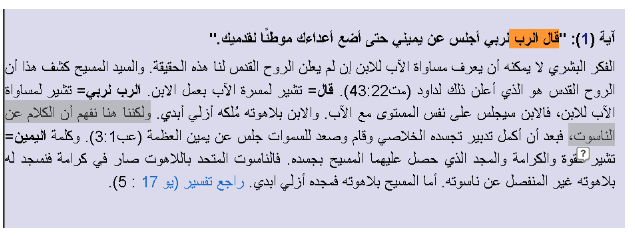
Also, Father Tadros Yacoub Malti’s interpretation of Psalm 110/1
https://2.top4top.net/m_12548ntbv1.bmp

So the text here talks about the humanity of Christ because it is impossible for the divinity to need someone to put its enemies under its feet.
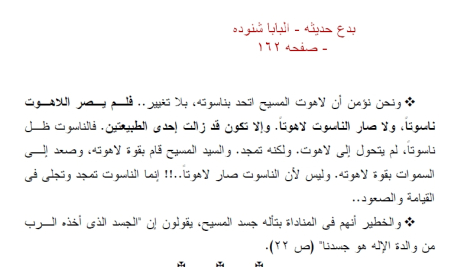
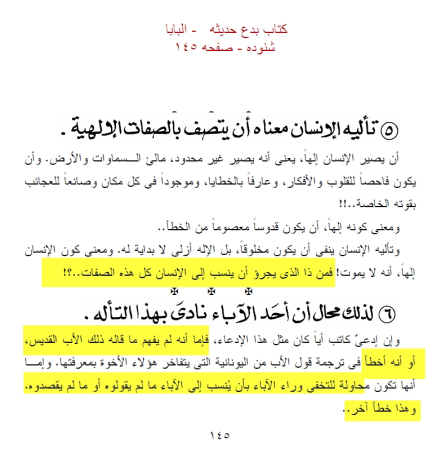
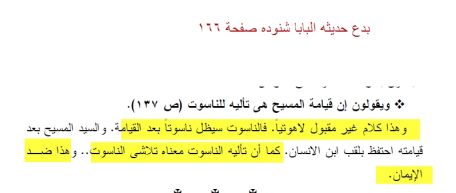
- Here we ask the question: Can whatever is said about the “humanity of Christ” become a god?
We leave the answer to Pope Shenouda in his book Modern Heresies - Pope Shenouda - Book Modern Heresies.
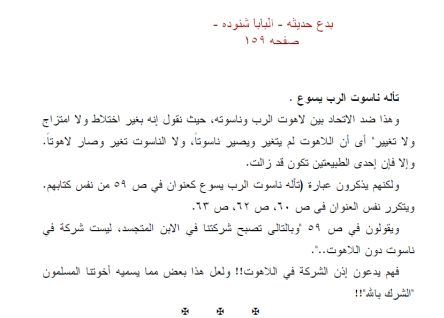
Summary of the above.
1The text, according to the Christian belief, speaks of a person who was described as God who will put his enemies under his feet. This of course shows that the addressee in this text is not God because it is unreasonable for the divinity to need someone to put his enemies under his feet. Therefore, the Christian fathers tried to get out of this predicament by declaring that the text here was talking about humanity and not divinity.
So, the one who was said to be “the Lord of David” is humanity.
So, the one whose enemies will be put under his feet “is humanity”.
So, the one who will sit at the right hand of God “is humanity” .
2The humanity of Christ, no matter what was said or will be said about it, did not and will not become God because this is against the law of union between two natures.
Accordingly, the addressee here in this text “i.e. humanity” is not God.
Now a very important question: If this text is attributed to the humanity of Christ because it is against his divinity… then how can we rely on this text to prove the divinity of Christ through a text that is against the divinity of Christ in the first place?
What was said about the text: -
Father Abdel-Masih Basit Abu Al-Khair, professor of defensive theology, said in his book “Yes, Christ said, I am God.”
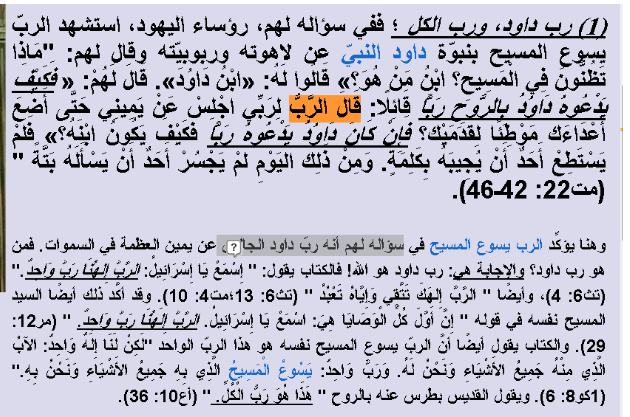
Here, the priest explains that the evidence for the divinity of Christ according to this text is that Christ is the “Lord” of David, therefore he is God.
Indeed, the priest’s words are invalidated because the basis on which he built his conclusion is a false conclusion, since the word used here in the text is originally “Lord” and not “Lord.”
Here are some of the proofs for that.
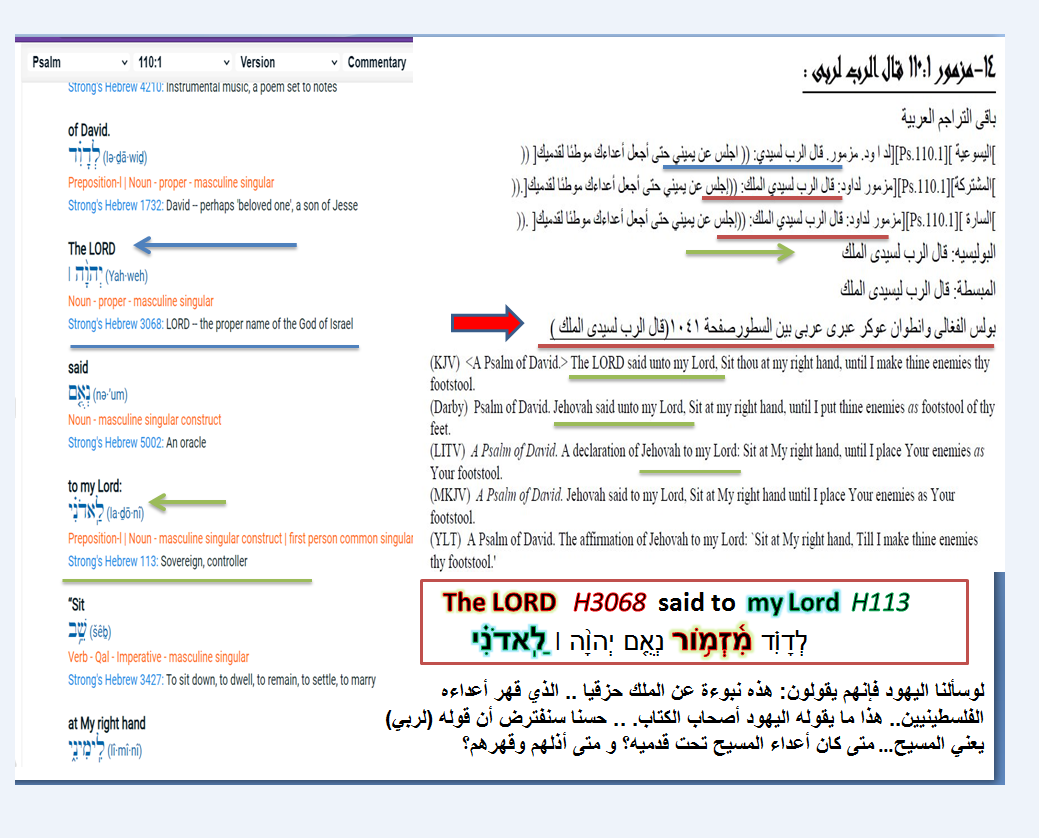
The Lord said unto my lord, Sit thou at my right hand, Until I make thine enemies thy footstool. A Hebrew-Arabic book between the lines by Paul Al-Feghali and Antoine Awkar under the title - Psalm 110/1 “The Lord said unto my lord, Sit thou at my right hand , Until I make thine enemies thy footstool . ” To my Lord, translate the text to “The Lord said to my lord .”
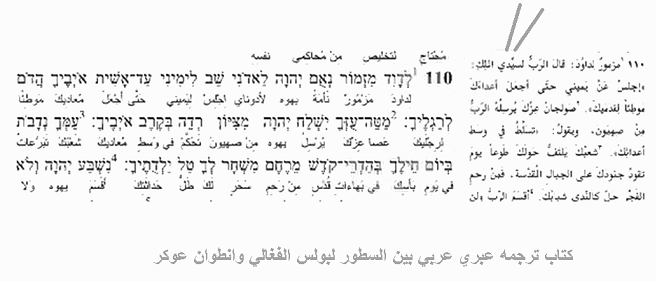
https://drive.google.com/file/d/1jQge75dqcqyRLvg1eDImrrtf_2KrP64x/view
{Embed}
https://drive.google.com/file/d/1jQge75dqcqyRLvg1eDImrrtf_2KrP64x/view
العهد-القديم-ترجمة-بين-السطور-عبري-عربي.pdf
Also, the “Hebrew text” says in the Mikhon Mimra Encyclopedia:
The LORD said unto my lord : ‘Sit thou at My right hand, until I make thine enemies thy footstool.’
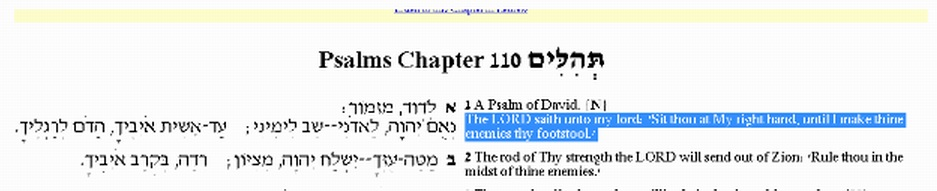
https://mechon-mamre.org/p/pt/pt26b0.htm
So the Hebrew text makes it clear that the word here is “my lord.”
English translations state that the word here is “sir”.
Arabic translations show that the word here is “Sir”.
A Hebrew-Arabic translation book between the lines explains that the word here is “my lord .”
The funny thing here is that the Anba Takla website once quoted this text using the word “my lord” and not “my Lord.”
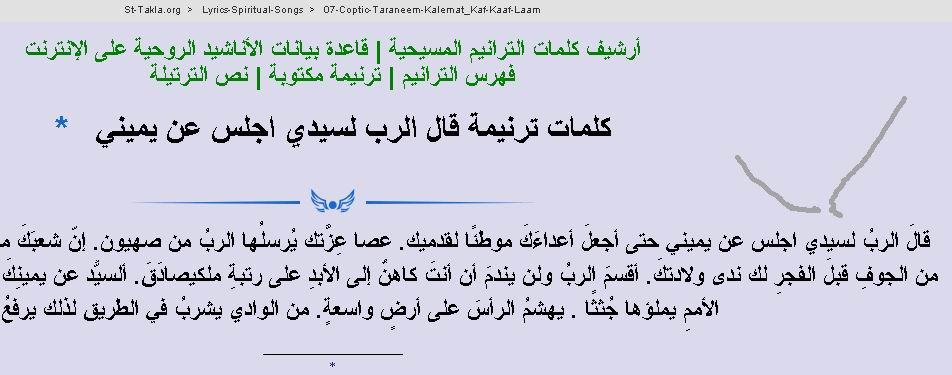
Now a question to the priest?
If the original text here says “the Lord said to my lord,” then why do you tamper with the text and distort it to become “the Lord said to my Lord?” Isn’t this the meaning of the distortion that you mentioned in your book “Where, When, Why and How the Bible Was Distorted” when you said that the meaning of distortion is deletion, addition or substitution? You did all of that in this text.
Another question:
If the text here says “the Lord said to my lord,” then what is the evidence of the divinity of Christ in this text, and this word was said to millions of people before and after Jesus?:shrug:
- It appears in the Bible Dictionary under the title of the word “Rabboni”
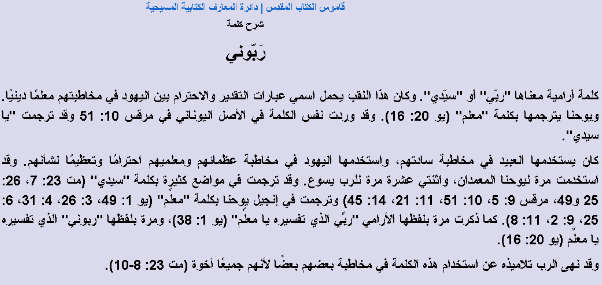
Another question to Father:
The context of the text does not prove divinity, as the text is against divinity. Therefore, the text was attached to the humanity of Christ and not to his divinity. So where did you get your conclusion that Christ is God according to this text?
The text linguistically does not prove divinity!
The context of the text does not prove divinity.
The text is basically against theology.
So where did you get the theology of Christ in this text, Father?
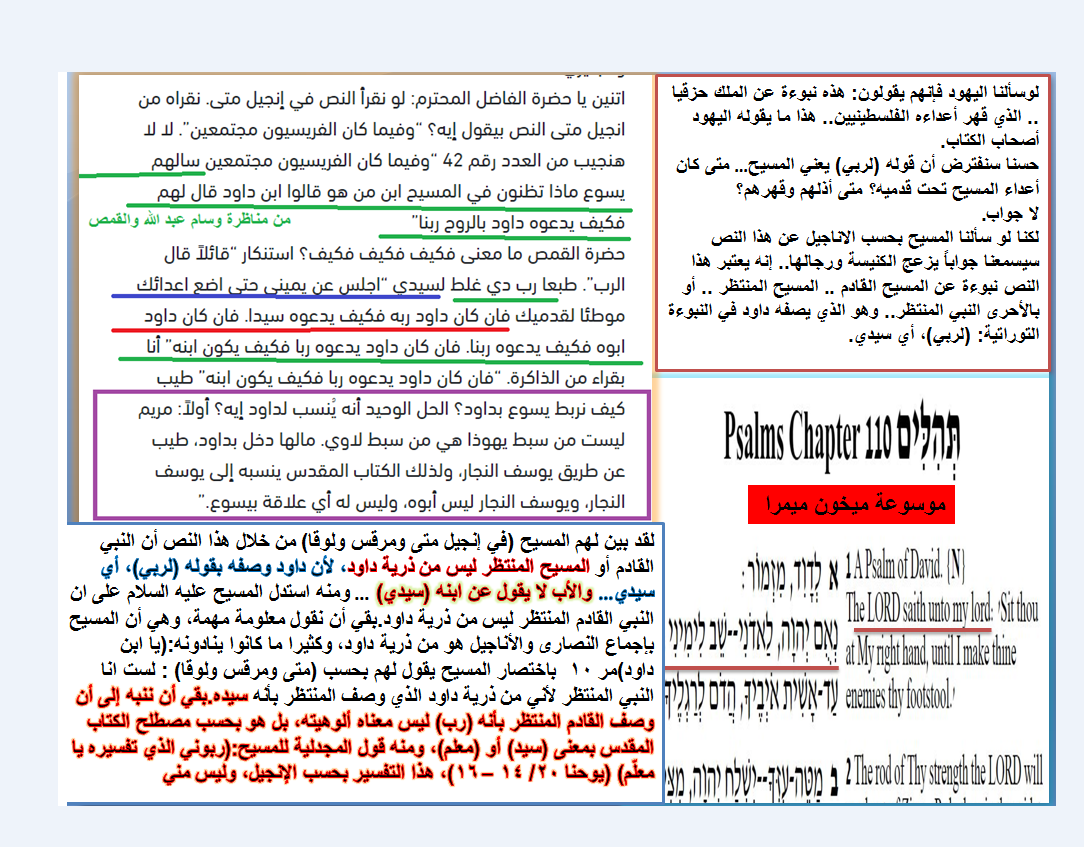
@everyone a comprehensive response to Psalms 110 n proof Jesus being Divine in O.T
Related : #Is Jesus Mentioned in O.T?