Response to Christians Who Object That Zakat Is Not Permissible for Non Muslims
Response to Christians Who Object That Zakat Is Not Permissible for Non-Muslims
Table of Contents
- The Christian Objection About Zakat
- Zakat Is a Restricted Legal Category
- Charity to Non-Muslims Is Wide and Open
- The Biblical Principle: Give What Is Due
- Jesus and the Canaanite Woman
- Specific Biblical Expenditures for Specific Groups
- The Priests and the Levites
- The Tithe Offering to the Church
- From the Bible Dictionary: Tithes in the Law
- The First Tithe
- The Second Tithe
- The Third Tithe
- Giving It Voluntarily
- Nehemiah and the Portions of the Levites
- Malachi and Robbing God
- Numbers 18 and the Tenth of the Tithe
- Numbers 31 and the Lord’s Share From the Spoils
- According to the Book of Numbers, Chapter 31, Verse 28, the Share of the Lord of the Church from the Zakat on the Spoils of War is
- Scan Evidence
- Question to the Skeptic
- Conclusion
The Christian Objection About Zakat
Recently, objections have been circulated by anti-Islam media from Christians about the fatwa that it is not permissible to give zakat to nonMuslims.
This is a weaker suspicion than a spider’s web.
Zakat Is a Restricted Legal Category
Zakat is one of the laws, and laws are sometimes restricted and specific and have conditions that are not valid without them.
Charity to Non-Muslims Is Wide and Open
As for giving to non -Muslims, the door to charity is wide and includes non-Muslims
. _____
The Biblical Principle: Give What Is Due
God willing, I will begin the response from the laws and rulings of the Holy Book. The response is general and brief from the rulings and laws of the Holy Book, followed by details.
There are rulings and laws in spending that are directed and specific to a specific and undivided expenditure. Putting it in another expenditure is what your apostle
” Therefore give to all what is due to them: the tax to whom the tax is due; the collection to whom the collection is due.” And fear to whom fear is due, and honor to whom honor is due.
Jesus and the Canaanite Woman
21 Then Jesus went out from there and departed to the region of Tyre and Sidon.
22 And behold, a Canaanite woman from that region came out and cried out to Him, saying, ” Have mercy on me, O Lord , Son of David! My daughter is grievously possessed by a demon.”
23 But He did not answer her a word . Then his disciples came and begged him, saying, “Send her away, for she is cribbing after us .”
24 But he answered and said, “I was sent only to the lost sheep of the house of Israel .”
25 So she came and worshiped him, saying, “Lord, help me.”
26 But he answered and said, “It is not good to take the children’s bread and throw it to the dogs.”
27 “Yes, Lord,” she said . Even the dogs eat the crumbs that fall from their masters’ table.”
28 Then Jesus answered and said to her, “O woman, great is your faith ! Let it be to you as you wish.” And her daughter was healed from that hour.
Then we find in your book that there are laws and rulings specific to specific and specific expenditures directed to specific people or groups, and it is not permissible or permissible to give them to others. So why do you not object!?
Then we find in your book that there are laws and rulings specific to specific expenditures directed to specific people or groups, and it is not permissible or permissible to give them to others .
Specific Biblical Expenditures for Specific Groups
” The Levitical priests, the whole tribe of Levi, shall have no portion or inheritance with Israel . They shall eat the offerings made by fire to the Lord, and their inheritance.
2 So he shall have no portion among his brothers . The Lord is his portion, as he said to him.
The Priests and the Levites
For example,
the priests: They had the firstfruits and a tenth of the tithes or the heave offerings, in addition to the vows, sacrifices, grain offerings, and offerings.
The Levites: They had the first tithes and did not own the lands
The Tithe Offering to the Church
Is it permissible to give what the priests had to the Levites or to the people, in addition to others!?
Is it permissible to give the church’s tithes to the mosque, for example!?
From the Bible Dictionary: Tithes in the Law
tithes in the law : The law commanded that every Jew give the firstfruits of his land “to the house of the Lord his God” (Exodus 23:19, see Deuteronomy 26:1, 2). Since the law did not specify a value for the firstfruits, some believe that the tithe was an additional offering in addition to the firstfruits. Jewish sources state that the firstfruits were 1/50 of the crop.
The laws concerning tithes mentioned in the Pentateuch are:
The First Tithe
(1) “And every tithe of the land, whether of the grain of the land or of the fruit of the trees, is the Lord’s; it is holy to the Lord. And if a man redeems a part of his tithe, he shall add a fifth part to it. But all the tithe of the herds and of the flocks, whatever passes under the rod, the tenth shall be holy to the Lord. It shall not be examined whether it is good or bad, nor shall he exchange it. But if he exchanges it, it and its substitute shall be holy; it shall not be redeemed” (Lev. 27:30-33).
This does not contradict what the Lord had previously commanded them while they were still in Egypt: “You shall present to the Lord every firstborn of the womb and every firstborn of the livestock that you have; the males belong to the Lord. But every firstborn of a donkey you shall redeem with a lamb; but if you do not redeem it, you shall break its neck. And every firstborn of a man among your sons you shall redeem” (Exod. 13:12-13).
so the tithes were theirs instead, because they were doing the “service of the tabernacle of meeting.” The Levites were to present “a tenth of the tithe” and give it as an offering to the priests, the sons of Aaron . They would bring this offering to the house of the Lord, where the priests would serve them (Num. 18:21-32). It appears from what is mentioned in the Book of Nehemiah that one of the priests from the sons of Aaron was in charge of presenting this offering (a tenth of the tithe) (Neh. 10:38).
The Second Tithe
“You shall pay a tenth of all the produce of your seed that comes out of the field year by year. You shall eat it before the Lord your God in the place which He chooses to place His name there, the tenth of your grain, your new wine, your oil, and the firstborn of your herds and your flocks… But if the journey is too long for you to carry it, or if the place which the Lord your God chooses to put His name there, when the Lord your God blesses you, is too far from you, then you shall sell it for its money, and bind the money in your hand, and go to the place which the Lord your God chooses, and spend the money in every place as your heart desires… And eat there before the Lord your God, and rejoice, you and your household. But do not leave the Levite who is within your gates alone, for he has no portion or inheritance with you”
(Deut. 14:22-27; see also Deut. 12:5-8).
Many see this tithe as a second tithe of the nine tithes remaining after the first tithe was given to the Levites.
The Third Tithe
(3) “At the end of every three years you shall bring out all the tenth part of your produce in that year, and you shall deposit it within your gates. Then the Levite, the stranger, the fatherless, and the widow who are in your possession shall come to you. “And when thou hast finished tithing all the tithes of thy produce in the third year, which is the year of tithes, and hast given them unto the Levite, and to the stranger, and to the fatherless, before the Lord thy God: I have taken away the holy thing out of the house, and have given it also unto the Levite, and to the stranger, and to the fatherless, and to the widow, according to all thy commandment which thou hast commanded me.” (Deut. 26:12-15).
Opinions differ concerning this third “tithe.” Josephus, the Jewish historian, says that it was in fact a “third tithe,” given every three years, in which the priests and Levites participated. Others say that this “tithe” was the same as the “second tithe,” but that every three years it was not carried to Jerusalem, but given to the poor in their own land.
Giving It Voluntarily
(c) Giving it voluntarily: Giving tithes was not done in a compulsory manner, but had to be done voluntarily “with all the heart and with all the soul” (Deut. 26:12-15). 26:16). And in the third year the call was made on the last day of the Passover, when the person would say after offering the tithes: “But I have obeyed the voice of the Lord my God, and have done according to all that you commanded me” (Deut. 26:14).
And the prophet David says: “For all things come from you, and from your own hand we have given you” (1 Chron. 29:14). And the wise man says: “Honor the Lord with your substance and with the firstfruits of all your increase; then your barns will be filled with plenty, and your vats will overflow with new wine” (Proverbs 3:9, 10).
Nehemiah and the Portions of the Levites
In the days following the return from the Babylonian captivity, Nehemiah learned that “the portions of the Levites had not been given, but that the Levites and the singers who did the work had fled, each to his own field.” So he contended with the governors for leaving the house of God, and brought “all Judah with a tithe of the grain, of the new wine, and of the oil into the storehouses” and set up “a treasurer over the storehouses” (Neh. 13:10-13).
“And you shall eat before the Lord your God in the place which he shall choose to place his name there , the tithe of your grain, of your new wine, and of your oil, and the firstborn of your herds and of your flocks… But if the way is too long for you, so that you are not able to carry it, if the place which the Lord your God chooses is too far from you … then sell it for money, and bind the money in your hand, and go to the place which the Lord your God chooses . And spend the money on all that your heart desires… and go out, you and your household, and do not leave the Levite who is within your gates” (Deut. 14:23-27).
Malachi and Robbing God
And the Lord says through the prophet Malachi: Can a man rob God? For you have robbed me, and you say, ‘In what way have we robbed you? In tithes and grain offerings.’… Bring all the tithes into the storehouse, that there may be food in my house, and prove me hereby, says the Lord of hosts : ‘If I will not open the floodgates of heaven and pour out a blessing upon you, so that there will be no room for it…’” (Malachi 3:8-12).
Numbers 18 and the Tenth of the Tithe
“And the Lord spoke to Moses, saying, ‘Speak to the Levites and say to them, ‘When you take a tithe from the children of Israel, then you shall offer it as an offering to the Lord, a tenth part of the tithe. You shall give of it the offering to the Lord to Aaron the priest.’” (Numbers 18:25-28).
Numbers 31 and the Lord’s Share From the Spoils
Scan Evidence
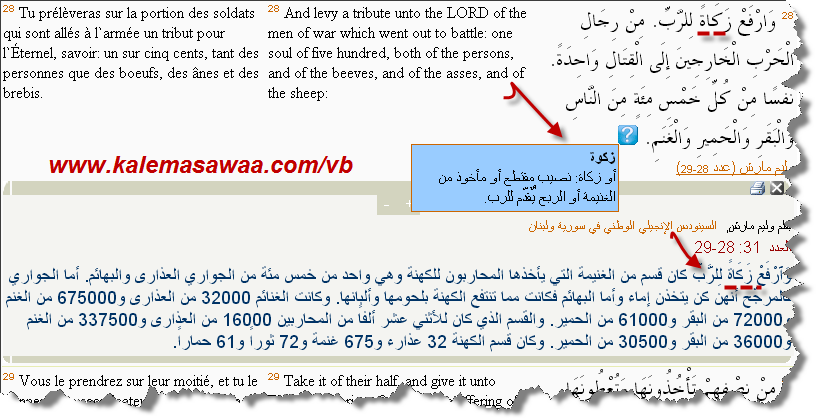
This scan presents the passage from Numbers 31 concerning the distribution of the spoils of war and the portion assigned as the Lord’s tribute. The highlighted section focuses on the numbers taken from the spoils: sheep, cattle, donkeys, and virgin girls. The scan shows that the biblical law itself contains specific categories of distribution, with a dedicated share assigned to the Lord through the priestly system. The relevant point is that the text treats certain religious dues as restricted and assigned to particular recipients, rather than as a general charity that can be redirected wherever someone wishes.
Question to the Skeptic
Is it permissible to give the proceeds of this zakat to someone other than the Lord of the Church in the person of Eleazar the priest???
Conclusion
The objection collapses because the Bible itself contains restricted religious payments and offerings directed to specific people and institutions:
- priests,
- Levites,
- the house of the Lord,
- the storehouse,
- Aaron the priest,
- Eleazar the priest,
- and specific categories in the distribution of spoils.
Therefore, if Christians accept restricted religious dues in their own book, they have no consistent basis to object merely because Islamic zakat has legal restrictions.
As for non-Muslims, the door of charity remains wide and includes non-Muslims.