

Satan Plays With the Private Parts — Hadith Grading and Refutation
This post addresses the doubt raised against the hadith: “Whoever goes to relieve himself should cover himself. If he finds nothing but a mound of sand, then he should turn his back to it, for Satan plays with the private parts of the children of Adam.” The objector said: “When a Muslim uses the toilet, he covers his private parts (his buttocks) because Satan plays with them if he doesn’t cover them… Does Satan have nothing better to do than play with the private parts of Muslims?” The greatest calamity that befalls ignorant peoples is when their ignorance becomes sanctified ignorance.
The Hadith and Its Correct Version
Some scholars reported that this hadith was considered authentic. It was narrated by Abu Dawud and Ahmad. However, Al-Bukhari and Muslim narrated it in an abridged form, on the authority of the Prophet ﷺ, who said: “Whoever performs ablution should rinse his nose, and whoever uses stones for purification should use an odd number.” This is the correct version.
The Hadith Is Weak — More Scholars Declared It Weak Than Authenticated It
In response, we say: this hadith is weak, and more scholars have declared it weak than those who authenticated it — if the objector is arguing against us by claiming that there are scholars who authenticated it.
- Ibn Hazm
- Al-Bayhaqi
- Ibn Abd al-Barr
- Abd al-Haqq al-Ishbili
- Ibn Sayyid al-Nas
- Ibn Muflih
- Ibn Kathir
- Al-San’ani
- Al-Albani
To those mentioned, I add the authors of the book Diwan al-Sunnah who also deemed the hadith weak. I further add: Sheikh Abd al-Qadir al-Arna’ut and Sheikh Shu’ayb al-Arna’ut (may God have mercy on them), and Dr. Bashar Ma’ruf (may God preserve him).
The crucial point, as I have mentioned repeatedly, is the defect, not who authenticated or weakened it. The defect here lies in Husayn al-Habrani, who is unknown. Furthermore, the editor of the issues of Ishaq al-Kawsaj and Ibrahim al-Nahhas concluded that this hadith is what Imam Ahmad meant when he was asked about the manner of performing Witr prayer, and he said: “Witr,” and it has no chain of narration. “It has no chain of narration” means it has no established chain of narration.
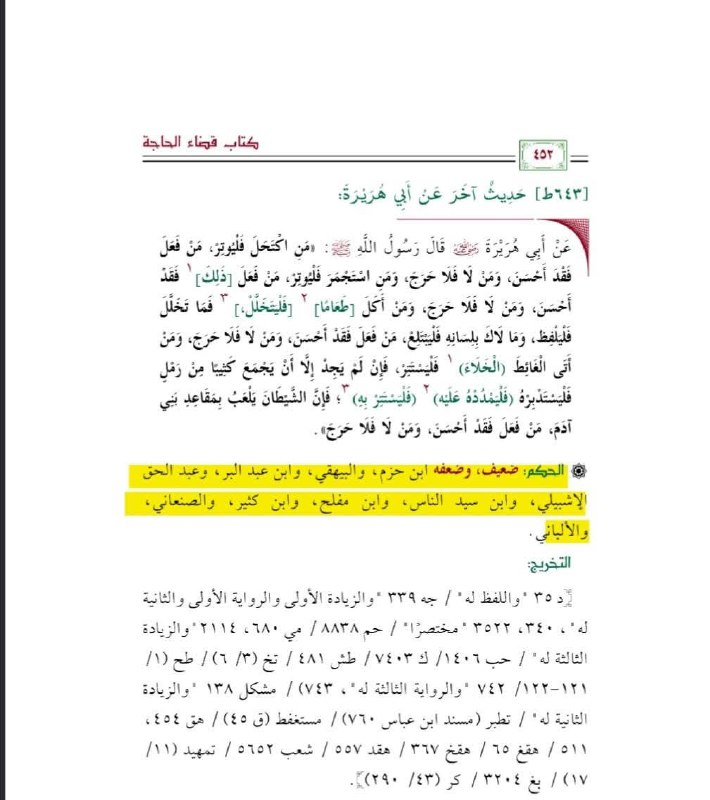
The relevant source establishing these scholarly verdicts is shown below.
The entry from Diwan al-Sunnah (entry #643, p. 453), with the Da’if verdict and nine scholars highlighted, is shown below.
Scholarly Consensus on the Grading of the Hadith
-
The Context: The main text contains a detailed Hadith narrated by Abu Hurayrah regarding the etiquettes and rulings of relieving oneself, using an eyeliner stone, and cleaning teeth (Kitab Qada’ al-Hajah, entry #643, page 453).
-
The Highlighted Verdict: The yellow highlighted section provides the definitive rulings of various classical and modern scholars regarding its authenticity: “الحكم: ضعيف، وضعفه ابن حزم، والبيهقي، وابن عبد البر، وعبد الحق الإشبيلي، وابن سيد الناس، وابن مفلح، وابن كثير، والصنعاني، والألباني.”
-
Summary of Verdict: The Hadith is graded as weak (Da’if). This weakness is a matter of broad agreement, as it was explicitly declared weak by a long succession of prominent Hadith authorities and jurists across Islamic history, including:
- Ibn Hazm
- Al-Bayhaqi
- Ibn Abd al-Barr
- Abd al-Haqq al-Ishbili
- Ibn Sayyid al-Nas
- Ibn Muflih
- Ibn Kathir
- Al-San’ani
- Al-Albani
The cover page of the second source used to document this verdict is shown below.
The entry from this second source, with the Da’if verdict and scholars listed, is shown below.
Scholarly Consensus on the Grading of the Hadith
-
The Context: The main text contains a detailed Hadith narrated by Abu Hurayrah regarding the etiquettes and rulings of relieving oneself, using an eyeliner stone, and cleaning teeth (Kitab Qada’ al-Hajah, entry #643, page 453).
-
The Highlighted Verdict: The yellow highlighted section provides the definitive rulings of various classical and modern scholars regarding its authenticity: “الحكم: ضعيف، وضعفه ابن حزم، والبيهقي، وابن عبد البر، وعبد الحق الإشبيلي، وابن سيد الناس، وابن مفلح، وابن كثير، والصنعاني، والألباني.”
-
Summary of Verdict: The Hadith is graded as weak (Da’if). This weakness is a matter of broad agreement, as it was explicitly declared weak by a long succession of prominent Hadith authorities and jurists across Islamic history, including:
- Ibn Hazm
- Al-Bayhaqi
- Ibn Abd al-Barr
- Abd al-Haqq al-Ishbili
- Ibn Sayyid al-Nas
- Ibn Muflih
- Ibn Kathir
- Al-San’ani
- Al-Albani
The Chain in Musnad Ahmad Is Also Weak
The cover page of the Musnad Ahmad volume containing the chain grading is shown below.
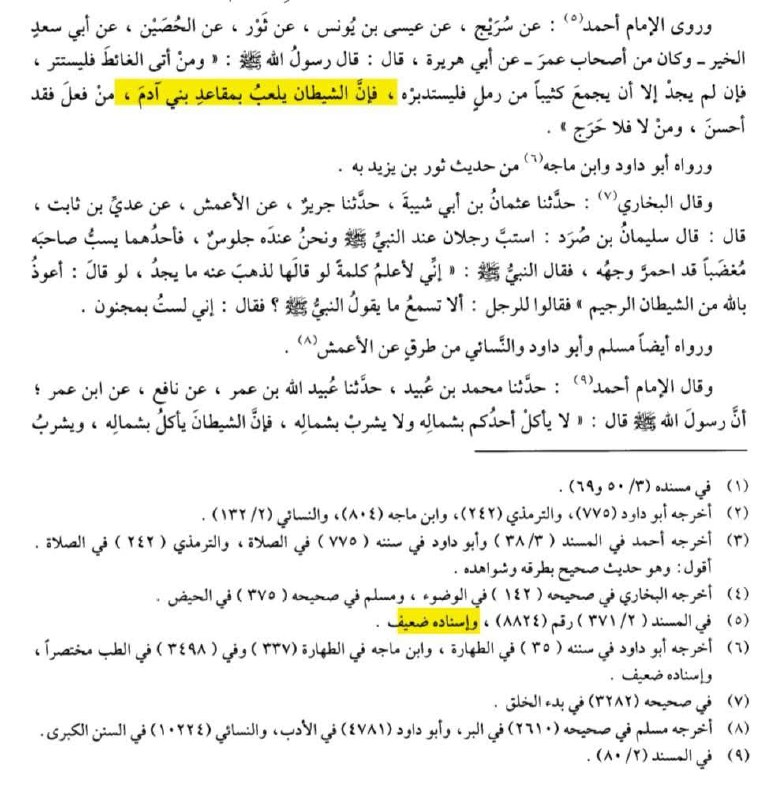
The specific entry from Musnad Ahmad (2/371, Hadith 8824) with the chain grading highlighted is shown below.
Hadith Textual Warning and Grading
-
The Narrative Warning (Top Highlight): The text highlights a specific warning within a larger prophetic narration concerning toilet etiquettes: “فَإِنَّ الشَّيْطَانَ يَلْعَبُ بِمَقَاعِدِ بَنِي آدَمَ” (“For indeed, Satan plays with the sitting places of the children of Adam”). This segment serves as a spiritual rationale for the prescribed modesty and cleansing rules.
-
The Chain Grading (Bottom Highlight): In footnote 5, the text provides the critical authentication for this specific transmission chain found in Musnad Ahmad (2/371, Hadith 8824): “وَإِسْنَادُهُ ضَعِيفٌ” (“And its chain of narration is weak”).
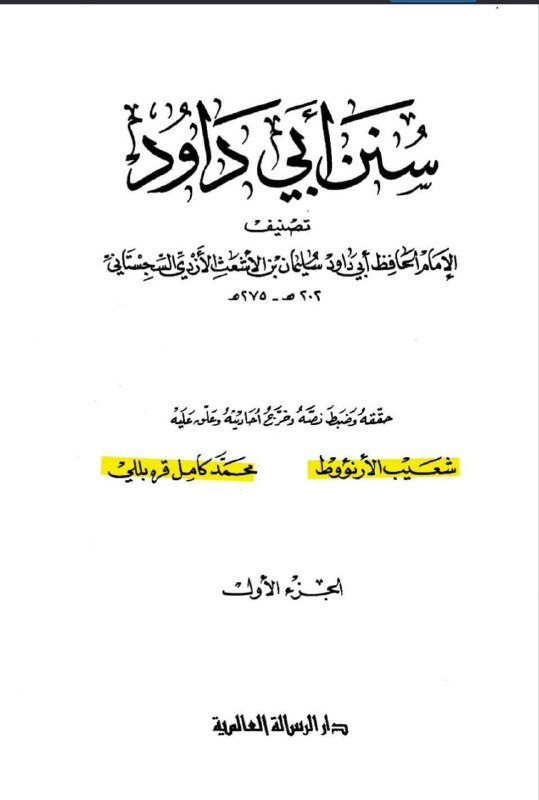
The cover page of the fourth source with additional documentation of the Da’if verdict is shown below.
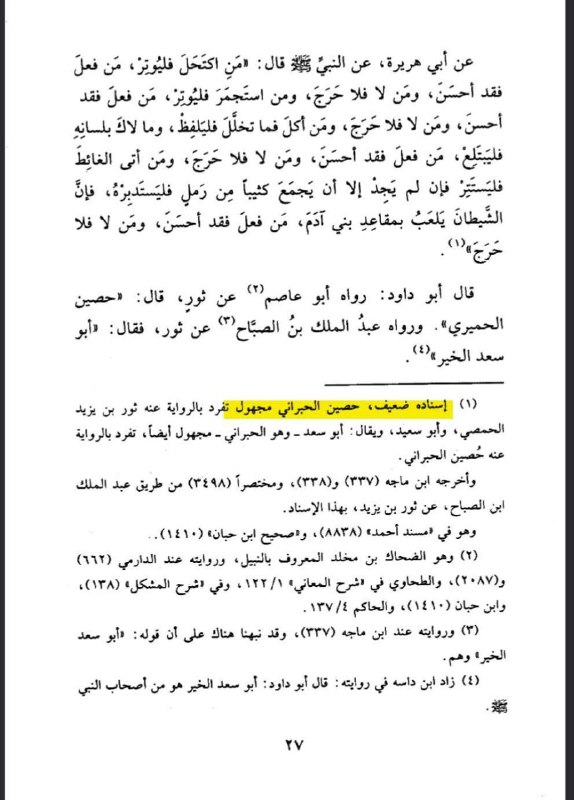
The entry from this fourth source, with the Da’if verdict and scholars listed in yellow, is shown below.

Hadith Authentication and Scholarly Consensus
-
The Core Hadith: The main text discusses a narration regarding toilet etiquettes and a warning about spiritual distractions during the process (
عن أبي هريرة قال: قال رسول الله ﷺ...). -
The Highlighted Verdict: The yellow highlighted text provides the definitive critical grading of this specific narration: “الحكم: ضعيف، وضعفه ابن حزم، والبيهقي، وابن عبد البر، وعبد الحق الإشبيلي، وابن سيد الناس، وابن مفلح، وابن كثير، والصنعاني، والألباني”
-
Summary of Verdict: The narration is graded as weak (Da’if). The text notes a broad, historical consensus among major Hadith authorities and experts who independently declared it weak, spanning from classical scholars to modern researchers, specifically listing:
- Ibn Hazm
- Al-Bayhaqi
- Ibn Abd al-Barr
- Abd al-Haqq al-Ishbili
- Ibn Sayyid al-Nas
- Ibn Muflih
- Ibn Kathir
- Al-San’ani
- Al-Albani
Imam Ahmad’s Own Verdict: No Established Chain
The cover page of the source documenting Imam Ahmad’s verdict on the kohl hadith is shown below.
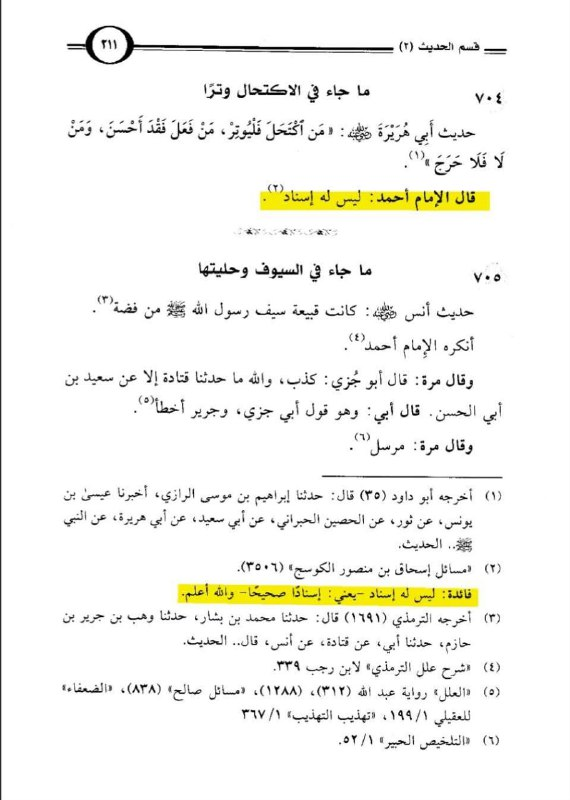
The entry documenting Imam Ahmad’s statement, with his verdict highlighted, is shown below.
- Imam Ahmad’s Statement: Imam Ahmad stated regarding the first Hadith (about applying kohl an odd number of times): “It has no chain of narration (Isnad).”
- Explanatory Footnote Note: The footnote clarifies this phrase, explaining that “It has no Isnad” specifically means “It does not have a Sahih (authentic/sound) chain of narration” — and Allah knows best.
The cover page of the sixth source providing the explanatory commentary on Imam Ahmad’s terminology is shown below.
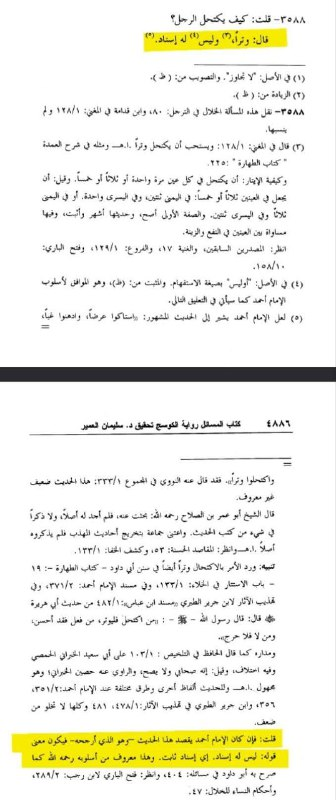
- The Core Statement (Top Highlight): In response to a question about how a man should apply kohl, the reply given is: “An odd number of times (Wifran), and it has no chain of narration (Isnad).”
- The Explanatory Commentary (Bottom Highlight): The commentator notes that if Imam Ahmad was referring specifically to this Hadith (which is the most likely conclusion), the intended meaning behind his phrase “It has no Isnad” is actually “It does not have an established/authentic chain of narration (Isnad Thabit).” The text points out that this particular usage and stylistic expression is well-known to be part of Imam Ahmad’s terminology (as explicitly stated by Abu Dawud in his Masa’il and Ibn Rajab in Fath al-Bari).
A Response to the Christian Objector
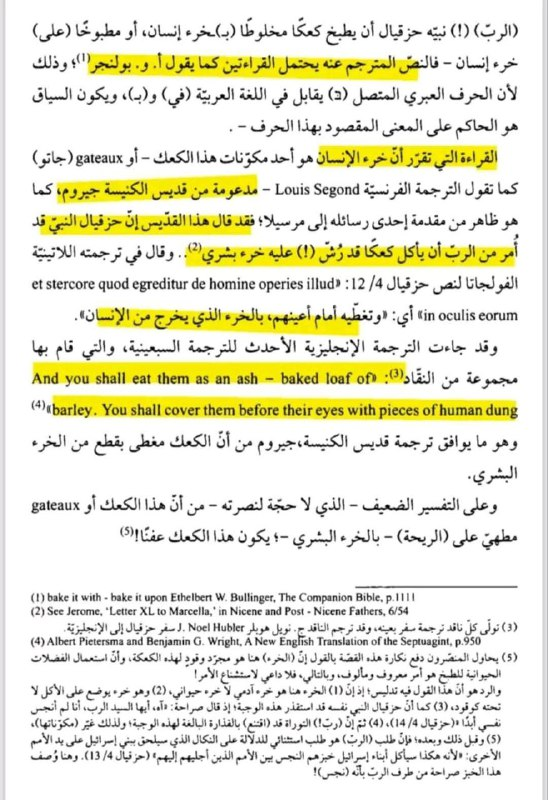
Secondly: why does the Christian object? Doesn’t he believe that his incarnate god was a pit bull? Advice for the Christian: Go and eat cakes made from shit, it’s better for you. The source below documents the Ezekiel 4:12 analysis referenced in this section.
Analysis of Ezekiel 4:12 Regarding the “Barley Cake” Command
-
The Textual Variant (Top Highlight): The Arabic text analyzes the translated sentence concerning the Prophet Ezekiel being commanded to bake or cook a barley cake. It mentions that the text allows for two different textual readings as noted by Bullinger (
أ. و. بولنجر). -
The Core Ingredients Controversy (Middle Highlights):
- The accepted reading establishes that human excrement (
خرء الإنسان) is indeed an intended component or catalyst for the preparation of this cake. - This interpretation is explicitly backed by the French translation of Louis Segond and heavily supported by the church father Saint Jerome (
قديس الكنيسة جيروم). Jerome explicitly stated in his letters to Marcella that “the Lord commanded Ezekiel the Prophet to eat a cake sprinkled with human waste (!)” (أمر من الرب أن يأكل كعكاً قد رُشَّ (!) عليه خرء بشري). His Latin Vulgate translation reads: “and thou shalt cover it before their eyes with the dung that cometh out of man.”
- The accepted reading establishes that human excrement (
-
Modern English Translations (Bottom Highlight): The text references a modern English translation of the Septuagint by a group of critics (specifically Albert Pietersma and Benjamin G. Wright), which translates the passage as: “And you shall eat them as an ash-baked loaf of barley. You shall cover them before their eyes with pieces of human dung.” This translation further cements that the cake was meant to be prepared or covered directly with human feces.
The hadith “Satan plays with the private parts of the children of Adam” is weak by broad scholarly consensus. Its defect lies in the narrator Husayn al-Habrani, who is unknown. Nine classical scholars — Ibn Hazm, Al-Bayhaqi, Ibn Abd al-Barr, Abd al-Haqq al-Ishbili, Ibn Sayyid al-Nas, Ibn Muflih, Ibn Kathir, Al-San’ani, and Al-Albani — all declared it da’if, in addition to the authors of Diwan al-Sunnah, Sheikh Abd al-Qadir al-Arna’ut, Sheikh Shu’ayb al-Arna’ut, and Dr. Bashar Ma’ruf. The chain in Musnad Ahmad (2/371, Hadith 8824) was also graded weak. Imam Ahmad himself stated that the kohl hadith has no established chain (Isnad Thabit), as documented by Abu Dawud in his Masa’il and Ibn Rajab in Fath al-Bari. The crucial point is always the defect in the chain — not who authenticated or weakened it.